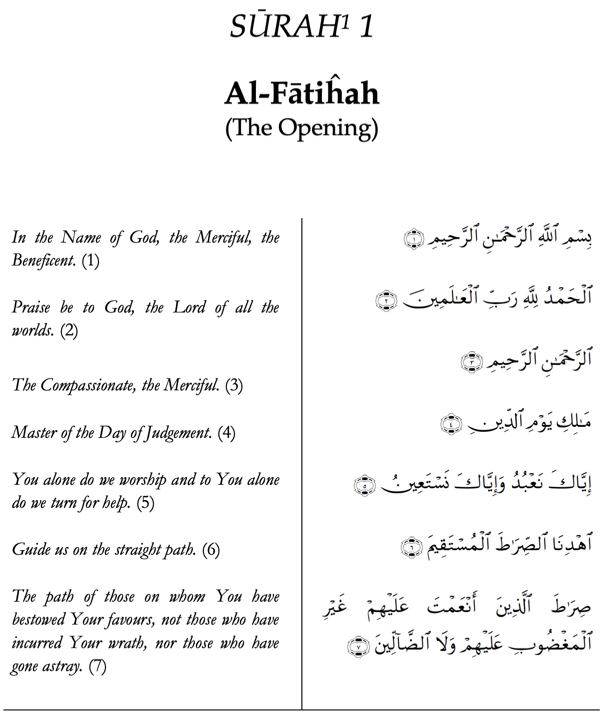
Har bir musulmon bu yetti oyatdan iborat qisqa surani kuniga kamida o‘n yetti marta o‘qiydi. Payg‘ambar Muhammad ﷺ dan rivoyat qilingan sahih hadisda shunday deyilgan: “Fotiha surasini o‘qimagan kishining namozi botildir.” Bu qisqa sura Islomning asosiy g‘oyalarini, e’tiqod va tushunchalarini o‘z ichiga oladi. U Islomning muhim tasavvurlari va munosabatlarini belgilab beradi. Shu sababli u tez-tez o‘qilishi uchun tanlangan va namozning to‘g‘riligi uchun zarurdir.
Every Muslim recites this short sūrah of seven verses at least seventeen times a day. An authentic ĥadīth of the Prophet Muĥammad (peace be upon him), says: “A prayer by one who does not read the Fātiĥah is invalid.” This short sūrah contains a great deal of the central basic ideas of Islam, its beliefs and concepts. It outlines many of its essential perceptions and attitudes. All this makes it clear why it is chosen for frequent recitation and why it is essential for the validity of prayer.
Surа shu ibora bilan boshlanadi:
The sūrah opens with the phrase:
Mehribon va rahmli Alloh nomi bilan. (1-oyat)
In the name of God, the Compassionate, the Merciful. (Verse 1)
Ko‘pchilik olimlar bu oyatni suraning mustaqil oyati, ya’ni uning oyatlarini yettitaga yetkazuvchi oyat deb bilishadi. Biroq boshqa suralarning, ya’ni Qur’onning boshqa suralarida xuddi shu so‘zlar bilan boshlangan barcha suralarda ham shunday ekanligi haqida olimlar o‘rtasida ixtilof bor. Ba’zi olimlar quyidagi Qur’on oyatida aytilgan so‘zlar Fotiha surasiga qaratilgan deb hisoblashadi: “Biz sizga hamisha takrorlanadigan yetti oyat va bu ulug‘ Qur’onni berdik.” (15:87)
This is recognized by the majority of scholars as a verse of the sūrah, in its own right, completing its verses into seven. There is, however, a difference of opinion over whether this is so with respect to all other sūrahs of the Qur’ān in which the same words appear as the opening phrase. Some scholars maintain that it is to the Fātiĥah that the following Qur’ānic statement refers: “We have given you seven oft- repeated verses and this sublime Qur’ān.” (15: 87)
Qur’onning Payg‘ambar Muhammad ﷺ ga nozil bo‘lgan dastlabki oyatlari — “O‘qing, Rabbingiz nomi bilan…” (96: 1) bilan boshlanadi — har bir ishni boshlashda Xudoning nomini zikr qilish islomiy odobini o‘rnatadi. Bu, shuningdek, Xudo “avval ham, oxir ham, zohir ham, botin ham” (57: 3) ekanligi haqidagi islomiy asosiy tamoyilga mos keladi. Darhaqiqat, U haqiqiy mavjud zotdir, mavjud bo‘lgan barcha narsaning asli va mavjudlik sababidir. Shu sababli har bir harakat va amal Uning nomi bilan qilinadi va hamma narsa Uning nomi bilan boshlanadi.
The very first verses of the Qur’ān revealed to Prophet Muĥammad, which begin with: “Read in the name of your Lord...” (96: 1) establish the Islamic etiquette of invoking the name of God at the beginning of every action. This is also in line with the fundamental Islamic principle that God is “the first and the last, the outward and the inward.” (57: 3) He is indeed the real being, the origin and the raison d’être of all that exists. In His name, therefore, every movement and action is made, and in His name everything begins.
Rahmon — Allohning go'zal ismlari bo'lib, mehribon va rahmli Zot ma'nosini anglatadi, Raĥīm esa Allohning yana bir go'zal ismi bo'lib, rahmdil va mehribon Zot ma'nosini anglatadi. Ushbu ikki sifat birgalikda, faqat Allohga nisbatan qo'llanilishi mumkin. Bandaga nisbatan Raĥīm sifatini ishlatish o'rinli bo'lar edi, biroq Islom e'tiqodi Raĥmon sifatining faqat Allohga xos ekanligini talab qiladi. Ikki sifatdan qaysi biri rahm va shafqatning kengroq ma'nosini ifodalashi haqidagi bahs esa bu yerda bizni qiziqtirmaydi. Shunga qaramay, shuni xulosa qilish mumkinki, ikkalasi birgalikda kelganda rahm va shafqatning barcha jihatlari va o'lchamlarini o'z ichiga oladi.
The divine attributes of the Compassionate, al-Raĥmān, and the Merciful, al-Raĥīm, encompass all aspects and meaning of mercy, and can only be used together with respect to God Almighty. It would be appropriate to use the attribute of al-Raĥīm in reference to a human being, but the Islamic faith requires that use of al-Raĥmān is exclusive to God. As for the debate over which of the two adjectives denotes the wider meaning of mercy and compassion, it does not concern us here. We can conclude, however, that when combined, they encompass all aspects and dimensions of mercy.
Xudoning nomini zikr qilish har bir ishning boshida amalga oshirilishi musulmon e'tiqodining birinchi asosiy tamoyilini tashkil etganidek, ar-Rahmon va ar-Rahim nomlarining faqat Xudoga xos ekanligini tan olish ikkinchi tamoyilni tashkil etadi va Xudo bilan inson o'rtasidagi munosabatni belgilaydi. Xudoning nomini zikr qilib, Uning cheksiz rahmatini tan olgan kishi Xudoga hamd aytishga va Uning barcha mavjudotlar ustidan mutlaq hukmronligini e'tirof etishga yo'naltiriladi.
As the invocation of God’s name at the beginning of every action constitutes the first fundamental principle of the Muslim faith, the restriction of the use of al-Raĥmān and al-Raĥīm to God alone constitutes the second principle and defines the relationship between God and man. Having invoked God’s name and acknowledged His infinite mercy, one is directed to praise God and recognize His absolute sovereignty over all beings:
Barcha olamlarning Parvardigori bo'lgan Allohga hamd bo'lsin. (2-oyat)
Praise be to God, the Lord of all the worlds. (Verse 2)
Xudoga hamd aytish mo‘min-mo‘minaning qalbida Xudo zikr etilganda birinchi uyg‘onadigan his-tuyg‘udir. Chunki insonning o‘z mavjudligi ham Xudoning cheksiz marhamatining bir ko‘rinishidir va bu marhamat Xudoga nisbatan shukronalik va hurmat-ehtiromni tug‘diradi. Xudoning insonga va boshqa mavjudotlarga ko‘rsatgan in‘om-ehsonining namoyonlari har yerda mo‘l-ko‘lligicha bo‘lib, uni har bir lahzada ko‘rish mumkin. Har bir ishning boshida va oxirida Xudoga hamd aytish Islom dinining yana bir asosiy tamoyilidir. Qur’oni karimda shunday deyilgan: “U Xudodir, Undan o‘zga iloh yo‘qdir. Dunyoda ham, oxиratda ham hamd Unga xosdir...” (28:70)
Praise of God is the first feeling aroused in a believer’s heart at the mention of God. For man’s own existence is an aspect of God’s infinite grace, which engenders gratitude and reverence towards God. The manifestations of God’s munificence and generosity to man and other creatures abound everywhere and can be seen at every moment. To praise God at the beginning and at the end of every action is another fundamental principle of the Islamic faith. The Qur’ān says: “He is God; there is no deity but He. To Him belongs praise in the first and in the last...” (28: 70)
Shunga qaramay, Xudoning marhamati shundayki, mo‘min banda "Xudoga hamdlar bo‘lsin" deganida, bu uning uchun hamma narsadan ustun turadigan yaxshi amal sifatida yoziladi. Payg‘ambarimiz (ﷺ)ning sahobasi `Umar ibn al-Xattob rivoyat qiladilar: Payg‘ambar (ﷺ) bir kishi qanday aytganini bayon qilib berdilar: "Ey Rabbim, Sening yuzingning ulug‘ligi va qudratingning buyukligiga munosib tarzda Senga hamd aytaman." Ul kishi bilan birga bo‘lgan ikki farishta bu gapni baholay olmadilar va ularni buyurgan Xudoi taolo murojaat qilindi. U zot shunday amr qildi: "Uning gapini aytganidek uning yozuviga yozinglar, va u Menga qaytganida, unga munosib mukofotini beraman."
Bu oyatning oxirgi qismi, "Olamlarning Rabbi", mutlaq va umumiy ilohiylikka bo‘lgan e’tiqodni ifodalaydi, va bu Islomdagi Xudo tushunchasining asosidir. Xudo yagona, mutlaq va oxirgi egadir, butun koinotda to‘liq mustaqil vakolatga ega. U olamni yaratgan, uni kuzatib turgan, unga g‘amxo‘rlik qilgan va uning barqarorligi hamda farovonligini ta’minlaydigan barcha hukmron zotdir. Yaratguvchi va yaratilganlar o‘rtasidagi bu tirik va harakatdagi munosabat barcha mavjudotlar uchun hayotning abadiy manbaidir. Xudo dunyoni yaratib, uni o‘z holiga tashlab qo‘ymagan. U o‘z yaratiqlari ustidan faol, tirik hokimiyat bo‘lib qolmoqda va ularga davomli va mazmunli hayoti uchun zarur bo‘lgan narsalarni bermoqda. Bu hamma Xudo yaratgan narsalarga taalluqlidir.
Nevertheless, God’s grace is such that when a believer says, ‘praise be to God,’ it is recorded for him as a good deed outweighing everything. `Umar ibn al-Khaţţāb, the Prophet’s Companion, relates that the Prophet (peace be upon him) told how a man once said, “Lord, I praise You as befits the majesty of Your face and the greatness of Your power.” The two angels accompanying that man could not evaluate the remark and referred to God Almighty, who commanded them: “Register it in his record as he said it, and I shall reward him as he deserves when he returns to Me.” The last part of this verse, “Lord of all the worlds”, expresses the belief in absolute universal Godhead which is at the very core of the Islamic concept of God. God is the sole, absolute and ultimate owner with full independent authority to act in the whole cosmos. He is the overall supreme master who has created the world and continues to watch over it, take care of it, and ensure its stability and well-being. This living and dynamic relationship between the Creator and the created is the perpetual fountain of life for all creation. God has not created the world and abandoned it to its own devices. He continues to be an active living authority over His creation, giving it what it needs for its continued and meaningful life. This applies to all God’s creation.
Худо мутлақ рububiyyat (Робубиятига эга экани)ни тан олиш ҳақидаги аниқлик ва чалкашлик ўртасидаги фарқни, Худонинг мутлақ ягоналиги борасида, ҳал қилади. Одамлар кўпинча Худонинг ягона яратувчи эканини тан олиш билан ҳаётларида бир нечта илоҳнинг ҳукмронлиги бор деган эътиқодни қўшиб юборишган. Бундай эътиқоднинг пайдо бўлиши ажабланарли туюлиши мумкин, аммо бу ўтмишда ҳам рўй берган ва бугун ҳам давом этмоқда. Қуръони карим бундай даъво қилувчилар ҳақида гапиради: улар «Фақат уларга (кичик худоларга) сиғинамиз, токи бизни Худога яқинлаштирсинлар», дейишади (39:3). Шунингдек, айрим яҳудий ва насроний гуруҳлар «ўз раввинлари ва роҳибларини Худодан ташқари илоҳлар қилиб олганлари» ҳақида ҳам зикр қилинади (9:31). Ислом VII асрда Арабистонда пайдо бўлган вақтда кўплаб худоларга ёки «Буюк Худо»дан ташқари бошқа илоҳ ва ярим илоҳларга сиғиниш кенг тарқалган эди.
Acknowledging God’s absolute Lordship makes all the difference between clarity and confusion with regard to God’s absolute oneness. People often combined their acknowledgement of God as the sole creator with belief in multiple deities having authority in their life. It may seem absurd that people should ever hold such a belief, but this was true in the past and is still true today. The Qur’ān speaks of those who claim that they “only worship them [minor gods] so that they may bring us nearer to God.“ (39: 3) It also mentions that some Jewish and Christian groups who “have taken their rabbis and priests as gods alongside God.” (9: 31) Polytheism, or the worship of several deities or demigods besides the perceived ‘Grand Deity’, was widespread when Islam emerged in the 7th century in Arabia.
Yagona Xudoning mutlaq hukmronligi va faol hokimiyatini tasdiqlash.
The affirmation of the absolute sovereignty and active authority of the One God.
barcha yaratilishning ustidan hukmronlik qiluvchi zot bo‘lishi inson aqlining izchilligini va ruhiy tinchligini ta’minlash, uni shirk (ko‘p xudolilik)ning shafqatsiz chalkashligidan xalos etish uchun zarur edi. Inson ishonch hosil qilishi kerakki, bu dunyoning ishini ogoh va g‘amxo‘r Xudo boshqaradi va U hech qachon uni tark etmaydi yoki e’tiborsiz qoldirmaydi.
over all creation was necessary to ensure man’s rationality and peace of mind, and to relieve him from the cruel bewilderment of polytheism. Man must be reassured that a vigilant and caring God is in charge of this world and will never abandon or forsake it.
Islomning paydo bo‘lgan davrda dunyo noto‘g‘ri e’tiqodlar va falsafalar, hamda xurofot, afsona va mifologiyaga asoslangan soxta dinlar bilan to‘la edi. Ularning juda oz qismi haqiqat yoki hatto oqilona edi. Xudo tushunchasi va Uning inson hamda olam bilan munosabati borasida esa ko‘plab achinarli chalkashliklar mavjud edi. Bu, o‘z navbatida, insonning dunyoni va o‘zining unda tutgan o‘rni hamda vazifasini tushunishida chalkashlikka olib keldi.
At the advent of Islam, the world was full of erroneous beliefs and philosophies, and of false religions based on superstition, legend and mythology. Very little of it was true or even rational. As far as the concept of God and His relationship with man and the world was concerned, there was plenty of miserable confusion. This in turn led to confusion in man’s understanding of the world and of his own position and role within it.
Rational, aniq va izchil e'tiqodlar tizimiga bo'lgan ehtiyoj faqat insoniyat tarixining shunday qorong'i davrlarini o'rgangan paytda ayon bo'ladi, o'sha paytlarda bunday tizim mavjud bo'lmagan. Shunda biz bunday katta afsonalar va noto'g'ri e'tiqodlarning insonga qanchalik og'ir yuk bo'lishini anglab yetamiz. Qur'on'dagi aniq misollarni o'rganishga kelganimizda, bu haqda batafsil so'z yuritiladi.
The need for a rational, clear and consistent system of beliefs only becomes apparent when we study those dark periods of human history when there was no such system. We then realize how heavily such great myth and false beliefs weigh on man. There will be more on this when we come to study specific instances in the Qur’ān.
Shunday ehtiyoj nuqtai nazaridan Islom insonning e'tiqodlarini to'g'rilashga, Xudo tushunchasini va tabiatini, Uning sifatlarini hamda Yaratuvchi bilan yaratiqlar o'rtasidagi munosabatni juda aniq belgilashga katta e'tibor bergan.
It is in the light of such need that Islam has taken great care to correct man’s beliefs and define very clearly the concept and nature of God and His attributes, and the relationship between Creator and creation.
Bu Islomiy tushunchada, ya'ni Allohning yagonaligi tushunchasida mujassam bo'lgan bo'lib, bu Islomning mohiyati va eng asosiy tamoyilidir. Allohning birligini, mutlaq va ulug' Rab hamda mavjud bo'lgan barcha narsaning Egasi ekanini tasdiqlash va bayon etishga katta e'tibor berilgan. Islom eng katta e'tiborni qaratgan yana bir jihat esa Xudoning sifatlarini belgilashdir. Bu masala tarixning turli davrlarida ko'plab chalkashliklarga, noaniqliklarga va diniy hamda falsafiy fikrlarning tartibsiz bo'lishiga sabab bo'lgan.
This is embodied in the Islamic concept of God’s oneness, the essence and most fundamental principle of Islam. Much care has been devoted to establishing and elucidating the affirmation that God is the One, absolute and transcendent Lord and Master of all that exists. The other aspect of this concept to which Islam has given its greatest attention is the definition of God’s attributes, which has been the cause of much confusion, obfuscation and muddled religious and philosophical thinking through the ages.
Islom Xudoning birligi va unga bog‘liq barcha masalalarni yoritishda namoyon qilgan jiddiylik, urg‘u va batafsillik faqat tarix davomida to‘plangan xato e’tiqodlar va chalkash ilohiyotlar fonida to‘liq anglanishi mumkin. Shu nuqtai nazardan qaraganda, Islomni insoniyatga ato etilgan chuqur va o‘z vaqtidagi ilohiy rahmat harakati sifatida osongina ko‘rish mumkin — bu rahmat go‘zallik, soddalik, aniqlik, uyg‘unlik va inson tabiatiga to‘liq mos holda berilgan.
The intensity, emphasis and detail with which Islam has dealt with the concept of God’s oneness, and all subjects related to it, can only be appreciated against the background of the great mass of erroneous beliefs and confused theologies that had accumulated in the course of history. From this perspective, Islam can readily be seen as a profound and timely act of divine mercy bestowed on humanity — mercy that is given with beauty, simplicity, clarity, harmony and full accordance with human nature.
Mehribon, rahmli (Oyat 3)
The Compassionate, the Merciful. (Verse 3)
Bular rahmat va shafqatning barcha ma'nolari va jihatlarini o'z ichiga oladigan, Alloh Taoloning rahmati sifatining mohiyatini ifodalovchi ikki sifatdir. Bu ikki sifat Yaratuvchi sifatidagi Rabb bilan Uning maxluqoti o'rtasidagi aloqani belgilaydi. Bu aloqa butunlay muhabbat, tinchlik, ishonch va g'amxo'rlikka asoslangan bo'lib, insonda Xudoga nisbatan beixtiyor shukr va hamd hissini uyg'otadi.
These are two attributes that encompass all meanings and aspects of mercy and compassion, and epitomize mercy as a property of God Almighty. These two attributes define the link between the Lord as Creator and His creation. It is a link based entirely on love, peace, reassurance and care, and which inspires within man a spontaneous feeling of gratitude and praise towards God.
Yunon mifologiyasi yoki Eski Ahddagi (Ibtido, 4:11–12) farqli o‘laroq, Islomda Xudo insonni shafqatsiz qasos bilan quvib yuruvchi dushman sifatida tasvirlanmaydi, va O‘z yaratilmishlariga hasad va qasd bilan fitna uyushtiruvchi sifatida ham ko‘rsatilmaydi.
Unlike Greek mythology or the Old Testament (Genesis, 4: 1112), Islam does not depict God as an enemy who pursues man with relentless vengeance, or plots and schemes against His creation with spite and vindictiveness.
Qiyomat kunining egasi. (4-oyat)
Master of the Day of Judgement. (Verse 4)
Ushbu oyat insoniy hayotga eng chuqur ta’sir ko‘rsatadigan asosiy islomiy tamoyilni ifodalaydi: oxiratga ishonish. Qur’on odamlarning ko‘pincha Xudoni Yaratuvchi sifatida tan olib, lekin Qiyomat kuni, mukofot va jazo beriladigan, adolat muvozanatini tiklaydigan kelajak hayotga ishonmay qo‘yganlari haqidagi g‘alati holatni eslatadi. Ana shunday kishilar haqida Qur’on shunday deydi: “Agar ulardan so‘rasang: «Osmonlarni va yerni kim yaratgan?» — albatta: «Alloh», deb javob beradilar” (31:25). Boshqa joyda esa shunday kishilar haqida aytiladi: “Ular o‘zlaridan bir ogohlantiruvchi kelganini g‘alati deb bilishadi. Shuning uchun kofirlar: «Bu juda ajib narsa! Biz o‘lib, tuproqqa aylanganimizdan keyin (qayta tirilamizmi)? Bu qaytish juda uzoq ko‘rinadi», deydilar” (50:2-3).
This verse states a fundamental Islamic principle that has a most profound influence on human life: belief in the hereafter. The Qur’ān comments on the curious fact that people have often believed in God as Creator but have failed to believe in a Day of Judgement, in a life to come, when reward and punishment are meted out to restore the balance of justice. It is in reference to these that the Qur’ān says: “If you ask them, ‘Who is it that created the heavens and the earth?’ they will surely answer, ‘God’” (31: 25) Elsewhere the Qur’ān says of such people: “They deem it strange that a warner should have come to them from their own midst. Thus, the unbelievers say, A strange thing is this! [Are we to be resurrected] after we have died and become mere dust? Such a return seems far-fetched indeed!’“ (50: 2-3)
Oxirat ishonchi zarurdir, chunki u inson qalbi va aqlini band qiladi hamda insonning e’tiborini kelajakdagi hayotga qaratadi. Bu esa insonning bu dunyo hayotiga bo‘lgan haddan ortiq ishtiyoqini jilovlashga va uning darhol dunyoviy istaklaridan yuqoriga ko‘tarilishiga yordam beradi. U endi bor mukofotini shu yerda va hozirning o‘zida olishga intilmaydi; o‘zining xudbinligini yengib, boshqalarga yaxshilik qilish tuyg‘ulari va qiziqishlarini rivojlantira oladi. Inson hayotni ruhlantirilgan, bag‘rikeng, ishonchli va optimistik shaxs sifatida o‘tkaza oladi.
Belief in the hereafter is essential because it engages the human soul and mind and concentrates man’s attention on a future existence. This in turn helps to rein in man’s obsession with the present life, and to transcend his immediate earthly desires. He is no longer anxious to reap all his rewards here and now; he can conquer his selfishness and develop altruistic feelings and interests. Man is able to go through life as a motivated, tolerant, confident and optimistic being.
Bu markaziy islomiy e'tiqod inson loyiq va muhtoj bo'lgan axloqiy va aqliy erkinlikka intilish bilan dunyoviy va xudbin istaklar hamda lazzatlarga taslim bo'lish o'rtasidagi farqni aniq ajratib beradi. U muvozanatli va vijdonli insoniyatni egoistik, faqat o'z manfaatini ko'zlaydigan insoniyatdan ajratib turuvchi chegarani belgilaydi.
This central Islamic belief distinguishes clearly between aspiring to gain the moral and intellectual freedom that man needs and deserves, and capitulation to worldly and selfish desires and pleasures. It marks the difference between a well-balanced and conscientious humanity and an egotistic, self-seeking one.
Inson hayoti, odamlar bu o'tkinchi dunyoda topgan narsalari hammasi emas, oxirati degan tushunchani qabul qilmagunlaricha, hech qachon muvozanatli va adolatli bo'la olmaydi. Inson bu qisqa hayotda bajarishi kerak bo'lgan mehnat, qurbonlik va harakatlarga arziydigan boshqa hayot borligiga ishonchli e'tiqod bilan rag'batlanishi kerak. Bu e'tiqod uni qabul qilganlarning his-tuyg'ulari, munosabatlari va xulq-atvorida tub farq paydo qiladi.
Human life can never be balanced and equitable until people believe that what they earn in this transient life is not the be-all and the end- all. Man needs to have the incentive of a confident belief that another life awaits him, which is worth the struggle and the sacrifices and the effort he may have to make here in this short one. This belief brings a fundamental difference in the feelings, attitudes and behaviour of those who uphold it.
Faqat Sendan ibodat qilamiz va faqat Sendan yordam so'raymiz. (5-oyat)
You alone do we worship and to You alone do we turn for help. (Verse 5)
Bu oyat oldingi oyatlardan mantiqan kelib chiqadigan yana bir asosiy tamoyilni ifodalaydi. Bu tamoyil hal qiluvchi va muhim bo‘lib, insonning Xudoga bo‘ysunishida qo‘lga kiritadigan erkinligi bilan odamning odamga qullik qilishida mavjud bo‘lgan haqorat va tahqirlash o‘rtasidagi chegarani belgilaydi.
This verse expresses another fundamental principle that follows logically from the preceding ones. It is also a decisive and crucial principle that draws a line between the freedom man gains in submitting to God and the abuse and debasement implicit in man’s servitude to man.
Inson o'zini Xudoga topshirib, yordam va hidoyatni faqat Undan so'raganida, u barcha diniy, aqliy, axloqiy va siyosiy kuchlarning zulmidan to'liq ozodlikka erishgan bo'ladi.
Once man has submitted himself to God and sought help and guidance from Him alone, he has achieved total liberation from the tyranny of all religious, intellectual, moral and political powers.
Islom e'tiqodiga ko'ra, inson qudrati ikki toifaga bo'linadi: Allohni tan olib, Uning ko'rsatmalariga amal qiladigan to'g'ri yo'lga boshlangan qudrat va Allohning hokimiyati hamda amrini e'tirof etmaydigan, takabbur va isyonkor qudrat. Musulmon birinchisini, qanchalik ojiz yoki qashshoq bo'lmasin, qo'llab-quvvatlashi va ma'qullashi, ikkinchisini esa, qanchalik kuchli yoki hukmron bo'lmasin, rad etishi va unga qarshi turishi shart. Qur'oni karimda shunday deyilgan: "Ko'p marta oz guruh Allohning irodasi bilan ko'p guruhni yenggan." (2: 249) Zohiran ojizroq bo'lgan lashkarning bunday g'alabasi faqat barcha qudrat manbai bo'lgan Allohga tayangandagina mumkin bo'ladi.
To the believer in Islam, human power falls into two categories: a rightly-guided power that recognizes God and abides by His directions, and an arrogant, rebellious one that does not admit to God’s sovereignty and authority. A Muslim is required to support and endorse the former, no matter how weak or disadvantaged it may be, and to reject and oppose the latter, regardless of its strength or dominance. The Qur’ān says: “Many a small band, by the grace of God, has vanquished a large one.” (2: 249) Such victory of the apparently weaker host could only be achieved when it relies on God, the source of all power.
Tabiat kuchlariga nisbatan musulmonning munosabati qo‘rquv yoki dushmanlik emas, balki qiziqish va do‘stona ruhdadir. Inson kuchlari va tabiat kuchlari Xudoning o‘z qudratining mahsulotlari deb qaraladi va Uning irodasiga bo‘ysunadi. Shu sababli ular bir-birini to‘ldiradi va bir-biriga bog‘liqdir.
Towards natural forces, a Muslim’s attitude is one of curiosity and friendliness rather than fear or hostility. The powers of man and the powers of nature are perceived as by-products of God’s own power, and subject to His will. They are, therefore, perfectly complementary and interdependent.
Islom bizga shuni o‘rgatadiki, Alloh taolo jismoniy olamni va uning barcha kuchlarini insonning o‘z foydasi va manfaati uchun yaratgan. Inson aynan shu dunyoni o‘rganishga, uning imkoniyatlarini kashf etishga va butun atrofidagi olamdan o‘z yaxshiligi hamda boshqa odamlarning yaxshiligi uchun foydalanishga buyurilgan va yo‘naltirilgan.
Inson tabiat tufayli ko‘rgan har qanday zarar faqat uning tabiatni va unga hukm qiluvchi qonunlarni bilmasligi yoki tushunmasligi natijasidir. Inson tabiat haqida qancha ko‘p bilsa, uning tabiat va atrof-muhit bilan munosabati shunchalik tinch va uyg‘un bo‘ladi.
Islam teaches that God has created the physical world and all its forces for man’s own use and benefit. Man is specifically taught and directed to study the world around him, discover its potential and utilize all his environment for his own good and the good of his fellow humans. Any harm that man suffers at the hands of nature is a result only of his ignorance or lack of understanding of it and of the laws governing it. The more man learns about nature, the more peaceful and harmonious his relationship with nature and the environment.
Shu sababli, "tabiatni zabt etish" tushunchasi osongina kinoya va salbiy nuqtai nazardan qaralishi mumkin. U islomiy tasavvurlarga yot bo'lib, dunyoning yaratilish ruhi va unda yotgan ilohiy hikmatni shafqatsiz bilmaslikdan dalolat beradi.
Hence the notion of “conquering nature” can readily be seen as cynical and negative. It is alien to Islamic perceptions and betrays a shameless ignorance of the spirit in which the world has been created and the divine wisdom that underlies it.
Doimo Xudoning qo‘lini va Uning dunyoni yaratishdagi va boshqarishdagi rolini his qilgan holda, musulmonlar inson va tabiat o‘rtasidagi munosabatga ijobiy, do‘stona va konstruktiv nuqtai nazardan qaraydilar. Sodda qilib aytganda, bu nuqtai nazar Xudoni barcha shu kuchlarning manbai va Yaratuvchisi deb biladi, bularning barchasi bir xil aksiomalar va qonunlar asosida ishlaydi. Ular birgalikda, umumiy maqsad uchun, uyg‘unlik, moslik va o‘zaro qo‘llab-quvvatlash asosida ishlashga mo‘ljallangan. Tabiat kuchlari, asosan, insonga bo‘ysunadi. Inson ularni anglash, sirlarini ochish, ularni boshqaruvchi qonunlarni tushunish va keyinchalik ularni Yer yuzida hayot sifatini yaxshilash uchun xizmatga jalb qilish qobiliyatiga aqliy va jismoniy jihatdan ega. Qur’oni Karim bunday deydi: {U sizlar uchun yerdagi barcha narsalarni bo‘ysundirib qo‘ydi.} (45:13)
Being always aware of God’s hand and role in shaping and running the world, Muslims have a positive, friendly and constructive outlook on man’s relationship with nature. Simply stated, it acknowledges God as the origin and Creator of all these forces, on the basis of the same set of axioms and laws. They are designed to function together, for a common purpose, in harmony, compatibility and mutual support. The forces of nature are essentially subservient to man, who is mentally and physically equipped to discern them, unravel their secrets, comprehend the laws governing them and, subsequently, to harness them to improve the quality of life on earth. The Qur’ān asserts: “He has all that is on the earth subservient to you.” (45: 13)
Bunday qarash har qanday qo'rquv yoki yolg'izlik izlarini yo'qotadi va buning o'rniga insonni nafaqat dunyoning umumiy tuzilmasining ajralmas qismi, balki mohiyatan samarali va ta'sirchan bir mavjudot sifatida ko'radigan chuqur tegishlilik tuyg'usiga imkon beradi. Shunday qilib, uning dunyosi do'stona bir dunyoga aylanadi. Bu, Payg'ambar ﷺ bir safar musulmonlar uchun og'ir mag'lubiyat sahnasi bo'lgan Uhud tog'iga yuzlanib: "Biz bu tog'ni qanchalik sevamiz, u ham bizni qanchalik sevadi!" deganlarida eng yaxshi ifodalangan. Bu gap, Payg'ambar ﷺ tabiatning eng qo'pol shakllariga nisbatan ham his qilgan yaqinlikni qisqacha ifodalaydi.
Such an outlook eliminates all traces of fear or isolation and allows, instead, a profound sense of belonging in which man is seen not only as an integral part of the overall design of the world, but also an essentially effective and influential one. Thus, his world becomes a friendly one. This is best expressed by the Prophet when he once faced Mount Uĥud, the scene of a bitter defeat for Muslims, and said, “How we love this mountain, and how it loves us!” This expresses in a nutshell the affinity the Prophet felt towards nature even in its most rugged forms.
Shu asosiy tamoyillarni belgilab olgach, bu sura ularga javob berishning ayrim amaliy vositalariga yo‘l ko‘rsatadi, ularning eng asosiysi esa ibodatdir:
Having established these fundamental principles, the sūrah points the way to certain practical means of responding to them, foremost among which is prayer:
Bizni to‘g‘ri yo‘lga yo‘naltir, — Sen ne‘mat berganlarning yo‘liga, g‘azabga uchraganlarning va adashganlarning yo‘liga emas. (Oyatlar 6-7)
Guide us on the straight path; the path of those on whom You have bestowed Your favours, not those who have incurred Your wrath, nor those who have gone astray. (Verses 6-7)
Shu so'zlar bilan mo'min bandasi o'zini to'g'ri yo'lga boshlashni va shu yo'lda yordam berishni so'raydi. Bunga Allohning hidoyati, g'amxo'rligi va rahmatisiz erishib bo'lmaydi. Buni tan olish o'zi Allohning barcha narsa va voqealar ustidan hukmronligi va qudratini e'tirof etishdir.
With these words a believer pleads to be shown the Right Way and to be helped along it, which cannot be achieved without God’s guidance, care and mercy. To acknowledge that is in itself a recognition of God’s sovereignty and dominance over all things and events.
Haqiqiy hayot yo'liga yo'naltirish insonga bu dunyoda ham, oxirat(da) ham baxt-saodatni kafolatlaydi. Bu, aslida, insonning tabiatini, nafs-istaklarini, intilishlarini va ilhomlarini Ilohiy irodani anglash va tushunishga yo'naltirish orqali yuzaga keladi va shu tariqa insoniy faoliyatni tabiiy tartib hamda moddiy olam bilan uyg'unlashtiradi.
Guidance to the right way of life guarantees man’s happiness in this world and in the hereafter. It comes about, in effect, by guiding human nature and man’s instincts, desires and inspirations towards the recognition and comprehension of the divine will, so bringing human activity into rhythm with the natural order and the physical world.
Bu sura "to'g'ri yo'l"ning mohiyatini ochib beradi: bu Xudo in'om etgan kishilarning yo'li bo'lib, Haqdan og'ib, Xudoning g'azabiga uchragan kishilarning yo'li ham, haqiqatni bilmasdan g'aflatda qolgan kishilarning yo'li ham emas. Bu baxt va najot yo'lidir.
The sūrah reveals the nature of the “straight path” as being one taken by those whom God has favoured, not the way of those who have earned His displeasure by their deviation from the Truth, nor that of the heedless who have no knowledge of the truth. It is the path of happiness and salvation.
Mana, bu al-Fotiha — har kuni tez-tez o‘qish uchun tanlangan sura bo‘lib, usiz islomiy namozlar haqiqiy bo‘lmaydi. Qisqaligiga qaramay, u islom dinining eng asosiy tamoyillarini va ulardan kelib chiqadigan ayrim tushunchalarni o‘z ichiga oladi.
This, then, is al-Fātiĥah, the sūrah selected for frequent daily recitation, without which Islamic prayers are invalid. Despite its brevity, it contains some of the most fundamental principles of the Islamic faith and certain insights that arise from them.
Ahmad Mukhammad Ali?
Yo'q, bu matnni tarjima qilaman:
Payg'ambar Muhammad ﷺ Alloh (taolo) dan rivoyat qilingan holda ishonchli tarzda xabar beriladiki, Alloh (taolo) shunday deydi: "Namozning mevalari Men bilan Mening bandam o'rtasida teng taqsim qilinadi va bandam so'ragan narsaga erishadi. Namozxon: «Olamlarning Parvardigori bo'lgan Allohga hamd bo'lsin», deb o'qiganida, Alloh: «Bandam Meni hamd qildi», deydi. U: «Rahmoni va Rahimdir», deb o'qiganida, Alloh: «Bandam Menga shukr qildi», deydi. U: «Qiyomat kunining egasidir», deb o'qiganida, Alloh: «Bandam Meni ulug'ladi», deydi. U: «Faqat Seni ibodat qilamiz va faqat Sendan yordam so'raymiz», deganida, Alloh: «Bu Men bilan bandam o'rtasidadir va bandam so'ragan narsasiga erishadi», deydi. Va u: «Bizni to'g'ri yo'lga yo'llagin, Sen in'om etganlarning yo'liga, g'azabingga uchraganlarning va adashganlarning yo'liga emas», deganida, Alloh: «Bu Mening bandam uchundir va u istagiga erishadi», deydi."
Bu hadis al-Fotiha surasining ba'zi ma'nolarini ochib beradi. O'quvchi, ehtimol, nima uchun Alloh bu surani musulmonlar kun va tun davomida, farz namozlarida kamida o'n yetti marta, shuningdek, nafl namozlarida yanada ko'proq o'qishlari uchun tanlaganini tushunishda bu hadis foydali ekanini topar.
The Prophet Muĥammad is reliably reported to have quoted God as saying that the fruits of prayer are shared equally between Me and My servant, and My servant will be granted what he asks for. As the worshipper recites [in Prayer]: “Praise be to God, the Lord of all the worlds,” God will say: ‘My servant has praised Me.’ As he recites: “The Compassionate, the Merciful,” God will say: ‘My servant has thanked Me.’ As he recites: “Master of the Day of Judgement,” God will say: “My servant has glorified Me.” As he says: “You alone do we worship, and to You alone do we turn for help,” God will say: ‘This is between Me and My servant, and My servant will receive what he asks for.’ And, as he says: “Guide us on the straight path, the path of those on whom You have bestowed Your favours, not those who have incurred Your wrath, nor those who have gone astray,” God will say: ‘This is for My servant, and he will be granted his wish.’“ This ĥadīth explores some of the meanings of al-Fātiĥah. The reader will perhaps find it helpful in understanding why God has chosen this sūrah for recitation by Muslims at least seventeen times a day, as they stand up for their obligatory prayers, spread over the night and day, and even more frequently, whenever they offer voluntary prayers.