10.14 ज़ायोनी बसने वालों और लातीनी मध्यकालीन क्रूसेडरों की काल्पनिक स्थान-नाम विद्या
10.14 The Legendary Toponymy Of Zionist Settlers And The Latin Medieval Crusaders
इज़राइली नामकरण समितियों ने 19वीं सदी के ईसाई बाइबिल-भूगोलवेत्ताओं और बाइबिल पुरातत्वविदों, जैसे विक्टर गेरां और एडवर्ड रॉबिन्सन, की पद्धतियों का अनुसरण किया। ये विद्वान, मध्यकालीन लैटिन क्रूसेडर तीर्थयात्रियों की तरह, जिनका वर्णन मौरिस अल्बाक्स की पुस्तक *La Topographie légendaire des évangiles en terre sainte: étude de mémoire collective* (1941) में मिलता है, बाइबिल, तल्मूद और मिश्ना की पौराणिक कथाओं से कुछ विशेष स्थान-नाम "खोजते", गढ़ते और दोहराते थे।
Israeli renaming committees followed the methods of Christian scriptural geographers and biblical archaeologists of the 19th century such as Victor Guérin and Edward Robinson who, like the Latin medieval Crusader pilgrims in Maurice Halbwachs’ La Topographie légendaire des évangiles en terre sainte: étude de mémoire collective (1941), ‘discovered’, produced and reproduced particular place names from the myth narratives of the Bible, Talmud and Mishna.
टोपोनिमसाइड, नक़ल और अ-अरबीकरण: फ़िलिस्तीनी विरासत का हड़पना, फ़िलिस्तीनी अतीत का मिटाना
Toponymicide, Mimicry And De-arabisation: Appropriating Palestinian Heritage, Erasing The Palestinian Past
फ़िलिस्तीनी लोग उन अन्य स्वदेशी समुदायों के साथ साझा अनुभव रखते हैं जिनसे उनके आत्मनिर्णय और उनके वृत्तांत का अधिकार छीन लिया गया, जिनकी भौतिक संस्कृति नष्ट कर दी गई, और जिनके इतिहास को यूरोपीय श्वेत बसने वालों और उपनिवेशकों द्वारा मिटा दिया गया, दोबारा सुनाया गया, नए सिरे से गढ़ा गया या विकृत किया गया। फ़्रांसिस जेनिंग्स ने अपनी पुस्तक *The Invasion of America* (1975) में यूरोपीय श्वेत बसने वालों के वर्चस्ववादी आख्यानों की ओर ध्यान दिलाया, यह बताते हुए कि पीढ़ियों तक इतिहासकारों ने सांस्कृतिक श्रेष्ठता के भाव से अमेरिका के स्वदेशी लोगों के बारे में लिखा, जिसने स्वदेशी लोगों के वास्तविक इतिहास और यूरोपीय बसने वालों के साथ उनके संबंधों को मिटा दिया या विकृत कर दिया। *Decolonizing Methodologies* में:
The Palestinians share common experiences with other indigenous peoples who had their self-determination and narrative denied, their material culture destroyed and their histories erased, retold, reinvented or distorted by European white settlers and colonisers. In The Invasion of America (1975), Francis Jennings highlighted the hegemonic narratives of the European white settlers by pointing out that for generations historians wrote about the indigenous peoples of America from an attitude of cultural superiority that erased or distorted the actual history of the indigenous peoples and their relations with the European settlers. In Decolonizing Methodologies:
रिसर्च और स्वदेशी लोग: माओरी विद्वान लिंडा तुहिवाई स्मिथ तर्क देती हैं कि यूरोपीय बसे हुए उपनिवेशवाद (settler-colonisation) का प्रभाव आज भी स्वदेशी लोगों को पीड़ा पहुँचा रहा है और उन्हें नष्ट कर रहा है। उनके अनुसार, स्वदेशी लोगों के इतिहास संबंधी दृष्टिकोण को नकारना औपनिवेशिक विचारधारा को स्थापित करने में एक निर्णायक भूमिका निभाता था। इसका एक कारण यह था कि स्वदेशी दृष्टिकोणों को गलत या आदिम माना जाता था, लेकिन मुख्य रूप से इसलिए कि वे "उपनिवेशीकरण के मिशन को चुनौती देते थे और उसका प्रतिरोध करते थे" (Smith, L. 1999: 29)। वे लिखती हैं:
Research and Indigenous Peoples, Maori scholar Linda Tuhiwai Smith argues that the impact of European settler-colonisation is continuing to hurt and destroy indigenous peoples; that the negation of indigenous views of history played a crucial role in asserting colonial ideology, partly because indigenous views were regarded as incorrect or primitive, but primarily because ‘they challenged and resisted the mission of colonisation’ (Smith, L. 1999: 29). She states:
औपनिवेशिक शासन के अंतर्गत स्वदेशी लोगों ने इतिहास के एक पश्चिमी दृष्टिकोण के विरुद्ध संघर्ष किया है, और फिर भी उस दृष्टिकोण के साथ मिलीभगत भी की है। हमने अक्सर अपने 'इतिहास' को दूसरों द्वारा सुनाए जाने दिया है, और फिर जब हमने उन्हें दोबारा सुनाए जाते हुए सुना, तो हम स्वयं बाहरी लोग बन गए ... दुनिया के नक्शों ने हमारे इस स्थान को दुनिया की परिधि पर और पक्का कर दिया, हालाँकि फिर भी हमें साम्राज्य का हिस्सा माना जाता था। इसमें हमें अपनी भूमि के लिए नए नाम सीखने पड़े। हमारी निष्ठा के अन्य प्रतीक, जैसे ध्वज, भी साम्राज्यिक पाठ्यक्रम का अभिन्न अंग थे। दुनिया के प्रति हमारा अभिविन्यास पहले ही पुनर्परिभाषित किया जा रहा था, क्योंकि हमें अपनी ही भूमि के इतिहास के लेखन से व्यवस्थित रूप से बाहर रखा जा रहा था।
अरबी स्थाननामों के विनियोग और नकल के उदाहरण
Examples Of Appropriation Of Arabic Toponyms And Mimicry
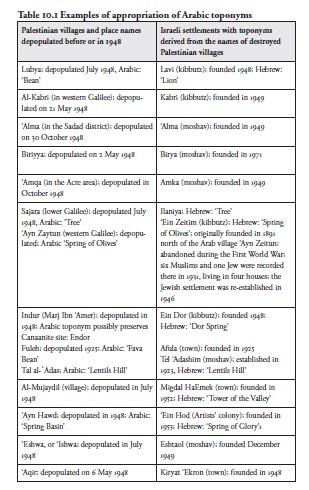
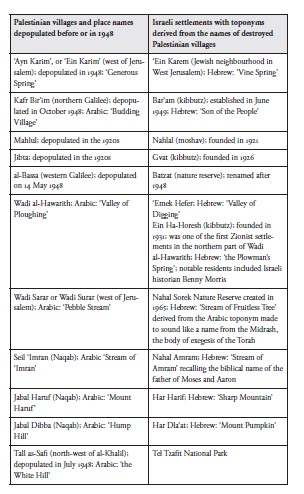
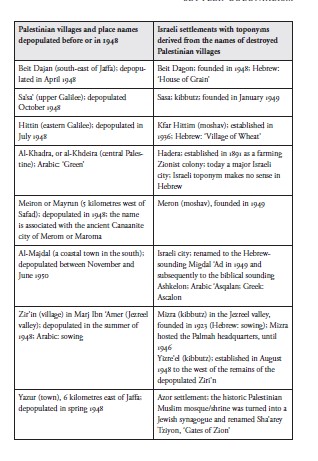
फ़िलिस्तीनी अरबी स्थाननामों का प्रभाव इज़राइली स्थाननामों पर स्पष्ट रूप से दिखाई देता है, जो अरबी मूल के उधार लिए गए स्थाननामों, अरबी स्थाननामों के अनुवादों और नामकरण के आकारिक (मॉर्फ़ोलॉजिकल) पैटर्नों में झलकता है। तालिका 10.1 उन नए हिब्रू-ध्वनि वाले स्थाननामों को दिखाती है, जो 1948 से पहले या उस दौरान आबादी-विहीन और नष्ट कर दिए गए फ़िलिस्तीनी गाँवों के अरबी स्थाननामों पर आधारित, उनसे व्युत्पन्न या उनके आधार पर गढ़े गए हैं।
The influence of Palestinian Arabic toponyms on the Israeli toponyms are clear in loan Arabic place names, translations of Arabic place names and morphological patterns of renaming. Table 10.1 shows new Hebrew-sounding toponyms based on, derived from or modelled on the Arabic toponyms of Palestinian villages depopulated and destroyed before or in 1948.
नकबा के छप्पन साल बाद, मार्च 2004 में, इज़राइली पत्रकार गिदोन लेवी ने लिखा: ‘ज़ायोनी सामूहिक स्मृति हमारे सांस्कृतिक और भौतिक परिदृश्य दोनों में मौजूद है, फिर भी फ़िलिस्तीनियों ने जो भारी कीमत चुकाई है – जीवन में, सैकड़ों गाँवों के विनाश में, और फ़िलिस्तीनी शरणार्थियों की लगातार दुर्दशा में – उसे सार्वजनिक रूप से बहुत कम मान्यता मिली है’ (Levy 2004)।
Fifty-six years after the Nakba, in March 2004, Israeli journalist Gideon Levy wrote: ‘The Zionist collective memory exists in both our cultural and physical landscape, yet the heavy price paid by the Palestinians – in lives, in the destruction of hundreds of villages, and in the continuing plight of the Palestinian refugees – receives little public recognition’ (Levy 2004).
लेवी ने जोड़ा:
Levy adds:
देखिए यह कांटेदार नाशपाती (प्रिकली पियर) का पौधा है। यह पत्थरों के एक टीले को ढके हुए है। यह पत्थरों का टीला कभी एक घर था, या एक झोपड़ी, या एक भेड़शाला, या एक स्कूल, या एक पत्थर की बाड़। कभी – 56 साल पहले तक, डेढ़ पीढ़ी पहले – कोई बहुत लंबा समय नहीं हुआ। इस कैक्टस ने घरों और एक ज़मीन के टुकड़े को दूसरे से अलग किया था, एक जीती-जागती बाड़, जो अब उस जीवन का इकलौता स्मारक भी है जो कभी यहां था। कांटेदार नाशपाती के चारों ओर के चीड़ के झुरमुट को भी देखिए। उसके नीचे कभी एक गांव बसा था। उसके सभी 405 घर 1948 में एक ही दिन में नष्ट कर दिए गए और उसके 2,350 निवासी इधर-उधर बिखर गए। हमें इसके बारे में कभी किसी ने नहीं बताया। चीड़ इसके तुरंत बाद यहूदी नेशनल फंड (JNF) द्वारा लगाए गए थे, जिसमें हम बचपन में हर शुक्रवार को चंदा देते थे, ताकि खंडहरों को ढका जा सके, लौट आने की संभावना को ढका जा सके और शायद थोड़ी-सी शर्म और अपराधबोध को भी ढका जा सके। (Levy 2004)
Look at this prickly pear plant. It’s covering a mound of stones. This mound of stones was once a house, or a shed, or a sheep pen, or a school, or a stone fence. Once – until 56 years ago, a generation and a half ago – not that long ago. The cactus separated the houses and one lot from another, a living fence that is now also the only monument to the life that once was here. Take a look at the grove of pines around the prickly pear as well. Beneath it there was once a village. All of its 405 houses were destroyed in one day in 1948 and its 2,350 inhabitants scattered all over. No one ever told us about this. The pines were planted right afterward by the Jewish National Fund (JNF), to which we contributed in our childhood, every Friday, in order to cover the ruins, to cover the possibility of return and maybe also a little of the shame and the guilt. (Levy 2004)
1992 में फ़िलिस्तीनी क्षेत्र-शोधकर्ताओं और शिक्षाविदों की एक टीम ने फ़िलिस्तीनी इतिहासकार वलीद ख़ालिदी के निर्देशन में एक विशाल अध्ययन प्रकाशित किया, जिसमें उन सैकड़ों गाँवों के विनाश का विवरण दिया गया है जो 1949 की
A monumental 1992 study by a team of Palestinian field researchers and academics under the direction of Palestinian historian Walid Khalidi details the destruction of hundreds of villages falling inside the 1949