الخلافة
17. The Khilafah
الخلافة هي القيادة العامة أو الشاملة لجميع المسلمين في العالم، لإقامة أحكام الشريعة الإسلامية، ولحمل دعوة الإسلام إلى العالم. وهي نفسها الإمامة، فالإمامة والخلافة لهما المعنى ذاته. وقد جاءت بالمعنى نفسه في عدة أحاديث صحيحة. ولم يأتِ أيٌّ من اللفظين في أي نص شرعي، أي في القرآن أو السنة، بمعنى يختلف عن الآخر، إذ إن هذين المصدرين هما المصدران الوحيدان للشريعة. وليس من الواجب التمسك بلفظ الخلافة أو الإمامة، وإنما الواجب التمسك بمعنى اللفظ.
The Khilafah is the general or overall leadership for all the Muslims in the world in order to establish the laws of the Islamic Shari’ah and to carry the da’wa of Islam to the world. It is the same as the Imamah, as the Imamah and Khilafah have the same meaning. Several saheeh ahadith mention them with the same meaning. Neither of the two terms has ever come with any meaning different from the other in any Shari’ah text i.e. the Qur’an or the Sunnah, as these two (sources) are the only Shari’ah sources. It is not compulsory to hold to the term of Khilafah or Imamah, but rather it is compulsory to hold to the meaning of the term.
إقامة الخلافة فرضٌ على جميع المسلمين في جميع أنحاء العالم. وإقامتها، كأداء أيّ فرضٍ فرضه الله سبحانه وتعالى على المسلمين، أمرٌ حتمي لا خيار فيه ولا رخصة. والتقصير في إقامتها من أعظم الذنوب التي يعاقب الله عليها بأشدّ العقوبات.
Establishing the Khilafah is an obligation upon all Muslims in all regions of the world. Establishing it, like the performing of any obligation that Allah (swt) obliged upon Muslims, is an inevitable matter without choice or leniency in it. Negligence in performing it is one of the worst sins for which Allah (swt) punishes with the strictest of the punishments.
الأدلة على وجوب إقامة الخلافة على جميع المسلمين (وهي مأخوذة من): القرآن الكريم، والسنة النبوية، وإجماع الصحابة.
The evidence for establishing the Khilafah upon all Muslims (come from): The Qura'n, The Sunnah and Ijmaa as-Sahabah.
أمّا القرآن، فإنّ الله سبحانه قد أمر الرسولَ ﷺ أن يحكم بين المسلمين بما أنزل الله إليه، وكان أمره سبحانه له في ذلك أمرًا حاسمًا. وقد خاطب اللهُ سبحانه النبيَّ ﷺ قائلًا:
As for the Qura'n, Allah (swt) has ordered the Messenger (saw) to rule between Muslims by all that He (swt) revealed to him (saw), and His order (swt) to him was in a decisive manner. Allah (swt) addressed the Prophet (saw) saying:
وَأَنِ احْكُم بَيْنَهُم بِمَا أَنزَلَ اللَّهُ وَلَا تَتَّبِعْ أَهْوَاءَهُمْ وَاحْذَرْهُمْ أَن يَفْتِنُوكَ عَن بَعْضِ مَا أَنزَلَ اللَّهُ إِلَيْكَ [TMQ 5:48]
"And rule between them by that which Allah revealed to you, and do not follow their vain desires away from the truth which came to you" [TMQ 5:48]
وَقَالَ سُبْحَانَهُ:
And He (swt) said:
وَأَنِ احْكُمْ بَيْنَهُم بِمَا أَنزَلَ اللَّهُ وَلَا تَتَّبِعْ أَهْوَاءَهُمْ وَاحْذَرْهُمْ أَن يَفْتِنُوكَ عَن بَعْضِ مَا أَنزَلَ اللَّهُ إِلَيْكَ [TMQ 5:49]
"And rule between them by that which Allah revealed to you and do not follow their whims, and beware (be on the alert) that they may deviate you away from even some part of what Allah revealed to you" [TMQ 5:49]
إنَّ خِطابَ اللهِ سُبحانَه وتعالى لرسولِ اللهِ ﷺ هو خِطابٌ لأمَّتِه ما لم يَقُمْ دليلٌ يَقصُرُ الخِطابَ عليه ﷺ، وليس هنا دليلٌ كذلك، فالخِطابُ لجميعِ المسلمينَ بإقامةِ الحُكمِ. وإقامةُ الخلافةِ لا تعني غيرَ إقامةِ الحُكمِ والسُّلطانِ. وفضلاً عن ذلك فقد أوجبَ اللهُ سُبحانه وتعالى على المسلمينَ طاعةَ أولي الأمرِ أي الحاكمِ، وهذا يدلُّ على أنَّ وجودَ وليِّ الأمرِ واجبٌ على المسلمينَ. قالَ اللهُ تعالى:
The speech of Allah (swt) to the Prophet (saw) is a speech to his Ummah unless there is evidence which limits the speech to him (saw). In this case there is no such evidence, so the address is to all the Muslims to establish the rule (hukm). The establishment of the Khalifah does not mean other than the establishment of the rule and the authority. Moreover, Allah (swt) made it obligatory upon Muslims to obey those in authority i.e. the ruler, which indicates that the existence of the one in authority is obligatory upon Muslims. Allah (swt) said:
يَا أَيُّهَا الَّذِينَ آمَنُوا أَطِيعُوا اللَّهَ وَأَطِيعُوا الرَّسُولَ وَأُولِي الْأَمْرِ مِنْكُمْ [TMQ 4:59]
"O you who believe obey Allah and obey the Messenger and those in authority amongst you" [TMQ 4:59]
لا يأمر الله سبحانه وتعالى بالطاعة لمن لا وجود له. وهذا يدل على أن وجود صاحب السلطان واجب. فإذا أمر الله سبحانه وتعالى بطاعة أولي الأمر فإنه سبحانه يأمر بإقامتهم. وإن نتيجة إقامة الحاكم هي إقامة الحكم الشرعي، وإن عدم إقامته يؤدي إلى إهمال الحكم الشرعي. ولذلك يكون وجوده واجبًا، لأن ما يؤدي إليه تركه هو من المحرمات، أي إهمال الحكم الشرعي.
Allah (swt) does not order obedience to someone who does not exist. This indicates that the existence of the person in authority is obligatory. When Allah (swt) commands obedience to those in authority then He (swt) is commanding their establishment. The result of establishing the ruler is the establishment of the Shari’ah rule (hukm shar’i) and the failure to establish it will result in neglecting the Shari’ah rule (hukm shar’i). Thus his existence is obligatory as the result of the failure to establish it is will be from the prohibited matters i.e. the neglect of the Shari’ah rule (hukm shar’i).
وأما السنة، فقد روى نافع قال: قال لي عبد الله بن عمر إنه سمع النبي ﷺ يقول:
As for the Sunnah, Nafi‘ reported saying: Abdullah bin ‘Umar said to me that he heard the Prophet (saw) saying:
«مَنْ نَزَعَ يَدًا مِنْ طَاعَةٍ، لَقِيَ اللَّهَ يَوْمَ الْقِيَامَةِ لَا حُجَّةَ لَهُ، وَمَنْ مَاتَ وَلَيْسَ فِي عُنُقِهِ بَيْعَةٌ، مَاتَ مِيتَةً جَاهِلِيَّةً».
“Whoever removes his hand from obedience will meet Allah on the Day of Resurrection without having any proof for him, and whoever dies without a pledge of allegiance (bay’ah) on his neck dies a death of ignorance (jahiliyyah).”
لہٰذا نبیِ کریم ﷺ نے ہر مسلمان پر یہ لازم کیا کہ اس کی گردن پر بیعت ہو، اور فرمایا کہ جو شخص مرتے وقت اس حال میں مرے کہ اس کی گردن پر بیعت نہ ہو تو وہ جاہلیت کی موت مرا۔ اور بیعت کسی کے لیے نہیں ہو سکتی سوائے خلیفہ کے۔ نبیِ کریم ﷺ نے ہر مسلمان پر اپنی گردن پر خلیفہ کی بیعت ہونا واجب کیا، لیکن ہر مسلمان پر خلیفہ کو بیعت دینا واجب نہیں کیا۔ فرض یہ ہے کہ ہر اہل مسلمان کی گردن پر بیعت موجود ہو، یعنی خلیفہ کا موجود ہونا، جو اس بنا پر ہر مسلمان کی گردن پر بیعت کا حق دار ہو۔ پس خلیفہ کی موجودگی ہی ہر مسلمان کی گردن پر بیعت قائم کرتی ہے، خواہ مسلمان نے خود اس کو (بالمشافہ) بیعت دی ہو یا نہ دی ہو۔ لہٰذا نبیِ کریم ﷺ کی یہ حدیث اس بات کی دلیل ہے کہ خلیفہ کا مقرر کرنا فرض ہے، نہ کہ اس بات کی دلیل کہ بیعت دینا واجب ہے۔ اس کی وجہ یہ ہے کہ نبیِ کریم ﷺ نے جس چیز پر ملامت فرمائی وہ یہ تھی کہ کسی مسلمان کی گردن پر بیعت نہ ہو یہاں تک کہ وہ مر جائے، لیکن آپ ﷺ نے بیعت نہ دینے پر ملامت نہیں فرمائی۔ مسلم نے الاعرج سے، انہوں نے ابو ہریرہ رضی اللہ عنہ سے، اور انہوں نے نبیِ کریم ﷺ سے روایت کیا، آپ ﷺ نے فرمایا:
So the Prophet (saw) made it compulsory upon every Muslim to have a bay’ah on his neck, and described that whoever dies without a bay’ah on his neck that he dies a death of jahiliyyah. The bay’ah cannot be for anyone except the Khalifah. The Prophet (saw) made it obligatory upon every Muslim to have on his neck a bay’ah to a Khalifah, yet he did not make it an obligation upon every Muslim to give bay’ah to a Khalifah. The duty is the existence of a bay’ah on the neck of every eligible Muslim i.e. the existence of a Khalifah who accordingly deserves a bay’ah upon the neck of every Muslim. So it is the presence of the Khalifah which places a bay’ah on the neck of every Muslim, whether the Muslim actually gave a bay’ah to him (in person) or not. Therefore, this hadith of the Prophet (saw) is evidence that the appointment of the Khalifah is an obligation and not a proof that giving the bay’ah is obligatory. This is so because what was rebuked by the Prophet (saw) was the absence of a bay’ah on the neck of a Muslim until he dies, but he did not rebuke the absence of the bay’ah. Muslim narrated from Al-’Araj from Abu Hurairah (ra) from the Prophet (saw) who said:
إِنَّمَا الْإِمَامُ جُنَّةٌ يُقَاتَلُ مِنْ وَرَائِهِ وَيُتَّقَى بِهِ
“Behold, the Imam is a shield from behind whom the people fight and by whom they protect themselves.”
وَرَوَى مُسْلِمٌ عَنْ أَبِي حَازِمٍ قَالَ:
And Muslim reported from Abu Hazim who said:
صَحِبْتُ أَبَا هُرَيْرَةَ خَمْسَ سِنِينَ، فَسَمِعْتُهُ يُحَدِّثُ عَنِ النَّبِيِّ ﷺ، أَنَّهُ قَالَ: «كَانَتْ بَنُو إِسْرَائِيلَ تَسُوسُهُمُ الْأَنْبِيَاءُ، كُلَّمَا هَلَكَ نَبِيٌّ خَلَفَهُ نَبِيٌّ، وَإِنَّهُ لَا نَبِيَّ بَعْدِي، وَسَيَكُونُ خُلَفَاءُ فَيَكْثُرُونَ». قَالُوا: فَمَا تَأْمُرُنَا؟ قَالَ: «فُوا بِبَيْعَةِ الْأَوَّلِ فَالْأَوَّلِ، وَأَعْطُوهُمْ حَقَّهُمُ، فَإِنَّ اللهَ سَائِلُهُمْ عَمَّا اسْتَرْعَاهُمْ».
“I accompanied Abu Hurairah for five years and heard him reporting from the Prophet who said: The Prophets ruled over the children of Israel. Whenever a Prophet died another Prophet succeeded him, but there will be no Prophet after me. There will be Khulafaa and they will number many. They asked: What then do you order us? He said: Fulfil the bay’ah to them one after the other and give them their due right. Surely Allah will ask them about what He entrusted them with.”
وَعَنِ ابْنِ عَبَّاسٍ، عَنِ النَّبِيِّ ﷺ، قَالَ:
And from bin ‘Abbas from the Prophet (saw) who said:
مَنْ رَأَى مِنْ أَمِيرِهِ شَيْئًا يَكْرَهُهُ فَلْيَصْبِرْ، فَإِنَّهُ مَنْ فَارَقَ الْجَمَاعَةَ شِبْرًا فَمَاتَ، فَمِيتَتُهُ مِيتَةٌ جَاهِلِيَّةٌ
“If anyone sees in his Amir something that displeases him let him remain patient. For, behold, he who separates himself from the sultan (authority of Islam) by even so much as a hand span and dies thereupon, has died a death of jahiliyyah”.
في هذه الأحاديث يُخبرنا النبي ﷺ أن الأمراء سيتولّون شؤون المسلمين، وقد تضمّنت وصف الخليفة بأنه جُنّة، أي وقاية وحماية. فوصف الإمام بأنه جُنّة يُفيد بيان فوائد وجود الإمام، ولذلك فهو أمرٌ بالفعل. وذلك لأن الخبر الصادر عن الله تعالى ورسوله ﷺ إن تضمّن ذمًّا كان نهيًا، وإن تضمّن مدحًا كان أمرًا بالفعل. فإذا كان الفعل المطلوب لازمًا لتنفيذ حكمٍ شرعي، أو كان إهماله يؤدي إلى تعطيل حكمٍ شرعي، فإن هذا الأمر يكون جازمًا. وفي هذه الأحاديث أيضًا إخبارٌ بأن الذين يتولّون شؤون المسلمين هم الخلفاء، وهذا يدلّ على الأمر بتنصيبهم. كما تضمّنت نهيًا للمسلمين عن الخروج من السلطة، مما يدل على وجوب أن ينصِّب المسلمون لأنفسهم سلطانًا يحكمهم. وفضلًا عن ذلك، أمر النبي ﷺ المسلمين بطاعة الخليفة وبقتال من ينازع في سلطانه خليفةً، وهذا يدلّ على الأمر بنصب خليفة، وحماية خلافته بقتال كل من ينازعه فيها. وروى مسلم أن النبي ﷺ قال:
In these ahadith, the Prophet (saw) informs us that leaders will run the affairs of Muslims, and they include the description of the Khalifah as a shield i.e. a protection. So the description of the Imam as a shield is informative of the benefits of the presence of the Imam, thus it is a command for action. This is because if the information conveyed by Allah (swt) and the Prophet (saw) contained rebuke then it is a command of prohibition, and if it contained praise then it is a command for action. If the ordered action is necessary to implement a hukm shari’ (Shari’ah rule), or by its negligence a hukm shar‘i will be neglected, then this command is decisive. In these ahadith there is information also that those who run the affairs of Muslims are Khulafaa, which indicates an order to appoint them. They also include a prohibition for Muslims to separate from the authority, which indicates the obligation upon Muslims to appoint an authority for themselves i.e. ruling. Moreover, the Prophet (saw) ordered the Muslims to obey the Khalifah and to fight those who dispute his authority as Khalifah, which indicates an order to appoint a Khalifah and to protect his Khilafah by fighting against whosoever disputes with him. Muslim reported that the Prophet (saw) said:
مَنْ بَايَعَ إِمَامًا فَأَعْطَاهُ صَفْقَةَ يَدِهِ وَثَمَرَةَ فُؤَادِهِ، فَلْيُطِعْهُ مَا اسْتَطَاعَ، فَإِنْ جَاءَ آخَرُ يُنَازِعُهُ فَاضْرِبُوا عُنُقَ الْآخَرِ.
“He who pledged allegiance to an Imam giving him the clasp of his hand and the fruit of his heart shall obey him as long as he can, and if another comes to dispute with him you have to strike the neck of that man.”
فَإِنَّ الأَمْرَ بِطَاعَةِ الإِمَامِ أَمْرٌ بِإِقَامَتِهِ، وَالأَمْرَ بِقِتَالِ مَنْ يُنَازِعُهُ دَلِيلٌ عَلَى أَنَّ هَذَا الأَمْرَ حَاسِمٌ فِي الحِفَاظِ عَلَى وُجُودِ خَلِيفَةٍ وَاحِدٍ.
So the command to obey the Imam is an order to establish him, and the command to fight those who dispute with him is evidence that this command is decisive in maintaining the presence of one Khalifah.
أما إجماع الصحابة رضي الله عنهم، فقد أجمعوا جميعاً على وجوب إقامة خليفة أو إمام يخلف النبي ﷺ بعد وفاته، وأجمعوا على تعيين خليفة لأبي بكر، ثم لعمر، ثم لعثمان، بعد وفاة كل واحد منهم. وقد تجلّى إجماع الصحابة رضي الله عنهم على إقامة الخليفة تجلياً واضحاً حين أخّروا دفن النبي ﷺ بعد وفاته مشتغلين بتعيين خليفة له، مع أن دفن الميت فرض، وأنه يحرم على من يتولون تجهيزه أن يشتغلوا بغيره حتى يتموا دفنه. وقد كان الصحابة رضي الله عنهم مُلزَمين بالاشتغال بتجهيز النبي ﷺ ودفنه، فاشتغل بعضهم بتعيين خليفة بدلاً من القيام بالدفن، وسكت آخرون عن هذا الاشتغال فشاركوا في تأخير الدفن ليلتين، مع قدرتهم على إنكار التأخير وقدرتهم على دفن النبي ﷺ. فكان هذا إجماعاً منهم على الاشتغال بتعيين خليفة بدلاً من دفن الميت، ولا يصح ذلك إلا إذا كان تعيين الخليفة أوجب من دفن الميت. كما أجمع الصحابة رضي الله عنهم جميعاً طوال حياتهم على وجوب تعيين خليفة، وإن اختلفوا في الشخص الذي يُنتخب خليفةً، فإنهم لم يختلفوا قط في تعيين خليفة، لا حين توفي النبي ﷺ، ولا حين توفي أيٌّ من الخلفاء الراشدين. ولذلك فإن إجماع الصحابة دليلٌ واضحٌ قويٌّ على أن إقامة الخليفة واجبة.
As for the Ijma’a of the Sahabah (ra) they all agreed upon the necessity to establish a successor or Khalifah to the Prophet (saw) after his death, and they all agreed to appoint a successor to Abu Bakr, then to ‘Umar, then to ‘Uthman, after the death of each one of them. The Ijma’a of the Sahabah (ra) to establish a Khalifah manifested itself emphatically when they delayed the burial of the Prophet (saw) after his death while engaged in appointing a successor to him, despite the fact that the burial of the dead person is fard, and that it is haram upon those who are supposed to prepare for his burial to engage themselves in anything else until they complete the burial. The Sahabah (ra) were obliged to engage themselves in preparing the burial of the Prophet (saw), instead some of them engaged themselves in appointing a Khalifah rather than carrying out the burial, and some others kept silent on this engagement and participated in delaying the burial for two nights despite their ability to deny the delay and their ability to bury the Prophet (saw). So this was an Ijma’a to engage themselves in appointing a Khalifah rather than to bury the dead. This could not be legitimate unless the appointment of a Khalifah is more obligatory than the burial of the dead. Also, all the Sahabah (ra) agreed throughout their lives upon the obligation of appointing a Khalifah. Although they disagreed upon the person to be elected as a Khalifah, they never disagreed upon the appointment of a Khalifah, neither when the Prophet (saw) died, nor when any of the Khulafaa ar-Rashidun died. Therefore the Ijma’a of the Sahabah is clear and strong evidence that the appointment of a Khalifah is obligatory.
ما لا يتم الواجب إلا به فهو واجب
‘What is necessary to accomplish a wajib (duty) is itself a wajib’
وعليه فإن إقامة الخلافة واجبةٌ أيضًا وفق هذا الأصل الشرعي.
So the establishment of a Khalifah is also compulsory according to this divine principle.
فَيَتَبَيَّنُ مِنْ هَذِهِ الأَدِلَّةِ أَنَّ إِقَامَةَ الحُكْمِ وَالسُّلْطَانِ بَيْنَ المُسْلِمِينَ فَرْضٌ، وَيَتَبَيَّنُ أَيْضًا أَنَّ نَصْبَ خَلِيفَةٍ يَتَوَلَّى الحُكْمَ وَالسُّلْطَانَ وَاجِبٌ عَلَى المُسْلِمِينَ لِيُطَبِّقُوا أَحْكَامَ الشَّرِيعَةِ، لَا لِمُجَرَّدِ الحُكْمِ وَالسُّلْطَانِ فِي ذَاتِهِمَا. وَتَأَمَّلْ مَا رَوَاهُ مُسْلِمٌ عَنْ قَوْلِهِ ﷺ عَنْ طَرِيقِ عَوْفِ بْنِ مَالِكٍ:
Therefore, it is clear from these evidences that the establishment of the rule and the authority amongst Muslims is fard, and it is also clear that the appointment of a Khalifah who takes the charge of the rule and the authority is compulsory upon Muslims in order to implement the Shari’ah rules and not merely for the sake of rule and authority in themselves. Reflect upon what Muslim narrated of his saying (saw) via ‘Awf bin Malik:
"خَيْرُ أَئِمَّتِكُمُ الَّذِينَ تُحِبُّونَهُمْ وَيُحِبُّونَكُمْ، وَيُصَلُّونَ عَلَيْكُمْ وَتُصَلُّونَ عَلَيْهِمْ، وَشِرَارُ أَئِمَّتِكُمُ الَّذِينَ تُبْغِضُونَهُمْ وَيُبْغِضُونَكُمْ، وَتَلْعَنُونَهُمْ وَيَلْعَنُونَكُمْ». قِيلَ: يَا رَسُولَ اللهِ، أَفَلَا نُنَابِذُهُمْ بِالسَّيْفِ؟ فَقَالَ: «لَا، مَا أَقَامُوا فِيكُمُ الصَّلَاةَ» ﷺ.
“The best of your Imams (leaders) are those whom you love and they love you, who pray for you and you pray for them; and the worst of your Imams are those whom you hate and they hate you and you curse them and they curse you. The Messenger of Allah (saw) was asked: Should we not face them with the swords? He said: No, not as long as they establish salat (meaning Islam) among you.”
هذا الحديث واضح في الإخبار عن الأمراء الصالحين والفاسدين، وواضح في النهي عن قتالهم بالسيف ما داموا يقيمون الدين، إذ إن إقامة الصلاة دليل على إقامة الدين والحكم به.
This hadith is clear in informing about the good and bad leaders, and clear in prohibiting confronting them with the sword as long as they establish the deen, since establishing the salat (prayer) indicates upholding of the deen and ruling by it.
إنَّ وجوبَ نصبِ الخليفةِ الذي يُقيمُ أحكامَ الإسلامِ ويحملُ دعوتَه أمرٌ لا شكَّ في ثبوتِه في نصوصِ الشريعةِ الصحيحةِ. وهو واجبٌ لأنَّ الله سبحانه وتعالى فرضَ على المسلمين إقامةَ حكمِ الإسلامِ وحمايةَ حرماتِ المسلمين. غيرَ أنَّ هذا الواجبَ فرضُ كفايةٍ، فإذا قامَ به بعضُ الأمةِ سقطَ الفرضُ عن الباقين. وإذا عجزَ جزءٌ من الأمةِ عن تحقيقِ الفرضِ، وإن قاموا بالأعمالِ التي تُفضي إليه، فإنَّ المسؤوليةَ باقيةٌ على جميعِ المسلمين، ويبقى الفرضُ على كلِّ مسلمٍ ما دامَ المسلمونَ بلا خليفةٍ.
So the obligation upon Muslims to appoint the Khalifah who establishes the laws of Islam and conveys its call is a matter which has no doubt with regard to its certainty in the sound texts of Shari’ah. Moreover, it is an obligatory duty due to the fact that Allah (swt) made it fard upon Muslims to establish the rule of Islam and to protect the honour of Muslims. However, this duty is a collective one, so if some people of the Ummah accomplished it, the fard is fulfilled and thus responsibility drops from the rest of the Ummah. And if part of the Ummah was unable to achieve the fard, though they carried out the actions which establish it, then the responsibility remains upon all the Muslims, and the fard remains upon every Muslim as long as Muslims are without a Khalifah.
الامتناع عن إقامة الخلافة للمسلمين من أعظم الذنوب، لأنه ترك لأهم الواجبات في الإسلام التي يتوقف عليها تطبيق الدين، بل إن وجود الإسلام نفسه في ميدان الحياة يتوقف عليها أيضاً. فإذا امتنع المسلمون جميعاً عن إقامة خليفة لجميع المسلمين، فقد ارتكبوا إثماً عظيماً. ولو اتفقوا جميعاً على البقاء بلا خليفة لوقع الإثم على جميع المسلمين في جميع الأقاليم المسكونة (في العالم كله). أما إذا شرع بعض المسلمين في العمل على إقامة الخلافة، وقعد الآخرون، فإن الإثم يسقط عن أولئك الذين بدأوا العمل على إقامة الخلافة، وإن بقي الفرض قائماً عليهم حتى يُنصب الخليفة. وذلك لأن الانشغال بإقامة الفرض يرفع الإثم عن التأخير في إقامته في وقته المعتاد، وعن عدم إقامته، وذلك بسبب عمله على إقامته وكراهيته لما يحول دون إقامته.
To refrain from establishing a Khalifah for the Muslims is among the greatest sins because it is abstaining from carrying out among the most important obligations of Islam upon which the implementation of the deen depends; nay even the very existence of Islam in the battlefield of life depends upon it as well. So Muslims as a whole commit a great sin by refraining from establishing a Khalifah for all Muslims. And if they all agreed to remain without a Khalifah the sin would befall all Muslims in all inhabited regions (entire world). However, if some of the Muslims embarked on working to establish a Khalifah and the others did not, the sin will drop from the shoulders of those who started to work to establish the Khalifah though the fard remains upon them until the Khalifah is appointed. (This is so) because the involvement in establishing the fard removes the sin for the delay in establishing it in its proper time, and for its non-establishment, due to one’s work to establish it and his hatred of that which prevents him from establishing it.
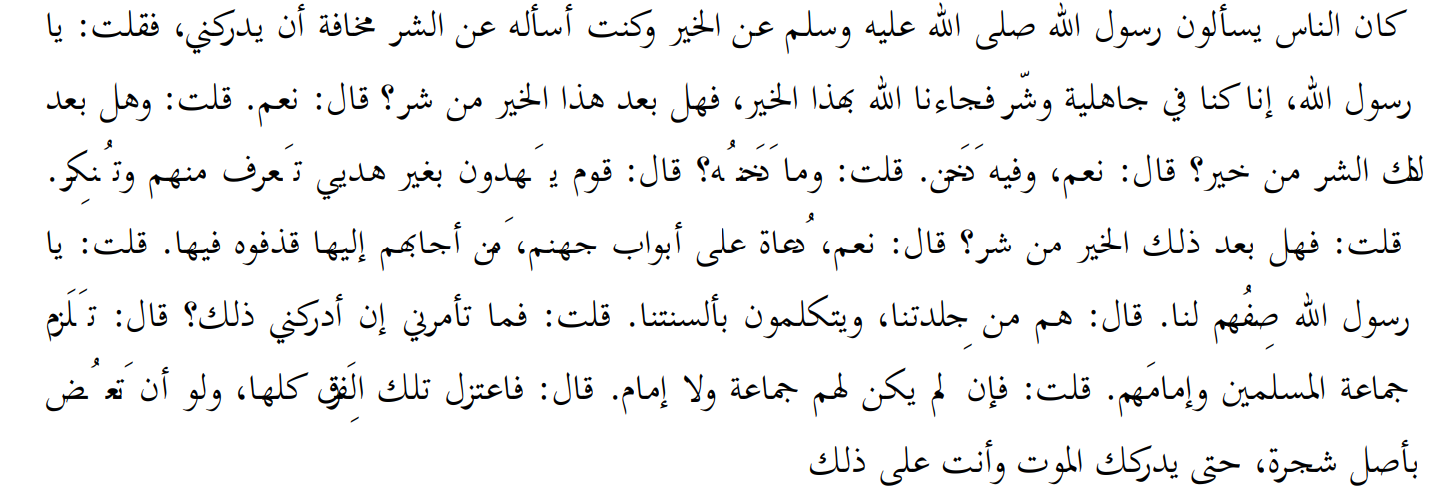
كان الناس يسألون رسولَ اللهِ ﷺ عن الخير، وكنتُ أسألُه عن الشرِّ مخافةَ أن يُدركني. فقلتُ: يا رسولَ اللهِ، إنا كنا في جاهليةٍ وشرٍّ، فجاءنا اللهُ بهذا الخيرِ، فهل بعدَ هذا الخيرِ من شرٍّ؟ قال: نعم. قلتُ: فهل بعدَ ذلكَ الشرِّ من خيرٍ؟ قال: نعم، وفيه دَخَنٌ. قلتُ: وما دَخَنُه؟ قال: قومٌ يهدون بغيرِ هَدْيي، تعرفُ منهم وتنكرُ. قلتُ: فهل بعدَ ذلكَ الخيرِ من شرٍّ؟ قال: نعم، دعاةٌ على أبوابِ جهنمَ، مَن أجابهم إليها قذفوه فيها. قلتُ: يا رسولَ اللهِ، صِفْهم لنا. قال: هم من جِلدتِنا، ويتكلمون بألسنتِنا. قلتُ: فما تأمرني إن أدركني ذلك؟ قال: تلزمُ جماعةَ المسلمينَ وإمامَهم. قلتُ: فإن لم يكن لهم جماعةٌ ولا إمامٌ؟ قال: فاعتزلْ تلكَ الفِرقَ كلَّها، ولو أن تعضَّ بأصلِ شجرةٍ حتى يدركَك الموتُ وأنت على ذلك.
“The people used to ask the Prophet of Allah (saw) about the good and I used to ask him about the bad in fear that it might catch me. So I said: O Prophet of Allah! We were in times of jahiliyyah and mischief then Allah brought us this good, so is there any mischief after this good? He (saw) said: Yes. I said: Will there be any good after that mischief? He said: Yes, and it has smoke (dukhan). I said: What is its smoke? He said: People guiding but not on my guidance. You recognise some (from them) and deny some. I said: Will there be any mischief after that good? He said: Yes, callers (du’at) who invite at the doors of Hellfire. They throw him into it (hell) whoever accepted their invitation. I said: O Prophet of Allah, describe them to us. He said: They are of our own skin (of our people) and talk our language. I said: What do you order me to do if that (matter) caught me? He said: Adhere to the jama‘ah of Muslims and their Imam. I said: What if the Muslims have no jama‘ah nor an Imam? He said: Then separate from all those groups, even if you (have to) bite the root of a tree till death comes to you as such.”
يُبيّن هذا الحديث بوضوح في لفظه أن النبي ﷺ أمر المسلمين بلزوم جماعة المسلمين وبلزوم إمامهم، وبترك الدعاة إلى أبواب جهنم. وقد سأله السائل عمّا يفعله في حال كان المسلمون لا إمام لهم ولا جماعة، فأمره النبي ﷺ حينئذٍ بأن يعتزل جميع هذه الفرق، ولا يتبرأ من المسلمين، ولا يمتنع عن العمل لإقامة إمام. فأمره واضح: «اعتزل تلك الفرق كلها»، وقد أكّد ﷺ الاعتزال عنها حتى قال إن عزلته عنها تبلغ به أن يَعَضّ بأصل شجرة حتى يدركه الموت. ومعنى ذلك أن يتمسك المرء بدينه ويبتعد عن الدعاة إلى الضلال الذين هم على أبواب جهنم. وليس في هذا الحديث عذرٌ ولا رخصةٌ لأحدٍ في ترك العمل لإقامة الخلافة، وإنما هو مقصور على الأمر بالتمسك بالدين وترك دعاة جهنم، ويبقى الإثم عليه إن لم يسعَ لإقامة الخلافة. فهو مأمور بترك الفرق الضالة حفاظاً على دينه من دعاة الضلال، ولو اضطر إلى أن يعَضّ على أصل شجرة، لكن دون أن يبتعد عن جماعة المسلمين أو يترك العمل لإقامة أحكام الدين ونصب إمام للمسلمين.
This hadith is clear in its expression that the Prophet (saw) ordered the Muslims to adhere to the jama‘ah of Muslims and to adhere to their Imam, and to leave those who invite people to the doors of hell. The questioner asked him what he has should do in relation to those callers at the doors of Hellfire in the situation wherein the Muslims have no Imam and no jama‘ah; thereupon the Prophet (saw) ordered him to separate from all these groups, not to disassociate himself from the Muslims nor to abstain from the action for establishing an Imam. So his order is clear “Separate from all those groups”, and he emphasised the separation from those groups even to the extent that his isolation from them would make him clench to the trunk of a tree until death comes to him. Its meaning is to adhere to your deen and keep away from the misguiding callers who are at the doors of Hellfire. In this hadith there is no excuse or permission (for anybody) to abandon the work for establishing a Khalifah, it is, rather, confined to the command of adhering to the deen and abandoning the callers at the doors of hell, and the sin will remain on him if he does not work to establish a Khalifah. So he is ordered to abandon the misguiding groups in order to save his deen from the callers of the misguidance, even if he had to bite the root of a tree, but not to distance himself from the Muslim community and abandon the work for establishing the laws of the deen and establishing an Imam for Muslims.
ومثال آخر ما رواه البخاري عن أبي سعيد الخدري، قال:
Another example is what al-Bukhari narrated from Abu Said al-Khudri, who said:
قال رسول الله ﷺ: «يُوشِكُ أن يكونَ خيرُ مالِ المسلمِ غنمٌ يَتْبَعُ بها شَعَفَ الجبالِ ومواقعَ القَطْرِ، يَفِرُّ بدِينِه من الفتن».
“The Messenger of Allah (saw) said: A time will come that the best property of a Muslim will be sheep which he will take on the top of mountains and the places of rainfall (valleys) so as to flee with his religion from afflictions (fitan)”
لا يعني هذا أن يعتزل المسلم جماعة المسلمين، أو يترك العمل بأحكام الدين، أو يترك السعي لإقامة خلافة للمسلمين عندما لا توجد خلافة على وجه الأرض، وكل ما فيه بيانُ ما هو خيرُ مالِ المسلم في أوقات الفتن، وهو لا يدعو إلى الفُرقة عن المسلمين ولا إلى العزلة عن الناس.
This does not mean that one should isolate oneself from the Muslim community, abandon practising the laws of the deen and establishing a Khalifah for Muslims when there is no Khilafah on earth. All that it contains is an explanation of what is the best wealth of the Muslim at the times of affliction; it does not encourage separation from the Muslims and isolation from the people.
وبناءً على ذلك، لا يملك أيُّ مسلمٍ على وجه هذه الأرض عذرًا في التخلي عن واجب إقامة الدين الذي أمر به الله سبحانه، وهو إقامة خليفةٍ للمسلمين حين لا توجد خلافةٌ على الأرض، وحين لا يوجد من يطبّق حدود الله سبحانه لحماية حرمات الله، ولا من يطبّق أحكام الدين ويوحّد الأمة الإسلامية تحت راية «لا إله إلا الله، محمدٌ رسول الله» ﷺ. ولا يجوز في الإسلام التخلي عن العمل لهذا الواجب حتى يتم فعلًا إنجازه.
Accordingly, no Muslim on the face of this earth has an excuse to abandon the duty of establishing the deen which Allah (swt) has ordered, that is, the establishment of a Khalifah for Muslims when there is no Khilafah on the earth, when there is no one to implement the punishments (hudood) of Allah (swt) to protect the sanctities of Allah (swt), and no one to implement the laws of the deen and unify the Muslim community under the banner of La ilaha illa Allah, Muhammad ur-Rasul Allah. There is no permission in Islam to abandon the work for this duty until it is indeed completed.