bahawa dia berkata bahawa ayat itu telah diturunkan berkenaan Rasulullah ﷺ ketika baginda cuba memenangkan bapa saudaranya, Abu Talib, kepada Islam. Kemudian datanglah Tabi'in selepas para Sahabah, yang meriwayatkan segala yang disebutkan oleh para Sahabah dengan cara ini. Dalam kalangan Tabi'in, ada yang menjelaskan ayat-ayat al-Qur'an yang mulia atau menyatakan sebab turunnya ayat, sama ada melalui ijtihad mereka sendiri dalam tafsir atau dengan mendengarnya daripada (pihak berautoriti lain). Selepas Tabi'in, datanglah para 'Ulama yang memperluaskan tafsir serta memetik riwayat-riwayat daripada orang Yahudi dan Nasrani. Para mufassir silih berganti dalam setiap zaman dan generasi; mereka menjelaskan al-Qur'an dan memperluaskan tafsir pada setiap zaman berdasarkan apa yang telah ada sebelumnya. Para mufassir mula memberi perhatian kepada ayat-ayat untuk mengeluarkan hukum daripadanya dan menerangkan mazhab mereka dari segi kehendak bebas (ikhtiyar) dan takdir (jabr). Mereka juga mula menghuraikan ayat-ayat yang membuktikan pendapat mereka mengikut kecenderungan masing-masing dalam perundangan, ilmu Kalam, balaghah, sarf dan nahu, dan sebagainya. Apa yang jelas daripada penelitian terhadap tafsir-tafsir sepanjang zaman yang berbeza, sejak zaman Sahabah hingga kini, ialah bahawa tafsir al-Qur'an pada setiap zaman dipengaruhi oleh gerakan keilmuan pada zaman itu; ia memaparkan gambaran yang mencerminkan pandangan, teori dan mazhab pemikiran zaman tersebut. Jarang sekali terdapat tafsir yang bebas daripada pengaruh pendapat, pemikiran dan kaedah pada zamannya.
that he said the verse had been revealed concerning the Messenger of Allah when he tried to win over his uncle Abu Talib to Islam. Then came the Tabi'un after the Sahabah who reported everything the Sahabah mentioned in this manner. From among the Tabi'un there were those who explained the verses of the Noble Qur’ān or stated the cause of revelation, either as their own Ijtihād in tafsīr or by hearing it from (other authorities). After the Tabi'un the 'Ulama came and expanded the tafsīr and quoted reports from the Jews and Christians. The mufassirun succeeded one after another in every age and generation, who explained the Qur’ān and expanded the tafsīr in each age on what had come before. The mufassirun began to give their attention to the verses to deduce rulings from them and explain their schools of thought in terms of freewill (ikhtiyar) and predestination (jabr). And they began to explain verses proving their opinions according to their inclinations in legislation, scholasticism ('ilm al-Kalam), rhetorics (balaagha), declension (sarf) and grammar etc. What is apparent from an examination of the tafaseers through the different ages since the time of the Sahabah until now is that the tafsīr of the Qur’ān in every age was influenced by the scholarly movement of the time, it presented a picture which reflected the views, theories and schools of thought of the time. Seldom were there tafsīrs that were free from the influence of opinions, thoughts and rules of the time.
Walau bagaimanapun, kesemua tafsir ini tidak dihimpunkan dalam kitab sejak hari pertama mufassirun wujud, iaitu sejak zaman Sahabah. Sebaliknya, ia berubah daripada satu keadaan kepada keadaan lain sepanjang zaman. Pada mulanya, tafsir merupakan sebahagian daripada hadith dan salah satu bab daripadanya. Hadith ialah topik yang meliputi segala cabang ilmu Islam. Maka perawi sesuatu hadith, sebagaimana dia meriwayatkan hadith yang mengandungi hukum fiqh, dia juga meriwayatkan hadith yang mengandungi tafsir bagi suatu ayat Al-Qur'an.
Kemudian, pada awal zaman Abbasiyyah dan menjelang akhir zaman Umaiyyah, iaitu pada awal abad kedua hijrah, para penulis mula menghimpunkan semua hadith yang serupa dan berkaitan di bawah satu topik, dan memisahkannya daripada topik-topik lain. Maka cabang-cabang ilmu seperti tafsir dan fiqh yang terkandung dalam hadith itu terpisah antara satu sama lain. Apa yang berlaku kepada ilmu-ilmu tersebut, itulah yang berlaku dari segi hadith, Sirah, perundangan dan tafsir. Dengan itu, ilmu tafsir wujud dan menjadi satu disiplin yang berdiri sendiri, yang dipelajari secara bebas.
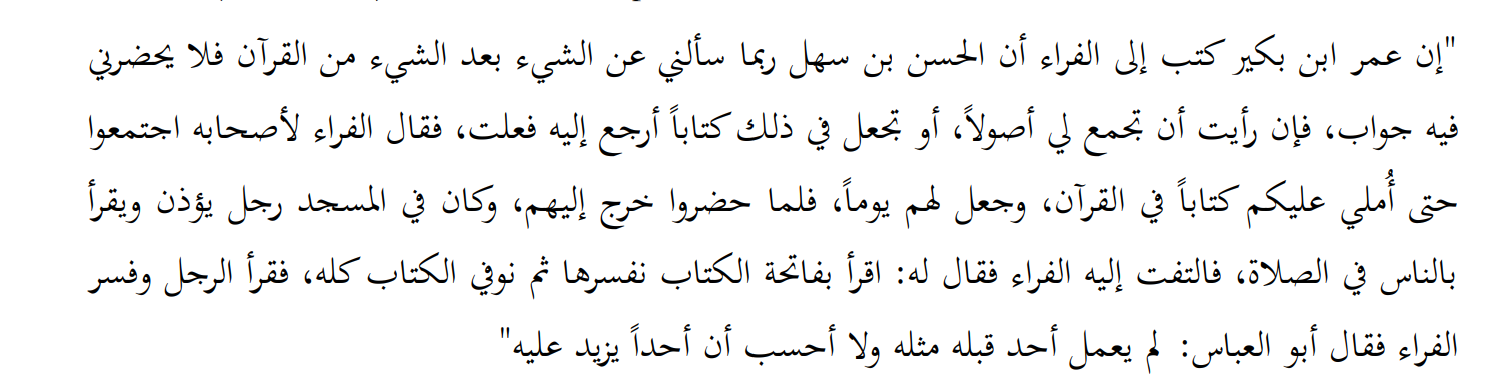
Namun, tafsir-tafsir tersebut belum mengambil bentuk yang tersusun, iaitu ayat-ayat Al-Qur'an tidak disebut mengikut susunan sebagaimana yang terdapat dalam mushaf, kemudian diikuti dengan tafsirnya. Sebaliknya, tafsir yang diriwayatkan itu bertaburan di sana sini. Ia merupakan tafsir bagi ayat-ayat yang berbeza-beza, sebagaimana keadaan hadith. Keadaan ini berterusan sehinggalah tafsir terpisah daripada hadith dan mula berdiri sebagai ilmu yang berdiri sendiri. Tafsir ditulis bagi setiap ayat Al-Qur'an atau sebahagian daripada ayat, dengan menyusun ayat-ayat ini mengikut susunan dalam mushaf. Orang pertama yang melakukan tafsir Al-Qur'an dengan memetik ayat demi ayat dan menerangkannya satu persatu ialah al-Farra' (w. 207 H). Ibn al-Nadim meriwayatkan dalam kitabnya al-Fihrist bahawa:
However, all of these tafsīrs were not compiled in books from the first day mufassirun came to exist i.e, from the time of the Sahabah. Rather, they changed from situation to situation through the ages. In the beginning, the tafsīr used to be a part of the hadīth and one of its chapters. The hadīth was the all-extensive topic which encompassed all the Islamic disciplines. So the transmitter of a hadīth just as he would narrate a hadīth containing a legal ruling he would also narrate a hadīth which contained the tafsīr of a Qur’ānic verse. Then writers, in the beginning of the Abbasid era and towards the end of the Umayyad era i.e, in the beginning of the second century hijri, began to bring together all the similar and relevant ahadīth under a topic and separate them from other topics. So the disciplines such as tafsīr and fiqh which the hadīth contains were separated from each other. What resulted from the sciences is what resulted in terms of hadīth, Sīrah, jurisprudence and tafsīr. Thus, the science of tafsīr came to exist and it became an independent science which was studied on its own. However, the tafsīrs did not take any organised form, in that verses of Qur’ān were not mentioned in an ordered manner like the arrangement found in the mushaf (Qur’ān) and then followed by their tafsīr. Rather the tafsīrs narrated were scattered here and there. They were tafsīr for miscellaneous verses as was the case with the hadīth. This situation continued until the tafsīr became separated from the hadīth and began to stand up as a science in its own right. Tafsīr was written for each ayah of the Qur’ān or part of an ayah, arranging these verses according to the order in mushaf. The first one to undertake the tafsīr of the Qur’ān quoting ayah after ayah and explain them one after another was al-Farra' (d.207 A.H.). Ibn al-Nadim reports in his book alFihirst that: