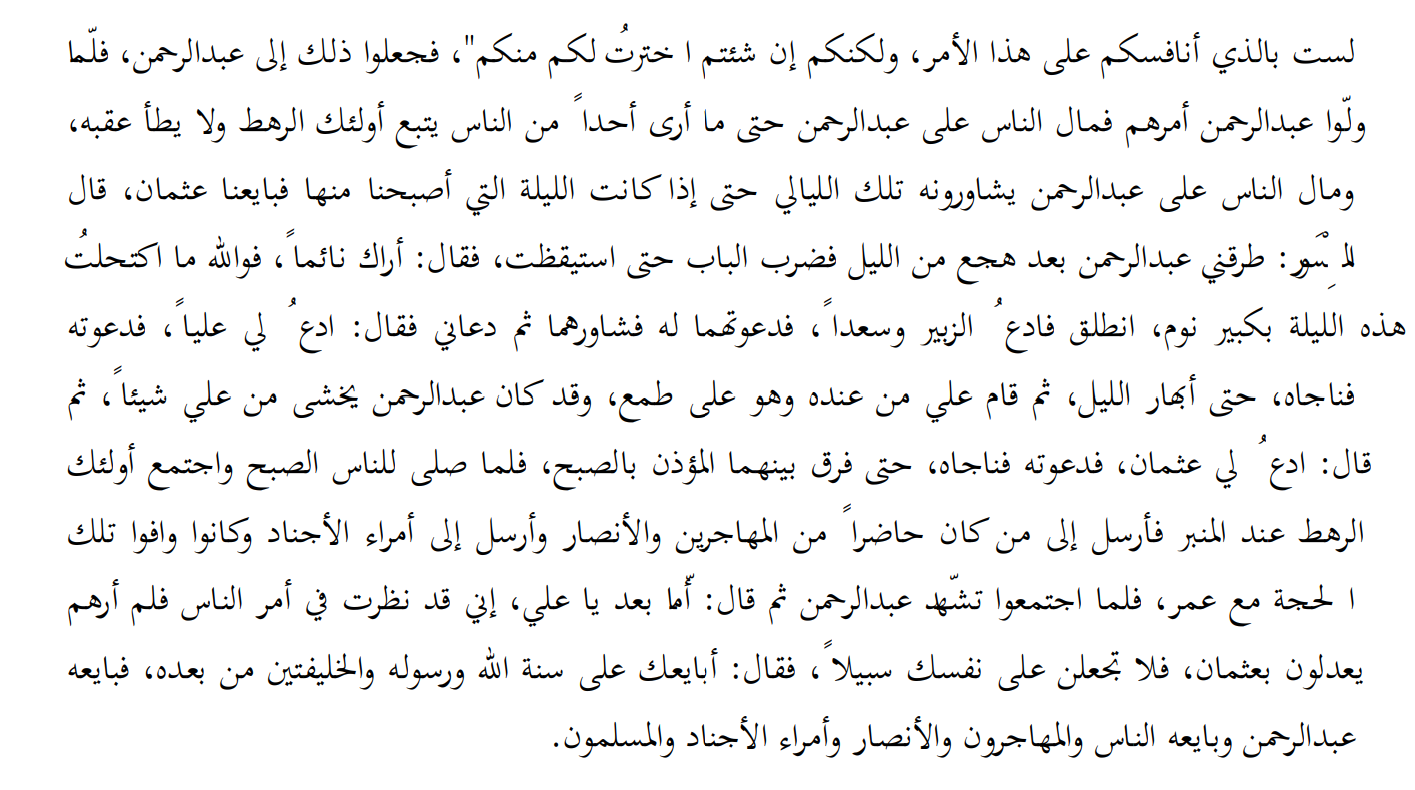
Dan ini bersifat umum bagi setiap Muslim. Oleh itu, orang-orang berpengaruh tidak memiliki hak eksklusif untuk melantik Khalifah dan tidak boleh mengabaikan Muslim yang lain. Begitu juga, individu tertentu tidak memiliki hak eksklusif tersebut. Sebaliknya, hak ini adalah untuk semua Muslim tanpa pengecualian, malah termasuk golongan fajir (orang-orang fasik) dan munafiqeen (orang-orang munafik), dengan syarat mereka adalah Muslim yang telah baligh, kerana nas syariat dalam hal ini datang dalam bentuk umum dan tiada apa yang datang untuk mengehadkannya (menjadikannya khusus kepada golongan tertentu) kecuali penolakan baiah daripada golongan muda yang belum mencapai umur baligh. Maka nas tersebut mesti difahami secara umum.
And this is general for every Muslim. Therefore, the influential people do not possess the exclusive right to appoint the Khalifah and cannot ignore the rest of the Muslims. Nor do specific persons have the exclusive right. Rather, this right is for all the Muslims with no exception, it even includes the fajirs (wicked people) and munafiqeen (hypocrites), provided they are mature Muslims because the Shari’ah text came in a general form in this instance and nothing came to limit it (make it specific to certain people) except the refusal of the pledge from the young who have not yet reached the age of puberty. So the text has to be taken generally.
Namun, tidak menjadi syarat bahawa semua umat Islam mengamalkan hak ini. Walaupun ia adalah kewajipan, kerana bai'ah itu fardu, ia adalah fardu kifayah dan bukan fardu ain. Oleh itu, jika sebahagian daripada umat Islam melaksanakannya, kewajipan itu gugur daripada umat Islam yang lain. Tetapi semua umat Islam mesti diberi kemampuan untuk mengamalkan hak mereka dalam memilih Khalifah, sama ada mereka menggunakan hak tersebut atau tidak. Dengan kata lain, setiap umat Islam mesti dapat turut serta dalam memilih Khalifah. Maka persoalannya ialah memberi kemampuan kepada umat Islam untuk melaksanakan kewajipan menegakkan Khalifah yang Allah (SWT) fardukan ke atas mereka, dengan cara sedemikian rupa sehingga kewajipan ini gugur (daripada bahu mereka). Persoalannya bukanlah penyertaan sebenar semua umat Islam dalam melaksanakan kewajipan ini. Ini kerana kewajipan yang Allah (SWT) tetapkan ialah menegakkan Khalifah bagi umat Islam dengan persetujuan mereka, dan ia bukan satu keperluan bagi semua umat Islam untuk melaksanakannya. Dua perkara terhasil daripada ini: Pertama, persetujuan semua umat Islam dalam penegakan Khalifah tercapai. Kedua, persetujuan semua umat Islam mengenai pelantikan itu tidak tercapai. Namun umat Islam tetap diberi kemampuan (untuk turut serta dalam pelantikan) dalam kedua-dua keadaan tersebut.
However, it is not a condition that all Muslims practise this right. While it is a duty, because the bay’ah is fard, it is fard kifayah (obligation of sufficiency) and not fard ain (individual obligation). Thus, if some of the Muslims fulfill it, the duty drops from the rest of the Muslims. But all Muslims must be enabled to practice their right in electing the Khalifah, regardless of whether they use their right or not. In other words, every Muslim must be able to participate in selecting the Khalifah. So the issue is to enable the Muslims to carry out the duty of establishing the Khalifah which Allah (swt) prescribed upon them, in such a way that this duty falls (from their shoulders). The issue is not the actual participation of all the Muslims in conducting this duty. This is because the duty which Allah (swt) has prescribed is to establish the Khalifah for the Muslims by their consent, and it is not a requirement for all Muslims to perform it. Two matters result from this: One of them is that the consent of all the Muslims in the establishment of the Khalifah is achieved. Secondly, the consent of all the Muslims about the appointment is not achieved. The Muslims are however enabled (to participate in the appointment) in both cases.
Mengenai perkara pertama, tiada syarat yang ditetapkan tentang bilangan tertentu yang diperlukan untuk melantik Khalifah. Sebaliknya, mana-mana bilangan kaum Muslimin boleh memberikan bay'ah mereka kepada Khalifah, dan dalam bay'ah ini persetujuan selebihnya kaum Muslimin diperoleh melalui diam mereka, atau dengan terus taat kepadanya, atau dengan apa-apa yang menunjukkan persetujuan mereka; maka Khalifah yang dilantik itu menjadi Khalifah bagi seluruh kaum Muslimin. Dia sah sebagai Khalifah walaupun hanya tiga orang yang melantiknya, kerana kebersamaan (kolektiviti) tercapai dengan pelaksanaan pelantikan Khalifah. Persetujuan itu tercapai melalui diam mereka dan melalui ketaatan atau perkara yang serupa, dengan syarat ia berlaku dengan pilihan yang bebas dan dalam setiap aspek memberi ruang untuk menyatakan pandangan bagi semua pihak. Akan tetapi, jika persetujuan seluruh kaum Muslimin tidak tercapai, maka pelantikan Khalifah tidak akan sempurna kecuali ia dilaksanakan oleh sekumpulan orang yang mewakili persetujuan majoriti kaum Muslimin, tanpa mengira bilangan kumpulan tersebut.
Daripada sini, sebahagian ahli fiqh menyatakan bahawa pelantikan Khalifah itu sah dengan bay'ah yang diberikan kepadanya oleh ahl al-hall wa al-'aqd (golongan yang berpengaruh), kerana mereka menganggap golongan berpengaruh itu sebagai kumpulan yang mencapai persetujuan kaum Muslimin melalui bay'ah yang mereka berikan kepada mana-mana lelaki yang memenuhi syarat-syarat akad Khilafah. Oleh itu, bukanlah bay'ah golongan berpengaruh yang mengesahkan Khalifah, dan bukan juga bay'ah mereka menjadi syarat bagi keabsahan pelantikan Khalifah. Sebaliknya, bay'ah golongan berpengaruh itu ialah dalil yang menunjukkan bahawa persetujuan kaum Muslimin terhadap bay'ah itu telah tercapai, kerana golongan berpengaruh itu dianggap sebagai wakil kaum Muslimin. Dan setiap dalil yang menunjukkan bahawa persetujuan kaum Muslimin dengan bai'ah kepada seorang Khalifah telah terpenuhi, maka ia menyempurnakan pelantikan Khalifah, dan pelantikan Khalifah melalui bai'ah ini adalah sah.
With regards to the first matter, no condition is set concerning a specific number required to appoint the Khalifah. Rather any number of Muslims can give their bay’ah to the Khalifah and in this bay’ah the consent of the rest of the Muslims is attained by their silence, or by proceeding to obey him, or by anything which implies their consent, then the appointed Khalifah becomes a Khalifah for all the Muslims. He will legally be the Khalifah even if only three people appointed him, because collectivity is achieved by carrying out the appointment of the Khalifah. The consent is achieved by their silence and through obedience or anything similar, on condition that this is accomplished by unfettered choice and in every respect enabling the expression of opinions for all. However, if the consent of all the Muslims was not achieved, then the appointment of the Khalifah would not be accomplished unless it was performed by a group that represents the consent of the majority of the Muslims, regardless of the number in this group. From here some jurists stated that the appointment of the Khalifah is established by the pledge given to him by the people of influence (ahl al-hall wa al-‘aqd), because they consider the influential people as the group which achieves the consent of the Muslims through the pledge they give to any man who fulfils the contractual conditions of the Khilafah. Therefore, it is not the pledge of the influential people which establishes the Khalifah, nor is their pledge a condition for the legality of the appointment of the Khalifah. Rather the pledge of the influential people is evidence indicating that the consent of the Muslims to the pledge has been achieved, because the influential people are considered as representative of the Muslims. And every evidence which indicates that the consent of the Muslims with the pledge to a Khalifah is fulfilled completes the appointment of the Khalifah, and the appointment of the Khalifah by this bay’ah (pledge) would be legal.
Oleh itu, hukum Syarak ialah menubuhkan Khalifah melalui mana-mana perhimpunan yang pelantikan Khalifah itu memperoleh persetujuan kaum Muslimin melalui apa-apa petunjuk yang membuktikan persetujuan tersebut. Hukumnya sama sama ada petunjuk itu ialah baiah majoriti orang-orang berpengaruh, majoriti wakil kaum Muslimin, penerimaan senyap kaum Muslimin terhadap kumpulan yang memberikan baiah, kesegeraan mereka menunjukkan ketaatan hasil daripada baiah tersebut, atau mana-mana cara yang serupa, selagi mereka diberikan kemudahan yang sepenuhnya untuk menyatakan pendapat mereka dengan bebas. Bukanlah hukum Syarak bahawa perhimpunan ini mesti terdiri daripada orang-orang berpengaruh sahaja, atau bilangan mereka empat orang, empat ratus orang atau lebih, atau mereka mesti penduduk ibu kota atau wilayah-wilayah. Sebaliknya, hukum Syarak ialah baiah mereka itu memenuhi persetujuan majoriti kaum Muslimin melalui apa-apa petunjuk yang bersama-sama membolehkan mereka menyatakan pendapat secara bebas dan sepenuhnya.
Accordingly the Shari’ah rule is to establish the Khalifah by any gathering where appointment of the Khalifah achieves the consent of the Muslims by any indication that proves this consent. It is the same whether this indication is the pledge of the majority of the influential people, the majority of the representatives of the Muslims, the silent acceptance of the Muslims regarding the group that gave the pledge, their hurry to show obedience as a result of the pledge or by any similar means, as long as they were provided with the full facility to freely express their opinions. It is not a Shari’ah rule that this gathering must be only from the influential people or that they are four or four hundred or more, or that they must be the residents of the capital or the regions. Rather the Shari’ah rule is that their pledge fulfils the consent of the majority of Muslims by any indication together enabling them to freely express their opinion fully.
Yang dimaksudkan dengan semua orang Islam ialah mereka yang tinggal di wilayah yang dikuasai oleh Negara Islam, iaitu mereka yang menjadi rakyat bekas Khalifah jika Khilafah wujud, atau mereka yang oleh merekalah penubuhan Negara Islam dilaksanakan dan Khilafah dikontrakkan, sekiranya Negara Islam belum ditubuhkan. Merekalah yang bangkit untuk mewujudkannya (Khilafah) dan menyambung semula cara hidup Islam melaluinya. Adapun selebihnya daripada orang Islam, baiat dan persetujuan mereka bukanlah syarat yang mesti, kerana mereka adalah orang beriman di luar kekuasaan Islam, atau mereka tinggal di Dar al-Kufr (negeri kufur) dan tidak dapat menyertai Dar al-Islam. Maka mereka tidak mempunyai hak dalam baiat kontrak, tetapi mereka wajib memberi baiat ketaatan kerana dari sudut undang-undang, mereka yang memberontak terhadap kekuasaan Islam diperlakukan sebagai pemberontak. Adapun mereka yang tinggal di Dar al-Kufr, penubuhan kekuasaan Islam tidak tercapai oleh mereka kecuali jika mereka menegakkannya dalam realiti atau memasuki wilayahnya. Oleh itu, orang Islam yang mempunyai hak dalam baiat kontrak, dan persetujuan mereka dianggap sebagai syarat bagi memastikan perlantikan Khalifah yang sah, ialah mereka yang oleh merekalah kekuasaan Islam ditegakkan dalam realiti. Tidak benar untuk mengatakan bahawa ini adalah kajian rasional, atau mengatakan ia tidak mempunyai dalil Syarak. Ini kerana ia adalah kajian tentang subjek (manat) yang padanya hukum Syarak diterapkan, bukan tentang hukum itu sendiri, maka ia tidak memerlukan hukum Syarak tetapi mesti menerangkan realitinya. Contohnya, memakan bangkai diharamkan oleh hukum Syarak. Penentuan apakah bangkai itu ialah subjek hukum, iaitu perkara yang berkaitan dengan hukum tersebut. Maka perlantikan Khalifah oleh orang Islam ialah hukum Syarak, dan bahawa perlantikan ini hendaklah dengan persetujuan dan pilihan juga merupakan hukum Syarak. Ketentuan-ketentuan inilah yang memerlukan dalil Syarak. Adapun siapakah orang Islam yang oleh mereka perlantikan itu disempurnakan? Dan apakah perkara yang dengannya persetujuan dan pilihan itu dipenuhi? Perkara-perkara ini dinamakan sebagai subjek hukum, iaitu subjek yang untuknya hukum syarak itu datang untuk menyelesaikannya. Pelaksanaan hukum Shari'ah ke atas subjek tersebut ialah pencapaian hukum itu. Oleh itu, perlu dikaji subjek (manat) yang hukum Shari'ah datang untuk menanganinya dengan menjelaskan hakikatnya.
What is meant by all Muslims is those Muslims who live in lands controlled by the Islamic State i.e. those who are subjects of the former Khalifah if the Khilafah exists, or those by whom the Islamic State’s establishment is accomplished and the Khilafah is contracted, in case the Islamic State was not established. They are the ones who stood to create it (the Khilafah) resume the Islamic way of life through it. As for the rest of the Muslims, their pledge and consent are not an essential condition, because they are believers outside the Islamic authority or they live in Dar al-Kufr (land of kufr) and they cannot join Dar al-Islam. So they have no right in the contracting pledge, but they must give the pledge of obedience because legally those who rebel from the Islamic authority are treated as rebels. As for those who live in Dar al-Kufr, the establishment of the Islamic authority is not achieved by them unless they establish it in reality or they enter into its domain. Therefore, the Muslims who have the right in the contracting pledge and their consent is considered a condition to ensure the legal appointment of the Khalifah are those Muslims by whom the authority of Islam is established in reality. It is not true to say that this is a rational study, or to say it has no Shari’ah evidence. This is because it is a study about the subject (manat) upon which the Shari’ah rule applies and not on the law itself, therefore it does not need a Shari’ah rule but rather must explain its reality. For example, the eating of dead meat is prohibited by the Shari’ah rule. Verification of what is the dead meat is the subject of the law i.e. the subject with which the law is related. So appointing of the Khalifah by Muslims is the Shari’ah rule, and that this appointment should be by consent and choice is also the Shari’ah rule. It is these provisions which need the Shari’ah evidence. As for who are the Muslims by whom the appointment is completed? And what is the matter by which the consent and choice are fulfilled? These (matters) are referred to as the subject of the law i.e. the subject which the law came to solve. The application of the Shari’ah rule upon the subject is the achievement of the law. Therefore, it is needed to study the subject (manat) which the Shari’ah rule came to treat by explaining its reality.
Adalah tidak tepat untuk mengatakan bahawa subjek (manat) hukum ialah ‘illah (sebab) hukum, lalu ia semestinya memerlukan dalil Syariah, kerana subjek hukum berbeza daripada sebab hukum. Terdapat perbezaan yang besar antara ‘illah dan manat. ‘Illah ialah dorongan bagi hukum, iaitu perkara yang menunjukkan tujuan (maksud) Pembuat Syariah (Ash-Shari’ iaitu Allah) bagi hukum ini, dan ia mesti mempunyai dalil Syariah supaya dapat difahami bahawa ia adalah tujuan Pembuat Syariah (Allah). Manakala manat hukum ialah subjek yang untuknya hukum itu datang, iaitu persoalan yang hukum itu terpakai ke atasnya, bukan dalilnya atau ‘illahnya. Maksud bahawa ia ialah subjek yang dengannya hukum itu ditetapkan ialah bahawa ia adalah subjek yang dengannya hukum itu tergantung, iaitu hukum itu diturunkan untuk menyelesaikannya. Ia tidak bermakna hukum itu datang kerana sebabnya sehingga ia dinamakan ‘illah hukum. Oleh itu, manat hukum ialah sesuatu yang selain daripada aspek hukum Syariah yang disampaikan (ghayr an-naqliyya). Cara pengesahannya berbeza daripada pengesahan ‘illah. Pengesahan ‘illah bergantung kepada pemahaman nas yang datang bersama sebab, dan ini ialah kefahaman terhadap apa yang disampaikan, bukannya manat. Manat ialah selain daripada apa yang disampaikan; maknanya ialah realiti yang atasnya hukum Syariah hendak dilaksanakan.
It is incorrect to say that the subject (manat) of the law is the ‘illah (reason) of the law so it would necessarily need Shari’ah evidence because the subject of the law is different than the reason of the law. There is a great difference between ‘illah and manat. The ‘illah is the incentive for the law i.e. the thing which indicates the intention (aim) of the Lawgiver (Ash-Shari’ i.e. Allah) for this law, and this must have a Shari’ah evidence so as to understand that it is the aim of the Lawgiver (Allah). Whereas the subject (manat) of the law is the subject for which the law came i.e. the question upon which the law applies, not its evidence or its ‘illah. What is meant by its being the subject with which the law is arrived at is that it is the subject with which the law suspends or hangs i.e. the law was brought to solve it. It does not mean that the law came because of it so as to be called the ‘illah of the law. So the manat of the law is that which is other than the conveyed (ghayr an-naqliyya) aspect of the Shari’ah rule. Its verification is different from the verification of the ‘illah. The verification of the ‘illah turns upon the comprehension of the text which came with a reason, and this is an understanding of what is conveyed and it is not the manat. The manat is other than than what is conveyed; its meaning is the reality upon which the Shari’ah rule is to be applied.
Jika anda mengatakan bahawa arak itu haram, maka hukum syarak ialah pengharaman arak. Menentukan sama ada sesuatu minuman itu arak atau bukan, supaya dihukum haram atau tidak, adalah satu tahqiq al-manat. Oleh itu, perlu dikaji sama ada minuman tersebut arak atau bukan untuk menyatakan bahawa ia haram. Penyelidikan terhadap hakikat arak ialah tahqiq al-manat. Dan jika anda mengatakan bahawa air yang boleh digunakan untuk wuduk ialah air mutlak, maka hukum syarak ialah air mutlak itulah yang dibenarkan untuk wuduk. Oleh itu, memastikan sama ada air itu mutlak atau terikat, supaya dihukum boleh digunakan untuk wuduk, adalah tahqiq al-manat. Maka, perlu dikaji air itu untuk menentukan sama ada ia bebas atau terikat. Kajian terhadap hakikat air ini ialah tahqiq al-manat. Dan jika anda mengatakan bahawa orang yang berhadas (yang keluar sesuatu dari dubur atau qubul) wajib berwuduk untuk solat, maka memastikan sama ada seseorang itu muhdath atau tidak muhdath ialah tahqiq al-manat, dan seterusnya.
Asy-Syatibi berkata dalam "Al-Muwafaqat": "Perkara-perkara ini dan yang seumpamanya, yang memerlukan takrif manat, mesti mengambil dalil mengenainya selaras dengan hakikat yang berkaitan dengan setiap peristiwa." Beliau juga berkata: "Ijtihad boleh berhubung dengan tahqiq al-manat, dan ini tidak memerlukan pengetahuan tentang maksud-maksud Pembuat Syariat (Allah), dan tidak pula memerlukan pengetahuan bahasa Arab, kerana tujuan ijtihad ini ialah mengetahui perkara itu sebagaimana adanya. Maka ia memerlukan pengetahuan yang tanpanya perkara itu tidak dapat dikenali menurut tujuan mengetahuinya. Oleh itu, mujtahid mestilah berilmu dan mujtahid dari aspek ini yang dipertimbangkannya, supaya dapat menerapkan hukum syarak selaras dengan apa yang dikehendaki." Penyelidikan terhadap 'illah kembali kepada memahami nas yang datang bersama sebab. Dan ini adalah pemahaman tentang perkara yang disampaikan (al-mabluugh), dan ia bukan al-manaat; sebaliknya, al-manaat ialah selain daripada perkara yang disampaikan. Ia dimaksudkan sebagai realiti yang di atasnya hukum Syariah itu terpakai. Jika anda mengatakan bahawa arak itu haram, maka menentukan sama ada sesuatu cecair itu arak atau bukan adalah penentuan al-manaat. Dan jika anda mengatakan bahawa air mutlaq ialah air yang boleh digunakan untuk berwuduk, maka menentukan sama ada air itu mutlaq atau tidak adalah penentuan al-manaat. Dan jika anda mengatakan bahawa orang yang berhadas wajib berwuduk, maka menentukan sama ada seseorang itu berhadas atau tidak adalah penentuan al-manaat. Oleh itu, penentuan al-manaat ialah penyelidikan terhadap perkara yang menjadi subjek hukum. Sehubungan itu, tidak menjadi syarat bahawa orang yang menentukan al-manaat itu seorang mujtahid atau seorang Muslim, tetapi memadai bahawa dia mempunyai pengetahuan dalam perkara tersebut. Maka, kajian tentang siapakah kaum Muslimin yang bai'ah mereka menjadi bukti penerimaan atau persetujuan ialah kajian mengenai penentuan al-manaat.
If you say alcohol is haram, the Shari’ah rule is the prohibition of alcohol. Verifying that a certain drink is alcohol or not, so as to judge it as haram or not is a verification of the manat. So it is necessary to study whether the drink is alcohol or not in order to state that it is haram. The investigation of the reality of the alcohol is a verification of the manat. And if you said that the water allowed to use for wudhu is the unrestricted (mutlaq) water then the Shari’ah rule is that the mutlaq water is the one which is allowed for wudhu. So the verification that the water is unrestricted or restricted in order to judge upon it as allowed for wudhu, is a verification of the manat. Therefore, it is necessary to study the water to determine if it is free or restricted. This study of the reality of the water is the verification of the manat. And if you said the person who made hadath (discharged something from back or front) has to make wudhu for the prayer, then the verification that the person is muhdath or not muhdath is a verification of the manat, and so on. Shatebi said in “Al-Muwafaqat”: “These subjects and their like which require defining the manat must take the evidence about it in conformity to the reality in relation to every incident.” And he said: “Ijtihad could be connected with the verification of the manat, and this does not require knowledge of the aims of the Lawgiver (Allah) nor does it require knowledge of the Arabic language, because the aim of this ijtihad is knowing the subject as it is. Thus it requires knowledge without which this subject could not be recognised according to the aim of knowing it. Therefore the mujtahid has to be knowledgeable and mujtahid from this aspect which he considers in order to apply the Shari’ah rule to conform to what is required.” The investigation of the ‘illah returns to understanding the text which came with a reason. And this is an understanding of the conveyed matters and it is not the manat, rather the manat is other than the conveyed matters. It is meant to be the reality upon which the Shari’ah rule applies. If you say that alcohol is haram, the verification of whether a liquid is alcohol or not is the verification of the manat. And if you say the unrestricted (mutlaq) water is that with which wudhu can be performed, then the verification that the water is unrestricted or not is the verification of the manat. And if you said that the muhdath has to make wudhu, then the verification that the person is muhdath or not is the verification of the manat. Thus the verification of the manat is the investigation of the thing that is the subject of the law. Accordingly, it is not a condition that the one who verifies the manat be a mujtahid or a Muslim, but it is enough that he or she be knowledgeable in the matter. So the study of who are the Muslims whose bay’ah is evidence of the acceptance or consent is a study about the verification of the manat.
Mengenai perkara pertama. Adapun isu kedua, iaitu apa yang berlaku pada zaman sekarang dalam menjalankan pilihan raya secara undi rahsia, menggunakan peti undi, mengedarkan undi dan seumpamanya; kesemua ini adalah cara untuk melaksanakan pemilihan dengan persetujuan. Oleh itu, perkara-perkara ini tidak termasuk di bawah hukum Syarak mahupun persoalan manat hukum Syarak, iaitu perkara yang didatangkan hukum Syarak untuk menyelesaikannya. Hal ini kerana perkara tersebut tidak berkaitan dengan perbuatan hamba mahupun subjek yang di atasnya hukum Syarak diterapkan. Sebaliknya, ia adalah sarana bagi perbuatan manusia yang kepadanya hukum Syarak didatangkan, iaitu perbuatan yang berkaitan dengan firman Pembuat Syariat (Allah (swt)); dalam hal ini, penubuhan Khalifah melalui persetujuan, dengan syarat disediakan kemudahan yang lengkap untuk membolehkan penyataan pendapat. Oleh itu, cara-cara dan sarana ini bukanlah sebahagian daripada apa yang dituntut oleh hukum-hukum Syarak, dan ia dianggap sebagai perkara yang telah dibenarkan oleh nas umum. Tiada dalil khusus yang melarangnya, maka ia adalah mubah. Kaum Muslimin berhak memilih cara-cara ini atau cara-cara lain. Mana-mana cara yang membawa kepada membolehkan kaum Muslimin melaksanakan fardu melantik Khalifah melalui persetujuan dan pilihan, maka kaum Muslimin dibenarkan menggunakannya selagi tidak datang dalil Syarak yang melarangnya.
This is in regard to the first question. As for the second issue, regarding what occurs nowadays in conducting elections by secret ballot, using polling boxes, distributing votes and the like; all these are styles to perform the selection by consent. Therefore, they do not enter under the Shari’ah rule nor the question of manat of the Shari’ah rule which is the subject that the Shari’ah rule came to solve. This is because this matter is not concerned with the actions of the slaves nor the subject upon which the Shari’ah rule applies. Rather they are the means of the human actions to which the Shari’ah rule came i.e. the action which the speech of the Law-giver (Allah (swt)) is related to; which in this instance, is the establishment of the Khalifah by consent, provided there is complete facilitation to enable the expression of opinion. Therefore, these styles and means are not part of what the Shari’ah rules are sought for, and they are treated as matters which the general text has permitted. There is no special evidence to forbid them, so they are mubah. The Muslims have the right to select these or other styles. Any style which leads to enabling the Muslims to carry out the fard of appointing the Khalifah by consent and choice, then the Muslims are allowed to use it unless there came Shari’ah evidence which prohibits it.
Adalah tidak tepat untuk mengatakan bahawa gaya ini ialah suatu perbuatan manusia yang tidak boleh dilakukan melainkan menurut hukum Syariah, dengan dalil yang menunjukkan hukumnya. Ia tidak tepat kerana perbuatan manusia yang mesti dilakukan menurut hukum Syariah dan mesti mempunyai dalil yang menunjukkan hukumnya ialah perbuatan yang dianggap sebagai asal (asl) atau cabang (far') kepada suatu asal yang dalilnya bukan umum, tetapi khusus (khaas). Contohnya ialah solat, yang dalilnya hanya berkaitan dengan mendirikannya, dan ia tidak merangkumi setiap perbuatan yang terdapat di dalamnya. Oleh itu, mesti ada dalil bagi setiap perbuatan dalamnya. Namun, perbuatan yang menjadi cabang kepada suatu perbuatan yang dalil umum terpakai ke atas asalnya, maka dalil umum itu terpakai ke atas semua cabangnya. Pengharaman sesuatu perbuatan yang merupakan cabang memerlukan dalil untuk mengharamkannya, dan mengeluarkannya daripada hukum asalnya, lalu memberinya hukum yang baharu. Demikian juga bagi semua gaya yang merupakan perbuatan manusia. Dalam persoalan pilihan raya, perbuatan asalnya ialah pelantikan Khalifah melalui persetujuan dan pilihan. Adapun perbuatan-perbuatan yang bercabang daripadanya seperti mengundi, menggunakan peti undi, memisahkan undi dan seumpamanya, semuanya termasuk di bawah hukum asal dan tidak memerlukan dalil lain. Untuk mengecualikan mana-mana daripadanya daripada hukum asal, iaitu untuk mengharamkannya, ialah perkara yang memerlukan dalil. Inilah keadaan bagi semua gaya yang merupakan perbuatan manusia. Adapun sarana, iaitu alat-alat seperti kotak tempat kertas undi dimasukkan, ia mengambil hukum benda dan bukan hukum perbuatan yang padanya terpakai kaedah Syariah.
It is incorrect to say that this style is a human act and should not be conducted except according to the Shari’ah rule, with an evidence to indicate its rule. It is incorrect to say so because the human action which must be conducted according to the Shari’ah rule and which must have an evidence that indicates its law, is the action which is considered as an origin (asl) or a branch (far’) of an origin whose evidence for the origin is not general but rather specific (khaas). An example for this is the prayer, whose evidence is only related to establishing it and it does not include every action included in the prayer. Therefore there must be an evidence for every action in it. However the action which is a branch for an action wherein general evidence applies to its origin, that general evidence applies upon all its branches. The prohibition of an action which is a branch requires an evidence to prohibit it, and remove it from the rule of its origin and thus give it a new rule. This is the same for all the styles. In the question of elections, the original action is the appointment of the Khalifah by consent and choice. As for the actions which branch out from that such as polling, using polling boxes, separating of votes and the like, they all enter under the rule of the origin and do not require another evidence. To exclude any of them from the rule of the origin, i.e. to prohibit it, is a matter which requires an evidence. This is the case for all the styles which are human actions. Concerning the means which are tools like the box in which the voting papers are put, these take the rule of things and not the rule for actions upon which applies the Shari’ah principle: