17.3 Присяга (бай‘а)
17.3 The Pledge (bay’ah)
Бай‘а является обязанностью для всех мусульман, и это право каждого мусульманина, мужчины или женщины. Доказательством того, что она является обязанностью, служат многочисленные хадисы Пророка ﷺ, в которых он сказал:
Bay’ah is an obligation upon all Muslims, and it is a right for every Muslim, man or woman. The evidence for it being an obligation is in many ahadith of the Prophet (saw), in which he said:
«Кто умрёт, не имея на своей шее бай'а, тот умирает смертью времён джахилиййы.»
“Whosoever dies without having a bay’ah upon his neck dies a death of jahiliyyah.”
Что касается того, что это право мусульман, то сам бай‘а на это указывает, ведь бай‘а приносится мусульманами халифу, а не халифом мусульманам. Бай‘а мусульман Пророку ﷺ подтверждена в хадисах. Аль-Бухари передал, что ‘Убада ибн ас-Самит (да будет доволен им Аллах) сказал:
As for being a right for Muslims, the bay’ah itself indicates that, because the bay’ah is offered by the Muslims to the Khalifah, and not by the Khalifah to the Muslims. The bay’ah of the Muslims to the Prophet (saw) was confirmed in the ahadith. Al-Bukhari reported that ‘Ubadah bin as-Samit (ra) said:
«Мы дали бай’ат Пророку ﷺ в том, что будем слушать и повиноваться во всём, что нам нравится и что нам не по душе, что не будем спорить с распоряжениями облечённых властью, что будем говорить правду где бы мы ни находились, и что не будем бояться порицания кого-либо, поступая или говоря ради Аллаhа.»
“We made a bay’ah to the Prophet (saw) to hear and to obey in whatever pleases and displeases us, and that we would not dispute the order of those in charge, that we would speak the truth wherever we are, and that we would not fear the blame of anyone when acting or speaking for the sake of Allah.”
Аль-Бухари передал от Аййуба, от Хафсы, от Умм ‘Атыййи, которая сказала:
Al-Bukhari reported from Ayyub from Hafsa from Umm ‘Atiyyah who said:
«Мы дали бай’ах Пророку ﷺ, и он прочитал мне аят: «что они не будут придавать Аллаху сотоварищей в поклонении» (ТМК 60:12). Он также запретил нам причитать и оплакивать умерших. Одна женщина из нас протянула руку и сказала: «Такая-то женщина плакала по умершему из моей семьи, и я хочу воздать ей за этот плач». Пророк ﷺ ничего не ответил, и она ушла и вернулась».
“We gave a bay’ah to the Prophet (saw) and he recited to me the verse That they will not associate anything in worship with Allah (TMQ 60.12). And he also prevented us from wailing and lamenting over the dead. A woman from us held her hand out and said, "Such-and-such a woman cried over a dead person belonging to my family and I want to compensate her for that crying" The Prophet did not say anything in reply and she left and returned.”
И в «Сахих аль-Бухари» от Абу Хурайры (ра), который сказал: Пророк ﷺ сказал:
And in Al-Bukhari from Abu Hurairah (ra) who said: The Prophet (saw) said:
«Есть три человека, с которыми Аллах не будет говорить в День Воскресения, и не очистит их, и для них — мучительное наказание: человек, у которого есть избыток воды на дороге и который не даёт её путнику; человек, который приносит клятву верности имаму ради одних лишь мирских дел: если имам даст ему то, что он желает, он выполняет клятву, а иначе — нет; и человек, продающий товар другому после аср (послеполуденной молитвы), и он клянётся Аллахом, что ему предлагали за него то-то и то-то, хотя это не так, и тот поверил ему и купил его».
“(There are) three persons to whom Allah will not talk on the Resurrection Day, nor purify them, and for them is a severe punishment: A person who has an excess of water on the road and prevents the wayfarer from it; a person who gives bay’ah to an Imam for his worldly affairs only, so if the Imam gave him that which he wants he fulfilled (the bay’ah) to him, otherwise he would not; and a person trading a commodity to another after asr (late afternoon) and he swore by Allah that he was offered so and so for it, although he was not, and the person believed him and bought it.”
Аль-Бухари передал со слов ‘Абдуллаха ибн ‘Умара (ра), который сказал:
Al-Bukhari narrated from ‘Abdullah bin ‘Umar (ra) who said:
Когда мы приносили бай‘ат Пророку ﷺ на то, чтобы слушать и повиноваться, он говорил нам: «Насколько вы в силах».
“When we gave a bay’ah to the Prophet (saw) to hear and obey, he would say to us: As much as you are capable of”
Когда мы приносили бay'ah Пророку ﷺ, обещая слушать и повиноваться, он говорил нам: «Насколько вы в силах»
“When we gave a bay’ah to the Prophet (saw) to hear and obey, he would say to us: As much as you are capable of”
«Я принёс бай‘ах Пророку ﷺ на то, чтобы слушать и повиноваться, и он дал мне наставление: «Насколько можешь», и давать добрый совет каждому мусульманину.»
“I gave bay’ah to the Prophet (saw) to hear and obey and he instructed me: As much as you are able, and to give good advice to every Muslim.”
Передал аль-Бухари со слов Джунады ибн Абу Умайи, который сказал:
Al-Bukhari narrated from Junada bin Abu Umayyah who said:
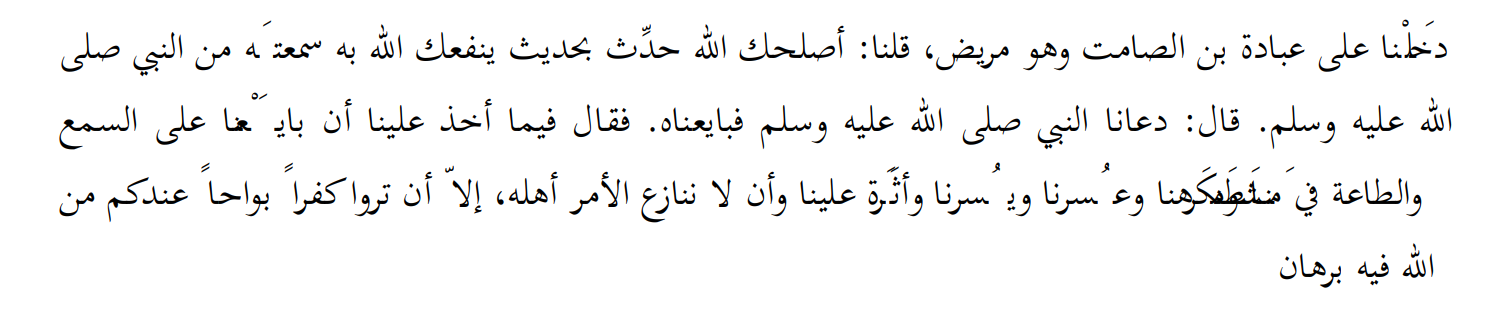
Мы вошли в дом ‘Убады ибн ас-Самита, когда он был болен, и сказали: «Да сделает Аллах тебя здоровым! Расскажи нам хадис, который ты слышал от Пророка ﷺ, чтобы Аллах (SWT) принёс тебе пользу через него». Он сказал: «Пророк ﷺ призвал нас, и мы дали ему нашу бay‘ah (клятву верности). Среди условий, на которых он взял с нас клятву, было то, что мы будем слушать и повиноваться (приказам) как тогда, когда мы деятельны, так и тогда, когда мы утомлены, и в дни лёгкости и трудностей, и когда мы видим предпочтение (других перед нами), и что не будем оспаривать власть тех, кому она вверена, (говоря): “Разве только если вы увидите открытое неверие (куфр бавах), относительно которого у вас есть ясное доказательство от Аллаха”».
“We entered the house of ‘Ubadah bin as-Samit while he was ill and we said: May Allah make you healthy, inform us of a hadith you heard from the Prophet (saw) by which Allah (swt) may benefit you. He said: The Prophet (saw) invited us and we gave him our bay’ah (pledge of Allegiance). And among the conditions on which he took the pledge from us, was that we were to listen and obey (the orders) both at the time when we were active and when we were tired , and in the times of ease and hardship and when we see preference (for others over us), and not to dispute the authority of those who are entrusted with it saying: Unless you see open disbelief (kufr bawah) upon which you have a clear proof from Allah.”
Байʼа халифу принадлежит мусульманам, и это их право: именно они приносят байʼу, и именно их байʼа делает халифат заключённым в отношении халифа. Байʼа может быть дана рукопожатием или письменно. Абдуллах ибн Динар передал, сказав:
The bay’ah for the Khalifah is in the hands of the Muslims, and it is their right; it is they who give the bay’ah, and it is their bay’ah which makes the Khilafah contracted for a Khalifah. The bay’ah can be by shaking hand or by writing. ‘Abdullah bin Dinar narrated saying:
«Я был свидетелем того, как ибн ‘Умар собрал людей вокруг ‘Абдулмалика ибн Марвана. Он написал: «Я соглашаюсь слушать и повиноваться рабу Аллаха, ‘Абдулмалику, Повелителю верующих, в соответствии с Сунной Аллаха и Сунной Его Пророка ﷺ, насколько я способен»».
“I witnessed bin ‘Umar where the people gathered around ‘Abdulmalik bin Marwan. He wrote: I agree to listen and obey to the slave of Allah, ‘Abdulmalik the Amir al-Mu’mineen, according to the Sunnah of Allah and the Sunnah of His Prophet as much as I am able.”
Более того, бай‘а действительна любым способом (василя). Однако бай‘а должна быть дана зрелым человеком, поэтому давать её ребёнку неправильно. Абу Ако́иль Захра ибн Ма‘бад передал от своего деда ‘Абдуллаха ибн Хишама, который был свидетелем Пророка ﷺ, что его мать Зайнаб, дочь Хамида, привела его к Пророку ﷺ и сказала: «О Пророк Аллаха, прими у него бай‘у». Пророк ﷺ сказал:
Moreover, the bay’ah is correct by any means (waseelah). However, the bay’ah has to be given by the mature person, so it is improper to be given by the young. Abu Aqeel Zahra bin Ma‘bed reported from his grandfather ‘Abdullah bin Hisham--who witnessed the Prophet (saw)--that his mother Zaynab, the daughter of Hameed, took him to the Prophet (saw) and said: O Prophet of Allah, take a pledge from him. The Prophet (saw) said:
«Он ребёнок», — погладил его по голове и сотворил для него дуа.
“He is a child, wiped his head and made a du‘a for him.”
Что касается слов бay'ah, то они не ограничены определёнными формулировками. Однако они обязательно должны включать действие по Книге Аллаха (subhanahu wa ta'ala) и Сунне Его Пророка ﷺ со стороны халифа, а также повиновение в трудности и в лёгкости, и повиновение, и во всём том, что нравится и не нравится со стороны того, кто приносит бay'ah (халифу). Когда тот, кто присягает, дал свою бay'ah халифу, или Халифат был заключён с халифом посредством бay'ah других мусульман, то бay'ah стала доверием на шее того, кто даёт бay'ah, и ему не позволено от неё отказываться. Она является правом для договора Халифата, пока он не дал её, и как только он её дал, он должен ей следовать. Ему не позволено от неё отступать. Аль-Бухари передал со слов Джабира ибн 'Абдуллаха (ra), что один бедуин принёс Пророку ﷺ свою присягу в верности Исламу, а затем его поразила болезнь, и он сказал Пророку ﷺ: «Позволь мне отозвать мою бay'ah», но Пророк ﷺ отказал, и человек ушёл. Тогда Пророк ﷺ сказал:
As for the words of the bay’ah they are not restricted to specific terms. However they must include acting according to the Book of Allah (swt) and the Sunnah of His Prophet (saw) by the Khalifah, and obedience in hardship and ease and obedience, and whatever pleases and displeases on the part of the person who gives the bay’ah (to the Khalifah). Whenever the one who pledges has given his bay’ah to the Khalifah or the Khilafah is contracted to the Khalifah by the bay’ah of other Muslims, then the bay’ah has become a trust on the neck of the one who gives the bay’ah and he is not allowed to retract it. It is a right for the contract of the Khilafah until he has given it, and once he has given it he must abide by it. He is not allowed to retract from it. Al-Bukhari narrated from Jabir bin ‘Abdullah (ra) that a Bedouin gave the Prophet (saw) his pledge on Islam, and an illness struck him so he said to the Prophet (saw): “Let me withdraw my bay’ah but the Prophet (saw) refused, and the man left. The Prophet (saw) then said:
«Медина подобна горну: она выталкивает нечистоты, отбирает хорошее и делает его совершенным.»
“Medina is like a furnace, it expels out the impurities and selects the good ones and makes them perfect.”
И передаётся от Нафи‘ы, который сказал: Ибн ‘Умар (ра) сказал мне, что он слышал, как Пророк ﷺ говорил:
And it is narrated from Nafi‘a who said: Ibn ‘Umar (ra) said to me that he heard the Prophet (saw) saying:
«Тот, кто выйдет из повиновения (эмиру), не будет иметь довода (в свою защиту), когда предстанет перед Аллахом в День Воскресения».
“Whoever withdraws his hand from obedience (to the Amir) will find no argument (in his defense) when he stands before Allah on the Day of Resurrection.”
Нарушить бай'ат халифу — значит вынуть свою руку из повиновения Аллаху (subhanahu wa ta'ala). Так обстоит дело, если его бай'ат халифу является бай'атом договора или бай'атом повиновения халифу, которого мусульмане приняли и которому дали свой бай'ат. Однако если он в начале дал бай'ат халифу, но он не был завершён, поскольку мусульмане в целом не приняли его в качестве халифа, то у него есть право отказаться от этого бай'ата. Запрет, упомянутый в хадисе, касается отказа от бай'ата халифу, а не человеку, для которого халифат не был осуществлён.
To break the bay’ah of the Khalifah is withdrawing of one’s hand from the obedience of Allah (swt). This is the case if his bay’ah to the Khalifah is a bay’ah of contract or it is a bay’ah of obedience to a Khalifah whom the Muslims accepted and gave their bay’ah to. However, if he gave his bay’ah in the beginning to a Khalifah and it was not completed because the Muslims as a whole did not accept him as Khalifah, then he has the right to withdraw from that bay’ah. The prohibition mentioned in the hadith is focused on the withdrawal of a bay’ah to a Khalifah, not to a man for whom the Khilafah was not accomplished