9. Наука и культура
9. Science And Culture
В арабском языке говорят: «‘алима человек» (‘алима ‘ильм), то есть он достиг подлинной сути знания (‘ильм). «Он узнал о вещи» означает, что он осознал её, то есть был осведомлён о деле или ознакомился с ним. Также в языке говорят: «Он приобрёл понимание» (thaqifa), что означает, что он стал искусным, следовательно, он образован и культурен (thaqif). «Он усвоил (thaqifa) язык» означает, что он овладел им и быстро понял его. Эти лингвистические значения лежат в основе употребления слов. Однако если эти слова употреблялись для обозначения других значений, связанных с лингвистическим, то это допустимо, как, например, в случае принятия слова fa’il (подлежащее) в грамматике. Лингвистическое значение слов было преобладающим, и поэтому древние применяли слово ‘ильм ко всем видам знания, не различая науки и дисциплины. Затем люди стали считать интеллектуальные и естественные дисциплины общими для всех людей, а другие традиционные (текстуальные) дисциплины — специфичными для нации, из которой они были переняты. Впоследствии и наука (‘ильм), и культура (thaqafa) стали определяться according to различных специфических дисциплин, приобретая терминологические значения, отличные от их лингвистических значений. Согласно этой терминологии они имеют следующее значение: наука (‘ильм) — это знание, которое приобретается посредством наблюдения, эксперимента и обучения, как физика, химия и остальные эмпирические науки; культура (thaqafa) — это знание, которое приобретается путём передачи, обучения и умозаключения, как изучение истории, языков, фикха (юриспруденции), философии и остальных неэмпирических дисциплин. И существуют также другие неэмпирические дисциплины, которые относятся к знанию (ʿилм), хотя и входят в состав культуры (тақафа), такие как арифметика, инженерное дело и промышленность. Несмотря на то что они принадлежат культуре (тақафа), их считают частью науки, поскольку они универсальны для всех людей и не свойственны какой-либо одной нации. Точно так же всё, что относится к культуре и связано с ремёслами, напоминающими промышленность, например торговля и судоходство, считается частью науки и является универсальным. Что же касается искусств, таких как живопись, скульптура и музыка, то они относятся к культуре. Они придерживаются определённой точки зрения, которая представляет собой конкретную культуру. Разница между культурой (тақафа) и наукой (ʿилм).
In Arabic language it is said: the man has obtained (‘alima) knowledge (‘ilm). This means that he attained the true reality of knowledge (‘ilm). He gained knowledge of a thing means he became cognisant of it, which means that he became informed of a matter or acquainted with it. Also in the language it is said: He has gained comprehension (thaqifa), which means that he has become proficient, thus he is educated and cultured (thaqif). He has understood (thaqifa) a language (means) he has mastered and understood it swiftly. These linguistic meanings are the basis of the use of words, However if these words were used to indicate other meanings that relate to the linguistic meaning then that is permitted, like in the case of the adoption of the word fa’il (subject) in grammar for example. The linguistic meaning (of the words) was prevailing and this is why the ancients used to apply the word ‘ilm on all forms of knowledge without differentiating between the sciences and disciplines. Then people began to consider intellectual and natural disciplines as being general to all people whilst other traditional (textual) disciplines were considered specific to the nation from which it was transferred. Subsequently, each of science (‘ilm) and culture (thaqafa) began to be defined according to different specific disciplines, acquiring terminological meanings which were different to their linguistic meanings. According to this terminology they have the following meaning: Science (‘ilm) is the knowledge which is acquired through observation, experimentation and education like physics, chemistry and the rest of the empirical sciences and culture (thaqafa) is the knowledge which is acquired by way of transmission, learning and deduction as in (the study of) history, languages, jurisprudence (fiqh), philosophy and the rest of the non-empirical disciplines. And there are other non-empirical disciplines which are included as sciences (‘ilm) even though they come within culture such as arithmetic, engineering and industry; even though they come under culture (thaqafa) they are regarded as part of science because they are universal to all people and not specific to any one nation. In a similar way anything from the culture related to crafts which resemble industry such as trade and shipping; they are considered to be part of science and they are universal. As for the arts such as; painting, sculpture and music they are part of culture. They follow a particular viewpoint; which is a specific culture. The difference between culture (thaqafa) and science (‘ilm)
Что наука универсальна для всех народов и не принадлежит какому-либо одному народу в ущерб другому. Что касается культуры (ثقافة, thaqafa), то она может быть специфичной, относясь к тому народу, из которого возникла, или же может быть частью специфических и особых черт народа, таких как литература и жизнеописания героев, их философия жизни; либо же она может быть универсальной, например торговля, судоходство и т. п. Поэтому наука заимствуется у всех народов universally, поскольку она универсальна и не принадлежит какому-либо конкретному народу. Что же касается культуры, то народ должен начинать со своей собственной культуры: когда он изучил её и осознал, пока она не укоренится в их умах, тогда они могут изучать другие культуры. Мусульмане всегда различали науки, которые человек постигал сам, и науки, которые он получал от других. Ибн Хальдун говорит в своей книге «аль-Мукаддима»:
is that science is universal to all nations and not specific to any nation to the exclusion of another nation. As for culture (thaqafa) it might be specific, being ascribed to the nation from which it resulted or it may be part of the nation’s specific and particular characteristics such as literature and biographies of heroes, and their philosophy concerning life or they may be universal such as trade, shipping etc. Therefore, science is adopted universally from all nations because it is universal and not specific to any particular nation. As for culture (thaqafa) the nation should begin with its own culture, when she has studied it and is cognisant of it until it becomes focused in their minds then they can study other cultures. The Muslims used to differentiate between the sciences which a person used to attain by himself and the sciences he used to receive from others. Ibn Khaldun says in his book al-Muqaddima:
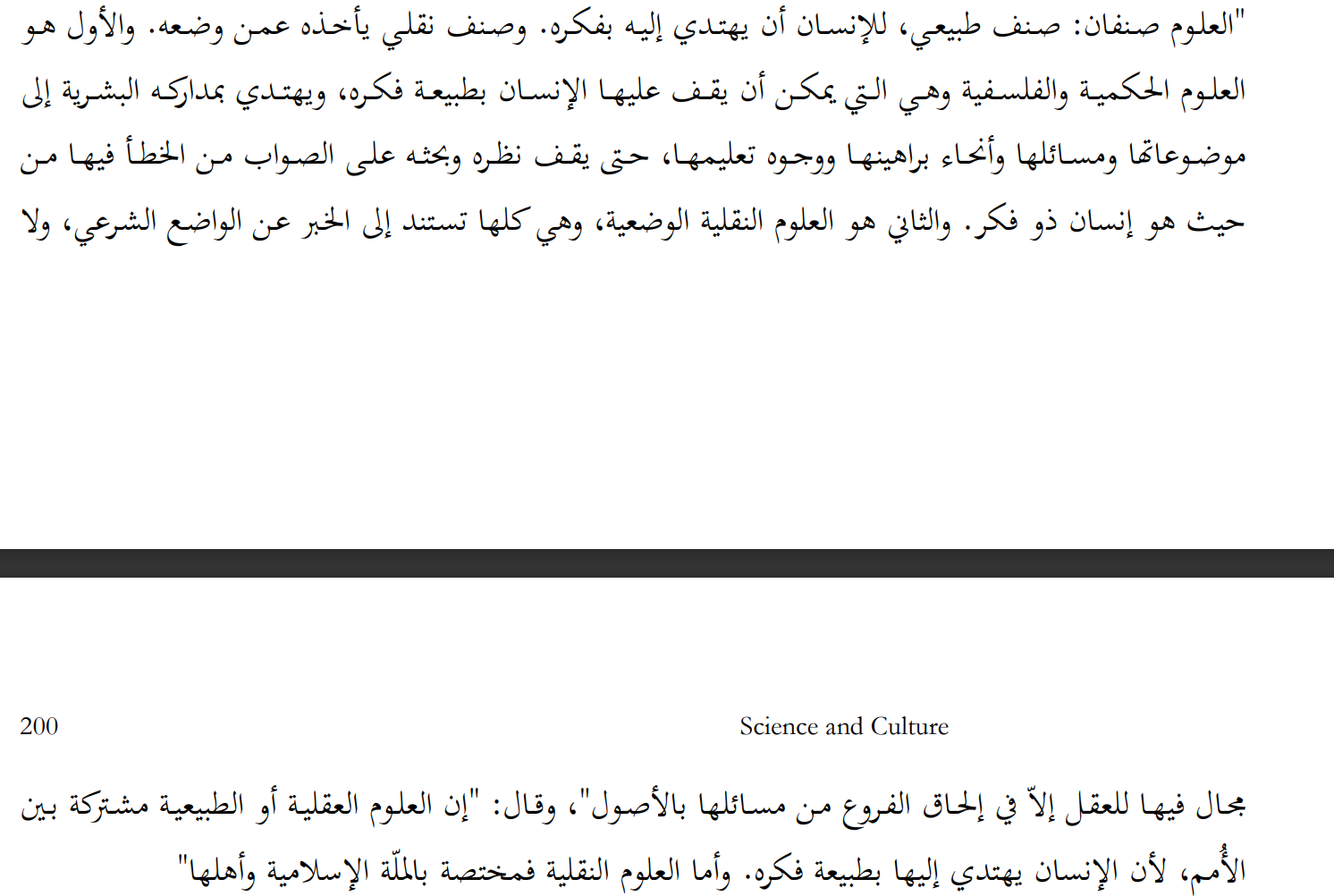
«Науки бывают двух видов: естественные, которые человек постигает через своё мышление, и текстуальные, которые он берёт у того, кто их передал. К первым относятся философские и рассудочные науки, которые человек может исследовать своей мыслью и которые направляют его способности к их предметам и вопросам, ко всем их решающим доказательствам и аспектам их положений. Так, в своём рассмотрении и изучении он отличает правильное мнение от неправильного в силу того, что он — человек, обладающий способностью мышления. Ко вторым относятся текстуальные и письменные науки. Они опираются на сообщение, идущее из шариатского источника. Разум в этом отношении не имеет простора, кроме как соотносить частные вопросы с усуль (основанием)».
“The sciences are of two types: A natural type which is for man to arrive at through his thinking and a textual type which he takes from the one who authored it. The first are the philosophical and aphoristic sciences which he can seek by his thought and be guided through the human faculties to its subjects and issues and all its decisive proofs and aspects of its teachings. So as in his discernment and study he attains the correct (opinion) from the incorrect, in his capacity as a human being possessing the faculty of thought. The second are the textual and written sciences. They depend on the report coming from a shar’i source. The mind has no scope in this regard except to relate the branch issues to the usul (foundation)”.
Он также сказал: «Рациональные, или естественные, науки общи для всех народов, поскольку человек приходит к ним естественным образом через свою мысль. Что же касается текстуальных наук, то они присущи мусульманской религии и её последователям». Представляется, что указание Ибн Хальдуна на то, что текстуальные науки относятся к исламской миллthe, было лишь примером, ведь и у других народов есть свои собственные текстуальные науки, например законодательство и язык. Заявление Ибн Хальдуна не указывает на то, что он проводил различие между наукой и культурой. Оно лишь указывает на то, что он различал текстуальные и рациональные науки. Его замечания не являются доказательством того, что мусульмане проводили различие между наукой и культурой; скорее, они доказывают, что мусульмане лишь различали дисциплины. Поэтому они делили их на два раздела. Однако это деление касалось общего способа их приобретения, а не способа получения знания. Так они назвали рациональными науками те, что приобретаются с помощью разума, и текстуальными науками те, что приобретаются из текста. Однако сегодня люди различают дисциплины по тому, каким образом они были восприняты. Так, они применяют термин «наука» (ʿilm) к тому, что приобретается эмпирическим методом, а термин «культура» (thaqafa) — к тому, что приобретается иными способами, нежели эмпирический метод.
He also said “The rational or natural sciences are common to all nations since man arrives at them naturally through his thought. As for the textual sciences they are specific to the Muslim religion and its adherents.” It appears that what Ibn Khaldun meant by specifying the textual sciences with the Islamic millah was only an example because nations other than the Islamic nation as well have textual sciences specific to them such as their legislation and language. Ibn Khaldun’s statement does not indicate that he distinguished between science and culture. It only indicates that he distinguished between textual and rational sciences. His comments are not an evidence to say that the Muslims used to differentiate between science and culture rather they are an evidence to prove that the Muslims used only to differentiate between disciplines. Thus, they divided them into two sections. However their division was in terms of their general acquisition and not in terms of the manner of acquisition. So they designated them as rational sciences i.e, acquired via the mind. And textual sciences acquired from the text. However, people today differentiate between disciplines in terms of the manner in which they were received. Thus, they apply the term ‘science’ (‘ilm) on anything that is acquired through the empirical method and they apply the term ‘culture’ (thaqafa) on anything acquired by means other than the empirical method