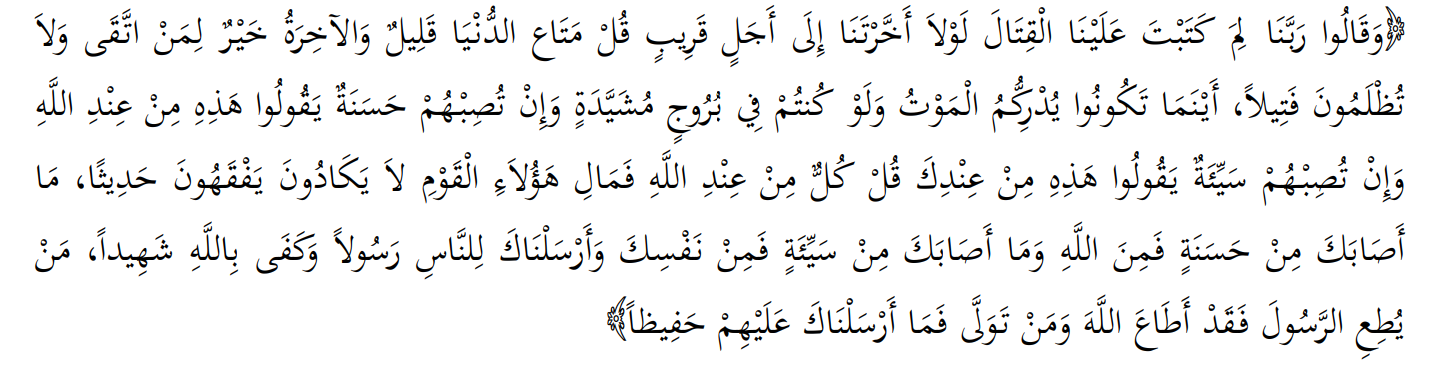
Таким образом, подлежащим здесь является то, что с ними происходит, а не то, что они делают. Поэтому это не имеет отношения к изучению аль-када уа-l-кадар.
So the subject is what befalls them and not what they are doing. Thus it has nothing to do with the study of al-qadā’ wa‘l-qadar.
Поэтому всё, что было сказано выше, не имеет отношения к изучению аль-када уа-ль-кадар; оно не входит в его смысл и никоим образом не связано с тем, что упоминалось выше. Скорее, аль-када уа-ль-кадар как понятие пришло из греческой философии, была передана мутазилитами, которые высказали по этому поводу своё мнение. Ахль ас-сунна и джабрии опровергли их, а ахль ас-сунна также опровергла джабриев. Спор велся в рамках одного и того же понятия и исходил из одной и той же посылки. Таким образом, вопрос представляет собой понятие, пришедшее из греческой философии, и оно выдвинулось на первый план в дискуссии, которая велась между мусульманами и неверующими, вооружёнными греческой философией. Это понятие имеет отношение к 'акыде (вероучению), поэтому желательно изложить мнение ислама относительно этого понятия. Мутазилиты высказали мнение, джабрии опровергли их и предложили другое мнение. Ахль ас-сунна опровергла их всех и высказала собственное мнение, заявив, что оно является третьим мнением, которое возникло из двух предыдущих, и описали его как «чистое молоко, сладкое на вкус, которое выходит из-между испражнений и крови».
Therefore, all that has been mentioned above has nothing to do with the study of al-qadā’ wa‘l qadar; they do not come under its meaning and have no relation whatsoever with what has been mentioned above. Rather, al-qadā’ wa‘l-qadar as a meaning has come from Greek philosophy which was transmitted by the Mu'tazilah who gave an opinion with regards to it. Ahl al-Sunnah and the Jabriyyah refuted them and Ahl al-Sunnah (also) made a refutation of the Jabriyyah. The discussion was confined to the same meaning and preceded upon the same premise. Thus the issue is a meaning/sense that came from Greek philosophy and it came to the fore in the debate which used to take place between the Muslims and the kuffar who used to be armed with the Greek philosophy. It is a meaning which has a relevance to the ‘aqīdah (creed), thus what is desired is to give Islam's opinion regarding this meaning. The Mu'tazilah gave an opinion and the Jabriyyah refuted them and gave another opinion. Ahl al-Sunnah refuted all of them and gave an opinion, and said about it that it is a third opinion which has come out from the two opinions and they described it as ‘the pure milk, sweet to drink, that comes out from between excrement and blood’.
Поэтому предмет обсуждения, пришедший из греческой философии, стал известен, и поскольку он связан с ‘акидой (вероубеждением), мусульманин должен ясно понимать, каково его убеждение относительно этого предмета. Мусульмане действительно высказали своё мнение, и возникли три школы мысли. Таким образом, не дозволено относить вопрос об аль-када' ва-ль-када́р к тому, что пришло в значение аль-када' или аль-кадар в языке и в Шариате, и также не дозволено представлять или мыслить для аль-када' или аль-кадар какое-либо значение, исходя из одних лишь предположений, представлений или воображения, и говорить, например, что аль-када' — это всеобщее решение лишь относительно общих понятий, а аль-кадар — всеобщее решение относительно частных аспектов и их деталей, или говорить, что аль-кадар — это вечный замысел о вещах, а аль-када' — это исполнение и сотворение в соответствии с этим предопределением и замыслом. Ведь это недозволено, потому что это всего лишь домысел, предположение и неудачная попытка применить определённые языковые и шариатские выражения, ибо они к этому не относятся, а указывают на общие значения. Тогда ограничивать эти два слова такими частными значениями без доказательства было бы произвольным действием.
Therefore, the subject of discussion, which came from the Greek philosophy, became known, and since it is related to the ‘aqīdah (creed), the Muslim must be clear as to what his belief is regarding this subject. The Muslims did actually state their opinion and three schools of thought arose. Thus it is not allowed to refer the issue of al-qadā’ wa‘l-qadar to what has come of the meaning of al-qadā’ or al-qadar, linguistically and in the Sharī’ah, nor is it allowed to imagine or conceive for al-qadā’ or ‘al-qadar any meaning from mere supposition, conception or imagination, and to say, for example, that al-qadā’ is the universal judgement on only the universals and al qadar is the universal judgement on the partial aspects and its details, or to say that al-qadar is the eternal plan for things and al-qadā’ is the execution and creation according to that predetermination and plan. Indeed, this is not allowed because this is mere imagination, assumption and a failed attempt of applying certain linguistic and shar’i expressions because they do not apply to it, they rather indicate general meanings; . It would then be an arbitrary action to restrict the two words to these specific meanings without evidence.
Точно так же недопустимо утверждать, что аль-кадā’ уа-ль-кадар является одной из тайн Аллаha и что нам запрещено обсуждать его, ибо нет шаръи'ческого текста, который бы говорил, что это одна из тайн Аллаха, не говоря уже о том, что предмет этот воспринимается чувствами, а по нему необходимо высказывать мнение, так как же можно утверждать, что его нельзя изучать?! Кроме того, это рациональное исследование и предмет, относящийся к тем вопросам, которые изучаются разумом как реальность, воспринимаемая чувствами; и поскольку он связан с имāном в Аллаха. Таким образом, аль-кадā’ уа-ль-кадар в том смысле, в каком он поставлен как предмет исследования и вошёл в состав ‘акыды (вероубеждения), должен изучаться.
Similarly, it is not allowed to claim al-qadā’ wa‘l-qadar is a secret from amongst the secrets of Allah and that we have been forbidden to discuss it, because there is no shar’i text to say that it is one of the secrets of Allah , not to mention the fact that the subject matter is sensorially perceivable, for which an opinion must be given, so how can it be said that it cannot to be studied?! In addition to the fact that it is a rational inquiry and a subject which relates to matters that are studied by the intellect as a reality that is sensorially-perceivable; and since it relates to the imān in Allah . Thus, al-qadā’ wa‘l-qadar, in the meaning placed as the subject matter and which became part of the ‘aqīdah (creed) must be studied.
Вопрос об аль-када’ уа-ль-кадар, или, иначе говоря, вопрос о предопределении, касается поступков рабов и свойств вещей. Ведь речь идёт о поступках раба и о том, что возникает в результате этих поступков, то есть о свойствах, которые раб производит в вещах: являются ли они творением Аллаха ? Им ли Он сотворил их и привёл в бытие? Или же это раб? Является ли раб тем, кто создал их и привёл в бытие?
Мутазилиты все без исключения утверждали, что раб сам творит свои поступки: он создаёт действие и приводит его в бытие. Относительно свойств они разошлись. Одни говорили, что раб создаёт все свойства, порождаемые человеком, и он же приводит их в бытие. Другие проводили различие между свойствами: часть из них, возникающих в вещах, они считали созданными рабом и приведёнными им в бытие, а часть — созданными в вещах Аллахом и приведёнными в бытие Им.
Что касается джабаритов, то они утверждали, что Аллах творит все поступки человека, а также все свойства, порождаемые человеком в вещах. Он приводит их в бытие; раб не имеет никакого отношения к сотворению и образованию действия или к порождению свойства в вещи.
Ахль ас-сунна же говорили, что поступки раба и свойства, порождаемые рабом в вещах, сотворены Аллахом . Но они утверждали, что Аллах творит их тогда, когда раб совершает действие и когда раб порождает свойство, и что раб совершает их не своей собственной силой и волей, а Аллах творит их при наличии у раба способности и воли.
The question of al-qadā’ wa‘l-qadar, or in other words, the issue of al-qadā’ wa‘l-qadar, is the actions of the servants and the attributes of things. This is because the issue mentioned is the actions of the servant and what arises from these actions, that is, the attributes brought about by the servant in things: are they the creation of Allah ? Is He the one who has created them and brought them into being? Or is it the servant? Is the servant the one who created them and brought them into being? The Mu'tazilah, all of them, said that the servant is the one who creates his own actions: he is the one who creates the action and brings it into being. They differed about the attributes. Some of them said that the servant is the one who creates all of the attributes that are caused by man and he is the one who brings them into existence. Others differentiated between the attributes. Some of these made them as being created in things by the servant and brought into existence by him and part of them made them as being created in things by Allah and brought into existence by Him. As for the Jabriyyah, they said that Allah creates all the actions of man as well as all the attributes caused by man in things. He is the one who brings them into existence; the servant has nothing to do with the creation and formation of the action or in causing the attribute in the thing. Ahl us-Sunnah said that the actions of the servant and the attributes caused in things by the servant are created by Allah . But they said that Allah creates them while the servant performs the action and the servant causes the attribute. So Allah creates them when the servant has the ability and will and not by his own ability and will.
Предмет данного вопроса — это вопрос аль-када’ уа-ль-кадар. Ниже приводится обзор мнений, которые были высказаны по нему. Всякий, кто изучает эти взгляды, должен знать основу, на которой построено обсуждение, чтобы рассуждение велось на общем основании. Тогда итог будет таким, каким его требует основа обсуждения, и он не будет ошибочным.
Основой обсуждения в вопросе аль-када’ уа-ль-кадар не является деяние раба с точки зрения того, создал ли он это деяние сам или его создал Аллах, и не является воля Аллаха в том смысле, что Его воля обусловлена деянием раба, поэтому она должна существовать вместе с этой волей. Не является основой и знание Аллаха в том смысле, что Он знает, что раб совершит такое-то деяние, или что Его знание охватывает раба, или что это деяние раба записано в Хранимой скрижали, и поэтому он обязан действовать согласно записанному. Ведь основа обсуждения, безусловно, не в этих вещах, поскольку они не имеют отношения к предмету с точки зрения награды и наказания. Они относятся к вопросу с точки зрения сотворения из ничего, связи воли со всеми возможными вещами, всеобъемлющего знания обо всём и Хранимой скрижали. Это совершенно иной предмет, нежели награда и наказание за деяние.
Предмет обсуждения, на основании которого построен вопрос аль-када’ уа-ль-кадар, — это вопрос награды и наказания за деяние, то есть: обязан ли человек совершать деяние, благое или злое, или же он наделён выбором? И имеет ли человек выбор в совершении деяния, или у него нет выбора? Тот, кто внимательно рассматривает поступки рабов, видит, что человек живёт в двух сферах: одна из них подвластна ему, это сфера, находящаяся в пределах его поведения, и в ней его действия совершаются полностью по его выбору; другая сфера господствует над ним: он существует в её пределах, и поступки, которые происходят в ней, будь то исходящие от него или постигающие его, совершаются без его выбора.
This is the issue - the issue of al-qadā’ wa‘l-qadar – and this is a summary of the opinions that have been opined about it. Anyone who scrutinises these views must know the basis on which the discussion has been built such that the discussion is on a common basis. Thus the outcome will be as required by the basis of the discussion and it will not be an incorrect one. The basis of the discussion in al-qadā’ wa‘l-qadar is not the action of the servant in terms of whether he created the action or Allah created it, nor is it the will of Allah in that His will is conditional on the action of the servant so it must exist with this will, nor is it the Knowledge of Allah in terms of Him knowing that the servant will do such and such an action or that His Knowledge encompasses the servant, or that this action of the servant is written in the Lawh al-Mahfūdh so he must act according to what has been written. Indeed, the basis of the discussion is definitely none of these things, because they have no relation to the subject from the perspective of reward and punishment; they are related to the question from the perspective of formation from nothing, the connection of the will to all possibilities, the all-encompassing Knowledge of all things and the Lawh al-Mahfūdh. This is quite different from the subject of the reward and punishment for an action.The topic of discussion on whose basis the question of al-qadā’ wa‘l qadar is built is the issue of reward and punishment for an action, that is, is man obliged to perform an action, good or evil, or does he have a choice? And, does man have the choice to perform an action, or does he have no choice? The person who scrutinises the actions of the servants sees that man lives within two spheres: one which he dominates, the sphere that is present within the region of his conduct, and within which his actions happen absolutely by his choice; the other (sphere) dominates him; he exists within its domain, and the actions that occur within it, whether they originate from him or fall upon him, occur without his choice.
Таким образом, поступки, которые относятся к сфере, господствующей над человеком, не зависят от его выбора ни в самих этих поступках, ни в их существовании. Они бывают двух видов: один вид является требованием законов вселенной, а другой не предопределён законами вселенной, хотя не все происходящие вещи могут исходить из этих законов. Что касается поступков, предопределённых законами вселенной, то человек полностью подчиняется им; он действует в соответствии с ними по принуждению, поскольку движется вместе со Вселенной и жизнью, которые подчинены определённому порядку, не меняющемуся. Следовательно, поступки человека в этой сфере совершаются без его воли, он вынужден в этих поступках и не имеет выбора. Он пришёл в эту жизнь без своего желания и покинет её без своего желания; он не может взлететь, лишь используя своё тело, не может ходить по воде в своём естественном виде, не может сам выбрать цвет своих глаз, форму головы или размер своего тела. Воистину, всё это создал Аллах без какого-либо влияния или участия созданного человека, ибо Аллах создал законы Вселенной, заставил их управлять мирозданием и заставил мироздание действовать в соответствии с ними, не имея возможности изменить их. Что касается второго вида, то это поступки, которые происходят вне контроля человека, которых он не может избежать и которые не связаны с законами вселенной; это поступки, которые совершаются через человека или над ним непреднамеренно и которых он не может избежать, например, если кто-то упадёт на человека и тем самым убьёт его, или если кто-то выстрелит в птицу и непреднамеренно попадёт в человека, убив его, или если автомобиль, поезд или самолёт потерпит катастрофу, без всякой возможности избежать происшествия, и в результате пассажиры погибнут. Все эти примеры — поступки, которые совершились человеком или над ним; хотя они и подчинены законам вселенной, они произошли без его воли и вне его возможности контролировать их, и они относятся к сфере, господствующей над человеком. Все действия, которые происходят в сфере, подвластной человеку, называются кадар (кадā), поскольку Аллах единолично предопределил их и не дал рабу свободы воли в таких действиях; он не имеет выбора в отношении них. Поэтому человек не несёт ответственности за эти действия, независимо от того, приносят ли они ему пользу или вред, нравятся ему или не нравятся, то есть независимо от того, являются ли они, по его мнению, хорошими или плохими. Лишь Аллах знает добро и зло в этих действиях, поскольку человек не имеет на них влияния; он не знает их и не знает, как они возникают, и он абсолютно не способен их избежать или осуществить. Поэтому за них нет ни награды, ни наказания. Таким образом, это и есть кадар, и потому говорят, что действие произошло по кадару. Долг человека — веровать в этот кадар и в то, что этот кадар от Аллаха, Прославленного и Возвышенного.
Thus, the actions that fall within the sphere that dominates man, man has no choice in them or in their existence; they are of two types: a type which is a requirement of the laws of the universe, and a type not necessitated by the universal laws, even though all the things (that occur) may not emanate from these laws. As for the actions necessitated by the laws of the universe, man submits to them totally; he acts according to them as a matter of compulsion, because he moves with the Universe and Life, which are subjected to a specific regulation, which does not change. Subsequently, man's actions in this sphere occur without his will, he is forced in these actions and has no choice. He came to this life without his will and he will leave it without his will; he cannot fly merely by the use of his own body, nor can he walk in his natural form on water, nor choose for himself the colour of his eyes, the shape of his head or the size of his body. Indeed, it was Allah who created all of this without any influence or relation from the created man, because Allah created the laws of the Universe, made them regulate the universe and made the universe act according to them without having the ability to change. As for the second type, they are actions which happen beyond man's control, which he cannot avoid and which are not related to the laws of the universe; they are the actions which occur either unintentionally through him or upon him and which he cannot avoid, such as if someone falls on a person and thus kills him, or if someone shoots at a bird and unintentionally hits a person and kills him, or if a car, train or plane should crash, without any possibility to avoid the incidents, and as a result the passengers die. All these examples are actions which occurred from a man or upon him - though they are bound by the laws of the universe - they happened without his will and outside his ability to control them, and they are within the sphere that dominates man. All the actions which occur within the sphere that dominates man are termed qadā, because Allah alone has decreed them, and has not given the servant the freedom of will in such actions; he has no choice with regards to them. Therefore man is not reckoned on these actions, whether, with respect to man, there is benefit or harm in them or like or dislike, that is, regardless of whether they are, according to man, good or bad; Allah alone knows the good and bad in these actions, because man has no influence on them; he does not know them or how they are brought into existence, and he is absolutely unable to avoid and bring them about. Therefore there is no reward or punishment for them. Thus this is qadā’, and it is therefore said that the action happened by qadā’. It is upon man to have imān in this qadā’ and that this qadā’ is from Allah , the Glorified and Exalted.
Что касается действий, которые происходят в сфере, подвластной человеку, то это та сфера, в которой он действует по своему выбору согласно системе, которую он избирает, будь то Шариа Аллаха или какая-либо иная. Это сфера, в которой действия, совершаемые человеком или связанные с ним, происходят по его воле. Так, он ходит, ест, пьёт и путешествует, когда пожелает; точно так же он воздерживается от любого из этих действий, когда захочет. Он также обжигается огнём и режет ножом, когда выбирает, и удовлетворяет свои инстинкты продолжения рода, владения и голода так, как пожелает. Всё это он совершает или от чего воздерживается по своему выбору. Поэтому человек подотчётен за действия, которые происходят в этой сфере. Так, он вознаграждается за действие, заслуживающее награды, и наказывается за действие, заслуживающее наказания. Эти действия не имеют отношения к кадару, и кадар не имеет отношения к ним, ибо человек сам совершает их по своей воле и выбору. Следовательно, действия, совершаемые по выбору, не входят в сферу аль-кадā’.
As for the actions that occur in the sphere that man dominates, it is the sphere in which he proceeds with choice according to the system he chooses, whether it is the Sharī’ah of Allah or any other. This sphere is the one in which actions carried out by man or involving him occur by his will. Thus he walks, eats, drinks and travels anytime he likes; likewise he refrains from doing any of these things whenever he likes; he also burns with fire and cuts with a knife when he chooses, and he satisfies his instincts of procreation, ownership and hunger as he likes. All this he performs or abstains from, by his choice. Therefore, man is accountable on actions which occur within this sphere. Thus, he is rewarded for the action deserving reward and is punished for the action deserving punishment. These actions have nothing to do with qadā’ nor does it have anything to do with them because man is the one who undertook them with his own will and choice. Therefore, actions of choice do not come under al-qadā’.
Что касается аль-кадара, то он относится к действиям — будь то действия, происходящие в сфере, которой человек владеет, или в сфере, которая владеет им, — которые совершаются с вещами или над ними через материю мироздания, человека и жизни и порождают следствие, то есть из действия что-то возникает. Так вот, этот механизм, который человек производит в вещах в отношении их свойств, создан ли он человеком или Аллахом, так же как Он создал сами вещи? Тот, кто вдумчиво исследует этот вопрос, обнаружит, что эти явления, возникающие в вещах, принадлежат свойствам самих вещей, а не действию человека. Об этом свидетельствует то, что человек не способен произвести их (то есть эти следствия) иначе как в тех вещах, которые обладают соответствующим свойством среди своих качеств. Что же касается вещей, не имеющих соответствующего свойства среди своих качеств, то человек не может вызвать в них то, что он желает. Следовательно, эти явления не являются действиями человека, но принадлежат свойствам вещей.
As for al-qadar, it relates to the actions, whether they occur in the sphere which man dominates or in the sphere which dominates him, which occur from or on things through the matter of the universe, man and life, and cause an effect, that is, something results from the action; so this mechanism that man causes in things in terms of attributes, is it created by man or by Allah just as He has created the things themself. The one who scrutinises this issue will find that these matters which are caused in things are from the attributes of the things, not from the action of man, as evidenced by the fact that man is not able to form them (i.e these effects) except in the things which possess the (relevant) attribute amongst its attributes. As for the things which do not have the (relevant) attribute amongst their attributes, man is not able to cause in them what he wants. Therefore these matters are not from the actions of man but from the attributes of the things.
Так, Аллах создал вещи и установил [кадdarа] в них свойства таким образом, что из них не может произойти ничего, кроме того, что Он установил в них: например, Он установил в косточке финика свойство вырастить финиковую пальму, а не яблоню, и в человеческом семени — свойство дать начало человеку, а не какому-либо другому животному. Аллах создал в вещах определённые свойства: например, Он создал в огне свойство жечь, в дереве — свойство воспламеняться, а в ноже — свойство резать. Он сделал эти свойства существенной и постоянной частью предметов в соответствии с Законами Вселенной. Когда оказывается, что свойства больше не присутствуют, это означает, что Аллах лишил их этих свойств, и подобное событие было бы необычным; оно случается только с пророками как чудо для них. Так же, как Аллах создал свойства для предметов, Он создал в человеке инстинкты и органические потребности и, как Он создал свойства в предметах, Он создал в инстинктах и органических потребностях определённые свойства. Поэтому в инстинкте продолжения рода Аллах создал половое влечение, а в органических потребностях Он создал свойство голода. Он сделал так, чтобы эти свойства были присущи им в соответствии с законами Вселенной. Определённые свойства, которые Аллах Всевышний создал в предметах, инстинктах и органических потребностях, называются аль-кадар, потому что только Аллах создал вещи, инстинкты и органические потребности и определил в них их свойства. Таким образом, когда у человека возникает половое влечение, когда он видит, открыв глаза, и когда камень поднимается вверх, если его бросить вверх, и падает вниз, если его бросить вниз, всё это происходит не по действию человека, а по действию Аллаха; то есть таково естество вещей, то есть Аллах сотворил их и создал в них особые свойства, и потому эти свойства исходят от Аллаха, а не от человека; человек не имеет к ним никакого отношения и не может каким-либо образом на них повлиять. Это и есть аль-кадар, и потому говорится, что аль-кадар в предмете аль-кадã уа-ль-кадар - это свойства вещей, которые человек в них вызывает. Долг человека - веровать (иман), что тот, кто определил свойства этих вещей, - это Аллах.
Thus, Allah has created the things and set [qaddara] in them attributes in a manner that nothing else is possible to come from them except what He has set in them, such as setting in the date pit (the attribute) of growing date palm from it and not apple, and such the human sperm to result in humans not any other animal. Allah has created specific attributes in things, for example, He created in fire the attribute of burning, in wood the attribute of catching fire, and in the knife the attribute of cutting. He made the attributes an essential and perpetual part of the objects in accordance with the Laws of the Universe. When it appears that the attributes are no longer present, it means Allah has stripped them off, and such an event would be unusual; it only happens to the prophets as a miracle for them. Likewise, in the manner that Allah created attributes for the objects, He created in man instincts and organic needs and, as He created attributes in objects, He created in the instincts and organic needs specific attributes. Hence, in the procreational instinct Allah created the sexual inclination, and in the organic needs He created the attribute of hunger. He made these attributes adhere to them according to the laws of the universe. The particular attributes that Allah the Exlated has created in objects, instincts and organic needs are called al-qadar, because Allah alone created the things, instincts and organic needs and determined in them their attributes. Thus when the sexual desire occurs in man, when he sees upon opening his eyes and when the stone goes up when thrown upwards and down when thrown downward, all of this is not by man’s action, rather it is by the action of Allah ; meaning that it is from the nature of the things to be so, that is, Allah created them and created particular attributes in them, thus they (the attributes) are from Allah and are not from man; man has nothing to do with them, nor can he effect them in any way. This is al-qadar, and it is thus said that al-qadar in the subject of al-qadā’ wa‘l-qadar is the attributes of the things which man causes in them. It is upon man to have imān in that the one who determined the attributes in these things is Allah .
Таким образом, аль-кадаа уа-ль-кадар — это действия, которые происходят в сфере, господствующей над человеком, независимо от того, являются ли они требованием Законов Вселенной или нет, исходят ли они от него или падают на него, а также свойства, которые приводят к появлению предметов. Смысл имана в аль-кадаа уа-ль-кадар, в том, что и благое, и дурное в нём от Аллаха, заключается в том, что действия, которые происходят от Него или на него против его воли, и он не имеет возможности их отвратить, а свойства, которые человек создаёт в предмете, — от Аллаха, и не от раба, и он не имеет к ним никакого отношения. Поэтому действия, в отношении которых человек обладает выбором, исключаются из предмета аль-кадаа уа-ль-кадар, поскольку эти действия происходят от человека или на него по его выбору, и потому что, когда Аллах создал человека, создал свойства в предметах, а также инстинкты и органические потребности, и создал в человеке различающий разум, Он дал ему выбор совершить действие или воздержаться от него, и не обязал его ни делать, ни не делать его. Также Он не поместил в свойствах вещей, или в инстинктах и органических потребностях ничего, что обязывало бы человека совершить действие или не совершать его. Поэтому у человека есть выбор совершить действие или воздержаться от него посредством различающего ума, которым Аллах его наделил, и Он сделал (здравый) разум критерием ответственности. Поэтому Он установил для человека награду за совершение добра, потому что его разум выбрал исполнять повеления Аллаха и воздерживаться от Его запретов, а также Он установил для него наказание за совершение зла, потому что его разум выбрал ослушаться повелений Аллаха и совершить то, что Он запретил. Поэтому его спрос за такие действия справедлив и правосуден, ибо у человека есть выбор совершать действия, и он не принуждён к этому; а аль-кадаа уа-ль-кадар не имеет отношения к этому вопросу, это вопрос о том, что сам человек совершает своё действие по выбору. Поэтому человек отвечает за то, что он приобретает.
Hence al-qadā’ wa‘l-qadar are the actions which occur in the sphere that dominates man, irrespective of whether they are a requirement of the Laws of the Universe or not, or if they emanate from him or fall upon him, and the attributes which results in the objects. The meaning of imān in al-qadā’ wa‘l-qadar, both the good and the bad thereof being from Allah , is (having) imān in that the actions which occur from him or upon him against his will, and he has no power to drive them away, and the attributes which man causes in the object are from Allah and are not from the servant, nor does he have anything to do with them. Thus the actions with regards to which man has a choice are excluded from the subject of al-qadā’ wa‘l-qadar, because these actions occur from man or upon him by his choice, and because when Allah created man and created the attributes in the objects and in the instincts and the organic needs, and created in man the distinguishing intellect, He gave him the choice to carry out the action, or abstain from it, and He did not oblige him to do or not do it. Nor did He make in the attributes of things, or in the instincts and organic needs anything that obliges man to do or not to do the action. Therefore man has the choice to carry out the action or abstain from it by way of the distinguishing mind that Allah bestowed him with, and He made the (sound) intellect the criteria of the accountabilty. Therefore He set for man reward for doing good, because his mind chose to carry out the orders of Allah and abstain from his prohibitions, and He also set for him punishment for doing bad, because his mind chose to disobey the the orders of Allah and commit what He had prohibited. So his accounting on such actions is true and just, because man has the choice to carry out the actions and is not compelled to do so; and al qadā’ wa‘l-qadar has nothing to do with this matter, it is a question of the man himself doing his action by choice. Therefore man is accountable for what he earns,