10.2 As Abordagens Exegéticas dos Mufassirun
10.2 The Exegetical Approaches Of Mufassirun
Os Companheiros (Sahabah) faziam tafsīr dos versículos do Nobre Alcorão, seja por seu próprio ijtihād na interpretação, seja por tê-lo ouvido do Mensageiro de Allah ﷺ. Muitas vezes explicavam a causa da revelação de um versículo ou esclareciam a quem ele havia sido revelado. Ao explicar um versículo, limitavam-se a elucidar o significado linguístico que compreendiam dele, com as palavras mais concisas, como quando diziam: ghayr mutajanif li ithm (não inclinado ao pecado), isto é, não predisposto ao pecado (ghayr muta'arrid li ma'siyya). Da mesma forma, foi sua declaração sobre o dizer d'Ele:
The Sahabah made tafsīr for the verses of the Noble Qur’ān either as their own Ijtihād in tafsīr or by hearing it from the Messenger of Allah . Many a time they would explain the cause of revelation for a verse or explain with respect to whom it had been revealed. In explaining a verse they would restrict themselves to elucidating the linguistic meaning which they understood from the verse with the most concise of words like their saying: ghayr mutajanif li ithm (not inclined to sin) i.e, not predisposed to sin (ghayr muta'arrid li ma'siyya). Similarly their statement regarding His saying:
“(Proibido) também é usar flechas para buscar sorte ou decisão” [TMQ Mā’idah: 3]
“(Forbidden) also is to use arrows seeking luck or decision” [TMQ Mā’idah: 3]
Os habitantes da jahiliyya, quando um deles queria sair (em viagem), pegava uma flecha e dizia: "Esta me ordena sair". Assim, se ele saísse em sua viagem, encontraria boa sorte. E pegava outra flecha e dizia: "Esta me ordena ficar", e então não teria sorte em sua viagem. A flecha de má sorte era uma das duas flechas. Por isso, Allah proibiu-lhes essa prática. Um exemplo disso é o que foi narrado sobre Ibn 'Abbas a respeito do dito de Allah:
The people of jahiliyya when one of them wanted to go out (on a journey) he would take an arrow and say: This one orders me to go out. So if he goes out on his journey will meet good luck. And he will take another arrow and say: This one orders me to stay, so he will not be lucky in his journey. The unlucky arrow is one of the two arrows. So Allah forbade them from this practice. An example would be what has been narrated about Ibn 'Abbas regarding His saying:
"Certamente Ele vos fará retornar ao ma'ad (lugar de retorno)" [TMQ Qasas: 85]
“ He will surly bring you back to the ma'ad (place of return)” [TMQ Qasas: 85]
Ele disse: a Meca. Se acrescentaram algo a isso, seria o que foi narrado sobre a causa da revelação e a respeito de quem o versículo em questão foi revelado. Foi narrado sobre Abu Hurairah acerca do dito de Allah:
He said: to Makkah. If they added anything to that it would be what has been narrated about the cause of revelation and with regards to whom the verse in question was revealed. It has been narrated about Abu Hurairah regarding His saying:
Verdadeiramente! Você (ó Muhammad ﷺ) não guia quem você quiser. [TMQ Qasas: 56]
“Verily ! You (O Muhammad (saw)) guide not whom you like” [TMQ Qasas: 56]
que ele disse que o versículo fora revelado a respeito do Mensageiro de Allah ﷺ quando este tentou convencer seu tio Abu Talib a abraçar o Islã. Depois vieram os Tabi'un, após os Sahabah, que relataram tudo o que os Sahabah mencionaram dessa maneira. Entre os Tabi'un havia aqueles que explicaram os versículos do Nobre Alcorão ou mencionaram a causa da revelação, seja por seu próprio Ijtihad no tafsir, seja por tê-la ouvido de (outras autoridades). Depois dos Tabi'un vieram os 'Ulama, que ampliaram o tafsir e citaram relatos dos judeus e dos cristãos. Os mufassirun sucederam-se uns aos outros em cada época e geração; eles explicaram o Alcorão e ampliaram o tafsir em cada era sobre o que havia sido dito antes. Os mufassirun passaram a dedicar sua atenção aos versículos para deduzir deles regras e para explicar suas escolas de pensamento em termos de livre-arbítrio (ikhtiyar) e predestinação (jabr). E começaram a explicar versículos que comprovavam suas opiniões de acordo com suas inclinações na legislação, na escolástica ('ilm al-Kalam), na retórica (balaagha), na declinação (sarf) e na gramática etc. O que se evidencia ao examinar os tafaseer através das diferentes épocas, desde o tempo dos Sahabah até hoje, é que o tafsir do Alcorão em cada época foi influenciado pelo movimento acadêmico do tempo; apresentava um quadro que refletia as visões, teorias e escolas de pensamento da época. Raramente houve tafsirs que estivessem livres da influência das opiniões, dos pensamentos e das regras do tempo.
that he said the verse had been revealed concerning the Messenger of Allah when he tried to win over his uncle Abu Talib to Islam. Then came the Tabi'un after the Sahabah who reported everything the Sahabah mentioned in this manner. From among the Tabi'un there were those who explained the verses of the Noble Qur’ān or stated the cause of revelation, either as their own Ijtihād in tafsīr or by hearing it from (other authorities). After the Tabi'un the 'Ulama came and expanded the tafsīr and quoted reports from the Jews and Christians. The mufassirun succeeded one after another in every age and generation, who explained the Qur’ān and expanded the tafsīr in each age on what had come before. The mufassirun began to give their attention to the verses to deduce rulings from them and explain their schools of thought in terms of freewill (ikhtiyar) and predestination (jabr). And they began to explain verses proving their opinions according to their inclinations in legislation, scholasticism ('ilm al-Kalam), rhetorics (balaagha), declension (sarf) and grammar etc. What is apparent from an examination of the tafaseers through the different ages since the time of the Sahabah until now is that the tafsīr of the Qur’ān in every age was influenced by the scholarly movement of the time, it presented a picture which reflected the views, theories and schools of thought of the time. Seldom were there tafsīrs that were free from the influence of opinions, thoughts and rules of the time.
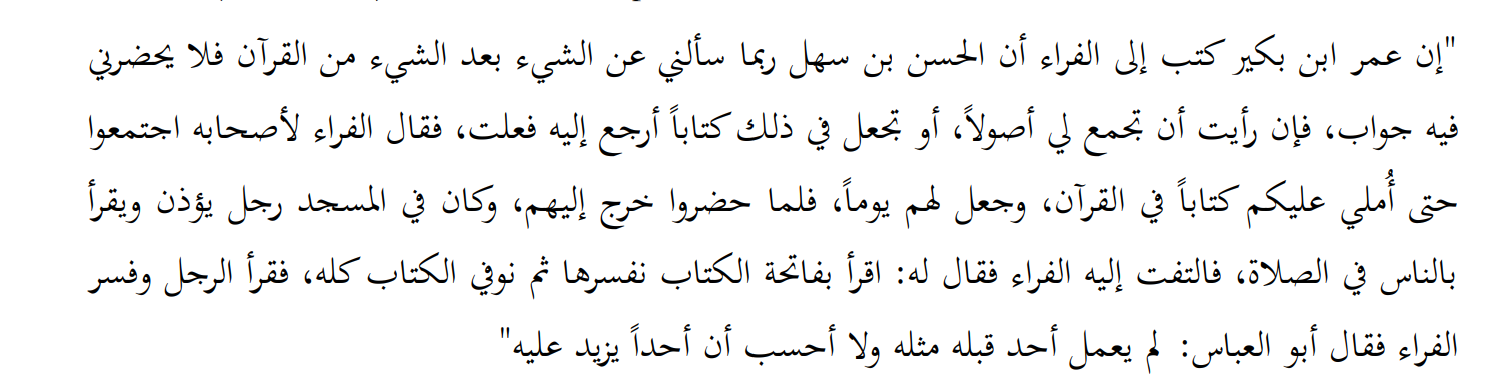
‘Umar ibn Bukayr escreveu a al-Farra' que al-Hasan ibn Sahl talvez me faça uma pergunta após outra sobre o Qur’ān, mas eu não serei capaz de recordar todas as respostas. Acho que você deveria reunir os pontos essenciais e compilá-los num livro ao qual eu possa recorrer. Então al-Farra' disse aos seus alunos: reúnam-se para que eu possa ditar-lhes um livro sobre o Qur’ān. Deu-lhes um dia. Quando chegaram, ele foi até eles; na mesquita havia um homem que dava o adhān e recitava o Qur’ān com o povo na oração. Al-Farra' voltou-se para ele e disse: recite a surata de abertura do Qur’ān (fatihatul kitab), nós a explicaremos e depois falaremos amplamente sobre o livro inteiro. O homem recitou e al-Farra' fez o tafsīr. Abu al-'Abbas disse: ninguém fez nada semelhante a ele antes, e não acho que alguém possa acrescentar algo a isso.
“Umar ibn Bukayr wrote to al-Farra' that al-Hasan ibn Sahl perhaps may ask me one thing after another from the Qur’ān but I will not be able to recall all the answers. I think you should bring together the essential points and compile them in a book I will refer to it, so al-Farra' said to his students; gather together so that I can dictate to you a book about the Qur’ān. He gave them a day. When they came he went to them, in the mosque there was man giving azan and reciting the Qur’ān with the people in prayer. Al-Farra' turned to him and said: recite the opening chapter of the Qur’ān (fatihatul kitab), we will explain it and then we will speak fully about the whole book. The man recited and al-Farra' made tafsīr. Abu al-'Abbas said: no one did anything like him before and I don't think anyone can add to that.'
Depois dele veio Ibn Jarir al-Tabari (m. 310 A.H.), que escreveu o seu famoso tafsīr. Vários tafsīrs anteriores ao tafsīr de Ibn Jarir tornaram-se conhecidos, como o tafsīr de Ibn Jurayj. A sua situação era a situação dos primeiros muhaddithin, que compilavam tudo o que lhes chegava sem diferenciar entre os relatos corretos (Sahih) e os incorretos. Disseram que "o objetivo de Ibn Jurayj não era a autenticidade; antes, relatava tudo o que se transmitia sobre cada ayah, quer fosse correto (Sahih), quer fraco (saqim)". Também destes tafsīrs fazem parte o tafsīr de al-Suddi (m. 127 A.H.) e o tafsīr de Muqatil (m. 150 A.H.). 'Abd Allah ibn al-Mubarak disse sobre o tafsīr de Muqatil: "Quão excelente é o seu tafsīr, se ao menos ele fosse fidedigno (thiqa)." Entre eles está também o tafsīr de Muhammad ibn Ishaq. Ele costumava transmitir dos judeus e cristãos, e citava ditos de Wahb ibn Munabbih, Ka'b al-Ahbar e outros, que relatavam coisas da Torá, da Bíblia e dos seus comentários. Estes tafsīrs não chegaram até nós, embora Ibn Jarir al-Tabari tenha reunido a maior parte deles e os incluído no seu livro. Depois vieram os mufassirun, um após outro, explicando o Alcorão de maneira completa e bem ordenada, em livros completos e sistemáticos.
Then, after him came Ibn Jarir al-Tabari (d.310 A.H.) who wrote his famous tafsīr. A number of tafsīrs before the tafsīr of Ibn Jarir became well known such as the tafsīr of Ibn Jurayj. His situation was the situation of the first muhaddithin who compiled everything that reached them without differentiating between the correct (Sahih) and incorrect reports. They said 'that Ibn Jurayj's aim was not authenticity; rather he reported everything that was reported about every ayah whether it was correct (Sahih) or weak (saqim).' Also from these tafsīrs is the tafsīr of al-Suddi (d.127 A.H.) and the tafsīr of Muqatil (d.150 A.H.). 'Abd Allah ibn al-Mubarak said about the tafsīr of Muqatil: How excellent is his tafsīr, if only he were reliable (thiqa).' Amongst them is also the tafsīr of Muhammad ibn Ishaq. He used to transmit from the Jews and Christians and he used to quote sayings of Wahb ibn Munabbih, Ka'b al-Ahbar and others, who reported thing from the Torah, Bible and their commentaries. These tafsīrs have not reached us, although Ibn Jarir al-Tabari has collected most of it and included it in his book. Then came mufassirun one after another explaining the Qur’ān in an complete and well-ordered manner in books that were complete and systematic.
No entanto, quem examinar os tafsīrs constatará que os mufassirun abordaram o tafsīr a partir de diversas perspectivas. Alguns estavam interessados em observar os estilos e os significados do Livro e tudo o que ele inclui quanto às formas de retórica (balāgha), a fim de conhecer as formas mais elevadas e distintas de expressão em comparação com outros tipos de discurso. Por isso, o aspecto retórico prevaleceu em seus tafsīrs. Um desses autores é Muhammad ibn al-Zamakhshari, em seu tafsīr intitulado al-Kashshāf. Houve também os que se dedicaram aos fundamentos da crença, ao combate aos falsos pretendentes e ao debate com os que divergiam (do Islam), como Fakhr al-Din al-Razi em seu célebre tafsīr: al-Tafsīr al-Kabīr. E alguns deles estudaram as regras da Sharī'ah e se interessaram por deduzi-las dos versículos. Assim, direcionaram seu interesse para os versículos de ahkām, como Abu Bakr al-Razi, conhecido como al-Jassās, em seu renomado tafsīr Ahkām al-Qur'ān. Houve ainda os que se ocuparam das narrativas e acrescentaram às histórias do Alcorão material extraído de livros de história e de israiliyyat (judaicos), passando a reunir tudo o que ouviam, por pouco ou muito que fosse, sem revisar as coisas que contradiziam a Sharī'ah, não concordavam com a razão ou contrariavam os versículos do Alcorão de significado definitivo. Um desses foi 'Alā' al-Din 'Ali ibn Muhammad al-Baghdadi, o sufi conhecido como al-Khāzin, que o fez em seu tafsīr Bāb al-ta'wīl fī ma'ānī al-tanzīl. E houve os que se preocuparam em apoiar a sua madhhab (escola) e em explicar os versículos de acordo com tudo o que sustentava a sua facção, como o tafsīr al-Bayān do Shaykh al-Tibrisi e o tafsīr al-Tibyān do Shaykh al-Tusi. Ambos sustentaram as opiniões da Shi'a e da sua madhhab quanto à crença ('aqā'id) e aos ahkām. E houve também os que se ocuparam apenas do tafsīr, com o objetivo de explicar os versículos e as decisões do Alcorão, independentemente de qualquer perspectiva. Eles são os mufassirun cujos tafsirs são considerados a essência dos livros de tafsir. E são considerados os imames do tafsir e de outras disciplinas, como o tafsir de Ibn Jarir al-Tabari, o tafsir de Abu 'Abd Allah Muhammad al-Qurtubi, e o tafsir de al-Nasafi, entre outros. Quanto aos tafsirs escritos nesta era e próximos do fim do período de decadência, como o tafsir de Muhammad 'Abduh, o tafsir de Tantawi Jawhari e o tafsir de Ahmad Mustafa al-Muraghi, entre outros, não são considerados parte da literatura de tafsir, e neles não se deposita qualquer confiança. Isso porque há um risco para a religião de Allah na explicação de muitos versículos, como no tafsir de Muhammad Rasheed Ridha sobre o versículo:
However, anyone who inspects the tafaseer will find that the mufassirun approached the tafsīr from various perspectives. Some were interested in looking at the styles and meanings of the Book and whatever it included in terms of the forms of rhetorics (balaagha) to know the highest and distinguished forms of speech as compared to other types of speech. So the rhetorical aspect prevailed in their tafsīrs. One of those people is Muhammad ibn al-Zamakhshari in his tafsīr entitled al-Kashaf. There were those who looked into the foundations of belief, the fighting of pretenders and debating those who disagreed (with Islam) like Fakhr al-Din al-Razi in his famous tafsīr: al-Tafsīr al-Kabir. And some of them studied the Sharī’ah rules and were interested in deducing them from the verses. So they channelled their interest towards the verses of ahkām like Abu Bakr al-Razi commonly known as al-Jassas in his well known tafsīr Ahkām al-Qur’ān. There were those who went after stories and added to the Qur’ānic stories from the books of history and israiliyyat (Judaica) and began to collect everything they heard however meagre or abundant without revising the things that contradicted the Sharī’ah, did not agree with the mind or contradicted Qur’ānic ayāt which are definite in meaning. One such person is 'Ala' al-Din 'Ali ibn Muhammad al-Baghdadi, the sufi otherwise known as al-Khazin who did this in his tafsīr Bab al ta'weel fi ma'ani al-tanzeel. And there were those that concerned themselves with supporting their mazhab (school) and explaining the verses in accordance with whatever supports their faction like the tafsīr al-Bayan of al-Shaykh al-Tibrisi and the tafsīr al-Tibyan of al-Shaykh al-Tusi. Both of them supported the views of the Shi'a and their mazhab regarding belief ('aqaid) and ahkām. And there were those that were only concerned with the tafsīr in order to explain the verses and rulings of the Qur’ān regardless of any perspective. They are the mufassirun whose tafsīrs are considered the essence of the books of tafsīr. And they are considered the imams of tafsīr and other topics. Like the tafsīr of Ibn Jarir al-Tabari, the tafsīr of Abu 'Abd Allah Muhammad al-Qurtubi, and the tafsīr of al-Nasafi and others. As for the tafsīrs written in this age and towards the end of the period of decline like the tafsīr of Muhammad 'Abduh, the tafsīr of Tantawi Jawhari and the tafsīr of Ahmad Mustafa al-Muraghi and others, they are not considered part of the tafsīr literature and nor is there any trust put in them. This is because there is a risk in the deen of Allah in the explanation of many verses like Muhammad Rasheed Ridha’s tafsīr of the verse:
"E quem não julgar pelo que Allah revelou, esses são os Fasiqun (transgressores)" [TMQ Mā’idah: 44]
“And whosoever does not judge by what Allahhas revealed, such are the Fasiqun (transgressors)” [TMQ Mā’idah: 44]
Ele permitiu aos muçulmanos da Índia adotarem as leis inglesas e submeterem-se às decisões dos juízes ingleses. O Shaykh Muhammad Rasheed Ridha mencionou no volume seis do Tafsīr do Nobre Alcorão, amplamente conhecido como al-Manar, no tafsīr da sura al-Mā'idah, quando explicou o dito de Allah:
He permitted the Muslims of India to adopt English laws and submit to the rulings of English judges. Shaykh Muhammad Rasheed Ridha mentioned in volume six of the Tafsīr of the Noble Qur’ān widely known as al-Manar in the tafsīr of sura al- Mā’idah when he explained His saying:
"E quem não julgar pelo que Allah revelou, esses são os Fasiqun (transgressores)" [TMQ Mā’idah: 44]
“And whosoever does not judge by what Allah has revealed, such are the Fasiqun (transgressors)” [TMQ Mā’idah: 44]
Nas páginas 406-409, ele foi perguntado:
In pages 406-409 he was asked:
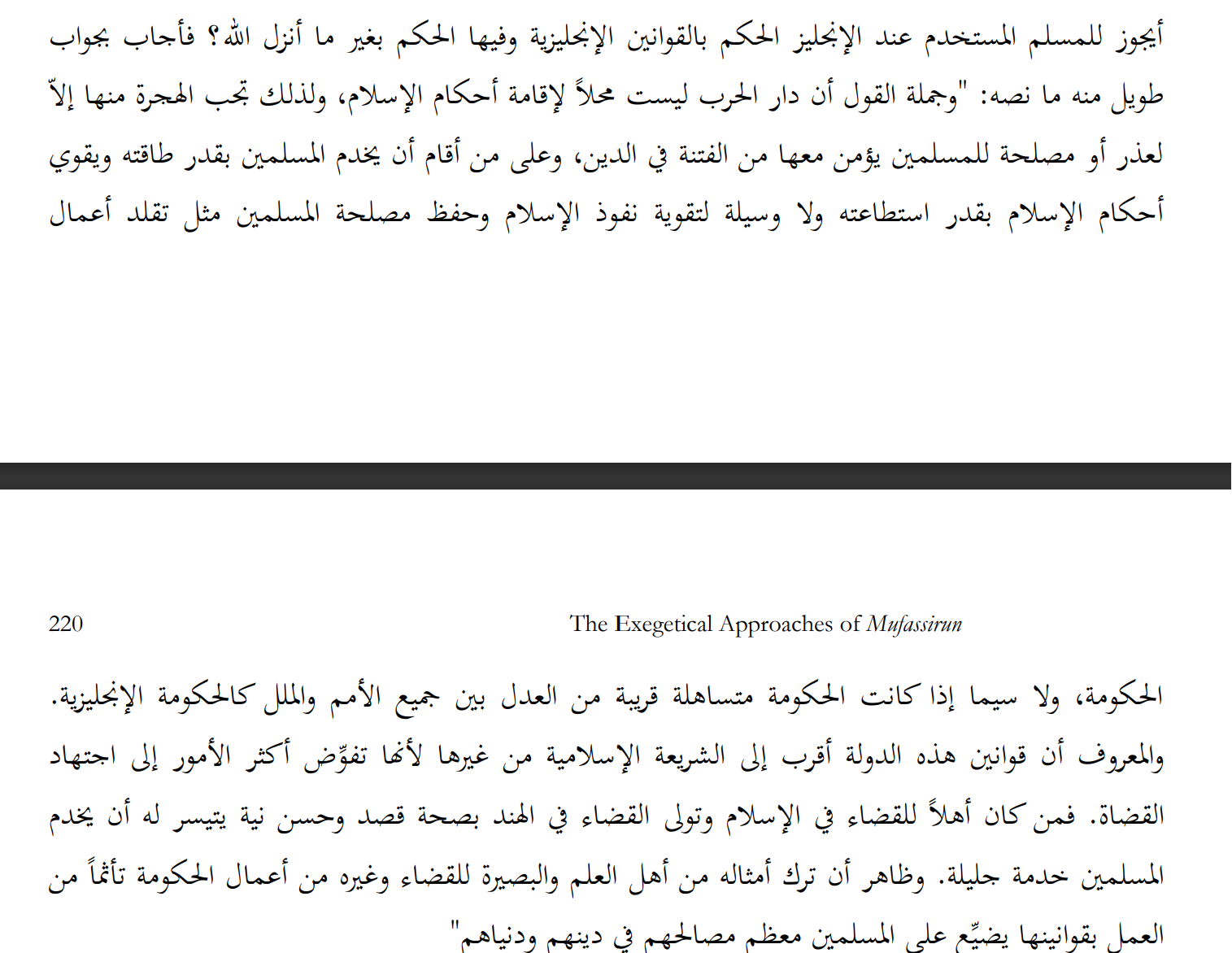
É permitido para um muçulmano ser empregado pelos ingleses para governar segundo as leis inglesas, algumas das quais constituem julgar por outro que não o que Allah revelou? Ele deu uma longa resposta: "Em resumo, a terra da guerra (dar al-harb) não é um lugar para o estabelecimento das regras do Islã; portanto, é obrigatório fazer hijra, a menos que haja uma desculpa ou um benefício para os muçulmanos pelo qual ele estará seguro da fitna (provação) em sua religião. É incumbência daquele que reside (na Índia) servir aos muçulmanos de acordo com o melhor de suas capacidades e fortalecer as regras do Islã o quanto puder. E não há meio de fortalecer a influência do Islã e proteger os interesses dos muçulmanos senão assumindo os cargos de governo, especialmente se o governo for brando e razoavelmente justo entre todas as pessoas e religiões, como o governo inglês. É bem sabido que as leis deste país são mais próximas da Sharī'ah islâmica do que outras, porque delega a maioria dos assuntos ao Ijtihād dos juízes. Assim, quem for qualificado para ser juiz no Islã e assumir um cargo no judiciário na Índia, com a intenção correta e boa intenção, pode prestar um grande serviço aos muçulmanos. É óbvio que o abandono do judiciário e de outros cargos governamentais pelas pessoas de conhecimento e discernimento, por considerarem pecaminoso trabalhar de acordo com as leis deles (ou seja, dos ingleses), fará com que os muçulmanos percam seus interesses em sua religião e em sua vida mundana."
Is it permitted for a Muslim to be employed by the English to rule by English laws some of which constitutes ruling by other than what Allah has revealed ? He gave a long reply: 'In short, the abode of war (dar al-harb) is not a place for the establishment of the rules of Islam, therefore it is obligatory to make hijra unless there is an excuse or benefit for the Muslims due to which he will be safe from the fitna (test) on his deen. It is incumbent on the one who resides (in India) to serve the Muslims according to the best of his abilities and to strengthen the rules of Islam as much as he can. And there is no means of strengthening the influence of Islam and protecting the interests of the Muslims except by assuming the government posts especially if the government is lenient and fairly just between all people and religions like the English government. It is well known that the laws of this country are closer to the Islamic Sharī’ah than others because it delegates most matters to the Ijtihād of judges. So whoever is qualified to be a judge in Islam and takes up a post in the judiciary in India with the correct aim and good intention, it is possible for him to do a great service for the Muslims. It is obvious that the abandonment of the judiciary and other government posts by the people of knowledge and insight due to being sinful for working according to their (i.e The English) laws will forfeit the interests of the Muslims in their deen and dunya.'
Então ele disse:
Then he said:
É evidente, a partir de tudo isso, que a aceitação do muçulmano em trabalhar no governo inglês na Índia, "e em qualquer outro trabalho semelhante", e sua decisão de governar de acordo com as leis deles, é uma concessão (rukhsa), que se enquadra no princípio de escolher o menor de dois males, caso não exista uma 'azeema pela qual se pretenda o apoio ao Islam e a proteção dos interesses dos muçulmanos…
“It is obvious from all of this that the Muslim's acceptance to work in the English government in India 'and any other similar work' and his ruling according to their laws is a dispensation (rukhsa) which comes under the principle of doing the lesser of two evils if there is no 'azeema by which support of Islam and protecting the interests of Muslims is intended…”
Assim como, o tafsir de Tantawi Jawhari, no qual ele afirmou que há ciências e disciplinas modernas no Alcorão e encheu seu tafsir com figuras de pássaros e animais para demonstrar que o Alcorão explicava tais coisas. E o tafsir de Mustafa Zayd, no qual ele interpretou e rejeitou a existência dos anjos e dos shayatin. Portanto, ele cometeu kufr com seu tafsir e se colocou para fora do Islã. Esses tafsirs e seus semelhantes não são considerados livros de tafsir pelos muçulmanos, nem suas explicações recebem qualquer consideração.
Much similar is the tafsīr of Tantawi Jawhari where he mentioned that there are modern sciences and disciplines in the Qur’ān and he filled his tafsīr with pictures of birds and animals to demonstrate that the Qur’ān did explain such things. And the tafsīr of Mustafa Zayd in which he interpreted and rejected the existence of angels and Shayateen. So he committed kufr by his tafsīr and took himself outside of Islam. These tafsīrs and their likes are not considered books of tafsīr by the Muslims and nor are their explanations given any consideration