3.1 A Compilação do Alcorão
3.1 The Compilation Of The Qur’ān
Foi comprovado por evidências decisivas e definitivas que, quando o Profeta ﷺ faleceu, todo o Alcorão já havia sido escrito em omoplatas (de animais), talos de palmeira e lukhaf (uma pedra branca, fina e larga). Todo ele estava preservado nos corações dos Companheiros (que Allah esteja satisfeito com eles). Quando um versículo ou versículos eram revelados, ele ordenava que fossem imediatamente escritos diante dele. Ele não proibia os muçulmanos de escrever o Alcorão em outros materiais além daqueles que ditava aos escribas que registravam a revelação. Muslim relatou um hadith de Abu Sa'id al-Khudri, que disse que o Mensageiro de Allah ﷺ disse:
It has been proven by decisive and definite evidence that when the Prophet died the whole Qur’ān had been written on pieces of shoulder blades (of animals), palm risps and on lukhaf’s (a thin broad white stone). All of it was preserved in the hearts of the Sahabah (may Allah be pleased with them). When an ayah or ayāt would be revealed he would order that they be written down before him at once. He did not prevent the Muslims from writing the Qur’ān in other than what he used to dictate to the scribes who wrote down the revelation. Muslim reported a hadīth from Abu Sa'id al-Khudri that the Messenger of Allah said:
"Não escrevam nada de mim, quem tiver escrito qualquer coisa que eu tenha dito, além do Alcorão, que a apague."
“Do not write down anything from me, whosoever writes anything I have said other than the Qur’ān let him erase it”
O que os escribas registraram da revelação foi reunido em folhas. Ele disse:
What the scribes wrote from the revelation was collected on sheets. He said:
Um Mensageiro de Allah, recitando páginas purificadas (suhuf) (do Alcorão) [TMQ Bayyinah:2]
“A Messenger from Allah, reciting purified pages (suhuf) (of the Qur’ān)” [TMQ Bayyinah:2]
isto é, recitar folhas purificadas da falsidade, escritas à mão, verdadeiras e justas sem qualquer dúvida. Allah disse:
i.e, reciting sheets purified from falsehood, honestly handwritten unequivocally true and just. Allah said:
“Não! Na verdade, (os versículos do Alcorão) são uma advertência (tazkirah). Portanto, quem quiser, que lhes preste atenção. (Eles estão) em Registros guardados (com grande honra), elevados (em dignidade), purificados. Nas mãos de escribas, nobres e obedientes.” [TMQ ‘Abasa: 11-16]
“Nay, indeed it (verses of the Qur’ān) are an admonition (tazkirah). So whoever wills, let him pay attention to it. (It is) in Records held (greatly) in honour. Exalted (in dignity), purified. In the hands of scribes. Honourable and obedient” [TMQ ‘Abasa: 11-16]
i.e. esta admoestação registrada nos documentos é tida em alta honra junto a Allah e elevada em valor, livre das mãos dos que são corruptos, e que foi transcrita por escribas tementes a Deus. Ele deixou tudo o que foi escrito entre as duas capas do mushaf, que havia sido escrito diante dele. 'Abd al-'Aziz b. Rufayya' narrou:
i.e this admonition established in the records is held (highly) in honour with Allah and exalted in value, free from the hands of those that are corrupt and that they have been written down by God fearing scribes. He left everything that was written between the two covers of the mushaf which had been written down in front of him. 'Abd al-'Aziz b Rufayya' narrated:
“Shaddad bin Ma'qil e eu entramos para visitar Ibn 'Abbas. Shaddad bin Ma'qil perguntou-lhe: 'O Profeta ﷺ deixou alguma coisa (além do Alcorão)?' Ele respondeu: 'Ele não deixou nada além do que está entre as capas (do Alcorão).' Depois visitamos Muhammad bin al-Hanafiyya e lhe fizemos a mesma pergunta. Ele respondeu: 'O Profeta ﷺ não deixou senão o que está entre as capas (do Alcorão).'”
“Shaddad bin Ma'qil and I entered upon Ibn 'Abbas. Shaddad bin Ma'qil asked him, 'Did the Prophet leave anything (besides the Qur’ān)?' He replied. “He did not leave anything except what is between the bindings (of the Qur’ān).' Then we visited Muhammad bin al-Hanafiyya and asked him (the same question). He replied, 'The Prophet did not leave except what is between the bindings (of the Qur’ān)”
Estabeleceu-se um Ijma' (consenso) sobre o fato de que todos os versículos do Alcorão, em seus respectivos capítulos (suras), foram escritos diretamente diante do Mensageiro ﷺ quando a revelação lhe era descida, e que foram registrados em folhas (suhuf). O maior dos Mensageiros ﷺ faleceu satisfeito com o Alcorão, seu maior milagre, que estabeleceu a prova para os árabes e para o mundo. Ele não temia que os versículos do Alcorão se perdessem, pois Allah {SWT} preservou o Alcorão com um texto explícito:
An Ijma' (consensus) has been established on the fact that all of the verses of the Qur’ān in their respective chapters (Sura’s) had been written down directly in front of the Messenger when the revelation was being revealed to him, and that they were written on sheets (suhuf). The greatest of the Messengers died content about the Qur’ān, his greatest miracle which established the proof for the Arabs and the world. He did not fear for the verses of the Qur’ān that they would be lost because Allah has preserved the Qur’ān with an explicit text:
Em verdade, Nós: Somos Nós que fizemos descer o Dhikr (o Alcorão) e, certamente, Nós o protegeremos (da corrupção). [TMQ Hijr: 9]
“Verily We: It is We who have sent down the Zikr (the Qur’ān) and surely, We will guard it (from corruption)” [TMQ Hijr: 9]
Porque esses versículos foram preservados de forma permanente, por terem sido colocados por escrito em vida dele, e por estarem preservados nos corações dos Sahabah, e pela permissão concedida aos muçulmanos para escrever o Qur’ān. Por isso, após a morte do Mensageiro de Allah ﷺ, os Sahabah não sentiram a necessidade de compilar o Qur’ān num só livro, nem de o escrever, até que muitos dos Huffaz (memorizadores do Qur’ān) fossem mortos nas guerras da Riddah. Por causa disso, 'Umar temeu pela perda das folhas escritas (suhuf) e pela morte dos Qurra' (aqueles que tinham memorizado todo o Qur’ān), o que poderia fazer com que alguns versículos se perdessem. Então pensou em reunir as folhas escritas (numa única compilação). Apresentou sua ideia a Abu Bakr, e assim a compilação do Qur’ān foi realizada. Foi narrado por 'Ubayd ibn al-Sibaq que Zayd ibn Thabit al-Ansari disse: Abu Bakr mandou chamar-me depois das (pesadas) baixas entre os guerreiros da batalha de Yamama (onde um grande número de Qurra' foi morto). 'Umar estava presente com Abu Bakr, que disse: “'Umar veio até mim e disse: ‘As pessoas sofreram pesadas baixas no dia da batalha de Yamama, e temo que haja mais perdas entre os Qurra' (os que sabem o Qur’ān de cor) em outros campos de batalha, de modo que uma grande parte do Qur’ān possa se perder, a menos que você o recolha. E sou de opinião que você deve recolher o Qur’ān.’” Abu Bakr acrescentou: “Eu disse a 'Umar:”
Because these verses had been preserved permanently via them being written down before him , and being preserved in the hearts of the Sahabah and by the permission granted to the Muslims to write down the Qur’ān. This is why after the death of the Messenger the Sahabah did not feel the need to compile the Qur’ān in one book or the need to write it down until many of the Huffaz (memorisers of the Qur’ān) had been killed in the Riddah wars. So due to this 'Umar feared for the loss of the sheets (suhuf) and the death of the Qurra' (Those who had committed the whole of the Qur’ān to memory), thereby causing some verses to be lost. So he thought about bringing the written sheets together (in one compilation). He presented his idea to Abu Bakr and so the compilation of the Qur’ān was performed. It has been narrated by 'Ubayd ibn al-Sibaq that Zayd b al-Thabit al-Ansari said: Abu Bakr sent for me after the (heavy) casualties among the warriors (of the battle) of Yamama (where a great number of Qurra' were killed). 'Umar was present with Abu Bakr who said, 'Umar has come to me and said, The people have suffered heavy casualties on the day of (the battle of) Yamama, and I am afraid that there will be more casualities among the Qurra' (those who know the Qur’ān by heart) at other battle-fields, whereby a large part of the Qur’ān may be lost, unless you collect it. And I am of the opinion that you should collect the Qur’ān.” Abu Bakr added, “I said to 'Umar ,
"Como você pode fazer algo que o Mensageiro de Allah ﷺ não fez?"
'How can you do something which Allah's Apostle did not do?'
'Umar disse (para mim),
'Umar said (to me),
"Por Allah, é de fato uma coisa boa."
'By Allah, it is (really) a good thing.'
Então 'Umar continuou tentando me convencer e persuadir a aceitar a sua proposta, até que Allah abriu o meu coração para ela, e passei a ter a mesma opinião que 'Umar. (Zayd b. al-Thabit acrescentou:) 'Umar estava sentado com ele (ou seja, Abu Bakr) e não falava comigo. Abu Bakr disse: "Você é um jovem sábio e não suspeitamos de você (de contar mentiras ou de esquecimento), e você costumava escrever a revelação (wahy) para o Mensageiro de Allah ﷺ. Portanto, procure o Alcorão e reúna-o (em um único manuscrito)." "Por Allah, se ele (Abu Bakr) tivesse me ordenado remover uma das montanhas de seu lugar, não teria sido mais difícil para mim do que o que ele me ordenou com relação à compilação do Alcorão." Eu disse aos dois: "Como vocês ousam fazer algo que o Profeta ﷺ não fez?" Abu Bakr disse: "Por Allah, é realmente uma coisa boa." Então continuei discutindo com ele sobre isso, até que Allah abriu o meu coração para aquilo que havia aberto os corações de Abu Bakr e 'Umar. Assim, comecei a localizar o material corânico e a reuni-lo a partir de pergaminhos, ossos de omoplata, talos de folhas de tamareira e das memórias de homens (que o sabiam de cor). Encontrei com Abu Khuzaima dois versículos da Sura at-Tawba que não encontrei com mais ninguém, (e eram):
So ‘Umar kept on trying to convince me and persuade me to accept his proposal till Allah opened my heart for it and I had the same opinion as 'Umar.' (Zayd b al-Thabit added:) Umar was sitting with him (i.e Abu Bakr) and was not speaking to me). 'You are a wise young man and we do not suspect you (of telling lies or of forgetfulness): and you used to write the revelation (wahy) for Allah's Apostle . Therefore, look for the Qur’ān and collect it (in one manuscript). 'By Allah, if he (Abu Bakr) had ordered me to shift one of the mountains (from its place) it would not have been harder for me than what he had ordered me concerning the collection of the Qur’ān. I said to both of them, “How dare you do a thing which the Prophet has not done?' Abu Bakr said, 'By Allah, it is (really) a good thing So I kept on arguing with him about it till Allah opened my heart for that which He had opened the hearts of Abu Bakr and Umar . So I started locating the Qur’ānic material and collecting it from the parchments, scapula bones, leaf-stalks of date palms and from the memories of men (who knew it by heart). I found two Verses of Sura at-Tawba with Abu Khuzaima which I did not find with anybody else, (and they were):
Em verdade, chegou até vós um Mensageiro dentre vós mesmos. Aflige-o que sofrais qualquer dano ou dificuldade. [TMQ Tawba: 128]
“Verily, there has come unto you a Messenger from amongst yourselves. It grieves him that you should receive any injury or difficulty” [TMQ Tawba: 128]
até o fim da Sura Bara'ah. O manuscrito sobre o qual o Alcorão foi reunido permaneceu com Abu Bakr até que ele faleceu, e depois com 'Umar durante a sua vida, e por fim permaneceu com Hafsa bint Umar. A compilação do Alcorão feita por Zayd não consistia no que ele havia registrado a partir dos Huffaz (ou seja, os memorizadores do Alcorão). Antes, a sua compilação reunia o que ele mesmo havia escrito na presença do Mensageiro de Allah ﷺ. Ele não colocava uma folha ou página junto a outra folha para compilá-las, a menos que duas testemunhas atestassem, para cada folha que lhe era apresentada, que ela havia sido escrita na presença do Mensageiro de Allah ﷺ. Além disso, ele não aceitava uma folha a menos que ela cumprisse duas condições: primeiro, que estivesse presente em forma escrita com um dos Sahabah; e segundo, que tivesse sido memorizada por um dos Sahabah. Quando a forma escrita e a forma memorizada coincidiam com a folha que se pretendia compilar, ele a aceitava. Caso contrário, não a aceitava. Por isso, ele se absteve de tomar o final da Sura al-Bara'ah até encontrá-lo na forma escrita com Abu Khuzayma, embora Zayd mesmo pudesse recitá-lo e recordá-lo. Foi narrado por meio de Yahya ibn 'Abd al-Rahman ibn Hatib que ele disse:
until the end of Sura Bara'ah. The manuscript on which the Qur’ān was collected, remained with Abu Bakr till he passed away, and then with 'Umar during his lifetime, and finally it remained with Hafsa bint Umar . Zayd's compilation of the Qur’ān did not consist of what he wrote down from the Huffaz (i.e the memorisers of the Qu’ran). Rather his compilation brought together what he had written himself in front of the Messenger of Allah . He did not place one sheet/page with another sheet in order to compile them unless two witnesses testified, for every sheet that had been presented to him that it was written in the presence of the Messenger of Allah . Furthermore, he did not accept a sheet unless it met two conditions; firstly, that it was present in written form with one of the Sahabah. And second, that it had been memorised by one of the Sahabah. When the written and memorised forms concurred with the sheet that was intended to be compiled, he accepted it. Otherwise he did not accept it. This is why he refrained from taking the end of sura al-Bara'ah until he found it in written form with Abu Khuzayma even though Zayd could himself recall and remember it. It has been narrated via Yahya b 'abd al-Rahman ibn Hatib that he said:

"Umar (ra) levantou-se e disse: quem tiver recebido alguma parte do Alcorão do Mensageiro de Allah ﷺ, que a traga. Costumavam escrevê-la em folhas, tábuas e talos de palmeira. Ibn Hatib disse: Zayd não aceitava nada de ninguém até que duas testemunhas dessem testemunho disso. Isso mostra que Zayd não se contentava apenas em encontrar algo por escrito até que aquele que o recebera testemunhasse que o ouvira, apesar de Zayd já o ter memorizado. Ele agia assim devido à sua extrema cautela".
“Umar (ra) stood up and said; whosoever has received anything of the Qur’ān from the Messenger of Allah , let him bring it forth. They used to write that on sheets, tablets and palm risps. Ibn Hatib said: He (Zayd) did not accept anything from anyone until two witnesses had given testimony to it. This shows that Zayd was not satisfied by merely finding something in written form until the one who received it testified that he had heard it despite the fact that Zayd had memorised it already. He used to do this due to his extreme caution”.
Assim, o processo de compilação não foi outra coisa senão reunir em um único livro, encadernado entre duas capas, as folhas que já haviam sido escritas na presença do Mensageiro de Allah ﷺ. O Alcorão costumava ser escrito em folhas, mas elas eram guardadas separadamente. Então Abu Bakr as reuniu em um só lugar. É por isso que a ordem de Abu Bakr para compilar o Alcorão não foi uma ordem para escrevê-lo em um único mushaf; antes, foi uma ordem para reunir em um só lugar as folhas que haviam sido escritas na presença do Mensageiro ﷺ, e foi uma ordem para certificar-se de que elas estavam na mesma forma em que haviam sido escritas, apoiando isso com os testemunhos de duas testemunhas de que elas haviam sido escritas diante do Mensageiro de Allah ﷺ, de que estavam na posse dos Companheiros em forma escrita e de que eles as haviam memorizado. Essas folhas permaneceram preservadas na posse de Abu Bakr durante a sua vida, depois com 'Umar durante a sua vida e, em seguida, com Hafsa, filha de 'Umar, mãe dos Crentes, de acordo com o legado de 'Umar. Disso fica claro que a compilação do Alcorão feita por Abu Bakr constituiu apenas o reunir de folhas que haviam sido escritas na presença do Mensageiro de Allah ﷺ, e não foi uma compilação propriamente dita do Alcorão. E a memorização dizia respeito a estas folhas, isto é, aos documentos que foram escritos diante do Mensageiro de Allah ﷺ, e não à memorização do Alcorão. O reunir de tais peças e a sua preservação só foram feitos por cautela e com o empenho de todos os esforços no exame da memorização exatamente do que fora transmitido do Mensageiro de Allah ﷺ. Quanto ao próprio Alcorão, ele estava preservado nos corações dos Companheiros e memorizado em sua mente. Na memorização, confiava-se em uma grande multidão de Companheiros, porque os que o memorizavam, total ou parcialmente, eram muitos.
Thus, the (process) of compilation was nothing other than the bringing together of sheets that had already been written in the presence of the Messenger of Allah into one book between two covers. The Qur’ān used to be written down on sheets but they were kept seperately. So Abu Bakr assembled them in one place. That is why Abu Bakr's order to compile the Qur’ān was not an order to write it down in one mushaf, rather it was an order to bring the sheets that had been written in the Messenger's presence together in one place and it was an order to make certain; that they are in the same form as they were by supporting it with the testimonies of two witnesses that they had been written in front of the Messenger of Allah and that they were in the possession of the Sahabah in written form and that they had memorised them. These sheets remained preserved in the possession of Abu Bakr during his life and then with 'Umar during his lifetime and them with Hafsa the daughter of 'Umar , the mother of the Believers in accordance with 'Umar's bequest. From this it becomes clear that Abu Bakr's compilation of the Qur’ān constituted only the bringing together of sheets that had been written in the presence of Allah's Messenger and it was not an actual compilation of the Qur’ān. And the memorisation was in regard to these sheets i.e the documents which were written in front of the Messnegr of Allah and not the memorisation of the Qur’ān. The bringing together of such pieces and their preservation was not done except by way of cautiousness and expending all efforts in examining the memorisation of exactly what had been reported from the Messenger of Allah . As for the Qur’ān itself, it was preserved in the hearts of the Sahabah and memorised in their memory. In memorization, dependence was put on a great multitude of Sahabah because those memorising it completely or partially were many.
E cumpri adequadamente o Hajj e a 'Umra por Allah (wa atimmul hajja wal 'umrata lillah) [TMQ Baqarah: 196]
“And perform properly the hajj and 'Umra for Allah (wa atimmul hajja wal 'umrata lillah)” [TMQ Baqarah: 196]
E o outro lê:
And the other read:
"E cumpram corretamente o Hajj e a 'Umra para a Casa (de Allah) (wa atimmul hajja wal 'umrata lil bayt)"
''And perform properly the hajj and 'Umra to the House (of Allah)(wa atimmul hajja wal 'umrata lil bayt)”
Então Huzayfah ficou irritado e seus olhos ficaram vermelhos de raiva. Foi narrado sobre Huzayfah que ele disse:
So Huzayfah became angry and his eyes went red with rage. It has been narrated about Huzayfah that he said:
Os habitantes de Kufa se apegam à recitação de Ibn Mas'ud, e os habitantes de Basra se apegam à recitação de Abu Musa. Por Allah! Se eu for ao Ameer al Mumineen (Líder dos Crentes), vou ordená-lo que torne isso uma única recitação. Assim, ele viajou até 'Uthman.
The people of Kufah adhere to the recitation of Ibn Mas'ud and the people of Basra adhere to the recitation of Abu Musa . By Allah ! If I go to the Ameer al Mumineen (Leader of the Believers) I will order him to make it a single recitation. So he travelled to 'Uthman .
Foi relatado por Ibn Shihab que Anas ibn Malik narrou: Huzayfa bin al-Yaman foi até Uthman no momento em que as pessoas de al-Sham e as pessoas do Iraque estavam travando uma guerra para conquistar a Armênia e o Azerbaijão. Hudhayfa temia as diferenças deles (das pessoas de al-Sham e do Iraque) na recitação do Alcorão, então disse a Uthman:
It has been reported by Ibn Shihab that Anas ibn Malik narrated: Huzayfa bin al-Yaman came to Uthman at the time when the people of al-Sham and the people of Iraq were waging a war to conquer Armenia and Azerbaijan. Hudhayfa was afraid of their (the people of al-Sham and Iraq) differences in the recitation of the Qur’ān, so he said to 'Uthman ,
"Ó Ameer Al Mumineen! Salve esta nação antes que ela divirja a respeito do Livro (Alcorão), como os judeus e os cristãos divergiram antes."
'O Ameer Al Mumineen! Save this nation before they differ about the Book (Qur’ān) as Jews and the Christians did before.'
Então ʿUthmān enviou uma mensagem a Ḥafṣa dizendo,
So 'Uthman sent a message to Hafsa saying,
Envie-nos os manuscritos do Alcorão para que possamos compilar os materiais corânicos em cópias perfeitas e devolver os manuscritos a você.
Send us the manuscripts of the Qur’ān so that we may compile the Qur’ānic materials in perfect copies and return the manuscripts to you.
Hafsa enviou-a para 'Uthman. 'Uthman então ordenou a Zaid bin Thabit (ra), 'Abd Allah ibn al-Zubair, Said ibn al-'As e 'Abd al-Rahman ibn Harith ibn Hisham que reescrevessem os manuscritos em cópias perfeitas. 'Uthman disse aos três homens de Quraysh:
Hafsa sent it to 'Uthman . 'Uthman then ordered Zaid bin Thabit (ra), 'Abd Allah ibn al Zubair, Said ibn al-'As and 'Abd al-Rahman ibn Harith ibn Hisham to rewrite the manuscripts in perfect copies. 'Uthman said to the three Qurayshi men,
"Caso você discorde de Zaid ibn al-Thabit (ra) em qualquer ponto do Alcorão, então escreva-o no dialeto dos Quraysh, pois o Alcorão foi revelado em sua língua."
'Incase you disagree with Zaid ibn al-Thabit (ra) on any point in the Qur’ān, then write it in the dialect of Quraysh, the Qur’ān was revealed in their tongue.'
Eles assim o fizeram e, quando haviam feito muitas cópias, 'Uthman devolveu os manuscritos originais a Hafsa. 'Uthman enviou uma cópia do que haviam copiado a cada província muçulmana e ordenou que todos os outros materiais do Alcorão, escritos em manuscritos fragmentados ou em cópias completas, fossem queimados. O número de cópias feitas foi de sete. Os sete mushaf foram enviados a Makkah, al-Sham, Iémen, Bahrein, Basra, Kufah, e uma cópia foi mantida em Madinah.
They did so, and when they had written many copies, 'Uthman returned the original manuscripts to Hafsa . 'Uthman sent one copy of what they have copies to every Muslim province, and ordered that all the other Qur’ānic materials, whether written in fragmentary manuscripts or whole copies, be burnt. The number of copies made was seven. The seven mushaf’s were sent to Makkah, al-Sham, Yemen, Bahrain, Basra, Kufah, and one copy was kept in Madinah.
Portanto, a ação de 'Uthman não foi a compilação do Alcorão, mas consistiu apenas na cópia e na transcrição daquilo que foi transcrito do Mensageiro de Allah ﷺ tal como estava. Ele não fez nada além de fazer sete cópias do exemplar preservado que estava em posse de Hafsa, a mãe dos Crentes, e unir o povo sobre esta única grafia, proibindo qualquer outra grafia ou recitação que não fosse ela. O assunto foi resolvido com base neste exemplar, tanto na grafia quanto na recitação. É a mesma grafia e recitação em que as folhas foram escritas na presença do Mensageiro de Allah ﷺ quando a revelação foi revelada. E é o mesmo exemplar que Abu Bakr havia compilado. Então os muçulmanos começaram a fazer cópias deste exemplar e não de nenhum outro. Não restou nada além do Mushaf de 'Uthman em sua grafia. Quando surgiram as impressoras, o Mushaf foi impresso a partir deste exemplar, com a mesma grafia e recitação.
Therefore, 'Uthman's action was not the compilation of the Qur’ān rather it constituted in only the copying and transcription of the same thing transcribed from the Messenger of Allah as it was. He did not do anything other than make seven copies from the preserved copy in the possession of Hafsa , the mother of the Believers and unite the people on this single script and forbade any other script or dictation other than it. The matter was settled on this copy as a script and dictation. It is the same script and dictation in which the sheets were written as was written in the presence of Allah's Messenger when the revelation was revealed. And it is the same copy which Abu Bakr had compiled. Then the Muslims began to make copies from this copy and not any other copy. Nothing remained except the mushaf of 'Uthman in its script. When printers came about, the mushaf was printed from this copy with the same script and dictation.
A diferença entre a compilação de Abu Bakr e a de 'Uthman é que a compilação de Abu Bakr ocorreu por receio de que algo do Alcorão se perdesse caso alguns de seus portadores (memorizadores) falecessem, pois, embora estivesse escrito em folhas, não havia sido reunido em um só lugar como um único livro. Assim, foi compilado em páginas. A compilação de 'Uthman ocorreu porque as divergências aumentaram quanto a certos aspectos do Alcorão, que alguns recitavam segundo os seus próprios dialetos, e isso levou alguns a acusar outros de cometer erro. Temeu-se que o assunto se agravasse, por isso aquelas folhas foram copiadas em um único mushaf. O mushaf que temos hoje diante de nós é o mesmo mushaf revelado ao Mensageiro de Allah ﷺ, e é o mesmo que foi escrito nas folhas redigidas na presença do Mensageiro de Allah ﷺ. E é o mesmo mushaf que Abu Bakr reuniu quando as folhas foram compiladas em um só lugar. E é o mesmo a partir do qual 'Uthman transcreveu as sete cópias e ordenou que o restante fosse queimado. E é o mesmo Nobre Alcorão em seu arranjo dos versículos em relação uns aos outros e em sua disposição em suas respectivas suras, em sua escrita e em seu ditado. Quanto ao exemplar ditado pelo Mensageiro de Allah ﷺ a partir da revelação, cujas folhas foram reunidas e depois copiadas, ele permaneceu preservado em posse de Hafsa, a mãe dos crentes, até que Marwan se tornou o Wali (governador) de Medina e o rasgou, pois não era considerado importante, já que cópias do mushaf haviam se espalhado por toda parte. Ibn Shihab narrou que Salim ibn 'Abd Allah ibn 'Umar lhe informou:
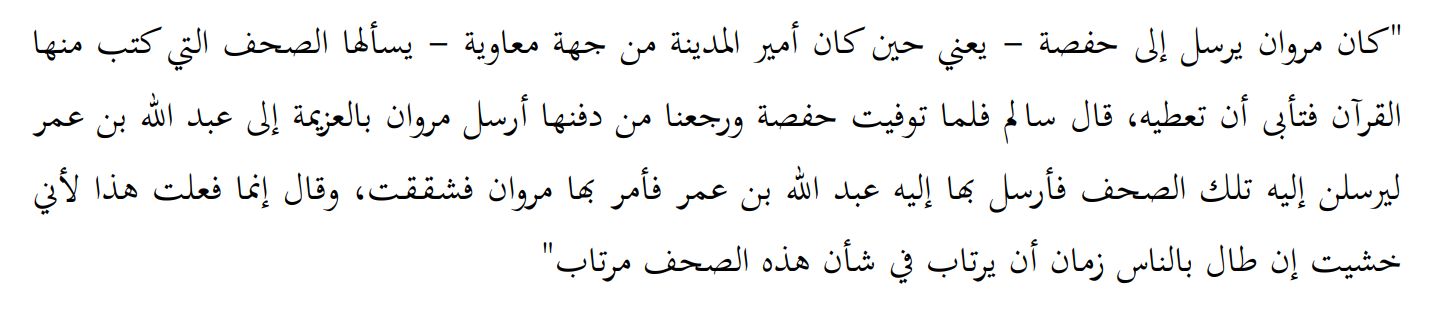
Que Marwan costumava mandar buscar Hafsa – ou seja, quando ele era o emir de Medina por intermédio de Mu'awiyya – pedindo-lhe as folhas a partir das quais o Alcorão foi escrito. Ela recusou-se a entregá-las a ele. Salim disse: Quando Hafsa faleceu, enquanto regressávamos do seu enterro, Marwan comunicou a 'Abd Allah ibn 'Umar a sua firme decisão de que lhe enviasse aquele mushaf. Então 'Abd Allah ibn 'Umar enviou-lhe o mushaf. Marwan ordenou que fosse destruído. Ele disse: Fiz isto porque temia que, se permanecesse com as pessoas por muito tempo, as pessoas teriam dúvidas quanto a estas folhas.
‘That Marwan used to send for Hafsa – i.e when he was the amir of Madinah via Mu'awiyya - asking her for the sheets from which the Qur’ān was written. She refused to give him it. Salim said: When Hafsa died, while we were returning from her burial Marwan communicated his firm decision to 'Abd Allah ibn 'Umar that he send him that mushaf. So 'Abd Allah ibn 'Umar sent it to him. Marwan ordered it to be destroyed. He said: I did this because I feared that if it remained with people for a long time then people will have doubts regarding these sheets’.