26. A Amizade do Crente com os Descrentes
26. The Believer's Befriending The Disbelievers
Allah (SWT) disse:
Allah (swt) said:
“Que os crentes não tomem os descrentes como aliados em vez dos crentes; e quem fizer isso não está em nada com Allah, a não ser que temais algo de sua parte. E Allah vos previne contra Si mesmo, e a Allah é o retorno” [TMQ 3:28].
“Let not the believers take the disbelievers as friends instead of believers, and whoever does that is not of Allah in anything except if you fear from them something to be feared. And Allah warns you against Himself and to Allah is the return” [TMQ 3:28].
Yaʿqub e Sahl recitam como (taqiyyah), que é a recitação de Al-Hasan e Mujahid, enquanto os demais recitam como (tuqat). Diz-se no Al-Qamus Al-Muheet: ‘(At-tawqiyya) é (al-kalau) e proteção. Eu faço (taqa) algo e eu fiz (taqa) e faço (taqi) e (taqa) e ele (taqi) e (tiqa), como (kisa), ou seja, temi isso.’ Este texto da ayah especifica o seu assunto, e este significado linguístico da palavra (taqiyyah) especifica o que esta palavra significa nesta ayah quanto ao sentido, visto que não foi estabelecido para ela nenhum significado na Shariʿah. Portanto, especifica interpretá-la com o seu significado linguístico. Somente sobre esta base é que a ayah é compreendida em sua generalidade e em seus detalhes. Quanto ao que veio nos ahadith sobre as circunstâncias de sua revelação, se forem autenticados, eles orientam quanto aos detalhes do que veio na ayah, mas não mudariam o seu assunto nem o significado de suas frases segundo a língua e a Shariʿah. O assunto da ayah está claro em sua frase, que é os crentes tomarem os descrentes como aliados, isto é, tratá-los como amigos. O texto é:
Ya’qub and Sahl recite it as (taqiyyah) which is the recitation of Al-Hasan and Mujahid, while the rest (recite it) as (tuqat). It is said in Al-Qamus Al-Muheet: ‘(At-tawqiyya) is (al-kalau) and protection. I do (taqa) something and I did (taqa) it and do (taqi) it (taqa) and he (taqi) it (tiqa) like (kisa) is I feared it.’ This text in the ayah specifies its subject and this linguistic meaning of the word (taqiyyah) specifies what this word means in this ayah in meaning since no Shari’ah meaning was established for it. So it specifies interpreting it with its linguistic meaning. Upon this basis alone is the ayah understood in its generality and details. As for what came in the ahadith of the circumstances of its revelation, if authenticated, guides to the details of what came in the ayah but would not change its subject neither the meaning of its sentences according to the language and Shar’a. The subject of the ayah is clear in its sentence which is believers befriending the disbelievers i.e. treating them as friends. The text is:
"Que os crentes não tomem os descrentes como aliados em vez dos crentes" [TMQ 3:28].
“Let not the believers take the disbelievers as friends instead of believers” [TMQ 3:28].
Se a āyah ou os ahadith surgiram a respeito de um assunto específico, então são específicos a esse assunto e não incluem nada além dele. O ponto em questão é o da amizade dos crentes com os descrentes, para a qual veio a āyah proibindo-a de forma categórica. Nem esta é a única āyah sobre o tema; vieram numerosas āyahs, como a declaração de Allah:
If the ayah or ahadith came about a specific subject, then it is specific to this subject and does not include anything else. The issue is the issue of believers befriending disbelievers for which came the ayah decisively prohibiting it. Nor is this the only ayah upon this subject; there have come numerous ayahs like Allah’s statement:
“Anuncie aos hipócritas que haverá para eles um castigo doloroso. Aqueles que tomam os descrentes como (awliya) em vez dos crentes” [TMQ 4:138-139].
“Give tidings to the hypocrites that for them is a painful punishment. Those who take the disbelievers as (awliya) instead of believers” [TMQ 4:138-139].
E a declaração de Allah:
And Allah’s statement:
"Ó vós que credes, não tomeis os descrentes como awliyā’ em vez dos crentes" [TMQ 4:144]
“O you who believe, do not take the disbelievers as (awliya) instead of disbelievers” [TMQ 4:144]
E a declaração Dele (SWT):
And His (swt) statement:
"Você não encontrará um povo que creia em Allah e no Dia do Juízo amando aqueles que se opõem a Allah e ao Seu Mensageiro" [TMQ 58:22]
“You will not find a people who believe in Allah and the Day of Judgement loving those who oppose Allah and His Messenger” [TMQ 58:22]
E a Sua (SWT) declaração
And His (swt) statement
"Não tomeis os judeus e os cristãos como awliya" [TMQ 5:51]
“Do not take the Jews and Christians as (awliya)” [TMQ 5:51]
E a Sua declaração:
And His statement:
"Não tomem como aliados (awliya) o meu inimigo e o vosso inimigo" [TMQ 60:1]
“Do not take my enemy and your enemy as (awliya)” [TMQ 60:1]
O assunto é o da amizade dos crentes com os descrentes, e o restante do versículo detalha esse assunto. Isso porque Allah (SWT) proibiu os crentes de tomarem os descrentes como amigos, e vinculou essa proibição a uma firme determinação de que aquele que o fizer e tomar os descrentes como amigos, então Allah está isento dele. Em seguida, excluiu desta proibição categórica uma situação: a de o crente temer um dano por parte do descrente, caso em que é permitido que ele se aproxime dos descrentes para prevenir esse dano. Isso ocorre se o muçulmano estiver sob a autoridade dos descrentes, derrotado em seu assunto; ou seja, o temor pelo descrente permite essa aproximação. Se o temor desaparecer, então a aproximação passa a ser proibida. Assim, a situação não envolve demonstrar amizade enquanto se esconde outra coisa; o ponto é excluir a situação do temor do crente em relação ao descrente, quando o muçulmano está derrotado em seu assunto, da generalidade da proibição de se aproximar deles. O significado do versículo é a proibição categórica para os crentes de tomarem os descrentes como seus amigos, de buscarem o seu auxílio e de depositarem neles a confiança, de estabelecerem amizade com eles e de haver amor entre eles. Assim, proibiu aos crentes a amizade com os descrentes em vez dos crentes, e então excluiu uma situação dessa proibição, que é aquela em que existe temor deles quando os crentes estão sob a sua autoridade. Nesse caso, é permitido demonstrar afeição por eles e se aproximar deles para afastar o seu mal e o seu dano. Ou seja, é permitido tomá-los como amigos na situação em que há temor deles quando estão sob o seu domínio. Fora isso, é absolutamente proibido. Isto vale apenas para os descrentes em relação aos crentes, pois o versículo foi revelado a respeito dos crentes que mantinham relações de amizade com os politeístas de Makkah. Ela proibiu aos que estavam em Medina de fazer amizade com os politeístas de Meca, e proibiu todos os crentes, mas excluiu dessa proibição os crentes que estavam em Meca e que foram derrotados em seu assunto. Assim, excluiu-os por causa da existência do temor do dano dos descrentes próximos a eles. Este é o tema do versículo, este é o seu significado, e esta é a regra da Shari'ah deduzida dele, que é a proibição de os crentes fazerem amizade com os descrentes em todos os tipos de amizade, seja por apoio, afeição, auxílio etc., já que o termo (awliya) veio em sentido geral no versículo, abrangendo todos os seus significados, e a permissão de fazer amizade com eles na situação de temê-los, ou seja, temer sua violência e seu dano quando os descrentes prevalecem sobre os muçulmanos e os muçulmanos são derrotados em seu assunto, exatamente como a situação dos muçulmanos em Meca com os politeístas. Não existe no versículo nenhum outro significado, nem qualquer outra regra além desta, deduzida dele. Quanto ao que alguns dizem, que a "taqiyyah" é que um muçulmano mostre o oposto do que esconde diante de qualquer pessoa da qual teme dano ou da qual teme que ela conheça sua realidade e o que há em sua alma, seja essa pessoa descrente ou crente, esta afirmação é puro erro. O versículo não indica nada disso, pois o sentido de: "Exceto se temerdes deles (tuqat)", isto é, exceto se temerdes deles algo que cause receio, como o sentido de "ittaqaytu" algo, "taqiyyah", é que temi isso, e (tuqat) e (taqiyyah) têm o mesmo significado. Isso é excluído da proibição de os crentes fazerem amizade com os descrentes no lugar dos crentes, portanto é específico àquilo que foi excluído dela.
Você não encontrará um povo que crê em Allah e no Último Dia amando aqueles que se opõem a Allah e ao Seu Mensageiro ﷺ. [TMQ 58:22]
‘You will not find a people who believe in Allah and the Last Day loving those who oppose Allah and His Messenger’ [TMQ 58:22]
E a declaração Dele (SWT):
And His (swt) statement:
"Não tomem os judeus e os cristãos como aliados." [TMQ 5:51]
‘Do not take the Jews and Christians as friends’ [TMQ 5:51]
E a declaração Dele (SWT):
And His (swt) statement:
"Não tomem como amigos o meu inimigo e o vosso inimigo." [TMQ 60:1]
‘Do not take my enemy and your enemy as friends.’ [TMQ 60:1]
E a declaração Dele (SWT):
And His (swt) statement:
"Não tomem como amigos o meu inimigo e o vosso inimigo." [TMQ 60:1]
‘Do not take my enemy and your enemy as friends.’ [TMQ 60:1]
A declaração Dele (SWT):
His (swt) statement:
"Em vez de crentes" [TMQ 28:53]
‘Instead of believers’ [TMQ 28:53]
Significa que a amizade é obrigatória com os crentes, e isto é uma proibição de fazer amizade com os descrentes e de os ajudar contra os crentes. E diz-se (que é) uma proibição de tratar os descrentes com bondade e afabilidade. Foi narrado de Ibn Abbas: "amigos" (awliya) é o plural de "amigo" (waliyy), que é aquele que comanda o que está satisfeito com a sua ação com assistência e apoio, e ocorre de duas formas. Primeiro, o apoiante designado com apoio, e o outro que é o apoiado. Assim, a Sua (swt) afirmação:
Means that friendship is obliged with believers, and this is a prohibition from befriending disbelievers and assisting them against believers. And it is said (that it is) a prohibition of treating the disbelievers with kindness and friendliness. It is narrated from ibn Abbas: "friends" (awliya) is the plural of "friend (waliyy) who is the one who commands the one pleased with his action with assistance and support, and it occurs in two ways. Firstly, the designated supporter with support and the other who is the supported. So His (swt) statement:
‘Allah é o aliado dos que creem’ [TMQ 2:257
‘Allah is the friend of those who believe’ [TMQ 2:257
Significa os seus auxiliares e apoiantes, pelo Seu apoio, e diz-se que o crente é amigo de Allah, ou seja, alguém amparado pelo Seu apoio. Quanto à Sua afirmação "quem fizer isso", refere-se a quem toma os descrentes como amigos em vez dos crentes, "então não está com Allah em nada", ou seja, não está entre os amigos de Allah (swt), e Allah (swt) está isento dele; diz-se também que ele não está sob a proteção (wilayah) de Allah em nada. Depois, Ele fez uma exceção e disse:
Means their helpers and supporters by His support, and it is said that the believer is the friend of Allah i.e. one assisted by His support. His statement: ‘whoever does that’ means whoever takes disbelievers as friends instead of believers ‘then he is not of Allah in anything’ i.e. he is not from the friends of Allah (swt) and Allah (swt) is absolved of him, and it is said he is not from the friendship (wilayah) of Allah in anything. Then He excluded and said:
"exceto se temerdes deles algo a ser temido"
‘except if you fear from them something to be feared’
Exceto que, se os descrentes saírem vitoriosos e os crentes forem derrotados, de modo que o crente tema por eles caso não demonstre sua concordância com eles ou não mantenha boa companhia com eles, nesse momento é permitido que ele demonstre afeição por eles com a língua e obediência a eles como precaução (taqiyyah) diante deles e como proteção para si mesmo, sem acreditar nisso. Nesta āyah há uma indicação de que a taqiyyah é permitida na religião quando há temor por si mesmo, e nossos companheiros dizem que ela é permitida em todos os assuntos em tempos de necessidade, e frequentemente torna-se obrigatória para a variedade de gentileza e reconciliação, mas não é permitida nas ações de matar um crente ou naquilo que é conhecido, ou que ele considera mais provável, como causa de corrupção (istifsād) na religião. Al-Mufīd disse que ela é obrigatória em certos momentos e torna-se fardo, e é permitida em outros momentos e torna-se recomendada. E é permitida em certo momento sem obrigação, e às vezes torna-se melhor do que deixá-la; e pode, por vezes, ser melhor deixá-la, ainda que quem a pratique seja desculpado e perdoado por ela, por não haver culpa sobre ele. O Xeique Abu Ja'far At-Tūsī disse que o sentido aparente das narrações indica que ela é obrigatória durante o temor pela própria vida, e foi narrado que há uma dispensa quanto a dizer claramente a verdade nessa situação. Al-Ḥasan narrou
means except that if the disbelievers are victorious and the believers defeated so the believer fears them if he does not show his agreement with them or make good his companionship with them. At that time, it is allowed for him to show his affection for them with his tongue and compliance to them as a precaution (taqiyyah) from them and protection for himself without believing that. In this ayah there is an indication that taqiyyah is permitted in the deen when there is fear over oneself and our companions say it is permitted in all matter at times of necessity and often it becomes obligatory for the variety of kindness and reconciliation, but it is not permitted from the actions in killing a believer or what is known or he considers most probable that it is spoiling (istifsad) in the deen. Al-Mufid said that it is obligatory at times and becomes fard, and it is permitted at times and becomes recommended. And it is permitted at time without obligation and it becomes at times better than leaving it; and it could at times be better to leave it even though its performer is excused and forgiven over it by leaving the blame over it. Sheikh Abu Ja’far At-Tusi said that the apparent meaning of the narrations indicate that it is obligatory during fear of one’s life, and it has been narrated that a dispensation in allowing speaking clearly the truth thereupon. Al-Hasan narrated
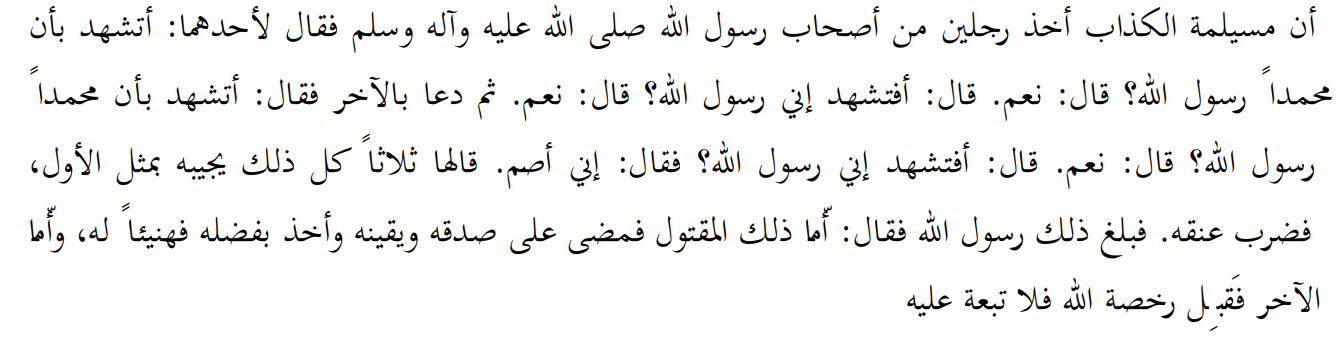
"Aquele Musaylimah, o mentiroso, pegou dois homens dentre os Companheiros do Mensageiro de Allah ﷺ e disse a um deles: Você testemunha que Muhammad é Mensageiro de Allah ﷺ? Ele disse: Sim. Ele disse: Então você testemunha que eu sou Mensageiro de Allah? Ele disse: Sim. Em seguida, chamou o outro e disse: Você testemunha que Muhammad é Mensageiro de Allah ﷺ? Ele disse: Sim. Então disse: Então você testemunha que eu sou Mensageiro de Allah? Ele disse: Sou surdo (a isso). Ele repetiu isso três vezes, e cada vez o homem lhe respondia como na primeira, então ele lhe cortou o pescoço. Isso chegou ao conhecimento do Mensageiro de Allah ﷺ, que disse: Quanto ao que foi morto, ele executou sua verdade e sua convicção, e obteve sua virtude, então que seja bom para ele. Quanto ao outro, ele aceitou a concessão de Allah, então não há responsabilidade sobre ele."
‘That Musaylimah the liar took two men of the Sahabah of the Messenger of Allah (saw) and said to one of them: Do you bear witness that Muhammad is a Messenger of Allah? He said: Yes. He said: Then do you bear witness that I am a Messenger of Allah? He said: Yes. Then he called for the other and said: Do you bear witness that Muhammad is a Messenger of Allah? He said: Yes. Then he said: Then do you bear witness that I am a Messenger of Allah? He said: I am deaf (to that). He said it thrice each time answering him like the first so he struck off his neck. This was conveyed to the Messenger of Allah who said: As for the one killed, he executed his truth and conviction, and he took his virtue so may it be good for him. As for the other, he accepted the concession of Allah so there is no liability on him.’
Consequentemente, a taqiyyah é uma dispensa, e falar claramente a verdade é uma virtude” (fim da fala de At-Tabarsi).
Accordingly taqiyyah is a dispensation and speaking clearly the truth is a virtue” (At-Tabarsi’s speech ends).
Assim, mostra-se, a partir das palavras dos dois mufassirin, At-Tabari e At-Tabarsi, que pertencem a duas escolas de pensamento diferentes, o seu acordo em explicar o significado do versículo tal como foi revelado: trata-se de uma proibição aos crentes de manterem amizade com os descrentes, excetuando-se a situação em que os crentes temem o dano dos descrentes. Vejam as palavras de At-Tabari: "exceto se temerdes deles algo a temer (tuqat)" (isto é) exceto se estiverdes sob a autoridade deles e temerdes por vossas vidas, de modo que lhes demonstreis amizade com a língua. E vejam as palavras de At-Tabarsi: "Então Ele excetuou e disse: 'exceto se temerdes deles algo a temer', e o significado é: exceto se os descrentes saírem vitoriosos e os crentes forem derrotados, de modo que o crente tema por eles se não demonstrar concordância com eles e não cultivar sua amizade. Naquele momento, é permitido que ele demonstre seu afeto por eles com a língua e a submissão a eles como precaução e para proteger sua alma." Os dois mufassirin concordam que o assunto é a exceção à proibição de os crentes manterem amizade com os descrentes, e que essa exceção se limita a isso. Contudo, At-Tabarsi foi além do assunto e tomou o versículo como prova de que a taqiyyah é permitida na religião durante a vida, o que não está presente no versículo, pois seu tema é a proibição de os crentes manterem amizade com os descrentes, e a exceção se refere à situação de temor dos descrentes quando estes derrotam os muçulmanos, permitindo a amizade nessa situação. Não se trata de taqiyyah na religião, nem ela se restringe ao temor por vida, pois a exceção é geral: "exceto se temerdes deles algo a temer" (isto é) exceto se temerdes deles aquilo de que se deve temer. Az-Zamakhshari disse em Al Kashaf
Accordingly it is shown from the words of the two mufasireen, At-Tabari and At-Tabarsi, who are of two different schools of thought, their agreement upon explaining the meaning of the ayah as it came in that it is a prohibition for believers befriending disbelievers and excluding the situation of believers fearing the harm of the disbelievers from this prohibition. Look at the words of At Tabari: “except if you fear from them something to be feared (tuqat)’ (i.e.) except if you are in their authority and you fear them over your lives so you show them friendship with your tongues.” And look at the words of At-Tabarisi: “Then He excluded and said: ‘except if you fear from them something to be feared’ and the meaning is except if the disbelievers are victorious and believers defeated so the believer fears them if he does not show his agreement with them and does not make good his friendship with them. At that time it is allowed for him to show his love for them by his tongue and compliance to them as a precaution and in protection of his soul.” The two mufasireen agree that the subject is excluding the prohibition of believers befriending disbelievers and that it is limited to that. Except that At-Tabarisi followed upon that which is outside the subject and made the ayah an evidence that taqiyyah is permitted in the deen during for one’s life which is not present in the ayah since its subject is the prohibition of believers befriending disbelievers and excluding the situation of fear of the disbelievers when they defeat the Muslims in allowing their friendship in this situation. It is not taqiyyah in the deen nor is it specified to fear over life because the exclusion is general “except if you fear from them something to be feared” (i.e.) except if you fear from them what is to be feared from. Az-Zamakhshari said in Al Kashaf
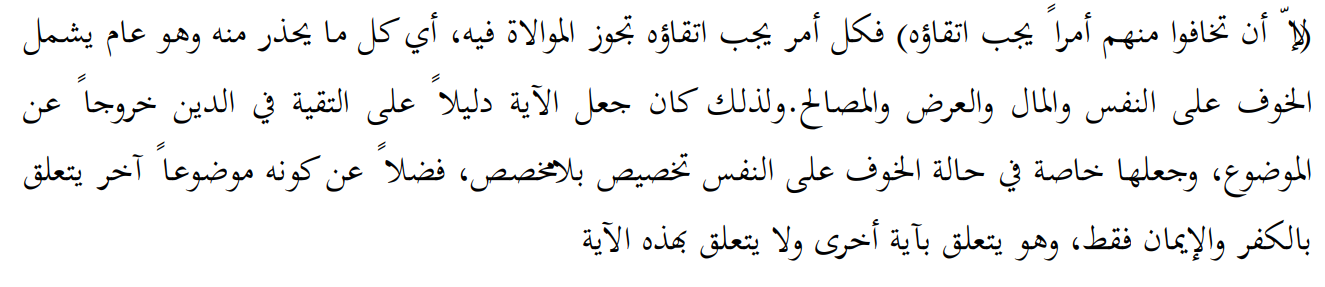
"Exceto se temerdes deles algo que exija proteção" — assim, qualquer assunto do qual se deve proteger permite a amizade com eles, isto é, tudo aquilo que se teme deles, abrangendo o temor pela vida, pelos bens, pela honra e pelos interesses. Consequentemente, tomar o versículo como evidência para a (taqiyyah) na religião fora do assunto em questão, e restringi-lo à situação de temor pela vida, constitui uma especificação sem um especificador (evidência). Além disso, trata-se de outro assunto, relacionado apenas à descrença (kufr) e à fé (iman), que se vincula a outro versículo e não tem relação com este versículo.
“Except if you fear from them a matter which requires protection from” so any matter which must be protected from permits befriending it i.e. all that you fear them which is general covering fear over life, wealth, honour and interests. Accordingly making the ayah an evidence for (taqiyyah) in the deen outside the subject, and making it specific in the situation of fear over life is specification without a specifying (evidence). This is besides it being another subject relating to kufr and iman only which is related to another ayah and it is not related to this ayah.
Quanto à declaração de At-Tabarisi: “Os nossos companheiros disseram que é permitido em todos os assuntos durante a necessidade”, então o que ele cita de Al-Mufid sobre ser obrigatório ou não obrigatório, até ao final do que mencionou, é um discurso abstrato sem qualquer evidência. O versículo não indica isto de nenhuma forma, nem mesmo segundo o próprio tafsir de At-Tabarisi, e ele não trouxe nenhuma outra prova, nem do Livro, nem da Sunnah, nem do consenso (ijma‘) dos Companheiros. Por isso, é rejeitado e cai da categoria de algo a ser considerado. Nem se pode dizer que, se for permitido aliar-se aos descrentes em situação de temor deles, então a obediência ao governante injusto ou transgressor que detém o poder tem maior precedência. Isto não se diz, porque aquilo que tem maior precedência é o sentido do discurso, e isto não faz parte dele, nem há qualquer extensão de conexão com ele. Não é como a declaração de Allah:
As for the statement of At-Tabarisi: “Our companions said (it is) permitted in all matters during necessity” then what he quotes from Al-Mufid of its being obligatory or not obligatory to the last of what he mentioned is abstract speech of any evidence. The ayah does not indicate this in any way even according to At-Tabarisi’s own tafsir, nor did he come with any other evidence neither from the Book or Sunnah or Ijma’a of the Sahabah, hence it is rejected and falls from the rank of consideration. Nor is it said that if befriending disbelievers in the situation of fear of them is allowed then compliance with the unjust or transgressor ruler with power is of greater precedent. This is not said because that which is of greater precedent is the sense of the speech and this is not from it nor is their any extention of any connection with it. It is not like Allah’s statement:
"Entre eles há alguém que, se você lhe confiar um dinar, não o devolverá a você" [TMQ 3:75]
“Among them is one whom if you entrust him with a Dinar would not return it to you” [TMQ 3:75]
Nem é como a declaração de Allah:
Nor is it like Allah’s statement:
"E entre o Povo do Livro há quem, se lhe confiares um qintar, to devolverá" [TMQ 3:75].
“And of the People of the Book is one whom if you entrusted with a qintar will return it to you” [TMQ 3:75].
Isto se deve ao fato de que o transgressor não pertence à categoria do descrente nem à sua classe, e porque a amizade proibida nesta āyah é tomar como amigos aqueles que estão no lugar dos crentes. O governante injusto e transgressor que detém o poder está entre os crentes; a injustiça que procede dele, ou a transgressão que o cobre, não anula a descrição de īmān que lhe é atribuída. Por isso, este assunto não entra na pesquisa do precedente maior, e, em consequência, o precedente maior não se aplica a ele de modo que seja usado como testemunho.
This is because the transgressor is not from the category of the disbeliever or from their class, and because the friendship prohibited in this ayah is befriending instead of the believers. The unjust and transgressor ruler with power is among the believers injustice occurring from him or the transgression covering him does not negate the description of iman from him. Hence this subject does not enter in the research of greater precedent, so accordingly the greater precedent does not come into it such that it is used as a witness.
Além disso, a amizade com o governante injusto e transgressor que detém o poder é permitida tanto em situação de segurança quanto em situação de medo, pois ele é um crente, e a amizade com os crentes é definitivamente permitida, porque a palavra "crentes" em Sua afirmação: "em vez de crentes" é geral, abrangendo todos os crentes. Não surgiu nenhum texto que proíba a amizade com o governante injusto ou transgressor, ou a amizade com os transgressores e os perversos (fujjar); antes, os textos são específicos em proibir a amizade com os descrentes. Mais do que isso, a obediência ao governante injusto é obrigatória em tudo que não seja pecado, e o jihad é obrigatório sob a sua bandeira, sendo permitido rezar atrás do Imam na oração mesmo que ele seja transgressor, o que são as mais fortes indicações a respeito da permissão de sua amizade. O que é proibido é o contentamento com a injustiça do governante e com a transgressão do transgressor. Consequentemente, rejeita-se a taqiyyah quando se trata de um crente que demonstra o oposto do que oculta diante de um governante injusto ou transgressor poderoso, ou de um opositor na opinião ou similar, e fazê-lo é haram, pois é hipocrisia, e toda hipocrisia é proibida.
Moreover the befriending of the unjust and transgressor ruler with power is allowed in the situation of security and the situation of fear equally because he is a believer and befriending believers is definitely allowed because the word “believers” in His statement: “instead of believers” is general covering all believers. There did not come any text prohibiting befriending the unjust or transgressor ruler or befriending transgressors and the wicked (fujjar); rather the texts are specific in prohibiting the befriending of disbelievers. More than that, the obedience to the unjust ruler is obliged in other than sin and jihad is obliged under his banner and it is allowed to pray behind the Imam in prayer if he is a transgressor which are of the greatest indication regarding permitting their friendship. What is prohibited is the pleasure with the injustice of the ruler and the transgression of the transgressor. Accordingly taqiyyah is rejected when it is a believer showing opposite to what he hides in front of powerful unjust or transgressor ruler or opponent in the opinion or similar, and doing it is haram as it is hypocrisy and all hypocrisy is forbidden.
"Exceto aquele que for compelido enquanto o seu coração permanece firme na fé" [TMQ 16:106].
“Except the one who is compelled and his heart is content upon iman” [TMQ 16:106].
Alguns mufassirun associam isso com o versículo: "exceto se temerdes deles algo a temer", e deduzem dele que mostrar a descrença e ocultar a fé entra na categoria da amizade, fazendo com que entre no que chamam de (taqiyyah), havendo quem deduza dele que a amizade é permitida apenas na situação de temor pela própria vida, mas não em outras situações. Isso é puro erro, pois o versículo: "exceto aquele que for coagido, enquanto seu coração estiver tranquilo com a fé" trata de uma situação diferente e de um assunto diferente, já que seu assunto é a apostasia do Islam na situação em que existe o temor de uma morte certa e confirmada, e não provável, enquanto o assunto do versículo: "exceto se temerdes deles algo a temer" é a proibição de se fazer amizade com os descrentes em todos os seus tipos, excluindo a permissibilidade dessa amizade na situação em que existe algo temido, seja o temor pela vida, pela riqueza, pelo interesse ou por qualquer dano. Ele distingue entre as duas situações e os dois assuntos, de modo que um não entra no outro nem estão vinculados um ao outro, devido à diferença de situação e de assunto. Quando o muçulmano está sob a autoridade de descrentes que o venceram em seu caso diante deles, não lhe é permitido apostatar do Islam como demonstração de submissão a eles; ao contrário, é obrigatório que ele emigre, caso seja incapaz de cumprir as normas de sua religião, o que é diferente de se fazer amizade com eles, que é permitido. No entanto, se os muçulmanos temerem pela vida dele uma morte certa e ele for forçado à descrença, então é permitido que ele demonstre descrença e oculte a fé; fora isso, não é permitido, por causa do texto do versículo:
Some mufasireen link it with the ayah: “except if you fear from them something to be feared” and deduce from it the entering of showing kufr and hiding iman in the category of friendship and making it to enter what they call (taqiyyah), with some deducing from it that friendship is allowed in the situation of fearing for one’s life only but not in other (situations). This is pure error because the ayah: “except the one who is compelled and his heart is content upon iman” has a different situation and a different subject as its subject is apostasy from Islam in the situation where there exists fear of definite, confirmed killing not probable and the subject of the ayah: “except if you fear from them something to be feared” is prohibiting befriending disbelievers in all its types and excluding the permissibility of this befriending in the situation of there existing what is feared from whether it was fear over life, wealth, interest or any harm. It distinguishes between the two situations and two subjects such that one does not enter into the other nor are they linked with it due to the difference in situation and subject. When the Muslim is under the authority of disbelievers defeated over his matter before them, it is not permitted for him to apostatise from Islam as a show of compliance to them; rather it is obligatory upon him to emigrate if he is unable to perform the rules of his deen contrary to befriending them which is allowed. However if the Muslims fear over his life a confirmed death and he is forced upon kufr then it is permitted for him to show kufr and hide iman, and other than that it is not permitted because of the text of the ayah:
“Quem descrer em Allah depois de ter tido fé, exceto aquele que for compelido enquanto o seu coração permanecer contente com a fé, …” [TMQ 16:106].
“Whoever disbelieves in Allah after his iman except the one who is compelled and his heart is content upon iman.” [TMQ 16:106].
O assunto é o da descrença (kufr) após a fé (īmān), isto é, o assunto da apostasia do Islã, e a situação é a de temer a morte. Isto é o que os fuqahā chamam de ikrāh mulji' (coação por refúgio), que é a única coação considerada pela Sharī'a em todas as situações em que a norma é suspensa para quem é coagido. A coação que a Sharī'a excluiu é a coação por refúgio, isto é, a situação de temer a morte certa. Isto é reforçado pelo āyah que foi revelado sobre os muçulmanos que apostataram por temor da morte. Foi narrado que este āyah foi revelado sobre 'Ammār bin Yāsir. At-Ṭabarī disse: "Muḥammad bin Sa'd relatou-me e disse: meu tio paterno relatou-me e disse: meu pai relatou-me, de seu pai, de Ibn 'Abbās, sobre o dito de Allah: 'Quem descrer em Allah depois da sua fé, exceto quem for coagido e o seu coração estiver contente com a fé', até o fim do āyah. Isto ocorreu porque os politeístas espancaram 'Ammār bin Yāsir, castigaram-no e depois o deixaram. Então ele voltou ao Mensageiro de Allah ﷺ e informou-o sobre o que enfrentou dos Quraysh e o que disse. Então Allah revelou a menção da sua desculpa: 'Quem descrer em Allah depois da sua fé', até o dito 'grande castigo'. Bashr relatou-nos e disse: Yazīd relatou-nos e disse: Sa'īd relatou-nos, de Qatādah: 'Quem descrer em Allah depois da sua fé, exceto quem for coagido e o seu coração estiver contente com a fé', e disse: Foi-nos mencionado que foi revelado sobre 'Ammār bin Yāsir, a quem os Banū al-Mughīra capturaram e mergulharam no poço de Maymūn, dizendo: Descreia em Allah. Então ele os seguiu nisso, mas o seu coração estava coagido. Então Allah revelou o Seu dito: 'exceto quem for coagido e o seu coração estiver contente com a fé'." E At-Tabari disse: Ibn Abd al-‘Ala nos relatou e disse: Muhammad bin Thawr nos relatou, de Mu’ammar, de Abdulkareem Al-Juzri, de Abu Ubayd bin Muhammad bin Ammar bin Yasir, que disse:
So the subject is the subject of kufr after iman i.e. the subject of apostasy from Islam, and the situation is the situation of fearing death. This is what the fuqaha term as alikrah almulji (compulsion of refuge) which is the only compulsion considered by the Shar’a in all situations in which the rule is lifted from the one compelled. The compulsion which the Shar’a excluded is the compulsion by refuge i.e. the situation of fearing definite death. This is strengthened in the ayah that was revealed about Muslims who apostatised fearing death. It was narrated that this ayah was revealed about Ammar bin Yasir. At-Tabari said: “Muhammad bin S’aad related to me and said: My paternal uncle related to me and said: My father related to me from his father from ibn Abbas that His statement: ‘Whoever disbelieves in Allah after his belief except the one who is compelled and his heart is content upon iman’ to the end of the ayah. This was because the polytheists struck Ammar bin Yasir and punished him then left him. So he returned to the Messenger of Allah (saw) and informed him about what he met with from Quraysh and what he said. So Allah (swt) revealed his mention of his excuse: ‘Whoever disbelieves in Allah after his iman’ until His statement ‘great punishment.’ Bashr related to us and said: Yazid related to us and said: Saeed related to us from Qatadah: ‘Whoever disbelieves in Allah after his belief except the one who is compelled and his heart is content upon iman’ and said: It was mentioned to us that it was revealed about Ammar bin Yasir whom Banu Al-Mughira captured and covered him in the well of Maymun and said: Disbelieve in Allah, so he followed them in that and his heart was compelled. So Allah (swt) revealed His statement: ‘except the one who is compelled and his heart is content upon iman.’ And At-Tabari said: Ibn Abd al-‘Ala related to us and said: Muhammad bin Thawr related to us from Mu’ammar from Abdulkareem Al-Juzri from Abu Ubayd bin Muhammad bin Ammar bin Yasir who said:
Os politeístas capturaram Ammar bin Yasir e o castigaram até que ele dissesse algo do que eles queriam. Ele mencionou isso ao Profeta ﷺ, e o Profeta ﷺ disse: "Como você encontrou o seu coração?" Ele respondeu: "Firme na fé." O Profeta ﷺ disse: "Se eles voltarem a fazer isso, então repita."
The polytheists took Ammar bin Yasir and punished him until he said to them in some of what they wished. He mentioned that to the Prophet (saw) and the Prophet (saw) said: How did you find your heart? He said: Secured upon iman. The Prophet (saw) said: If they repeat, then you repeat.”
Esses ahadith indicam que a circunstância de revelação do versículo é o incidente de Ammar, e que seu assunto é a apostasia do Islã. A situação específica a ele é o temor definitivo de ser morto, que por si só basta para reforçar que não tem relação com o versículo: "exceto se temerdes deles algo a ser temido". O versículo: "exceto quem for forçado enquanto seu coração permanece firme na fé" foi revelado em Makkah sobre o assunto da fé (imān), e o versículo: "exceto se temerdes deles algo a ser temido" é de Madinah, revelado sobre a exclusão da situação de temer algo a ser temido da proibição de os crentes tomarem os descrentes como aliados. Por conseguinte, este versículo não é aplicável a esse assunto.
These ahadith indicate that the circumstance of revelation of the ayah is the incident of Ammar and its subject is apostasy from Islam. The situation specific to it is the definite fear of killing which alone is sufficient to strengthen that it has no relationship with the ayah: “except if you fear from them something to be feared.” The ayah: “except the one who is compelled and his heart is content upon iman” was revealed in Makkah on the subject of iman, and the ayah: “except if you fear from them something to be feared” is Madinan revealed on the subject of excluding the situation of fearing what is to be feared from the prohibition of believers befriending disbelievers. Accordingly this ayah is not applicable on that subject.
Resta a regra referente àquele que está ameaçado de morte confirmada: é mais virtuoso demonstrar kufr e ocultar o iman para estar a salvo da morte, ou é melhor perseverar em seu iman mesmo que isso leve à morte? A resposta é que perseverar no iman, mesmo que isso leve à morte, é melhor, porque a permissão de demonstrar kufr é uma dispensa (rukhsah) que alivia a dificuldade, enquanto preservar o iman é a conduta de excelência (‘azeemah), que é o princípio; portanto, é melhor. Foi narrado
There remains the rule regarding the one threatened with confirmed killing: Is it more virtuous to show kufr and hide iman so as to be safe from death or is it better to persevere upon his iman even if it leads to death? The answer is that persevering to iman even if it leads to death is better because the permissibility of showing kufr is a dispensation and lifts difficulty, and preserving the iman is (‘azeemah) which is the principle therefore it is better. It is narrated

“Que Musaylimah tomou dois homens e disse a um deles: O que você diz sobre Muhammad ﷺ? Ele respondeu: Um Mensageiro de Allah ﷺ. Ele disse: E o que você diz de mim? Você também. Então o deixou livre. Disse ao outro: O que você diz sobre Muhammad ﷺ? Ele respondeu: Um Mensageiro de Allah ﷺ. Ele disse: E o que você diz de mim? Ele respondeu: Sou surdo. Repetiu isso três vezes, e ele repetiu sua resposta, então o matou. Isso chegou ao Mensageiro de Allah ﷺ, e ele disse: Quanto ao primeiro, aceitou a permissão de Allah. Quanto ao segundo, proclamou a verdade, então que seja abençoado.”
“That Musaylimah took two men and said to one of them: What do you say about Muhammad? He said: A Messenger of Allah. He said: Then what do you say of me? You as well. So he left him free. He said to the other: What do you say of Muhammad? He said: A Messenger of Allah. He said: Then what do you say of me? He said: I am dumb. He repeated it thrice and he repeated his answer, so he killed him. That reached the Messenger of Allah (saw) so he said: As for the first, he took the dispensation of Allah. As for the second, he exposed the truth so blessed be he.”
Isto é explícito em preferir aquele que foi paciente e se manteve firme na fé (iman) àquele que tomou a permissão (rukhsa) de Allah (SWT) e demonstrou kufr por temor pela própria vida diante de uma morte certa.
This is explicit in preferring the one who was patient and stuck to iman over the one who took the dispensation of Allah (swt) and showed kufr fearing for his life from a confirmed killing.
Isto diz respeito àquele de quem se exige o kufr. Quanto àquele de quem se busca algo menos do que isso, como abandonar a da'wah islâmica ou cometer um pecado ou algo semelhante, não se extrai permissão a partir deste versículo. Por isso, não se diz que, se Allah permitiu ao muçulmano mostrar kufr, então o que é menor do que o kufr tem precedência maior. Não se diz isso porque a desobediência não pertence à espécie do kufr, portanto não entra na pesquisa por precedência maior. Da mesma forma, não se realiza uma analogia entre o kufr e o pecado, já que não existe uma razão que justifique a analogia. Entretanto, quanto àquele que teme pela sua vida diante de uma morte certa, e se exige dele um pecado ou algo menor do que o kufr, é permitido que ele o faça para salvar sua vida, e não há pecado sobre ele. Isso se deve ao dito do Profeta ﷺ:
This is regarding the one from whom kufr is demanded. As for the one from whom is sought less than that like leaving the Islamic da’wah or performing a sin or something similar; permissibility is not taken from this ayah. Accordingly it is not said that if Allah permitted the Muslim to show kufr, then what is lesser than kufr is of greater precedent. This is not said because disobedience is not from the species of kufr, so it does not enter the research by greater precedent. Similarly an analogy between kufr and sin is not performed since there does not exist a reason until analogy occurs. However as for the one who fears for his life over confirmed killing and it is sought from him sin or doing less than kufr, it is permitted for him to do so to save his life and there is no sin upon him. This is due to his (saw) statement:
"Foram perdoado à minha Ummah o erro, o esquecimento e aquilo a que for coagida."
“Lifted from my Ummah is the mistake, forgetfulness and what is compelled upon it”
Ou seja, a culpa e o pecado são retirados, e a norma é retirada, o que significa a permissibilidade de fazê-lo. No entanto, isto ocorre apenas numa situação, que é a situação de morte certa e confirmada, o que os fuqaha chamam de alikrah almulji (coação por refúgio), que é a única coação considerada pela Shar'a em todas as condições, na qual se retira da pessoa coagida, como no divórcio, no casamento, no comércio e em outras ações e contratos. A Sua declaração "e o que é imposto a ele" refere-se ao alikrah almulji (coação por refúgio).
I.e. the blame and sin is lifted, and the rule is lifted, which means the permissibility of doing it. However (this is) only in one situation which is the situation of definite, confirmed killing which is what the fuqaha called alikrah almulji (compulsion by refuge) which is the only compulsion considered by the Shar’a in all conditions in which there is lifted from the one compelled like divorce, marriage, trade and other actions and contracts. His statement “and what is forced upon it” which is alikrah almulji (compulsion by refuge).