9. Ciência e Cultura
9. Science And Culture
Em língua árabe diz-se: o homem alcançou (‘alima) o conhecimento (‘ilm). Isso significa que ele atingiu a verdadeira realidade do conhecimento (‘ilm). Quando se diz que ele obteve conhecimento de uma coisa, quer dizer que se tornou ciente dela, ou seja, que foi informado sobre um assunto ou que se familiarizou com ele. Também na língua se diz: ele adquiriu compreensão (thaqifa), o que significa que se tornou proficiente, e assim é instruído e culto (thaqif). Ele entendeu (thaqifa) uma língua, quer dizer, dominou-a e compreendeu-a rapidamente. Esses significados linguísticos são a base do uso das palavras. No entanto, se essas palavras forem usadas para indicar outros significados relacionados ao significado linguístico, isso é permitido, como no caso da adoção da palavra fa’il (sujeito) na gramática, por exemplo. O significado linguístico (das palavras) era predominante, e por isso os antigos aplicavam a palavra ‘ilm a todas as formas de conhecimento, sem distinguir entre as ciências e disciplinas. Depois, as pessoas passaram a considerar as disciplinas intelectuais e naturais como gerais a todos os povos, enquanto outras disciplinas tradicionais (textuais) passaram a ser consideradas específicas da nação de onde haviam sido transmitidas. Posteriormente, cada uma das palavras ‘ilm (ciência) e thaqafa (cultura) começou a ser definida de acordo com diferentes disciplinas específicas, adquirindo significados terminológicos diferentes de seus significados linguísticos. Segundo essa terminologia, elas têm o seguinte significado: ‘ilm (ciência) é o conhecimento adquirido por meio da observação, da experimentação e da educação, como a física, a química e as demais ciências empíricas; e thaqafa (cultura) é o conhecimento adquirido por meio da transmissão, do aprendizado e da dedução, como no estudo da história, das línguas, da jurisprudência (fiqh), da filosofia e das demais disciplinas não empíricas. E há outras disciplinas não empíricas que são incluídas como ciências (‘ilm), mesmo estando inseridas na cultura (thaqafa), como a aritmética, a engenharia e a indústria; ainda que pertençam à cultura, são consideradas parte da ciência porque são universais a todos os povos e não específicas de nenhuma nação. De modo semelhante, tudo o que pertence à cultura relacionada aos ofícios que se assemelham à indústria, como o comércio e a navegação, é considerado parte da ciência e é universal. Quanto às artes, como a pintura, a escultura e a música, elas fazem parte da cultura. Seguem um ponto de vista particular, que é uma cultura específica. A diferença entre cultura (thaqafa) e ciência (‘ilm)
In Arabic language it is said: the man has obtained (‘alima) knowledge (‘ilm). This means that he attained the true reality of knowledge (‘ilm). He gained knowledge of a thing means he became cognisant of it, which means that he became informed of a matter or acquainted with it. Also in the language it is said: He has gained comprehension (thaqifa), which means that he has become proficient, thus he is educated and cultured (thaqif). He has understood (thaqifa) a language (means) he has mastered and understood it swiftly. These linguistic meanings are the basis of the use of words, However if these words were used to indicate other meanings that relate to the linguistic meaning then that is permitted, like in the case of the adoption of the word fa’il (subject) in grammar for example. The linguistic meaning (of the words) was prevailing and this is why the ancients used to apply the word ‘ilm on all forms of knowledge without differentiating between the sciences and disciplines. Then people began to consider intellectual and natural disciplines as being general to all people whilst other traditional (textual) disciplines were considered specific to the nation from which it was transferred. Subsequently, each of science (‘ilm) and culture (thaqafa) began to be defined according to different specific disciplines, acquiring terminological meanings which were different to their linguistic meanings. According to this terminology they have the following meaning: Science (‘ilm) is the knowledge which is acquired through observation, experimentation and education like physics, chemistry and the rest of the empirical sciences and culture (thaqafa) is the knowledge which is acquired by way of transmission, learning and deduction as in (the study of) history, languages, jurisprudence (fiqh), philosophy and the rest of the non-empirical disciplines. And there are other non-empirical disciplines which are included as sciences (‘ilm) even though they come within culture such as arithmetic, engineering and industry; even though they come under culture (thaqafa) they are regarded as part of science because they are universal to all people and not specific to any one nation. In a similar way anything from the culture related to crafts which resemble industry such as trade and shipping; they are considered to be part of science and they are universal. As for the arts such as; painting, sculpture and music they are part of culture. They follow a particular viewpoint; which is a specific culture. The difference between culture (thaqafa) and science (‘ilm)
É que a ciência é universal a todas as nações e não é específica de nenhuma nação com exclusão de outra. Quanto à cultura (thaqafa), ela pode ser específica, por ser atribuída à nação da qual resultou, ou pode fazer parte das características específicas e particulares da nação, como a literatura e as biografias dos heróis e a sua filosofia acerca da vida, ou pode ser universal, como o comércio, a navegação etc. Portanto, a ciência é adotada universalmente de todas as nações, porque é universal e não específica de nenhuma nação em particular. Quanto à cultura (thaqafa), a nação deve começar pela sua própria cultura; quando a tiver estudado e a conhecer bem, até que ela se fixe em suas mentes, então poderá estudar outras culturas. Os muçulmanos costumavam diferenciar entre as ciências que uma pessoa adquiria por si mesma e as ciências que recebia de outros. Ibn Khaldun diz em seu livro al-Muqaddima:
is that science is universal to all nations and not specific to any nation to the exclusion of another nation. As for culture (thaqafa) it might be specific, being ascribed to the nation from which it resulted or it may be part of the nation’s specific and particular characteristics such as literature and biographies of heroes, and their philosophy concerning life or they may be universal such as trade, shipping etc. Therefore, science is adopted universally from all nations because it is universal and not specific to any particular nation. As for culture (thaqafa) the nation should begin with its own culture, when she has studied it and is cognisant of it until it becomes focused in their minds then they can study other cultures. The Muslims used to differentiate between the sciences which a person used to attain by himself and the sciences he used to receive from others. Ibn Khaldun says in his book al-Muqaddima:
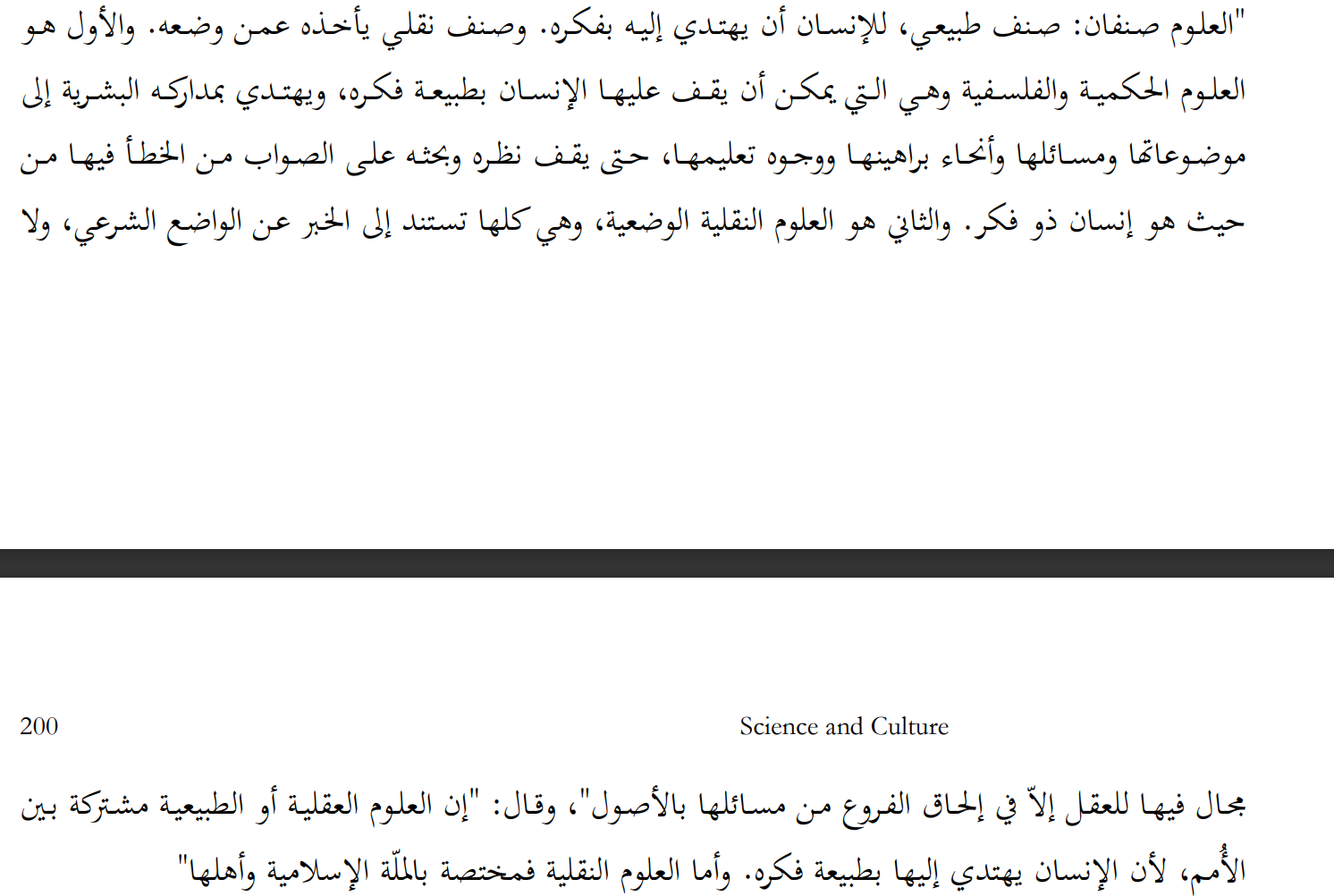
As ciências são de dois tipos: um tipo natural, que o homem alcança por meio de seu pensamento, e um tipo textual, que ele toma daquele que o estabeleceu. O primeiro são as ciências filosóficas e aforísticas, que pode buscar pelo seu raciocínio e ser guiado, através das faculdades humanas, aos seus temas e questões, a todas as suas provas decisivas e aos aspectos de seus ensinamentos. Assim, em seu discernimento e estudo, ele alcança o correto (entendimento) do incorreto, na sua condição de ser humano que possui a faculdade do pensamento. O segundo são as ciências textuais e escritas. Elas dependem do relato proveniente de uma fonte shar'i. A mente não tem espaço nesse campo, exceto para relacionar as questões secundárias ao usul (fundamento).
“The sciences are of two types: A natural type which is for man to arrive at through his thinking and a textual type which he takes from the one who authored it. The first are the philosophical and aphoristic sciences which he can seek by his thought and be guided through the human faculties to its subjects and issues and all its decisive proofs and aspects of its teachings. So as in his discernment and study he attains the correct (opinion) from the incorrect, in his capacity as a human being possessing the faculty of thought. The second are the textual and written sciences. They depend on the report coming from a shar’i source. The mind has no scope in this regard except to relate the branch issues to the usul (foundation)”.
Ele também disse: "As ciências racionais ou naturais são comuns a todas as nações, pois o homem as alcança naturalmente por meio do seu pensamento. Já as ciências textuais são específicas da religião muçulmana e dos seus seguidores." Parece que o que Ibn Khaldun quis dizer ao especificar as ciências textuais com a millah islâmica foi apenas um exemplo, pois outras nações, para além da nação islâmica, também possuem ciências textuais que lhes são específicas, como a sua legislação e a sua língua. A afirmação de Ibn Khaldun não indica que ele tenha distinguido entre ciência e cultura. Indica apenas que ele distinguiu entre ciências textuais e ciências racionais. Os seus comentários não são prova de que os muçulmanos costumavam diferenciar entre ciência e cultura; são antes prova de que os muçulmanos costumavam diferenciar apenas entre disciplinas. Assim, dividiram-nas em duas secções. No entanto, a sua divisão era feita em termos da sua aquisição geral e não em termos do modo de aquisição. Por isso, designaram-nas como ciências racionais, isto é, adquiridas através da mente, e ciências textuais, adquiridas a partir do texto. Hoje, porém, as pessoas diferenciam as disciplinas em termos do modo como foram recebidas. Assim, aplicam o termo "ciência" (ʿilm) a tudo o que é adquirido através do método empírico, e aplicam o termo "cultura" (thaqafa) a tudo o que é adquirido por meios diferentes do método empírico.
He also said “The rational or natural sciences are common to all nations since man arrives at them naturally through his thought. As for the textual sciences they are specific to the Muslim religion and its adherents.” It appears that what Ibn Khaldun meant by specifying the textual sciences with the Islamic millah was only an example because nations other than the Islamic nation as well have textual sciences specific to them such as their legislation and language. Ibn Khaldun’s statement does not indicate that he distinguished between science and culture. It only indicates that he distinguished between textual and rational sciences. His comments are not an evidence to say that the Muslims used to differentiate between science and culture rather they are an evidence to prove that the Muslims used only to differentiate between disciplines. Thus, they divided them into two sections. However their division was in terms of their general acquisition and not in terms of the manner of acquisition. So they designated them as rational sciences i.e, acquired via the mind. And textual sciences acquired from the text. However, people today differentiate between disciplines in terms of the manner in which they were received. Thus, they apply the term ‘science’ (‘ilm) on anything that is acquired through the empirical method and they apply the term ‘culture’ (thaqafa) on anything acquired by means other than the empirical method