17. O Califado
17. The Khilafah
O Khilafah é a liderança geral ou global de todos os muçulmanos no mundo, com o objetivo de estabelecer as leis da Shari'ah islâmica e levar a da'wa do Islã ao mundo. Ela é o mesmo que a Imamah, pois Imamah e Khilafah têm o mesmo significado. Vários ahadith saheeh os mencionam com o mesmo sentido. Nenhum dos dois termos jamais veio, em qualquer texto da Shari'ah, ou seja, no Alcorão ou na Sunnah, com um significado diferente do outro, já que essas duas fontes são as únicas fontes da Shari'ah. Não é obrigatório aderir ao termo Khilafah ou Imamah, mas é obrigatório aderir ao significado do termo.
The Khilafah is the general or overall leadership for all the Muslims in the world in order to establish the laws of the Islamic Shari’ah and to carry the da’wa of Islam to the world. It is the same as the Imamah, as the Imamah and Khilafah have the same meaning. Several saheeh ahadith mention them with the same meaning. Neither of the two terms has ever come with any meaning different from the other in any Shari’ah text i.e. the Qur’an or the Sunnah, as these two (sources) are the only Shari’ah sources. It is not compulsory to hold to the term of Khilafah or Imamah, but rather it is compulsory to hold to the meaning of the term.
Estabelecer o Khilafah é uma obrigação sobre todos os muçulmanos em todas as regiões do mundo. Estabelecê-lo, assim como o cumprimento de qualquer obrigação que Allah (SWT) impôs aos muçulmanos, é uma questão inevitável, sem escolha ou margem de tolerância. A negligência em cumpri-lo está entre os piores pecados, pelo qual Allah (SWT) pune com o mais severo dos castigos.
Establishing the Khilafah is an obligation upon all Muslims in all regions of the world. Establishing it, like the performing of any obligation that Allah (swt) obliged upon Muslims, is an inevitable matter without choice or leniency in it. Negligence in performing it is one of the worst sins for which Allah (swt) punishes with the strictest of the punishments.
As provas para o estabelecimento do Califado sobre todos os muçulmanos (provêm de): O Alcorão, a Sunnah e o Ijmaa as-Sahabah.
The evidence for establishing the Khilafah upon all Muslims (come from): The Qura'n, The Sunnah and Ijmaa as-Sahabah.
Quanto ao Alcorão, Allah (SWT) ordenou ao Mensageiro ﷺ que julgasse entre os muçulmanos segundo tudo o que Ele (SWT) lhe revelou, e Sua ordem (SWT) a ele foi de maneira decisiva. Allah (SWT) dirigiu-se ao Profeta ﷺ dizendo:
As for the Qura'n, Allah (swt) has ordered the Messenger (saw) to rule between Muslims by all that He (swt) revealed to him (saw), and His order (swt) to him was in a decisive manner. Allah (swt) addressed the Prophet (saw) saying:
"E julga entre eles de acordo com o que Allah revelou, e não sigas as suas paixões, afastando-te da verdade que te chegou" [TMQ 5:48]
"And rule between them by that which Allah revealed to you, and do not follow their vain desires away from the truth which came to you" [TMQ 5:48]
E Ele (SWT) disse:
And He (swt) said:
E julga entre eles de acordo com o que Allah revelou e não sigas as suas paixões, e tem cuidado para que não te desviem de parte alguma do que Allah te revelou. [TMQ 5:49]
"And rule between them by that which Allah revealed to you and do not follow their whims, and beware (be on the alert) that they may deviate you away from even some part of what Allah revealed to you" [TMQ 5:49]
A fala de Allah (SWT) ao Profeta ﷺ é uma fala dirigida à sua Ummah, a menos que haja uma evidência que limite a fala a ele ﷺ. Neste caso, não há tal evidência, portanto o endereçamento é a todos os muçulmanos para que estabeleçam o hukm. O estabelecimento do Khalifah não significa outra coisa senão o estabelecimento do governo e da autoridade. Além disso, Allah (SWT) tornou obrigatório aos muçulmanos obedecer àqueles que detêm a autoridade, isto é, o governante, o que indica que a existência daquele que detém a autoridade é obrigatória para os muçulmanos. Allah (SWT) disse:
The speech of Allah (swt) to the Prophet (saw) is a speech to his Ummah unless there is evidence which limits the speech to him (saw). In this case there is no such evidence, so the address is to all the Muslims to establish the rule (hukm). The establishment of the Khalifah does not mean other than the establishment of the rule and the authority. Moreover, Allah (swt) made it obligatory upon Muslims to obey those in authority i.e. the ruler, which indicates that the existence of the one in authority is obligatory upon Muslims. Allah (swt) said:
"Ó vós que credes, obedeçam a Allah e obedeçam ao Mensageiro e às autoridades entre vós" [TMQ 4:59]
"O you who believe obey Allah and obey the Messenger and those in authority amongst you" [TMQ 4:59]
Allah (SWT) não ordena a obediência a alguém que não existe. Isto indica que a existência da pessoa com autoridade é obrigatória. Quando Allah (SWT) ordena a obediência àqueles que detêm autoridade, Ele está ordenando o seu estabelecimento. O resultado do estabelecimento do governante é o estabelecimento do hukm shar'i (o juízo da Shari'ah), e a falha em estabelecê-lo resultará em negligenciar o hukm shar'i. Assim, a sua existência é obrigatória, pois o resultado da falha em estabelecê-la será um dos assuntos proibidos, ou seja, a negligência do hukm shar'i.
Allah (swt) does not order obedience to someone who does not exist. This indicates that the existence of the person in authority is obligatory. When Allah (swt) commands obedience to those in authority then He (swt) is commanding their establishment. The result of establishing the ruler is the establishment of the Shari’ah rule (hukm shar’i) and the failure to establish it will result in neglecting the Shari’ah rule (hukm shar’i). Thus his existence is obligatory as the result of the failure to establish it is will be from the prohibited matters i.e. the neglect of the Shari’ah rule (hukm shar’i).
Quanto à Sunnah, Nafi‘ relatou que disse: Abdullah bin ‘Umar me contou que ouviu o Profeta ﷺ dizer:
As for the Sunnah, Nafi‘ reported saying: Abdullah bin ‘Umar said to me that he heard the Prophet (saw) saying:
"Quem retirar sua mão da obediência encontrará Allah no Dia da Ressurreição sem ter qualquer prova a seu favor, e quem morrer sem um juramento de lealdade (bay'ah) em seu pescoço morre uma morte de ignorância (jahiliyyah)."
“Whoever removes his hand from obedience will meet Allah on the Day of Resurrection without having any proof for him, and whoever dies without a pledge of allegiance (bay’ah) on his neck dies a death of ignorance (jahiliyyah).”
Assim, o Profeta (saw) tornou obrigatório para todo muçulmano ter uma bay'ah em seu pescoço, e descreveu que quem morrer sem uma bay'ah em seu pescoço morre morte de jahiliyyah. A bay'ah não pode ser para ninguém senão o Khalifah. O Profeta (saw) tornou obrigatório para todo muçulmano ter em seu pescoço uma bay'ah a um Khalifah, mas não tornou obrigatório para todo muçulmano dar bay'ah a um Khalifah. O dever é a existência de uma bay'ah no pescoço de cada muçulmano elegível, ou seja, a existência de um Khalifah que, consequentemente, merece uma bay'ah no pescoço de cada muçulmano. Portanto, é a presença do Khalifah que coloca uma bay'ah no pescoço de cada muçulmano, quer o muçulmano tenha de fato dado bay'ah a ele (pessoalmente) ou não. Desse modo, este hadith do Profeta (saw) é evidência de que a nomeação do Khalifah é uma obrigação, e não uma prova de que dar a bay'ah é obrigatório. Isso se dá porque o que foi repreendido pelo Profeta (saw) foi a ausência de uma bay'ah no pescoço de um muçulmano até sua morte, mas ele não repreendeu a ausência da bay'ah em si. Muslim narrou de Al-'Araj, de Abu Hurairah (ra), que o Profeta (saw) disse:
So the Prophet (saw) made it compulsory upon every Muslim to have a bay’ah on his neck, and described that whoever dies without a bay’ah on his neck that he dies a death of jahiliyyah. The bay’ah cannot be for anyone except the Khalifah. The Prophet (saw) made it obligatory upon every Muslim to have on his neck a bay’ah to a Khalifah, yet he did not make it an obligation upon every Muslim to give bay’ah to a Khalifah. The duty is the existence of a bay’ah on the neck of every eligible Muslim i.e. the existence of a Khalifah who accordingly deserves a bay’ah upon the neck of every Muslim. So it is the presence of the Khalifah which places a bay’ah on the neck of every Muslim, whether the Muslim actually gave a bay’ah to him (in person) or not. Therefore, this hadith of the Prophet (saw) is evidence that the appointment of the Khalifah is an obligation and not a proof that giving the bay’ah is obligatory. This is so because what was rebuked by the Prophet (saw) was the absence of a bay’ah on the neck of a Muslim until he dies, but he did not rebuke the absence of the bay’ah. Muslim narrated from Al-’Araj from Abu Hurairah (ra) from the Prophet (saw) who said:
"Atente: o Imam é um escudo por trás do qual os povos combatem e com o qual se protegem."
“Behold, the Imam is a shield from behind whom the people fight and by whom they protect themselves.”
E Muslim relatou de Abu Hazim, que disse:
And Muslim reported from Abu Hazim who said:
“Acompanhei Abu Hurairah durante cinco anos e o ouvi relatar do Profeta ﷺ, que disse: Os Profetas governavam os filhos de Israel. Sempre que um Profeta morria, outro Profeta o sucedia, mas não haverá Profeta depois de mim. Haverá califas, e eles serão numerosos. Perguntaram: Então, o que nos ordenas? Ele disse: Cumpri o juramento de lealdade (bay'ah) a eles, um após o outro, e dai-lhes o seu direito. Certamente Allah os questionará sobre aquilo que Ele lhes confiou.”
“I accompanied Abu Hurairah for five years and heard him reporting from the Prophet who said: The Prophets ruled over the children of Israel. Whenever a Prophet died another Prophet succeeded him, but there will be no Prophet after me. There will be Khulafaa and they will number many. They asked: What then do you order us? He said: Fulfil the bay’ah to them one after the other and give them their due right. Surely Allah will ask them about what He entrusted them with.”
E de Ibn ‘Abbas, do Profeta ﷺ, que disse:
And from bin ‘Abbas from the Prophet (saw) who said:
“Se alguém vir em seu Amir algo que o desagrade, que tenha paciência. Pois, por certo, quem se separar da autoridade (sultão) do Islã, nem que seja por um palmo, e morrer nessa condição, terá morrido uma morte de jahiliyyah.”
“If anyone sees in his Amir something that displeases him let him remain patient. For, behold, he who separates himself from the sultan (authority of Islam) by even so much as a hand span and dies thereupon, has died a death of jahiliyyah”.
Nestes ahadith, o Profeta (saw) nos informa que os líderes conduzirão os assuntos dos muçulmanos, e incluem a descrição do Khalifah como um escudo, isto é, uma proteção. Portanto, a descrição do Imam como um escudo informa sobre os benefícios da presença do Imam, sendo, assim, uma ordem para a ação. Isso porque, se a informação transmitida por Allah (swt) e pelo Profeta ﷺ contivesse repreensão, seria uma ordem de proibição, e se contivesse louvor, seria uma ordem para a ação. Se a ação ordenada é necessária para implementar um hukm shar'i (regra da Shari'ah), ou se, por sua negligência, um hukm shar'i seria negligenciado, então essa ordem é decisiva. Nestes ahadith há também informação de que aqueles que conduzem os assuntos dos muçulmanos são Khulafaa, o que indica uma ordem para nomeá-los. Eles incluem também uma proibição para os muçulmanos de se separarem da autoridade, o que indica a obrigação, para os muçulmanos, de nomear uma autoridade para si mesmos, isto é, governar. Além disso, o Profeta ﷺ ordenou aos muçulmanos que obedecessem ao Khalifah e que combatessem aqueles que contestam sua autoridade como Khalifah, o que indica uma ordem para nomear um Khalifah e para proteger seu Khilafah lutando contra quem disputar com ele. Muslim relatou que o Profeta ﷺ disse:
In these ahadith, the Prophet (saw) informs us that leaders will run the affairs of Muslims, and they include the description of the Khalifah as a shield i.e. a protection. So the description of the Imam as a shield is informative of the benefits of the presence of the Imam, thus it is a command for action. This is because if the information conveyed by Allah (swt) and the Prophet (saw) contained rebuke then it is a command of prohibition, and if it contained praise then it is a command for action. If the ordered action is necessary to implement a hukm shari’ (Shari’ah rule), or by its negligence a hukm shar‘i will be neglected, then this command is decisive. In these ahadith there is information also that those who run the affairs of Muslims are Khulafaa, which indicates an order to appoint them. They also include a prohibition for Muslims to separate from the authority, which indicates the obligation upon Muslims to appoint an authority for themselves i.e. ruling. Moreover, the Prophet (saw) ordered the Muslims to obey the Khalifah and to fight those who dispute his authority as Khalifah, which indicates an order to appoint a Khalifah and to protect his Khilafah by fighting against whosoever disputes with him. Muslim reported that the Prophet (saw) said:
“Aquele que prestou juramento de lealdade a um Imam, dando-lhe o aperto de sua mão e o fruto de seu coração, deve obedecê-lo enquanto puder; e se outro vier disputar com ele, deve-se golpear o pescoço desse homem.”
“He who pledged allegiance to an Imam giving him the clasp of his hand and the fruit of his heart shall obey him as long as he can, and if another comes to dispute with him you have to strike the neck of that man.”
Portanto, a ordem de obedecer ao Imam é uma ordem para estabelecê-lo, e a ordem de combater aqueles que disputam com ele é prova de que esta ordem é decisiva para manter a presença de um único Khalifah.
So the command to obey the Imam is an order to establish him, and the command to fight those who dispute with him is evidence that this command is decisive in maintaining the presence of one Khalifah.
Quanto ao Ijma' dos Sahabah (ra), todos concordaram quanto à necessidade de estabelecer um sucessor, ou Khalifah, para o Profeta ﷺ após a sua morte, e todos concordaram em nomear um sucessor para Abu Bakr, depois para 'Umar, depois para 'Uthman, após a morte de cada um deles. O Ijma' dos Sahabah (ra) para estabelecer um Khalifah manifestou-se de forma enfática quando adiaram o enterro do Profeta ﷺ após a sua morte, enquanto se ocupavam em nomear um sucessor para ele, apesar de o enterro do defunto ser fard e de ser haram para aqueles que deveriam preparar o seu enterro ocuparem-se com qualquer outra coisa até concluírem o sepultamento. Os Sahabah (ra) estavam obrigados a ocupar-se da preparação do enterro do Profeta ﷺ; em vez disso, alguns deles ocuparam-se em nomear um Khalifah em vez de realizar o enterro, e outros mantiveram-se em silêncio quanto a esta ocupação e participaram no adiamento do enterro por duas noites, apesar de poderem opor-se ao atraso e de poderem enterrar o Profeta ﷺ. Assim, houve um Ijma' em ocupar-se da nomeação de um Khalifah em vez de sepultar o morto. Isto não seria legítimo a menos que a nomeação de um Khalifah fosse mais obrigatória do que o enterro do morto. Além disso, todos os Sahabah (ra) concordaram, ao longo das suas vidas, quanto à obrigação de nomear um Khalifah. Embora tenham divergido quanto à pessoa a ser eleita como Khalifah, nunca divergiram quanto à nomeação de um Khalifah, nem quando o Profeta ﷺ morreu, nem quando qualquer um dos Khulafaa ar-Rashidun morreu. Portanto, o Ijma' dos Sahabah é prova clara e forte de que a nomeação de um Khalifah é obrigatória.
As for the Ijma’a of the Sahabah (ra) they all agreed upon the necessity to establish a successor or Khalifah to the Prophet (saw) after his death, and they all agreed to appoint a successor to Abu Bakr, then to ‘Umar, then to ‘Uthman, after the death of each one of them. The Ijma’a of the Sahabah (ra) to establish a Khalifah manifested itself emphatically when they delayed the burial of the Prophet (saw) after his death while engaged in appointing a successor to him, despite the fact that the burial of the dead person is fard, and that it is haram upon those who are supposed to prepare for his burial to engage themselves in anything else until they complete the burial. The Sahabah (ra) were obliged to engage themselves in preparing the burial of the Prophet (saw), instead some of them engaged themselves in appointing a Khalifah rather than carrying out the burial, and some others kept silent on this engagement and participated in delaying the burial for two nights despite their ability to deny the delay and their ability to bury the Prophet (saw). So this was an Ijma’a to engage themselves in appointing a Khalifah rather than to bury the dead. This could not be legitimate unless the appointment of a Khalifah is more obligatory than the burial of the dead. Also, all the Sahabah (ra) agreed throughout their lives upon the obligation of appointing a Khalifah. Although they disagreed upon the person to be elected as a Khalifah, they never disagreed upon the appointment of a Khalifah, neither when the Prophet (saw) died, nor when any of the Khulafaa ar-Rashidun died. Therefore the Ijma’a of the Sahabah is clear and strong evidence that the appointment of a Khalifah is obligatory.
"O que é necessário para cumprir um wajib (dever) é, por si só, um wajib"
‘What is necessary to accomplish a wajib (duty) is itself a wajib’
Portanto, o estabelecimento de um Khalifah também é obrigatório de acordo com este princípio divino.
So the establishment of a Khalifah is also compulsory according to this divine principle.
Portanto, torna-se claro, a partir dessas evidências, que o estabelecimento do governo e da autoridade entre os muçulmanos é fardo, e também fica claro que a nomeação de um Khalifah, que assume a responsabilidade pelo governo e pela autoridade, é obrigatória para os muçulmanos a fim de implementar as regras da Shari'ah, e não meramente pelo governo e pela autoridade em si. Reflita sobre o que Muslim narrou de seu dito ﷺ por meio de 'Awf bin Malik:
Therefore, it is clear from these evidences that the establishment of the rule and the authority amongst Muslims is fard, and it is also clear that the appointment of a Khalifah who takes the charge of the rule and the authority is compulsory upon Muslims in order to implement the Shari’ah rules and not merely for the sake of rule and authority in themselves. Reflect upon what Muslim narrated of his saying (saw) via ‘Awf bin Malik:
"Os melhores dos vossos Imames (líderes) são aqueles que amais e que vos amam, que rezam por vós e vós rezais por eles; e os piores dos vossos Imames são aqueles que odiais e que vos odeiam, que amaldiçoais e que vos amaldiçoam." Foi perguntado ao Mensageiro de Allah ﷺ: "Não devemos enfrentá-los com as espadas?" Ele respondeu: "Não, enquanto estabelecerem a salat (significando o Islã) entre vós."
“The best of your Imams (leaders) are those whom you love and they love you, who pray for you and you pray for them; and the worst of your Imams are those whom you hate and they hate you and you curse them and they curse you. The Messenger of Allah (saw) was asked: Should we not face them with the swords? He said: No, not as long as they establish salat (meaning Islam) among you.”
Este hadith é claro ao informar sobre os bons e os maus governantes, e claro ao proibir confrontá-los com a espada enquanto estabelecerem a religião, pois estabelecer a oração indica a manutenção da religião e o governo segundo ela.
This hadith is clear in informing about the good and bad leaders, and clear in prohibiting confronting them with the sword as long as they establish the deen, since establishing the salat (prayer) indicates upholding of the deen and ruling by it.
Portanto, a obrigação sobre os muçulmanos de nomear o Khalifah, que estabelece as leis do Islam e transmite o seu chamado, é uma questão cuja certeza não admite dúvida nos textos autênticos da Shari'ah. Além disso, trata-se de um dever obrigatório, pois Allah (SWT) tornou fard sobre os muçulmanos estabelecer o domínio do Islam e proteger a honra dos muçulmanos. Contudo, este dever é coletivo: se algumas pessoas da Ummah o cumprirem, o fard está cumprido e a responsabilidade se retira do restante da Ummah. E se parte da Ummah não conseguir realizar o fard, ainda que tenha executado as ações que o estabelecem, a responsabilidade permanece sobre todos os muçulmanos, e o fard continua sobre cada muçulmano enquanto os muçulmanos estiverem sem um Khalifah.
So the obligation upon Muslims to appoint the Khalifah who establishes the laws of Islam and conveys its call is a matter which has no doubt with regard to its certainty in the sound texts of Shari’ah. Moreover, it is an obligatory duty due to the fact that Allah (swt) made it fard upon Muslims to establish the rule of Islam and to protect the honour of Muslims. However, this duty is a collective one, so if some people of the Ummah accomplished it, the fard is fulfilled and thus responsibility drops from the rest of the Ummah. And if part of the Ummah was unable to achieve the fard, though they carried out the actions which establish it, then the responsibility remains upon all the Muslims, and the fard remains upon every Muslim as long as Muslims are without a Khalifah.
Deixar de estabelecer um Khalifah para os muçulmanos está entre os maiores pecados, pois significa abster-se de cumprir uma das mais importantes obrigações do Islã, da qual depende a implementação do deen; mais ainda, da mesma forma depende a própria existência do Islã no campo de batalha da vida. Assim, os muçulmanos, como um todo, cometem um grande pecado ao abster-se de estabelecer um Khalifah para todos os muçulmanos. E se todos concordassem em permanecer sem um Khalifah, o pecado recairia sobre todos os muçulmanos em todas as regiões habitadas (o mundo inteiro). No entanto, se alguns dos muçulmanos se empenhassem em trabalhar para estabelecer um Khalifah e os outros não o fizessem, o pecado cairá dos ombros daqueles que começaram a trabalhar para estabelecer o Khalifah, embora a obrigação (fard) permaneça sobre eles até que o Khalifah seja nomeado. (Isto é assim) porque o envolvimento em estabelecer a obrigação (fard) remove o pecado pelo atraso em estabelecê-la em seu tempo apropriado, e pela sua não implementação, devido ao trabalho de alguém para estabelecê-la e à sua aversão àquilo que o impede de estabelecê-la.
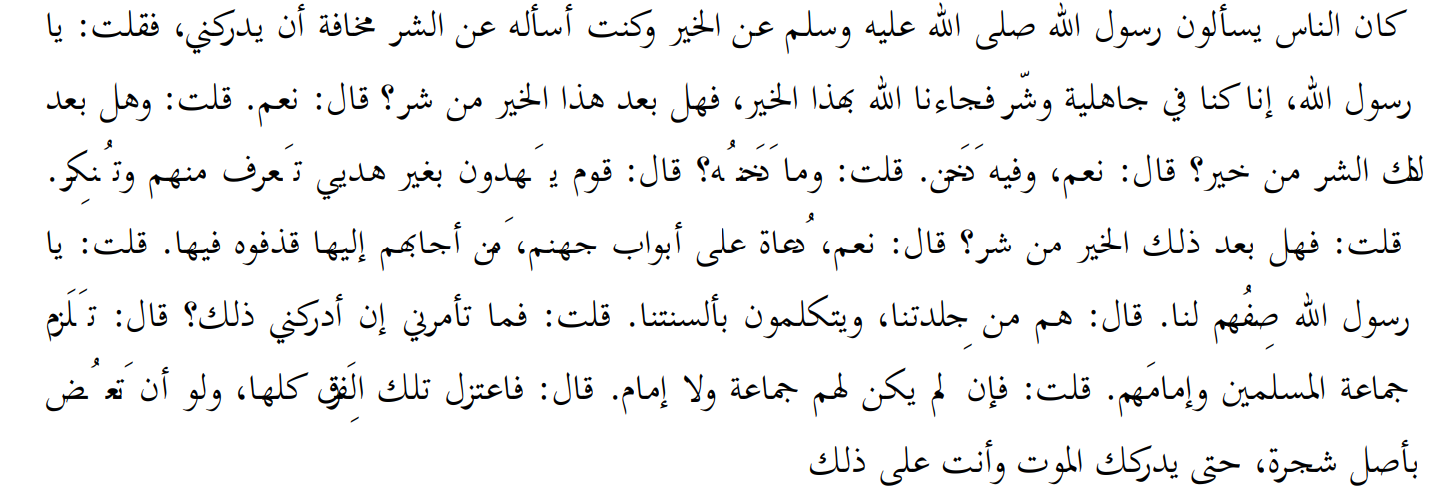
"As pessoas costumavam perguntar ao Profeta de Allah ﷺ sobre o bem, e eu costumava perguntar-lhe sobre o mal, com receio de que este me alcançasse. Então disse: Ó Profeta de Allah! Estávamos em tempos de jahiliyyah e de corrupção, então Allah nos trouxe este bem. Haverá, depois deste bem, alguma corrupção? Ele ﷺ disse: Sim. Perguntei: Haverá, depois daquela corrupção, algum bem? Ele disse: Sim, e terá fumaça (dukhan). Perguntei: Qual é a sua fumaça? Ele disse: Pessoas que guiam, mas não pela minha orientação. Reconhecerás algumas delas e rejeitarás outras. Perguntei: Haverá, depois daquele bem, alguma corrupção? Ele disse: Sim, chamadores (du'at) que convidam às portas do Inferno. Quem aceitar o seu convite, eles o lançarão nele (no Inferno). Perguntei: Ó Profeta de Allah, descreve-os para nós. Ele disse: São da nossa própria pele (do nosso próprio povo) e falam a nossa língua. Perguntei: O que me ordenas que faça, se tal (situação) me alcançar? Ele disse: Adere à jama'ah dos muçulmanos e ao seu Imam. Perguntei: E se os muçulmanos não tiverem jama'ah nem Imam? Ele disse: Então afasta-te de todos esses grupos, mesmo que tenhas de morder a raiz de uma árvore até que a morte te alcance nessa condição."
“The people used to ask the Prophet of Allah (saw) about the good and I used to ask him about the bad in fear that it might catch me. So I said: O Prophet of Allah! We were in times of jahiliyyah and mischief then Allah brought us this good, so is there any mischief after this good? He (saw) said: Yes. I said: Will there be any good after that mischief? He said: Yes, and it has smoke (dukhan). I said: What is its smoke? He said: People guiding but not on my guidance. You recognise some (from them) and deny some. I said: Will there be any mischief after that good? He said: Yes, callers (du’at) who invite at the doors of Hellfire. They throw him into it (hell) whoever accepted their invitation. I said: O Prophet of Allah, describe them to us. He said: They are of our own skin (of our people) and talk our language. I said: What do you order me to do if that (matter) caught me? He said: Adhere to the jama‘ah of Muslims and their Imam. I said: What if the Muslims have no jama‘ah nor an Imam? He said: Then separate from all those groups, even if you (have to) bite the root of a tree till death comes to you as such.”
Este hadith é claro em sua expressão: o Profeta (saw) ordenou aos muçulmanos que aderissem à jama‘ah dos muçulmanos e a seu Imam, e que se afastassem daqueles que convidam as pessoas às portas do inferno. O questionador perguntou-lhe o que deveria fazer em relação àqueles que chamam às portas do Fogo na situação em que os muçulmanos não têm Imam nem jama‘ah; então o Profeta ﷺ ordenou-lhe que se separasse de todos esses grupos, sem se desligar dos muçulmanos nem abster-se da ação de estabelecer um Imam. Portanto, sua ordem é clara: "Separa-te de todos esses grupos", e ele enfatizou a separação desses grupos a ponto de dizer que, mesmo que o isolamento deles o levasse a agarrar-se ao tronco de uma árvore até que a morte lhe sobreviesse. Seu significado é aderir à sua religião e manter-se distante dos chamadores desviados que estão às portas do Fogo. Neste hadith não há desculpa nem permissão (para ninguém) para abandonar a obra de estabelecer um Califado; ele se limita, antes, ao comando de aderir à religião e abandonar os chamadores às portas do inferno, e o pecado permanecerá sobre quem não trabalhar para estabelecer um Califado. Assim, ele é ordenado a abandonar os grupos desviados a fim de preservar sua religião dos chamadores ao desvio, ainda que tenha de morder a raiz de uma árvore, mas não a afastar-se da comunidade muçulmana e abandonar a obra de estabelecer as leis da religião e um Imam para os muçulmanos.
This hadith is clear in its expression that the Prophet (saw) ordered the Muslims to adhere to the jama‘ah of Muslims and to adhere to their Imam, and to leave those who invite people to the doors of hell. The questioner asked him what he has should do in relation to those callers at the doors of Hellfire in the situation wherein the Muslims have no Imam and no jama‘ah; thereupon the Prophet (saw) ordered him to separate from all these groups, not to disassociate himself from the Muslims nor to abstain from the action for establishing an Imam. So his order is clear “Separate from all those groups”, and he emphasised the separation from those groups even to the extent that his isolation from them would make him clench to the trunk of a tree until death comes to him. Its meaning is to adhere to your deen and keep away from the misguiding callers who are at the doors of Hellfire. In this hadith there is no excuse or permission (for anybody) to abandon the work for establishing a Khalifah, it is, rather, confined to the command of adhering to the deen and abandoning the callers at the doors of hell, and the sin will remain on him if he does not work to establish a Khalifah. So he is ordered to abandon the misguiding groups in order to save his deen from the callers of the misguidance, even if he had to bite the root of a tree, but not to distance himself from the Muslim community and abandon the work for establishing the laws of the deen and establishing an Imam for Muslims.
Outro exemplo é o que al-Bukhari narrou de Abu Said al-Khudri, que disse:
O Mensageiro de Allah ﷺ disse: Virá um tempo em que a melhor propriedade de um muçulmano serão as ovelhas, que ele levará para o topo das montanhas e para os lugares de chuva (vales), a fim de fugir com a sua religião das provações (fitan).
“The Messenger of Allah (saw) said: A time will come that the best property of a Muslim will be sheep which he will take on the top of mountains and the places of rainfall (valleys) so as to flee with his religion from afflictions (fitan)”
Isso não significa que alguém deva isolar-se da comunidade muçulmana, abandonar a prática das leis da religião (deen) e deixar de estabelecer um Califado para os muçulmanos quando não há Khilafah na terra. Tudo o que ele contém é uma explicação de qual é a melhor riqueza do muçulmano nos tempos de provação; não encoraja a separação dos muçulmanos nem o afastamento das pessoas.
This does not mean that one should isolate oneself from the Muslim community, abandon practising the laws of the deen and establishing a Khalifah for Muslims when there is no Khilafah on earth. All that it contains is an explanation of what is the best wealth of the Muslim at the times of affliction; it does not encourage separation from the Muslims and isolation from the people.
Portanto, nenhum muçulmano sobre a face desta terra tem desculpa para abandonar o dever de estabelecer a religião (deen) que Allah (swt) ordenou, isto é, o estabelecimento de um Califado para os muçulmanos quando não há Khilafah na terra, quando não há ninguém para aplicar as punições (hudud) de Allah (swt) para proteger as coisas sagradas de Allah (swt), e ninguém para aplicar as leis da religião e unificar a comunidade muçulmana sob o estandarte de La ilaha illa Allah, Muhammad ur-Rasul Allah. Não há permissão no Islã para abandonar o trabalho por este dever até que ele seja de fato concluído.
Accordingly, no Muslim on the face of this earth has an excuse to abandon the duty of establishing the deen which Allah (swt) has ordered, that is, the establishment of a Khalifah for Muslims when there is no Khilafah on the earth, when there is no one to implement the punishments (hudood) of Allah (swt) to protect the sanctities of Allah (swt), and no one to implement the laws of the deen and unify the Muslim community under the banner of La ilaha illa Allah, Muhammad ur-Rasul Allah. There is no permission in Islam to abandon the work for this duty until it is indeed completed.