2.7 Al-qadā’ Wa‘l-qadar
2.7 Al-qadā’ Wa‘l-qadar
Al-qadā’ wa‘l-qadar, com este nome, isto é, pela ligação de duas palavras para um só significado, tem um referente específico; ou seja, al-qadā’ ligado a al-qadar, tornando-os duas matérias concomitantes, de modo que uma não é separável da outra, e possuem um significado exclusivo a eles. Não é correto incluir nele outro significado que não este, o qual não foi utilizado pelos Sahabah ou pelos Tabi’een. Ao estudar os textos da Shari’ah e os textos linguísticos, e ao estudar os ditos dos Sahabah, dos Tabi’een e daqueles que vieram depois deles dentre os Ulama, torna-se evidente que os termos al-qadā’ wa‘l-qadar, juntos, não foram empregados com um significado técnico [istilāhī] específico por nenhum dos Sahabah ou Tabi’een, nem vieram juntos com um significado técnico específico no Alcorão ou no Hadith; ainda que tenham vindo juntos em seu significado linguístico no que al-Bazzār relatou a partir do hadith de Jabir, com uma cadeia hasan, de autoridade do Profeta ﷺ, que disse:
Al-qadā’ wa‘l-qadar, with this name, that is, by connecting two words together for one meaning, has a specific referent; that is, al-qadā’ linked to al-qadar, by making them two concomitant matters whereby one is not separable from the other, and they have a meaning that is exclusive to them. It is not correct to include in it other than this meaning which has not been used by the Sahabah or the Tabi’een. By studying the shar’i and linguistic texts and studying the sayings of the Sahabah, Tabi’een and those who came after them from the Ulama’, it is apparent that the terms al qadā’ wa‘l-qadar together, have not been used with a specific technical [istilāhī] meaning by any of the Sahabah or Tabi’een, nor have they come together with a specific technical meaning in the Qur’ān or the Hadīth; though they have come together in their linguistic meaning in what al Bazzār reported from the hadīth of Jabir with a hasan chain on the authority of the Prophet (PBUH) that he said:
“A maior parte da minha Ummah morre após o qadā’ de Allah e o Seu qadar, com as almas [anfūs].”
“Most of my Ummah die after the qadā’ of Allaah and his qadar with the souls [anfūs].”
Por isso, este significado terminológico que alude a este nome não é encontrado senão entre os Mutakallimūn, depois de terminado o primeiro século e após a tradução da filosofia grega. Não existia na época dos Sahabah, nem houve qualquer disputa ou discussão sobre esses dois termos como um único nome para um significado técnico específico. Ao longo da era dos Sahabah, os muçulmanos não conheciam a expressão ‘al-qadā’ wa‘l-qadar’, embora a palavra qadā’ tivesse surgido isoladamente e a palavra qadar tivesse surgido isoladamente nos aḥādīth, assim como as duas tinham surgido juntas no mencionado ḥadīth de Jābir, mas em todos esses casos vieram no sentido linguístico. Não vieram no sentido técnico. A palavra qadā’ aparece no ḥadīth do qunūt. Al-Ḥasan disse: o Mensageiro de Allah ﷺ me ensinou palavras que digo no qunūt do witr, e então mencionou a du‘ā’ do qunūt, da qual é:
Therefore this terminological meaning which alludes to this name is not found except from the Mutakallimūn, after the first century had passed and after the translation of the Greek philosophy. It did not exist in the time of the Sahabah nor was there any dispute or discussion of those two terms as one name for a specific technical meaning. Throughout the era of the Sahabah the Muslims did not know of ‘al-qadā’ wa‘l-qadar’ though the word qadā’ had come on its own and the word qadar had come on its own in the ahadīth just as the two had come together in the aforementioned hadīth of Jabir, but in all of these cases they had come in the linguistic meaning. They have not come in the technical meaning. The word qadā’ has come in the hadīth of al-qunut. Al-Hasan said, the Messenger of Allah (PBUH) taught me words I say in the qunut of the witr, then he mentioned the du’a of qunut, of which is,
“...e livra-me do que Tu decretaste, pois Tu és Quem decreta e ninguém decreta sobre Ti.” [Reported by al-Darimi , Narrated by al-Hasan ibn Ali]
“...and save me from what You have decreed, for You are the one Who Decrees and you are not decreed upon,” [Reported by al-Darimi , Narrated by al-Hasan ibn Ali]
Seu significado é: proteja-me do mal daquilo que Você decretou, pois Você decide o que deseja e ninguém decide sobre Você. A palavra qadar aparece no hadīth de Jibrīl em algumas de suas narrações. Ele disse:
Its meaning is, protect me from the evil of what you have judged, for you judge what you wish and no one judges over you. The word qadar has come in the hadīth of Jibrīl in some of its narrations: He said,
"E crer no al-qadar, no seu bem e no seu mal." [Reported by Muslim, Narrated by Umar ibn al-Khattab]
“And to believe in al-qadar, the good and the bad thereof”, [Reported by Muslim, Narrated by Umar ibn al-Khattab]
E em Seu dizer
And in his saying
"…Se algo te acontecer, não digas: 'Se eu tivesse feito isto, teria acontecido tal e tal coisa', mas sim diz: 'Allah decretou [qaddara] e fez o que quis.'" [Reported by Muslim, Narrated by Abu Hurairah]
“…If anything befalls you do not say, ‘had I done (this), it would have been such-and-such, but rather say, ‘Allah determined [qaddara] and He did what He willed,’”[Reported by Muslim, Narrated by Abu Hurairah]
O significado da palavra qadar nestes dois ahadīth é a Determinação [taqdīr] e o Conhecimento de Allah, isto é, que você deve crer que as coisas foram escritas por Allah no Lawh al-Mahfūdh e Ele conhece-as antes de virem à existência, sejam elas boas ou más; e dizer: Allah escreveu isto no Lawh al-Mahfūdh e Ele o conheceu antes de vir a ser e fez o que quis. A palavra al-qadā’, no sentido em que veio neste hadīth ou em qualquer outro lugar onde apareceu, não foi objeto de disputa entre os muçulmanos; eles não tiveram discussões quanto à sua formulação ou ao seu significado.
The meaning of the word qadar in these two ahadīth is the Determination [taqdīr] and Knowledge of Allah , that is, that you should believe that the things have been written by Allah in the Lawh al-Mahfūdh and He knows of them before they come into existence, whether they be good or bad; and say Allah has written this in the Lawh al-Mahfūdh and he knew it before it came into being and he did what he wished. The word al-qadā’ in the meaning which it came in this hadīth or anywhere else it came was not disputed by the Muslims; they did not have discussions with regards to its wording or its import.
Quanto à palavra qadar no sentido mencionado nesses dois ahadīth, os muçulmanos, antes da presença da filosofia grega, não discordavam a respeito dela nem tinham discussões quanto à sua formulação ou significado. Mas, depois da presença da filosofia grega entre os muçulmanos, surgiu um grupo em Kufa que disse: não há qadar, ou seja, não há quem determine previamente, e tudo ocorre sem qualquer determinação anterior; foram chamados de Qadariyyah, e são eles que negam o qadar e dizem que Allah criou os fundamentos das coisas e depois os abandonou, de modo que Ele não tem conhecimento de seus particulares [juz'iyāt]. Isso contraria o que veio no texto claro do Alcorão, que afirma que Allah é o Criador de todas as coisas, pequenas ou grandes, fundamentais ou ramificadas, e que Ele determinou tudo antes de sua existência, isto é, Ele o escreveu na Lawh al-Mahfūdh, ou seja, Ele o conheceu antes que viesse a ser. Ele disse:
As for the word qadar in the meaning mentioned in those two ahadīth, the Muslims, before the presence of Greek philosophy, did not disagree about it or have discussions with regards to its wording or import. But after the presence of the Greek philosophy amongst the Muslims, a group from Kufa arose and said: there is no qadar, that is, there is no one who (pre)determines and everything occurs without any previous determination; they were called the Qadariyyah and they are the ones who deny the qadar and say that Allah created the fundamentals of things and then left them, so He does not have knowledge of their particulars [juz'iyāt]. This is contrary to what has come in the clear text of the Qur’ān which states that Allah is the Creator of all things, small or big, fundamental or branchial, and that He determined everything before its existence, that is, He wrote it in the Lawh al-Mahfūdh, that is, He knew it before it came to be. He said:
“Ele criou todas as coisas, e Ele é o Onisciente de tudo.” [TMQ-An’ām: 101]
“He created all things and He is the All-Knower of everything” [TMQ-An’ām: 101]
E
And
"E Ele sabe o que há na terra e no mar: nenhuma folha cai sem que Ele a saiba. Não há um grão nas trevas da terra, nem algo fresco ou seco, que não esteja registrado num Livro evidente." [TMQ-An’ām: 59]
“And He knows whatever there is in the Earth and in the sea: not a leaf falls, but He knows it. There is not a grain in the darkness of the Earth nor anything fresh or dry, but is written in a Clear Record.” [TMQ-An’ām: 59]
No entanto, esta divergência e discussão diz respeito apenas ao "qadar de Allah" no que se refere ao Seu Conhecimento. Assim, os Qadariyyah afirmavam que Allah conhece os fundamentos das coisas, mas não os seus aspectos parciais, enquanto o Islam afirma que Allah conhece tanto os fundamentos das coisas quanto os seus aspectos parciais. Portanto, a discussão a respeito do qadar de Allah, isto é, do Seu Conhecimento, versa sobre o tema do Conhecimento de Allah. É um tema diferente do de al-qadā’ wa‘l-qadar. É uma discussão distinta, separada da discussão de al-qadā’ wa‘l-qadar. A sua realidade, tal como ocorreu, é a mesma: trata-se de um tema diferente do de al-qadā’ wa‘l-qadar.
However, this disagreement and discussion is only with respect to the ‘qadar of Allah’ in terms of His Knowledge. So the Qadariyyah claimed that Allah knows the fundamentals of things but not their partial aspects, whilst Islam states that Allah knows the fundamentals of things as well as their partial aspects. Thus, the discussion with respect to the qadar of Allah , that is, His Knowledge, is about the subject of Allah's Knowledge. It is a subject different to that of al-qadā’ wa‘l-qadar. It is a different discussion, separate from the discussion of al-qadā’ wa‘l-qadar. Its reality that took place is the same, that is, it is a different subject to that of al-qadā’ wa‘l-qadar.
Assim, é claramente evidente que as palavras al-qadā’ e al-qadar vieram cada uma por si, possuindo cada uma um significado específico. Elas não têm qualquer relação com o estudo de al-qadā’ wa‘l-qadar. Em outras palavras, a palavra al-qadā’, em todos os seus significados linguísticos e na sharī‘ah que provieram do Legislador, e a palavra al-qadar, em todos os seus significados linguísticos e na sharī‘ah que provieram do Legislador, não têm relação alguma com estes termos, quer sejam mencionados isoladamente, quer juntos, na discussão sobre al-qadā’ wa‘l-qadar. Elas estão restritas, quanto ao seu significado, àquilo que trazem dos significados linguísticos e da sharī‘ah.
Thus, it is plainly apparent that the words al-qadā’ and al-qadar have each come on their own with each having a specific meaning. They do not have any relation with the study of al-qadā’ wa‘l qadar. In other words, the word al-qadā’ in all its linguistic and shar’i meanings that have come from the Legislator, and the word al-qadar in all its linguistic and shar’i meanings that have come from the Legislator, have no relation to any of these terms, whether mentioned alone or together, in the discussion of al-qadā’ wa‘l-qadar. They are confined with regards to their meaning, to that what they come with from the linguistic and shar'i meanings.
Os versículos (āyāt) que foram revelados demonstrando o Conhecimento de Allah são aqueles que indicam a natureza abrangente do Conhecimento de Allah em relação a todas as coisas, assim como o Seu dizer:
Nenhuma calamidade ocorre na terra ou em vós mesmos sem que esteja registrada num Livro, antes de Nós a trazermos à existência. Certamente, isso é fácil para Allah. [TMQ-Hadīd: 22]
“No calamity befalls on the Earth or in yourselves but is inscribed in a Book, before We bring it into existence. Indeed, that, upon Allah, is easy” [TMQ-Hadīd: 22]
E o Seu dito,
And His saying,
“Diga: ‘Nada nos acontecerá senão aquilo que Allah nos tem prescrito. Ele é o nosso Mawla.’ Então, que os crentes depositem sua confiança somente em Allah.” [TMQ Tawba: 51]
“Say: ‘Nothing shall ever happen to us except what Allah has ordained for us. He is our Mawla.’ Then in Allah let the believers put their trust” [TMQ Tawba: 51]
E o Seu dito,
And His saying,
"Nem o peso de um átomo, nos céus ou na terra, lhe escapa ao conhecimento, nem algo menor que isso ou maior, mas está num Livro evidente" [TMQ Saba: 3]
“Escapes not from His Knowledge even the weight of an atom, in the Heavens or in the Earth, or less than that, or greater, but it is in a Clear Book” [TMQ Saba: 3]
E o Seu dito,
And His saying,
Ele é Quem recolhe as vossas almas durante a noite, e conhece tudo o que fizestes durante o dia; depois, desperta-vos, para que se cumpra um termo previamente determinado. Depois, para Ele será o vosso retorno, e então Ele vos informará do que costumáveis fazer. [TMQ An’ām: 60]
“It is He, Who takes your souls by night, and (Who) has knowledge of all that you have done by day, then He raises (wakes) you up again that a term appointed be fulfilled, then unto Him will be your return. Then He will inform you what you used to do” [TMQ An’ām: 60]
Esses versículos foram revelados ao Mensageiro ﷺ, e foram memorizados e compreendidos pelos Sahabah. Não lhes ocorreu discutir al-qadā’ wa‘l-qadar. Além disso, a redação, a compreensão e a indicação desses versículos mostram que eles são um esclarecimento sobre o Conhecimento de Allah (SWT) e não têm relação com o estudo de al-qadā’ wa‘l-qadar. Da mesma forma, o versículo:
These verses were revealed to the Messenger (PBUH) and they were memorised and understood by the Sahabah, it did not occur to them to discuss al-qadā’ wa‘l-qadar. Furthermore, the wording, understanding and indication of these verses states that they are a clarification about the Knowledge of Allah and have no relation to the study of al-qadā’ wa‘l-qadar. Similarly the ayah,
"E se um bem os alcança, dizem: ‘Isto vem de Allah’; mas se um mal os atinge, dizem: ‘Isto vem de ti’. Diga: ‘Tudo vem de Allah’; então, o que há com essas pessoas, que não conseguem compreender palavra alguma?" [TMQ-Nisā’: 78]
“And if some good reaches them, they say, ‘This is from Allah’, but if some evil befalls them, they say, ‘This is from you’. Say: ‘All things are from Allah’; so what is wrong with these people that they fail to understand any word?’ [TMQ-Nisā’: 78]
Não tem relação com a discussão sobre al-qadā’ wa‘l-qadar, pois se trata de uma refutação aos kuffār, que diferenciavam entre o mal e o bem. Assim, atribuíam o mal ao Mensageiro ﷺ e o bem a Allah. Então Allah os refutou declarando que tudo provém de Allah. A discussão não é sobre o bem que o ser humano pratica e o mal que ele persegue; antes, a discussão é sobre combate e morte. O próprio versículo e aquilo que o precede esclarecem isso.
It has nothing to do with the discussion of al-qadā’ wa‘l-qadar because it is a refutation of the kuffār who differentiated between bad and good. Thus, they made bad to come from the Messenger and good from Allah . So Allah refuted them by declaring that everything is from Allah . The discussion is not about the good that a human being does and the evil that he pursues; rather the discussion is about fighting and death. The ayah itself and that what precedes it clarifies this:
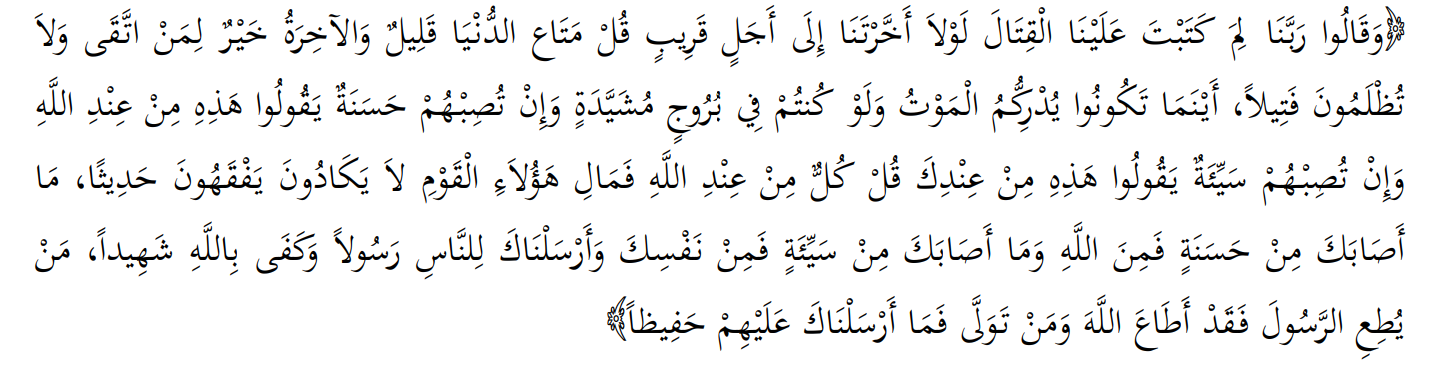
Eles dizem: “Ó nosso Senhor! Por que nos prescreveste o combate? Se ao menos nos tivesses concedido um prazo, por pouco tempo!” Dize: “Breve é o gozo deste mundo, e a Última Morada é melhor para quem teme a Allah, e não sereis lesados nem na mais ínfima medida. Onde quer que estiverdes, a morte vos alcançará, ainda que estejais em torres fortificadas e elevadas!” Quando lhes sobrevém algum bem, dizem: “Isto vem de Allah”; mas quando lhes sobrevém algum mal, dizem: “Isto vem de ti (ó Muhammad)”. Dize: “Tudo vem de Allah”. Qual é, então, o problema com essa gente, que não consegue compreender palavra alguma? Qualquer bem que te alcance vem de Allah, e qualquer mal que te alcance vem de ti mesmo. E Nós te enviamos ﷺ como Mensageiro aos homens, e Allah basta como Testemunha. Quem obedece ao Mensageiro ﷺ obedece a Allah; e quem vira as costas, então não te enviamos ﷺ como guardião sobre eles. [TMQ-Nisā’: 77-80]
“They say: Our Lord! Why have you ordained for us fighting? Would that you have granted us respite for a short period?’ Say: ‘Short is the enjoyment of this world. The Hereafter is (far) better for him who fears Allah, and you shall not be dealt with unjustly in the least. Wheresoever you may be, death will overtake you even if you are in fortresses built up strong and high! And if some good reaches them, they say, ‘This is from Allah,’ but if some evil befalls them, they say, ’This is from you.’ Say: ‘All things are from Allah’, so what is wrong with these people that they fail to understand any word? Whatever of good reaches you, is from Allah, but whatever of evil befalls you, is from yourself. And We have sent you (O Muhammad) as a Messenger to mankind, and Allah is sufficient as Witness. He who obeys the Messenger, has indeed obeyed Allah, but he who turns away, then we have not sent you as a watcher over them.” [TMQ-Nisā’: 77-80]
O sujeito é o que lhes acontece, e não o que eles estão fazendo. Portanto, isso não tem nada a ver com o estudo de al-qadā’ wa‘l-qadar.
So the subject is what befalls them and not what they are doing. Thus it has nothing to do with the study of al-qadā’ wa‘l-qadar.
Portanto, tudo o que foi mencionado acima não tem nada a ver com o estudo de al-qadā’ wa‘l-qadar; esses assuntos não se incluem em seu significado e não têm qualquer relação com o que foi mencionado acima. Pelo contrário, al-qadā’ wa‘l-qadar, enquanto conceito, provém da filosofia grega, que foi transmitida pelos Mu'tazilah, os quais emitiram uma opinião a respeito. Ahl al-Sunnah e os Jabriyyah refutaram-nos, e Ahl al-Sunnah também fez uma refutação aos Jabriyyah. A discussão limitou-se ao mesmo conceito e partiu da mesma premissa. Assim, a questão é um significado/sentido que provém da filosofia grega e veio à tona no debate que costumava ocorrer entre os muçulmanos e os kuffar, que se munham da filosofia grega. É um significado que se relaciona com a ‘aqīdah (crença), e por isso o que se deseja é apresentar a opinião do Islam sobre esse significado. Os Mu'tazilah emitiram uma opinião, os Jabriyyah refutaram-nos e deram outra opinião. Ahl al-Sunnah refutou todos eles e emitiu uma opinião, dizendo que ela é uma terceira posição que surgiu das duas anteriores, e descreveram-na como “o leite puro, doce de beber, que sai entre excremento e sangue”.
Therefore, all that has been mentioned above has nothing to do with the study of al-qadā’ wa‘l qadar; they do not come under its meaning and have no relation whatsoever with what has been mentioned above. Rather, al-qadā’ wa‘l-qadar as a meaning has come from Greek philosophy which was transmitted by the Mu'tazilah who gave an opinion with regards to it. Ahl al-Sunnah and the Jabriyyah refuted them and Ahl al-Sunnah (also) made a refutation of the Jabriyyah. The discussion was confined to the same meaning and preceded upon the same premise. Thus the issue is a meaning/sense that came from Greek philosophy and it came to the fore in the debate which used to take place between the Muslims and the kuffar who used to be armed with the Greek philosophy. It is a meaning which has a relevance to the ‘aqīdah (creed), thus what is desired is to give Islam's opinion regarding this meaning. The Mu'tazilah gave an opinion and the Jabriyyah refuted them and gave another opinion. Ahl al-Sunnah refuted all of them and gave an opinion, and said about it that it is a third opinion which has come out from the two opinions and they described it as ‘the pure milk, sweet to drink, that comes out from between excrement and blood’.
Portanto, o tema da discussão, que proveio da filosofia grega, tornou-se conhecido e, como se relaciona com a ‘aqīdah (crença), o muçulmano deve ter clareza quanto ao que crê a respeito deste assunto. Os muçulmanos de fato expressaram sua opinião e surgiram três escolas de pensamento. Assim, não é permitido remeter a questão de al-qadā’ wa‘l-qadar àquilo que se tem atribuído ao significado de al-qadā’ ou al-qadar, linguisticamente e na Sharī’ah, nem é permitido imaginar ou conceber para al-qadā’ ou al-qadar qualquer significado por mera suposição, concepção ou imaginação, e dizer, por exemplo, que al-qadā’ é o julgamento universal apenas sobre os universais e que al-qadar é o julgamento universal sobre os aspectos particulares e seus detalhes, ou dizer que al-qadar é o plano eterno para as coisas e que al-qadā’ é a execução e a criação de acordo com essa predeterminação e esse plano. Com efeito, isso não é permitido, pois se trata de mera imaginação, suposição e uma tentativa malsucedida de aplicar certas expressões linguísticas e da Sharī’ah que não se aplicam a ela, indicando antes significados gerais; seria então uma ação arbitrária restringir as duas palavras a esses significados específicos sem evidência.
"Toda alma é penhorada pelo que conquistou," [TMQ Muddathir: 38]
“Every soul is a pledge for what it earns,” [TMQ Muddathir: 38]