18 O Estado Islâmico é um Estado humano e não um Estado teocrático.
18 The Islamic State Is A Human State And Not A Theocratic State.
O Estado Islâmico é o Khilafah, pois é a posição na qual quem o supervisiona possui toda a competência de governar e a autoridade, e adota todas as regras sem exceção. É a liderança geral sobre todos os muçulmanos no mundo para implementar todas as regras da Shar'ia islâmica, segundo os pensamentos com que veio e as regras que legislou, e para levar a da'wah islâmica ao mundo, informando-lhes sobre o Islam, chamando-os a ele e à jihad no caminho de Allah. Também é conhecido como Imamah e a liderança sobre os crentes. É um papel humano, não divino, que existe para implementar a religião do Islam sobre os seres humanos e para espalhá-la entre eles. Certamente não é a Profecia, pois a Profecia e a Mensagem referem-se ao Profeta ou ao Mensageiro que transmite a Shar'ia de Allah (SWT) por meio da revelação para entregá-la às pessoas, sem se ater à sua implementação. Allah (SWT) diz:
The Islamic State is the Khilafah as it is the position in which the one who supervises it possesses all the competence of ruling and authority, and adopts all the rules without exception. It is the general leadership over all Muslims in the world to implement all the Islamic Shar’a rules, by the thoughts it came with and the rules it legislated, and to carry the Islamic da’wah to the world, by informing them of Islam, calling them to it and jihad in the way of Allah. It is also known as the Imamah and the leadership over the believers. It is a human role not a divine one, which exists to implement the deen of Islam over human beings and to spread it among them. It is definitely not the Prophethood as the Prophethood and Messengership conotates to the Prophet or the Messenger the Shar’a from Allah (saw) via the means of revelation to deliver it to the people without paying attention to his implementing it. Allah (swt) says:
"Não cabe ao Mensageiro senão a transmissão clara." [TMQ 24:54]
"There is nothing upon the Messenger except the clear conveyance " [TMQ 24:54]
E:
And:
Na verdade, cabe a ti apenas a transmissão [TMQ 3:20]
"Verily it is upon you the conveyance " [TMQ 3:20]
E:
And:
"Não cabe ao Mensageiro senão a transmissão" [TMQ 5:99].
"There is nothing upon the Messenger except the conveyance" [TMQ 5:99].
Isto é diferente do Califado, que é a implementação da Sharia de Allah sobre os seres humanos. Não é condição para o Profeta (saw) ou para o Mensageiro (saw) implementar o que Allah (swt) lhe revelou para ser um Mensageiro; a condição para se tornar Mensageiro ou Profeta é que Allah lhe revele uma Shari'a e lhe ordene que a transmita. Musa (as), Isa (as) e Ibrahim (as) foram Profetas e Mensageiros, embora não tenham implementado a Sharia com que vieram, nem foram governantes. Portanto, o cargo de Profecia e de Mensageria não é o cargo de Califado. A Profecia é um cargo divino que Allah concede a quem Ele quer, enquanto o Califado é um cargo humano, no qual os muçulmanos juram lealdade a quem quiserem entre eles para governá-los. Nosso mestre Muhammad ﷺ foi um governante que implementou a Shari'ah com que veio; assim, estava encarregado da Profecia e da Mensageria e, ao mesmo tempo, estava encarregado da liderança dos muçulmanos na implementação das normas islâmicas. Allah (swt) ordenou-lhe que governasse, assim como lhe ordenou que transmitisse a mensagem, pois Ele lhe disse:
This is different from the Khilafah which is the implementation of Allah’s Shar’a upon human beings. It is not a condition upon the Prophet (saw) or Messenger (saw) to implement what Allah (swt) revealed to him in order to be a Messenger, rather the condition to become a Messenger or Prophet is that Allah reveals a Shar’a to him and commands him to convey it. Musa (as), Isa (as) and Ibrahim (as) were Prophets and Messengers though they did not implement the Shariah they came with nor were they rulers. Therefore the post of Prophethood and Messengership is not the post of Khilafah. Prophethood is a divine post which Allah gives to whomever He wills, while the Khilafah is a human post in which the Muslims pledge whomever they wish over them from among the Muslims. Our master Muhammad (saw) was a ruler who implemented the Shari’ah he came with, so he would be in charge of the Prophethood and Messengership while at the same time he would be in charge of the post of leadership of the Muslims in establishing the Islamic rules. Allah (swt) commanded him to rule just like He commanded him to convey the message as He said to him:
"Julgue entre eles de acordo com o que Allah revelou" [TMQ 5:47]
"Rule between them by what Allah revealed" [TMQ 5:47]
E:
And:
Na verdade, revelamos a você o Livro com a Verdade, para que julgue entre as pessoas segundo o que Allah lhe mostrou. [TMQ 4:105]
"Verily we revealed the Book to you in Truth so that you rule between the people by what Allah showed you" [TMQ 4:105]
Assim como Ele (SWT) disse a ele:
Just like He (swt) said to him:
"Ó Mensageiro, transmita o que foi revelado a você por seu Senhor" [TMQ 5:67]
"O Messenger, convey what has been revealed to you from your Lord "[TMQ 5:67]
E:
And:
"Este Alcorão me foi revelado para que eu vos advirta e a todos aqueles a quem ele chegar." [TMQ 6:19]
"This Qur’an has been revealed to me so that I warn you and whoever it is conveyed to" [TMQ 6:19]
E:
And:
"Ó tu que te envolveste no manto. Levanta-te e adverte" [TMQ 74:1].
"O you enshrouded in a cloak. Stand up and warn" [TMQ 74:1].
Exceto que, quando ele estava encarregado de transmitir a mensagem pela fala, como ao transmitir a palavra de Allah:
Except that when he was in charge of conveying the message by speech like conveying Allah’s saying:
Allah permitiu o comércio e proibiu a riba. [TMQ 2:275]
Allah has permitted trade and forbidden riba" [TMQ 2:275]
ou por ação, como no Tratado de Hudaybiyya, ele seria decisivo ao transmitir e ordenaria de forma categórica que a ação fosse empreendida; nem consultaria, mas rejeitaria qualquer opinião se lhe fosse aconselhado algo diferente daquilo com que a revelação veio. E quando lhe perguntavam sobre uma norma para a qual ainda não havia descido revelação, ele permanecia em silêncio e não respondia até que a revelação descesse. Já quando ia empreender uma ação, consultava as pessoas e agia de acordo com a opinião dos especialistas ou a opinião da maioria, mesmo quando esta diferisse da sua própria opinião; e quando julgava entre as pessoas, não era categórico ao afirmar que o que julgava estava em conformidade com a realidade, mas sim que julgava de acordo com o que ouvia das provas. Quando a Surata Bara'ah foi revelada, ele ﷺ ordenou a Ali bin Abi Talib (ra) que fosse encontrar Abu Bakr e ordenou-lhe que anunciasse a desvinculação "Bara'ah" às pessoas durante o período do Hajj. Assim, ele a leu para elas em Arafah e percorreu as pessoas até tê-la transmitido. Quando assinou o Tratado de Hudaybiyya, ele ﷺ rejeitou a opinião de todos os Sahabah (ra) e impôs sobre eles a sua opinião, por ser revelação de Allah (swt). Quando Jabir lhe perguntou: "Como devo julgar sobre a minha riqueza?", ele ﷺ não lhe respondeu até que a revelação descesse com a norma. Al-Bukhari narrou por meio de bin al-Munkadir, que disse:
or by action like the Treaty of Hudaybiyya, he would be decisive in conveying and command decisively to undertake the action; nor would he consult but would rather reject all opinion if he was advised anything different from what the revelation came with. And when he was asked of a rule for which no revelation had descended yet, he would keep silent and not reply until the revelation descended. Whereas when he would undertake an action he would consult people and act according to the opinion of experts or the opinion of the majority even where it differed from his opinion, and when he would judge between people he would not be decisive saying that what he judged with conformed with the reality rather he was judging according to what he heard of the evidence. When Surah Bara’ah was revealed, he (saw) commanded Ali bin Abi Talib (ra) to go meet Abu Bakr and commanded him to announce inculpability “Bara’ah to the people during the Hajj period. So he read it to them Arafah and went around to the people until he had conveyed it. When he signed the Treaty of Hudaybiyya he rejected the opinion of all the Sahabah (ra) and compelled his opinion upon them as it was revelation from Allah (swt). When Jabir asked him: “How should I judge over my wealth?", He did not answer him until the revelation descended with the rule. Al-Bukhari narrated via bin al-Munkadir who said:
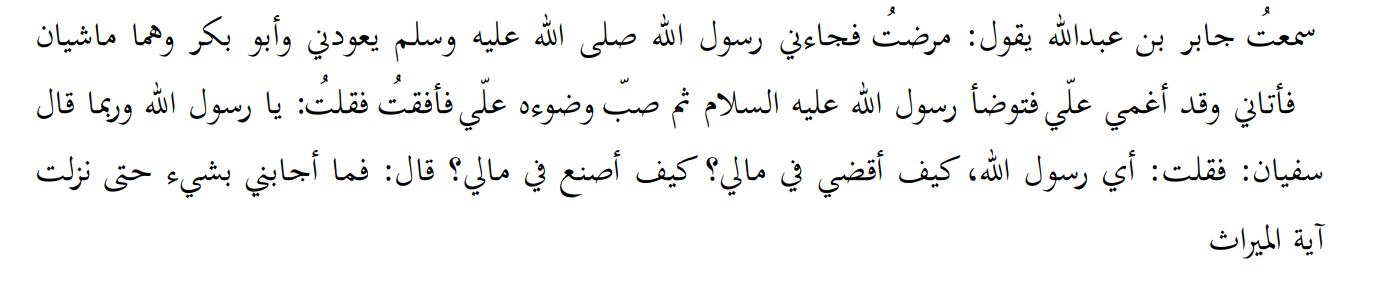
“Ouvi Jabir bin Abdullah dizer: Eu estava doente, então o Mensageiro de Allah ﷺ veio me visitar junto com Abu Bakr, caminhando. Eles me encontraram inconsciente. O Mensageiro de Allah ﷺ fez wudhu e depois derramou um pouco de água sobre mim. Acordei e disse ao Mensageiro de Allah ﷺ: Ó Mensageiro de Allah, como devo decidir sobre a minha riqueza? O que devo fazer com a minha riqueza? Ele não me respondeu nada até que foi revelado o versículo da herança.”
“I heard Jabir bin Abdullah saying: I was ill so the Messenger of Allah (saw) came to visit me together with Abu Bakr walking. They found me when I was unconscious. The Messenger of Allah (saw) made wudhu then poured some water upon me. I woke up and said to the Messenger of Allah (saw): O Messenger of Allah, how should I judge over my wealth? What should I do with my wealth? He said: He did not answer me at all until the ayah of inheritance was revealed.”
Isto dizia respeito ao exercício do encargo da Profecia e da Mensagem, e à transmissão da mensagem às pessoas, ao passo que, no exercício do encargo do governo, ele agia de modo diferente. Em Uhud, reuniu os muçulmanos na mesquita e consultou-os sobre se deveriam combater dentro de Medina ou fora dela; a opinião da maioria foi combater fora, enquanto a opinião do Mensageiro era combater dentro. Ele agiu segundo a opinião da maioria, saiu e combateu fora de Medina. Da mesma forma, quando julgava entre as pessoas, ele as advertia para que não o levassem a julgar a favor de alguém em detrimento do direito devido a outro. Al-Bukhari narrou, por meio de Umm Salamah, que o Mensageiro de Allah ﷺ ouviu uma disputa à porta de sua casa, então foi até eles e disse:
This was in the undertaking of the burden of Prophethood and Messengership and conveying to the people, whereas in undertaking the burden of rule he would behave differently. In Uhud he collected the Muslims in the mosque, consulted over whether to fight inside Madinah or outside; the opinion of the majority was to fight outside while the Messenger’s opinion was to fight inside. He acted upon the majority opinion, left and fought outside Madinah. Similarly when he judged between people, he would warn them from causing him to judge for them against someone else’s due right. Al-Bukhari narrated from Umm Salamah about the Messenger of Allah (saw) that he heard a dispute at the door of his house so he went to them and said:
"Sou apenas um ser humano, e litigantes com casos de disputa vêm até mim, e pode acontecer de algum de vocês ser mais eloquente (ao apresentar o seu caso) do que o outro, de modo que eu possa considerar que ele é sincero e proferir um julgamento a seu favor. Se eu, em algum momento, proferir um julgamento a favor de alguém e, com isso, ele tomar injustamente o direito de um muçulmano, então o que ele tomar não será senão um pedaço do Fogo, e cabe a ele tomar ou deixar."
“I am only a human being, and litigants with cases of dispute come to me, and someone of you may happen to be more eloquent (in presenting his case) than the other, whereby I may consider that he is truthful and pass a judgment in his favor. If ever I pass a judgment in favor of somebody whereby he takes a Muslim's right unjustly, then whatever he takes is nothing but a piece of Fire, and it is up to him to take or leave.”
Da mesma forma, ele narrou dele que o Profeta ﷺ disse:
Similarly he narrated from him that he (saw) said:
"Na verdade, desejo encontrar Allah, ʿazza wa jalla, sem que ninguém me reclame uma injustiça que eu tenha cometido contra ele, seja em sangue ou em bens."
“Verily I wish to meet Allah ‘azza wa jalla without anyone seeking from me an injustice I committed against him, whether in blood or money.”
Isto indica que ele assumiria dois papéis: a posição de Profeta e Mensageiro, e a posição de liderança dos muçulmanos neste mundo no estabelecimento da Shari'ah de Allah (swt), que lhe foi revelada. Ele agiria em cada papel de acordo com o que este exigia, de modo que conduziria um de forma diferente do outro. Ele recebeu o juramento de lealdade do povo no governo, tomando-o tanto das mulheres quanto dos homens, mas não das crianças pequenas que ainda não tinham atingido a puberdade, o que enfatiza que se tratava de um juramento de governo, e não de Profetismo. Daqui encontramos que Allah (swt) nunca o repreendeu em nada relacionado à transmissão da mensagem ou ao cumprimento de sua responsabilidade; pelo contrário, Ele lhe pedia que não se entristecesse pela falta de resposta das pessoas, pois a incumbência da mensagem era apenas a transmissão; portanto, não havia dever sobre ele senão transmitir. Allah (swt) disse:
This goes to indicate that he would undertake two roles: the position of Prophethood and Messengership, and the position of leading the Muslims in this world in establishing the Shari’ah of Allah (swt) which was revealed to him. He would dispose in undertaking each role according to what it required, so he would conduct one differently from the other. He took the pledge of the people in ruling, taking it from both women and men but not from young children who had not yet reached puberty, which emphasises that it was a pledge upon ruling not upon Prophethood. From here we find we find that Allah (swt) never censured him in anything to do with conveying the message or undertaking its burden, rather he would request him not to be troubled due to people’s failure to respond to him as the undertaking of the burden of the message was conveying alone; so there was no duty upon him except to convey. Allah (swt) said:
"Que vossas almas não se consumam em suspiros vãos por eles" [TMQ 35:8]
"Let not your souls go out in (vainly) sighing for them" [TMQ 35:8]
E:
And:
"Não te entristeças com o que eles estão tramando" [TMQ 16:27]
"Do not grieve over what they are plotting" [TMQ 16:27]
E:
And:
"A única (obrigação) que recai sobre você é transmitir" [TMQ 42:48].
"The only (duty) upon you is conveying" [TMQ 42:48].
Contudo, Allah (swt) o repreendeu pelo encargo do governo nas ações que realizou ao aplicar regras previamente reveladas a ele e já transmitidas. Allah (swt) o repreendeu por ter feito algo contrário ao que era melhor. Allah (swt) disse:
However Allah (swt) censured him over his undertaking of the burden of ruling in the actions he performed in implementing rules previously revealed to him and already conveyed. Allah (swt) censured him over doing something contrary to what was better. Allah (swt) said:
"Não é próprio de um Profeta ter prisioneiros de guerra até que ele tenha feito grande matança na terra" [TMQ 8:67]
"It is not for a Prophet to have captives of war until he made great slaughter in the world" [TMQ 8:67]
E:
And:
"Que Allah te perdoe! Por que lhes concedeste permissão?" [TMQ 9:43].
"Allah forgive you! Why did you grant them permission?" [TMQ 9:43].
Tudo isso deixa claro que o papel de liderança dos muçulmanos no governo era diferente do papel da Profecia. A partir disso fica evidente que o Khilafah, que é a liderança geral sobre todos os muçulmanos do mundo, é um cargo humano, não divino. Trata-se de uma função que o Mensageiro de Allah ﷺ costumava exercer e que deixou, ao mesmo tempo determinando que um muçulmano assumisse essa função após ele, para que este ocupasse o lugar do Mensageiro de Allah ﷺ e fosse seu Khalifah no governo, mas não na Profecia. É um Khilafah ao Mensageiro ﷺ na condução dos muçulmanos à implementação das regras islâmicas e à transmissão da mensagem, e não no recebimento da revelação ou na instituição de uma Shari'ah de Allah.
All this is clear that the role of leading Muslims in the rule was different from the role of Prophethood. From this it becomes clear that the Khilafah, which is the general leadership over all Muslims in the world, is a human post not a divine one. Since it is a role which the Messenger (saw) used to be in charge of and he left it while obliging that a Muslim should take it over for him so that he takes the place of the Messenger of Allah (saw) and be his Khalifah in ruling but not in Prophethood. It is a Khilafah to the Messenger in leading the Muslims to implement the Islamic rules and conveying the message not in receiving revelation or taking a Shari’ah from Allah.
Quanto à infalibilidade do Mensageiro (saw), ela provém de ser ele um Profeta e não de ser um governante. Isso porque a infalibilidade é um atributo obrigatório para todos os Profetas e Mensageiros, quer tenham eles mesmos sido os que governaram os povos pela sua Shari'ah e a implementaram, quer tenham estado apenas restritos a transmiti-la sem governar com ela ou implementá-la. Nosso mestre Musa (as), nosso mestre Isa (as) e nosso mestre Ibrahim (as) foram infalíveis, assim como nosso mestre Muhammad (saw) foi infalível, pois a infalibilidade é inerente à Profecia e à Mensagem, não ao governo. Quanto ao fato de ele (saw) não ter cometido nenhuma ação haram durante o exercício da responsabilidade de governar, nem ter deixado nenhuma ação obrigatória, isso decorreu de sua infalibilidade em relação à Profecia e à Mensagem, e não em relação a ser governante. Assim, o fato de ele (saw) assumir o governo não exigia que fosse caracterizado pela infalibilidade, mas, na prática, ele era infalível devido à sua condição de Profeta e Mensageiro. Consequentemente, ele assumia o governo na sua descrição como ser humano governando seres humanos. O Alcorão declarou explicitamente que ele é um ser humano. Allah (swt) disse:
As for the Messenger (saw)’s infallibility, it comes from his being a Prophet not from his being a ruler. This is because infallibility is an obligatory attribute for all Prophets and Messengers, irrespective of whether they themselves were the ones to rule over people by their Shari’ah and implement it or whether they were merely restricted to conveying it without ruling with it or implementing it. Our master Musa (as), our master Isa (as) and our master Ibrahim (as) were infallible just like our master Muhammad (saw) was infallible as the infallibility is for Prophethood and the Message not the rule. As for his (saw) not doing any haram action during his undertaking the burden of ruling nor leaving any obligatory action, this came from his being infallible in relation to Prophethood and the Message not in relation to his being a ruler. So his (saw) undertaking the rule did not require his being characterised with infallibility, but practically he was infallible due to his being a Prophet and Messenger. Accordingly, he would undertake the rule in his description as a human being ruling over human beings. The Qur’an has come explicitly stating that he is a human being. Allah (swt) said:
Diga: "Eu sou apenas um ser humano como vocês." [TMQ 18:110]
"Say: Verily I am only a human similar to you" [TMQ 18:110]
Então esclareceu a distinção dele em relação ao restante da humanidade (ao dizer):
Then it clarified distinguishing him from the rest of humanity (by saying):
"Foi-me revelado" [TMQ 6:50].
"It has been revealed to me" [TMQ 6:50].
A distinção dele em relação ao resto da humanidade é que ele recebe revelação, isto é, na Profecia. Fora isso, ele é humano como o restante da humanidade. Assim, no governo ele é um ser humano como as outras pessoas, de modo que quem se tornar Khalifah depois dele seria, sem dúvida, um ser humano como o restante das pessoas, já que é seu Khalifah no governo, e não na Profecia ou na Mensagem. Portanto, a infalibilidade não é uma condição para isso, pois não se inclui entre os assuntos que exigem infalibilidade, que só é exigida para a Profecia. Ele é um governante, nada mais, e por isso não há lugar para exigir infalibilidade daqueles que estão encarregados dele. Na verdade, não é permitido exigir infalibilidade de quem assume essa função, pois a infalibilidade é restrita aos Profetas e não é permitida a outros que não sejam Profetas, uma vez que sua existência no Profeta e Mensageiro ﷺ é necessária para a transmissão. Trata-se, portanto, de infalibilidade na transmissão, e a aquisição dela por nunca cometer um haram decorre naturalmente da infalibilidade na transmissão, pois a infalibilidade desta não pode ser completa sem a infalibilidade quanto a cometer haram. O que exige isso é a transmissão.
The distinction from the rest of humanity is that he is revealed to i.e. in the Prophethood. Apart from that he is a human like the rest of mankind. So he is in the rule a human like other people so whoever becomes Khalifah after him would doubtless be a human being like the rest of the people since he is his Khalifah in the rule not in Prophethood or the Message. Therefore infallibility is not a condition for it since it is not one of the matters which require infallibility which is only required for Prophethood. He is a ruler, nothing else, so there is no place for requiring infallibility for those who are in charge of it. In fact, it is not allowed to require infallibility for the one undertaking it as infallibility is restricted to Prophets and it is not allowed for other than Prophets as its existence for the Prophet and Messenger (saw) is required for conveyance. So it is infallibility in conveyance and its acquirement in never performing a haram naturally follows the infallibility in conveyance as the infallibility in the latter cannot be complete save with the infallibility from performing haram. The matter which requires it is the conveyance, The Islamic Personality Vol 2 95
não se trata da crença ou descrença das pessoas, nem do erro nas ações ou da sua ausência; a questão que exige isso é, antes, a transmissão da mensagem, e nada além disso. Isto porque, se ele não tivesse sido feito infalível por Allah (swt), seria possível que ocultasse a mensagem, acrescentasse ou reduzisse nela, mentisse contra Allah dizendo o que Ele não havia dito, ou cometesse um erro e transmitisse algo diferente daquilo que lhe fora ordenado transmitir. Tudo isso é negado numa mensagem de Allah (swt) e negado no fato de ele ser um Mensageiro em quem se deve crer. Portanto, é inevitável que o Mensageiro seja caracterizado pela infalibilidade na transmissão da mensagem, e a infalibilidade quanto à prática do haram decorre naturalmente disso. Por causa disso, os eruditos divergiram quanto à infalibilidade dos Profetas em relação à prática do haram: alguns disseram que ele é infalível apenas quanto aos pecados maiores (kabair), sendo aceitáveis dele os pecados menores (saghair), enquanto outros disseram que ele é infalível tanto quanto aos pecados maiores quanto aos menores. Disseram isso conforme as ações estejam ou não vinculadas à conclusão da transmissão. Se a realização da transmissão depende delas, então a infalibilidade na transmissão abrange-as, de modo que o Profeta se torna infalível quanto a elas, pois a transmissão não se completa senão com a sua infalibilidade em relação a elas. Já se a conclusão da transmissão não depende delas, então a infalibilidade não as abrange, e ele não é infalível quanto a elas, pois a transmissão se cumpre sem elas. Assim, não há divergência entre os muçulmanos de que o Mensageiro (ﷺ) não é infalível quanto a ações que são contrárias ao que é melhor, visto que a transmissão da mensagem não depende delas. Desse modo, a infalibilidade é específica da transmissão e, portanto, não existe senão nos Profetas e Mensageiros, nem é possível em ninguém além deles.
Na verdade, a evidência da infalibilidade é racional, não textual, pois não surgiram quaisquer textos da Shari'ah, nem um texto claro no Alcorão ou no Hadith, que estabeleçam a existência de infalibilidade para quem quer que seja, sejam os Profetas, os Mensageiros ou outros. Quanto à declaração de Allah:
Verily the evidence for infallibility is rational not textual as there has not come any Shari’ah texts, whether a clear text in the Qur’an or Hadith, upon the existence of infallibility for anyone whether the Prophets, the Messengers or others. As for Allah’s statement:
"Na verdade, Allah apenas deseja afastar de vós a impureza (rijs), ó família da casa, e purificar-vos completamente" [TMQ 33:33],
"Verily, Allah only intends to remove filth (rijs) from you, the family of the house, and purify you completely" [TMQ 33:33],
Seu significado é que Ele pretende remover de vocês toda dúvida e acusação. Este versículo faz parte de três versículos. Allah (SWT) disse:
Its meaning is that He intends to remove from you any doubt and accusation. This ayah is a piece among three ayat. Allah (swt) said:
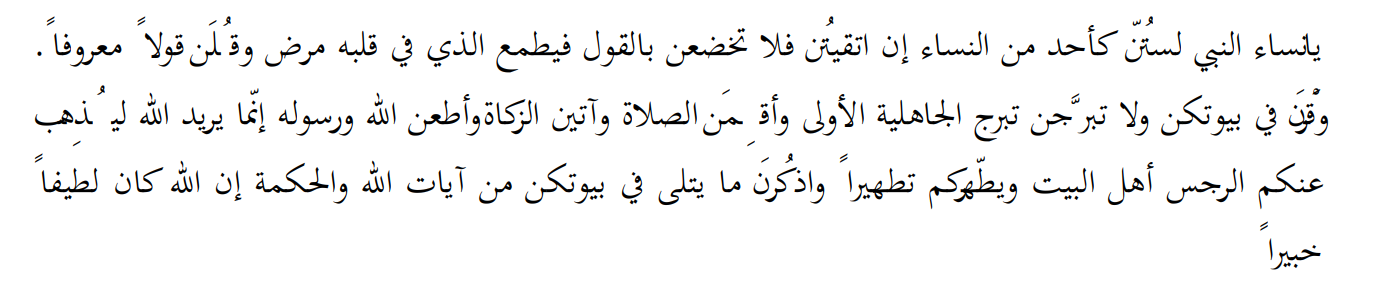
"Ó esposas do Profeta ﷺ, vós não sois como qualquer outra mulher. Se temeis (a Allah), então não sejais complacentes na fala, para que aquele em cujo coração há uma doença não se deixe levar pelo desejo, mas dizei uma palavra justa. E permanecei tranquilamente em vossas casas e não vos exibais com ostentação, como a das eras anteriores da ignorância. Estabelecei a oração, pagai o zakat e obedecei a Allah e ao Seu Mensageiro. Na verdade, Allah só quer afastar de vós a impureza, ó família da casa, e purificar-vos completamente. E lembrai-vos do que é recitado em vossas casas dos sinais de Allah e da Sabedoria. Na verdade, Allah é Gentil, Onisciente" [TMQ 33:32-34].
"O wives of the Prophet, you are not like any other woman. If you fear (Allah) then be not too complaisant of speech lest one in whose heart is a disease should be moved with desire but speak a speech (that is) just. And stay quietly in your houses and make not a dazzling display like that of the former times of ignorance, and establish prayer and give the zakat and obey Allah and His Messenger. Verily Allah only wishes to remove filth from you, O family of the house, and purify you completely. And remember what is recited in your homes of the signs of Allah and the Wisdom. Verily Allah is Courteous, All-Knowing" [TMQ 33:32-34].
Não há nenhuma relação, de forma alguma, entre este versículo e a infalibilidade. Não é possível compreender, a partir da expressão “para remover de vós a impureza”, isto é, para torná-los infalíveis. Antes, a remoção da impureza é a remoção de toda sujeira, e o sentido aqui é a impureza metafórica, isto é, a dúvida e a suspeita, como fica explicitamente claro nas frases que precedem esta frase nos dois versículos. A purificação aqui é a limpeza da dúvida e da suspeita, porque os sentidos da palavra impureza são a impureza material, a impureza metafórica e até mesmo o castigo, como aparece no Alcorão com estes sentidos. Allah (SWT) disse:
There is no relationship between this ayah and infallibility in any way whatsoever. It is not possible to understand from His statement “to remove filth from you” i.e. to make you infallible. Rather the removing of filth is the removing of all dirt and the meaning here is metaphorical filth i.e. doubt and suspicion as is explicitly clear in the sentences before this sentence in the two ayat. The purification here is cleansing from doubt and suspicion because the meaning(s) of the word filth is material filth, metaphorical filth and even punishment as it has come in the Qur’an with these meanings. Allah (swt) said:
Evitem a imundícia dos ídolos [TMQ 22:30]
"Avoid the filth of the idols" [TMQ 22:30]
E:
And:
Da mesma forma, Allah impõe a imundície sobre aqueles que não creem {Assim Allah impõe a imundície sobre os que não creem} [TMQ 6:125].
"Similarly does Allah ordain the filth upon those who do not believe" [TMQ 6:125].
Nestes dois versículos, a impureza é uma impureza figurada. E Allah (SWT) disse:
In these two ayat, filth is metaphorical filth. And Allah (swt) said:
Ou a carne de porco, pois, em verdade, ela é impureza. [TMQ 22:30]
"Or the meat of pig for verily it is filth" [TMQ 22:30]
isto é, impureza ritual, ou seja, sujidade física. E Allah (SWT) disse:
i.e. ritual impurity meaning physical filth. And Allah (swt) said:
Assim, Allah coloca a ira sobre aqueles que não creem [TMQ 6:125].
"Thus Allâh puts the wrath on those who believe not" [TMQ 6:125].
Assim, a afirmação d'Ele, "para remover de vós a impureza", significa remover a impureza metafórica, isto é, a suspeita. Quanto à Sua afirmação "e purificar-vos completamente", na verdade a palavra yutahirukum (purificar-vos) e a palavra purificação nunca vieram com o sentido de infalibilidade, nem na língua, nem no Alcorão, nem no Hadith. Na língua, purificar (tahara) algo, purificação (tatheer), significa remover a impureza dele, e a mulher é pura (tahir) da menstruação e (tahira) da impureza e dos defeitos, e (tahara), na Shar'a, significa remover o hadath. O Profeta ﷺ disse:
So His statement in the ayah “to remove the filth from you” means to remove metaphorical filth i.e. suspicion. As for His saying: “And purify you completely” verily the word yutahirukum (to purify you) and the word purification never came with the meaning of infallibility, neither in the language, Qur’an or the Hadith. In the language, to purify (tahara) something purification (tatheera) means to remove impurity from it, and the woman is pure (tahir) from menstruation and (tahira) from impurity and defects, and (tahara) in the Shar’a is removing the (hadath). He (saw) said:
"Allah não aceita a oração sem pureza (tuhur)"
“Allah does not accept prayer without purity (tuhur)”
E isso foi mencionado no Alcorão com este significado. Allah (SWT) disse:
And it has come in the Qur’an with this meaning. Allah (swt) said:
"E purifica a tua roupa" [TMQ 74:4]
"And purify your garment" [TMQ 74:4]
E:
And:
Água para que possais purificar-vos com ela [TMQ 8:11]
"Water so that you may be purified by it" [TMQ 8:11]
E:
And:
Não se aproximem delas até que se purifiquem. [TMQ 2:222]
Do not approach them until they purify themselves [TMQ 2:222]
"Escolheu-te e purificou-te" [TMQ 3:42
"Chose you and purified you" [TMQ 3:42
ou seja, dos defeitos e também:
i.e. from faults and also:
"E se estiverem em estado de impureza maior (junub), então purifiquem-se" [TMQ 5:6]
"And if you are (junub) then purify yourselves" [TMQ 5:6]
Ou seja, da impureza. A purificação dos crentes também veio quando Allah (SWT) disse:
I.e from the impurity. The purification of the believers also came when Allah (swt) said:
{Allah não quer criar dificuldade (haraj) para vós, mas deseja purificar-vos e completar a Sua bênção sobre vós} [TMQ 5:6].
"Allah does not wish to make difficulty (haraj) for you but rather He wishes to purify you and complete His blessing upon you" [TMQ 5:6].
Todos esses textos especificam que o significado do versículo é que Allah (SWT) os purificou da dúvida e da suspeita, e negam que seu significado seja a infalibilidade; portanto, o versículo não indica infalibilidade.
All these texts specify that the meaning of the ayah is that Allah (swt) cleansed them from doubt and suspicion, and negates that its meaning is infallibility hence the ayah does not indicate infallibility.
Portanto, não há evidência textual para a existência da infalibilidade em ninguém; há somente prova racional para ela. A mente é o que impõe que haja infalibilidade na transmissão para o Profeta e Mensageiro, pois ser ele Profeta e Mensageiro exige que seja infalível, do contrário não pode ser Profeta ou Mensageiro. A mente é também a que impõe que quem não recebeu a responsabilidade de transmitir uma mensagem de Allah (swt) não pode ser infalível, pois é um ser humano, e sua natureza (fitra), com a qual Allah (swt) o criou, é que ocorram nele erro e esquecimento. E enquanto não for investido da responsabilidade de uma mensagem de Allah (swt), isso significa que nada exige que ele seja infalível. Se for alegado que ele é infalível, então isso significa que ele está investido de uma mensagem de Allah, o que não é permitido, visto que não há Profeta depois de Muhammad, o Mensageiro de Allah ﷺ. Allah (swt) disse:
Therefore there is no textual evidence for the existence of infallibility for anyone; there is only rational proof for it. The mind is what compels that there be infallibility in conveyance for the Prophet and Messenger as his being a Prophet and Messenger requires that he be infallible otherwise he cannot be a Prophet or Messenger. The mind is the one which compels that one not given the responsibility to convey a message from Allah (swt) is not allowed to be infallible as he is a human being, and his nature (fitra) with which Allah (swt) created him is that error and forgetfulness occur in him. And as long as he is not given responsibility with a message from Allah (swt), this means there is nothing which requires that he be infallible. If it is claimed that he is infallible, then this means that he is responsible with a message from Allah which is not permitted since there is no Prophet after Muhammad, the Messenger of Allah (saw). Allah (swt) said:
"Mas ele é o Mensageiro de Allah e o selo dos Profetas" [TMQ 33:40].
" But he is the Messenger of Allah and seal of the Prophets" [TMQ 33:40].
Afirmar a infalibilidade equivale a afirmar a Mensagem, pois o Mensageiro é um transmissor de Allah, e nele há, por causa de seus atributos como ser humano, a possibilidade de erro e desvio na transmissão de Allah. Proteger a mensagem de Allah contra o erro e a alteração na transmissão exige que o Mensageiro seja infalível quanto ao erro e ao desvio. Por essa razão única, a infalibilidade é um atributo do Mensageiro, e somente ele é a quem ela é exigida. Se ela for afirmada para outra pessoa, sabendo-se que a única coisa que a exige é a transmissão da mensagem de Allah, então equivale a atribuir a essa outra pessoa aquilo que exige a infalibilidade e sua causa, isto é, a transmissão da mensagem. Assim, seria afirmar que ela é responsável por transmitir uma mensagem de Allah (SWT). Portanto, não é permitido exigir infalibilidade para o Khalifah, pois exigi-la significa que ele é responsável por transmitir uma mensagem de Allah (SWT), o que o obrigaria a ser infalível, e isso não é permitido.
Claiming infallibility means claiming Messengership since the Messenger is a conveyor from Allah, and there is within him due to his attributes as a human being the potential of error and misguidance in conveying from Allah, protecting the message of Allah from error and change in the conveyance requires that the Messenger be infallible from error and misguidance. For this reason alone, infallibility is an attribute of the Messenger and it alone requires infallibility. If it is claimed for anyone other than him while being known that the only matter requiring it is conveying the message from Allah then it is equivalent to claiming for this other person what requires infallibility and its cause i.e. conveying the message. Thus it would be claiming that he is responsible to convey a message from Allah (swt). Therefore it is not allowed to require infallibility for the Khalifah as requiring it means that he is responsible to convey a message from Allah (swt) thus requiring him to be infallible, and this is not permitted.
Isto deixa claro que o Khalifah é um ser humano que pode errar ou acertar, e pode ocorrer dele o que ocorre a qualquer ser humano: negligência e esquecimento, falsidade, traição e pecados, pois ele é um ser humano e não um Profeta ou Mensageiro. O Mensageiro de Allah ﷺ informou que é possível que o Imam erre, e informou que pode ocorrer dele aquilo que pode levar as pessoas a odiá-lo e amaldiçoá-lo por injustiça, pecados etc. Ele chegou a informar que pode ocorrer dele até uma descrença clara. Muslim relatou: Zuhayr bin Harb me contou que Shababa nos contou que Warqa me contou, de Aby Zayyad, de Al-‘Araj, de Abu Hurayray, do Profeta ﷺ, que disse:
This makes it clear that the Khalifah is a human being who can make a mistake or be correct, and it is allowed to occur from him what occurs from any human being of neglect and forgetfulness, falsehood, treachery, sins as he is a human being and not a Prophet or Messenger. The Messenger (saw) informed that it is possible for the Imam to err, and he informed that it may occur from him what may cause people the hate him and curse him due to injustice, sins etc. He even informed that clear disbelief may occur from him. Muslim narrated: Zuhayr bin Harb related to me that Shababa related to us that Warqa related to me from Aby Zayyad from Al- ‘Araj from Abu Hurayray from the Prophet (saw) who said:
"Verdadeiramente, o Imam é um escudo por trás do qual se luta e pelo qual se é protegido. Se ele ordena com o temor (taqwa) de Allah ‘azza wa jalla e pratica a justiça, então há recompensa por isso para ele. E se ele ordena com outra coisa que não essa, então há o mesmo peso contra ele."
“Verily the Imam is a shield from behind whom they fight and by whom they are protected. If he commanded with the fear (taqwa) of Allah ‘azza wa jalla and does justice then there is reward for that for him. If he commands with other than that, then there is the same against him.”
Isso significa que o Imam não é infalível e é possível que ele ordene algo que não seja o temor de Allah. Muslim também narrou: Uthman bin Abi Sheeba nos relatou que Jareer nos relatou, de Al-‘Amash, de Zayd bin Wahhab, de Abdullah, que disse: O Mensageiro de Allah ﷺ disse:
This means that the Imam is not infallible and it is possible for him to command other than the fear of Allah. Muslim also narrated: Uthman bin Abi Sheeba related to us that Jareer related to us from Al-‘Amash from Zayd bin Wahhab from Abdullah who said: The Messenger of Allah (saw) said:
"Na verdade, depois de mim haverá preferências injustas e assuntos que vocês rejeitarão." Disseram: "Ó Mensageiro de Allah, o que você nos ordena caso isso nos alcance?" Ele disse: "Cumpram os direitos que lhes são devidos e peçam a Allah o que lhes é devido."ﷺ
“Verily there will be after me some improper preferences and matters which you will reject. They said: O Messenger of Allah, what would you command anyone of us when that reaches him? He said: Fulfill the rights due from you and ask Allah (for) what is due to you.”
Muslim narrou: Ishaq bin Ibrahim Al-Handhalee nos relatou que Isa bin Yunus nos informou que Al-Awza'i nos relatou de Zayd bin Yazid bin Jabir, de Zareeq bin Hayyan, de Muslim bin Qurta, de 'Awf bin Malik, que o Mensageiro de Allah ﷺ disse:
Muslim narrated: Ishaq bin Ibrahim Al-Handhalee related to us that Isa bin Yunus informed us that Al-Awza’i related to us from Zayd bin Yazid bin Jabir from Zareeq bin Hayyan from Muslim bin Qurta from ‘Awf bin Malik from the Messenger of Allah (saw) who said:
"Os melhores dos vossos governantes são aqueles que amais e que vos amam, que invocam a bênção de Deus sobre vós e vós invocais a Sua bênção sobre eles. E os piores dos vossos governantes são aqueles que odiais e que vos odeiam, aos quais amaldiçoais e que vos amaldiçoam." Foi perguntado (pelos presentes): "Não devemos derrubá-los com a ajuda da espada?" Ele disse: "Não, enquanto estabelecerem a oração entre vós. Se então encontrardes algo detestável neles, deveis odiar a sua administração, mas não vos afasteis da sua obediência."
“The best of your rulers are those whom you love and who love you, who invoke God's blessings upon you and you invoke His blessings upon them. And the worst of your rulers are those whom you hate and who hate you and whom you curse and who curse you. It was asked (by those present): Shouldn't we overthrow them with the help of the sword? He said: No, as long as they establish prayer among you. If you then find anything detestable in them. You should hate their administration, but do not withdraw yourselves from their obedience.”
Al-Bukhari narrou: “Ismail nos relatou que Bin Wahhab me relatou de Amru, de Bukayr, de Busr bin Said, de Junada bin Abu Umayyah, que disse: Entramos na casa de ‘Ubadah bin As-Samit, que estava doente, e dissemos: Que Allah o restabeleça. Relate-nos um hadith que tenha ouvido do Profeta ﷺ, pelo qual Allah o ajude. Ele disse:
Al-Bukhari narrated: “Ismail related to us that Bin Wahhab related to me from Amru from Bukayr from Busr bin Said from Junada bin Abu Umayyah who said: We entered to ‘Ubadah bin As-Samit who was ill and we said: May Allah improve you. Relate to us a hadith which you heard from the Prophet by which Allah will help you. He said:
“O Profeta ﷺ nos chamou e nós lhe fizemos um juramento de lealdade. Ele disse, entre o que nos fez prometer, que lhe prometêssemos ouvir e obedecer tanto no que nos agrada como no que nos desagrada, na dificuldade e na facilidade, e quando outros fossem preferidos a nós, e que não disputaríamos a autoridade com os que detêm o comando. (Ele disse): A não ser que vejais uma descrença manifesta (kufr bawah), sobre a qual tenhais de Allah uma prova clara (sultan).”
“The Prophet (saw) called us so we gave him a pledge. So he said in what we took from us that we pledged him to hear and obey in what attracts us and what we hate, in hardship and ease, and when others are preferred over us and that we do not dispute the rule with those in authority (He said): Unless you see clear disbelief (kufr bawah) upon which you have from Allah a clear proof (sultan).”
E de Aisha, que disse: "O Mensageiro de Allah ﷺ disse:
And from Aisha who said: “The Messenger of Allah (saw) said:
"Evitem aplicar as penas legais aos muçulmanos na medida do possível; se houver uma saída para ele, deixem-no seguir o seu caminho, pois se o Imam errar ao perdoar, isso seria melhor do que errar ao punir."
" Avert the legal penalties from the Muslims as much as possible, if he has a way out then leave him to his way, for if the Imam makes a mistake in forgiving it would be better than making mistake in punishment.”
Tirmidhi narrou este hadith, que é claro quanto ao fato de que o Imam pode errar, esquecer e pecar. Apesar disso, o Mensageiro (saw) ordenou que se continue a obedecê-lo enquanto ele governar pelo Islam, enquanto não tiver ocorrido dele uma descrença evidente e ele não tiver ordenado o pecado. Após a notícia do Mensageiro ﷺ sobre os Khulafaa, de que haverá alguns que os muçulmanos desaprovarão, mas ainda assim ele ordenou a obediência, há alguma possibilidade, depois disso, de afirmar que o Khalifah deve ser infalível e que não é permitido a ele o que é permitido aos seres humanos? Isso faz parte da realidade do Khalifah em relação à ausência da condição de infalibilidade, ou melhor, até mesmo à ausência de permissão para tornar isso uma condição. No entanto, aqueles que disseram que é necessário que o Khalifah seja infalível apresentaram evidências para a sua opinião, portanto devemos examiná-las e esclarecer o que há nelas. Essas evidências se resumem em quatro evidências.
Tirmidhi narrated this hadith which is clear that the Imam can err, forget and sin. Despite that, the Messenger (saw) commanded to continue obeying him as long as he rules by Islam and clear disbelief has not occurred from him and he has not commanded with sin. After the news of the Messenger (saw) about the Khulafaa that there will be some which the Muslims will dislike yet he commanded obedience, is there after that any possibility of saying that the Khalifah must be infallible and that it is not permitted from him what is permitted from human beings? This is from the reality of the Khalifah in relation to the absence of the condition of infallibility, rather even the absence of permission to even make it a condition. However, those who said it is required that the Khalifah be infallible have presented evidences for their view, so we must examine and clarify what is within them. These evidences are summarised in four evidences:
1. O Imam ocupa a posição do Mensageiro na preservação da Shari'ah, na sua transmissão e ensino, na supervisão dos assuntos dos cidadãos, no estabelecimento da justiça entre eles, no auxílio aos oprimidos, na aplicação dos castigos islâmicos obrigatórios (hudood) e dos castigos discricionários (ta'zeer), e na implementação do Islã conforme a Shari'ah. Por isso, é inevitável que ele seja infalível e puro de todo mal, grande ou pequeno, quer tenha ocorrido deliberadamente quer por esquecimento, desde o início até ao fim da sua vida.
1. The Imam stands in the position of the Messenger in preserving the Shari’ah , conveying and teaching it, supervising the citizens’ affairs, establishing justice among them, assisting the oppressed, establishing the mandatory Islamic punishments (hudood) and discretionary punishments (ta’zeer) and implementing Islam in the Shari’ah way. Therefore it is inevitable that he be infallible and pure from all evil, large or small, whether they occurred deliberately or through forgetfulness, from the beginning of his life to the end.
"Minha promessa não inclui os opressores" [TMQ 2:124]
"My promise does not include the oppressors" [TMQ 2:124]
A declaração de Allah (SWT) é uma evidência da obrigatoriedade de um Imam infalível, que é guardião da Sharia. Este versículo está na Surata Al-Baqara. Allah (SWT) disse:
The statement from Allah (swt) is an evidence upon the obligation of an infallible Imam who is a protector of Shari’ah. This ayah is in Surah Al-Baqarah. Allah (swt) said:
E quando Ibrahim foi provado por seu Senhor com certas palavras, e ele as cumpriu. Disse: "Farei de ti um Imam para os homens." Perguntou: "E dos meus descendentes?" Respondeu: "Minha promessa não alcança os opressores." [TMQ 2:124]
"And when Ibrahim was tested by his Lord with certain words which he fulfilled. He said: I will make you an Imam for the people. He said: And of my offspring? He said: My promise will not reach the oppressors" [TMQ 2:124].
As palavras "fazendo dele" são as que o tornam um Imam, como o versículo seguinte deixa claro. Quando Ibrahim ouviu a declaração de Allah:
The words making him are those making him an Imam as the ayah coming after this ayah give sense to. When Ibrahim heard Allah’s statement:
"Eu certamente farei de você um Imã para os homens" [TMQ 2:124]
"Verily I will make you an Imam for the people" [TMQ 2:124]
E viu a grandeza deste posto honroso; ele esperava que seus descendentes tivessem uma parte dele. Então Allah (SWT) disse:
And saw the greatness of this honourable post; he hoped that his descendants would have a share of it. So Allah (swt) said:
"Minha promessa não alcança os oprimidos" [TMQ 2:124].
"My promise does not reach the oppressors" [TMQ 2:124].
Seu significado é que este cargo não será dado a alguém que esteja manchado ou que venha a ser maculado pela injustiça, o que é mais abrangente do que saber se ele é injusto consigo mesmo ou com outros, mesmo que apenas por um curto período de sua vida. Pelo contrário, ele é dado a alguém que não cometa nenhuma injustiça ao longo de sua vida.
Its meaning is that this post will not be given to someone who is blemished or will become stained with injustice, which is more general than whether this one is unjust to his own soul or someone else even if only for a short time in his life. Rather it is given to someone who does not do any injustice in his life.
b) Allah (SWT) disse:
b) Allah (swt) said:
"Aquele que guia para a Verdade é mais digno de ser seguido, ou aquele que não guia a menos que seja guiado?" [TMQ 10:35].
"Is the one guided to the Truth of more right to be followed or the one who does not guide unless he is guided?" [TMQ 10:35].
Esta é uma evidência para a obrigação da infalibilidade do Imam, pois aquele que guia à verdade é infalível, e aquele de quem é possível um erro não guia a ela, ainda que possa acontecer de ele alcançar a verdade.
This is an evidence for the obligation of the infallibility of the Imam as he guides to the truth, and the one from whom an error is possible does not guide to it though it may happen that he achieves the truth.
c) Allah (SWT) disse:
c) Allah (swt) said:
"Obedeçam a Allah, obedeçam ao Mensageiro e àqueles dentre vós que detêm a autoridade" [TMQ 4:59].
"Obey Allah and obey the Messenger and those in authority among you" [TMQ 4:59].
Este versículo é uma evidência da infalibilidade dos detentores da autoridade, isto é, da infalibilidade do Imam, porque Allah (SWT) ordenou a obediência aos detentores da autoridade de forma irrestrita, sem especificar a obediência a uma pessoa determinada ou a um período determinado. Isto exige que aquele a quem se obedece seja infalível, pois um falível pode ordenar o pecado e o erro. Se a sua obediência fosse obrigatória enquanto ele estivesse nesta situação, sendo ela proibida, isto obrigaria a que o Senhor, cujo domínio é glorificado, tivesse ordenado a reunião de dois opostos ou matérias contraditórias, o que é impossível. Portanto, aquele a quem se deve obedecer tem de ser infalível. Além disso, Allah (SWT) associou a obediência aos detentores da autoridade à obediência ao Mensageiro ﷺ, cuja obediência está associada à Sua (SWT) obediência, o que exige exaltação. Os que são aqui referidos como detentores da autoridade são os Imams infalíveis. Estas são as evidências daqueles que dizem que é uma condição que o Imam seja infalível. A resposta a cada uma delas está resumida a seguir:
This ayah is an evidence for the infallibility of those in authority i.e. infallibility of the Imam, because Allah (swt) commanded the obedience of those in authority in an unrestricted manner without specifying the obedience for a specific or period. This requires that the obeyed one is infallible as a fallible one can command with sin and error. If his obedience was obliged while this is (his) situation though it is forbidden, this obliges that the Lord whose matter is glorified has commanded to combine two opposites or contradictory matters which is impossible. The obeyed one must be infallible. Also, Allah (swt) linked obedience to those in authority with obedience to the Messenger (saw) whose obedience is linked to His (swt) obedience which requires exaltation. Those meant in authority here are the infallible Imams. These are the evidences of those who say that it is a condition that the Imam be infallible. The response to each one of this is summarised in the following:
Primeiro: O Khalifah ocupa o lugar do Mensageiro no governo ao implementar a Shari'ah, não ao transmiti-la de Allah (swt); ele é o Seu (saw) Khalifah no governo, não na transmissão de Allah (swt). Isso não exige que ele seja infalível, pois o cargo de governar não exige infalibilidade, nem racionalmente nem pela Shari'ah. É verdade que existem algumas características exigidas do Khalifah, que são: ser muçulmano, ser homem, ser livre (não escravo), ter atingido a maturidade (isto é, ter alcançado a puberdade), ser são de mente, ser íntegro e ser capaz. Cada uma dessas características foi exigida com base em evidência(s) trazida(s) pela Shari'ah. No entanto, exigir essas condições não significa que o Khalifah seja infalível em não contrariá-las; antes, significa que quem ocupa esse cargo é obrigado a possuir essas características no momento em que é nomeado, e não que seja infalível em não perdê-las. É possível que ele as perca, caso em que ou merece a destituição, ou deixa o Khilafah (isto é, deixa de ser Khalifah). Exigir essas características do Khalifah é como exigir justiça da testemunha em relação à sua descrição com ela para aceitar seu testemunho; isso não significa exigir que ele seja infalível em não contrariá-la. Portanto, a posição do Khalifah no lugar do Profeta ﷺ no governo não é evidência de que ele deva ser infalível. Quanto à transmissão da Shari'ah pelos muçulmanos, ela não é uma transmissão de Allah (swt). Trata-se, antes, da execução do que Allah (swt) exigiu dos muçulmanos: levar a da'wah à humanidade e ensinar-lhes os pensamentos do Islam e suas leis, e isso jamais pode significar outra coisa. Não é transmissão de Allah (swt); é uma das responsabilidades com que o Mensageiro ﷺ veio, e não é como a transmissão do Mensageiro ﷺ de Allah (swt). Portanto, não exige infalibilidade; executá-la é como executar as demais responsabilidades da Shari'ah. Não é obrigatório ao Khalifah na sua qualidade de Khalifah; antes, é obrigatório a todo muçulmano que conhece a Shari'ah. O Khalifah é ordenado a transmitir a Shari'ah na sua qualidade de muçulmano; isto na sua qualidade de erudito, se for um, pois a transmissão é obrigatória ao muçulmano conhecedor da Shari'ah naquilo que sabe. A infalibilidade não é obrigatória aos transmissores, nem é uma condição para eles. Quanto a carregar a da'wah islâmica, obrigatória ao Khalifah na sua qualidade de Khalifah, isto é obrigatório a ele na sua qualidade de governante em cujas mãos está a autoridade. É obrigatório a ele carregá-la por um método específico, ou seja, a jihad, que não requer infalibilidade. Antes, não há lugar para exigi-la.
"Em verdade, governantes serão designados sobre vós. Vós reconhecereis (parte do que eles fazem) e desaprovareis (parte do que eles fazem). Quem detestar o munkar deles estará isento de culpa, e quem o rejeitar estará a salvo; mas quem se agradar e seguir (não estará isento de culpa nem a salvo)." Perguntaram: "Ó Mensageiro de Allah, não devemos combatê-los?" Ele ﷺ respondeu: "Não, enquanto eles fizerem a oração."
“Verily there will be appointed rulers over you. You will recognise (some of what they do) and deny (some of what they do). Whoever dislikes (the munkar from them) will be guiltless, and whoever denies it will be safe; but whoever is pleased and follows (will not be guiltless or safe). They said: O Messenger of Allah, should we not fight them? He said: No, not as long as they prayed.”
Através disso, a Sharia esclareceu o método para impedir que o Khalifah cometa pecados. Não é através da existência de um Imam que o impeça, mas sim a Ummah que o faz. Quem diz que o Khalifah precisa de outro Khalifah para impedi-lo de cometer pecados não compreende o que significa governar e não tem uma visão correta disso, pois o Khalifah não impede outro Khalifah, mas sim luta contra ele pelo poder. Ou o segue, tornando-se então um governador ou Wali e não o Khalifah, ou luta contra ele por rebelião. Como, então, se pode imaginar que um Khalifah impeça outro Khalifah de cometer pecados?
Through this the Shar’a clarified the method to prevent the Khalifah form committing sins. It is not via the existence of an Imam who prevents him but rather the Ummah does that. The one who says that the Khalifah requires another Khalifah to prevent him from committing sins does not understand what ruling means and he does not have a vision of it because the Khalifah does not prevent another Khalifah but rather he fights him over for the rule. Or he follows him, thereby becoming a governor or Wali not the Khalifah, or he fights him for rebellion. So how can one imagine that a Khalifah prevents another Khalifah from committing sins?
Em terceiro lugar: A Imamah não é um cargo divino, mas um cargo humano. Ela não existe para proteger a regra da Shari'ah, mas sim para implementar a Shari'ah que Allah (SWT) revelou ao nosso mestre Muhammad ﷺ. Quanto à proteção da Shari'ah, em verdade Allah (SWT) garante protegê-la, assim como garante proteger o Alcorão. Allah (SWT) disse:
Thirdly: The Imamah is not a divine post but a human one. It does not exist to protect the Shari’ah rule but rather to implement the Shari’ah which Allah (swt) revealed to our master Muhammad (saw). As for the protection of the Shari’ah, verily Allah (swt) guarantees to protect it when He (swt) guarantees to protect the Qur’an. Allah (swt) said:
"Em verdade, Nós revelamos a Mensagem e Nós somos os seus guardiões" [TMQ 15:9].
"Verily We revealed the Remembrance and We will be its protector" [TMQ 15:9].
O objetivo de estabelecer o Khalifah não é que ele seja designado para proteger tudo o que o Profeta ﷺ trouxe, de modo que se diga que é obrigatório para ele conhecer todas as regras e ser um protetor de todas elas. Antes, o objetivo de estabelecê-lo é implementar as regras do Livro e da Sunnah, isto é, aplicar o Islam e levar sua da‘wah ao mundo, o que não exige dele conhecer todas as regras nem proteger todas elas. Portanto, não é requerido que ele seja infalível, e, consequentemente, designá-lo não implica necessariamente contradizer o objetivo para o qual foi designado. Quanto à confiança das pessoas nele, a ponto de tomarem todas as regras vindas dele como regras de Allah (swt), na realidade e sem qualquer dúvida que impeça de agir e seguir essas regras, isso não decorre de o Khalifah ser infalível ou falível. Decorre, antes, da própria evidência da regra: se ela é uma evidência legal e foi deduzida por uma dedução da Shari‘ah, as pessoas confiarão que essa regra é uma regra da Shari‘ah, e nenhuma dúvida entrará nelas nessa situação a ponto de impedi-las de agir e seguir a regra, sem olhar para quem é o Khalifah, mesmo que ele próprio divirja da regra que deduziram. Isso porque a divergência na dedução não torna uma regra legítima diante de um mujtahid e ilegítima diante de outro. Antes, ela é uma regra da Shari‘ah diante de todos os muçulmanos, desde que haja, ainda que seja uma evidência obscura (shubha daleel), dentre as evidências da Shari‘ah diante de quem deduziu a regra, e seja possível, segundo os conhecimentos linguísticos e da Shari‘ah, deduzir esse tipo de dedução. Quanto a ser ele falível, pela possibilidade de pecado e erro nele, levando à falta de confiança nele e a não estar certo de que aquilo a que conduz é a lei de Allah (swt), a questão aqui diz respeito à regra e ao governante, isto é, a regra pela qual ele governa e a que chega, e o governante que governa e chega. A confiança que se busca não está em saber se o governante alcança a lei de Allah (swt) ou se governa por ela ou não. A consideração recai somente sobre a regra pela qual ele governa e que adota, quanto a ser ela uma lei islâmica ou não. Não se trata da pessoa que a estabelece, quanto a ser infalível ou não. O que leva as pessoas a confiar implicitamente na regra, de modo a impedir que a dúvida nela entre e as impeça de agir conforme ela ou segui-la, é a sua consideração da própria regra, quanto a ser legítima ou não. Isso não depende de o Khalifah de quem recebem a regra ser infalível ou não.
The objective in establishing the Khalifah is not that he is appointed to protect all that the Prophet (saw) came with such that it is said that it is obligatory for him to know all the rules and be a protector for all of them. Rather the objective in establishing him is to establish the rules of the Book and Sunnah i.e. to implement Islam and carry its da’wah to the world which does not require from him to know all the rules and protect all of them. Therefore it is not required for him to be infallible so accordingly appointing him does not neccesarily mean contradicting the objective for which he was appointed. As for the people’s trust in him such that they take all rules from him as the rules of Allah (swt) in reality without any doubt which prevents acting upon and following them, this does not come from the Khalifah being infallible or fallible. Rather it comes from the evidence of the rule itself; if it is a Shari’ah evidence and has been deduced by a Shari’ah deduction, the people will trust that this rule is a Shari’ah rule and no doubt will enter into them in this situation preventing them from acting upon and following it without looking to who the Khalifah is, even if he himself differs from the rule they deduced. This is because a difference of opinion in deduction does not make a rule legitimate before a mujtahid and illegitimate before another. Rather it is a Shari’ah rule before all Muslims as long as there is (even) obscure evidence (shubha daleel) from the Shari’ah evidence before the deducer of the rule and it is possible according to the linguistic and Shari’ah knowledge's that one can deduce this type of deduction. As for his being fallible due to the possibility of sin and error upon him leading to lack of trust in him, and that one is not definite that what he leads to is the law of Allah (swt), the issue here is one of the rule and the ruler i.e. the rule he rules by and arrives at and the ruler who rules and arrives at. The trust sought is not whether the ruler arrives at Allah’s (swt) law or whether he rules by it or not. The consideration is only in the rule which he rules by and adopts in relation to it being an Islamic law or not. It is not in relation to the person who gives it as to whether he is infallible or not. That which makes the people implicitly trust the rule so as to prevent doubt entering into it which would prevent them from acting upon or following it is their consideration of the rule itself as to whether it is legitimate or not. It does not depend on whether the Khalifah from whom they take the rule is infallible or not.
"Minha promessa não abrange os opressores" [TMQ 2:124],
"My promise does not cover the oppressors" [TMQ 2:124],
A palavra Imam nela não significa o Califado ou o governo. A palavra Imam aparece no Glorioso Alcorão em muitos versículos. Allah (SWT) disse:
The word Imam therein does not mean the Khilafah or the rule. The word Imam came in the Glorious Qur'an in many ayat. Allah (swt) said:
"E antes dele, o Livro de Musa (como um) Imam e misericórdia" [TMQ 11:17]
"And before him the book of Musa (as an) Imam and mercy" [TMQ 11:17]
E:
And:
"E aqueles que dizem: Ó Senhor nosso, concede-nos, em nossas esposas e em nossa descendência, a alegria dos nossos olhos, e faze-nos líderes para os piedosos" [TMQ 25:74].
"And those who say: O our Lord, grant for us from our wives and our offspring the comfort of our eyes and make us Imams for the pious" [TMQ 25:74].
O significado da palavra Imam nestes dois versículos é um guia. O Imam Al-Bukhari disse: "A declaração de Allah (SWT):
The meaning of the word Imam in these two ayat is a guide. Imam Al-Bukhari said: “The statement of Allah (swt):
"E faze-nos líderes dos piedosos" [TMQ 25:74].
"And make us Imams for the pious" [TMQ 25:74].
Ele disse: "Líderes que seguem aqueles que vieram antes de nós e são seguidos por aqueles que virão depois de nós." A palavra Imam na declaração de Allah:
He said: Leaders who follow those before us and are followed by those after us.” The word Imam in Allah’s statement:
E quando Ibrahim foi provado por seu Senhor com algumas palavras, e ele as cumpriu. Disse: Farei de ti um Imam para os homens. Disse: E quanto aos meus descendentes? Disse: Minha promessa não alcança os opressores.
"And when Ibrahim was tested by his Lord with some words which he fulfilled. He said: I make you an Imam for the people. He said: And my descendants? He said: My promise does not cover the oppressors" [TMQ 2:124 ].
O sentido aqui é Profetismo e exemplo, pois os versículos que vêm depois tratam da Ka'bah, do povo de Isma'il e, em seguida, da concessão do Profetismo a Ibrahim. Assim, o sentido torna-se: Fizemos de ti um Imam que as pessoas imitam e um Profeta a quem as pessoas seguem. Não é possível que a palavra Imam aqui signifique o Khilafah ou o governo, especialmente porque Ibrahim nunca esteve à frente do governo, nem foi governante, mas sim um Profeta e Mensageiro. Assim, Allah (SWT) lhe disse que este posto, que é o exemplo e o Profetismo, não se destina aos opressores, quando ele Lhe pediu que concedesse aos seus descendentes o que Lhe havia concedido a ele. Portanto, não há nesse versículo qualquer evidência da infalibilidade do Khalifah. Além disso, o sentido oposto da palavra opressores é confiáveis, não pessoas infalíveis. Assim, aqueles que não são opressores não significa que sejam infalíveis; significa, antes, aqueles caracterizados pela ausência de opressão, que é a justiça. Quanto ao segundo texto, que é o versículo:
The meaning here is Prophethood and example as the ayat which are after it discuss about the Ka’abah, the people of Ismail then the granting of Prophethood to Ibrahim so the meaning becomes: We made you an Imam whom the people imitate and a Prophet whom people follow. It is not possible that the word Imam here means the Khilafah or rule, especially since Ibrahim was never in charge of the rule nor was he a ruler but was a Prophet and Messenger. So Allah (swt) said to him that this post which is the example and Prophethood is not for oppressors when he requested from Him (swt) to ordain for his descendants what He ordained for him. So there is no evidence in the ayah for the infallibility of the Khalifah. Moreover, the opposite meaning for the word oppressors is trustworthy not infallible persons. So those who are not oppressors does not mean that they are infallible; rather it means those who are characterised with the absence of oppression which is justice. As for the second text which is the ayah:
"Aquele que guia para a Verdade" [TMQ 10:35],
"Is the one guided to the Truth" [TMQ 10:35],
Seu significado é: e Allah (swt) sabe melhor. Quem segue a orientação, isto é, o Mensageiro (swt), é mais digno de ser seguido, ou aquele que não é guiado, a menos que outro o guie? Todo o assunto diz respeito à orientação e a seguir o guia, e não tem qualquer relação com o governo ou o Khilafah. O Imam governa o povo, e seu dever é governar, não guiar; ele pune as pessoas desviadas e desobedientes e combate os descrentes. A palavra "guia" não é usada aqui, exceto para o Mensageiro. O significado não se aplica ao Khalifah, e não há relação entre este versículo e a infalibilidade do Khalifah. O governo é orientação ou é a implementação da Shari'ah?
Its meaning and Allah (swt) knows best is: Is the one who is following the guidance i.e. the Messenger (swt) more worthy to be followed or the one who is misguided nor does he guide except if another guides him. The whole subject is guidance and following the guide, and it has no relationship with the rule or Khilafah. The Imam rules the people and his duty is ruling not guidance; he punishes the misguided and disobedient persons, and fights the disbelievers. The word guide is not used here except for the Messenger. The meaning does not apply upon the Khalifah, and there is no relationship between this ayah and Khalifah’s infallibility. Is the rule guidance or the implementation of the Shari’ah ?
Quanto ao terceiro texto, que é o versículo:
As for the third text which is the ayah:
"Obedeçam a Allah, obedeçam ao Mensageiro e àqueles entre vocês que detêm autoridade" {TMQ 4:59},
"Obey Allah and obey the Messenger and those in authority among you" [TMQ 4:59],
É o mandamento de obedecer aos que detêm a autoridade, e ele está vinculado à obediência a Allah (swt) e à obediência ao Mensageiro (ﷺ). É evidência de que a sua regra é como a regra de obedecer a Ele (swt) e obedecer ao Mensageiro (ﷺ), nada além disso. Veio na prática de forma geral dentro do versículo; porém, é especificado por outros versículos e por numerosos hadiths. Foi especificado pelos versículos e hadiths relacionados à obediência em tudo que não seja pecado e não seja descrença; e não parou por aí, mas ordenou também combater o Imam. Os versículos e hadiths especificadores são explícitos quanto a isso. Allah (swt) disse:
It is the command to obey those in authority, and linking this with obedience to Allah (swt) and obedience to the Messenger (saw). It is evidence that its rule is like the rule of obeying Him (swt) and obeying the Messenger (saw), nothing else. It came in practice generally within the ayah; it is, however, specified by other ayat and numerous ahadith. It was specified by those ayat and ahadith related to obedience in other than sin and other than disbelief; and it did not stop there but rather commanded fighting the Imam. The specifying ayat and ahadith are explicit upon this. Allah (swt) said:
"Não obedeças àquele cujo coração fizemos esquecer a Nossa lembrança" [TMQ 18:28]
"Do not obey the one whose heart we have made forget our remembrance" [TMQ 18:28]
E:
And:
"Não obedeçais aos descrentes" [TMQ 25:52]
"Do not obey the disbelievers" [TMQ 25:52]
E:
And:
Não obedeçais aos mentirosos [TMQ 68:8]
"Do not obey the liars" [TMQ 68:8]
E:
And:
"Não obedeça a todo aquele que jura em vão e é desprezível." [TMQ 68:10]
"Do not obey each despicable swearer" [TMQ 68:10]
E:
And:
"Não obedeças entre eles ao pecador nem ao descrente" [TMQ 76:24]
"Do not obey among them the sinful or the disbeliever" [TMQ 76:24]
A fala dirigida ao Mensageiro (ﷺ) é uma fala dirigida à sua Ummah, desde que não haja evidência de que seja específica para ele e entre as suas particularidades; aqui não há evidência de que seja específica para ele, portanto é uma fala dirigida à sua Ummah. Al-Bukhari narrou de Nafi', de Abdullah (ra), do Profeta (ﷺ), que disse:
The speech to the Messenger (saw) is the speech to his Ummah as long as there came no evidence that it is specific for him and among his specificities; no evidence came here that it is specific for him so it is a speech to his Ummah. Al-Bukhari narrated from Nafi’ from Abdullah (ra) from the Prophet (saw) who said:
“Ouvir e obedecer é obrigatório para o muçulmano naquilo de que gosta e naquilo de que não gosta, exceto se lhe for ordenado um pecado. Se lhe for ordenado um pecado, não há ouvir nem obedecer.”
“To hear and to obey is obligatory upon the Muslim person in what he likes and dislikes except if he is commanded with a sin. If he is commanded with a sin, there is no hearing or obedience.”
E ele (ﷺ) disse, a respeito da obediência aos Califas e governantes, conforme narrado por Muslim:
And he (saw) said in the matter of obeying the Khalifahs and leaders according to what Muslim narrated:
Disseram: Não deveríamos combatê-los? Ele disse: Não, enquanto eles orassem.
“They said: Should we not fight them? He said: Not as long as they prayed.”
Ele também narrou:
He also narrated:
Foi dito: Ó Mensageiro de Allah ﷺ, não devemos enfrentá-los com a espada? Ele disse: Não, enquanto eles estabelecerem a oração entre vocês?” e: “…exceto se virem descrença evidente.”
“It was said: O Messenger of Allah, should we not confront them with the sword? He said: Not as long as they establish the prayer over you?” and: “…except if you see clear disbelief.”
E Al-Bukhari e Muslim narraram:
And Al-Bukhari and Muslim narrated:
"Quem desaprova (então ele) está isento de culpa, e quem rejeita (então ele) está seguro, mas quem segue (não está isento de culpa nem seguro)" (Relatado por Muslim)
“Whoever dislikes (then he) is guiltless and whoever rejects (then he) is safe, but whoever follows (is neither guiltless nor safe)” (Reported by Muslim)
Estes versículos e ahadith especificam a obediência ao Khalifah em tudo, exceto em pecado ou descrença. Portanto, não procede a afirmação de que o falível possa ordenar o pecado e o erro, de modo que, se sua obediência fosse obrigatória, isso significaria necessariamente que Allah (SWT) ordenou a junção de dois assuntos contraditórios, ao ordenar a obediência ao Khalifah e proibir os pecados. Essa afirmação não procede, pois não existe a junção de dois assuntos contraditórios, já que Ele ordena a obediência em tudo que não seja pecado ou descrença, ordena a não obediência no pecado e na descrença, e ordena a proibição dos pecados. Assim, não há contradição nos Seus mandamentos (SWT) neste assunto. Isso esclarece que este versículo não é adequado como prova da exigência da infalibilidade, e, por conseguinte, a dedução baseada nele fracassa.
These ayat and ahadith specify the obedience to the Khalifah for other than sin or disbelief. Therefore the statement does not come that the fallible can command with sin and error such that if his obedience is obliged this would necessarily mean that Allah (swt) has commanded the joining between two contradictory matters by commanding obedience to the Khalifah and prohibiting sins. This statement does not come because there does not exist the joining between two contradictory matters as He commands obedience in other that sin and disbelief, commands with non-obedience in sin and disbelief, and commands the prohibition of sins. So there is no contradiction in His commands (swt) in this issue. This clarifies that this ayah is not suitable as evidence upon the requirement of infallibility so such deduction by it fails.
Estas são as evidências daqueles que afirmam (a exigência d)a infalibilidade. Cada uma delas caiu da categoria da dedução e não é adequada como prova. Portanto, fica esclarecido que não se exige do Khalifah que seja infalível; antes, não é permitido implicar isso, e que o Khilafah é um cargo humano, não divino. Assim, o Estado Islâmico é um Estado humano, e não um Estado teocrático.
These are the evidences of those stating (the requirement) of infallibility. Each one of them has fallen from the rank of deduction and is not suitable as proof. Therefore from this it is clarified that it is not required from the Khalifah that he be infallible rather it is not allowed to entail this and that the Khilafah is a human post not a divine one. Thus the Islamic State is a human state and not a Theocratic state.