2.15 A Revelação
2.15 The Revelation
Cada muçulmano deve crer na revelação, pois ela é um aspecto fundamental da crença. No entanto, a prova da revelação não é racional; ela é aceita com base em textos autênticos. Como a revelação não possui uma sensação ou realidade tangível, a mente não pode verificar sua validade. Portanto, toda tentativa de provar a revelação por meio do intelecto será incorreta, pois não é possível usar a mente para provar algo que não tem realidade tangível.
Each and every Muslim must believe in revelation, as it is a fundamental aspect of belief. However, the evidence for revelation is not rational, rather it is accepted on the basis of authentic texts. Since revelation does not have a tangible sensation or reality, the mind cannot verify its validity. Therefore every attempt to prove revelation by means of the intellect will be incorrect, as it is not possible to use the mind to prove something without a tangible reality.
Portanto, como mencionado anteriormente, a prova da revelação não é intelectual; ela se estabelece com base em narrações autênticas. O texto definitivo do Alcorão confirma que o Mensageiro Muhammad ﷺ recebeu revelação. Allah (SWT) diz:
Hence, as mentioned earlier, the evidence for revelation is not intellectual; rather it is established on the basis of authentic narrations. The Definite text of the Qur’ān verifies that the messenger Muhammad recieved revelation. Allah says,
Assim também Allah, o Honrado, o Sábio, revela a ti e aos que vieram antes de ti. [TMQ Shura: 3]
"Likewise Allah, the Honourable, the all-wise, reveals to you and to those before you." [TMQ Shura: 3]
"E assim também Nós te revelamos uma inspiração por Nossa ordem." [TMQ Shura:52]
"And likewise we have revealed to you an invigorate thing by our command." [TMQ Shura:52]
"E ele não fala por seu próprio desejo. Isso não é senão uma revelação revelada." [TMQ Najm: 3]
"And he doesn't utter from his own desire. Indeed it is an inspired inspiration" [TMQ Najm: 3]
Sem dúvida, ó profeta! Enviamos revelação a ti, assim como a enviamos a Noé e aos profetas depois dele. [TMQ Nisa: 163]
"Undoubtedly, O prophet! We have sent revelation to you as we sent it to Noah and the prophets after him." [TMQ Nisa: 163]
"E siga aquilo que lhe foi revelado e tenha paciência até que Allah decrete, e Ele é o melhor dos juízes." [TMQ 10:109]
"And follow that which is revealed to you and have patience until Allah decrees and He is the best of judges." [TMQ 10:109]
A revelação que desceu sobre o Mensageiro ﷺ tinha três estados, e todos os profetas que vieram antes dele receberam a revelação apenas por meio destes, e por nenhum outro. Esses estados estão todos classificados sob a revelação, que Allah explica no Alcorão. Ele diz:
The revelation that descended on the messenger had three states, all prophets before him recieved the revelation through these only and not another. These states are all categorised under the revelation which Allah explains in the Qur’ān. He says,
"E não é próprio de nenhum homem que Allah lhe fale senão por revelação, ou por trás de um véu de grandeza, ou enviando um mensageiro que revele, por Sua permissão, o que Ele quiser, pois Ele é Altíssimo, Sábio." [TMQ Shura: 51]
"And it is not fit for any man that Allah should speak to him but through revelation, or that the man may be at the other side of the veil of grandeur, or by sending messengers and inspiring whom he wills." [TMQ Shura: 51]
Ou seja, Allah só se comunica com o homem por meio da inspiração, do contato verbal por trás de um véu ou pelo envio de mensageiros. A revelação que descia sobre o Mensageiro ﷺ tinha dois estados. Ele informou sobre eles quando uma vez lhe perguntaram: "Como chega a revelação até você?" Ele respondeu:
That is, Allah only communicates with man through inspiration, through verbal contact via a veil or by sending messengers. The revelation that descended upon the messenger had two states. He informed about them when he was once asked, "How does the revelation come to you?" He replied,
"Às vezes ela vem como o tilintar ou o badalar de um sino, o que é o mais penoso para mim; e quando ela me deixa, eu já assimilei tudo. E às vezes o anjo vem a mim na forma de um homem, fala comigo, e eu percebo o que está sendo dito." [Bukhari]
"Sometimes it comes like the clattering or the jingling of a bell which is severest on me and when it leaves me, I have absorbed everything. And sometimes the angel comes to me in a form of a man and speaks to me and I am aware of what is being said." [Bukhari]
Estes dois estados são os seguintes: Primeiro — o anjo inspira o Profeta por indicação e sem usar palavras ou linguagem. A revelação é inspirada na mente do Profeta ﷺ, assim como ele disse,
These two states are as follows: Firstly- the angel inspires the prophet by indication and without using words or language. The revelation is inspired into the mind of the prophet , just as he said,
"Ruh Al-Quds (Jibril) inspirou em mim que nenhuma alma morrerá até completar o seu Rizq e o seu Ajal. Portanto, temam a Allah, ó povo, e busquem os meios para fazer o bem." [Extraced by AlHakim]
"Ruh Al-Quds (Jibril) inspired in to me that no soul shall die until it has completed its Rizq and its Ajal. Therefore fear Allah O people and acquire the means to do good" [Extraced by AlHakim]
Também o Mensageiro, durante o sono, tinha visões que recebia de Allah, tanto em estados de vigília quanto de sono. Parte delas lhe era inspirada enquanto estava acordado, e ele também tinha certas visões em seus sonhos, todas elas sendo revelação. Como disse a mãe dos crentes, Aisha ﷺ,
Also the messenger whilst dreaming had visions that he received from Allah both in the states of consciousness and sleep. Some of it was inspired to him whilst he was awake and he would have certain visions in his dreams all of which were revelation. As the mother of the believers, Aisha said,
Primeiramente, o Mensageiro ﷺ começou a ter visões verdadeiras durante o sono. Toda visão que tinha era verdadeira, tão clara quanto a luz da manhã.
"Firstly, the messenger began seeing true visions in his sleep. Every vision he had was true as clear as the morning."
O Mensageiro ﷺ também sentia que alguma forma de revelação estava prestes a chegar, mas ela não chegava. Aisha narrou que Harith ibn Hashim perguntou ao Mensageiro ﷺ: "Ó Mensageiro, como a revelação chega a você?" O Mensageiro ﷺ disse:
The messenger would also feel that some form of revelation was about to come, but it didn't come. Aisha narrated that Harith ibn Hashim asked the messenger , "O messenger, how does the revelation come to you?" The messenger said,
"Às vezes ele vem como o tilintar/retinir de um sino, o que é mais penoso para mim, e quando me deixa, já absorvi tudo o que foi dito." [Bukhari]
"Sometimes it comes like the clattering /jingling of a bell which is severest on me and when it leaves me, I have absorbed everything." [Bukhari]
Todas estas variações, ou seja, inspiração, sonho, revelação sem fala e tudo semelhante, constituem um único estado e se enquadram na afirmação de Allah,
All these variations i.e. inspiration, dream, revelation without talk and everything similar constitute one state and fall within the saying of Allah ,
"Nada além da revelação" [TMQ Shura: 51]
"Nothing but revelation" [TMQ Shura: 51]
Porque, linguisticamente, quando o verbo "revelar a alguém" é usado, significa indicar ou acenar com a cabeça. Assim, Allah revela a ele e o inspira. Allah diz,
Because linguistically when the verb "to reveal to someone" is used it means to indicate or shake ones head. Thus Allah reveals to him and inspires him. Allah says,
"E o teu Senhor inspirou a abelha" [TMQ Nahl: 68]
"And your lord inspired the bee", [TMQ Nahl: 68]
Assim, a inspiração dada à abelha é: a inspiração e o conhecimento inato no coração da abelha.
Thus the inspiration to the bee is: the inspiration and the innate knowledge within the bee’s heart.
O segundo estado é a revelação inspirada por meio de comunicação oral do anjo. Ela é transmitida oralmente ao Profeta ﷺ depois que ele fica sabendo, por meio de evidência decisiva, que isto é revelação e que o portador da mensagem é o anjo, ou seja, Jibril. Allah diz,
The second state is the revelation inspired by means of oral communication from the angel. It is transmitted orally to the prophet after he learns through decisive evidence that this is revelation and the message bearer is the angel, i.e. Jibril. Allah says,
"O Espírito fiel desceu com ele, sobre o teu coração, para que sejas um dos que advertem." [TMQ Shuara: 193]
"The trusted spirit has descended with it. On your heart that you may warn." [TMQ Shuara: 193]
Em outras palavras, Allah envia Jibril, que fala com o mensageiro, o qual simultaneamente ouve e preserva as suas palavras. Aisha narrou que o Profeta ﷺ disse,
In other words, Allah sends Jibril who speaks with the messenger who simultaneously both hears and preserves his words. Aisha narrated that the prophet said,
"E às vezes o anjo vem a mim na forma de um homem, fala comigo e eu tenho consciência do que ele diz." ﷺ [Bukhari]
"And sometimes the angel comes to me as a man and he talks to me and I am conscious of what he is saying." [Bukhari]
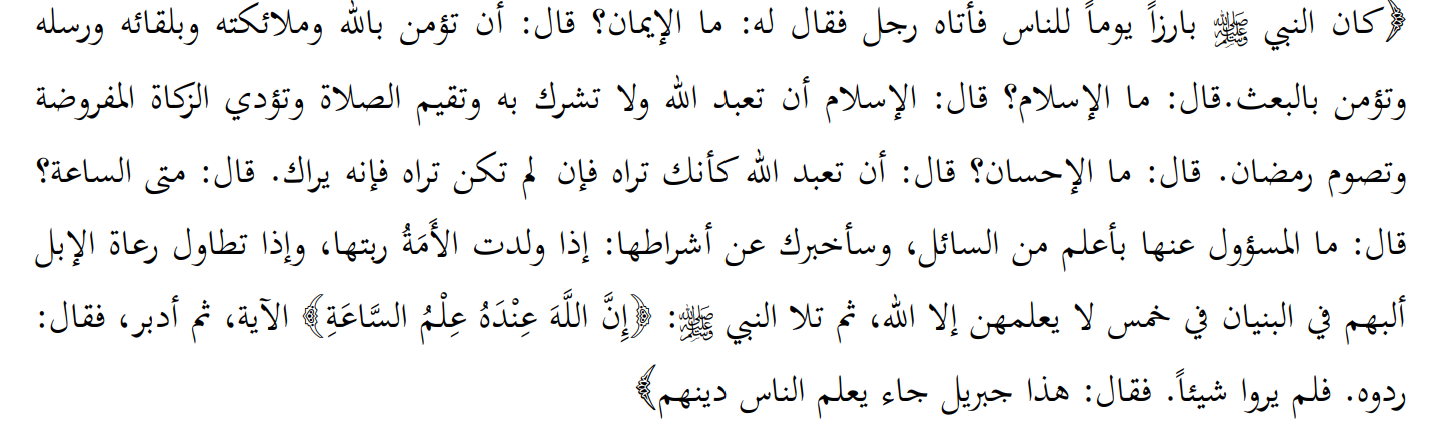
Abu Hurairah narrou que o Profeta ﷺ estava com as pessoas certo dia, quando um homem veio e lhe perguntou: "O que é a Fé (Iman)?" Ele ﷺ disse: "É crer em Allah, em Seus anjos, no encontro com Ele, em Seus mensageiros e na ressurreição." Ele perguntou: "O que é o Islam?" Ele ﷺ disse: "O Islam é que você adore Allah e não Lhe atribua parceiros, estabeleça a oração, pague o Zakat obrigatório e jejue no Ramadã." Ele perguntou: "O que é o Ihsan?" Ele ﷺ disse: "É que você adore Allah como se O visse, e se não O vê, certamente Ele te vê." Ele perguntou: "Quando será a Hora?" Ele ﷺ disse: "Quem é questionado sobre ela não sabe mais do que quem pergunta. Eu te direi de seus sinais: quando a serva der à luz sua senhora, e quando os pastores de camelos construírem edifícios altos. É uma das cinco coisas que ninguém conhece, exceto Allah." Então o Profeta ﷺ recitou o versículo: "Por certo, Allah possui o conhecimento da Hora." Então o homem virou-se e foi embora. O Profeta ﷺ disse aos Companheiros: "Chamem-no de volta", mas eles não viram nada. Ele ﷺ disse: "Este era Jibril, que veio para ensinar às pessoas a sua religião." [Bukhari]
Abu Hurairah narrated that the prophet was with the people one day when a person came and asked him, "What is Emaan?" He said, "It is the belief in Allah , his angels, in the meeting with him , his messengers and the resurrection." He asked, "What is Islam?" He said, "Islam is that you worship Allah and do not commit Shirk, establish the prayer, pay the enjoined Zakat and you fast in Ramadan." He said, "What is Ihsaan?" He said, "That you worship Allah as if you see him, and if you can not see him, surely he sees you." He said, "When is the hour?" He said, "The one questioned about it knows no better then the questioner. I will tell you of its signs. When the mother will give birth to her Master and when the shepherd will build tall buildings. It is one of the five things that no one will know them except Allah ." Then the prophet recited the Ayat, "Indeed Allah has the knowledge of the hour." Then the man turned and left. The prophet said to the Sahaba call him but they didn't see anything. He said, "This was Jibril, he came to teach people their Deen." [Bukhari]
Há uma série de episódios mencionados nos Ahadith em que Jibril desceu, falou com o Profeta ﷺ e este o escutava. Esta era uma forma de revelação para o Mensageiro, pois o anjo lhe transmitia os significados na forma de uma conversa. A revelação por palavras e significado é restrita ao Nobre Alcorão. Quanto à revelação por significado, o Mensageiro ﷺ a expressava usando as suas próprias palavras, por meio da aplicação, isto é, as suas ações, ou pelo silêncio, e isto é a Sunnah.
There are a number of incidents mentioned in Ahadith in which Jibril descended and talked to the prophet and he would listen. This was a form of revelation for the messenger, as the angel would tell the messenger the meanings in the form of a conversation. The revelation by words and meaning is restricted to the Noble Qur’ān. As for revelation by meaning, the messenger would express this by using his own words, through application i.e. his actions, or by silence and this is the Sunnah.
O Hadith Qudsi é considerado Sunnah porque, embora o seu significado seja revelado por Allah, as suas palavras são do Profeta ﷺ. As palavras do Hadith Qudsi não são de Allah, porque as palavras que são de Allah são especificamente as do Alcorão, e isto é comprovado pela sua inimitabilidade. Embora a Sunnah venha sob a forma de inspiração, de sonho e de algo lançado diretamente no coração, ela também vem tanto estando o Profeta ﷺ acordado como em forma de diálogo entre Jibril e o Mensageiro de Allah ﷺ.
The Hadith Qudsi is regarded as Sunnah because although its meaning is revealed from Allah its words are from the prophet . The words of the Hadith Qudsi are not from Allah because the words that are from Allah are specifically for the Qur’ān and this is proven by its inimitability. Although the Sunnah comes in the forms of inspiration, dream and is cast directly in the heart, it also comes both in wakefulness and as a dialogue between Jibril and the messenger .
O Alcorão só foi revelado por meio do Mensageiro, porque as suas palavras são de Allah. Há numerosos versículos que detalham a revelação do Alcorão. Allah diz,
The Qur’ān is only revealed through the messenger because its words are from Allah . There are numerous ayats detailing the revelation of the Qur’ān. Allah says,
"E Nós revelamos a você o Alcorão em árabe" [TMQ Shura:7]
"And we have revealed the Quran to you in Arabic" [TMQ Shura:7]
"E o que Te revelamos (ó Muhammad ﷺ) do Livro é a verdade" [TMQ Fatir: 31]
" And what We have revealed to you (O Muhammad [saw]) of the Book, it is the (very) truth " [TMQ Fatir: 31]
O livro referido é o Alcorão, e "min" aqui indica representação.
The book referred to is the Qur’ān and “min” here is to indicate representation.
"Este Alcorão me foi revelado para que, por meio dele, eu vos advirta e a quem quer que ele alcance." [TMQ An’aam: 6]
“This Qur'ân has been revealed to me that I may therewith warn you and whomsoever it may reach " [TMQ An’aam: 6]
"Nós te relatamos (Muhammad ﷺ) a melhor das histórias, por meio de Nossas Revelações a ti, deste Alcorão." [TMQ Yoosuf: 3]
" We relate to you (Muhammad [sal-Allâhu 'alayhi wa sallam]) the best of stories through Our Revelations to you, of this Qur'ân" [TMQ Yoosuf: 3]
"E recite o que lhe foi revelado (ó Muhammad ﷺ) do Livro (o Alcorão) do seu Senhor. Ninguém pode alterar as Suas Palavras," [TMQ alKahf: 27]
" And recite what has been revealed to you (O Muhammad PBUH) of the Book (the Qur'ân) of your Lord. None can change His Words, " [TMQ alKahf: 27]
Trata-se do Qur’ān. Há também outros versículos que mencionam a revelação em geral, incluindo a Sunnah. Por exemplo, Allah diz,
It is the Qur’ān. There are other ayats as well, which mention the revelation in general including the Sunnah. For example, Allah says,
"Se eu permanecer no caminho da retidão, é por causa da Revelação de meu Senhor que me foi concedida." [TMQ As-saba: 50]
" If I remain guided, it is because of the Revelation of my Lord to me” [TMQ As-saba: 50]
E Ele diz,
And He says,
"Na verdade, Nós te enviamos a Revelação (ó Muhammad ﷺ), assim como enviamos a Revelação a Nûh (Noé) e aos Profetas depois dele" [TMQ Nisa: 163]
" Verily, We have sent the Revelation to you (O Muhammad [saw]) as We sent the Revelation to Nûh (Noah) and the Prophets after him" [TMQ Nisa: 163]
E Ele diz,
And He says,
E siga o que lhe foi revelado por seu Senhor. Verdadeiramente, Allah está bem informado sobre o que vocês fazem. [TMQ Ahzaab: 2]
"And follow that which is revealed to you from your Lord. Verily, Allâh is Well-Acquainted with what you do" [TMQ Ahzaab: 2]
Esses dois estados mencionados já foram discutidos nos textos. O terceiro estado é mencionado na Sua declaração:
These two mentioned states have been discussed in the texts, The third state is mentioned in His saying,
Ou por trás de um véu” [TMQ Shura: 51]
"Or from behind a veil” [TMQ Shura: 51]
Isso foi o que aconteceu com Musa. Este Ayat indica o episódio em que Allah falou com Musa ﷺ por trás de um véu. Ou seja, assim como a pessoa velada fala com algumas autoridades e pessoas de distinção, Ele fala por trás de um véu e, embora se ouça a voz da outra pessoa, não se a vê. Foi desta maneira que Allah falou com Musa.
This is what happened with Musa . This Ayat is indicating to the incident in which Allah spoke to Musa from behind a veil. That is, just as the veiled person speaks with some dignitaries and with people of distinction. He speaks from behind a veil and although one hears the other person’s voice, he does not see him. This is the manner in which Allah spoke with Musa .
Um incidente desse tipo ocorreu apenas uma vez com o Profeta ﷺ durante al-Isra wal-Miraj, o que foi não apenas mencionado em um Hadith autêntico, mas também indicado pela Sura al-Najm. Allah diz,
Such an incident only occurred once with the prophet during the al-Isra wal-Miraj, which has not only been mentioned in an authentic Hadith, but has also been indicated by Sura al-Najm. Allah says,
"Não é senão uma Revelação revelada. Foi-lhe ensinado (este Alcorão) por alguém poderoso em força [Jibril]. Alguém livre de qualquer defeito no corpo e na mente; então ele (Jibril) se ergueu e se firmou. Estando ele [Jibril] na parte mais alta do horizonte, então se aproximou e chegou mais perto, e ficou a uma distância de duas larguras de arco ou ainda mais perto. Então (Allah) revelou a Seu servo [Muhammad ﷺ, por meio de Jibril (as)] o que Ele revelou." [TMQ Najm: 4-10]
"It is only a Revelation revealed.He has been taught (this Qur'ân) by one mighty in power [Jibril].One free from any defect in body and mind then he (Jibrîl) rose and became stable.While he [Jibrîl)] was in the highest part of the horizon, Then he [Jibrîl] approached and came closer, And was at a distance of two bows' length or (even) nearer. So (Allâh) revealed to His slave [Muhammad [saw] through Jibrîl [as]] whatever He revealed." [TMQ Najm: 4-10]
Com exceção deste evento, isto é, al-Isra wal-Miraj, a revelação desceu sobre o Profeta ﷺ na forma de inspiração e por meio de um mensageiro.
With the exception of this event i.e. al-Isra wal-Miraj, the revelation descended upon the prophet in the form of an inspiration and through a messenger.
Todos os tipos de revelação são formas de evidência. A comunicação entre o anjo e o mensageiro, por meio de fala, de indicação ou de conversa, é uma revelação clara. A inspiração e as visões são revelações claras, e Allah falar com os profetas também é uma forma de revelação. Essa revelação é uma prova categórica, pois foi relatada nos textos mais autênticos e de significado definitivo.
All the types of revelation are forms of evidence. The communication between the angel and the messenger by talk or indication or conversation is a clear revelation. The inspiration and visions are clear revelations and Allah speaking to the prophets is also a form of revelation. This revelation is a categorical proof as it has been reported in the most authentic and definite texts of definite meaning.