20.3 O Mártir
20.3 The Martyr
Os mártires (shuhadaa) são de três tipos: o shaheed apenas da Akhirah, mas não segundo as regras deste mundo; o shaheed apenas deste mundo; e o shaheed deste mundo e da Akhirah. Quanto ao shaheed apenas da Akhirah e não deste mundo, eles são mencionados nos ahadith. Em algumas narrações são sete, em outras oito, em outras nove e em outras onze. A posição autêntica, conforme o que consta em Muslim, é que são cinco: (al-mat'un), que é aquele que morre de peste, isto é, a famosa praga; (al-mabtun), que é aquele que morre de diarreia; o afogado, que morre por causa da água; aquele que morre por (al-hadm), isto é, o edifício que desaba; e aquele que morre no caminho de elevar a palavra de Allah fora do campo de batalha. Muslim narrou de Abu Hurayra (ra) que o Mensageiro de Allah ﷺ disse:
Martyrs (shuhadaa) are of three types; the shaheed of the Akhirah but not by the rules of the world; the shaheed of the world only and the shaheed of the world and Akhirah. As for the shaheed of the Akhirah only and not of this world, they are mentioned in the ahadith. In some narrations they are seven, in some eight, in some nine and in some eleven. The authentic (position) as what came in Muslim is that they are five who are: (al-mat’un) who is the one who dies in the plague i.e. the famous pestilence, the (mabtun) who is the one with diarrhoea, the drowned person who dies because of water, the one who dies of (al-hadm) i.e. the collapsed building, and the one who dies in the way of raising the word of Allah outside the battlefield. Muslim narrated from Abu Hurayra (ra) that the Messenger of Allah (saw) said:
“Um homem que caminhava pelo caminho encontrou um galho de espinhos na estrada e o removeu. Allah ficou agradecido a ele e o perdoou. O Profeta ﷺ disse: Os mártires (shuhadaa) são cinco: (al-mat’un), (al-mabtun), o afogado, aquele que morreu sob um edifício que desabou, e o shaheed no caminho de Allah ‘azza wa jalla.”
“A man walking along the road found a thorn-branch in the road and removed it. Allah was grateful to him and forgave him. He (saw) said: The martyrs (shuhadaa) are five: (al-mat’un), (al-mabtun), the drowned one, the one who died in a collapsed (building) and the shaheed in the way of Allah ‘azza wa jalla.”
Muslim narrou de Abu Hurairah (ra), que disse: O Mensageiro de Allah ﷺ disse:
Muslim narrated from Abu Hurairah (ra) who said: The Messenger of Allah (saw) said:
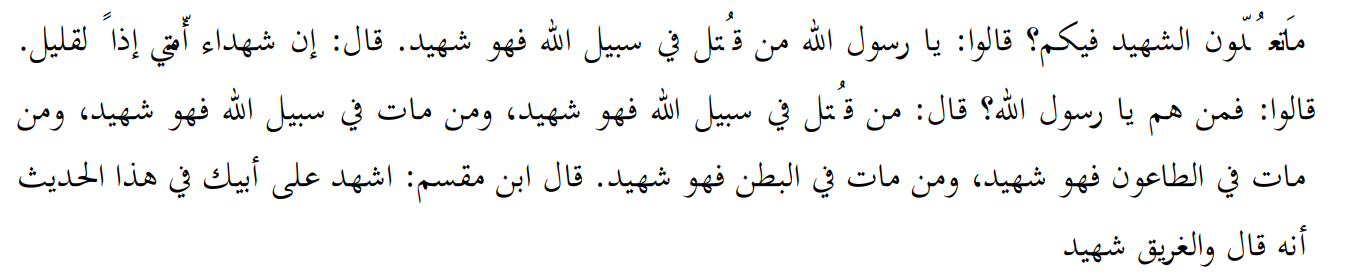
"Quem vocês consideram um shaheed entre vocês?" Disseram: "Ó Mensageiro de Allah, aquele que é morto no caminho de Allah é um shaheed." Ele disse: "Então os shuhadaa da minha Ummah seriam poucos." Disseram: "Então quem são eles, ó Mensageiro de Allah?" Ele ﷺ disse: "Aquele que é morto no caminho de Allah é um shaheed, aquele que morre no caminho de Allah é um shaheed, aquele que morre de peste é um shaheed, aquele que morre por causa do estômago é um shaheed (Ibn Muqsim disse: Testemunho que, sobre o seu pai, neste hadith, ele disse isso) e o afogado é um shaheed."
“Whom do you consider a shaheed among you? They said: O Messenger of Allah, the one killed in the way of Allah is a shaheed. He said: Then the shuhadaa among my Ummah would be few. They said: Then who are they, O Messenger of Allah? He said: The one killed in the way of Allah is a shaheed, the one who dies in the way of Allah is a shaheed, the one killed in pestilence is a shaheed, the one killed due to the stomach is a shaheed (ibn Muqsim said: I testify that upon your father in this hadith that he said) and the drowned person is a shaheed.”
O significado destes shuhadaa é que, no Akhirah, há para eles a recompensa dos shuhadaa; quanto a este mundo, são lavados e sobre eles se faz a oração fúnebre. Quando a palavra "shaheed" é mencionada em conexão com a recompensa e com o hadith sobre isso, é correto estender o termo a essas pessoas. Contudo, se a palavra "shaheed" é usada de forma irrestrita, sem qualquer conotação, então ela não é entendida como denotando essas pessoas, mas sim apenas aqueles que foram mortos no caminho de Allah.
The meaning of these shuhadaa is that there is for them in the Akhirah the reward of the shuhadaa; as for this world, they are washed and prayed over. When the word “shaheed” is said in connection with reward and the hadith about that, it is correct to generalize it to these (persons). However, if the word “shaheed” is used in an unrestricted manner without any connotation, then it is not taken to denote these (persons) but rather to denote only those killed in the way of Allah.
Quanto ao shaheed deste mundo, e não do Akhirah, ele é aquele que recebe as normas do shaheed deste mundo, na medida em que não é lavado nem se faz oração sobre ele, mas é enterrado com as suas roupas. Contudo, ele não recebe no Akhirah a recompensa do shaheed que lutou para exaltar ao máximo a palavra de Allah. Este é aquele que luta por algo diferente do caminho de Allah, como lutar apenas por fama ou por butim, ou enquanto recua. Isto se deve a que os ahadith especificaram a recompensa do shaheed para aquele que luta no caminho de Allah (SWT), e para quem combate avançando, e não recuando. Muslim narrou de Abu Musa al-Ash'ari.
As for the shaheed of the world not the Akhirah, he is the one who takes the rules of the shaheed of the world in so far as he is not washed nor prayed over but rather buried in his clothes. However he does not take in the Akhirah the reward of the shaheed who fought to raise the word of Allah the highest. This is the one who fights in other than the way of Allah such as fighting for fame or booty alone or while retreating. This is because the ahadith specified the shaheed’s reward for the shaheed who fights in the way of Allah (swt), and the one fighting advancing not retreating. Muslim narrated from Abu Musa al-Ash’ari
“Um homem veio ao Profeta ﷺ e disse: Ó Mensageiro de Allah, o homem que luta por butim, o homem que luta para ser mencionado e o homem que luta para que a sua posição seja vista. Qual deles está no caminho de Allah? O Mensageiro de Allah ﷺ disse: ‘Aquele que luta para que a palavra de Allah seja a mais elevada, esse está no caminho de Allah.’”
“That a man came to the Prophet (saw) and said: O Messenger of Allah, the man who fights for booty, the man who fights to be mentioned and the man who fights so that his rank is seen. Which one is in the way of Allah? The Messenger of Allah (saw) said: ‘The one who fights so that the word of Allah be highest is the one in the way of Allah.”
Muslim narrou de Abu Musa
Muslim narrated from Abu Musa
O Mensageiro de Allah ﷺ foi questionado sobre o homem que luta para mostrar sua bravura, aquele que luta por raiva e aquele que luta para se exibir (de forma hipócrita). O Mensageiro de Allah ﷺ disse: Aquele que luta para que a palavra de Allah seja a mais alta está no caminho de Allah.
“The Messenger of Allah (saw) was asked about the man who fights (to show his) courage, the one who fights out of anger, and the one who fights to show off (hypocritically). The Messenger of Allah (saw) said: The one who fights so that the word of Allah is highest is in the way of Allah.”
O Mensageiro fez, como condição para que o shaheed tenha seus pecados perdoados, que ele lute avançando e não recuando. Muslim narrou de Abdullah bin Abi Qatadah, de Qatadah, que ele ouviu isso sendo narrado do Mensageiro de Allah ﷺ.
The Messenger made a condition of the shaheed being forgiven his sins that he fights advancing not retreating. Muslim narrated from Abdullah bin Abi Qatadah from Qatadah that he heard it being narrated from the Messenger of Allah
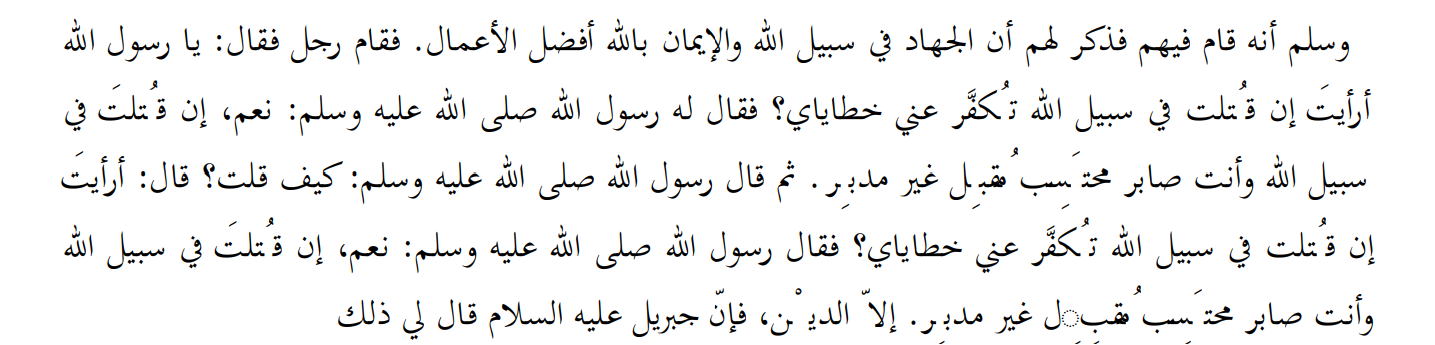
“Que ele se pôs entre eles e lembrou que a jihad na via de Allah e a crença firme em Allah são as melhores ações. Então um homem levantou-se e disse: Ó Mensageiro de Allah, vê que, se eu lutasse na via de Allah, todos os meus erros seriam perdoados? O Mensageiro de Allah ﷺ disse-lhe: Sim, se lutasses na via de Allah e fosses paciente, esperançoso, avançando e não recuando. Depois o Mensageiro de Allah ﷺ disse: O que disseste? Ele disse: Vê que, se eu lutasse na via de Allah, todos os meus pecados seriam perdoados? O Mensageiro de Allah ﷺ disse: Sim, se fores paciente, esperançoso, avançando e não recuando, exceto por dívidas, como Jibril (AS) me disse.”
“That he stood among them and reminded them that jihad in the way of Allah and decisive belief in Allah is the best deeds. So a man stood up and said: O Messenger of Allah, do you see that if I fought in the way of Allah that all my errors would be forgiven? The Messenger of Allah (saw) said to him: Yes, if you fought in the way of Allah and you are patient, hopeful, advancing and not retreating. Then the Messenger of Allah (saw) said: What did you say? He said: Do you see that if I fought in the way of Allah that all my sins would be forgiven? The Messenger of Allah (saw) said: Yes, if you are patient, hopeful, advancing and not retreating except for debts as Jibril (AS) told me that.”
A compreensão disto é que os pecados do combatente que foge não são perdoados, nem ele recebe a recompensa do shaheed. Quanto àquele que luta por fama, o Mensageiro ﷺ esclareceu que ele seria castigado e, ainda assim, o chamou de shaheed. Muslim narrou de Sulayman bin Yasar, que disse: As pessoas se dispersaram ao redor de Abu Hurairah (ra), e Natil, que era do povo de Sham, disse-lhe: Ó Sheikh, relata-nos um hadith que tenhas ouvido do Mensageiro de Allah ﷺ. Ele disse: Sim, ouvi o Mensageiro de Allah ﷺ dizendo:
The understanding of this is that the retreating fighter’s sins are not forgiven nor does he have the reward of the shaheed. As for the one fighting for fame, the Messenger (saw) clarified that he would be punished and (yet) called him shaheed. Muslim narrated from Sulayman bin Yasar who said: People dispersed about Abu Hurairah (ra) and Natil who was from the people of Sham said to him: O Sheikh related to us a hadith you heard from the Messenger of Allah (saw). He said: Yes, I heard the Messenger of Allah (saw) saying:
"Em verdade, as primeiras pessoas a serem julgadas no Dia do Juízo serão um homem que foi morto como shaheed. Ele é trazido diante Dele (Allah) e Ele o informa sobre as bênçãos (de Allah), e ele as reconhece. Ele (swt) diz: O que fizeste com elas? Ele responde: Lutei por Ti até ser morto como shaheed. Ele diz: Mentiste. Antes, lutaste para que se dissesse 'ele é bravo', e assim foi dito. Então Ele ordena a seu respeito, e ele é arrastado sobre o rosto até ser lançado no Fogo."
“Verily the first person(s) to be judged on the Day of Judgement is a man who was killed as a shaheed. He is brought to Him (Allah) and He informs him of the bounties (of Allah) and he acknowledges them. He (swt) says: What did you do with them? He answers: I fought for you until I was killed as a shaheed. He says: You lied. Rather you fought so that it be said ‘(he is) brave’ and it has been said. Then He commands regarding him and he is dragged upon his face until he is thrown into the Fire”
Até o fim do hadith. Isso indica que aquele que é morto por buscar fama, mesmo que receba as normas do shaheed neste mundo, não obterá a recompensa do shaheed no Dia do Juízo, mas será castigado.
Till the end of the hadith. This indicates that the one killed for fame, even if he takes the rules of the shaheed in this world, will not gain the reward of the shaheed on the Day of Judgement but would be punished.
Quanto ao shaheed deste mundo e da Akhirah, ele é aquele que luta contra os descrentes para elevar a palavra de Allah e foi morto no campo de batalha entre muçulmanos e descrentes, quer a luta tenha ocorrido em território de guerra ou em terra islâmica. Allah (SWT) disse:
As for the shaheed of the world and the Akhirah, he is the one who fights the disbelievers to raise the word of Allah and was killed in the battle (field) between Muslims and disbelievers, whether the fighting was in the land of war or the Islamic land. Allah (swt) said:
"Não penses que aqueles que foram mortos no caminho de Allah estão mortos. Pelo contrário, estão vivos e recebem sustento junto ao seu Senhor" {Alcorão 3:169}.
“Do not think that those killed in the way of Allah are dead. Rather they are alive and receiving sustenance before their Lord” [TMQ 3:169].
Este shaheed é aquele a quem se aplicam as regras da Shari'ah relativas a ele. Ele é especificado como aquele que é morto na guerra contra os descrentes; de maneira semelhante, aquele que foi ferido no campo de batalha e depois morreu em consequência do ferimento recebido no campo de batalha também é considerado como o que foi morto no campo de batalha. Quanto aos demais, não são considerados shaheed. Assim, aquele que é morto lutando contra rebeldes (bughat) não é considerado shaheed, nem aquele que foi ferido no campo de batalha, se recuperou do ferimento e depois morreu por causa dele. O shaheed que possui regras específicas, e aquele a respeito de quem Allah afirmou que está vivo, é especificado como aquele que foi morto no campo de batalha contra os descrentes para exaltar a palavra de Allah, e aquele que foi ferido no campo de batalha e depois morreu devido a esse ferimento.
This shaheed is the one upon whose rights came in the Shari’ah rules. He is specified as the one killed in the war with disbelievers; similarly the one who was wounded in the battlefield then died of the wound he received in the battlefield is also considered like the one killed in the battlefield. As for other than these, they are not considered shaheed. Accordingly the one killed in fighting with rebels (bughat) is not considered shaheed nor the one wounded in the battlefield then recovered from the wound then died because of it. The shaheed who has specific rules, and the one about whom Allah stated that he is alive, is specified to the one killed in the battlefield with the disbelievers to raise the word of Allah and the one injured in the battlefield then died due to this wound.
A regra sobre este mártir mencionado é que ele não é lavado nem envolto em mortalhas; antes, é enterrado com seu sangue e suas roupas, pois o mártir será ressuscitado no Dia do Juízo com o cheiro do seu sangue, como o almíscar mais perfumado. Quanto a não lavar o mártir, isso se deve ao que Al-Bukhari narrou de Jabir, que disse:
The rule of this mentioned shaheed is that he is neither washed nor shrouded in burial shrouds; rather he is buried in his blood and clothes because the shaheed is resurrected on the Day of Judgement with the smell of his blood like the sweetest-smelling musk. As for not washing the shaheed, this is due to what Al-Bukhari narrated from Jabir who said:
“O Mensageiro de Allah ﷺ costumava reunir dois homens dentre os mortos em Uhud num mesmo pano e então dizia: Qual deles conhecia mais do Alcorão? Se lhe indicavam um dos dois, ele o colocava à frente na cova lateral (lihd) e dizia: Eu sou testemunha sobre estes. Ordenou que fossem enterrados com o seu sangue e não fez oração fúnebre sobre eles nem os lavou.”
“The Messenger of Allah (saw) would collect two men of those killed in Uhud in one cloth, and then he would say: Which one of them knew more of the Qur’an? If one of the two was indicated to him, he brought him forward in the grave-niche (lihd) and said: I am a witness over these. He commanded their burial with their blood and did not pray over them nor wash them.”
E Ahmad (narrado) que o Profeta ﷺ disse sobre os que foram mortos em Uhud:
And Ahmad (narrated) that the Prophet (saw) said about those killed in Uhud:
"Não os lavem, porque cada ferida ou (cada gota de) sangue exalará almíscar no Dia do Juízo, e ele não rezou por eles."
“Do not wash them because each wound or (each drop of) blood will diffuse musk on the Day of Judgement and he did not pray over them.”
Narra-se que o Profeta ﷺ disse a respeito daqueles que foram mortos em Uhud:
It is narrated that the Prophet (saw) said about those killed in Uhud:
"Cubram-nos com o seu sangue e não os lavem, pois não há ferida que alguém tenha sofrido no caminho de Allah que não venha no Dia do Juízo com a sua veia jugular a jorrar sangue, cuja cor é a cor do sangue e cujo odor é o odor do almíscar."
“Cover them in their blood and do not wash them as there is no wound wounded in the way of Allah save that it will come on the Day of Judgement with its jugular vein flowing blood whose colour is the colour of blood and the odour is the odour of musk.”
Foi narrado por Anas
It has been narrated from Anas
Que o Profeta ﷺ não rezou o funeral (salat al-janazah) pelos que foram mortos em Uhud, nem rezou por eles.
“That the Prophet (saw) did not pray over those killed in Uhud or pray over them.”
Assim como ele não lavou os que foram mortos em Uhud, também não lavou os shuhadaa de Badr; da mesma forma, não lavou os shuhadaa de Khandaq e Khaybar. Ficou assim claro que o shaheed não é lavado. Do mesmo modo, o shaheed não é amortalhado como o morto é amortalhado; antes, é envolto nas roupas que traz consigo, devido à declaração do Mensageiro de Allah ﷺ sobre os que foram mortos em Uhud:
Just as he did not wash those killed in Uhud, he did not wash the shuhadaa of Badr; similarly he did not wash the shuhadaa of Khandaq and Khayber. So it became clear that the shaheed is not washed. Similarly the shaheed is not enshrouded as the dead person is shrouded; rather he is shrouded in the clothes that he has due to the Messenger of Allah (saw)’s statement about those killed in Uhud:
"Cubram-nos com suas feridas e seu sangue" (narrado por Ahmad)
“Cover them in their wounds and blood” (narrated by Ahmad)
E também devido ao que Ibn Abbas (ra) narrou
And also due to what ibn Abbas (ra) narrated
Que o Mensageiro de Allah ﷺ ordenou, a respeito dos que foram mortos em Uhud, que o ferro e as peles fossem retirados deles e que fossem enterrados com o seu sangue e as suas roupas” (narrado por Abu Dawud).
“That the Messenger of Allah (saw) commanded about those killed in Uhud that the iron and skins be removed from them and that they be buried with their blood and clothes” (narrated by Abu Dawud).
Quanto à oração sobre o shahid, é permitido orar sobre eles e é permitido não orar sobre eles. Quanto à permissibilidade de orar sobre eles, isso se deve às narrações que chegaram de que o Mensageiro (saw) orou sobre os que foram mortos em Uhud após o seu sepultamento, e orou sobre Hamza e sobre um homem morto no campo de batalha. Em Al-Bukhari é narrado por Uqbah bin ‘Amir
As for the prayer over the shaheed, it is allowed to pray over them and it is allowed not to pray over them. As for the permissibility of prayer over them, this is due to the narrations which came that the Messenger (saw) prayed over those killed in Uhud after their burial and prayed over Hamza and a man killed in the battlefield. In Al-Bukhari it is narrated from Uqbah bin ‘Amir
Ele (ﷺ) orou pelos que morreram em Uhud após oito anos; a oração sobre os mortos foi como uma despedida tanto dos vivos quanto dos mortos.
“He (saw) prayed over those killed in Uhud after eight years, the prayer over the dead was like a farewell to those alive and those dead.”
E de Abu Dawud, de Malik al-Ghiffari
And from Abu Dawud from Malik al-Ghiffari
Ele ﷺ orou pelos que foram mortos em Uhud em grupos de dez, com Hamza em cada grupo de dez, até que orou setenta vezes por ele.
“He (saw) prayed over those killed in Uhud in groups of ten with Hamza in each ten until he prayed seventy times over him.”
Abu Dawud narrou de Abu Salim, de um homem dos Companheiros do Profeta ﷺ, que disse:
Abu Dawud narrated from Abu Salim from a man of the Prophet (saw)’s Sahabah who said:

"Atacamos de surpresa uma tribo de Juhainah. Um homem dentre os muçulmanos procurou um homem deles para golpeá-lo, mas errou o golpe e feriu a si mesmo. O Mensageiro de Allah ﷺ disse: Seu irmão, ó comunidade dos muçulmanos. Então as pessoas se apressaram e o encontraram morto. O Mensageiro de Allah ﷺ o cobriu com suas vestes e sangue, rezou por ele e o sepultou. Perguntaram: Ele é um shaheed? Ele disse: Sim, e eu sou testemunha por ele."
“We attacked by surprise a tribe from Juhainah. A man of the Muslims sought a man of them to strike him, but he missed and struck himself. The Messenger of Allah (saw) said: Your brother, O community of Muslims so the people hastened and found him dead. The Messenger of Allah (saw) covered him in his clothes and blood, prayed over him and buried him. They said: Is he a shaheed? He said: Yes, and I am a witness for him.”
“Atacamos de surpresa uma tribo de Juhainah. Um homem dentre os muçulmanos perseguiu um homem deles para atingi-lo, mas errou o golpe e feriu a si mesmo. O Mensageiro de Allah ﷺ disse: ‘Vosso irmão, ó comunidade de muçulmanos!’ Então as pessoas apressaram-se e o encontraram morto. O Mensageiro de Allah ﷺ cobriu-o com suas roupas e seu sangue, rezou por ele e o sepultou. Perguntaram: ‘Ele é um shaheed?’ Ele respondeu: ‘Sim, e eu sou testemunha por ele.’”
“We attacked by surprise a tribe from Juhainah. A man of the Muslims sought a man of them to strike him, but he missed and struck himself. The Messenger of Allah (saw) said: Your brother, O community of Muslims so the people hastened and found him dead. The Messenger of Allah (saw) covered him in his clothes and blood, prayed over him and buried him. They said: Is he a shaheed? He said: Yes, and I am a witness for him.”
"Que o Profeta ﷺ não rezou o funeral pelos que morreram em Uhud, nem os lavou."
“That the Prophet (saw) did not pray over those killed in Uhud or wash them.”
E Ahmad narrou de Anas
And Ahmad narrated from Anas
Os shuhadaa de Uhud não foram lavados. Foram sepultados com suas roupas e não se fez a oração fúnebre sobre eles.
“The shuhadaa of Uhud were not washed. They were buried in their clothes and not prayed over.”
Al-Bukhari narrou de Jabir bin Abdullah (ra), que disse:
Al-Bukhari narrated from Jabir bin Abdullah (ra) who said:

O Profeta ﷺ costumava reunir dois homens entre os mortos de Uhud e então perguntava: "Qual deles memorizou mais do Alcorão?" Quando um dos dois era indicado a ele, ele o colocava à frente na cova e dizia: "Eu sou a testemunha sobre estes no Dia do Juízo." Ele ordenou que fossem enterrados com seu sangue e não lavou os corpos nem fez oração por eles.
“The Prophet (saw) would combine between two men of those killed in Uhud then say: Which one of them memorized more of the Qur’an? When one of the two was indicated to him, he would bring him forward in the grave-niche and he said: I am the witness over these on the Day of Judgement, commanded their burial in their blood and did not wash them or pray over them.”
Estes ahadith são estabelecidos e de indicação explícita de que o shaheed não é rezado (janaza). Ash-Shafi'i respondeu ao hadith de Ibn Abbas (ra) e ao que se depreende de seu significado sobre rezar pelos mortos de Uhud antes de seu sepultamento, dizendo: "que a informação veio como se fosse sobre casos específicos diante do mutawatir de que o Mensageiro ﷺ não rezou pelos mortos de Uhud." Todos esses ahadith são estabelecidos, tanto os que narram que o Mensageiro ﷺ rezou pelos shuhada quanto os que narram que ele não rezou por eles. Não há como rejeitar nenhum deles por causa de sua autenticidade, pois são dos que servem de prova tanto na transmissão quanto no significado. Não há como dar preferência a um sobre o outro, pois é improvável que os Companheiros tenham esquecido de rezar pelos shuhada, assim como também é improvável que deixassem uma questão contrária ao que está estabelecido sobre ele ﷺ quanto a rezar pelos mortos. Então, como um pode ter preferência sobre o outro? Tampouco se deve dizer que a oração mencionada nos ahadith que estabelecem a oração pelo shaheed é a du'a, de modo que sua expressão "rezou" signifique "fez du'a". Isso não é possível, pois as realidades da Shari'ah têm precedência sobre as realidades linguísticas, desde que não haja conotação. Aqui não há conotação, portanto é inevitável que o sentido de oração seja a oração da Shari'ah sobre os mortos. Tampouco se deve dizer que os ahadith sobre rezar pelos mortos abrogam os ahadith sobre não rezar por eles, pois um deles, que é a oração pelos mortos de Uhud após oito anos, foi transmitido mais tarde que todos os ahadith, já que veio na narração de Ibn Hibban.
These ahadith are established and of explicit indication that the shaheed is not prayed over. Ash Shafi’ responded to the hadith of ibn Abbas (ra) and what came of its meaning regarding praying over those killed in Uhud before their burial “that the information came as if it were specific ones in the face of mutawatirah that the Messenger did not pray over those killed in Uhud.” All these ahadith are established whether those narrated that the Messenger (saw) prayed over the shuhadaa or those narrated that he didn’t pray over them. There is no way to reject any of them due to their authenticity, and because they are of those used as proofs in narration and meaning. There is no way to outweigh one over the other as it is remote that the Sahabah forgot to pray over those shuhadaa, just as it is also remote for them to leave an issue which is opposite of what is established about him (saw) of praying over the dead. So how can one be outweighed over the other? Nor should one say that the prayer in the ahadith which established the prayer over the shaheed is the du’a so that his saying “prayed” means made du’a. One cannot say this since the Shari’ah realities precede the linguistic (realities) as long as there is no connotation. Here there is no connotation so it is inevitable that the meaning of prayer is the Shari’ah prayer over the dead. Nor should one say that the ahadith of praying over the dead abrogates the ahadith of not praying over them since one of them, which is the prayer over those killed in Uhud after eight years is prayed to later than all the ahadith since it came in the narration of ibn Hibban
"Então ele entrou em sua casa e não saiu até que Allah fez com que ele morresse."
“Then he entered his house and did not go out until Allah caused him to die.”
Não se deve dizer isso, pois o fato de o hadith ser posterior, por si só, não é indicação suficiente de revogação (naskh); é preciso haver outra indicação da qual a revogação possa ser compreendida. Aqui não há tal indicação, portanto não há revogação nele. Assim, todas as narrações permanecem válidas e são entendidas como significando que não rezar sobre o shaheed é permitido. Não se narra que o Mensageiro de Allah ﷺ tenha rezado sobre os que foram mortos em Badr, Khandaq ou Khayber. Elas também são entendidas como significando que, se alguém reza sobre o shaheed, não há nenhum problema nisso, e as pessoas não são impedidas de rezar sobre eles. O shaheed é chamado de shaheed (testemunha) porque o Paraíso é testemunhado por ele, conforme o texto explícito do Alcorão. Allah (SWT) disse:
One should not say that because the lateness of the hadith alone is not sufficient indication of abrogation; rather there must be another connotation from which abrogation is understood. Here no connotation is present so there is no abrogation in it. So all the narrations remain recognized and are taken to mean that not praying over the shaheed is allowed. It is not narrated that the Messenger (saw) prayed over those killed in Badr, Khandaq or Khayber. They are also taken to mean that if one prays over the shaheed there is nothing (wrong) in that and people are not prevented from praying over them. The shaheed is named shaheed (witness) as Paradise is witnessed for him by the explicit text of the Qur’an. Allah (swt) said:
Por certo, Allah comprou dos crentes as suas almas e as suas riquezas em troca do Paraíso. Eles combatem no caminho de Allah, matando e sendo mortos" [TMQ 9:111].
“Verily Allah purchased from the believers there souls and wealth in return for paradise. They fight in the way of Allah, killing and being killed” [TMQ 9:111].
Muslim narrou de Jabir, que disse:
Muslim narrated from Jabir who said:
"Um homem disse: Onde estarei, ó Mensageiro de Allah, se eu for morto? Ele disse: No Paraíso. Então ele jogou fora as tâmaras que tinha nas mãos e lutou até ser morto; e no hadith de Suwaid. Um homem disse ao Profeta ﷺ no dia de Uhud."
“A man said: Where am I, O Messenger of Allah, if I am killed? He said: In Paradise. So he threw the dates that were in his hands and fought until he was killed and in the hadith of Suwaid. A man said to the Prophet (saw) on the day of Uhud.”
É narrado de Anas bin Malik (ra) que o Mensageiro de Allah ﷺ foi com os seus Companheiros até chegarem antes dos politeístas a Badr. Os politeístas chegaram, e o Mensageiro de Allah ﷺ disse:
It is narrated from Anas bin Malik (ra) that the Messenger of Allah (saw) went with his Sahabah until they preceded the polytheists to Badr. The polytheists came and the Messenger of Allah (saw) said:
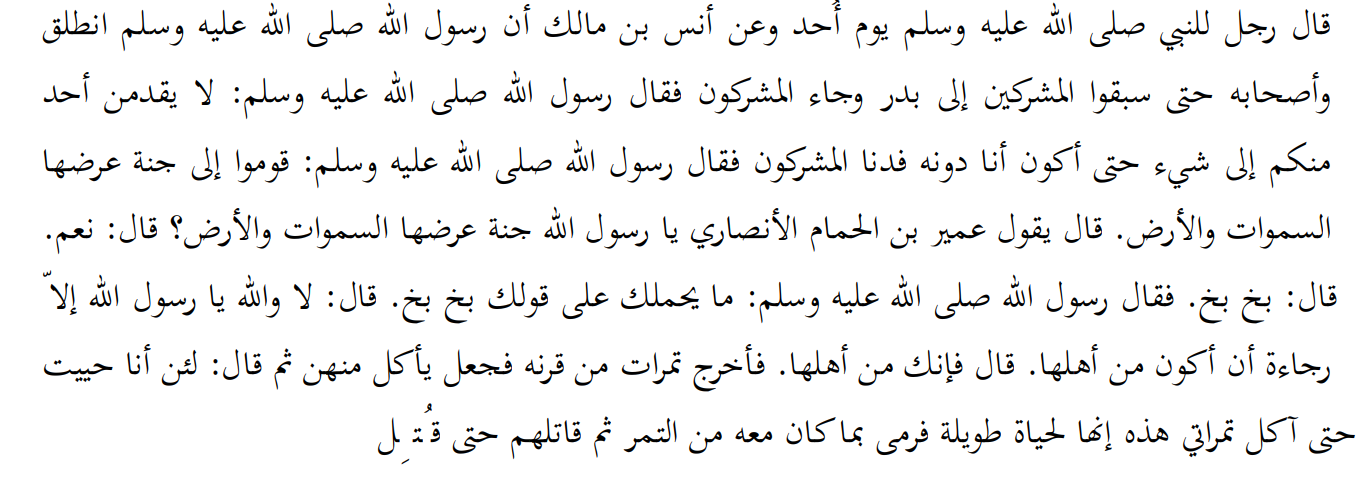
"Que nenhum de vocês se adiante a qualquer coisa sem a minha permissão." Os politeístas se aproximaram, então o Mensageiro de Allah ﷺ disse: "Levantem-se para um Paraíso cuja largura é a dos céus e da terra." Ele disse: 'Umayr bin al-Hammam al-Ansari disse: "Ó Mensageiro de Allah, um Paraíso cuja largura é a dos céus e da terra?" Ele disse: "Bakh! Bakh!" Então o Mensageiro de Allah ﷺ disse: "O que o levou a dizer 'Bakh! Bakh!'?" Ele disse: "Nada, por Allah, exceto a esperança de que eu seja um de seus habitantes." Ele disse: "Verdadeiramente, você é um de seus habitantes." Ele tirou tâmaras de sua aljava e começou a comer delas. Então disse: "Se eu viver até comer estas tâmaras, então esta seria uma vida longa!" Jogou fora as tâmaras que lhe restavam e lutou até ser morto. (Narrado por Muslim).
“Let none of you precede to anything without my being. The polytheists came close so the Messenger of Allah (saw) said: Stand forth to a Paradise whose breadth is that of the heavens and the earth. He said: ‘Umayr bin al-Hammam al-Ansari said: O Messenger of Allah, a Paradise whose breadth is that of the heavens of the earth? He said: (Bakh! Bakh!). So the Messenger of Allah (saw) said: What carried you to your statement, (Bakh! Bakh!). He said: Nothing, by Allah, except the hope that I be one of its people. He said: Verily you are one of its people. He removed dates from his (qaran) and began eating from them. Then he said: If I were to live until I ate these dates, it would then be a long life! He threw the dates that had then fought them until he was killed” (Narrated by Muslim).
Então, Allah (SWT) e o Mensageiro de Allah ﷺ testemunharam o Paraíso para o shaheed. Quanto à vida do shaheed, ela está estabelecida pelo texto explícito do Alcorão. Allah (SWT) disse:
So Allah (swt) and the Messenger of Allah (saw) have witnessed the Paradise for the shaheed. As for the life of the shaheed, it is established by the explicit text of the Qur’an. Allah (swt) said:
"Não penses que os que foram mortos no caminho de Allah estão mortos; antes, estão vivos, sustentados junto ao seu Senhor. Alegres com o que Allah lhes concedeu de Suas graças, e com boas-novas para aqueles que ficaram para trás e que ainda não se lhes juntaram: que não há temor para eles, nem tampouco tristeza. Recebem boas-novas de bênçãos de Allah e de Seu favor, e, em verdade, Allah não deixa que se perca a recompensa dos crentes" [TMQ 3:169].
“Do not think that those killed in the way of Allah are dead, rather (they are) alive with sustenance before their Lord. Pleased with what Allah gave them of His favours and with good tidings for those behind them who have not met them, that there is no fear for them nor do they grieve. They have glad tidings of blessings from Allah and His favour, and verily Allah does not cause the reward of the believers to be lost” [TMQ 3:169].
Esta vida dos shuhadaa é invisível, algo que não compreendemos nem percebemos da forma como existe na morada eterna. Embora não compreendamos esta vida oculta nem a percebamos, cremos, não obstante, na sua existência, mas não compreendemos a sua realidade. A nossa convicção quanto à sua existência é uma questão inevitável, pois está estabelecida por um texto corânico definitivo. Allah (SWT) disse:
This life for the shuhadaa is unseen which we do not understand nor perceive as it is in the eternal abode. Although we do not understand this hidden life nor perceive it, nevertheless we believe in its existence but do not understand its reality. Our conviction in its existence is an inevitable matter as it is established by a definite Qur’anic text. Allah (swt) said:
"Não digas daqueles que foram mortos no caminho de Allah que estão 'mortos'... Pelo contrário, estão vivos, mas vós não percebeis" [AT 2:154].
“Do not say of those killed in the way of Allah (are) ‘dead’... Rather they are alive but you do not know” [TMQ 2:154].
A vida dos shuhadaa pertence ao mundo invisível, em que é obrigatória a crença (îmân). Quanto à virtude dos shuhadaa, trata-se de uma grande virtude sem igual, e o Profeta ﷺ esclareceu-a em numerosos ahadith. Al-Bukhari narrou de Qatadah, que disse: Ouvi Anas bin Malik (que Allah esteja satisfeito com ele) relatar do Profeta ﷺ, que disse:
The life of the shuhadaa is from the unseen (matters) in which iman is obliged. As for the virtue of the shuhadaa, it is a great virtue without an equivalent and he (saw) clarified it in numerous ahadith. Al-Bukhari narrated from Qatadah who said: I heard Anas bin Malik (ra) from the Prophet (saw) who said:
Nenhum daqueles que entram no Paraíso desejaria voltar ao mundo para obter tudo o que há sobre a terra, exceto os shuhadaa, que desejariam voltar ao mundo para serem mortos dez vezes, devido ao que veem da honra (karamah).
“No one who enters Paradise would like to return to the world to obtain all that is upon the world except the shuhadaa who would wish to return to the world to be killed ten times due to what he sees of the honour (karamah).”
E no Al-Bukhari:
And in Al-Bukhari:
Al-Mughira bin Shu’bah disse que o nosso Profeta ﷺ nos informou da mensagem do nosso Senhor de que quem for morto entre nós vai para o Paraíso, e Umar disse ao Profeta ﷺ: “Não estão os nossos mortos no Paraíso e os deles no Fogo?” Ele disse: “Sim.”
“Al-Mughira bin Shu’bah said that our Prophet (saw) informed us of the message of our Lord that whoever is killed among us goes to Paradise and Umar said to the Prophet (saw): ‘Are not our dead in Paradise and their dead in the Fire. He said: Yes.”
E de Abdullah bin ‘Amru bin al-‘Aas, que o Mensageiro de Allah ﷺ disse:
And from Abdullah bin ‘Amru bin al-‘Aas that the Messenger of Allah (saw) said:
"Todos os pecados do shahid são perdoados, exceto a dívida" (narrado por Muslim).
“All the shaheed’s sins are forgiven except the debt” (narrated by Muslim).
"Todos os pecados do shahid são perdoados, exceto a dívida" (narrado por Muslim).
“All the shaheed’s sins are forgiven except the debt” (narrated by Muslim).
"Quem for morto no caminho de Allah tem todos os seus pecados apagados, exceto a dívida."
“The one killed in the way of Allah has all his sins wiped out except the debt.”
E Al-Bukhari e Muslim narraram de Abu Hurairah (ra), que disse que o Profeta ﷺ disse:
And Al-Bukhari and Muslim narrated from Abu Hurairah (ra) from the Prophet (saw) who said:
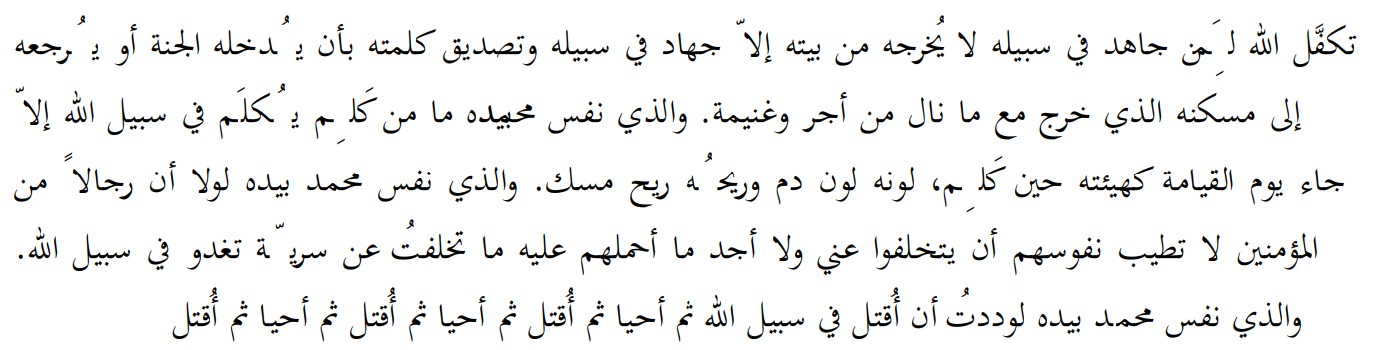
"Allah garante a segurança daquele que morre no jihad em Seu caminho, que não sai de sua casa por nenhuma outra razão senão o jihad em Seu caminho e a crença em Suas palavras, de que Ele o fará entrar no Paraíso ou o fará retornar à sua morada de onde saiu, junto com o que alcançou de recompensa ou butim. Por Aquele em cuja mão está a alma de Muhammad ﷺ, quem for ferido no caminho de Allah não virá no Dia do Juízo senão na forma em que foi ferido, sua cor será a cor do sangue e seu odor, o odor do almíscar. Por Aquele em cuja mão está a alma de Muhammad ﷺ, se não fosse porque há homens entre os crentes cujas almas não se satisfazem em ficar para trás de mim (quando eu partir), nem tenho como carregá-los, eu não ficaria para trás de nenhuma expedição que saia no caminho de Allah pela manhã. Por Aquele em cuja mão está a alma de Muhammad ﷺ, eu gostaria de morrer no caminho de Allah, depois ser ressuscitado, depois morto, depois ressuscitado, depois morto, depois ressuscitado, depois morto."
“Allah guarantees security for the one who dies jihad in His way, not leaving his house for any other reason except jihad in His way and believing in His words, that He will enter him into Paradise or return him to his abode from which he left together with what he achieved of reward or booty. By the One in whose hand lies the should of Muhammad, whoever is wounded in the way of Allah will not come on the Day of Judgement except in his form when he was wounded, his colour the colour of blood and his odour the odour of musk. By the one in whose hand lies the soul of Muhammad, were it not that there were men among the believers whose souls are not pleased to stay behind me (when I go) nor do I find that could carry them upon, I would not stay behind any expedition that goes out in the way of Allah in the morning. By the One in whose hand lies the soul of Muhammad, I would love to die in the way of Allah then I am resurrected then killed, then resurrected then killed, then resurrected then killed.”