17.9 A Shari'a Não Designou Uma Pessoa Específica Para o Califado
17.9 The Shar'a Did Not Designate A Specific Person For The Khilafah
A opinião de que o Mensageiro (saw) designou uma pessoa específica para ser o Khalifah depois dele contradiz os textos da Shari'ah. E a afirmação de que o Mensageiro (saw) nomeou certas pessoas para serem Khulafaa depois dele até o Dia do Juízo é ainda mais contraditória aos textos islâmicos.
The view that the Messenger (saw) designated a specific person to be the Khalifah after him contradicts the Shari’ah texts. And the statement that the Messenger (saw) nominated certain persons to be Khulafaa after him until the Day of Judgement is even more contradictory to the Islamic texts.
Quanto a invalidar a opinião de que o Mensageiro ﷺ nomeou o Califado para alguém depois dele, isso se evidencia de diversas maneiras:
As for invalidating (the opinion) that the Messenger (saw) nominated the Khilafah for someone after him, this is apparent in numerous ways:
Primeiro: Isto contradiz a bay'ah (juramento de lealdade), pois nomear uma pessoa significa informar os muçulmanos de quem será o Khalifah sobre eles. Assim, o Khalifah seria conhecido, e não haveria mais necessidade de legislar (tashri') a bay'ah, visto que a bay'ah é o método de designar o Khalifah. Portanto, se ele já foi designado antecipadamente, não há mais necessidade de demonstrar o método de designá-lo, pois, de fato, ele já foi designado. Tampouco se pode dizer que a bay'ah seja a bay'ah de obediência ao Khalifah, uma vez que a Shar'a estabeleceu a obediência ao Khalifah e aos detentores da autoridade (ulu al-amr) em muitos outros textos distintos do texto da bay'ah. A obediência foi explicitamente exigida dos muçulmanos; quanto à bay'ah, ela foi exigida dos muçulmanos em outra(s) exigência(s), não considerada(s) como (mera) obediência, embora inclua o sentido de obediência, mas considerada como um contrato para o Khilafah. Seu significado em todos os ahadith que a mencionam não é obediência, mas sim conferir a liderança àquele que recebe a bay'ah e preparar-se para submeter-se a essa liderança. Assim, fazer da bay'ah uma condição para designar o Khilafah contradiz o fato de o Mensageiro ﷺ ter nomeado uma pessoa específica para ser Khalifah depois dele. Além disso, as palavras da bay'ah que vieram nos ahadith corretos (Saheeh) vieram de maneira geral ('aam), sem especificação (takhsees), e sem restrição (mutlaq), sem qualquer limitação (taqyeed), para qualquer pessoa. Se significassem a bay'ah para uma pessoa específica, não seriam gerais nem irrestritas. As palavras dos ahadith são:
First: This contradicts the pledge (bay’ah) since nominating a person means informing the Muslims as to who will be the Khalifah over them. Hence the Khalifah would be known so there would remain no need for legislating (tashri’) the pledge as the pledge is the method of appointing the Khalifah. So if he has already been appointed in advance, there remains no need to demonstrate the method of appointing him as, in fact, he has already been appointed. Nor can it be said that the pledge is the pledge of obedience to the Khalifah since the Shar’a has enunciated the obedience to the Khalifah and those in charge (ulu al-amr) in many other texts distinct from the text of the pledge. Obedience has been explicitly requested from Muslims; as for the pledge, it has been requested from Muslims in other request(s) not in consideration as being (merely) obedience, though it does include the meaning of obedience, but in consideration as being a contract for the Khilafah. Its meaning in all the ahadith that mentioned it is not obedience, rather it is about giving leadership to the one who is pledged and preparing to submit to this leadership. So making the pledge a condition for appointing the Khilafah contradicts the Messenger (saw) nominating a specific person to be Khalifah after him. Moreover, the words of the pledge which came in the correct (Saheeh) ahadith came in a general manner (‘aam) without specification (takhsees), and unrestricted (mutlaq) without any restriction (taqyeed), for anyone. Were they to mean the pledge for a specific person they would not have been general and unrestricted. The word(s) of the ahadith are:
"Quem morre sem um compromisso de lealdade sobre o pescoço,"
“He who dies without a pledge on his neck,”
"Quem pronunciar juramento de lealdade a um Imam,"
“Whosoever pledges an Imam,”
E
And
"Um homem que presta juramento de lealdade a um Imam."
“A man who pledges an Imam.”
A opinião de que o Mensageiro (saw) designou uma pessoa específica para ser Khalifah depois dele contradiz e invalida a generalidade e o caráter irrestrito do juramento de lealdade (bay'ah). Portanto, não se pode dizer que a bay'ah seja apenas um meio de reconhecer um Khalifah já nomeado, enquanto a nomeação do Khalifah é algo separado da bay'ah, razão pela qual o Khalifah seria nomeado primeiro e só depois receberia a bay'ah. Não se deve dizer isso, pois a bay'ah é o método de nomeação do Khalifah, e isso não significa que seja exatamente o mesmo que a sua nomeação. Tampouco se deve dizer que é obrigatório nomear primeiro o Khalifah e reconhecer a sua nomeação antes de lhe dar a bay'ah, pois isso implicaria a existência de outro método para nomear o Khalifah, de modo que a bay'ah serviria apenas para a sua obediência, quando os ahadith sobre a bay'ah indicam todos que ela é o método para nomear o Khalifah e que não existe outra forma. Considere a sua declaração ﷺ:
The opinion that the Messenger (saw) designated a specific person to become Khalifah after him contradicts and invalidates the generality and unrestricted nature of the pledge. Therefore, it cannot be said that this means that the ba’yah is the very way of appointing the Khalifah while the appointment of the Khalifah is separate to the ba’yah, this is why the Khalifah is appointed first & then the ba’yah is given to him; one should not say this because the ba’yah is the method of appointing the Khalifah and this does not mean that it is exactly the same as his appointment. Nor should one say that it is compulsory to first appoint the Khalifah and acknowledge his appointment before giving him the ba’yah as this would mean that there is another method for appointing the Khalifah such that the ba’yah is merely for his obedience, whereas the ahadith about the ba’yah all indicate that it is the method to appoint the Khalifah and there is no other way. Consider his (saw) statement:
"Quem morrer sem um juramento de lealdade sobre o pescoço"
“Whoever dies without a pledge on his neck”;
É bastante explícito no sentido de que quem morre sem ter o seu Imam designado mediante o juramento de lealdade (bay'ah) — e não significa de forma alguma quem morre sem obedecer a um Imam. Isso indica que, neste hadith, o Profeta ﷺ se refere ao método de designação do Khalifah, e não à mera obediência. Considere também a declaração dele ﷺ:
It is quite explicit in meaning that whoever dies without appointing his Imam via the pledge and it does not mean in any way whoever dies without obeying an Imam. This indicates that in this hadith the Prophet means the method of appointing the Khalifah and does not mean mere obedience. Also consider his (saw) statement:
“Quando o juramento de lealdade for dado a dois califas, mate o último”;
“When the pledge is given to two Khalifahs, kill the latter”;
Isto é explícito: se dois Califas forem nomeados, matem o último deles. Da mesma forma, todos os ahadith do Profeta são explícitos quanto a ser este o método de nomeação do Califa. Os ahadith do Profeta são explícitos em não significar mera obediência ou obediência irrestrita (mutlaq); antes, significam seguir aquele que foi nomeado como Califa, com o sentido de que este é o método de nomeação do Califa. Além disso, não há sequer um único hadith autenticado, seja na narração ou no sentido, que demonstre um método de nomeação do Califa diferente da bay'ah.
This is explicit that if two Khalifahs are appointed, kill the later of them. Likewise all ahadith of the Prophet are explicit that it is the method of appointing the Khalifah. The ahadith of the Prophet are explicit in not meaning mere obedience or unrestricted (mutlaq) obedience; rather, they mean following the one appointed as the Khalifah with their meaning that this is the method of appointing the Khalifah. Further, there is not even one authenticated hadith, whether in narration or meaning, which demonstrates a method of appointing the Khalifah other than the ba’yah.
Em segundo lugar: Foram transmitidos ahadith do Mensageiro de Allah ﷺ indicando que haverá disputas e contendas entre as pessoas acerca do Khilafah e competição por ele. Se houvesse um texto do Mensageiro de Allah ﷺ quanto à nomeação de uma pessoa específica, não surgiria disputa na presença desse texto, ou o Mensageiro de Allah ﷺ afirmaria que as pessoas disputariam com essa pessoa. Em vez disso, vieram textos dizendo que as pessoas disputariam entre si, e também esclareceram o método para resolver essa disputa e encerrar a questão do Khilafah. Muslim narrou em seu Saheeh: Wahab bin Baqiyyat al-Wasiti narrou-me que Khalid bin Abdullah al-Juzairi nos disse, de Abu Nadhra, de Abu Saeed al-Khudri, que disse: O Mensageiro de Allah ﷺ disse:
Second: Ahadith have been narrated from the Messenger (saw) indicating that there will be disputes and contentions among people about the Khilafah and competition over it. If there was a text from the Messenger (saw) concerning the appointment of a (specific) person, there would not arise a dispute in the presence of that text or the Messenger (saw) would state that people would dispute with that person. Whereas the texts came saying that people would dispute between themselves and it also clarified the method to resolve this dispute and settle the issue of the Khilafah. Muslim narrated in his Saheeh: Wahab bin Baqiyyat al-Wasiti narrated to me that Khalid bin Abdullah al-Juzairi told us from Abu Nadhra from Abu Saeed al-Khudri who said: The Messenger of Allah (saw) said:
"Se o juramento de lealdade for dado a dois califas, mate o último deles."
“If the pledge is given to two Khalifahs, kill the latter of them.”
Muslim também relatou em seu Saheeh: Zuhayr bin Harb e Ishaq bin Ibrahim me narraram, sendo que Ishaq disse: "fomos informados", e Zuhayr disse: foi-nos narrado por Jareer, de Al-‘Amash, de Zaid bin Wahhab, de Abdurrahman bin Abdurrabb al-Ka’aba, que disse: Entrei na mesquita e Abdullah bin ‘Amru bin al-‘Aas estava sentado à sombra da Ka’aba, com pessoas reunidas ao seu redor. Então me juntei a eles e sentei-me com ele. Ele disse: Estávamos com o Mensageiro de Allah ﷺ numa viagem e paramos num acampamento quando um anunciador (mu’adhin) do Mensageiro de Allah ﷺ anunciou a oração coletiva. Então todos nos reunimos diante do Mensageiro de Allah ﷺ, que disse:
Muslim also said in his Saheeh: Zuhayr bin Harb and Ishaq bin Ibrahim narrated to me, with Ishaq saying we were informed and Zuhayr said it was narrated to us by Jareer, from Al-‘Amash from Zaid bin Wahhab from Abdurrahman bin Abdurrabb al-Ka’aba who said: I entered the mosque and Abdullah bin ‘Amru bin al-‘Aas was seated in the shade of the Ka’aba with people gathered around him. So I joined them and sat with him. He said: We were with the Messenger of Allah (saw) in a voyage and we stopped at an encampment when an announcer (mu’adhin) of the Messenger of Allah (saw) announced the collective prayer. So we all gathered before the Messenger of Allah (saw) who said:

"Não houve profeta antes de mim que não tivesse a obrigação de guiar a sua comunidade (Ummah) para o melhor que ele conhecia para eles e de advertí-los sobre o pior que ele conhecia para eles, até que disse: Quem tiver prestado juramento a um Imam, dando-lhe o aperto de sua mão e o fruto de seu coração, que lhe obedeça na medida do que puder. Se outro vier disputar com ele, que golpeie o pescoço dessa outra pessoa."
“There was no Prophet before me except that it was obligatory upon him to guide his Ummah to the best that he knew for them and warn them of the worst he knew for them until he said: Whoever pledged an Imam, giving him the clasp of his hand and the fruit of his heart, should obey him as much as he can. If another comes to dispute with him, strike the neck of the other person.”
Muslim também narrou em seu Saheeh: Muhammad bin Bashar nos narrou que Muhammad bin Ja'far nos narrou que Shu'ba nos narrou, a partir de Furrat al-Qazzaz, a partir de Abu Hazm, que disse: Permaneci com Abu Hurayra por cinco anos e o ouvi narrar do Profeta ﷺ, que disse:
Muslim also narrated in his Saheeh: Muhammad bin Bashar narrated to us that Muhammad bin Ja’far narrated to us that Shu’ba narrated to us from Furrat al-Qazzaz from Abu Hazm who said: I remained with Abu Hurayra for five years and heard him narrate from the Prophet (saw) who said:
Os filhos de Israel eram governados pelos Profetas, que cuidavam de seus assuntos como políticos (tasusuhum). Sempre que um Profeta morria, outro o sucedia. No entanto, não haverá Profeta depois de mim, mas haverá califas, e serão muitos. Eles perguntaram: O que nos ordenas? Ele disse: Cumpri o juramento de lealdade, um após o outro.ﷺ
“The children of Israel had Prophets taking care of their affairs as politicians (tasusuhum). Whenever one Prophet died, another followed him. However, there will be no Prophet after me but there will be Khulafaa who will be many. They said: What do you command us? He said: Fulfil the pledge one after the other.”
Muslim narrou em seu Saheeh: Uthman bin Abu Shayba nos narrou que Yunus bin Abu Ya'fur lhes narrou, por meio de seu pai, de Arfaja, que disse: ouvi o Mensageiro de Allah ﷺ dizer:
Muslim narrated in his Saheeh: Uthman bin Abu Shayba narrated to us that Yunus bin Abu Ya’fur narrated to them from his father from Arfaja who said he heard the Messenger of Allah (saw) saying:
"Quem quer que encontrar, quando os vossos assuntos estiverem unidos sob um só homem, alguém que pretenda incitar à rebelião ou dividir a vossa unidade, matem-no."
“Whoever finds when all your affairs have been united under one man, intending to incite rebellion or divide your unity, kill him.”
Isso significa que o Califado é direito de todos os muçulmanos, de modo que qualquer um pode disputá-lo. Isso contradiz a afirmação de que o Mensageiro ﷺ nomeou uma pessoa específica para ser o Califa depois dele.
This means that the Khilafah is the right of all Muslims such that anyone can contend for it. This contradicts the (saying that) the Messenger (saw) nominated a specific person to be the Khalifah after him.
Terceiro: Os ahadith que trazem a palavra Imam denotando o Califa vieram com essa palavra em forma indeterminada; e quando veio em forma determinada, veio determinada com o "al" (o artigo "o") da espécie ou relacionada a um substantivo coletivo. Nas possibilidades em que veio determinada com "al", era o "al" da espécie, por evidência da própria frase. O Mensageiro ﷺ disse:
Third: The ahadith which came with the word Imam denoting the Khalifah came with this word in an unspecified form; and when it came in an specified one, it either came specified with “the” (“al”) of the species or related to a collective noun. In the possibilities which came specified with “al”, it was the “al” of species by evidence of the sentence. The Messenger said:
"Quem presta juramento de lealdade a um Imam"
“Whoever pledges an Imam”,
“…se opôs a um Imam injusto”,
“…stood against an unjust Imam”,
"haverá imames depois de mim."
“there will be Imams after me.”
E ele disse:
And he said:
"O Imam é aquele que é um guardião (ra'i) sobre o povo, e ele é responsável por seus cidadãos"
“The Imam is the one who is a guardian (ra’i) over the people and he is responsible for his citizens”,
Na verdade, o Imam é um escudo, por trás do qual se combate e pelo qual se é protegido.
“Verily the Imam is a shield from behind whom they fight and by whom they are protected”
e disse:
and he said:
“…para o Imam dos muçulmanos”,
“…to the Imam of the Muslims”,
“O melhor dos seus Imams”,
“The best of your Imams”,
"…o pior dos vossos Imames."
“…the worst of your Imams.”
Tudo isso indica que o Mensageiro (saw) deixou a questão de quem seria o Khalifah depois dele sem especificação, sem designar uma pessoa em particular. Isso é explícito em sua indicação de que o Mensageiro ﷺ não designou uma pessoa específica para o Khilafah, mas o deixou como um direito de todos os muçulmanos. Quando se soma a isso o fato de que alguns textos vieram com linguagem no coletivo (jam'u), isso se torna um texto claro negando que o Imam seja uma pessoa específica.
All this indicates that the Messenger (saw) left the issue concerning who would be the Khalifah after him unspecified without specifying him. This is explicit in its indication that the Messenger (saw) did not designate a specific person for the Khilafah but rather left it as a right for all Muslims. When you add to this that some texts came with the collective (jam’u) language, this becomes a clear text in negating the Imam being a specific person.
Quarto: Os Sahabah (ra) divergiram em seu tempo sobre quem deveria ser o Khalifah entre eles. Essa divergência entre as pessoas é prova de que o Mensageiro (saw) não designou uma pessoa específica para o Khilafah. Entre as mesmas pessoas que divergiram estão aquelas sobre as quais se diz que o Mensageiro proferiu algo a respeito de seu Khilafah, a saber: Abu Bakr (ra) e Ali (ra). Apesar de suas divergências, nenhum deles jamais argumentou que houvesse um texto do Mensageiro (saw) de que o Khilafah lhe pertencia, nem qualquer um dos Sahabah (ra) argumentou que houvesse um texto em favor de determinadas pessoas em geral. Se houvesse algum texto, teriam argumentado com base nele; logo, o fato de não terem recorrido a nenhum texto significa que não existe texto algum para uma pessoa específica para o Khilafah. Tampouco se deve dizer que existe um texto que se tornou conhecido depois deles, mas que não chegou até eles, porque tomamos nosso dīn dos Sahabah (ra). Foram eles que nos transmitiram o Alcorão e nos narraram os hadiths. Assim, se não há texto algum vindo dos Sahabah (ra), então ele não é reconhecido de forma alguma. Aceitamos tudo o que procedeu deles e rejeitamos tudo o que não procedeu deles. Quanto à questão de um texto para um Khalifah após o Mensageiro (saw), constatamos que todos os Sahabah (ra), sem exceção, incluindo Abu Bakr (ra) e Ali (ra), concordaram com a ausência de qualquer texto para uma pessoa específica para o Khilafah, pois não o mencionaram, apesar da necessidade de falar e da obrigação de mencionar o texto caso ele existisse. Isso indica a invalidade de o Mensageiro (saw) ter designado uma pessoa para o Khilafah. Tampouco se deve dizer que a omissão do texto se deveu à precaução de preservar a unidade dos muçulmanos, pois isso significaria ocultar uma norma de Allah e não a transmitir no momento em que era urgentemente necessária, especialmente em um assunto tão importante para os muçulmanos. Este ocultamento na religião de Allah não é possível que tenha vindo dos Companheiros (ra) do Mensageiro de Allah ﷺ.
"Se eu nomear um Califa, de fato alguém melhor do que eu nomeou um Califa, ou seja, Abu Bakr. E se eu não nomear, então alguém melhor do que eu não nomeou, ou seja, o Mensageiro de Allah ﷺ."
“If I appoint a Khilafah, verily one better than me did appoint a Khalifah i.e. Abu Bakr. And if I do not, then one better than me did not i.e. the Messenger of Allah (saw).”
Muslim narrou de Ibn Umar que Umar bin al-Khattab (ra) disse:
Muslim narrated from bin Umar that Umar bin al-Khattab (ra) said:
"Na verdade, Allah ‘azza wa jall preservará a religião. Se eu não nomear um Khalifah, na verdade o Mensageiro de Allah ﷺ não nomeou; e se eu nomear, na verdade Abu Bakr nomeou."
“Verily Allah ‘azza wa jall will preserve the deen. If I do not appoint a Khalifah, verily the Messenger of Allah (saw) did not appoint; and if I do appoint, verily Abu Bakr did appoint.”
É um texto claro de que o Mensageiro ﷺ não nomeou um Califa. Nem se deve dizer que isto é uma opinião de Umar, pois quando um companheiro diz: "O Mensageiro ﷺ fez isto ou não fez isto, ou estávamos no seu tempo assim, ou houve no seu tempo tal e tal coisa", isto é um hadith usado como prova, e não meramente a opinião de um companheiro. Além disso, Umar disse isto na presença e à vista dos Sahabah (ra), e Ali (ra) estava presente, e esta declaração chegou até ele e ele não a contestou, o que indica a concordância deles quanto ao que Umar (ra) relatou.
This is a clear text that the Messenger (saw) did not appoint a Khalifah. Nor should one say that this is Umar’s opinion for when a companion says, ‘The Messenger (saw) did this or did not do this or we were in his time like this or there was in his time such and such’, this is a hadith used as evidence not merely a companion’s view. Moreover, Umar said this within the hearing and sight of the Sahabah (ra), and Ali (ra) was present and this statement reached him and he did not oppose it, which indicates their agreement upon what Umar (ra) narrated.
Tudo isso diz respeito à ausência de qualquer texto específico que designe uma pessoa determinada para o Califado. Quanto aos textos apresentados por aqueles que afirmam que existem textos designando uma pessoa específica, entre esses textos estão os trazidos para indicar que o Mensageiro ﷺ nomeou Abu Bakr (ra) para ser Califa depois dele, enquanto outros são trazidos para indicar que ele nomeou Ali (ra) como Califa depois dele. Devemos apresentá-los e explicar o seu conteúdo.
This is all with respect to the absence of any specific text designating a specific person for the Khilafah. As for the texts brought by those who say that there are texts designating a specific person, among these texts are those brought to indicate that the Messenger appointed Abu Bakr (ra) to become Khalifah after him whereas others are brought to indicate that he appointed Ali (ra) as the Khalifah after him. We must present them and explain their contents.
Quanto aos textos trazidos por aqueles que dizem que o Mensageiro (saw) nomeou Abu Bakr (ra), eles se dividem em dois grupos. Uma parte, na qual o Mensageiro ﷺ elogia Abu Bakr (ra), sem que haja nada que indique que o Mensageiro ﷺ o nomeou. A outra parte é aquela na qual alguns deduzem, por inferência, que o Mensageiro ﷺ nomeou Abu Bakr (ra), enquanto outros deduzem que ele o indicou. Apresentaremos o modelo deles citando alguns, observando que nenhum deles ultrapassa o sentido de elogio.
As for the texts brought by those who say the Messenger (saw) appointed Abu Bakr (ra), they are divided into two: One portion in which the Messenger (saw) praises Abu Bakr (ra) wherein there is nothing to indicate that the Messenger (saw) appointed him. The other portion is one wherein some deduce by deduction that the Messenger (saw) appointed Abu Bakr (ra) while others deduce that he nominated Abu Bakr (ra). We will present their model by presenting some of them, noting that none of them exceed the meaning of praise.
“Por certo, a pessoa que mais me favoreceu com sua companhia e riqueza é Abu Bakr. Se eu fosse tomar um amigo íntimo (khaleel) que não fosse meu Senhor, eu teria tomado Abu Bakr (ra), mas, em vez disso, existe a fraternidade do Islam e o seu amor. Não deve permanecer na mesquita nenhuma porta que não esteja fechada, exceto a porta de Abu Bakr.” ﷺ
“Verily the most gracious of people to me in his companionship and wealth is Abu Bakr. Were I to take an intimate friend (khaleel) other than my Lord, I would have taken Abu Bakr (ra) but instead there is the brotherhood of Islam and its love. There should not remain in the mosque any door but that it should be closed except for the door of Abu Bakr.”
Muslim também narrou este hadith, mas com uma redação diferente, embora semelhante a estes. Nada neste hadith leva a pessoa a concluir que ele tenha nomeado Abu Bakr (ra) como Khalifah. Tudo o que ele contém é um elogio a Abu Bakr (ra) feito pelo Mensageiro (saw), e o Mensageiro (saw) elogiou muitos companheiros pelo nome. Há também ahadith com elogios a Umar (ra), Uthman (ra), Ali (ra), Sa'd bin Abu Waqqas (ra), Talha (ra), Az-Zubayr (ra), Abu 'Ubaydah bin al Jarrah (ra), Al-Hassan (ra) e Al-Hussein (ra), Zayd bin Haritha (ra), Usama bin Zayd (ra), Abdullah bin Ja'far (ra), Khadija (ra), Aisha (ra), Fatima (ra), filha do Profeta (saw), Umm Salamah (ra), Bilal (ra) e outros. O elogio, por si só, de forma alguma indica nomeação como Khalifah.
Muslim also narrated this hadith but with different wording, although similar to these ones. There is nothing in this hadith to make a person say that he appointed Abu Bakr (ra) as Khalifah. All that it contains is praise for Abu Bakr (ra) from the Messenger (saw), and the Messenger (saw) praised many companions by name. There have come ahadith with praise for Umar (ra), Uthman (ra), Ali (ra), Sa’d bin Abu Waqqas (ra), Talha (ra), Az-Zubayr (ra), Abu ‘Ubaydah bin al Jarrah (ra), Al-Hassan (ra) and Al-Hussein (ra), Zayd bin Haritha (ra), Usama bin Zayd (ra), Abdullah bin Ja’far (ra), Khadija (ra), Aisha (ra), Fatima (ra) daughter of the Prophet (saw), Umm Salamah (ra), Bilal (ra) and others. Praise by itself does not in any way whatsoever indicate appointment to be Khalifah.
Quanto aos ahadith dos quais alguns deduziram o califado de Abu Bakr (ra), são quatro ahadith que apresentaremos e esclareceremos em tudo o que contêm. Estes ahadith são:
As for the ahadith from which some deduced the Khilafah of Abu Bakr (ra), they are four ahadith which we will present and clarify all that they contain. These ahadith are:
Primeiro: Al-Bukhari narrou de Al-Qasim bin Muhammad (ra), que disse:
First: Al-Bukhari narrated from Al-Qasim bin Muhammad (ra) who said:
Aisha disse: Ai, minha cabeça! Então o Mensageiro de Allah ﷺ disse: Se isso acontecesse e eu ainda estivesse vivo, eu pediria perdão por você e oraria por você. Aisha disse: Isso é algo sério. Por Allah, acredito que você desejaria a minha morte, para que, se ela acontecesse, passasse o resto de seus dias feliz ao lado de algumas de suas esposas. O Profeta ﷺ disse: Na verdade, é a minha cabeça que está pesada. Eu pretendia ou planejava mandar chamar Abu Bakr e seu filho para lhe fazer uma promessa ('ahd), para que nenhuma pessoa falasse e ninguém desejasse. Então eu disse: Allah rejeitará, e os crentes impedirão, ou Allah impedirá, e os crentes rejeitarão.
“Aisha said: O my head so the Messenger of Allah (saw) said: If it were to happen and I were alive, I would ask for you to be forgiven and pray for you. Aisha said: That is a serious matter. By Allah, I believe that you would like my death so that it if happened, you would spend the rest of your days wedded happily with some of your wives. The Prophet (saw) said: Rather it is my head which is heavy. I intended or planned to send for Abu Bakr and his son so as to give him a promise (‘ahd) so that no person will speak or a wisher wish. Then I said that Allah will reject and the believers prevent that or Allah will prevent and the believers reject.”
Muslim narrou este hadith de Aisha (ra) com esta redação dela: O Mensageiro de Allah ﷺ disse-me durante a sua doença:
Muslim narrated this hadith from Aisha (ra) in this wording from her: The Messenger of Allah (saw) said to me in his illness:
"Chame para mim teu pai, Abu Bakr, e teu irmão, para que eu escreva um livro, pois temo que alguém deseje ou que alguém diga: sou melhor (ou tenho precedência). Mas Allah rejeitará, e também os crentes, exceto Abu Bakr."
“Call for me your father, Abu Bakr, and your brother so that I write a book for I fear that a wisher will wish or a speaker say: I am better (or take precedence). But Allah will reject, and so the believers, except for Abu Bakr.”
Em segundo lugar: Al-Bukhari narrou de Muhammad bin Jubayr bin Mut’im, de seu pai, que disse:
Secondly: Al-Bukhari narrated from Muhammad bin Jubayr bin Mut’im from his father who said:
Uma mulher foi até o Profeta ﷺ e falou com ele sobre algo; e ele ordenou que ela voltasse a ele. Ela disse: Ó Mensageiro de Allah, e se eu viesse e não o encontrasse — como se quisesse dizer a morte — ele disse: Se você não me encontrar, então vá até Abu Bakr.
“A woman came to the Prophet (saw) and spoke to him about something; and he commanded her to return to him. She said: O Messenger of Allah, what if I came and did not find you—as if she meant death—so he said: If you do not find me, then go to Abu Bakr.”
Muslim narrou este hadith de Muhammad bin Jubayr bin Mut'im, de seu pai, nas seguintes palavras:
Muslim narrated this hadith from Muhammad bin Jubayr bin Mut’im from his father in the words:
Uma mulher perguntou ao Mensageiro de Allah ﷺ algo, e ele ordenou que ela voltasse a ele. Ela disse: "Ó Mensageiro de Allah, e se eu vier e não o encontrar?" — Meu pai disse: como se ela quisesse dizer a morte. Então ele disse: "Se não me encontrar, então vá até Abu Bakr."
“A woman asked the Messenger of Allah (saw) something and he commanded her to return to him. She said: O Messenger of Allah, what if I come and do not find you—My father said: As if she meant death—so he said: If you do not find me, then go to Abu Bakr.”
Terceiro: Al-Bukhari narrou de Aisha (ra), a mãe dos crentes,
Thirdly: Al-Bukhari narrated from Aisha (ra), the mother of the believers,
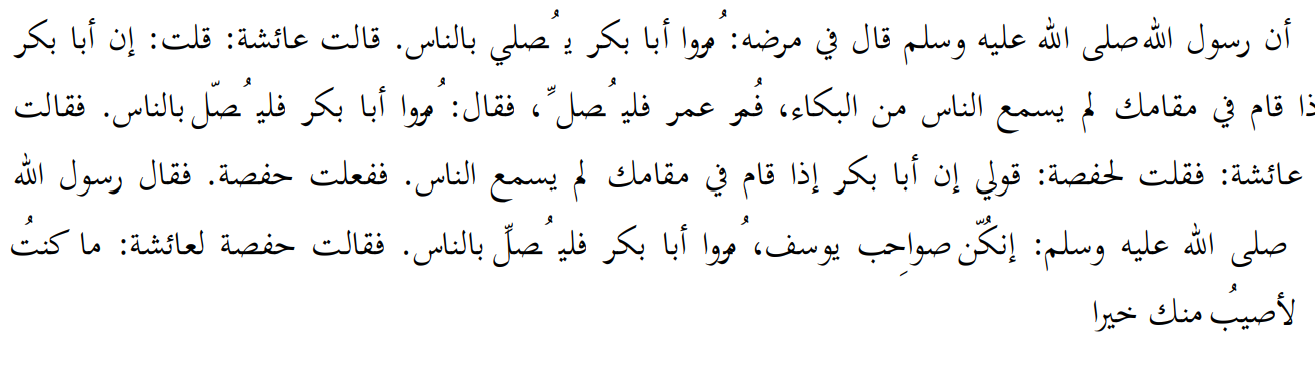
Que o Mensageiro de Allah ﷺ me disse durante a sua doença: Ordena a Abu Bakr que conduza as pessoas na oração. Aisha disse: Eu disse: Quando Abu Bakr estiver no teu lugar, as pessoas não o ouvem por causa do seu choro, por isso ordena a Umar que conduza as orações. Ele disse: Ordena a Abu Bakr que conduza as pessoas na oração. Aisha disse: Eu disse a Hafsa: Diz que, quando Abu Bakr estiver no teu lugar, as pessoas não o ouvem, e ela assim o fez. O Mensageiro de Allah ﷺ disse: Vocês são como as companheiras de Yusuf. Ordena a Abu Bakr que conduza as pessoas na oração. Hafsa disse a Aisha: Nunca alcançarei qualquer bem através de ti!
“That the Messenger of Allah (saw) told me during his illness: Command Abu Bakr to lead the people in prayer. Aisha said: I said: When Abu Bakr stands in your place, people do not hear him for his crying so command Umar to lead prayers. He said: Command Abu Bakr to lead people in prayer. Aisha said: I said to Hafsa: Say that when Abu Bakr stands in your place, the people do not hear, and she did that. The Messenger of Allah (saw) said: You are like the companions of Yusuf. Command Abu Bakr to lead the people in prayer. Hafsa said to Aisha: I will never achieve any good through you!”
Em quarto lugar: Muslim narrou de Ibn Abi Mulaykah, que disse:
Fourthly: Muslim narrated from bin Abu Mulkiyya who said:

“Ouvi Aisha ser questionada: Quem o Mensageiro de Allah ﷺ teria designado como Khalifah depois dele, caso o tivesse designado? Ela disse: Abu Bakr. Perguntaram-lhe: E depois de Abu Bakr, quem? Ela disse: Umar. Perguntaram-lhe então: E depois de Umar, quem? Ela disse: Abu ‘Ubaydah bin al-Jarrah, e parou por aí.”
“I heard Aisha being asked: Whom would the Messenger of Allah (saw) have appointed as Khalifah after him had he so appointed? She said: Abu Bakr. She was asked: Then whom after Abu Bakr? She said: Umar. She was then asked: Then whom after Umar? She said: Abu ‘Ubaydah bin al-Jarrah, and she stopped at that.”
Todos estes ahadith não são evidência adequada de que o Mensageiro (SWT) tenha nomeado Abu Bakr (ra) como Khalifah. O primeiro hadith é rejeitado por duas razões: a primeira é que o Mensageiro de Allah ﷺ disse:
All these ahadith are not suitable evidence for the Messenger (saw) appointing Abu Bakr (ra) as Khalifah. The first hadith is rejected for two reasons: The first is that the Messenger (saw) said:
"Desejei ou pretendi"
“I wished or intended”
Mas ele não fez isso, portanto isto não é uma evidência. Pois a evidência é a dizer, a ação ou a aprovação tácita do Mensageiro ﷺ; qualquer outra coisa além destas não é considerada evidência da Shari'ah. Em segundo lugar, Aisha (ra) é filha de Abu Bakr (ra), e, se este hadith existisse, ela o teria informado a Abu Bakr (ra). Ele então o teria contestado quando foi ao pátio (saqeefa) para contender com os Ansar, quando eles se reuniram para prestar juramento de lealdade a um Khalifah entre eles. Portanto, este hadith é rejeitado (mardud) e não é adequado como evidência para a nomeação de Abu Bakr (ra) como Khalifah.
But he did not do so, so this is not an evidence. For the evidence is the Messenger’s (saw) saying, action or silent consent; anything other than these is not considered Shari’ah evidence. Secondly, Aisha (ra) is Abu Bakr’s daughter so were this hadith present she would have informed Abu Bakr (ra). Then he would have argued with it when he went to the courtyard (saqeefa) to contend with the Ansar when they gathered to pledge allegiance to a Khalifah amongst them. Therefore this hadith is rejected (mardud) and is unsuitable to be an evidence for the appointment of Abu Bakr (ra) as Khalifah.
Quanto ao segundo hadith, ele não indica a nomeação de Abu Bakr (ra) como Khalifah, pois a mulher disse: "Se eu não te encontrar"; logo, é correto que ela não o tenha encontrado por causa de sua ausência numa guerra ou em qualquer outro assunto. Não há nada nele que indique que, com as palavras "Se eu não te encontrar", ela quisesse dizer que você (ﷺ) havia morrido. As palavras que vieram no hadith "como se quisesse dizer a morte" são palavras de Jubayr e de seu entendimento. Assim, a ordem do Mensageiro (ﷺ) para que ela fosse até Abu Bakr (ra), caso viesse e não o encontrasse, não é prova da nomeação de Abu Bakr (ra) como Khalifah depois do Mensageiro (ﷺ). Ainda que fôssemos obrigados a tomar o entendimento dela como significando a morte, essas palavras ainda assim não designariam Abu Bakr como Khalifah depois dele (ﷺ). Quanto ao terceiro hadith, trata-se da nomeação para dirigir a oração e nada além disso. A nomeação para dirigir a oração não significa nomeação em autoridade (hukm). Quanto à afirmação deles: "O Mensageiro de Allah ficou satisfeito com ele em um assunto da religião (deen), então não deveríamos nós ficar satisfeitos com ele em um assunto do mundo (dunya)?", trata-se do entendimento deles, e este é equivocado, pois há uma grande diferença entre a oração e a governança. Nem todo aquele que é apto a tornar-se líder (Imam) na oração é apto a ser líder na governança. Além disso, o texto é específico à oração, portanto não abrange outras coisas, nem deve ser tomado como significando outras coisas em razão da especificidade (khususiyya) do texto.
As for the second hadith, it does not indicate the appointment of Abu Bakr (ra) as Khalifah because the woman said: “If I did not find you”; so it is correct that she failed to find him due to his absence in a war or any other matter. There is nothing in it to indicate that she meant by her words “If I did not find you” that you had died. The words which came in the hadith “As if she meant death” are the words of Jubayr and his understanding. So the Messenger’s command for her to go to Abu Bakr (ra) if she came and did not find him is no proof for the appointment of Abu Bakr (ra) as Khalifah after the Messenger (saw). Even if we were compelled to take her understanding to mean death, these words still would not designate Abu Bakr as Khalifah after him (saw). As for the third hadith, this is the appointment over prayer and nothing else. Appointment over prayer does not mean appointment in authority (hukm). As for their statement: “The Messenger of Allah was pleased with him in a matter of the deen, so should we not be pleased with him in a matter of the world (dunya)”; this is their understanding, and it is erroneous because there is a large difference between prayer and ruling. Not all who are suitable to become a leader (Imam) in prayer are suitable to be a leader in ruling. Moreover, the text is specific to prayer so it does not encompass other things, nor should it be taken to mean other things due to the specificity (khususiyya) of the text.

"Que o Mensageiro de Allah ﷺ disse: Amanhã darei a bandeira (rayah) a alguém por intermédio de quem Allah concederá a vitória. Ele disse: Então as pessoas passaram a noite pensando a quem ela seria dada. Quando as pessoas acordaram, foram cedo pela manhã ao Mensageiro de Allah ﷺ, esperando que ela lhes fosse dada, mas ele disse: Onde está Ali bin Abi Talib? Disseram: Seus olhos estão doendo, ó Mensageiro de Allah. Ele disse: Mandem chamá-lo para vir a mim. Quando ele chegou, cuspiu em seus olhos e orou por ele. Ele foi curado como se nunca tivesse tido dor, e lhe deu a bandeira."
“That the Messenger of Allah (saw) said: I will give the flag (rayah) tomorrow to someone by whose hands Allah will conquer. He said: So the people spent the night thinking which one of them it would be given to. When people woke up, they went early in the morning to the Messenger of Allah (saw) hoping it would be given to them, but he said: Where is Ali bin Abi Talib? They said: His eyes are paining O Messenger of Allah. He said: Send for him to come to me. When he came, he spit in his eyes and prayed for him. He was cured as if he never had pain, and he gave him the flag.”
Muslim narrou este hadith de Abu Hurairah com as seguintes palavras:
Muslim narrated this hadith from Abu Hurairah with the words:

"O Mensageiro de Allah ﷺ disse no dia de Khayber: Entregarei esta bandeira a alguém que ama a Allah e a Seu Mensageiro, e por cujas mãos Allah conquistará. Umar bin al-Khattab disse: Eu nunca havia desejado a liderança senão naquele dia. Ele disse: Eu me imaginava nela, esperando que fosse chamado para ela. Ele disse: O Mensageiro de Allah ﷺ chamou Ali bin Abi Talib e lhe entregou a bandeira."
“The Messenger of Allah (saw) said on the day of Khayber: I will give this flag to someone who loves Allah and His Messenger by whose hands Allah will conquer. Umar bin al-Khattab said: I had never wished for leadership except for that day. He said: I visualised it hoping that i would be called for it. He said: The Messenger of Allah (saw) called Ali bin Abi Talib and gave him the flag.”
Al-Bukhari narrou no capítulo sobre as virtudes de Ali (ra) que o Mensageiro de Allah ﷺ disse a Ali (ra):
Al-Bukhari narrated in the chapter of virtues of Ali (ra) that the Messenger of Allah (saw) said to Ali (ra):
"Você é de mim e eu sou de você."
“You are of me and I am of you.”
Muslim narrou de ‘Amir bin S’ad bin Abi Waqqas (ra), de seu pai, que disse: Muawiya bin Abu Sufyan (ra) ordenou a S’aad (ra) dizendo: O que te impediu de insultar Abu Turab (ra)? Ele disse: Quando eu lembro de três (coisas) que o Mensageiro de Allah ﷺ disse sobre ele, nunca o insultarei. Que eu tenha sequer uma dessas coisas é mais amado por mim do que camelos vermelhos. O Mensageiro de Allah ﷺ deixou-o para trás em algumas de suas expedições de guerra, então Ali (ra) disse a ele: Ó Mensageiro de Allah ﷺ, deixou-me para trás com mulheres e crianças? O Mensageiro de Allah ﷺ disse a ele:
Muslim narrated from ‘Amir Bin S’ad bin Abi Waqqas (ra) from his father who said: Muawiya bin Abu Sufyan (ra) commanded S’aad (ra) saying: What has prevented you from insulting Abu Turab (ra)? He said: When I remember three (things) which the Messenger of Allah (saw) said of him, I will never insult him. That I should have even one of these is more beloved to me than red camels. The Messenger of Allah (saw) left him behind in some of his war expeditions, so Ali (ra) said to him: O Messenger of Allah (saw), have you left me behind with women and children? The Messenger of Allah (saw) said to him:
“Você não fica satisfeito em ter a mesma posição junto a mim que a posição de Harun junto a Musa, exceto que não haverá profeta depois de mim?” ﷺ
“Are you not pleased to be in the same status next to me like the status of Harun next to Musa, except that there is no Prophet after me.”
Também o ouvi dizer no dia de Khayber:
I also heard him say on the day of Khayber:
"Eu darei a bandeira a um homem que ama a Allah e a Seu Mensageiro ﷺ, e a quem Allah e Seu Mensageiro amam."
‘I will give the flag to a man who loves Allah and His Messenger, and whom Allah and His Messenger love.
Ele disse: Nós nos mobilizamos para isso e ele disse:
He said: We moved for it and he said:
“Chame Ali. Ele foi trazido, e tinha os olhos inflamados. O Profeta ﷺ cuspiu em seus olhos, entregou-lhe a bandeira, e Allah conquistou por meio dele.”
“Call Ali, so he was brought and he had sore eyes. He spit in his eyes and gave him the flag, and Allah conquered through him.’
E quando este versículo foi revelado:
And when this verse was revealed:
Diga: Venham, chamemos nossos filhos e vossos filhos [TMQ 3:61],
Say: Come and let us call our sons and your sons [TMQ 3:61],
O Mensageiro de Allah ﷺ chamou Ali (ra), Fátima (ra), Hassan (ra) e Husain (ra) e disse:
The Messenger of Allah (saw) called Ali (ra), Fatima (ra), Hassan (ra) and Husain (ra) and said:
“Ó Allah, esta é a minha família.”
‘O Allah, this is my family.’”
Muslim narrou de Sahl bin S'aad, que disse: Um homem da família de Marwan foi nomeado (como governante) sobre Madinah. Ele disse: Ele chamou Sahl bin S'aad e ordenou-lhe que insultasse Ali (ra). Ele disse: Sahl recusou, então foi-lhe dito: Se recusas, então diz: Que Allah amaldiçoe Abu Turab (ra). Sahl disse: Ali (ra) não tem nome mais querido para mim do que Abu Turab (ra), e ele ficaria satisfeito quando chamado por ele. Foi-lhe perguntado: Informa-nos sobre o incidente de por que ele foi chamado Abu Turab (ra). Então ele disse: O Mensageiro de Allah ﷺ foi à casa de Fátima e não o encontrou em casa, então ele disse:
Muslim narrated from Sahl bin S’aad who said: A man from the family of Marwan was appointed (as ruler) over Madinah. He said: He called Sahl bin S’aad and commanded him to insult Ali (ra). He said: Sahl refused, so it was said to him: If you refuse, then say: Allah curse Abu Turab (ra). Sahl said: Ali (ra) has no name more beloved to me than Abu Turab (ra), and he would be pleased when called by it. It was said to him: Inform us of the incident as to why he was called Abu Turab (ra), so he said: The Messenger of Allah (saw) came to Fatima’s house and did not find him in the house, so he said:
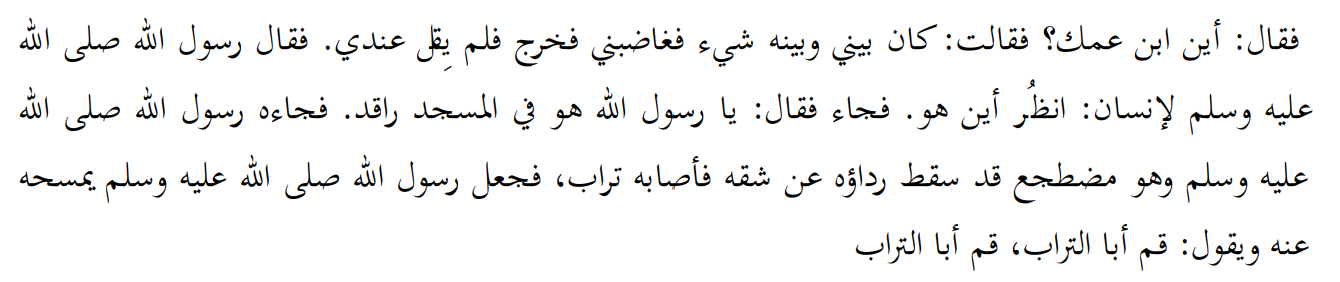
“Onde está o filho do seu tio paterno?” Ela disse: Houve algo entre ele e eu, e ele me deixou irritada e saiu sem me avisar. Então o Mensageiro de Allah ﷺ disse a alguém: “Vá descobrir onde ele está.” Ele voltou e disse: Ó Mensageiro de Allah, ele está descansando na mesquita. Então o Mensageiro de Allah ﷺ foi até ele enquanto ele estava deitado. Seu manto havia caído do corpo e sujeira o havia atingido, e o Mensageiro de Allah ﷺ começou a limpá-la dele enquanto dizia: “Levante-se, ó Abu Turab.”
“Where is the son of your paternal uncle?” She said: There was something between him and me, and he made me angry and left without telling me. So the Messenger of Allah (saw) said to someone: “Go find out where he is.” He came back and said: O Messenger of Allah, he is resting in the mosque. So the Messenger of Allah (saw) came to him while he was reclining. His cloak had fallen from his body and dirt had touched him, so the Messenger of Allah (saw) began wiping it off him while saying: “Stand up, O Abu Turab.”
Muslim narrou de ‘Adiyy bin Thabit, de Dharr, que disse: Ali disse:
Muslim narrated from ‘Adiyy bin Thabit from Dharr who said: Ali said:
"Por Aquele que fende o grão e cria o ser vivo, o Profeta ﷺ fez-me uma promessa: que ninguém além de um crente me amaria, e que ninguém além de um hipócrita nutriria rancor contra mim."
“By Him Who split up the seed and created something living, the Prophet (may peace and blessings be upon him) gave me a promise that no one but a believer would love me, and none but a hypocrite would nurse grudge against me..”
Não há nada nesses ahadith que leve alguém a dizer que o Mensageiro (saw) nomeou Ali (ra) como Khalifah depois dele. O hadith de Khayber é um elogio do Mensageiro de Allah. A declaração do Mensageiro (saw) a Ali (ra):
There is nothing in these ahadith to make someone say that the Messenger (saw) appointed Ali (ra) to be Khalifah after him. The hadith of Khayber is praise from the Messenger of Allah. The Messenger’s (saw) statement to Ali (ra):
"Você é de mim e eu sou de você"
“You are of me and I am of you”
É um louvor do Mensageiro de Allah ﷺ. Quanto ao hadith de Sa'd, no qual consta:
Is a praise from the Messenger of Allah (saw). As for the hadith of S’aad in which came:
"Não te agrada teres a posição diante de mim como a de Harun em relação a Musa?"
“Are you not pleased to have the status before me as that of Harun with Musa”,
Este assunto será discutido na segunda categoria dos ahadith sobre o tema. Nela também está o hadith de Khayber, que é um elogio, e nele está que Ali (ra), Fatima (ra), Hassan (ra) e Husain (ra) são a sua família, o que é um elogio, e o hadith de Sahl bin S'ad é um elogio. Assim como o Mensageiro de Allah ﷺ elogiou Ali (ra), também elogiou outros dos seus Companheiros (ra). O elogio do Mensageiro a uma pessoa não indica de forma alguma a sua nomeação.
This subject will be discussed in the second category of the ahadith on the topic. In it is also the hadith of Khayber which is a praise and in it is that Ali (ra), Fatima (ra), Hassan (ra) and Husain (ra) are his family which is a praise, and the hadith of Sahl bin S’ad is a praise. Just like the Messenger of Allah (saw) praised Ali (ra), he also praised others among his Sahabah (ra). The Messenger’s praise for a person does not in any way indicate his appointment.
Quanto à segunda categoria de ahadith, aqueles dos quais alguns deduziram que o Mensageiro de Allah (saw) declarou textualmente que Ali seria o Khalifah depois dele, eles estão resumidos nestes quatro textos: 1- Al-Bukhari narrou de Mus’ab bin S’ad, de seu pai
As for the second category of ahadith which are those from which some deduced that the Messenger (saw) stated textually that Ali would be the Khalifah after him, they are summarised in these four texts:- 1- Al-Bukhari narrated from Mus’ab bin S’ad from his father
Que o Mensageiro de Allah ﷺ partiu para Tabuk e designou Ali, então ele disse: "Você me deixa para trás junto com as mulheres e as crianças?" Ele disse: "Você não está satisfeito em ter comigo o mesmo status que Harun teve com Musa, exceto que não haverá profeta depois de mim?"
“That the Messenger of Allah (saw) left for Tabuk and appointed Ali, so he said: Do you leave me behind along with women and children? He said: Are you not pleased to have the same status with me as Harun had with Musa, except that there is no Prophet after me?”
Muslim narrou de ‘Amir bin S’ad bin Abi Waqqas (ra), de seu pai, que disse: O Mensageiro de Allah ﷺ disse a Ali (ra):
Muslim narrated from ‘Amir bin S’ad bin Abi Waqqas (ra) from his father who said: The Messenger of Allah (saw) said to Ali (ra):
"Você está para mim na mesma posição que Harun estava para Musa, exceto que não haverá profeta depois de mim."
“You are to me of the same status as Harun was to Musa, except that there is no Prophet after me.”
E Muslim narrou de Ibrahim bin S'ad, de S'ad, que o Profeta ﷺ disse a Ali (ra):
And Muslim narrated from Ibrahim bin S’ad from S’ad that the Prophet (saw) said to Ali (ra):
"Você não fica satisfeito em ter comigo a mesma relação que Harun tinha com Musa?"
“Are you not pleased to have the same relation with me as Harun had with Musa”
Ibn Ishaq narrou dizendo: O Mensageiro de Allah ﷺ deixou para trás Ali bin Abi Talib (ra) para cuidar e supervisionar a sua família. Os hipócritas começaram a espalhar falsos rumores e disseram-lhe que: Ele ﷺ não o deixou para trás senão pela razão de que lhe era difícil e para que lhe fosse fácil. Quando os hipócritas disseram isso, Ali bin Abi Talib (ra) pegou nas suas armas e saiu até encontrar o Mensageiro de Allah ﷺ, que estava acampado em Al-Jarf, e disse: Ó Profeta de Allah ﷺ, os hipócritas afirmam que me deixaste para trás porque era difícil para mim e para que me fosse fácil. Ele disse:
Ibn Ishaq narrated by saying: The Messenger of Allah (saw) left behind Ali bin Abi Talib (ra) to look after and supervise his family. The hypocrites started spreading false rumors and said to him that: He (saw) did not leave him behind except for the reason that it was hard on him and so that it could become easy for him. When the hypocrites said that, Ali bin Abi Talib (ra) took his weapons and moved out until he met the Messenger of Allah (saw) who was encamped at Al-Jarf and said: O Prophet of Allah (saw), the hypocrites claimed that you left me behind because it was hard for me and to make it easy for me. He said:

"Eles mentiram; na verdade, deixei você para trás por causa do que deixei atrás de mim, então volte e supervisione minha família e a sua família em meu nome. Você não está satisfeito, ó Ali, por ter a mesma posição diante de mim que Harun teve diante de Musa, exceto que não há profeta depois de mim?" ﷺ
“They lied; rather I left you behind due to what I left behind me so return and supervise my family and your family on my behalf. Are you not pleased, O Ali, to have the same status before me as Harun had before Musa except that there is no Prophet after me?”
Então Ali retornou a Medina e o Mensageiro de Allah ﷺ continuou sua jornada. As-Sayyid Abd al-Husain Sharaf ud-Deen mencionou o seguinte no livro "Al-Muraja'at": "O hadith de Jabir bin Abdullah, que disse: O Mensageiro de Allah ﷺ disse:"
So Ali returned to Madinah and the Messenger of Allah (saw) continued on his journey. As-Sayyid Abd al-Husain Sharaf ud-Deen mentioned the following in the book “Al-Muraja’at ”: “The hadith of Jabir bin Abdullah who said: The Messenger of Allah (saw) said:
"Ó Ali, na verdade é permitido para ti na mesquita o que é permitido para mim, e a tua relação comigo é a de Harun com Musa, exceto que não há profeta depois de mim."
O Ali, verily it is allowed for you in the mosque what is allowed for me, and your relation with me is that of Harun with Musa except that there is no Prophet after me.”
2. Muslim narrou de Yazid bin Hayyan, que disse: Saí com Husain bin Sabra e Umar bin Muslim para visitar Zayd bin Arqam (ra). Quando nos sentamos com ele, Husain disse-lhe: "Verdadeiramente, ó Zayd, tu alcançaste muito bem. Viste o Mensageiro de Allah ﷺ, ouviste o seu hadith, combateste com ele e rezaste atrás dele. Verdadeiramente, ó Zayd, tu alcançaste muito bem. Relata-nos, pois, ó Zayd, o que ouviste do Mensageiro de Allah ﷺ." Ele disse: "Ó filho do meu irmão, por Allah, fiquei velho e o meu tempo aproximou-se. Esqueci alguma coisa daquilo que compreendi do Mensageiro de Allah ﷺ, por isso aceitai o que vos relatar e não me forceis a relatar aquilo que não relato." Depois disse: "O Mensageiro de Allah ﷺ levantou-se um dia diante de nós, discursando junto às águas conhecidas como Khum, entre Makkah e Madinah. Louvou a Allah, enalteceu-O, exortou e lembrou, e então disse:"
2. Muslim narrated from Yazid bin Hayyan who said: I left with Husain bin Sabra and Umar bin Muslim to Zayd bin Arqam (ra). When we sat with him, Husain said to him: “Verily, O Zayd, you met a great deal of good. You saw the Messenger of Allah (saw), heard his hadith, fought with him and prayed behind him. Verily, O Zayd, you met a great deal of good. So relate to us, O Zayd, of what you heard from the Messenger of Allah (saw). He said: O son of my brother, by Allah I have become old and my time has approached. I have forgotten some of that, which I understood from the Messenger of Allah (saw), so accept whatever I relate to you and do not force me on that which I do not relate. Then he said: The Messenger of Allah (saw) stood one day before us speaking at the waters known as Khum between Makkah and Madinah. He thanked Allah, praised Him, exhorted and reminded then said:
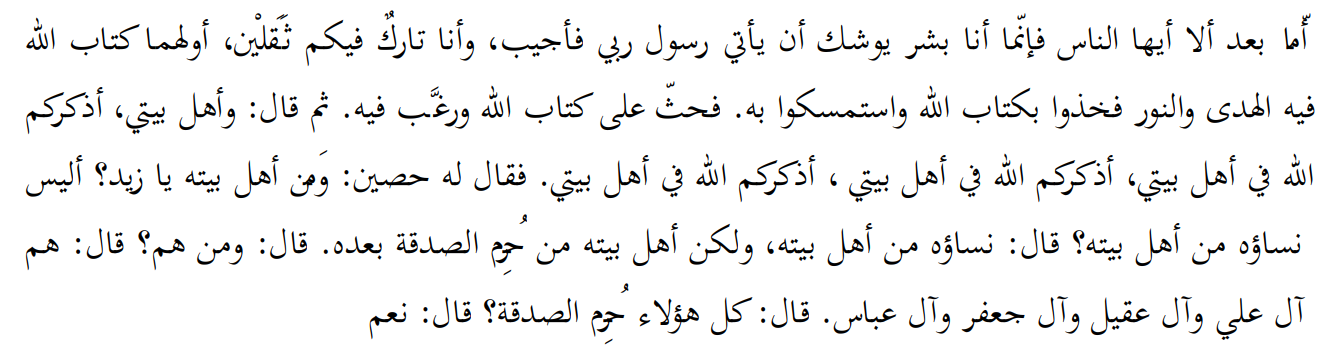
"Agora, ao nosso propósito. Ó povo, eu sou um ser humano. Estou prestes a receber um mensageiro (o Anjo da Morte) do meu Senhor e, em resposta ao chamado de Allah, despedir-me-ei de vós. Deixo entre vós duas coisas de grande peso: a primeira é o Livro de Allah, no qual há a orientação correta e a luz; apegai-vos, portanto, ao Livro de Allah e segui-o." Ele exortou (o povo) a apegar-se ao Livro de Allah e então disse: "A segunda são os membros da minha família; lembro-vos dos vossos deveres para com os membros da minha família." Ele (Husain) perguntou a Zaid: "Quem são os membros da casa dele? Acaso as suas esposas não são membros da sua família?" Ao que ele respondeu: "As suas esposas são membros da sua família, mas aqui os membros da sua família são aqueles para quem é proibido receber Zakat." E ele perguntou: "Quem são eles?" Ao que ele respondeu: "'Ali e os descendentes de 'Ali, 'Aqil e os descendentes de 'Aqil, os descendentes de Ja'far e os descendentes de 'Abbas." Husain disse: "Estes são aqueles para quem é proibido receber Zakat." Zaid disse: "Sim."
" Now to our purpose. O people, I am a human being. I am about to receive a messenger (the angel of death) from my Lord and I, in response to Allah's call, (would bid good-bye to you), but I am leaving among you two weighty things: the one being the Book of Allah in which there is right guidance and light, so hold fast to the Book of Allah and adhere to it. He exhorted (us) (to hold fast) to the Book of Allah and then said: The second are the members of my household I remind you (of your duties) to the members of my family. He (Husain) said to Zaid: Who are the members of his household? Aren't his wives the members of his family? Thereupon he said: His wives are the members of his family (but here) the members of his family are those for whom acceptance of Zakat is forbidden. And he said: Who are they? Thereupon he said: 'Ali and the offspring of 'Ali, 'Aqil and the offspring of 'Aqil and the offspring of Ja'far and the offspring of 'Abbas. Husain said: These are those for whom the acceptance of Zakat is forbidden. Zaid said: Yes.”
Al-Sayyid Abd al-Husain Sharaf ud-Deen mencionou em seu livro "Al-Muraja'at" este hadith, através da seguinte narração que At-Tabarani transmitiu por uma cadeia de transmissão cuja autenticidade é unanimemente aceita, de Zayd bin Arqam (ra), que disse: O Mensageiro de Allah ﷺ falou em Ghadeer Khum, debaixo de algumas árvores, e disse:
As-Sayyid Abd al-Husain Sharaf ud-Deen mentioned in his book “Al-Muraja’at” this hadith via the following narration which At-Tabarani narrated through a chain whose authenticity is unanimously accepted from Zayd bin Arqam (ra) who said: The Messenger of Allah (saw) spoke at Ghadeer Khum underneath some trees and said:
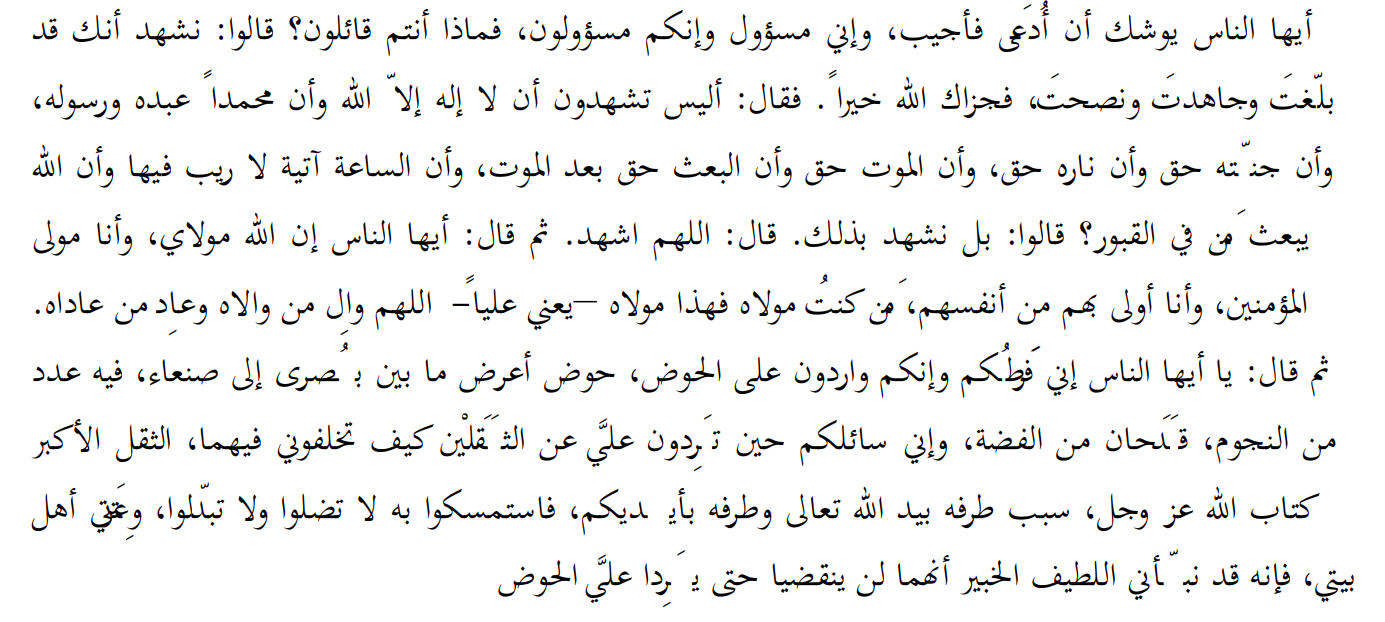
"Ó povo, está para chegar o momento em que serei chamado e responderei (indicando a morte). Em verdade, eu sou responsável e vós sois responsáveis, então o que direis?" Disseram: "Testemunharemos que transmitiste, lutaste e aconselhaste; que Allah te recompense bem." Ele disse: "Não testemunhais que não há divindade senão Allah e que Muhammad é Seu servo e Mensageiro ﷺ, que o Paraíso é verdade e que o Fogo é verdade, que a morte é verdade e que a ressurreição após a morte é verdade, que a Hora (do Juízo) virá sem qualquer dúvida, e que Allah ressuscitará todos aqueles que estão em seus túmulos?" Disseram: "Sim, testemunhamos." Então ele disse: "Ó povo, em verdade Allah é meu Protetor, e eu sou o protetor dos crentes, de modo que tenho precedência sobre eles, mais do que sobre eles mesmos. Quem me tomar como protetor, então este é seu protetor" — ou seja, Ali. "Ó Allah, sê amigo de quem for amigo dele, e sê inimigo de quem for inimigo dele." Então ele disse: "Ó povo, em verdade eu vos deixarei, e me encontrareis no Cântaro (Al-Hawd), um cântaro mais largo do que a distância entre Basra e Sana'a. Nele há copos de prata em número igual às estrelas. Em verdade, eu vos perguntarei, quando vierdes perante mim, sobre as duas coisas pesadas: como cuidastes delas depois de mim. A mais pesada e maior é o Livro de Allah, 'azza wa jalla, um sabab (corda) cuja uma extremidade está nas mãos de Allah e a outra nas vossas mãos. Segurai-o firmemente para que não vos desvieis nem o altereis; e a minha Utra (família), as pessoas da minha casa. Em verdade, o Misericordioso e Onisciente (swt) me informou que elas nunca se separarão até que venham a mim junto ao cântaro (fonte)."
“O people, it is about to be that I am called and I will respond (indicating death). Verily, I am accountable and you are accountable, so what will you say? They said: We will testify that you conveyed, struggled and advised so may Allah recompense you well. He said: Do you not bear witness that there is no deity but Allah and Muhammad is His slave and Messenger, that Paradise is true and Hellfire is true, that death is true and resurrection after death is true, that the Hour (of Judgement) will come without any doubt, and that Allah will resurrect all those in their graves? They said: Yes, we do bear witness. Then he said: O people, verily Allah is my Patron and I am the patron of the believers such that I take precedence before them over their own selves. Whoever takes me as his patron then this one is his patron—meaning Ali. O Allah, befriend whoever befriends him and take as enemy whoever takes him as an enemy. Then he said: O people, verily I will leave you and you will find me at the Cistern, a cistern wider than the distance from Basra to Sana’a. In it are tumblers of silver the number of stars. Verily I will ask you when you come before me on the two weighty things, how you took care of them after me. The weightier and greater one is the Book of Allah ‘azza wa jalla, a (sabab) of which one end is in the hands of Allah and the other in your hands. Hold tightly to it so that you do not go astray or change, and my Utra (household), the people of my house. Verily The Kind & All-Knowing (swt) has informed me that they will never seperate until they come before me at the cistern (fountain)”
(Este é o fim do que As-Sayyid Abd al-Husain Sharaf ud-Deen mencionou). E o Shaikh Abd al-Husain Ahmad Al-Ameeni An-Najafi declarou o seguinte em seu livro “Al Ghadeer”: “Quando ele terminou seus ritos de adoração, ou seja, o Profeta ﷺ, e partiu para Medina, junto com o(s) grupo(s) de pessoas mencionado(s), chegou a Ghadeer Khum, em Al-Jahfa, onde as estradas se bifurcam para os habitantes de Medina, do Egito e do Iraque. Era o décimo quinto dia de Dhul-Hijja, e Jibril, o confiável, desceu até ele vindo de Allah (SWT) com a Sua declaração:
(This is the end of what As-Sayyid Abd al-Husain Sharaf ud-Deen mentioned). And Shaikh Abd al-Husain Ahmad Al-Ameeni An-Najafi stated the following in his book “Al Ghadeer”: “When he finished his rites of worship i.e. the Prophet (saw) and left for Madinah, together with the mentioned group(s) of people, he reached Ghadeer Khum in Al-Jahfa where the roads branch for the people of Madinah, Egypt and Iraq. This was the 15th day of Dhul-Hijja and Jibril, the trustworthy, descended to him from Allah (swt) with His saying:
"Ó Mensageiro, transmite o que te foi revelado pelo teu Senhor" [TMQ 5:67]
‘O Messenger, deliver what was revealed to you from your Lord” [TMQ 5:67]
E Ele lhe ordenou que fizesse Ali (ra) se levantar para que o povo soubesse e fosse informado do que havia sido revelado a respeito de sua tutela e da obrigação de obediência por parte de todos. Os primeiros dos presentes estavam próximos de Al-Jahfa, então o Mensageiro de Allah ﷺ ordenou que aqueles que haviam avançado retornassem e reuniu os que haviam se atrasado naquele lugar, e proibiu que as pessoas acampassem sob as cinco grandes árvores. Quando o povo se acomodou e os que estavam sob elas (as árvores) se levantaram até que a oração do dhuhr fosse anunciada, ele se dirigiu até eles e orou sob elas. Era um dia escaldante, em que um homem colocava parte de sua capa sobre o rosto e parte sob os pés por causa do calor intenso, e o Mensageiro de Allah ﷺ estava à sombra de uma peça de roupa sobre a árvore sumra por causa do sol. Quando ele ﷺ terminou sua oração, levantou-se para falar no meio do povo, sobre a corcova de um camelo, e falou em voz alta, de modo que todos o ouvissem, e ele ﷺ disse:
And He commanded him to cause Ali (ra) to stand to let the people know and inform what was revealed regarding his patronage and the obligation of obedience upon every one. The first of the people were close to Al-Jahfa so the Messenger of Allah (saw) commanded those who had proceeded to return and enclosed those who had delayed at that place, and he prohibited people from encamping beneath the five large trees. When the people took camp and those underneath them (the trees) stood until the dhuhr prayer was announced, he headed for them and prayed beneath them. It was a sizzling day where a man placed some of his cloak upon his face and some under his feet due to the severe heat, and the Messenger of Allah was shaded by a garment upon the sumra tree due to the sun. When he (saw) finished his prayer, he stood to speak in the middle of the people on the hump of a camel and he spoke with a raised tone with every one hearing him and he (saw) said
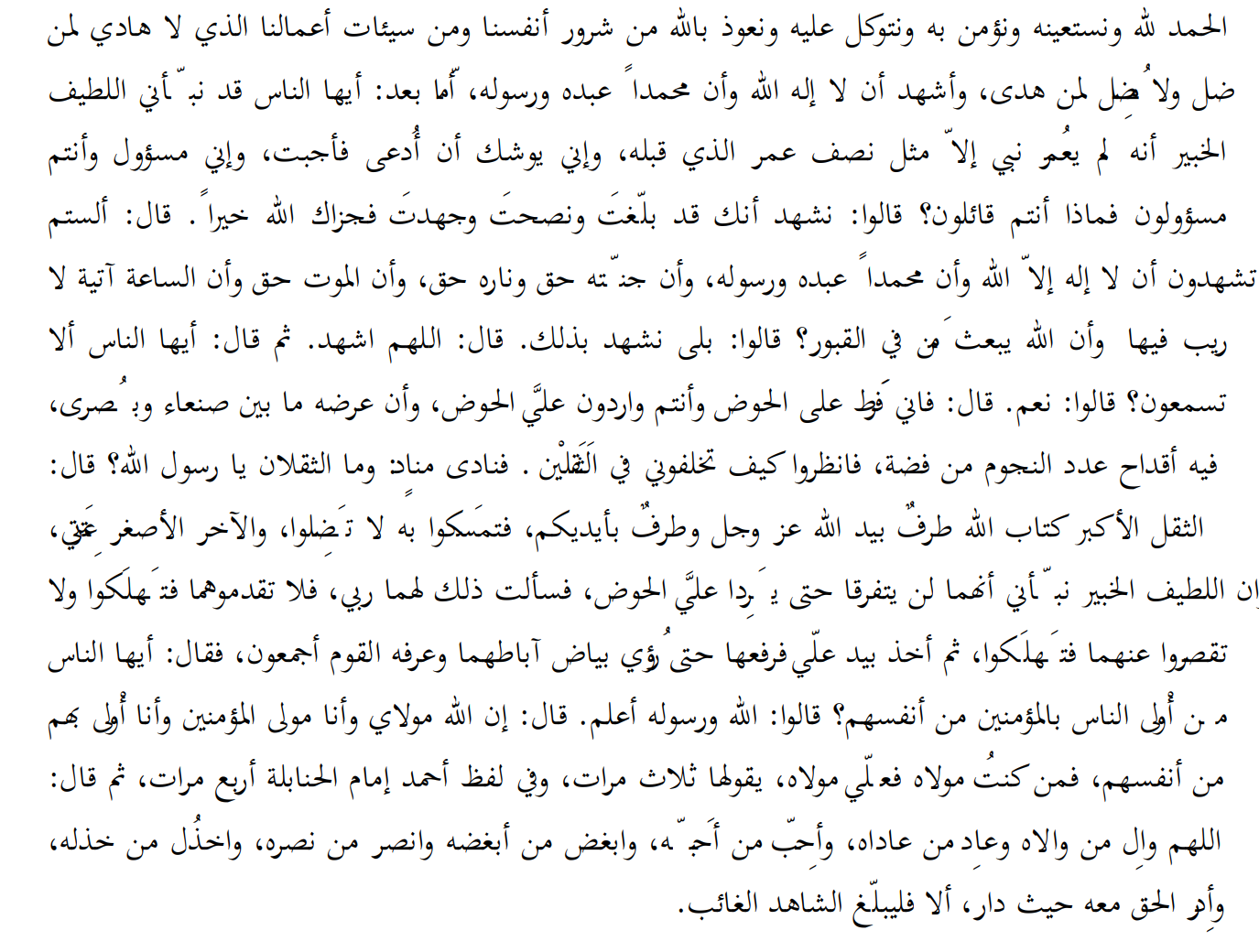
Todo louvor é devido a Allah, a quem pedimos ajuda, em quem cremos e de quem dependemos. Pedimos a Allah que nos proteja dos males de nossas almas e de nossas más ações. Aquele que Allah guia, ninguém pode desviar, e aquele que Ele desvia, ninguém pode guiar. Testemunho que não há deus senão Allah e que Muhammad ﷺ é Seu servo e Mensageiro. Quanto ao que se segue: ó povo, o Bondoso e Onisciente (swt) informou-me que Ele não concede longevidade a um Profeta senão por metade da idade do que o precedeu. Em verdade, está para acontecer que serei chamado e responderei. Em verdade, sou responsável e vós sois responsáveis, então o que direis? Disseram: Testemunhamos que, em verdade, transmitiste, aconselhaste e lutaste, que Allah te recompense bem. Ele disse: Não testemunhais que não há deus senão Allah e que Muhammad ﷺ é Seu servo e Mensageiro, que Seu paraíso é verdadeiro e Seu fogo do inferno é verdadeiro, que a morte é verdadeira, que a Hora virá sem qualquer dúvida e que Allah ressuscitará os que estão nos túmulos? Disseram: Sim, testemunhamos isso. Ele disse: Ó Allah, sê testemunha. Em seguida disse: Ó povo, não ireis ouvir? Disseram: Sim. Ele disse: Em verdade, irei ao tanque (al-Kawthar), e sereis apresentados diante de mim no tanque, cuja largura é a distância entre Sana'a e Basra. Nele há copos de prata, cujo número é o das estrelas. Então, vede como cuidais das duas coisas preciosas depois de mim. Um arauto anunciou: E quais são as duas coisas preciosas, ó Mensageiro de Allah? Ele disse: A maior das duas coisas preciosas é o Livro de Allah, uma extremidade do qual está na mão de Allah e a outra em vossas mãos; agarrai-vos a ele e não vos desviareis. A outra, menor, é a minha família (‘utra). Em verdade, o Bondoso e Onisciente (swt) informou-me que elas não se separarão até que Ali chegue ao tanque, e eu pedi isso ao meu Senhor. Então, não as precedais nem as negligencieis, pois, se o fizerdes, perecereis. Então ele pegou na mão de Ali e a ergueu até que se vissem as suas axilas, e todos o reconheceram, e disse: Ó povo, quem tem precedência sobre os crentes em relação às suas próprias pessoas? Disseram: Allah e o Seu Mensageiro sabem melhor. Ele disse: Verdadeiramente Allah é o meu protetor (mawla) e eu sou o protetor dos crentes, de modo que tenho precedência sobre eles em relação às suas próprias pessoas. Portanto, aquele que me tem como protetor, então Ali é o seu protetor. Ele disse isto três vezes e, segundo as palavras do Imam Ahmad, Imam dos Hanbalitas, quatro vezes. Depois disse: Ó Allah, sê amigo de quem for amigo dele e torna-te inimigo de quem for seu inimigo. Ama quem o amar e odeia quem o odiar, apoia quem o apoiar e abandona quem o abandonar, e que a verdade esteja com ele onde quer que ele resida. Verdadeiramente, que a testemunha presente informe o ausente.”
"All praise is due to Allah whom we ask for help, believe in and depend upon. We ask Allah to protect us from the evils of our souls and bad deeds, the One whom none can guide whom He causes to go astray or misguide whom He guides. I bear witness that there is no god but Allah and Muhammad is His slave and Messenger. As for what follows: O people, verily the The Kind & All-Knowing (swt) has informed me that He does not grant longevity to a Prophet except half the like of the one before him. Verily it is about to be that I will be called and I will respond. Verily I am accountable and you are accountable, so what will you say? They said: We bear witness that verily you have conveyed, advised and struggled so may Allah reward you well. He said: Do you not bear witness that there is no god but Allah and that Muhammad is His slave and Messenger that His paradise is true and His hellfire is true, that death is true, that the Hour will come without any doubt and that Allah will resurrect those in the graves? They said: Yes, we bear witness to this. He said: O Allah, do bear witness. Then he said: O people, will you not listen? They said: Yes. He said: Verily I will go to the cistern (alkauthar) and you will be presented at the cistern, whose breadth is that between Sana’a and Basra, before me. In it are cups of silver the number of which are the number of stars, so look how you take care of the two weighty things after me. An announcer announced: And what are the two weighty things, O Messenger of Allah? He said: The greater of the two weighty things is the Book of Allah, one end of which is in the hand of Allah and the other in your hands so hold fast to it and you will not go astray. The other smaller one is my household (‘utra). Verily the Kind & All-Knowing (swt) informed me that they will not go away until Ali reaches the cistern and I asked that from my Lord. So do not precede them or neglect them and if you do so you will perish. Then he took the hand of Ali and raised it until their armpits were seen and everyone recognised him and he said: O people, who takes precedence before the believers over their own selves? They said: Allah and His Messenger know best. He said: Verily Allah is my Patron (mawla) and I am the patron of the believers such that I take precedence before them over their own selves. So whoever has me as his patron then Ali is his patron. He said this three times, and in the words of Imam Ahmad, Imam of the Hanbalis, four times. Then he said: O Allah, befriend whoever befriends him and become an enemy to whoever takes him as an enemy. Love whoever loves him and hate whoever hates him, support whoever supports him and abandon whoever abandons him, and let the truth be with him wherever he is resides. Verily, let the witness who is present inform the (one who is) absent.’”
3. Aqueles que dizem que o Mensageiro ﷺ anunciou claramente o califado de Ali (ra) citam ahadith em seus livros. Quanto a esses ahadith, não faremos da investigação sobre suas narrações o ponto central, apesar de os dois xeiques, Al-Bukhari e Muslim, não os terem narrado, nem terem sido transmitidos por quaisquer narradores dignos de confiança, e de a maioria deles estar entre os ahadith fabricados. Não faremos de suas narrações objeto de pesquisa, de modo a dizer que esses ahadith não foram transmitidos por narradores dignos de confiança antes de vós, mas que foram transmitidos por narradores dignos de confiança antes de nós, para que aquele para quem o hadith é autenticado o use como evidência. Não tornaremos isso o campo da investigação; ao contrário, faremos da questão de pesquisa os próprios textos tal como chegaram nas narrações. São esses os textos dos quais deduziram que o Mensageiro ﷺ designou Ali como califa depois dele, e esses ahadith são conhecidos como os ahadith da “wilayah”. Deles apresentaremos alguns, e os restantes têm o mesmo significado e até as mesmas palavras.
3. Those who say that the Messenger (saw) clearly announced the Khilafah of Ali (ra) narrated ahadith in their books. As for these ahadith, we will not make the place of research in them their narrations, despite the fact that the two sheikhs Al-Bukhari and Muslim did not narrate them, nor were they narrated via any trustworthy narrators and most of them are among the fabricated ahadith. We will not make their narrations the subject of research such that they say that these ahadith were not narrated by trustworthy narrators before you but were narrated by trustworthy narrators before us so that the one for whom the hadith is authenticated uses it as an evidence. We will not make that the domain of research; rather we will make the matter of research the texts themselves as they came in the narrations. These are the texts from which they deduced that the Messenger (saw) appointed Ali to be the Khalifah after him—and these ahadith are known as the ahadith of “wilayah”—from which we will present some of them and the rest carry the same meaning and even the same wordings.
a) Abu Dawud At-Tayalisi narrou de ‘Ibn Abbas (ra) que o Mensageiro de Allah ﷺ disse a Ali ibn Abi Talib (ra):
a) Abu Dawud At-Tayalisi narrated from ‘Ibn Abbas (ra) that the Messenger of Allah (saw) said to Ali ibn Abi Talib (ra):
"Você é o walí de todos os crentes depois de mim."
“You are the waliy of all believers after me.”
b) Foi narrado no Kanz al-'Ammal, de Imran bin Husain, que disse: O Mensageiro de Allah ﷺ enviou uma expedição e nomeou Ali bin Abi Talib (ra) como comandante sobre eles. Ele escolheu para si uma escrava do quinto (khums), e eles rejeitaram isso dele. Quatro deles concordaram em queixar-se dele ao Profeta ﷺ. Quando chegaram, um dos quatro levantou-se e disse: Ó Mensageiro de Allah ﷺ, não vês que Ali (ra) fez tal e tal coisa? E ele ﷺ afastou-se dele. O segundo levantou-se e disse o mesmo, e ele afastou-se dele. O terceiro levantou-se e disse o mesmo, e ele afastou-se dele. E o quarto levantou-se e disse o mesmo que haviam dito. O Mensageiro de Allah ﷺ voltou-se para eles com a ira visível em seu rosto e disse:
b) It has been narrated in Kanz al-’Ammal from Imran bin Husain who said that the Messenger of Allah (saw) sent an expedition and appointed Ali bin Abi Talib (ra) over them. He chose for himself a slave girl from the fifth (khums) and they rejected this from him. Four of them agreed to complain about him to the Prophet (saw) so, when they came, one of the four stood and said: O Messenger of Allah (saw), do you not see that Ali (ra) did such and such, and he (saw) turned away from him. The second stood and said the same, so he turned away from him. The third stood and said the same, so he turned away from him. And the fourth stood and said the same as they had said. The Messenger of Allah (saw) turned towards them with anger visible in his face and said:
O que você quer de mim em relação a Ali? Na verdade, Ali é de mim e eu sou dele, e ele é o walī de todo crente depois de mim.
What do you want for me with regards to Ali? Verily Ali is from me and I am from him, and he is the waliy of every believer after me.”
c) E em um longo hadith de ‘Amru bin Maymun, de ‘Ibn Abbas (ra), que disse: O Mensageiro de Allah ﷺ enviou fulano com a Surah At-Tawbah. Em seguida, enviou ‘Ali (ra) atrás dele para retirá-la dele e disse:
c) And in a long hadith from ‘Amru bin Maymun from ‘Ibn Abbas (ra) who said: The Messenger of Allah (saw) sent so and so with Surah At-Tawbah. He then sent Ali (ra) after him to take it from him and said:
"Ninguém deve tomá-la, exceto um homem que é de mim e eu sou dele."
“No one should take it except a man who is from me and I am from him.”
d) Kanz al-'Ummal, de Wahhab bin Hamza, que disse: Viajei com Ali (ra) e vi nele aspereza, então disse que, quando eu voltasse, me queixaria disso. Assim, voltei e mencionei Ali (ra) ao Mensageiro de Allah ﷺ, e ele disse:
d) IKanz al-’Ammal from Wahhab bin Hamza who said: I travelled with Ali (ra) and I saw harshness from him, so I said that when I will return I will complain about it. So I returned and mentioned Ali (ra) to the Messenger of Allah (saw) and he said:
"Não diga isso sobre Ali, pois ele é o seu walī depois de mim."
“Do not say this for Ali, as he is your waliy after me.”
e) No Kanz al-'Ammal, de Ibn 'Abbas, que disse: O Mensageiro de Allah ﷺ disse:
e) In Kanz al-’Ammal from ‘ibn Abbas who said: The Messenger of Allah (saw) said:
“Quem se agrada em viver a minha vida, morrer a minha morte e residir no paraíso do Éden, irrigado pelo meu Senhor, então que tome Ali como seu waliy depois de mim.”
“Whoever is pleased to live my life, die my death and to reside in the paradise of Eden irrigated by my Lord then let him befriend Ali as a waliy after me.”
f) No Muntakhab al-Kanz, de Zayyad bin Mutarraf, que disse: Ouvi o Mensageiro de Allah ﷺ dizer:
f) In Muntakhab al-Kanz from Zayyad bin Mutarraf who said: I heard the Messenger of Allah (saw) saying:
“Quem desejar viver a minha vida, morrer a minha morte e entrar no paraíso prometido a mim pelo meu Senhor — e é um paraíso eterno — então que seja amigo de Ali e dos seus descendentes depois de mim. Por certo, eles jamais vos afastarão da porta da orientação, nem vos farão entrar pela porta do desvio.”
“Whoever would like to live my life, die my death, and enter the paradise promised to me by my Lord—and it is an eternal paradise—then let him befriend Ali and his descendants after me. Verily they will never remove you from the door of guidance nor enter you into the gate of misguidance.”
g) No Kanz al-’Ammal, de Ammar bin Yasir, que disse: O Mensageiro de Allah ﷺ disse:
g) In Kanz al-’Ammal from Ammar bin Yasir who said: The Messenger of Allah (saw) said:
"Lego a quem crê em mim e confia em mim a wilayah de Ali bin Abi Talib. Quem se torna amigo dele se tornou amigo de mim, e quem se torna amigo de mim se tornou amigo de Allah. Quem ama a ele amou a mim ﷺ, e quem me ama amou a Allah. Quem odeia a ele odiou a mim ﷺ, e quem me odeia odiou a Allah."
“I bequeath whoever believes in me and trusts me with the wilayah of Ali bin Abi Talib. Whoever befriends him has befriended me and whoever befriends me has befriended Allah. Whoever loves him has loved me, and whoever loves me has loved Allah. Whoever hates him has hated me, and whoever hates me has hated Allah.”
h) Também em Al-Kanz, de Ammar, foi narrado num hadith marfu':
h) Also in Al-Kanz from Ammar it has been narrated in a marfu hadith :
"Ó Allah, quem crer em mim e confiar em mim, que tome Ali bin Abi Talib como amigo. Na verdade, sua wilayah é a minha wilayah, e a minha wilayah é a wilayah de Allah Ta'ala."
“O Allah, whoever believes and trusts in me, let him befriend Ali bin Abi Talib. Verily his wilayah is my wilayah and my wilayah is the wilayah of Allah ta’ala.”
4. Há ahadith transmitidos por aqueles que afirmam que o Mensageiro (saw) declarou abertamente o califado de Ali (ra). Esses ahadith não foram transmitidos por nenhuma pessoa confiável, e a maioria deles são ahadith forjados. Apresentamos alguns deles não para pesquisá-los do ponto de vista de sua cadeia de transmissão, de modo que sejam tidos como autenticados para quem os transmite. Apresentamo-los, antes, para fazer a pesquisa sobre seus textos, de acordo com o que consta neles. Esses ahadith contêm a fraternidade do Mensageiro (saw) com Ali (ra) e a designação dele como herdeiro após o Mensageiro ﷺ. Apresentamos alguns deles, sendo que os restantes têm o mesmo significado e até as mesmas palavras.
4. There are ahadith narrated by those who say that the Messenger (saw) openly declared the Khilafah of Ali (ra). These ahadith have not been narrated by any trustworthy person and most of them are fabricated ahadith. We present them not to research them from the angle of their narration so that they are claimed to be authenticated for those who narrate them. Rather we present them to make the point of research their texts according to what came in their texts. These ahadith contain the brotherhood of the Messenger (saw) with Ali (ra), and making him the heir after him. We present a few of them with the remainder carrying the same meaning and even the same wordings.
a) O Profeta ﷺ estabeleceu uma irmandade entre os Muhajirin e escolheu Ali (ra) para si mesmo. No que resultou do hadith da primeira irmandade, "então Ali disse: Ó Mensageiro de Allah ﷺ, verdadeiramente minha alma me deixou e minha espinha foi quebrada quando vi você fazer o que fez com seus companheiros, exceto eu. Se isto é um sinal da sua ira contra mim, então me queixo somente a você e peço seu perdão." O Mensageiro de Allah ﷺ disse:
a) The Prophet (saw) established a brotherhood between the Muhajirin and chose Ali (ra) for himself. In what came of the hadith of the first brotherhood, “so Ali said: O Messenger of Allah (saw), verily my soul left me and my spine has been broken when I saw you do what you did with your companions other than me. If this is a sign of your anger with me, then I complain only to you and beg your pardon. The Messenger of Allah (saw) said:
"Por Aquele que me enviou com a verdade, eu só te deixei por mim. Tu és para mim na posição de Harun em relação a Musa, exceto que não haverá profeta depois de mim. Tu és meu irmão e meu herdeiro." Ele disse: "O que herdarei de ti?" Ele disse: "O que os Profetas herdaram antes de mim: o Livro do seu Senhor e a Sunnah dos seus Profetas."ﷺ
By the One who sent me with truth, I only left you for myself. You are to me of the status of Harun to Musa except that there is no Prophet after me. You are my brother and inheritor. He said: What will I inherit from you. He said: What did the Prophets inherit before me, the Book of their Lord and the Sunnah of their Prophets.”
b) O Profeta ﷺ estabeleceu a fraternidade entre os Muhajirin e os Ansar cinco meses após a hégira, mas não estabeleceu fraternidade entre Ali (ra) e nenhum dos Ansar; ao contrário, escolheu-o para si mesmo. Isso consta no hadith da segunda fraternidade.
b) The Prophet (saw) made a brotherhood between the Muhajirin and the Ansar five months after the hijrah, but he did not make a brotherhood between Ali (ra) and any of the Ansar; rather he chose him (Ali) for himself. It came in the hadith of the second brotherhood
"Que o Mensageiro ﷺ disse a Ali: Você ficou irritado comigo quando fiz uma fraternidade entre os Muhajirin e os Ansar, mas não fiz uma fraternidade entre você e nenhum deles? Você não se agrada de ser semelhante à posição de Harun em relação a Musa para mim, exceto que não haverá profeta depois de mim?"
“That the Messenger (saw) said to Ali: Did you become angry at me when I made a brotherhood between the Muhajirin and Ansar but did not make a brotherhood between you and any of them? Are you not pleased to be similar to the status of Harun to Musa for me except that there is no Prophet after me”
c) Foi narrado que o Mensageiro ﷺ saiu certo dia até aos seus companheiros com o rosto radiante, e Abdurrahman bin Awf (ra) perguntou-lhe, e ele disse:
c) It is narrated that the Messenger (saw) went out one day to his companions with his face brightened so Abdurrahman bin Awf (ra) asked him and he said:
“Boas novas chegaram-me do meu Senhor sobre meu irmão e o filho do meu tio paterno e a minha filha: que Allah casará Ali com Fátima.”
“Good news came to me from my Lord about my brother and paternal uncle’s son and my daughter, that Allah will marry Ali with Fatima.”
Quando se considerava o noivo digno para o casamento de Sayyida Annisa (líder das mulheres), o Profeta ﷺ disse:
When the sayyid Annisa’s (leader of the women) deserving groom for her marriage was being considered, the Prophet (saw) said:
"Ó Umm Ayman, chama meu irmão para mim." Ela disse: "Ele é teu irmão e, no entanto, vais casá-lo (com a tua filha)?" Ele disse: "Sim, ó Umm Ayman." Então ela chamou Ali, e ele veio.
“O Umm Ayman, call my brother for me. She said: He is your brother yet you are marrying him (to your daughter)? He said: Yes, O Umm Ayman. So she called Ali and he came.”
E o Profeta ﷺ falou com ele um dia a respeito de um julgamento entre ele, seu irmão Ja'far e Zayd bin Haritha, dizendo:
And the Prophet (saw) spoke to him one day regarding a judgement between him, his brother Ja’far (saw) and Zayd bin Haritha (saw), saying:
"Quanto a você, ó Ali, (você é) meu irmão, o pai do meu filho, e de mim e para mim."
“As for you, O Ali, (you are) my brother, the father of my son, and from me and for me.”
d) O Mensageiro ﷺ prometeu a Ali (ra) um dia, dizendo:
d) The Messenger (saw) promised to Ali (ra) one day saying:
"Você é meu irmão e meu wazīr. Você pagará as minhas dívidas, cumprirá os meus compromissos e completará as minhas responsabilidades."
“You are my brother and my wazeer. You will repay my debts, fulfill my commitments and complete my responsbilities.”
3) No Kanz al-'Ummal, ele (ﷺ) disse
3) In Kanz al-’Ammal, he (saw) said
"Está escrito no portão do Paraíso: Não há deus senão Allah, Muhammad é o Mensageiro de Allah ﷺ, Ali é o irmão do Mensageiro de Allah ﷺ."
“It is written on the gate of Paradise: There is no god but Allah, Muhammad is the Messenger of Allah, Ali is the brother of the Messenger of Allah.”
Estes quatro textos, que são os textos em que o Mensageiro (saw) colocou Ali no nível de Harun em relação a Musa, o texto em que deixou o Livro de Allah e a Sua descendência, o texto da wilayah e o texto da fraternidade, são os textos dos quais alguns muçulmanos deduziram que o Mensageiro (saw) designou Ali (ra), isto é, fez dele o Califa depois dele. Vamos tomá-los texto por texto:
These four texts, which are the texts in which the Messenger (saw) made him (Ali) of the status of Harun to Musa, the text that he left the Book of Allah and His progeny, the text of wilayah, and the text of brotherhood, are the texts from which some Muslims deduced that the Messenger (saw) appointed Ali (ra) i.e. made him the Khalifah after him. Let us take them text by text:
Quanto ao primeiro texto, aquele que colocou Ali na posição de Harun em relação a Musa, diante do Mensageiro (saw), seu significado se esclarece através do estudo da ocasião em que foi dito e do estudo de sua redação. Quanto à ocasião, o Mensageiro (saw) disse este hadith no dia da batalha de Tabuk. Nessa ocasião, o Mensageiro (saw) designou em Madinah, em seu lugar, Muhammad bin Maslamah (ra) para supervisionar os assuntos dos muçulmanos e administrar o governo, e designou nosso mestre Ali (ra) sobre a sua família, ordenando-lhe que cuidasse dela. Os hipócritas o criticaram e disseram: ele só o deixou para trás porque lhe foi difícil, e ele quis facilitar-lhe a situação. Quando os hipócritas disseram isso, Ali (ra) pegou sua arma e partiu até encontrar o Mensageiro (saw), que estava acampado em Al-Jarf, e disse:
As for the first text, which is the text which made Ali at the status of Harun to Musa before the Messenger (saw), its meaning is clarified though studying the occcasion in which it was said and studying its wording. As for the occasion, the Messenger (saw) said this hadith on the day of the battle of Tabuk. Therein the Messenger (saw) appointed in Madinah in his place Muhammad bin Maslamah (ra) to supervise the Muslims’ affairs and administer the rule, and appointed our master Ali (ra) over his family and commanded him to supervise them. The hypocrites shook him and said: He did not leave him behind except because it had become hard on him he wanted to make it easy for him. When the hypocrites said this, Ali (ra) took his weapon and left until he met the Messenger (saw) who was encamped at Al-Jarf and said:
“Ó Profeta de Allah, os hipócritas afirmaram que você me deixou para trás porque me considerou um fardo, e desejou aliviar-me desse peso.” Ele ﷺ disse: “Mentiram; antes, deixei-te para trás por causa do que deixo atrás de mim. Volta e toma o meu lugar junto à minha família e à tua família. Não estás satisfeito, ó Ali, de ocupar para comigo a mesma posição que Harun ocupava para com Musa, exceto que não haverá profeta depois de mim?”
“O Prophet of Allah, the hypocrites claimed that you left me behind because you found a burden on meand wished to make it light for me. He (saw) said: They lied, rather I left you behind due to what I left behind me. So return and take my place over my family and your family. Are you not pleased, O Ali, that you are of the same status to me as Harun to Musa except that there is no Prophet after me?”
Então o Mensageiro de Allah ﷺ prosseguiu em sua viagem. O hadith sobre Ali (ra) ocupar, em relação ao Mensageiro ﷺ, a mesma posição que Harun ocupava em relação a Musa diz respeito à designação feita pelo Mensageiro ﷺ dele sobre a sua família, pela evidência da própria declaração de Ali (ra).
So the Messenger of Allah (saw) continued on his travel. The hadith about Ali (ra) being the same status for the Messenger (saw) as Harun for Musa concern to his (saw)’s appointing him over his (saw) family by the evidence of Ali’s (ra) own statement:
"Você me deixa para trás com as mulheres e as crianças?"
“Do you leave me behind with women and children?”
The reality of the incident is that he was appointed over his family, so it cannot be taken to mean that he was appointed over the Khilafah, particularly when it is known that the Prophet ﷺ appointed Muhammad bin Maslamah as the ruler in his place and specified Ali (ra) to supervise over his family when he said to him, "my family and your family." Moreover, the Messenger's ﷺ appointment of one of his companions over the rule when he left for battle does not mean that this appointed person is the Khalifah in his place, by the evidence that the Messenger ﷺ appointed many in the battles. In the battle of Al-'Asheera he appointed Abu Salamah bin Abd al-Asad over Madinah, in the battle of Safwan he appointed Zayd bin Haritha (ra) over Madinah, in the battle of Banu Lahyan he appointed ibn Umm Maktum (ra) over Madinah, and so on. The appointment by the Messenger ﷺ of someone to rule over Madinah until he returns from his battles does not indicate that it means his appointment over the Khilafah, so what if he appointed him only over his family while appointing another in authority until he returns from his battle.
The reality of the incident is that he was appointed over his family so it cannot be taken to mean that he was appointed over the Khilafah, particularly when it is known that he (saw) appointed Muhammad bin Maslamah as the ruler in his place and specified Ali (ra) to supervise over his family when he said to him, “my family and your family.” Moreover, the Messenger’s (saw) appointment of one of his companions over the rule when he left for battle does not mean that this appointed person is the Khalifah in his place by the evidence that the Messenger (saw) appointed many in the battles. In the battle of Al-‘Asheera he appointed Abu Salamah bin Abd al-Asad over Madinah, in the battle of Safwan he appointed Zayd bin Haritha (ra) over Madinah, in the battle Banu Lahyan he appointed ibn Umm Maktum (ra) over Madinah, and so on. The appointment by the Messenger (saw) of someone to rule over Madinah until he returns from his battles does not indicate that means his appointment over the Khilafah, so what if he appointed him only over his family while appointing another in authority until he returns from his battle.
Isto está relacionado com a nomeação. Quanto ao dito do Mensageiro ﷺ:
This is in relation to the appointment. As for the saying of the Messenger (saw):
“Você não fica satisfeito por estar na mesma posição que Harun tinha em relação a Musa?”
“Are you not pleased to be similar to the status of Harun with Musa?”
O significado de suas palavras é: Não te agrada que haja para ti, naquilo sobre o que és designado, aquilo que Harun supervisionou para Musa. Trata-se da semelhança de Ali (ra) com Harun no sentido de semelhança sendo a designação, ou seja, a tua semelhança comigo ao designar-te (ou deixar-te para trás) é semelhante à de Harun quando Musa o designou. Este é o significado das palavras do hadith, e essas palavras não possuem nenhum outro significado. Este significado é específico e torna-se o único significado devido à fala de Ali (ra) ao Mensageiro ﷺ:
The meaning of its words is: Are you not pleased that there is for you, in what you are appointed over, what Harun supervised for Musa. It is the resemblance of Ali (ra) with Harun in the way of resemblance being the appointment i.e. your similitude in my appointing you (or leaving you behind) is similar to that of Harun when Musa appointed him. This is the meaning of the words of the hadith and these words do not have any other meaning. This meaning is specified and becomes the only meaning due to Ali’s (ra) saying to the Messenger:
"Você está me deixando para trás com as crianças e as mulheres?"
“Do you leave me behind with children and women?”
Com a declaração do Mensageiro ﷺ:
With the Messenger’s statement:
“Você não se alegra em ter comigo uma relação semelhante à que Harun tinha com Musa?”
“Are you not pleased to be related to me similar to the status of Harun with Musa?”
Isto veio em resposta a esta pergunta de Ali (ra) e como resposta à sua afirmação. Para compreender o que se quer dizer com este hadith, é preciso voltar ao Glorioso Alcorão para ver, dentro da questão da nomeação de Harun por Musa, o que ela é. Voltando ao Glorioso Alcorão, encontramos que este acontecimento é mencionado no Alcorão no seguinte texto:
This came in response to this question of Ali (ra) and as a response to his statement. To understand what is meant by this hadith one must return to the Glorious Qur’an to see within the issue of Musa’s appointing Harun to see what it is. Returning to the Glorious Qur’an, we find that this event is mentioned in the Qur’an in the following text:
“E designamos para Mûsâ (Moisés) trinta noites e completamos com dez (mais), e assim se completou o prazo, determinado por seu Senhor, de quarenta noites. E Mûsâ (Moisés) disse a seu irmão Hârûn (Arão): ‘Substitui-me entre meu povo, age retamente (ordenando ao povo que obedeça a Allâh e que O adore somente) e não sigas o caminho dos Mufsidûn (corruptores)’.” [TMQ 7:142]
“And we appointed for Mûsâ (Moses) thirty nights and added (to the period) ten (more), and he completed the term, appointed by his Lord, of forty nights. And Mûsâ (Moses) said to his brother Hârûn (Aaron): "Replace me among my people, act in the right way (by ordering the people to obey Allâh and to worship Him Alone) and follow not the way of the Mufsidûn (mischief-makers)” [TMQ 7:142].
Assim, o significado do hadith torna-se: "Não te agrada que eu te nomeie sobre a minha família como Musa nomeou Harun sobre o seu povo, de modo que tu sejas diante de mim na posição de Harun em relação a Musa, por causa da nomeação?" Portanto, a intenção do hadith é apaziguar o coração do nosso mestre Ali, pois ele ficou descontente com essa nomeação, e ao mesmo tempo informa Ali (ra) que ele ocupará o lugar do Profeta ﷺ sobre a sua família quando este estiver ausente, assim como Harun ocupou o lugar de Musa sobre o seu povo quando este esteve ausente. Quanto à sua afirmação,
So the hadith’s meaning becomes: Are you not pleased that I appoint you over my family like Musa appointed Harun over his people, so that you become before me of the status of Harun to Musa due to the appointment? So the hadith’s intent is to pacify our master Ali’s heart as he came displeased by this appointment, and at the same time it informs Ali (ra) that he will take his (saw) place over his family when he is absent just like Harun took Musa’s place over his people when he was absent. As for his saying:
"Exceto que não haverá profeta depois de mim" ﷺ
“Except that there is no Prophet after me”
Isto nega a semelhança de profecia, pois Harun era um Profeta (ﷺ)? Não, a frase correta é: Isto nega a semelhança de profecia, pois Harun era um Profeta, logo ele era um Profeta substituindo outro Profeta quando este estava ausente. Por isso, o Mensageiro de Allah ﷺ excluiu a profecia para remover qualquer ideia de que ele tinha o mesmo status na profecia. Nem se deve dizer que a sua declaração,
This negates the resemblance of Prophethood because Harun was a Prophet (saw) so he was a Prophet (saw) taking the place of another Prophet (saw) when he was absent. So the Messenger (saw) excluded Prophethood to remove any imagination that he is of the same status in Prophethood. Nor should one say that his statement,
"Nenhum Profeta depois de mim" ﷺ
“No Prophet after me”
Significa "depois da minha morte", já que as palavras se relacionam com a nomeação durante a vida dele. Isso porque Harun era um Profeta junto com Musa durante a vida deste, e não depois da sua morte; ele era seu sucessor (khalifa) sobre o seu povo enquanto Musa estava ausente durante a sua vida, e não depois da sua morte. Assim, o Mensageiro apenas fez a sua declaração: "Exceto que não há Profeta depois de mim", porque Harun era um Profeta durante a ausência de Musa enquanto este vivia; por isso ele fez esta declaração a fim de negar a Profecia a Ali (ra). Além disso, o Mensageiro de Allah ﷺ nos informou, num hadith autenticado narrado por Al-Hakim, que Harun morreu durante a vida de Musa. Portanto, não se levanta a questão de nomeação após a morte, pois ela não existiu em Harun e Musa, que são aqueles com quem se faz a comparação; logo, ela também não existe no Profeta ﷺ e em Ali (ra), que são os que se assemelham.
Means after my death as the words are related to appointment during his life. This is because Harun was a Prophet along with Musa during his life not after his death; he was his deputy (khalifa) over his people while he (Musa) was absent during his life not after his death. So the Messenger only made his statement: “Except that there is no Prophet after me” because Harun was a Prophet during Musa’s absence while he lived; so he made this statement in order to negate Prophethood from Ali (ra). Moreover, the Messenger of Allah (saw) informed us in an authenticated hadith narrated by Al-Hakim that Harun died during Musa’s life. So there does not raise the issue of appointment after death as it did not exist in Harun and Musa, who are those with whom resemblance is made, thus it does not exist in the Prophet (saw) and Ali (ra) who are the resemblers.
Este é o significado do hadith, e ele não contém nenhuma indicação de nomeação para o Califado, nem pode ser entendido, de forma alguma, como uma declaração clara do Mensageiro de Allah ﷺ de que ele pretendia tornar Ali (ra) o Califa sobre os muçulmanos após a morte do Mensageiro ﷺ. O hadith discutido refere-se à designação de Ali (ra) sobre a família do Mensageiro ﷺ durante a sua ausência por causa da batalha de Tabuk. Quanto às demais narrações que vieram neste hadith, ou seja, o seu ﷺ dizer:
This is the hadith’s meaning nor does it contain any indication to appointment for the Khilafah nor can it be understood in any way that the Messenger (saw) intended by this hadith to clearly state and make Ali (ra) the Khalifah over the Muslims after the Messenger’s (saw) death. The hadith discussed is related to the appointment of Ali (ra) over the Messenger’s (saw) family during his absence due to the battle of Tabuk. As for the remaining narrations which came in this hadith i.e. his (saw) saying:
“Você não ficaria satisfeito em estar comigo na mesma posição que Harun tinha com Musa?”
“Are you not please to be before me of the status of Harun with Musa?”
Algumas delas são narrações autenticadas, como as de Al-Bukhari e Muslim em seus hadiths de 'Amir e Ibrahim, os dois filhos de S'ad, enquanto outras não são autenticadas, mas todas vieram com o mesmo texto. Isso significa que o hadith foi dito em Tabuk e em outras ocasiões. A resposta a isso é que as narrações autênticas são uma narração que faz parte do episódio, isto é, narrações com as palavras do Mensageiro (saw) apenas, separadas do episódio, o que não significa que seja um episódio diferente do episódio de Tabuk. Narradores e compiladores de hadiths frequentemente narram uma parte de um hadith ou uma parte de um episódio, reduzindo-o ao trecho que serve de prova. Mesmo que aceitemos que o hadith não se refere apenas ao episódio de Tabuk, mas foi dito em Tabuk e em outras ocasiões, isso significaria que o Mensageiro ﷺ nomeou nosso mestre Ali (ra) sobre sua família de forma permanente durante Tabuk e em outras ocasiões; tampouco significaria sua nomeação (que Allah enobreça seu rosto) para o Califado após a morte do Mensageiro ﷺ. Tudo o que a explicação da palavra e do significado do hadith indica é: Não estás satisfeito por eu ter te nomeado sobre minha família durante minha ausência, assim como Harun supervisionou por Musa durante sua ausência, exceto que Harun era um Profeta e tu não és um Profeta, porque não há Profeta depois da minha profecia? Isto consta na narração de Muslim, de 'Amir bin S'ad, de seu pai.
Some of them are authenticated narrations like those by Al-Bukhari and Muslim in their hadith from ‘Amir and Ibrahim, the two sons of S’ad, while others are not authenticated, but all of them came with the same text. This means that the hadith was said in Tabuk and at other times. The response to this is that the authentic narrations are a narration which is a part of the incident i.e. narrations with the Messenger’s (saw) words alone separated from the incident which does not mean that it is an incident other than the incident of Tabuk. Narrators and collectors of hadith frequently narrate a part of a hadith or a part of an incident, shortening it to the place of evidence. Even if we accept that the hadith was not only about the incident of Tabuk but was said in Tabuk and other times, then this would mean that the Messenger (saw) appointed our master Ali (ra) over his family permanently during Tabuk and at other times; nor would it mean his appointment (may Allah ennoble his face) over the Khilafah after the Messenger’s (saw) death. All that the explanation of the hadith’s word and meaning indicate is: Are you not pleased that I appointed you over my family during my absence just like Harun supervised for Musa during his absence, except that Harun was a Prophet and you are not a Prophet because there is no Prophet after my Prophethood. This came in Muslim’s narration from Amir bin S’ad from his father:
“Você não se agrada de ser para mim o que Harun foi para Musa, exceto que não haverá profeta depois de mim?”
“Are you not pleased that you become before me of the status of Harun with Musa except that there is no Prophet after me”
i.e. depois da minha Profecia. Esta é a semelhança com que o Mensageiro (saw) comparou Ali (ra) em relação a ele, assim como Harun em relação a Musa, ou seja, a designação e nada mais, designação durante a sua ausência e nada mais, e designação sobre a sua família, como consta no texto do hadith em sua totalidade. A frequência com que um hadith é repetido não altera o seu significado para lhe dar um sentido alternativo. Assim, a designação em Tabuk foi apenas sobre a família do Mensageiro ﷺ, como está comprovado sem dúvida, enquanto as outras narrações fora de Tabuk transmitiram o mesmo texto mencionado em Tabuk, tanto nas palavras quanto no sentido, sem mencionar a restrição do incidente de Tabuk, isto é, a família. Na verdade, elas não mencionam qualquer restrição, portanto as medimos pelo que foi mencionado na narração de Tabuk. Isso porque a narração de Tabuk é restrita à família, enquanto as outras narrações são livres de qualquer restrição na designação, e por isso medimos o não restrito pelo restrito. Tampouco se deve dizer que as outras narrações são gerais, pois as palavras do hadith não pertencem às palavras gerais, já que os textos de todas as narrações, sejam elas: "Não estás satisfeito?", ou: "Certamente tu", ou: "Tu", e semelhantes, que possuem o peso da posição de Harun com Musa, todas essas palavras são específicas de um status determinado, que é o status de Harun com Musa, e não um status geral. Exceto que o status de Harun em relação a Musa veio sem restrição em algumas das narrações, que não estavam restritas por nenhuma condição, enquanto em algumas narrações estavam restritas à família; por isso medimos o não restrito pelo restrito, de modo que todas as narrações ficam restritas à família.
i.e. after my Prophethood. This is the similitude with which the Messenger (saw) compared Ali (ra) in relation to him just like Harun in relation to Musa i.e. the appointment and nothing else, appointment during his absence and nothing else, and appointment over his family as came in the hadith’s text in its entirety. The frequency with which a hadith is repeated does not change its meaning to give it an alternative meaning. So the appointment in Tabuk was only over the Messenger’s (saw) family as is proven without doubt, while the other narrations in other than Tabuk conveyed the same text mentioned in Tabuk in words and meaning without mentioning the restriction in the incident of Tabuk i.e. the family. Rather, they do not mention any restriction at all thus we measure them upon what was mentioned in the narration of Tabuk. This is because the narration of Tabuk is restricted to the family while the other narrations are free of any restriction in the appointment so we measure the unrestricted upon the restricted. Nor should one say that the other narrations are general as the words of the hadith are not from the general words as the texts of all the narrations whether the narration: “Are you not pleased” or the narration: “Verily you” or the naration: “You” and the similar which is of the weightage of Harun with Musa; all these words are specific to a specific status which is of the status of Harun with Musa which is not of the general status. Except that the status of Harun to Musa came unrestricted in some of the narrations which were not restricted by any restriction, while they were restricted to the family in some of the narrations so we measure the unrestricted upon the restricted such that all the narrations are restricted to the family.
"E designa para mim um auxiliar da minha família, Hârûn (Arão), meu irmão. Fortalece-me com ele, e faze-o partilhar a minha missão (de transmitir a Mensagem de Allâh e a Profecia)" [TMQ 20:29].
“And appoint for me a helper from my family, Hârûn (Aaron), my brother. Increase my strength with him, And let him share my task (of conveying Allâh's Message and Prophethood” [TMQ 20:29].
Não há lugar para elas em relação ao status de Harun para com Musa, nem à nomeação como Khalifa, pois trata-se de uma súplica que Musa fez a Allah para que tornasse seu irmão um auxiliar para ele e lhe concedesse a Profecia junto com ele, porque os assuntos pelos quais Musa suplicou a Allah (SWT) que associasse Harun a ele foram a Profecia e a Mensagem. Portanto, a associação deu-se apenas nesses assuntos, e não no governo, pois Musa não era governante, mas somente Profeta. Além disso, o pedido foi de auxílio para ele e de associação nos seus assuntos, e não de nomeação para o governo.
There is no place for them in relation to the status of Harun to Musa nor the appointment as the Khalifa since it is a prayer which Musa Made to Allah to make his brother an assistant to him and to give him the Prophethood along with him because the matters which Musa prayed to Allah (swt) to associate Harun with him upon were Prophethood and the Message so the association was only in these matters not the rule, as Musa was not a ruler but only a Prophet. Moreover, the request was a request for assistance for him and associating him in his matter, not a request for his appointment (in rule).
Acima de tudo isto, estes assuntos não são uma indicação do status de Musa em relação a Harun; antes, uma indicação do status de Musa em relação a Harun é o facto de este o ter nomeado sobre o seu povo durante a sua ausência; assim, o status dele perante ele era que cuidava do seu povo durante a sua ausência. Não existe qualquer fundamento para a ajuda e a associação na profecia na declaração do Mensageiro ﷺ: “do status de Harun para Musa”. De facto, o significado está restringido à nomeação sobre o povo, e os textos não encerram qualquer outro significado além deste.
Above all this, these matters are not an indication to the status of Musa to Harun; rather an indication for the status of Musa to Harun is his appointing him over his people during his absence; so his status before him is that he took care of his people during his absence. There is no existence for assistance and association in the Prophethood in the statement of the Messenger: “of the status of Harun to Musa” infact the meaning is restricted to the appointment over the people and the texts do not carry any meaning other than this.
Diz-se que Musa era um governante, porque lhe foi revelada uma Shari'ah para governar por ela, uma vez que nela há soluções e punições, e ele era o líder de um exército que pretendia ocupar Bayt al-Maqdis, quando o seu povo lhe disse:
It has been said that Musa was a ruler because a Shari’ah was revealed to him to rule by ,as there are solutions and punishments within it, and he was a leader of an army which intended to occupy Bait al-Maqdis when his people said to him:
"Vá você e seu Senhor e lutem" [TMQ 5:24],
You and your Lord go and fight” [TMQ 5:24],
Portanto, a sua nomeação de Harun sobre o seu povo foi uma nomeação em profecia e também em autoridade. A resposta a isto é que Musa não foi um governante, nem está narrado no Alcorão ou em outro lugar que ele executasse as regras sobre os filhos de Israel (Banu Israil) pela força e pela autoridade, nem que ele fosse um governante sobre eles. Aqueles que governaram os Banu Israil com a Shari'ah de Musa não foram o próprio Musa nem em sua vida, mas sim aqueles profetas que vieram depois dele, como Dawud, Sulayman e outros reis. Quanto à liderança de Musa sobre os exércitos, ela nunca ocorreu. Os versículos que estão na Surah Al-Ma'idah, do versículo 19 ao versículo 26, não contêm nada que indique a liderança de Musa sobre o exército; o que neles está é que Musa ﷺ pediu ao seu povo que entrasse na Terra Santa. Eles recusaram e disseram-lhe que nela havia um povo de gigantes agressivos, pelo que nunca entrariam enquanto esses gigantes não saíssem; pediram a ele e ao seu Senhor que fossem combater, mas ele não foi, e o resultado foi o seu exílio por quarenta anos no deserto. Quanto à revelação da Shari'ah a Musa ﷺ com soluções e punições, isto não significa que Musa ﷺ governou com elas; a realidade é que ele a trouxe e a transmitiu aos Banu Israil. Ele tentou levá-los a Bait al-Maqdis, mas eles se desviaram no deserto e não se estabilizaram até que o seu período tivesse terminado. Após terminar o seu castigo com o exílio, eles se moveram e foram governados por reis e profetas entre eles, segundo a Shari'ah de Musa ﷺ, o que é afirmado pelo Alcorão em mais de uma Surah. Além disso, os versículos em que Harun foi nomeado são explícitos em que foi uma nomeação em nome de Musa ﷺ na profecia, quando Musa foi encontrar-se com Allah (SWT), o que está na Surah Al-A'raf, a partir do versículo 141:
So his appointment of Harun over his people was an appointment in Prophethood and also in authority. The response to this is that Musa was not a ruler, nor is it narrated in the Qur’an or elsewhere that he would execute the rules upon the children of Israel (Banu Israil) by strength and the authority or that he was a ruler over them. Those who ruled Banu Israil with the Shari’ah of Musa were not Musa himself or in his lifetime, rather it was those Prophet who came after him like Dawud, Sulayman and other kings. As for Musa’s leadership over the armies, it never occurred. The ayaat which are in Surah Al-Maidah from ayah 19 to ayah 26 do no have anything within them which indicates Musa’s leadership over the army; rather what is within them is that Musa (as) requested his people to enter the Holy Land. They refused and said to him that there are giant aggressive people within it so they would never enter until these giants left; they asked him and his Lord to go and fight but he did not go so the result was their exile for fourty years in the wilderness. As for the revelation of the Shari’ah to Musa (as) with solutions and punishments, this does not mean that Musa (as) ruled with these; rather the reality is that he came with it and conveyed it to Banu Israil. He tried to take them to Bait al-Maqdis but they strayed in the wilderness and they did not stabilise until his period had ended. After their punishment with the exile ended, they moved and were ruled by kings and Prophets among them by the Shari’ah of Musa, which is stated by the Qur’an in more than one Surah. Moreover, the ayaat in which Harun was appointed are explicit that it was an appointment on behalf of Musa in Prophethood when Musa went to meet Allah (swt), which is in Surah Al-‘Araf from ayah 141:
“E designamos para Mûsâ (Moisés) trinta noites e completamos com dez (mais), e assim se completou o prazo, determinado por seu Senhor, de quarenta noites. E Mûsâ (Moisés) disse a seu irmão Hârûn (Arão): ‘Substitui-me entre meu povo, age retamente (ordenando ao povo que obedeça a Allâh e que O adore somente) e não sigas o caminho dos Mufsidûn (corruptores)’.” [TMQ 7:142]
“And we appointed for Mûsâ (Moses) thirty nights and added (to the period) ten (more), and he completed the term, appointed by his Lord, of forty nights. And Mûsâ (Moses) said to his brother Hârûn (Aaron): "Replace me among my people, act in the right way (by ordering the people to obey Allâh and to worship Him Alone) and follow not the way of the Mufsidûn (mischief-makers)” [TMQ 7:142].
“E Musa escolheu do seu povo setenta homens” [TMQ 7:155].
“And Musa chose from his people seventy men” [TMQ 7:155].
Todas essas coisas estão relacionadas à profecia e à designação para ela, ao lançamento das tábuas (por Musa) e ao fato de os Banu Israil terem tomado um bezerro para adoração, e coisas semelhantes; não há nada nelas com a menor relação com o governo e a autoridade. Não é possível suspeitar que estejam ligadas ao governo e à autoridade, portanto não há nenhuma evidência de que Musa tenha sido governante, e ele nunca designou Harun para o governo de modo algum.
All of these are related to the Prophethood and appointment in it, and the throwing of the tablets (by Musa), and the Banu Israil taking to worship the calf and the like; there is nothing within them with the slightest relationship to rule and authority. It is not possible to suspect that it is related with the rule and authority, so there is no evidence that Musa was a ruler and he never appointed Harun in the rule at all.
Este é o significado de todos os ahadith revelados, quer tenham surgido com uma causa, como o incidente de Tabuk, quer sem qualquer causa, os quais indicam que o Mensageiro de Allah ﷺ designou Ali (ra) para supervisionar a sua família enquanto ele estava ausente durante a sua vida, de forma semelhante a como Musa designou Harun para supervisionar o seu povo enquanto ele estava ausente durante a sua vida. Com esta ação, isto é, a designação de Ali (ra) pelo Mensageiro de Allah ﷺ, Ali passou a ocupar, em relação ao Mensageiro de Allah ﷺ, uma posição comparável à de Harun em relação a Musa. Não há nestes ahadith qualquer indicação de que o Mensageiro de Allah ﷺ tenha afirmado que Ali (ra) se tornaria o Califa sobre os muçulmanos no governo após a morte do Mensageiro de Allah ﷺ.
This is the meaning of all the revealed ahadith whether they came with a cause like the incident of Tabuk or without any cause, which indicate that the Messenger (saw) made Ali (ra) supervise his family while he was absent during his lifetime similar to how Musa made Harun supervise his people while he was absent during his lifetime. With this action i.e. the Messenger’s (saw) appointment of Ali (ra), Ali became to the Messenger (saw) comparable to the status of Harun to Musa. There is no indication in these ahadith that the Messenger (saw) stated that Ali (ra) would become the Khalifah over the Muslims in ruling after the Messenger of Allah (saw)’s death.
Quanto ao segundo texto e ao hadith de Ghadeer Khum, na narração autenticada, isto é, a narração de Muslim, ele exorta os muçulmanos a apegarem-se ao Livro de Allah e à família da sua (ﷺ) casa, a serem generosos com eles, a honrá-los e a não os magoar. Não há nela qualquer indicação de que o Mensageiro (ﷺ) tenha designado a sua família para o Khilafah. O hadith diz: "Quanto às pessoas da minha casa, exorto-vos perante Allah nas pessoas da minha casa"; nada nisto indica que ele tenha feito da família da sua casa os Khulafaa no governo sobre as pessoas depois da sua morte. As palavras são claras no seu texto expresso (mantuq) e no seu significado, de tal modo que jamais se pode entender que ele tenha designado a família da sua casa, ou qualquer um deles, para governar os muçulmanos através do Khilafah depois dele. Quanto à segunda e à terceira narrações, e a todas as narrações semelhantes a elas, estas não alteram o que nelas consta. Há duas questões nestas narrações. Primeiro, ao tomar Allah como protetor na sua afirmação:
Verdadeiramente Allah é o meu Protetor, e eu sou o protetor dos crentes, de modo que sou mais querido por eles do que suas próprias almas. Portanto, aquele para quem eu sou o protetor, então este é o seu protetor, ou seja, Ali. Ó Allah, sê amigo de quem for amigo dele e sê inimigo de quem for inimigo dele.
“Verily Allah is my Patron, and I am the patron of the believers such that I am dearer to them than their own souls. So the one for whom I am his patron, then this is his patron meaning Ali. O Allah, befriend whoever befriends him and be an enemy to whoever is an enemy to him.”
Quanto ao segundo ponto, trata-se de que ele aconselhou seus descendentes a praticarem boas ações, dizendo:
As for the second matter, this is that he advised his progeny to undertake good deeds by saying:
"E os meus descendentes, a gente da minha casa, pois, em verdade, o Gentil e Onisciente me informou que eles jamais se separarão até chegarem à fonte."
“And my progeny, the people of my house, for verily the kind and All knowing informed me that they will never end until they arrive at the cistern.”
Não há nada além destas duas questões em todos estes ahadith, apesar de sua grande quantidade e das narrações divergentes. Quanto à primeira questão, que é a amizade, a discutiremos durante a discussão sobre os ahadith da (wilayat), logo após este texto. Quanto à segunda questão, ela não difere de ser um conselho aos muçulmanos para que sejam bons com a sua descendência, as pessoas de sua casa, sendo gentis com elas, honrando-as e não as incomodando, pois serão questionados a respeito delas. Também que a família da casa e o Livro de Allah (swt) permanecerão unidos até o Dia do Juízo. Não há nada neste hadith e nos ahadith de Ghadeer Khum além de um conselho aos muçulmanos para fazerem o bem à sua descendência; não há nele nada que indique a designação de Ali (ra), ou das pessoas de sua casa, para o Califado após a morte do Mensageiro de Allah ﷺ. Onde está a designação na declaração do Mensageiro ﷺ, segundo todas as narrações anteriores relatadas no hadith de Ghadeer Khum?
There is nothing other than these two matters in all these ahadith, despite all their number and differing narrations. As for the first matter, which is the friendship, we shall discuss it during the discussion upon the ahadith of (wilayat) directly after this text. As for the second matter, it does not differ from being an advice to Muslims to be good to his progeny,, the people of his house, by being gracious to them, honouring and not annoying them as they will be questioned about them. Also that the family of the house and the Book of Allah (swt) will remain linked until the Day of Judgement. There exists nothing in this ahadith and the ahadith of Ghadeer Khum more than advising Muslims to do good to his progeny; there is nothing within in it indicating the appointment of Ali (ra), or the people of his house, over the Khilafah after the death of the Messenger of Allah (saw). Where is the appointment in the Messenger’s (saw) statement according to all previous narrations narrated in the hadith of Ghadeer Khum:
“Na verdade, eu vos questionarei quando chegardes a mim acerca das duas coisas de grande peso: o Livro de Allah e a minha ‘itrah, a família da minha casa”
“Verily I will question you when you reach me about the two weighty matters, the Book of Allah and my (‘utra), the family of my house”
Ou a sua declaração:
Or his statement:
"Na verdade, deixei entre vós duas coisas de grande peso: o Livro de Allah ta'ala e a minha descendência ('utra)".
“Verily I have left for you two weighty matters, the Book of Allah ta’ala and my progeny (‘utra)”
Ou
Or
"Em verdade, deixo entre vós duas coisas de grande peso: o Livro de Allah e a minha descendência (‘utra), a família da minha casa" ﷺ
“Verily I leave for you two weighty things, the Book of Allah and my progeny (‘utra), the family of my house”
Ou:
Or:
"Tenha cuidado ao assumir o meu lugar nesses dois assuntos."
"Be careful how you take my place over the two matters”
Ou:
Or:
"Não vão adiante deles, para que não pereçam, nem fiquem para trás deles, para que não pereçam."
“Do not go ahead of them so that you perish nor neglect them so that you perish.”
Há mais nestes textos do que apenas lembrar os muçulmanos sobre a sua descendência (saw) e exortá-los a ser bons para com eles? Alguém entende disto que isto significa que eles são os Khulafaa no governo dos muçulmanos após a morte do Mensageiro de Allah (saw)? De onde isto é retirado? Do texto literal das palavras ou dos seus significados? Assim, não há evidência no hadith de Khum para a nomeação de Ali (ra), ou das pessoas de sua família, sobre o Khilafah; portanto, deduzir algo a partir dele falha.
Is there more in these texts than reminding the Muslims about his progeny (saw) and exhorting them to be good to them? Does anyone understand from this that this means that they are the Khulafaa in ruling over Muslims after the Messenger of Allah (saw)’s death? From where is this taken? From the stated text of the words or their meanings? Thus there is no evidence in the hadith of Khum for the appointment of Ali (ra), or the people of his family, over the Khilafah; so deducing through it fails.
Quanto ao terceiro texto, que são os ahadith sobre (wilayah), esses ahadith, com estas palavras, não foram narrados pelos dois Xeiques, Al-Bukhari e Muslim. Além disso, mesmo que esses ahadith sejam autenticados diante daqueles que os utilizam como evidência para a designação de Ali, os textos que apresentam não podem, de forma alguma, ser usados para deduzir tal designação. Todas as suas palavras não passam de
As for the third text, which is the ahadith of (wilayah), these ahadith by these words were not narrated by the two Sheikhs Al-Bukhari and Muslim. Moreover, even if these ahadith are authenticated before those who rely upon them as evidence for Ali’s appointment, the texts they present cannot possibly be used to deduce such appointment. All their words are no more than
"O walī de todo crente depois de mim"
“The waliy of every believer after me”,
"Seu waliy depois de mim",
“Your waliy after me”,
“Você é o walī de todo crente depois de mim”,
“You are the waliy of every believer after me”,
"O walī dos crentes depois de mim",
“The waliy of the believers after me”,
"Verdadeiramente, ele é o seu walī depois de mim",
“Verily he is your waliy after me”,
"Que ele tome Ali como waliy depois de mim",
“Let him take Ali as waliy after me”,
"Que ele tome Ali e seus descendentes como waliy depois de mim",
“Let him take Ali and his descendants as waliy after me”,
"Quem o tomar como waliyy, terá me tomado como waliyy"
“Whoever takes him as waliyy has taken me as waliy”,
"Verdadeiramente, a sua wilayah é a minha wilayah",
“Verily his wilayah is my wilayah”,
"Seja amigo de quem for amigo dele."
“Befriend whoever befriends him.”
Todas essas palavras e as semelhantes a elas, presentes em todas as demais narrações, não diferem de al-waliyy, al-mawla e al-muwalat; por isso são conhecidas como o hadith da (al-wilayah). A interpretação de todas elas está no hadith de Ghadeer Khum:
All these words and their like from all the rest of the narrations do not differ from the word al waliyy, al-mawla and al-muwalat; so they are known as the hadith of (al-wilayah). The interpretation of all of them is in the hadith of Ghadeer Khum:
"Ó Allah, sê um walī para aqueles que O tomam como walī, e sê um inimigo para aqueles que O tomam como inimigo."
“O Allah, be a waliyy for those who take him as waliy, and be an enemy for those who take him as an enemy.”
O significado aqui é o apoio a eles, estar com eles e manter amizade (al-wala') e amor por eles. As palavras "waliyy" e "tawallaa" aparecem no Alcorão. Allah (SWT) disse:
The meaning here is their support and that they be with him and bear friendship (al-wala) and love for them. The word “waliyy” and “tawallaa” have come in the Qur’an. Allah (swt) said:
"Ele (swt) protege (yatawalla) os justos (as-saliheen)" [TMQ 7:196]
“He (swt) protects (yatawalla) the righteous (as-saliheen)” [TMQ 7:196]
E:
And:
"E quem tomar como protetor Allah, Seu Mensageiro e os crentes, então, de fato, o partido de Allah são os vitoriosos."
“And whoever protects (yatawalla) Allah and His Messenger and the beleivers, verily the party of Allah are the victorious”
E:
And:
"Verdadeiramente, o vosso único walī é Allah, e o Seu Mensageiro, e aqueles que creem" [TMQ 5:55]
“Verily your only waliy is Allah and His Messenger and those who believe” [TMQ 5:55]
E:
And:
"Sua (de Satanás) única autoridade é sobre aqueles que o tomam como waliy" [TMQ 16:100]
“His (Satan) only authority is over those who take him as waliy” [TMQ 16:100]
E:
And:
"Allah é o Walī dos crentes" [TMQ 2:257]
“Allah is the waliy of the believers” [TMQ 2:257]
E:
And:
"Eles não têm contra Ele nenhum waliy" [TMQ 6:70]
“They do not have against Him any waliy” [TMQ 6:70]
E:
And:
"E quem tomar Satanás como seu waliy" [TMQ 4:119]
“And whoever takes Satan as his waliy” [TMQ 4:119]
E:
And:
"Não tomem os judeus e os cristãos como awliyaa" [TMQ 5:51]
“Do not take the Jews and Christians as awliyaa” [TMQ 5:51]
E:
And:
Verdadeiramente, Nós determinamos para o seu waliy um caminho [TMQ 17:33]
“Verily We have ordained for his waliy a way” [TMQ 17:33]
E:
And:
"Em verdade, meu Walī é Allah" [TMQ 7:196]
“Verily my waliy is Allah” [TMQ 7:196]
E:
And:
Isso se deve a que Allah é o Walī daqueles que creram, e os descrentes não têm walī [TMQ 47:11].
“That is because Allah is the waliy of those whose believe and the disbelievers had no waliyy” [TMQ 47:11].
Na língua árabe: o amigo (al-waliyy) é o oposto do inimigo, por isso se diz: ele o tomou como amigo. O mawla é o apoiador e o senhor (as-sayyid). A amizade é o oposto da inimizade. E o waliy: aquele que cuida dos assuntos do menor de idade, como o pai e o avô. O waliy do contrato de casamento, das propriedades e do órfão é aquele que cuida do assunto e se torna seu responsável. No dicionário árabe Mu'jam Lisan al-'Arab: "Al-waliy é um dos nomes de Allah (swt), que é o Ajudador (An-Nasir), Aquele que está encarregado (Al-Mutawalli) dos assuntos do universo e de todas as criaturas, o Supervisor (Al-Qaim) sobre elas." E disse: "O waliy é o veraz (as-siddiq), o Ajudador, o seguidor (at-tab'i) e o amado." Abu al-'Abbas disse sobre a afirmação do Profeta ﷺ: "Aquele de quem eu sou o mawla, então Ali é o seu mawla", isto é, quem me ama e me tem por amigo deve tê-lo também por amigo. Nenhum desses sentidos é o significado de governo (hukm) e autoridade (sultan). Até mesmo os intérpretes desse hadith que afirmam que ele é um texto claro sobre o califado de Ali (ra) não conseguem apresentar nenhum significado claro na língua segundo o qual a palavra "mawla" signifique governo e autoridade linguisticamente. Por exemplo, o xeique Abd al-Husain Ahmad Al-Amini An-Najafi diz o seguinte em seu livro "Al Ghadeer", ao explicar o hadith de Al-Ghadeer: "Neste ponto, não resta ao pesquisador nenhum refúgio, a não ser cometer a autodestruição, de que "mawla" veio com o sentido de quem é mais apto a algo, mesmo que concedamos que este seja um de seus significados e que, linguisticamente, se trate de uma palavra com vários significados." A palavra "mawla" veio com vinte e sete significados, sem mencionar entre eles o governo e a autoridade. Ele disse: Depois de conhecermos os significados de "mawla", que chegam a vinte e sete sentidos, não é possível que ele apareça no hadith com um sentido que não esteja de acordo com o contexto, (e esses sentidos) são:
In the (Arabic) language: the friend (al-waliyy) is opposite to the enemy so it is said: He took him as a friend. The (mawla) is the supporter and the master (as-sayyid). Friendship is opposite to enemity. And the waliy: One who takes care of affairs of the minor like the father and grandfather. The waliy of the marriage contract, the properties and the orphan is the one who takes care of the affair and becomes his sponsor. In the Mu’jam Lisan al-‘Arab (an Arabic dictionary): “Al-waliy is among the names of Allah (swt) who is the Helper (An-Nasir) and he is the One in Charge (Al-Mutawalli) of the affairs of the universe and all creatures, the Supervisor (Al-Qaim) over them.” And it said: “The waliy is the truthful (as-siddiq), the Helper, the follower (at-tab’i) and the beloved.” Abu Al-‘Abbas said about his statement (saw): “The one for whom I am his (mawla), then Ali is his (mawla)”i.e. whoever loves and befriends me should befriend him. None of this is the meaning of rule (hukm) and authority (sultan). Even the interpreters of this hadith who say that it is a clear text for the Khilafah of Ali (ra) are unable to come with any clear meaning in the language that the word “mawla” means the rule and authority linguistically. For example, Sheikh Abd al-Husain Ahmad Al-Amini An-Najafi says the following in his book “Al Ghadeer” in explaining the hadith of Al-Ghadeer: “At this point there no longer remains for the researcher any refuge from committing suicide that “mawla” came with the meaning of the foremost suitable in something even if we condescend that this is one of its meaning and that linguistically it is a word with several meanings.” The word “mawla” came with twenty seven meanings without mentioning the rule and authority among them. He said: After we know about the meanings of “mawla” which reach up to twenty seven meanings, it is not possible that it comes with a meaning in the hadith except with that which conforms to it in meaning, (and these meanings) are:
Na verdade, aquilo que consideramos neste assunto específico, após pesquisar na vastidão da língua, nos dicionários de literatura e nos dicionários da língua árabe, é que a realidade do significado de "al-mawla" não pode ser senão a mais adequada em algo que reúna esses significados coletivamente e que seja extraído de cada um deles com uma certa atenção.
“Verily that which we consider in this specific issue after researching in the deluge of the language, the dictionaries of literature and the dictionaries of Arabic is that the reality of the meaning of “al-mawla” cannot be but the foremost suitable in something which collect these meanings collectively and is taken from each one of them with a manner of attention.”
Portanto, é evidente a partir disto que a palavra não tem o sentido de governante, e que "al-muwalat" não tem o sentido de governo, nem no Alcorão, nem no Hadith, nem na língua. As palavras são interpretadas ou pelo seu significado linguístico ou pelo seu significado na Sharia. Então, de onde foi tirada a explicação deste hadith, segundo a qual "waliy" e "muwalat" significam dar o Califado a Ali (ra) e à sua família? Quando seguimos aqueles que deduziram a partir destes hadiths qualquer um dos significados de "waliy" e "muwalat", nunca surge, em nenhum dos textos, o sentido de supervisionar o governo. É verdade que, se relacionarmos a palavra "waliy" com a palavra "amr", o seu significado passa a ser o de governante, diz-se "waliyy al-amr". Nos hadiths que chamam de hadiths da "al-wilayah", a palavra "amr" nunca aparece junto da palavra "waliy" em nenhuma das suas narrações, nem em quaisquer outras narrações, o que anula, a partir dos hadiths, o sentido de cuidar do Califado depois do Mensageiro de Allah ﷺ.
So it is apparent from this that the word did not come with the meaning of ruler and that “al muwalat” did not come with the meaning of rule, neither in the Qur’an or Hadith or the language. Words are interpreted either by their linguistic or Shari’ah meanings, so from where was the explanation of this ahadith taken that the “waliy” and “muwalat” means giving the Khilafah to Ali (ra) and his family? When we follow those who deduced by these ahadith in any of the meanings of “waliy” and “muwalat”, there never comes the meaning of supervising the rule in any of the texts. It is true that if we relate the word “waliy” with the word “amr”, then its meaning becomes the ruler and it is said “waliyy al-amr”. In the ahadith which they call the ahadith of “al-wilayah”, the word “amr” never comes together with the word “waliy” in any of their narrations, or any other narrations, which negates the meaning of taking care of the Khilafah after the Messenger of Allah (saw) from the ahadith.
É verdade que a palavra “wilayah” isolada, e não as palavras “mawla”, “waliy” ou “muwalat”, é um termo com muitos significados, incluindo apoio (nusra) e autoridade, isto é, o domínio. Nos ahadith narrados, há o hadith mencionado no Kanz al-’Ammal que traz a palavra “wilayah”, de modo que alguém poderia dizer que isso significa domínio, conforme o que a língua indica. A resposta é que essa palavra aparece no hadith com o sentido de tomar como amigo, o que é indicado pelo texto do hadith. Seu texto, segundo o que é narrado por aqueles que o utilizam como prova, é:
It is true that the word “wilayah” alone not the words “mawla” or “waliy” or “muwalat” is a word with many meanings including support (nusra) and authority i.e. the rule. In the ahadith which they narrated is the hadith mentioned in Kanz al-’Ammal which came with the word “wilayah” so one may say this means rule according to what the language states. The response is that this word came in the hadith by the meaning of taking as a friend which is indicated by the hadith’s text. Its text, according to what is narrated by those who use it as evidence, is:
"Ó Allah, quem crer em mim e confiar em mim, que tome Ali bin Abi Talib como amigo, pois, em verdade, a sua wilayah é a minha wilayah, e a minha wilayah é a wilayah de Allah ta'ala."
“O Allah, whoever believes in me and trusts me, let him befriend Ali bin Abi Talib for verily his wilayah is my wilayah and my wilayah is the wilayah of Allah ta’ala.”
Este texto especifica que seu significado é o apoio, conforme o Mensageiro ﷺ solicitou que quem crê nele ﷺ se tornasse amigo de Ali (ra), pois quem o apoia apoia o Mensageiro ﷺ, e quem apoia o Mensageiro ﷺ apoia Allah (SWT). Este é o significado da palavra “wilayah”, e é por isso que foi expressa pela palavra “fa”.
This text specifies that its meaning is support as the Messenger (saw) requested that whoever believes in him (saw) to befriend Ali (ra) because whoever supports him supports the Messenger (saw) and whoever supports the Messenger (saw) supports Allah (swt). This is the meaning of the word “wilayah” and this is why it was expressed by the word “faa”:
"Pois, verdadeiramente, a sua wilayah é a minha wilayah."
“For verily his wilayah is my wilayah.”
Não é possível compreender que dar-lhe autoridade (sultan) seja dar-me a mim (o mesmo); pelo contrário, a única compreensão é que quem o apoia me apoia. Assim fica claro que todos os ahadith que vieram (dizendo) que Ali (ra) é o “waliy” de todo crente depois do Mensageiro de Allah ﷺ e o seu “mawla”, e que devem lhe dar “muwalat” e tornar-se seus amigos porque a sua “wilayah” é a “wilayah”, todos esses ahadith, segundo a língua e os textos do Qur'an, não podem de modo algum ser interpretados como significando assumir o comando do governo, quer quanto ao sentido da palavra, quer quanto à sua posição na(s) frase(s) que aparecem nos mencionados ahadith. Portanto, estes não são prova de que o Mensageiro de Allah ﷺ nomeou Ali (ra) para o Khilafah depois dele, e assim a sua argumentação com estes textos não se sustenta. Aqui devemos observar duas questões. A primeira delas é que a palavra é conjugada a partir de um artigo específico, e isso não significa que todas as conjugações desse artigo sejam unificadas em significado, de modo que uma delas tome o significado da outra. A língua pode ter mais de uma palavra para um mesmo sentido, ou pode atribuir apenas um sentido estabelecido para uma palavra sem dar esse sentido a qualquer outra palavra, conforme os árabes o estabeleceram. A semelhança das palavras na conjugação não implica semelhança no significado; antes, a palavra assume o sentido para o qual os árabes a estabeleceram, sem levar em conta o artigo de conjugação. As palavras “ja’a” e “aja’a” são do mesmo artigo; apesar disso, o significado de “ja’a” é ele veio, e o significado de “aja’a” é dar refúgio a (alja’a). “An-nadhuw” com um “kasra” sobre o “nun” significa camela magra, enquanto com um “dhumma” sobre o “nun” significa vestimenta. Quanto à palavra "mawla", ela não significa isso, pois um de seus significados é o agente e aquele que está encarregado de um assunto, e o mais digno entre as pessoas; daí não se segue que signifique governo e autoridade, assim como a expressão "waliy al-amr" significa governo e autoridade por causa da mesma conjugação. O "mawla" difere em significado de "waliy al-amr", assim como o agente e o encarregado de um assunto diferem em significado de "waliy al-amr". "Waliy al-amr" é específico para o governante, ao passo que "mawla" possui muitos significados, nenhum dos quais é o governante. O agente nos assuntos significa aquele que está encarregado de cada assunto, e não especificamente o governante, e o governante não é compreendido a partir dele, porque a língua não atribuiu a ele este significado. A questão é de aceitação conforme o que os árabes estabeleceram para a palavra, e não conforme o que alguém possa entender de um conjunto de palavras ou de diversos indícios. Portanto, enquanto os árabes não tiverem estabelecido o uso da palavra "mawla" para significar governo e autoridade, ela jamais poderá ser interpretada assim. Esta é a primeira parte. Quanto à segunda, trata-se da conotação contextual em geral; porém, eles não podem atribuir a uma palavra um significado diferente daquele que os árabes estabeleceram para ela em sua fala explícita. As conotações especificam um dos significados de uma palavra de sentido geral ou contrastam com ela, e a desviam de outro significado, mas não criam um novo sentido para essa palavra que os árabes não lhe tenham atribuído. A palavra "mawla" aparece no hadith chamado hadith das duas coisas preciosas ou hadith de Khum, e nele há conotações nas frases que indicam o encorajamento aos muçulmanos a confiar com base na confiança neles depositada pelo Mensageiro de Allah ﷺ; isso não lhe confere um novo significado, de que Ali (ra) se tornaria o governante depois do Mensageiro de Allah ﷺ, enquanto a língua não lhe tiver atribuído este significado. Disso fica claro que o hadith de Khum e outros que vieram com as palavras "mawla" e "waliy" não podem levar à dedução de que Ali (ra) é o Khalifah, visto que os árabes não atribuíram explicitamente este significado a esta palavra.
“Você é meu irmão e herdeiro”,
“You are my brother and inheritor”,
"Meu irmão e filho do meu tio paterno",
“My brother and paternal uncle’s son”,
"Meu irmão e pai do meu filho",
“My brother and father of my son”,
"Vem de mim e para mim",
“From me and for me”,
“Meu irmão e auxiliar (wazeer), aquele que paga minhas dívidas, cumpre minha promessa e me libera de minhas responsabilidades”
“My brother and assistant (wazeer) who repays my debts, fulfills my promise and frees me from by responsibilities”
"Ali é o irmão do Mensageiro de Allah ﷺ."
“Ali is the brother of the Messenger of Allah.”
Todas estas são palavras e frases das quais não se pode deduzir a nomeação de forma alguma. Isto porque não vão além de assuntos ligados entre um par, sendo que o primeiro expressa a extrema proximidade do segundo a ele (dizendo que é) seu irmão. O Mensageiro (saw) expressou sua extrema proximidade a Ali (ra) chamando-o de seu irmão e dizendo que ele é dele, é seu auxiliar e paga suas dívidas. Isto não é nenhum assunto geral, nem se relaciona com o governo ou o Khilafah. Mesmo que insistamos que Ali (ra) é irmão ou filho do Mensageiro ﷺ, isto não indica que seu significado seja que ele é o Califa depois dele. Sua declaração a Ali de que:
All of these are words and sentences from which one cannot possibly deduce the appointment in any way. This is because they do not go beyond matters linked between a pair, the first expressing the extreme closeness of the second to him by (saying he is) his brother. The Messenger (saw) expressed his extreme closeness to Ali (ra) to him by calling him his brother and saying that he is from him, is his assistant and repays his debts. This is not any general matter nor does it relate to the rule or Khilafah. Even if we insist that Ali (ra) is the Messenger’s (saw) brother or his son, this does not indicate its meaning to be that he is the Khalifah after him. His statement to Ali that:
"Você é meu irmão, meu filho ou meu assistente"
“You are my brother or son or assistant”
ou outras coisas semelhantes não têm nenhuma relação, de forma alguma, nem com a língua nem com a Shari'ah, com a norma, nem trazem qualquer indicação relativa à nomeação para o Khilafah. Esses ahadith não são adequados para servir de prova de que o Mensageiro de Allah ﷺ prometeu a Ali (ra) o Khilafah depois dele, e, por isso, não cumprem a função de prova. Quanto ao terceiro tipo, em que vieram textos claros de que o Mensageiro de Allah ﷺ designou Ali (ra) para se tornar Khalifah depois dele, são dois ahadith: o primeiro é uma das narrações do hadith de Ghadeer, numa narração do autor do livro "Al-Ghadeer", e o segundo é o hadith que chamam de hadith da casa. Quanto à narração do autor do livro "Al Ghadeer", ele mencionou uma narração no início de seu livro sem mencionar as palavras "meu herdeiro e Khalifah", e depois mencionou outra narração posterior, que atribuiu a At-Tabari, a qual veio com as palavras "meu herdeiro e Khalifah" de forma explícita. Assim, ele, o Sheikh Abd al-Husain Ahmad Al-Amini An-Najafi, autor do livro "Al-Ghadeer", disse em seu livro, sob o capítulo "Al-Ghadeer no Livro de Al-'Aziz": "Al-Hafidh Abu Ja'far Muhammad bin Jareer At-Tabari, que faleceu em 310 H., narrou em sua narração no livro de "Al-Wilayah", entre as cadeias do hadith de Al-Ghadeer, de Zayd bin Arqam (ra), que disse: 'Quando o Profeta ﷺ parou em Ghadeer Khum, em seu retorno da peregrinação de despedida, no horário da manhã, quando o sol estava muito quente, ordenou que se juntassem as tendas em volta das altas árvores que haviam sido reunidas. Chamou para a oração coletiva, e nós nos reunimos. Ele fez um longo khutbah e disse: "Por certo, Allah (swt) revelou-me:
Or other similar things have no relationship in any way whatsoever, either in the language or the Shari’ah, to the rule or carry any indication relating to the appointment over the Khilafah. These ahadith are not suitable to be evidence that the Messenger (saw) promised Ali (ra) the Khilafah after him, and accordingly they do not fulfil as evidence. As for the third type in which clear texts(s) came that the Messenger (saw) appointed Ali (ra) to become Khalifah after him, they are two ahadith: the first is one of the narrations of the hadith of Ghadeer in one narration by the writer of the book “Al-Ghadeer” and the second is the hadith which they call the hadith of the house. As for the narration of the writer of the book of “Al Ghadeer”, he mentioned a narration in the beginning of his book without mentioning the words “my heir and Khalifah” and then mentioned another later narration which he ascribed to At Tabari which came with the words “my heir and Khalifah” explicitly. So he, Sheikh Abd al Husain Ahmad Al-Amini An-Najafi, the writer of the book “Al-Ghadeer” said in his book under the chapter “Al-Ghadeer in the Book of Al-‘Aziz”: “Al-Hafidh Abu Ja’far Muhammad bin Jareer At Tabari who died in 310 Hijri narrated in his narration in the book of “Al-Wilayah” among the chains of the hadith of Al-Ghadeer from Zayd bin Arqam (ra) who said: ‘When the Prophet (saw) stopped at Ghadeer Khum in his return from the farewell pilgrimage at the time of forenoon when the sun was very hot, he commanded to assemble the tents around the lofty trees which were assembled. He called for the collective prayer so we gathered. He gave a lengthy khutbah and said: “Verily Allah (swt) revealed to me:
"Transmita o que foi revelado a você por seu Senhor. E se não o fizer, então você não terá transmitido Sua mensagem. E Allah o protegerá dos homens." [TMQ 5:67]
‘Convey what has been revealed to you from your Lord And if you don’t then you have not delivered his message and Allah will protect you from the people’ [TMQ 5:67]
Jibril me ordenou, em nome do meu Senhor, que eu me posicionasse neste ponto de testemunho e informasse todas as pessoas, brancas e negras (ou seja, todas as pessoas), que Ali bin Abi Talib é meu irmão, herdeiro, Khalifah e o Imam depois de mim.”
Jibril commanded me ob behalf of my Lord that I stand at this witness point and inform all white and black persons (i.e. all people) that Ali bin Abi Talib is my brother, heir, Khalifah and the Imam after me.’”
Esta é uma das narrações do hadith de Ghadeer Khum, e, devido ao sentido do seu texto, ela é rejeitada, de modo que o que nela se diz sobre o legado, a designação e a liderança depois do Mensageiro ﷺ é nulo e sem qualquer fundamento, por muitas razões, tais como:
This is one of the narrations of the hadith of Ghadeer Khum, and due to the meaning of its text it is rejected so that what is said within it of the bequest, appointment and leadership after the Messenger is void without any basis for many causes such as:
1. Este versículo não foi revelado na peregrinação de despedida; antes, foi revelado depois da Surata Al-Fath, no ano de Hudaybiyya. Este versículo pertence à Surata Al-Ma'ida, que foi revelada depois da Surata Al-Fath, e a Surata Al-Fath foi revelada durante o regresso do Profeta ﷺ do Tratado de Hudaybiyya. Um simples olhar ao Mushaf mostra claramente a época da revelação do versículo: "Ó Mensageiro, transmite o que te foi revelado", e mostra que foi revelado depois de Al-Fath. Assim, o versículo foi revelado quatro anos antes da peregrinação de despedida e não tem relação com o hadith de Ghadir Khum em todas as narrações, uma vez que todas as narrações do hadith de Ghadir Khum afirmam que o episódio ocorreu na peregrinação de despedida. Só isto basta para rejeitar este hadith e certificar a sua invalidade quanto ao que nele se afirma sobre o testamento e a nomeação.
1. This ayah was not revealed in the farewell pilgrimage, rather it was revealed after Surah Al Fath in the year of Hudaybiyya. This ayah is from Surah Al-Maidah which was revealed after Surah Al-Fath, and Surah Al-Fath was revealed during his (saw) return from the Treaty of Hudaybiyya. One glance to the Mushaf shows clearly the time of the revelation of the ayah: “O Prophet, convey what has been revealed to you” and shows it was revealed after Al-Fath. So the ayah was revealed four years before the farewell pilgrimage and has no relationship with the hadith of Ghadeer Khum in all the narrations since all narrations of the hadith of Ghadeer Khum say that it happened in the farewell pilgrimage. This alone is enough to reject this hadith and certify its invalidity of what is claimed within it about the testament and appointment.
2. O sentido do versículo é claro em seu texto explícito, e compreende-se que o Mensageiro foi ordenado a transmitir o que lhe foi revelado por seu Senhor, sendo que o que lhe foi revelado por seu Senhor era a Mensagem islâmica. Isso é designado e estabelecido como o único sentido pretendido, nada mais, pela Sua declaração no mesmo versículo: “E se não o fizeres, então não terás transmitido a Sua Mensagem”, ou seja, se não transmitires o que te foi revelado, então, na verdade, não terás transmitido a Sua mensagem. Este é um texto claro de que a intenção do versículo “o que te foi revelado” é a mensagem de Allah e nada mais. Além disso, sempre que a palavra transmitir (balligh) aparece no Alcorão, significa transmitir a mensagem de Allah (SWT), e nunca apareceu com nenhum outro sentido no Alcorão. Allah (SWT) disse:
E eles transmitiram a mensagem de Allah [TMQ 33:39]
“And they conveyed the message of Allah” [TMQ 33:39]
E:
And:
"Transmito-lhes a mensagem do meu Senhor" [TMQ 7:62]
“I convey to you the message of my Lord” [TMQ 7:62]
E:
And:
"Eu transmito a mensagem do meu Senhor" [TMQ 72:28]
“I convey the message of my Lord” [TMQ 72:28]
Também, sempre que as palavras
Also, whenever the words
"O que foi revelado a você" [TMQ 5:64]
“What was revealed to you” [TMQ 5:64]
Estes ayat foram reveladas no Alcorão, o propósito é a Shari'ah e ela não traz nenhum outro significado no Alcorão. Allah (SWT) disse:
These ayat were revealed in the Qur’an, the purpose is the Shari’ah and it does not come with any other meaning in the Qur’an. Allah (swt) said:
"E aqueles que creem no que foi revelado a ti e no que foi revelado antes de ti" [TMQ 2:4]
“And those who believe in what was revealed to you and what was reveeld before you” [TMQ 2:4]
E:
And:
"Cremos no que foi revelado a ti" [TMQ 2:91
“We believe in what was revealed to you” [TMQ 2:91
E:
And:
"Cremos em Allah e no que nos foi revelado, e no que foi revelado a Ibrahim" [TMQ 2:136]
“We believed in Allah and what was revealed to us and what was revealed to Ibrahim” [TMQ 2:136]
E:
And:
E, com certeza, entre os adeptos do Livro há quem creia em Allah e no que foi revelado a vós e no que foi revelado [TMQ 3:199]
“And verily among the people of the Book are those who believe in Allah and what was revealed to you and what was revealed” [TMQ 3:199]
E:
And:
"Você está irritado conosco apenas por termos acreditado em Allah, e no que nos foi revelado e no que foi revelado antes?" [TMQ 5:59]
“Are you angry with us except that we believed in Allah and what was revealed to us and what was revealed earlier?” [TMQ 5:59]
E:
And:
"Se ao menos tivessem estabelecido a Tawrat e o Evangelho e o que lhes foi revelado por seu Senhor" [TMQ 5:66]
“If only they had established the Torah and Gospel and what was revealed to them from their Lord” [TMQ 5:66]
E:
And:
“Até que estabeleçais a Torá e o Evangelho e o que vos foi revelado do vosso Senhor. Mas o que vos foi revelado do vosso Senhor só aumentará a transgressão e a descrença de muitos deles” [TMQ 5:68]
“Until you establish the Torah and Gospel and what was revealed to you from your Lord. But what was revealed to you from your Lord will only increase the excess and disbelief of many of them” [TMQ 5:68]
E:
And:
"Quando ouviram o que foi revelado ao Mensageiro, vês os seus olhos transbordarem de lágrimas" [TMQ 5:83]
“When they heard what was revealed to the Messenger you see their eyes flowing with tears” [TMQ 5:83]
E assim em todos os ayat do Alcorão. Quanto ao ayah:
And so in all the ayat of the Qur’an. As for the ayah:
"Transmite o que te foi revelado" [TMQ 5:67],
“Convey what was revealed to you” [TMQ 5:67 ],
Na ayah anterior e na ayah seguinte, foram mencionadas as palavras "o que foi revelado" com um único significado, isto é, a Shari'ah. Até mesmo as palavras na ayah seguinte são as mesmas:
In the ayah before and in the ayah after it was mentioned the words “what was revealed” with one meaning i.e. the Shari’ah. Even the words in the following ayah are the same:
"O que foi revelado de teu Senhor" [TMQ 5:67].
“What was revealed from your Lord” [TMQ 5:67].
Tudo isso serve para especificar que o sentido de "o que foi revelado a ti" na Sua frase: "Transmite o que te foi revelado" [TMQ 5:67] é a Shari'ah islâmica. Isso é claro para todos que acompanham essas duas palavras, "transmite" e "o que foi revelado a ti", em todos os versículos do Alcorão.
All this goes to specify the meaning of “what was revealed to you” in His saying: “Convey what was revealed to you” [TMQ 5:67] to be the Islamic Shari’ah. This is clear to all who follow these two words, “convey” and “what was revealed to you”, in all the ayat of the Qur’an.
3. A palavra “revelado” na Sua afirmação: “o que te foi revelado” é um verbo no particípio passado construído sobre a forma passiva (fi'l mādī mabnī li al-majhūl), o que significa que o que se pretende dele é transmitir tudo o que já foi revelado a ele pelo seu Senhor, isto é, o que chegou até ele da revelação e foi revelado ao Mensageiro ﷺ; assim, Allah (swt) ordena ao Mensageiro ﷺ que transmita às pessoas o que lhe foi revelado anteriormente. Portanto, o sentido torna-se: transmitir algo revelado antes da revelação do versículo, e não transmitir um assunto específico que surgiu com a revelação do versículo, de modo que o versículo tenha sido revelado por causa dele e ele tenha sido ordenado a transmiti-lo. Assim, o Mensageiro ﷺ interpretou-o como significando o testamento e a nomeação. Por isso, não é possível tornar o hadith uma explicação do versículo, pois o hadith que se tornou a causa da revelação do versículo afirma que o versículo foi revelado por ocasião do incidente mencionado no hadith, ou seja, foi revelado sobre algo no momento em que aconteceu. Ao passo que o versículo é explícito em que se trata da transmissão de algo que ocorreu antes de o versículo ser revelado. Portanto, o hadith não é adequado para ser a causa da revelação.
3. The word “revealed” in His saying: “what was revealed to you” is a past participle verb built upon an ambigous (f’il madhi mubni li al-majhul) which means that what is intended from him is to convey all that has already been revealed to him from his Lord i.e. what came to him from the revelation and revealed to the Messenger (saw); so Allah (swt) commands the Messenger (saw) to convey to the people what has previously been revealed to him. So the meaning becomes to convey something revealed before the ayah’s revelation not to convey a specific matter which came with the ayah’s revelation such that the ayah was revealed because of it and he was commanded to convey it so the Messenger translated it to mean the testament and appointment. Therefore it is not possible to make the hadith an explanation for the ayah as the hadith which became the cause of the ayah’s revelation says that the ayah was revealed upon the incident mentioned by the hadith, so it was revealed upon something at the time of its happening. Whereas the ayah is explicit that it is the conveyance of something that occurred before the ayah was revealed. Therefore the hadith is not suitable to be the cause of the revelation.
4. A palavra “o que (ma)” na Sua expressão: “o que te foi revelado” é um pronome relativo (ism mawsul), ou um substantivo indefinido com intenção (nakira maqsuda), o que torna adequado que o que foi revelado a ele seja um assunto e uma norma, ou muitos assuntos e muitas normas, isto é, seu significado pode ser transmitir a norma revelada a ti, ou transmitir tudo o que Nós (SWT) revelamos a ti, dos diversos assuntos e normas. O que especificaria qualquer um desses dois significados é a conotação contextual, e a mera leitura do versículo, sem falar do seu exame, esclarece que a Sua expressão: “Então não transmitiste a Sua mensagem” designa, pela Sua declaração “a Sua mensagem”, que o sentido de “o que” é tudo o que foi revelado a ti, que é a mensagem de Allah (SWT). Isso nega de forma categórica que o sentido de “o que” seja uma única norma revelada a ti; além disso, a palavra “a Sua mensagem” esclareceu que o sentido de “o que foi revelado a ti” é a mensagem de Allah.
"Allah o protegerá dos homens. Certamente Allah não guia o povo descrente." [TMQ 5:67]
“Allah will protect you from the people. Verily Allah does not guide the disbelieving folk” [TMQ 5:67]
É uma garantia de Allah ao Mensageiro ﷺ e uma proteção para ele contra o dano que o atingiria como resultado da transmissão da mensagem de Allah (swt). Esta garantia não se refere a um dano que o atingiria por transmitir uma única norma, mas sim por transmitir toda a mensagem aos descrentes, especialmente quando essa transmissão é acompanhada de combate. O sentido do final do versículo é que Allah o protegerá na transmissão desta mensagem por meio da jihad contra o dano causado pelas pessoas, pois, quando o versículo foi revelado, o método de transmitir a mensagem era a jihad, isto é, o combate com espadas. Não é possível que se queira dizer que Ele (swt) o protegerá daqueles que invejavam Ali (ra) por ele ter sido designado para o Califado, isto é, que o protegerá, segundo a opinião deles, de Abu Bakr (ra), Umar (ra), Uthman (ra) e seus semelhantes, pois a proteção no versículo é contra as pessoas, e não contra os crentes. O significado de "as pessoas" é especificado como sendo os descrentes pela declaração de Allah ao concluir o versículo:
Is an assurance from Allah to the Messenger (saw) and safety to him from the harm which will affect him as a result of delivering His (swt) message. This assurance is not because of harm which will affect him from delivering one rule, rather from conveying the entire message to the disbelievers and particularly where its conveyance is accompanied by fighting. The meaning of the end of ayah is that Allah will protect you in conveying this message by jihad from the harm of the people because when the ayah was revealed, the method of delivering the message was jihad i.e. fighting with swords. It is not possible that it is meant that He (swt) will protect you from those envious of Ali (ra) in making the Khilafah for him i.e. protect you according to their view from Abu Bakr (ra), Umar (ra), Uthman (ra) and their like as the protection in the ayah is from the people not believers. The meaning of “the people” is specified to be the disbelievers by His statement in concluding the ayah:
"Verdadeiramente, Allah não guia o povo descrente" [TMQ 5:67].
“Verily Allah will not guide the disbelieving folk” [TMQ 5:67].
Portanto, esta promessa de Allah (swt) ao Seu Mensageiro (ﷺ) de protegê-lo e preservá-lo do dano dos descrentes na transmissão do que lhe foi revelado especifica que o sentido da transmissão mencionada no versículo é a transmissão da mensagem do Islã. Foi dito que não faz sentido a Sua afirmação: "Transmite o que te foi revelado", já que ele estaria, na prática, transmitindo. A resposta a isso é que esta ordem de transmitir não sai de uma de duas possibilidades: ou o Mensageiro ocultou a mensagem sem transmiti-la, ou há pessoas às quais a mensagem não foi transmitida, de modo que a ausência de transmissão a elas é considerada ausência de transmissão ao mundo. É impossível que esta ordem signifique ele ter ocultado uma norma específica que lhe foi revelada e que não transmitiu, ou a transmissão de uma norma sem a qual a mensagem não estaria completa, porque ocultar uma única norma desmereceria a profecia do Mensageiro (ﷺ) e a sua mensagem, assim como ocultar toda a mensagem; logo, é impossível que signifique ocultar uma norma específica. Além disso, o versículo diz:
So this promise from Allah (swt) to His Messenger (saw) to protect and preserve him from the harm of disbelievers in conveying what was revealed to him specifies that the meaning of the conveyance in the ayah is the conveyance of the message of Islam. It has been said that there is no meaning in His statement: “Convey what was revealed to you” while he is conveying in practice. The response to this is that this command to convey does not depart from one of two matters: Either the Messenger has concealed the message without conveying it, or there are people to whom the message has not been conveyed so the absence of conveyance to them is considered the absence of conveyance to the world. It is impossible for this command to mean his concealing a specific rule revealed to him which he did not convey or conveyance of one rule without which the message is not complete because the concealment of one rule will denigrate the Messenger’s (saw) Prophethood and his message like the concealment of the entire message, so it is impossible for it to mean the concealment of one specific rule. Also the ayah says:
"Então não terias transmitido a Sua mensagem" [TMQ 5:67].
“Then you would not have conveyed His message” [TMQ 5:67].
Isto anula a transmissão, o que significa que ele não transmitiu a mensagem, e não que ele não tenha transmitido uma regra específica. Em particular, a transmissão de uma regra é considerada transmissão da mensagem. O Mensageiro ﷺ, desde o primeiro dia, transmitia as regras de acordo com a sua revelação, de modo que a transmissão de cada regra era considerada transmissão. Assim, é impossível que o sentido seja a não transmissão de uma regra específica; o sentido da frase é que ele não transmitiu a mensagem. Como é impossível que ele não tenha transmitido a mensagem, e já foi comprovado que, antes do versículo, ele estava (já) transmitindo, o sentido da revelação do versículo torna-se que há pessoas a quem a mensagem não foi transmitida, de tal modo que a ausência de transmissão a elas é considerada ausência de transmissão ao mundo. E a transmissão da mensagem não é considerada transmissão, exceto se for transmissão ao mundo. Por isso, Allah (swt) ordenou-lhe que transmitisse a mensagem às pessoas a quem ela não havia chegado, isto é, que a transmitisse ao mundo até que fosse considerada transmitida, e que essa transmissão se desse pelo método do jihad. Este sentido é reforçado pelo fato de que o versículo foi revelado ao Mensageiro ﷺ depois do Tratado de Hudaybiyya. Os Quraysh eram até então o principal inimigo contra o qual o Mensageiro ﷺ lutou na propagação da da'wa, de modo que o tratado com eles poderia levar alguém a entender a interrupção da transmissão por meio do jihad. Assim, Allah ordenou-lhe que continuasse a transmissão pelo método do jihad aos demais povos a quem ele não havia transmitido entre os árabes, romanos, persas, coptas e outros, de modo que a sua transmissão se tornasse transmissão da mensagem ao mundo, e para que a transmissão desta mensagem fosse considerada universal. Isto foi o que ocorreu na prática. Após a revelação deste versículo, o Mensageiro ﷺ lutou contra os judeus em Khayber, preparou a batalha de Mu’tah, marchou com um grande exército até Tabuk e permaneceu ali, conquistou Makkah, e escreveu aos reis da Pérsia, dos coptas, de Roma e de outros reis, o que esclareceu, a partir dele, o sentido da revelação de Sua declaração:
This negates the conveyance which means that he has not delivered the message not that he has not conveyed a specific rule, in particular the conveyance of one rule is considered the conveyance of the message. The Messenger (saw) from the first day onwards conveyed the rules according to their revelation such that the conveyance of each rule was considered the conveyance. Thus it is impossible for the meaning to be not conveying one specific rule; rather the sentence’s meaning is that he has not conveyed the message. Since it is impossible for him to not convey the message, and it has been proven that before the ayah he was (already) conveying, the meaning of the ayah’s revelation becomes that there are people to whom the message has not been conveyed such that the absence of conveyance to them is considered absence of conveyance to the world. And the message’s conveyance is not considered conveyance except if it is conveyance to the world. Due to this Allah (swt) commanded him to convey the message to the people whom it has not reached i.e. convey it to the world until it is considered conveyance and that this conveyance be by the method of jihad. This meaning is strengthened (by the fact) that the ayah was revealed to the Messenger (saw) after the Treaty of Hudaybiyya. Quraysh used to be the chief enemy whom the Messenger (saw) fought with in spreading the da’wa until that time, so the treaty with them would perhaps lead one to understand the stopping of conveyance via jihad. So Allah commanded him to continue the conveyance via the method of jihad to the rest of the people whom he has not conveyed to among the Arabs, Romans, Persians, Copts and others such that his conveyance becomes conveyance of the message to the world so that the conveyance of this message is considered universal. This is what occurred in practice. After the revelation of this ayah the Messenger (saw) fought the Jews at Khayber, prepared the battle of Mu’tah, went with a large army to Tabuk and remained there, conquered Makkah, and wrote to the kings of Persia, the Copts, Rome and other kings which clarified from him the meaning of the revelation of His statement:
"Transmite o que te foi revelado" [TMQ 5:67].
“Convey what was revealed to you” [TMQ 5:67].
E:
And:
"Então não terias transmitido a Sua mensagem" [TMQ 5:67].
“Then you would not have conveyed His message” [TMQ 5:67].
E:
And:
"Allah o protegerá dos homens" [TMQ 5:67].
“Allah will protect you from the people” [TMQ 5:67].
E:
And:
"Certamente, Allah não guia o povo descrente." [TMQ 5:67].
“Verily Allah will not guide the disbelieving folk”. [TMQ 5:67].
Quanto ao hadith da casa, conforme narrado em Kanz al-‘Ammal e como explicado em Nahj al-Balagha, ele é resumido da seguinte forma: Quando
As for the hadith of the house as narrated in Kanz al-‘Ammal and as explained in Nahj al-Balagha, it is summarised as followed: When
"E adverte os teus parentes mais próximos" [TMQ 26:214]
“And warn your nearest kinsfolk" [TMQ 26:214]
foi revelado, o Mensageiro (saw) chamou Ali (ra) para preparar a comida e convocar a família de Abd al-Muttalib, e Ali (ra) executou essas ordens. Depois que as pessoas se saciaram e ficaram à vontade, o Mensageiro ﷺ levantou-se diante delas e começou a falar.
was revealed, The Messenger (saw) called Ali (ra) to prepare food and call the family of Abd al-Muttalib so Ali (ra) executed these commands. After the people had become satisfied and relaxed, the Messenger stood before them speaking:
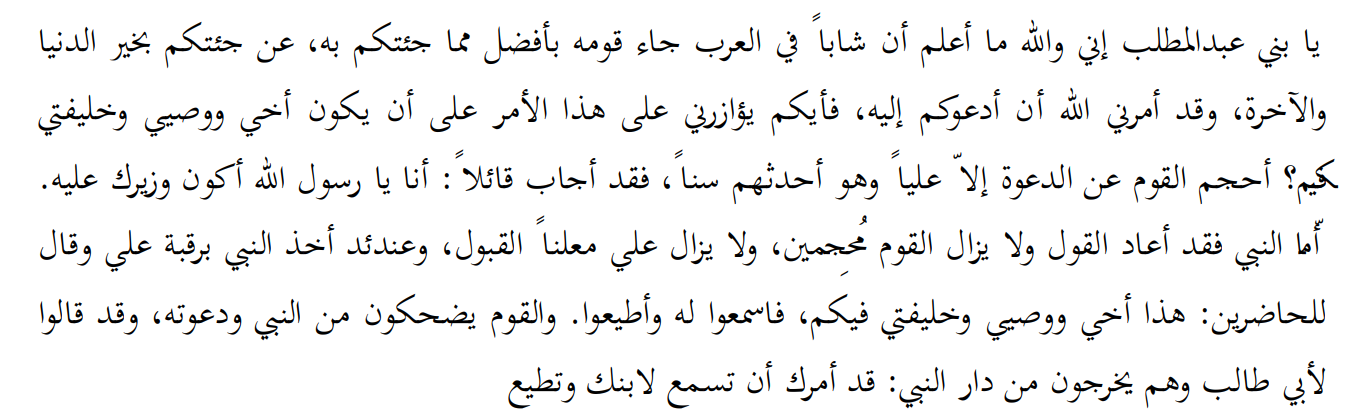
Ó Banu Abd al-Muttalib, por Allah, não conheço nenhum jovem entre os árabes que tenha vindo ao seu povo com algo melhor do que aquilo com que eu vim a vocês. Na verdade, eu vim a vocês com o bem deste mundo e da Vida Futura. Allah me ordenou que os chamasse a Ele; então, quem de vocês me ajudará nesta questão, para que se torne meu irmão, herdeiro e meu Khalifah entre vocês? As pessoas se afastaram do da'wa, exceto Ali, o mais novo entre eles, que respondeu dizendo: Eu, ó Mensageiro de Allah, serei seu auxiliar nesta questão. O Mensageiro repetiu sua declaração e as pessoas permaneceram afastadas, enquanto Ali continuava anunciando sua aceitação. Então o Mensageiro ﷺ segurou o pescoço de Ali e disse aos presentes: Este é meu irmão, herdeiro e meu Khalifah entre vocês; escutem-no e obedeçam-no. As pessoas riram do Profeta ﷺ e de seu convite, e disseram a Abu Talib, ao saírem da casa do Mensageiro ﷺ: "Ele lhe ordenou que ouvisse seu filho e lhe obedecesse."
O Banu Abd al-Muttalib, by Allah I do not know any youth among the Arabs who has come to his people with a thing better than what I have come to you with. Verily I have come to you with the good of this world and the Hereafter. Allah has commanded me to call you to Him, so which one of you will assist me in this matter so that he may become my brother, inheritor and my Khalifah among you? The people kept away from the da’wa except Ali, the youngest among them, who responded saying: I, O Messenger of Allah, will be your assistant upon this matter. The Messenger repeated his statement and the people remained away while Ali continued announcing his acceptance. So the Messenger took the neck of Ali and said to those present: This is my brother, inheritor and my Khalifah among you so listen to him and obey. The people laughed at the Prophet and his invitation, and said to Abu Talib while leaving the Messenger’s house: ‘He has commanded you to listen to your son and obey him.’”
Este é o resumo do hadith da casa, conforme narrado por aqueles que dependem dele como evidência.
This is the summary of the hadith of the house as narrated by those who depend upon it as evidence.
Al-Bukhari narrou o episódio do dia em que
Al-Bukhari narrated the incident of the day when
"E adverte os teus parentes mais próximos" [TMQ 26:214]
“And warn your nearest kinsfolk” [TMQ 26:214]
Foi revelado (dizendo) que o Mensageiro (saw) subiu ao (Monte) Safa, sem mencionar a preparação de comida. Ahmad bin Hanbal narrou em seu Musnad dois hadiths: um sobre a preparação de comida sem mencionar que foi no dia em que "E adverte os teus parentes mais próximos" foi revelado, e outro mencionando que a preparação de comida foi no dia em que o versículo foi revelado. Mostraremos primeiro esses textos e depois explicaremos o que eles contêm.
Was revealed (saying) that the Messenger (saw) stood upon (Mount) Safa, without mentioning the preparation of food. Ahmad bin Hanbal narrated in his Musnad two hadiths, one about the preparation of food without mentioning it was the day in which “And warn your nearest kinsfolk” was revealed and another mentioning that the preparation of food was on the day the ayah was revealed. We will show these texts first then explain what they contain.
Al-Bukhari narrou de Ibn ‘Abbas (ra), que disse: Quando
Al-Bukhari narrated from Ibn ‘Abbas (ra) who said: When
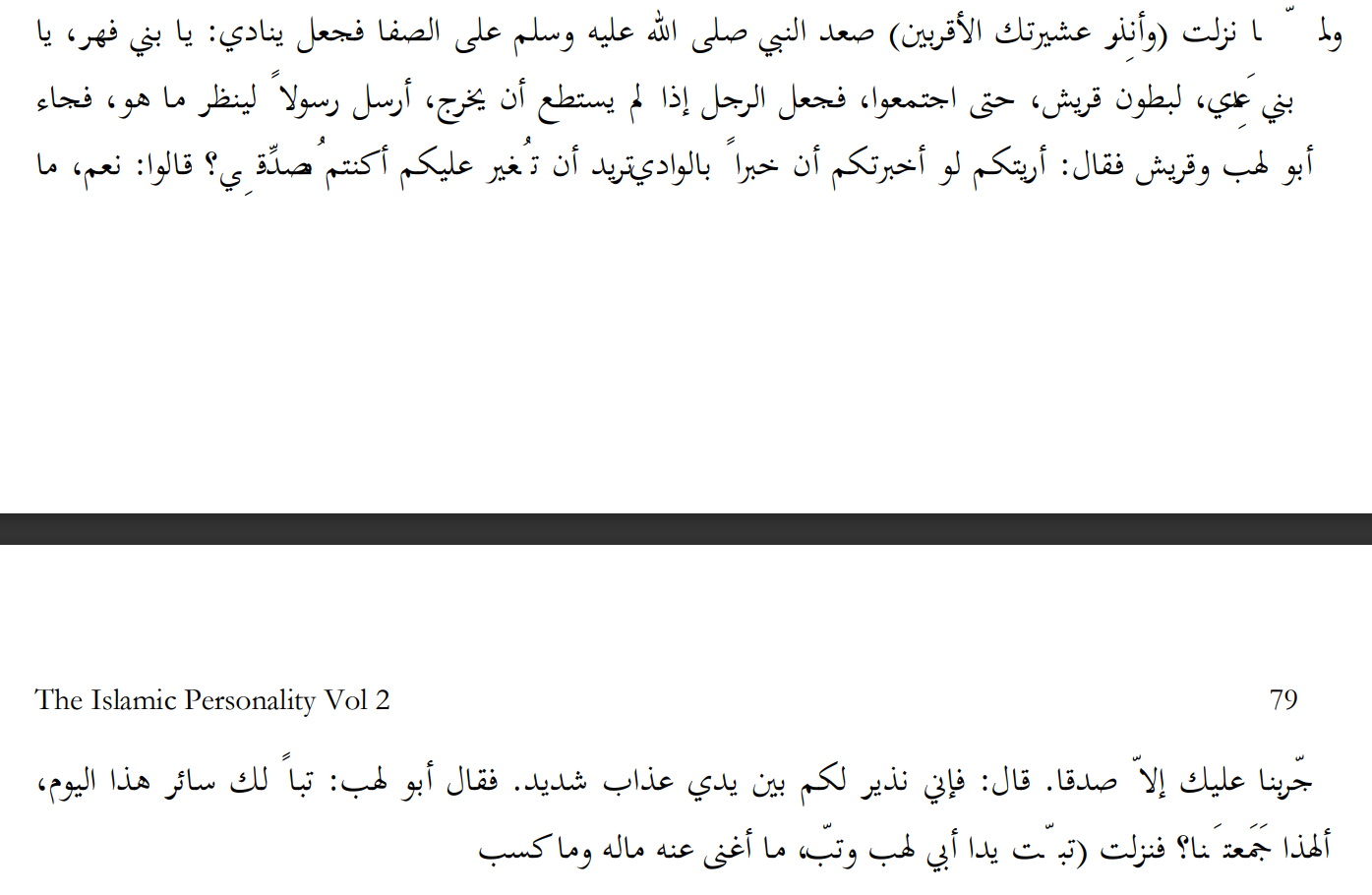
"E quando foi revelado: {E adverte os teus parentes mais próximos}, o Mensageiro subiu ao Safa e começou a proclamar: Ó Banu Fihr, ó Banu Adiyy, a todos os clãs (butun) de Quraysh, até que se reuniram. Quem não pôde ir enviou um mensageiro para ver o que estava acontecendo. Abu Lahab e Quraysh vieram, e ele disse: ‘Se eu lhes dissesse que há cavaleiros (homens) no vale com a intenção de atacá-los de surpresa, vocês acreditariam em mim?’ Disseram: Sim, nunca te testamos em nada além de te ouvir dizer a verdade. Ele disse: Em verdade, sou um admoestador para vocês antes de um castigo severo! Abu Lahab disse: Que a ruína caia sobre você pelo resto do dia. Foi por isso que nos reuniu? Então foi revelado: {Que pereçam as duas mãos de Abu Lahab, e que ele pereça! De nada lhe valerão sua riqueza e o que conquistou}. [TMQ 111:1-2]"
“And when And warn your nearest kinsfolk was revealed, the Messenger stood upon Safa and started announcing: O Banu Fihr, O Banu Adiyy for all the (butun) of Quraysh until they gathered together. Whoever was unable to go had sent a messenger to see what was happening. Abu Lahab and Quraysh came and he said: ‘If I told you there were horses (men) in the valley intending to attack you suddenly, would you believe me?’ They said: Yes, we have not tried you in anything except to find you saying the truth. He said: Verily, I am a warner to you before a severe punishment! Abu Lahab said: Woe be upon you for the rest of the day. Is it because of this that you gathered us? So “Perish the two hands of Abû Lahab (an uncle of the Prophet [sal-Allâhu 'alayhi wa sallam]) and perish he!, His wealth and his children will not benefit him!” [TMQ 111:1-2] was revealed”
Isto indica que o episódio da preparação da comida não ocorreu no dia em que foi revelado "E adverte os teus parentes mais próximos", pois não corresponde ao que se relata no texto do hadith. Ahmad bin Hanbal disse em seu Musnad: 'Affan nos relatou, dizendo: Abu Awana nos relatou, dizendo: De Uthman bin al-Mughira, de Abu Sadiq, de Rabi'a bin Najidh, de Ali (ra), que disse: O Mensageiro de Allah ﷺ reuniu ou convocou os Banu Abd al-Muttalib, em todos os seus grupos, para comer e beber. Preparou para eles uma quantidade de comida, da qual comeram até ficarem satisfeitos. Ele disse: A comida permaneceu como se não tivesse sido tocada. Então, mandou trazer uma bebida de açafrão, da qual beberam até ficarem saciados, e a bebida permaneceu como se não tivesse sido tocada. Então ele ﷺ disse:
This indicates that the incident of the preparation of food was not on the day in which “And warn your nearest kinsfolk” was revealed as it does not concur with what occurred in the hadith’s text. Ahmad bin Hanbal said in his Musnad: ‘Affan related to us that Abu Awana related to us from Uthman bin al-Mughira from Abu Sadiq from Rabi’a bin Najidh from Ali (ra) who said: The Messenger of Allah (saw) gathered or called Banu Abd al-Muttalib in all their groups to eat and drink. He prepared for them a quantity of food which they ate until they were satisfied. He said: The food remained as if it had not been touched. Then he called for a saffron drink which they drank until they will full, and the drink remained as if it had not been touched. Then he (saw) said:

"Ó Banu Abd al-Muttalib, fui enviado especificamente a vocês e à humanidade em geral. Vocês já viram deste sinal (ayah) o que viram; então, qual de vocês me dará um juramento de lealdade para se tornar meu irmão e companheiro?" Ele disse: Nenhum deles se levantou, então eu me levantei por ele, embora eu fosse o mais jovem do grupo, e ele disse: Sente-se. Ele repetiu isso três vezes, após o que me levantei por ele, e ele disse: "Sente-se", até a terceira vez, quando bateu na minha mão com a mão dele.
“O Banu Abd al-Muttalib, I have been sent specifically to you and to humanity in general. You have now seen of this sign (ayah) what you saw, so which one of you will give me a pledge in order to become my brother and companion?’ He said: None of them stood, so I stood for him though I was the youngest of the group and he said: Sit down. He repeated it three times following which I stood for him and he said ‘Sit down’, until the third time he struck my hand with his hand.”
Isso esclarece que não há, neste episódio, nenhum momento da revelação de "E adverte os teus parentes mais próximos", e que o Mensageiro de Allah ﷺ lhes ofereceu o Islam, para que quem se tornasse muçulmano se tornasse seu irmão e companheiro, e que ele não disse nada a Ali (ra).
This clarifies that there is no moment in this incident of the revelation of “And warn your nearest kinsfolk”, and that the Messenger (saw) offered Islam to them so that whoever became a Muslim would become his brother and companion and that he did not say anything to Ali (ra).
Quanto à segunda narração, Ahmad bin Hanbal relatou em seu Musnad: "Al-Aswad bin Amir nos relatou, Shareek nos relatou, de Al-'Amash, de Al-Minhal, de 'Ibad bin Abdullah al-Asadi, de Ali, que disse: Quando foi revelado o versículo "E adverte os teus parentes mais próximos", o Mensageiro de Allah ﷺ reuniu a família de sua casa. Trinta pessoas se reuniram; comeram e beberam, e então ele ﷺ lhes disse:
As for the second narration, Ahmad bin Hanbal narrated in his Musnad: “Aswad bin Amir related to us that Shareek related to us from Al-‘Amash from Al-Minhal from ‘Ibad bin Abdullah al Asadi from Ali who said: When the ayah “And warn your nearest kinsfolk” was revealed, the Messenger (saw) gathered the family of his house. Thirty people gathered; they ate and drank then he (saw) said to them:
"Quem garantirá minhas dívidas e promessas, para estar comigo no Paraíso, e será meu Khalifah sobre minha família?" Um homem, a quem Shareek não nomeou, disse: "Ó Mensageiro de Allah ﷺ, você era um oceano (bahr), então quem poderia cuidar disso?" Então outro disse (o mesmo?). Ele ofereceu isso à família de sua casa, e Ali (RA) disse: "Eu (garantirei)."
"Which one will guarantee my debts and promises so as to be with me in Paradise, and he will be my Khalifah over my family? A man, whom Shareek did not name, said: O Messenger of Allah, you were an ocean (bahr) so who could take care of this? Then another said (the same?). He offered that to the family of his house, so Ali (RA) said: I (will).”
A palavra "herdeiro" ou "Khalifah" não aparece de forma alguma nesses dois textos. O que aparece é apenas a palavra "Khalifah", restrita à sua família, e o Khilafah sobre a família não é o Khilafah no cargo de governo ou liderança, nem tem qualquer relação com ele. Estes são os textos que vieram nos livros Sahih, e vieram em numerosas narrações com wordings semelhantes e significados unificados, e não apareceu em nenhuma delas as palavras "herdeiro" ou "Khilafah". Nunca apareceu, seja por meio de qualquer um dos compiladores dos Sahih (livros de ahadith) ou de qualquer um dos narradores confiáveis, em nem um único hadith, a palavra ou as palavras "herdeiro" ou "Khalifah" de forma alguma, seja em relação a Ali ou a qualquer outra pessoa; portanto, a evidência cai pela ausência de qualquer prova para ela nos livros Sahih.
The word inheritor or Khalifah does not appear in these two texts in any way at all. Rather it is only the word Khalifah which appears restricted to his family, and the Khilafah over the family is not the Khilafah in the post of rule or leadership nor does it have any relationship with that. These are the texts which came in the Saheeh books, and they came in numerous narrations with similar wordings and unified meanings, and there did not appear in any of them the words inheritor or Khilafah. There has never appeared, either via any of the compilers of the Saheeh (books of ahadith) or any of the trustworthy narrators, in even one hadith the word(s) inheritor of Khalifah in any way at all either in relation to Ali or anyone else, so the evidence falls due to the absence of any evidence for it in the Saheeh books.
Quanto ao texto narrado por aqueles que disputam sobre a designação de Ali, a que chamaram o hadith da casa, este texto, com esta narração (riwayah), é rejeitado quanto ao seu sentido (dirayah). Um hadith é rejeitado na sua dirayah com base no seu significado, e na sua riwayah com base na sua cadeia de transmissão. Assim, se ele é rejeitado na sua cadeia ou no seu significado, não pode ser considerado e cai como prova. Quanto à rejeição do seu significado, isto se deve a muitas razões, entre elas:
As for the text narrated by those who contend about the appointment of Ali which they named the hadith of the house, this text with this narration (riwayah) is rejected in its meaning (Dirayah).A hadith is rejected in its dirayah based on its meaning, and its narration based on its chain. So if it is rejected in its chain or meaning then it cannot be considered and it falls as evidence. As for rejecting its meaning, this is due to many reasons including:
Primeiro: Nesse hadith parece que o Mensageiro (saw) buscou a ajuda da família de Abd al-Muttalib em sua da’wa sob a condição de que o governo se tornasse deles depois dele. Isso é inválido por dois aspectos: primeiro, isso contradiz a declaração e a ação do Mensageiro no episódio em que ele recusou o pedido da tribo de que o governo se tornasse deles depois dele caso se tornassem muçulmanos, ao que ele respondeu
"A autoridade é uma questão que pertence a Allah, e Ele (SWT) a colocará onde Lhe aprouver."
“Authority is a matter which belongs to Allah, and He (swt) will place it where He wishes.”
Ibn Hisham narrou em seu livro da Sirah do Profeta ﷺ: Ibn Ishaq disse que Az-Zuhri narrou que ele encontrou os Banu Amr bin Sa'sa'ah e os convidou para Allah ‘azza wa jalla e se ofereceu a eles. Um homem entre eles, a quem chamavam de Bayjirat bin Furra, disse-lhe: Por Allah, se eu tomasse este jovem dos Quraysh, eu comeria (ou seja, conquistaria) os árabes por meio dele. Então disse: E se nós nos comprometêssemos a apoiar o seu assunto, e então Allah lhe concedesse a vitória sobre os que se opõem a você, o governo ficaria conosco depois de você? Ele disse: “O governo pertence a Allah, e Ele o coloca onde quiser.” Então ele lhe disse: Vamos sacrificar nossas gargantas por você, e depois, quando Allah (swt) lhe conceder a vitória, o governo passará para outra pessoa? Então não temos necessidade do seu assunto, e eles o rejeitaram. Como pode o Mensageiro ﷺ dizer: “O assunto pertence a Allah, e Ele o colocará onde quiser”, isto é, o assunto do Califado e do governo depois dele, e ainda assim dizer aos Banu Abd al-Muttalib:
Ibn Hisham narrated in his book of the Sirah of the Prophet (saw): Ibn Ishaq said that Az-Zuhri narrated that he met Banu Amr bin Sa’sa’ah so he invited them to Allah ‘azza wa jalla and offered himself to them. One man among them, whom they called Bayjirat bin Furra, said to him: By Allah, if I were to take this youth from the Quraysh, I will eat (i.e. conquer) the Arabs through him. Then he said: What if we were to pledge to support your matter then Allah will grant you victory over those who oppose you. Will the rule be with us after you? He said: “The rule is for Allah and He places it where He wills.” He said: So he said to him: Will we sacrifice our throats for you, then when Allah (swt) grants you victory the rule becomes for someone else? Then we have no need of your matter, and they rejected him.” How can the Messenger (saw) say: “The matter belongs to Allah and He will place it where He wills” i.e. the matter of the Khilafah and the rule after him, yet he says to Banu Abd al-Muttalib:
"Quem de vós me auxiliará nesta questão, para que se torne meu irmão, herdeiro e califa entre vós?"
“Which one of you will assist me upon this matter so that he may become my brother, inheritor and Khalifah among you?”
Não é isto uma contradição clara? Inevitavelmente, é necessário que uma destas duas afirmações seja rejeitada. Uma vez que se diz do hadith da casa que ocorreu quando
Is this not a clear contradiction? Inevitably, it is necessary that one of these two statements be rejected. Since it is said of the hadith of the house that it occurred when
"Advirta os seus parentes mais próximos" [TMQ 26:214]
“Warn your nearest kinsfolk” [TMQ 26:214]
Foi revelado, ou seja, no terceiro ano da missão do Mensageiro ﷺ, e o hadith:
Was revealed i.e. the third year of the messenger ship and the hadith:
"O assunto pertence a Allah, e Ele o coloca onde quer."
“The matter belongs to Allah and He places it where He wills”
Quando o Mensageiro (saw) se ofereceu às tribos, ou seja, no décimo ano após a missão, e portanto depois do hadith da casa, então é o hadith da casa que é rejeitado. Quanto ao segundo aspecto, é que o Mensageiro (saw) neste hadith ofereceu algo aos descrentes para que se tornassem muçulmanos; na verdade, ofereceu-lhes a maior coisa, que é o Khilafah depois dele sobre todos os muçulmanos, como preço para que entrassem no Islam. Isso contradiz a ação do Mensageiro em sua da'wa e as normas da Shari'ah. O Mensageiro convidava as pessoas ao Islam porque ele é a religião correta, e nunca foi narrado dele, nem mesmo através de um hadith fraco, que tenha oferecido qualquer coisa, pequena ou grande, a um kafir em troca de sua entrada no Islam. Quanto àqueles cujos corações devem ser conquistados, são muçulmanos a quem se dá do zakat para fortalecer o Estado por meio deles, e não kuffar a quem se dá para que entrem no Islam. Tampouco é permitido dar algo aos kuffar em troca de sua entrada no Islã.
when the Messenger (saw) offered himself to the tribes i.e. in the tenth year after the messenger ship and therefore after the hadith of the house; so it is the hadith of the house which is rejected. As for the second side, it is that the Messenger (saw) in this hadith offered something to the disbelievers so that they may become Muslims, rather he offered them the greatest thing which is the Khilafah after him over all Muslims as the price for their entering into Islam. This contradicts the Messenger’s action in his da’wa and the Shari’ah rules. The Messenger would invite people to Islam because it is the correct deen and it has never been narrated from him, even through a weak hadith that he offered anything whether small or large to a kafir in exchange for his entering into Islam. As for those whose hearts are to be reconciled, they are Muslims who are given from the zakat in order to strengthen the State through them, not kuffar who are given so that they enter Islam. Nor is it allowed to give something to kuffar in exchange for their entering Islam.
Em segundo lugar: O hadith menciona que o Mensageiro de Allah ﷺ preparou um banquete de casamento e uma refeição para os kuffar a fim de convidá-los ao Islam, e os reuniu em torno de uma refeição para que entrassem no Islam, e não preparou comida para Ali (ra), que já havia aceitado o Islam. Portanto, se essas pessoas rejeitam o Islam e rejeitam que o governo passe a ser delas depois dele em troca do Islam, não há lugar ali para Ali (ra) dar a sua aceitação, pois ele não está sendo convidado ao Islam, já que é muçulmano, e não há nenhuma fala dirigida a ele. Por isso, não há lugar, nessa reunião, para que lhe diga:
Secondly: The hadith mentions that the Messenger (saw) prepared a wedding feast and meal for kuffar in order to invite them to Islam, and he gathered them around a meal so that they may enter Islam and he did not prepare food for Ali (ra) who had already accepted Islam. So if these people reject Islam and reject that the rule becomes theirs after him in exchange for Islam, there is no place there for Ali (ra) for giving his acceptance as he is not being invited to Islam because he is already a Muslim, and there is no speech addressed to him. This is why there is no place in this gathering such that he says to him:
"Este é meu irmão, meu herdeiro e meu Califa entre vocês, portanto, ouçam-no e obedeçam-lhe."
“This is my brother, inheritor and my Khalifah among you so listen to him and obey”
Visto que ele não é o alvo do discurso ou da negociação. Em terceiro lugar: o hadith menciona que o grupo rejeitou o Islã e, apesar de ele repetir sua oferta, eles persistiram em rejeitar o Islã e em rejeitar que o governo passasse a ser deles após ele, em troca de entrarem no Islã. Permaneceram incrédulos (kuffar), então como poderia o Mensageiro de Allah ﷺ dizer a eles, ao dirigir-se a eles:
Since he is not the target of the address or the negotiation. Thirdly: The hadith mentions that the group rejected Islam, and despite him repeating his offer they persisted in rejecting Islam and rejecting that the rule becomes theirs after him in exchange for entering Islam. They remained kuffar so how could the Messenger (saw) say to them in addressing them:
"Este é o meu Khalifah entre vós"
“This is my Khalifah among you”
Ordenar-lhes que ouçam e obedeçam a ele enquanto ele sabe que são kuffar que rejeitaram o Islã? E como ele poderia ser o Khalifah entre eles enquanto são kuffar?
Commanding them with hearing and obeying him while he knows they are kuffar who have rejected Islam? And how could he be the Khalifah among them while they are kuffar?
Em quarto lugar: A narração que eles relatam diz:
Fourthly: The narration they narrate says:
"Este é meu irmão, meu herdeiro e meu Califa entre vocês, portanto, ouçam-no e obedeçam-lhe."
“This is my brother, inheritor and my Khalifah among you so listen to him and obey”
Isto é um discurso dirigido à família de Abd al-Muttalib, uma vez que as palavras começam com a sua afirmação: "Ó Banu Abd al-Muttalib." Portanto, ele é específico para eles, pois ele o designou como califa sobre eles, isto é, sobre a família de Abd al-Muttalib, e não como califa dos muçulmanos, já que ele disse: "e meu califa sobre vós." Assim, ele não é o califa dos muçulmanos, como o texto explícito demonstra. Nem se pode afirmar aqui que a lição deriva da generalidade do texto e não da especificidade da causa, pois este é um incidente específico, não uma causa (sabab). Além disso, não se deve esquecer que as palavras também são específicas, e não gerais: "Ó Banu Abd al-Muttalib" e "meu califa entre vós". Portanto, a especificação é exigida, uma vez que se trata de um incidente específico e não de uma causa, e também devido à ausência de palavras gerais.
This is an address to the family of Abd al-Muttalib since the words started with his saying “O Banu Abd al-Muttalib.” So it is specific to them as he made him a Khalifah over them i.e. over the family of Abd al-Muttalib not the Khalifah of the Muslims since he said, “and my Khalifah over you.” Thus he is not the Khalifah for the Muslims as is depicted by the explicit text. Nor can one say here that the lesson is by the generality of the text not the specificity of the cause since this is a specific incident not a cause (sabab) not mentioning that the words are also specific and not general: “O Banu Abd al-Muttalib”, “my Khalifah among you” so the specification is demanded due to this being a specific incident not a cause, and also due to the absence of general words.
Apenas um destes quatro pontos basta para revelar a falsidade deste hadith e a sua contradição, e é obrigatório rejeitar a sua narração (dirayah). Por isso fica esclarecido que o Mensageiro de Allah ﷺ não declarou explicitamente que Ali (ra) fosse o Khalifah depois dele. De tudo isto torna-se claro que os ahadith narrados por aqueles que defendem que o Mensageiro de Allah ﷺ designou uma pessoa para o Khilafah depois dele são ahadith rejeitados, impróprios para servir de prova, e por isso caem. Não resta qualquer evidência de que o Mensageiro de Allah ﷺ tenha designado alguém para estar à frente do Khilafah depois dele; pelo contrário, a evidência estabelecida vai em sentido oposto, ou seja, que o Mensageiro de Allah ﷺ deixou o assunto aos muçulmanos para escolherem quem quisessem para o cargo, mas especificou-lhes o método para nomear o Khalifah.
Just one of these four matters suffices to reveal the falsehood of this hadith and its contradiction, and it is obligatory to reject its narration (dirayah). Therefore it is clarified that the Messenger (saw) did not explicitly state making Ali (ra) the Khalifah after him. From all this it becomes clear that the ahadith narrated by those who argue that the Messenger (saw) designated a person for the Khilafah after him are rejected ahadith unsuitable to depend upon as evidence so they fall. There remains no evidence that the Messenger (saw) designated anyone to be in charge of the Khilafah after him; rather the evidence has been established contrary to that i.e. that the Messenger (saw) left the matter to the Muslims to choose whom they want in relation to the person but he specified for them the method for appointing the Khalifah.