17.8 O Método para Designar o Khalifah
17.8 The Method To Appoint The Khalifah
Quando a Shari'ah tornou obrigatório para a Ummah nomear um Khalifah, também definiu o método pelo qual o Khalifah é nomeado. Este método está comprovado pelo Alcorão, pela Sunnah e pelo Ijma' dos Sahabah (ra), e este método é a bay'ah. Assim, a nomeação do Khalifah é realizada pela bay'ah a ele. A prova de que este método é a bay'ah está confirmada pela bay'ah dos muçulmanos ao Profeta ﷺ e pela ordem do Profeta ﷺ para que dêmos bay'ah ao Imam. A bay'ah dos muçulmanos ao Profeta ﷺ não foi sobre a sua profecia; antes, foi sobre a governação, uma vez que era uma bay'ah sobre a ação e não uma bay'ah sobre a crença. Portanto, a bay'ah foi dada ao Profeta ﷺ na sua qualidade de governante e não na de Profeta e Mensageiro. Porque o reconhecimento da profecia e da mensagem é uma questão de crença e não de bay'ah, a bay'ah só poderia ter sido para ele na sua qualidade de chefe do Estado. A bay'ah foi mencionada no Alcorão e nos ahadith. Disse Allah (swt):
When the Shari’ah made it obligatory upon the Ummah to appoint a Khalifah, it also defined the method by which the Khalifah is appointed. This method is proven by the Qur’an, the Sunnah and the Ijma’a of the Sahabah (ra), and this method is the bay’ah. So the appointment of the Khalifah is carried out by the bay’ah to him. The Proof that this method is the bay’ah is confirmed from the bay’ah of the Muslims to the Prophet (saw) and from the order of the Prophet (saw) for us to give bay’ah to the Imam. The bay’ah of the Muslims to the Prophet (saw) was not on his Prophethood; rather it was on ruling, since it was a bay’ah over action and not a bay’ah on belief. So the Prophet (saw) was given the bay’ah in his capacity as a ruler and not as a Prophet and a Messenger. Because the acknowledgement of the Prophethood and the Message is a matter of belief and not a bay’ah, so the bay’ah could only have been for him in his capacity as the head of the State. The bay’ah was mentioned in the Qur’an and the ahadith. Allah (swt) said:
"Ó Profeta, se as crentes vierem a ti para fazer-te o bay'ah de que não associarão parceiros a Allah, não roubarão, não cometerão adultério, não matarão os seus filhos, não produzirão nenhuma mentira que tenham forjado entre as suas mãos e pés, nem te desobedecerão no que é correto, então aceita-lhes o bay'ah." [TMQ 60:12]
"O Prophet, if the believing women come to give you a bay’ah that they will not associate anything as partners to Allah, not to steal, not to commit adultery, not to kill their children, not to produce any lie that they have devised between their hands and feet, nor disobey you in what is right then give them the bay’ah" [TMQ 60:12]
Allah (SWT) também disse:
Allah (swt) also said:
Na verdade, aqueles que juram lealdade a você (Muhammad) estão, na realidade, jurando lealdade a Allah. A mão de Allah está acima das mãos deles.
"Lo! Those who give bay’ah to you (Muhammad) they give bay’ah only to Allah. The hand of Allah is above their hands"
Al-Bukhari relatou: Ismail nos transmitiu que Malik nos transmitiu, de Yahya bin Said, que disse: "Ubadah bin Waleed me informou que meu pai me informou, de 'Ubadah bin as-Samit (ra), que disse:
Al-Bukhari reported: Ismail related to us that Malik related to me from Yahya bin Said who said: “Ubadah bin Waleed informed me that my father informed me from ‘Ubadah bin as-Samit (ra) who said:
que ouviríamos e obedeceríamos a ele, tanto na época em que estávamos dispostos quanto na época em que estávamos cansados, e que não lutaríamos contra o governante nem o desobedeceríamos, e que permaneceríamos firmes pela verdade ou diríamos a verdade onde quer que estivéssemos, e que, no Caminho de Allah, não temeríamos a censura dos que censuram.
“that we would listen to and obey him both at the time when we were active and at the time when we were tired and that we would not fight against the ruler or disobey him, and would stand firm for the truth or say the truth wherever we might be, and in the Way of Allah we would not be afraid of the blame of the blamers.
Al-Bukhari relatou: Ali bin Abdullah nos contou que Abdullah bin Yazeed nos contou que Saeed (que é ibn al-Musayyib) disse: Abu 'Aqeel Zahrah bin Ma'bad narrou-me, a partir de seu avô 'Abdullah bin Hisham, que presenciou o Profeta ﷺ, que sua mãe Zaynab, filha de Hameed, o levou ao Mensageiro de Allah ﷺ e disse: "Ó Mensageiro de Allah, aceita o seu juramento de fidelidade." O Profeta ﷺ disse:
Al-Bukhari reported: Ali bin Abdullah related to us that Abdullah bin Yazeed related to us that Saeed (who is ibn al-Musayyib) who said: Abu ‘Aqeel Zahrah bin Ma’bad narrated to me from his grandfather ‘Abdullah bin Hisham who witnessed the Prophet (saw) that his mother Zaynab, daughter of Hameed, took him to the Messenger of Allah (saw) and said: “O Messenger of Allah, take his pledge. The Prophet (saw) said:
"Ele é uma criança, e esfregou (passou a mão sobre) a sua cabeça e fez du'a por ele."
“He is a child, and rubbed (wiped) his head and said du‘a for him.”
Al-Bukhari disse: 'Abdan bin Abu Hamza nos relatou, a partir de Al-'Amash, a partir de Abu Salih, a partir de Abu Hurairah (ra), que disse: O Mensageiro de Allah ﷺ disse:
Al-Bukhari said: ‘Abdan bin Abu Hamza related to us from Al-‘Amash from Abu Salih from Abu Hurairah (ra) who said: The Messenger of Allah (saw) said:

(Haverá três tipos de pessoas com quem Allah não falará no Dia da Ressurreição, nem as purificará dos pecados, e elas terão um castigo doloroso: são elas: (1) um homem que possui água excedente (mais do que precisa) numa estrada e a retém dos viajantes. (2) um homem que faz juramento de lealdade a um Imam (governante) e o faz apenas por interesses mundanos: se o Imam lhe dá o que ele quer, ele cumpre o seu juramento; caso contrário, não cumpre o seu compromisso; (3) e um homem que vende algo a outro homem depois da oração do `Asr e jura por Allah (um juramento falso) que lhe ofereceram tanto por aquilo, de modo que o comprador acredita nele e compra, embora, na verdade, o vendedor não tenha recebido tal oferta.)
“(There will be three types of people whom Allah will neither speak to them on the Day of Resurrection nor will purify them from sins, and they will have a painful punishment: They are, (1) a man possessed superfluous water (more than he needs) on a way and he withholds it from the travelers. (2) a man who gives a pledge of allegiance to an Imam (ruler) and gives it only for worldly benefits, if the Imam gives him what he wants, he abides by his pledge, otherwise he does not fulfill his pledge; (3) and a man who sells something to another man after the `Asr prayer and swears by Allah (a false oath) that he has been offered so much for it whereupon the buyer believes him and buys it although in fact, the seller has not been offered such a price..”
A partir desses três ahadith é explícito que a bay'ah é o método de nomeação do Khalifah. O hadith de 'Ubadah afirma que ele fez bay'ah ao Profeta ﷺ para ouvir e obedecer, e esta é uma bay'ah a um governante. O hadith de 'Abdullah bin Hisham afirma que o Profeta ﷺ rejeitou a sua bay'ah porque ele não era maduro, o que indica que se trata de uma bay'ah sobre o governo. Do hadith relatado por Abu Hurairah (ra) fica evidente que se trata de uma bay'ah ao Imam. A palavra 'Imam' no hadith está indefinida, ou seja, qualquer Imam. Há outros ahadith que se referem a dar bay'ah ao Imam. Relata-se em Muslim, através de 'Abdullah bin 'Amru, que o Profeta ﷺ disse:
From these three ahadith it is explicit that the bay’ah is the method of appointing the Khalifah. The hadith of ‘Ubadah states that he gave bay’ah to the Prophet (saw) to listen and obey and this is a bay’ah to a ruler. The hadith of ‘Abdullah bin Hisham states that the Prophet (saw) rejected his bay’ah because he was not mature which indicates that it is a bay’ah on ruling. From the hadith reported by Abu Hurairah (ra) it is evident that it is a bay’ah to the Imam. The word ‘Imam’ in the hadith is undefined i.e. any Imam. There are other ahadith which refer to giving bay’ah to the Imam. It is reported in Muslim via Abdullah bin ‘Amru that the Prophet (saw) said:
"Quem prestou bay'ah a um Imam, dando-lhe a sua mão e o fruto do seu coração, deve obedecê-lo na medida do que puder. Se outra pessoa vier disputar com ele, golpeie o pescoço deste último."
“Whoever gave bay’ah to an Imam giving him his handshake and the fruit of his heart should obey him as much as he can. If another person comes to dispute with him, strike the neck of the latter”.
Muslim narra de Abu Said al-Khudri, que disse: O Profeta ﷺ disse:
Also Muslim narrates from Abu Said al-Khudri who said: The Prophet (saw) said:
"Se um juramento de lealdade (bay'ah) for dado a dois califas, mate o último deles."
“If a bay’ah is given to two Khalifahs kill the latter of them.”
E Muslim narrou que Abu Hazim disse: "Acompanhei Abu Hurairah (ra) por cinco anos e ouvi-o narrar do Profeta ﷺ, que disse:
And Muslim narrated that Abu Hazim who said: “I accompanied Abu Hurairah (ra) for five years and heard him narrate from the Prophet (saw) who said:
"Os Profetas governavam os filhos de Israel. Sempre que um Profeta morria, outro Profeta o sucedia, mas não haverá Profeta depois de mim. Haverá Califas, e eles serão muitos." Perguntaram: "O que então nos ordenas?" Ele disse: "Cumpri o juramento de lealdade (bay'ah) a eles, um após o outro, e dai-lhes o que lhes é devido. Certamente Allah os interrogará sobre aquilo que Ele lhes confiou."
“The Prophets ruled over the children of Israel. Whenever a Prophet died another Prophet succeeded him, but there will be no Prophet after me. There will be Khulafaa and they will number many. They asked: What then do you order us? He said: Fulfill the bay’ah to them one after the other and give them their due. Surely Allah will ask them about what He entrusted them with.”
Assim, os textos do Alcorão e da Sunnah são claros: o método de designar o Khalifah é a bay'ah. Todos os Sahabah compreenderam isso e seguiram-no. Abu Bakr (ra) recebeu uma bay'ah especial no pátio de Banu Sa‘ida, e uma bay'ah pública na mesquita. Aqueles que não lhe deram a bay'ah na mesquita, e cuja bay'ah é considerada, deram-na mais tarde, como ‘Ali bin Abu Talib (ra). ‘Umar (ra) recebeu a bay'ah dos muçulmanos, ‘Uthman (ra) também recebeu a bay'ah dos muçulmanos, e ‘Ali (ra) recebeu a bay'ah dos muçulmanos igualmente. Portanto, a bay'ah é o único método para designar um Khalifah para os muçulmanos.
So the texts from the Qura'n and the Sunnah are clear that the method of appointing the Khalifah is the bay’ah. All the Sahabah understood this and followed it. So Abu Bakr (ra) was given a special bay’ah in the courtyard of Banu Sa‘ida, and a public bay’ah in the mosque, those who did not give him the bay’ah in the mosque and whose bay’ah is considered gave it later on like ‘Ali bin Abu Talib (ra). ‘Umar (ra) was given the bay’ah from the Muslims, ‘Uthman (ra) also was given the bay’ah by the Muslims and ‘Ali (ra) was given the bay’ah by the Muslims as well. So the bay’ah is the only method to appoint a Khalifah for the Muslims.
Quanto aos detalhes práticos para realizar a bay'ah, eles são evidentes na nomeação dos quatro Khulafaa que vieram imediatamente após a morte do Profeta ﷺ, que são Abu Bakr (ra), 'Umar (ra), 'Uthman (ra) e 'Ali (ra). E todos os Sahabah (ra) aceitaram isso e o confirmaram. Se fosse contrário à Shari'ah, eles certamente o teriam negado, porque isso está relacionado à coisa mais importante da qual dependem o bem-estar dos muçulmanos e a perpetuação do governo islâmico. Quem acompanhar o que aconteceu na nomeação desses Khulafaa constatará que alguns muçulmanos debateram no pátio de Banu Sa'ida; os indicados eram apenas Sa'd (ra), Abu 'Ubaydah (ra), 'Umar (ra) e Abu Bakr (ra), e, como resultado do debate, Abu Bakr (ra) recebeu a bay'ah. No dia seguinte, os muçulmanos foram chamados à mesquita e lhe deram sua bay'ah. Como resultado dessa bay'ah, Abu Bakr (ra) tornou-se Khalifah dos muçulmanos. Quando Abu Bakr (ra) sentiu que sua doença trazia consigo a morte, convocou os muçulmanos para consultá-los sobre quem poderia tornar-se o próximo Khalifah. A opinião nessas consultas concentrou-se apenas em 'Ali (ra) e 'Umar (ra). Ele continuou essas consultas por três meses. Quando as concluiu e soube a opinião da maioria dos muçulmanos, anunciou-lhes que 'Umar (ra) seria o Khalifah depois dele. Imediatamente após sua morte, os muçulmanos foram à mesquita e deram a bay'ah de Khilafah a 'Umar (ra), de modo que ele se tornou Khalifah por essa bay'ah dos muçulmanos, e não pelas consultas nem pelo anúncio de Abu Bakr (ra). Quando 'Umar (ra) foi esfaqueado, os muçulmanos pediram-lhe que nomeasse um sucessor, mas ele recusou. Eles insistiram, então ele deixou a escolha entre seis dos Sahabah (ra). Depois de sua morte, os indicados escolheram um deles, 'Abdurrahman bin 'Auf (ra), como representante. Ele consultou a opinião dos muçulmanos e os ouviu. Então declarou a bay'ah a 'Uthman (ra). Os muçulmanos levantaram-se e deram o seu bay'ah a 'Uthman (ra), e assim ele tornou-se o Khalifah pelo juramento de lealdade dos muçulmanos e não pelo anúncio de 'Abdurrahman (ra). Mais tarde, 'Uthman (ra) foi morto, e a maioria dos muçulmanos de Madinah e de Kufa deu o seu bay'ah a 'Ali bin Abu Talib (ra), e assim ele também tornou-se o Khalifah pelo bay'ah dos muçulmanos.
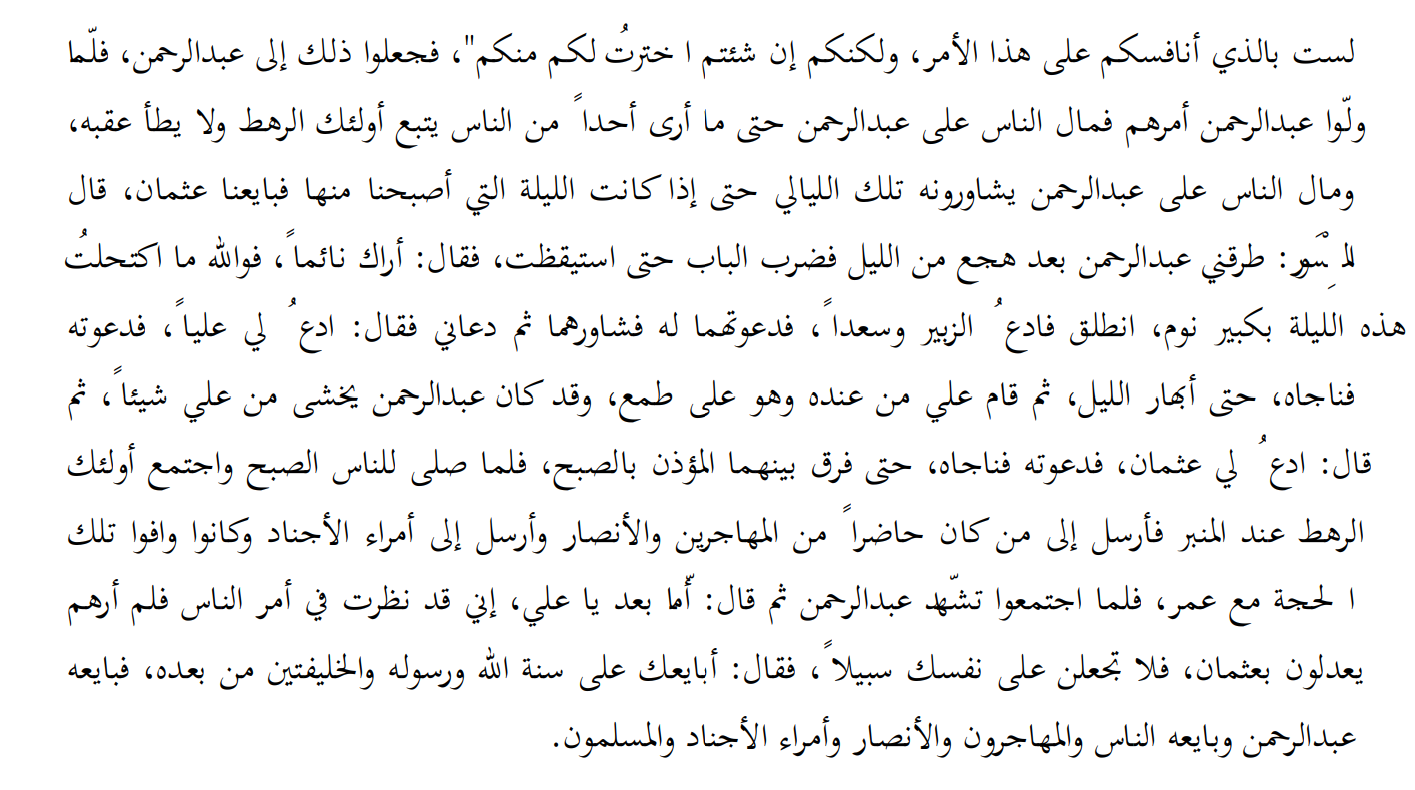
“Eu não sou alguém que disputa convosco este assunto, mas, se desejardes, posso escolher para vós um dentre vós mesmos.” Assim, eles designaram esta tarefa a ‘Abdurrahman. Quando ‘Abdurrahman assumiu esta questão, as pessoas voltaram-se para ele a tal ponto que não vi ninguém seguir aquele grupo ou ficar atrás deles. As pessoas recorriam a ‘Abdurrahman, consultando-o naquelas noites, até à noite em que acordámos pela manhã e demos o nosso juramento de lealdade (bay‘ah) a ‘Uthman. Al-Miswar disse: ‘Abdurrahman bateu à minha porta depois de já ter passado uma parte da noite, até que eu acordei. Ele disse: “Vejo que estás a dormir. Por Allah, os meus olhos não encontraram muito sono esta noite. Levanta-te e chama Az-Zubair e Sa‘d.” Convoquei-os para junto dele, e ele consultou-os. Depois chamou-me e disse: “Chama ‘Ali para mim.” Chamei-o, e ele manteve uma conversa em voz baixa com ele até a noite se desvanecer. Então ‘Ali saiu dali com algumas expectativas, e ‘Abdurrahman estava receoso de algo relativo a ‘Ali. Em seguida, disse: “Chama ‘Uthman para mim.” Chamei-o, e ele manteve uma conversa em voz baixa com ele até que se separaram quando o muezzin chamou para a oração da alvorada (fajr). Depois de dirigir a oração da alvorada às pessoas, e quando o grupo de seis pessoas se reuniu junto ao minbar (púlpito), mandou chamar todos os Muhajirun e Ansar presentes (em Madinah) e mandou chamar os comandantes do exército que haviam realizado a peregrinação naquele ano com ‘Umar. Quando se reuniram, ‘Abdurrahman recitou as duas testemunhas de fé (shahadah) e disse: “Ó ‘Ali! Considerei a questão do povo e não vi ninguém igualar-se a ‘Uthman; portanto, não permitas que nada te perturbe.” E disse a ‘Uthman: “Dou-te o bay‘ah segundo o caminho de Allah, do Seu Mensageiro e dos dois Califas que vieram depois dele.” Então ‘Abdurrahman, os Muhajirun, os Ansar, os comandantes do exército e o restante dos muçulmanos deram-lhe o bay‘ah.
“I am not one who competes with you for this matter but if you wish I could choose for you one from among you. So they assigned this to ‘Abdurrahman . When they charged ‘Abdurrahman with this matter, people turned to him to the extent that I did not see any one who followed this group or stepped behind them. The people turned to ‘Abdurrahman consulting him in those nights until the night of which we woke up in the morning and gave our pledge to ‘Uthman. Al-Miswar said: ‘Abdurrahman knocked at my door, after a part of the night had passed, until I woke up. He said: I see you sleeping. By Allah, my eyes did not find much sleep tonight. Set forth and call Az-Zubair and Sa‘d. I invited them to him. He consulted with them. Then he called me and said: Call ‘Ali for me, so I called him. He carried on a whispered conversation with him until the night faded away. Then ‘Ali left him with some expectations, and ‘Abdurrahman was afraid about something from ‘Ali. Then he said call ‘Uthman for me, so I called him. He carried on whispered conversation with him until they departed as the muezzin called for fajr prayer. After he led the people in the fajr prayer, and the group of six persons met near the minbar (pulpit), he sent for all the Muhajirs and Ansar who were present (in Madinah) and sent for the leaders of the army who delivered the pilgrimage that year with ‘Umar. When they met, ‘Abdurrahman recited the two testimonies of faith (shahadahs) and said: O ‘Ali! I viewed the matter of the people and did not see them equalling anyone to ‘Uthman, so do not let anything disturb yourself. And he said (to ‘Uthman): I give you the bay’ah upon the way of Allah, His Messenger and the two Khulafaa who came after him. So ‘Abdurrahman, the Muhajirs, the Ansar, the leaders of the army and rest of the Muslims gave him the bay’ah.”
Assim, os candidatos à Khilafah foram limitados ao grupo nomeado por ‘Umar (ra), depois que os muçulmanos lhe pediram que o fizesse. ‘Abdurrahman bin ‘Auf (ra), depois de retirar-se da candidatura à Khilafah, consultou a opinião dos muçulmanos sobre quem seria o Khalifah. Em seguida, anunciou o nome da pessoa que os muçulmanos desejavam, após consultá-los. Depois que anunciou o nome da pessoa que o povo queria, deu-se a bay’ah a ela, e ela se tornou Khalifah por meio dessa bay’ah. Portanto, o hukm shar’i a respeito da nomeação do Khalifah é limitar os candidatos à Khilafah àqueles que representam a opinião da maioria dos muçulmanos. Depois, seus nomes são apresentados aos muçulmanos, e pede-se que escolham um dos candidatos para ser Khalifah de todos. Então se determina quem a maioria dos muçulmanos escolheu, e a bay’ah de todos os muçulmanos é tomada para ele, quer cada pessoa o tenha escolhido especificamente, quer não. Este é o método por causa do Ijma’ dos Sahabah sobre ‘Umar (ra) ter limitado os candidatos à Khilafah a seis pessoas específicas, e pelo consenso dos Sahabah de que ‘Abdurrahman (ra) consulta a opinião de todos os muçulmanos sobre quem será o Khalifah para eles, e o consenso de dar a bay’ah àquele que ‘Abdurrahman (ra) anunciou como a pessoa eleita pelos muçulmanos como Khalifah é claro quando ele disse:
So the nominees for the Khilafah were limited to the group named by ‘Umar (ra) after the Muslims had asked him to do so. ‘Abdurrahman bin ‘Auf (ra), after he withdrew himself from the nomination to the Khilafah, took the opinion of the Muslims about who would be the Khalifah. He then announced the name of the person who the Muslims wanted after consulting with them. After he announced the name of the person who the people wanted, the bay’ah was given to him and he became the Khalifah by this bay’ah. Therefore the hukm shari’ concerning the appointment of the Khalifah is to limit the nominees for the Khilafah by those who represent the opinion of the majority of Muslims. Then their names are displayed to the Muslims and they are asked to select one of the nominees to be Khalifah for all. Then it is determined whom the majority of the Muslims have chosen, and the bay’ah from all the Muslims is taken for him, whether each person had specifically chosen him or not. This is the method because of the Ijma’a of the Sahabah about ‘Umar (ra) limiting the nominees for the Khilafah to six specific persons, and the consensus of the Sahabah that ‘Abdurrahman (ra) takes the opinion of all the Muslims about who will be the Khalifah for them, and the consensus to give the bay’ah to the one who ‘Abdurrahman (ra) announced as the person elected by Muslims as a Khalifah is clear when he said:
“Eu observei as tendências das pessoas e percebi que elas não consideram ninguém igual a ʿUthmān.”
“I have looked at the people's tendencies and noticed that they do not consider anybody equal to `Uthman.”
Todos esses pontos esclarecem o ḥukm sharʿī referente à nomeação do Khalīfah.
All of these points clarify the hukm shari’ concerning the appointment of the Khalifah.
Restam duas questões a serem examinadas. Uma delas é: quem são os muçulmanos que nomeiam o Khalifah? São as pessoas influentes ou um determinado número específico de muçulmanos? Ou todos os muçulmanos nomeiam o Khalifah? A segunda questão diz respeito às práticas que ocorrem neste século em eleições, como o voto secreto, as urnas e a contagem dos votos. Estas questões são compatíveis com o Islam e o Islam as permite ou não?
Two issues remain to be examined. One of them is who are the Muslims who appoint the Khalifah? Are they the influential people or a certain specific number of Muslims? Or do all of the Muslims appoint the Khalifah? The second issue concerns the actions occurring in this century in elections such as secret ballots, polling boxes and counting votes. Are these matters consistent with Islam and does Islam allows them or not?
Quanto à primeira questão, Allah (swt) concedeu a autoridade à Ummah e tornou a nomeação do Khalifah um direito e um dever de todos os muçulmanos; e Ele não a tornou um direito de um grupo particular com exclusão de outro, nem de uma jama‘ah deixando outra jama‘ah de lado, visto que a bay’ah é um dever sobre todos os muçulmanos. O Profeta ﷺ disse:
As for the first issue, Allah (swt), has given the authority to the Ummah and he (swt) made the appointment of the Khalifah a right and duty for all Muslims; and He did not make it a right for one particular group excluding another, nor for a jama‘ah leaving another jama‘ah aside, since the bay’ah is a duty upon all the Muslims. The Prophet (saw) said:
“Quem morrer sem ter um juramento de lealdade (bay'ah) sobre o pescoço morrerá a morte da jahiliyyah”,
“Whoever dies without having a pledge upon his neck would die the death of jahiliyyah”,
E isso é geral para todo muçulmano. Portanto, as pessoas influentes não possuem o direito exclusivo de nomear o Khalifah e não podem ignorar o restante dos muçulmanos. Tampouco pessoas específicas possuem o direito exclusivo. Pelo contrário, esse direito pertence a todos os muçulmanos, sem exceção; inclui até os fajirs (pessoas perversas) e os munafiqeen (hipócritas), desde que sejam muçulmanos maduros, pois o texto da Shari'ah veio de forma geral neste caso e nada veio para limitá-lo (torná-lo específico a certas pessoas), exceto a recusa do juramento de lealdade por parte dos jovens que ainda não alcançaram a idade da puberdade. Portanto, o texto deve ser entendido em seu sentido geral.
And this is general for every Muslim. Therefore, the influential people do not possess the exclusive right to appoint the Khalifah and cannot ignore the rest of the Muslims. Nor do specific persons have the exclusive right. Rather, this right is for all the Muslims with no exception, it even includes the fajirs (wicked people) and munafiqeen (hypocrites), provided they are mature Muslims because the Shari’ah text came in a general form in this instance and nothing came to limit it (make it specific to certain people) except the refusal of the pledge from the young who have not yet reached the age of puberty. So the text has to be taken generally.
No entanto, não é condição que todos os muçulmanos pratiquem este direito. Embora seja um dever, porque a bay'ah é fard, trata-se de fard kifayah (obrigação coletiva ou de suficiência) e não de fard ain (obrigação individual). Assim, se alguns dos muçulmanos a cumprirem, o dever cai sobre os demais. Mas todos os muçulmanos devem ser capacitados a exercer o seu direito de eleger o Khalifah, quer usem ou não esse direito. Em outras palavras, todo muçulmano deve poder participar na escolha do Khalifah. Assim, a questão é capacitar os muçulmanos a cumprir o dever de estabelecer o Khalifah que Allah (SWT) lhes prescreveu, de tal forma que esse dever seja desincumbido por eles. A questão não é a participação real de todos os muçulmanos na execução deste dever. Isto porque o dever que Allah (SWT) prescreveu é estabelecer o Khalifah para os muçulmanos por seu consentimento, e não é exigido que todos os muçulmanos o realizem. Disto decorrem duas questões: uma delas é que o consentimento de todos os muçulmanos no estabelecimento do Khalifah é alcançado. A segunda é que o consentimento de todos os muçulmanos quanto à nomeação não é alcançado. Contudo, os muçulmanos são capacitados (a participar da nomeação) em ambos os casos.
However, it is not a condition that all Muslims practise this right. While it is a duty, because the bay’ah is fard, it is fard kifayah (obligation of sufficiency) and not fard ain (individual obligation). Thus, if some of the Muslims fulfill it, the duty drops from the rest of the Muslims. But all Muslims must be enabled to practice their right in electing the Khalifah, regardless of whether they use their right or not. In other words, every Muslim must be able to participate in selecting the Khalifah. So the issue is to enable the Muslims to carry out the duty of establishing the Khalifah which Allah (swt) prescribed upon them, in such a way that this duty falls (from their shoulders). The issue is not the actual participation of all the Muslims in conducting this duty. This is because the duty which Allah (swt) has prescribed is to establish the Khalifah for the Muslims by their consent, and it is not a requirement for all Muslims to perform it. Two matters result from this: One of them is that the consent of all the Muslims in the establishment of the Khalifah is achieved. Secondly, the consent of all the Muslims about the appointment is not achieved. The Muslims are however enabled (to participate in the appointment) in both cases.
“Em princípio, as coisas são permitidas, a menos que exista uma evidência de proibição.”
“In Principle things are permitted unless there exists an evidence of prohibition.”
A diferença entre método (tarīqah) e estilo é que o método é uma ação considerada, por si mesma, como uma origem, ou um ramo de uma ação para a qual não há uma evidência geral quanto à sua origem; antes, sua evidência é específica a ele. O estilo é uma ação que é um ramo de uma ação — ou seja, a origem — para a qual não há evidência geral. Portanto, o método deve depender de uma evidência da Sharī'ah, porque é uma norma da Sharī'ah; por isso deve ser seguido, e os muçulmanos não têm escolha a seu respeito, a menos que sua norma seja ibāhah (permissibilidade). Isto difere do estilo, que não depende de uma evidência da Sharī'ah; antes, ele está incluído na norma de sua origem. Por isso, não é obrigatório seguir um estilo particular, mesmo que o Mensageiro ﷺ
The difference between method (tareeqah) and style is that the method is an action which is considered by itself as an origin, or a branch to an action that does not have a general evidence for its origin; rather its evidence is specific to it. The style is an action which is a branch to an action—i.e. the origin—upon which there is no general evidence. Therefore, the method must depend upon a Shari’ah evidence because it is a Shari’ah rule, thus it must be adhered to and Muslims have no choice concerning it unless its rule is ibaha (of permissibility). This is different from the style which does not depend on a Shari’ah evidence; rather it is included in the rule of its origin. Therefore, it is not obligatory to follow a particular style even if the Messenger (saw)
Ao contrário, é permitido ao muçulmano usar qualquer estilo, desde que isso leve à execução da ação, e assim ele se torna um ramo da ação. Por isso se diz que o estilo é definido pelo tipo de ação.
did so. Rather a Muslim is allowed to use any style as long as it leads to the performance of the action, and thus it becomes a branch to the action. Thus it is said that the style is defined by the type of action.