21.2 Espionagem
21.2 Spying
Espionagem é investigar informações. Diz-se na língua: "espionou a notícia" e "espiona-a", isto é, "investiga a respeito dela", e dessa palavra vem "espião". Se o homem investiga informações, então as espionou e é um espião, quer investigue informações abertas, quer ocultas. Não é condição, na investigação de informações, que sejam ocultas, isto é, secretas, para que se trate de espionagem; antes, espionagem é investigar notícias, quer sejam secretas, quer não secretas, isto é, tanto secretas como não secretas. Quanto a quem vê as coisas de maneira natural, sem investigação, e cuja ação não consiste em investigar notícias nem em reunir informações para as publicar, ou que não se ocupa de notícias, tudo isso não é espionagem, desde que não esteja investigando notícias e a investigação de notícias não faça parte de suas ações. Mesmo que acompanhe notícias nessas situações, não se trata de espionagem, pois a investigação de informações que constitui espionagem só existe quando seguir e examinar essas informações tem por objetivo examiná-las. Quanto àquele que acompanha informações para as recolher, ele não as examina com o objetivo de as examinar, mas as recolhe para as publicar ao povo. Assim, não se diz de quem acompanha notícias e as recolhe, como os correspondentes de jornais e agências de notícias, que sejam espiões, a menos que o seu trabalho seja espionagem e tomem a correspondência de jornais e agências como instrumento. Nesse caso, ele é espião não por ser correspondente que acompanha notícias, mas porque o seu trabalho é espionagem e toma a correspondência como cobertura, como ocorre com muitos correspondentes, sobretudo os descrentes belicosos entre eles. Quanto aos oficiais dos departamentos de investigação, do escritório de investigação e semelhantes, que investigam notícias, são espiões porque o seu trabalho é espionagem.
Spying is investigating information. It is said in the language “spied the news and spying it (is) investigating regarding it” and from it is the spy. If the man investigates information then he has spied it and he is a spy, whether he investigates open or hidden information. It is not a condition in investigating information that it be hidden i.e. secret so that it is spying; rather spying is investigating news whether secret or open i.e. secret and non-secret. Whereas if he sees things naturally without investigation and without his action being investigation of news, or collection of information to publish it or is concerned with news, all this is not spying as long at it is not investigating news and investigating news is not part of his actions. Even if he follows news in these situations, it is not spying because investigating of information which is spying is only where following and scrutinising it is for the objective of examining it. As for the one who follows information to collect it, he does not scrutinize it for the objective of examining it but rather he collects it to publish it to the people. Accordingly it is not said about the one who follows news and collects it like the correspondents of gazettes and news agencies that they are spies, except if their work is spying and they take the correspondence of gazettes and agencies as a tool. In this situation he is a spy not because of his being a correspondent who is following the news but rather because his work is spying and he takes correspondence as a tool for cover as is the situation with many correspondents and particularly the belligerent disbelievers among them. As for the officers of investigative departments and the investigative office and their like who investigate news, they are spies because their work is spying.
Esta é a realidade da espionagem e a realidade do espião. Quanto ao juízo sobre a espionagem, ele difere conforme aqueles que são espionados. Se for espionagem contra muçulmanos ou dhimmis que são cidadãos como os muçulmanos, então é haram e não é permitida. Se for espionagem contra descrentes beligerantes, quer sejam beligerantes de fato ou por norma, isso é permitido aos muçulmanos e obrigatório ao Khalifah. Quanto à espionagem contra muçulmanos e cidadãos do Estado Islâmico ser haram, isso está estabelecido explicitamente no Alcorão. Allah (swt) disse:
This is the reality of spying and the reality of the spy. As for the rule of spying, it differs according to those spied upon. If it is spying upon Muslims or dhimmis who are citizens like Muslims, then it is haram and not allowed. If it is spying upon belligerent disbelievers, whether they are belligerent in actual fact or by rule, this is allowed for Muslims and obligatory upon the Khalifah. As for spying upon Muslims and citizens of the Islamic State being haram, this is established by the Qur’an explicitly. Allah (swt) said:
“Ó vós que credes, evitai muitas suspeitas, pois algumas suspeitas são pecado, e não espioneis.” [TMQ 49:12]
“O you who believe avoid much suspicion (dhann) as some suspicion is sin and do not spy” [TMQ 49:12]
Então Allah proibiu a espionagem no versículo. Essa proibição é geral, abrangendo toda espionagem, quer seja para si mesmo ou para qualquer outra pessoa, quer seja para o Estado ou para indivíduos ou grupos, e quer quem a pratica, isto é, quem espiona, seja o governante ou o governado. O texto é geral, abrangendo tudo a que se aplica o termo espionagem.
So Allah prohibited spying in the ayah. This prohibition is general covering all spying whether it is spying for himself or anyone, whether it is for the State or individuals or groups, and whether the one performing it i.e. the spying is the ruler or the ruled. The speech is general covering everything applying upon it that it is spying.
Surge uma questão aqui: é permitido ao muçulmano trabalhar como oficial num departamento de inquérito ou de investigação, ou noutros departamentos cujo trabalho, ou parte dele, consiste em espionagem? A resposta depende. Se se trata de um cargo para espiar muçulmanos ou dhimmis que são cidadãos como os muçulmanos, então é haram, pelo texto explícito do Alcorão. É proibido ao dhimmi, tal como é proibido ao muçulmano, pois o dhimmi em Dar al-Islam é obrigado a aplicar sobre si mesmo as normas islâmicas, exceto no que diz respeito às crenças e às práticas de culto, e isto não faz parte dessas exceções. Se o cargo consiste em espiar descrentes belicosos que entram nas nossas terras, dos que receberam garantia de segurança ou dos que estão sob pacto, então é permitido, tal como é permitido espiar descrentes belicosos, quer sejam belicosos de facto ou por determinação, e quer estejam nas suas terras ou nas nossas. Assim, a existência de departamentos de inquérito ou de investigação e semelhantes não é haram, mas obrigatória, e o que é proibido neles é espiar muçulmanos ou dhimmis que sejam cidadãos muçulmanos. Não é permitido ao Estado ter um departamento para espiar muçulmanos e o restante dos cidadãos; pelo contrário, isso é-lhes vedado. Também não se pode alegar que o interesse do Estado exige conhecer as informações dos cidadãos para desmantelar conspirações e chegar aos criminosos, pois o Estado pode obter isso pelo método da polícia e das rondas noturnas, e não pelo método da espionagem. Que a mente veja ou não benefício numa coisa não é razão para a proibir ou permitir; só é benefício aquilo que a Shari'a considera benefício. Quando os versículos do Alcorão proíbem explicitamente algo, não há lugar para discutir se nele existe benefício para justificar torná-lo lícito, pois esse benefício não tem valor perante o texto explícito do Alcorão. O Alcorão diz: “Não espieis”, significando a proibição da espionagem, e não há forma de compreendê-lo senão pelo que o versículo indica e pelo sentido claro das suas palavras. Não surgiu nenhuma evidência que especifique a generalidade deste versículo ou que exclua algo dele, portanto ele permanece na sua generalidade, abrangendo toda a espionagem, e assim toda a espionagem sobre os cidadãos é haram.
"Quando você olhar para este meu livro, vá até chegar a Nakhlah, entre Makkah e Taif. Espreite os Quraysh e descubra as notícias deles para nós."
“When you look into this book of mine, go until you descend upon Nakhlah between Makkah and Taif. Lie in wait for Quraysh and find out their news for us.”
Neste livro, o Mensageiro ﷺ ordenou a Abdullah bin Jahsh que espionasse os Quraysh por ele e o informasse sobre as suas notícias. No entanto, deu a escolha aos seus companheiros de viajar ou não; quanto a ele (Abdullah), era obrigatório que executasse a operação. Assim, o Mensageiro ﷺ havia solicitado a todos que realizassem a espionagem, mas obrigou Abdullah e deu a escolha aos demais. Isto é evidência de que o pedido em relação ao líder de um grupo é um pedido decisivo, e em relação aos restantes que estão com ele é um pedido não decisivo. É também evidência de que a espionagem por parte dos muçulmanos sobre o inimigo é permitida. A espionagem sobre o inimigo é um dos assuntos sem os quais o exército islâmico não pode prescindir. Não é possível constituir um exército para a guerra sem que existam espiões sobre o inimigo, pelo que a presença da espionagem no exército torna-se obrigatória para o Estado, na categoria (min bab) de
In this book the Messenger (saw) command Abdullah bin Jahsh to spy for him upon Quraysh and to inform him of their news. However he gave a choice to his companions whether to travel or not; as for him (Abdullah), it was obliged upon him to execute the operation. So the Messenger had requested all to perform spying but obliged Abdullah and gave a choice to the rest. This is evidence that the request in relation to the leader of a group is a decisive request, and in relation to the rest together with him it is an indecisive request. It is also evidence that spying by Muslims upon the enemy is allowed. Spying upon the enemy is from the matters which the Islamic army cannot do without. It is not possible to accomplish the formation of an army for war without there being spies for it upon the enemy, so the presence of spying in the army becomes obligatory upon the State from the category (min bab) of
"Aquilo sem o qual uma obrigação não pode ser cumprida é obrigatório."
“That without which an obligation cannot be fulfilled is obligatory.”
Esta é a regra da espionagem em relação a ser haram, permitida ou obrigatória. Quanto à regra sobre punir o espião que espiona para os descrentes beligerantes, ela varia conforme a cidadania do espião e a sua religião. Quanto ao descrente beligerante quando é espião, a sua regra é a morte, como uma palavra decisiva, e não há para ele outra regra além dessa. Ele é morto assim que se souber que é espião, isto é, assim que apenas se provar que é espião. Isto se baseia no que Al-Bukhari narrou de Salamah bin Al-Akwa', que disse:
This is the rule of spying in relation to it being haram or allowed or obligatory. As for the rule on punishing the spy who spies for the belligerent disbelievers, this differs in relation to the citizenship of the spy and his deen. As for the belligerent disbeliever when he is a spy, his rule is killing as one decisive word and there is no rule for him other than that. He is killed merely upon knowing he is a spy i.e. upon mere proving that he is a spy. This is due to what Al-Bukhari narrated from Salamah bin Al-Akwa’ who said:
“Chegou ao Profeta ﷺ um espião dos politeístas enquanto ele estava viajando. Ele sentou-se com os Companheiros do Profeta ﷺ conversando, e então se apressou. O Profeta ﷺ disse: Procurem-no e matem-no. Eu os precedi até ele e o matei, e ele me deu como presente o seu despojo.”
“There came to the Prophet (saw) a spy of the polytheists while he was travelling. He sat with his (saw) Sahabah discussing then he hastened. The Prophet (saw) said: Seek him and kill him. I preceded them to him and killed him, so he gifted me his booty.”
E em Muslim foi narrado de Ikrimah com as palavras:
And in Muslim it has been narrated from Ikrimah with the words:
“Ele tirou uma tira de couro da sua cilha, amarrou com ela o camelo e então começou a comer com as pessoas e a olhar (curiosamente à sua volta). Estávamos em má situação, pois alguns de nós estavam a pé (sem qualquer animal de montaria). De repente, ele partiu de nós apressadamente.”
“He took a strip of leather from its girth and tethered the camel with it and then he began to take food with the people and look (curiously around). We were in a poor condition as some of us were on foot (being without any riding animals). All of a sudden, he left us hurriedy”
E na narração de Abu Nu'aym em Al-Mustakhraj, pelo caminho de Yahya bin Al-Hamani, de Abu Al-'Umays
And in the narration of Abu Nu’aym in Al-Mustakhraj via the way of Yahya bin Al-Hamani from Abu Al-‘Umays
"Ultrapassem-no, pois ele é um espião."
“Overtake him for he is a spy.”
A partir do texto dado, o Mensageiro ﷺ, com base apenas no fato de que foi estabelecido diante dele que ele era um espião, disse explicitamente
The is explicit in that the Messenger (saw) on the basis of merely being established before him that he is a spy said
"Encontrem-no e matem-no"
“Find him and kill him”
Isto é uma conotação de que o pedido é decisivo. Assim, a sua regra torna-se a morte como uma palavra decisiva, e é geral para todos os descrentes belicosos, quer estejam sob um pacto ou com uma garantia de segurança, ou que não sejam um mu'ahid ou musta'man. Todos são descrentes belicosos cuja regra é serem mortos se forem espiões.
This is a connotation that the request is a decisive request. So its rule becomes killing as one decisive word and it is general for all belligerent disbelievers whether he is under a covenant or with a pledge of security or other than a mu’ahid or musta’man. All are belligerent disbelievers whose rule is to be killed if they are spies.
Quanto aos incréus dhimmis, quando um deles é espião, o caso é examinado. Se foi estabelecido como condição, no momento em que ele entrou na dhimma, que não espionasse, e que, caso espionasse, seria morto, então a condição é cumprida. Assim, se ele se tornou espião, é morto de acordo com a condição. Entretanto, se tal condição não lhe foi imposta, então é permitido ao Khalifah fazer da morte a sua punição, de modo que ele é morto caso se torne espião, com base no que Ahmad narrou de Furrat bin Hayyan.
As for the dhimmi disbelievers when he is a spy, then it is looked into. If it was made a condition when he entered into the dhimma that he should not spy and if he spied he will be killed, then the condition is acted upon. So if he became a spy, he is killed according to the condition. However, if that is not made a condition upon him then it is allowed for the Khalifah to make killing as his punishment so he is killed if he becomes a spy due to what Ahmad narrated from Furrat bin Hayyan

Que o Profeta ﷺ ordenou a morte dele, e ele era um dhimmi. Ele era um espião de Abu Sufyan e um aliado. Então passou por um círculo dos Ansar e disse: "Eu sou muçulmano." Eles disseram: "Ele alega ser muçulmano", e então o Mensageiro de Allah ﷺ disse: "Há entre vós homens em quem confiamos quanto à sua fé. Entre eles está Furrat bin Hayyan."
“That the Prophet (saw) commanded his killing and he was a dhimmi. He was a spy for Abu Sufyan and an ally. So he passed by a circle of the Ansar and said: ‘I am a Muslim.’ They said: ‘He claims he is a Muslim’ so the Messenger of Allah (saw) said: ‘There are men among you whom we trust to their belief. Among them is Furrat bin Hayyan.”
Isto é explícito: o Mensageiro ordenou a morte de um espião dhimmi. Contudo, isto é permitido ao Imam e não é obrigatório para ele, como é o caso quando o espião é um descrente belicoso. A prova de que a morte de um espião dhimmi pelo Estado é permitida e não obrigatória é que o hadith não está associado a uma conotação que indique decisão, pelo que se trata de um pedido indeciso. Há uma conotação que indica a não decisão no pedido, que é o texto do hadith indicar que o Mensageiro (saw) não se apressou a matar Furrat depois do simples conhecimento de que ele era um espião, enquanto o descrente belicoso mencionado no hadith de Salama bin Al-Akwa’, o Profeta ordenou a sua morte assim que ficou simplesmente estabelecido perante ele que era um espião, e disse aos muçulmanos: "Procurai-o e matai-o." A prova de que não se apressou a matá-lo é que o Mensageiro (saw) o conhecia, o que aparece na expressão do hadith "ele era um dhimmi e era um espião", ou seja, era conhecido, e também na palavra do Mensageiro "entre eles está Furrat bin Hayyan". Além disso, o Mensageiro disse, quanto ao descrente belicoso: "Procurai-o e matai-o", ao passo que quanto a Furrat bin Hayyan ordenou a sua morte, mas não pediu aos muçulmanos que o procurassem. Fica claro aí a distinção entre ambos: o pedido de matar o belicoso é um pedido decisivo, e o pedido de matar o dhimmi é um pedido indeciso, o que indica a permissibilidade de matar o espião dhimmi e a permissibilidade de não o matar.
This is explicit that the Messenger commanded the killing of a dhimmi spy. However this is allowed for the Imam and not obligatory upon him as is the case when the spy if he is a belligerent disbeliever. The evidence that the killing of a dhimmi spy by the State is allowed and not obligatory is that the hadith is not associated with a connotation indicating decisiveness so it is an indecisive request. There is a connotation which indicates the non-decisiveness in the request which is that the text of the hadith indicates that the Messenger (saw) did not hasten to kill Furrat after the mere knowledge that he is a spy whereas the belligerent disbeliever mentioned in the hadith of Salama bin Al-Akwa’, the Prophet had commanded his killing upon it being merely established before him that he is a spy and he said to the Muslims: “Seek him and kill him.” The evidence that he did not hasten to kill him is that the Messenger (saw) used to know him, which appears in the saying of the hadith “he was a dhimmi and he was a spy” i.e. he was known, and (also) the saying of the Messenger “of them is Furrat bin Hayyan.” In addition to that, the Messenger said in the matter of the belligerent disbeliever: “Seek him and kill him” whereas in the matter of Furrat bin Hayyan he commanded his killing but did not request the Muslims to seek him. It is clear therein the distinction between both of them in that the request to kill the belligerent is a decisive request and the request to kill the dhimmi is an indecisive request which indicates the permissibility of killing the dhimmi spy and the permissibility of not killing him.
"Entre vós há homens em quem confiamos quanto à sua crença, e Furrat bin Hayyan é um deles."
“Among you are men whom we trust them to their belief, and Furrat bin Hayyan is among them”
Portanto, a causa ('illah) de abster-se de matá-lo é ele se tornar muçulmano. Al-Bukhari narrou de Ali bin Abu Talib (ra), que disse:
So the reason (‘illah) abstaining from killing him is his becoming a Muslim. Al-Bukhari narrated from Ali bin Abu Talib (ra) said:
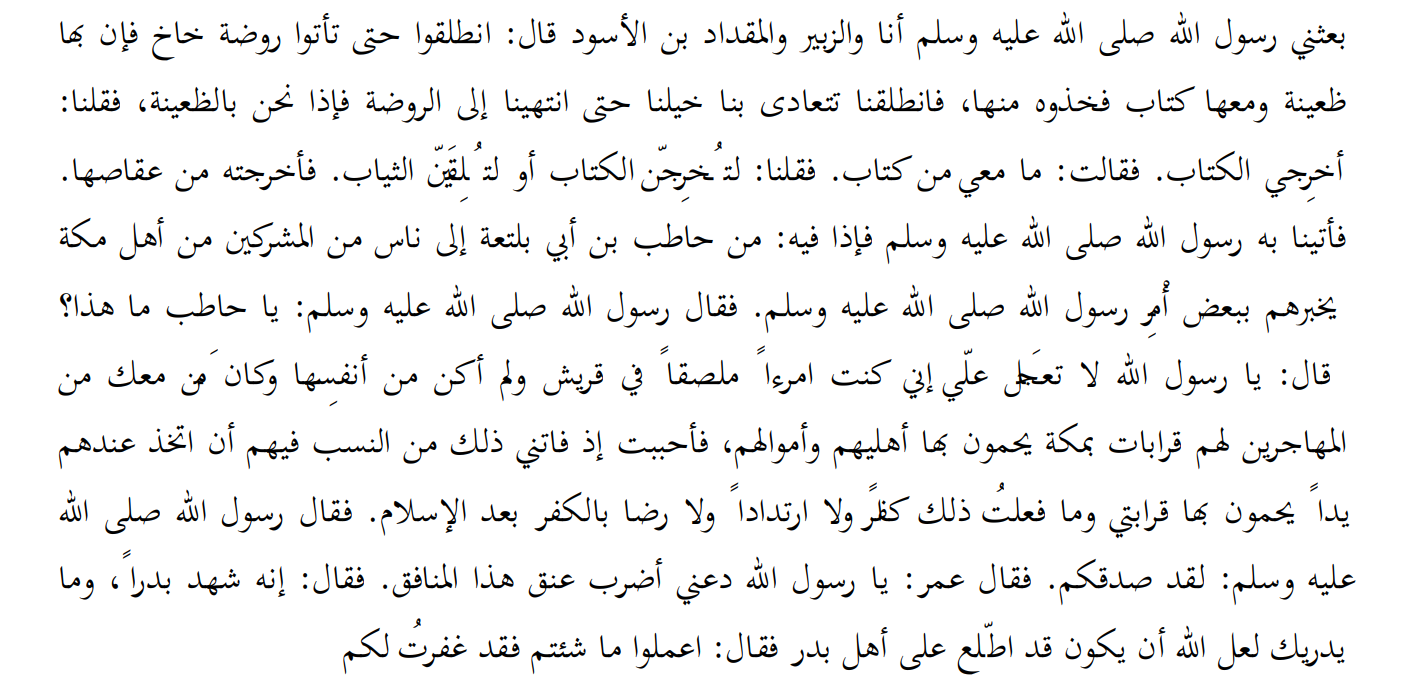
O Mensageiro de Allah (SWT) ﷺ enviou a mim, Az-Zubayr bin Al-‘Awwam e Al-Miqdad bin Al-Aswad, e disse: “Ide até chegar ao jardim de Khakh. Haverá ali uma liteira de mulher e, com ela, um livro; tomai-o dela.” Então partimos com nossos cavalos em passo veloz até chegarmos ao jardim, onde havia uma liteira de mulher. Dissemos: “Tira o livro”, e ela disse: “Não há livro comigo.” Então dissemos: “Ou tiras o livro, ou tiraremos as tuas roupas”, e ela o retirou de suas tranças. Levamo-lo ao Mensageiro de Allah (SWT) ﷺ, e nele estava escrito: “De Hatib bin Abu Balta’ah a alguns dos habitantes de Makkah, informando-os de parte do assunto do Mensageiro de Allah (SWT) ﷺ.” Então o Mensageiro de Allah (SWT) ﷺ disse: “O que é isto, ó Hatib?” Ele disse: “Ó Mensageiro de Allah, não te precipites comigo. Eu era um homem aliado aos Quraysh, mas não era de sua linhagem (isto é, de sua tribo). Os que estão contigo dos Muhajirin têm parentes em Makkah que protegem suas famílias e bens. Então desejei, já que o vínculo com eles se perdera, fazer um favor a eles, com o qual protegeria meus parentes. Não cometi descrença nem apostasia, nem me agradou a descrença depois do Islam.” Então o Mensageiro de Allah (SWT) ﷺ disse: “Ele vos disse a verdade.” ‘Umar disse: “Ó Mensageiro de Allah, deixa-me golpear o pescoço deste hipócrita.” Ele disse: “Ele esteve presente em Badr, e tu não sabes que Allah pode ter olhado com perdão para os que estiveram em Badr e dito: ‘Fazei o que quiserdes, pois vos perdoei.’”
“The Messenger of Allah (saw) sent me, Az-Zubayr bin Al-‘Awwam and Al-Miqdad bin Al-Aswad and said: ‘Go forth until you reach the garden of Khakh. There will be a woman’s litter and with her is a book, so take it from her.’ So we went with our horses in a rapid gait until we ended in the garden where there was a woman’s litter. We said: ‘Remove the book’ and she said: ‘There is no book with me.’ So we said: ‘You will remove the book or we will remove the clothes’ so she removed it from her plaits. We brought it to the Messenger of Allah (saw) and therein was: ‘From Hatib bin Abu Balta’ah to some people of the people of Makkah informing them with some of the matter of the Messenger of Allah (saw). So the Messenger of Allah (saw) said: ‘What is this, O Hatib?’ He said: ‘O Messenger of Allah, do not be hasty with me. I was a man allied to Quraysh, and I was not from her body (i.e. tribe). Those with you from the Muhajirin have relatives in Makkah who protect their families and property. So I wished if the relation with them escaped me that I take a hand with which to protect my relatives. Nor did I commit disbelief or apostasy nor was I pleased with disbelief after Islam. So the Messenger of Allah (saw) said: ‘He has spoken the truth to you.’Umar said: ‘O Messenger of Allah, leave me to strike the neck of this hypocrite.’ He said: “He witnessed Badr, and you do not know but that Allah may have overlooked the people of Badr and said: ‘Do whatever you wish for I have forgiven you.’”
Foi estabelecido, num hadith sobre Hatib, que ele era um espião contra os muçulmanos e que o Mensageiro de Allah ﷺ não o matou, o que indica que o espião muçulmano não é morto. Não se deve dizer que a regra é específica para os companheiros de Badr, porque o hadith é fundamentado (mu'allil) no fato de ele ser dos companheiros de Badr. Isso não deve ser dito, pois, ainda que o texto contenha aquilo que exige raciocínio e seu contexto seja tal que se compreenda a razão a partir dele, no hadith de Ahmad sobre Furrat bin Hayyan a execução lhe foi suspensa porque ele se tornou muçulmano depois de ser dhimmi, o que invalida a razão deste hadith e faz dele a descrição de uma realidade, pois Furrat bin Hayyan não era dos companheiros de Badr. Também não se deve dizer que o hadith de Furrat bin Hayyan em Abu Dawud tem em sua cadeia Abu Hammam Ad-Dalal Muhammad bin Muhabbib, cujos hadiths não são considerados provas, e que ele narra de Sufyan Ath-Thawri. Não se deve dizer isso, porque Ahmad narrou este hadith de Sufyan bin Bushr bin As-Sirri Al-Basri, que está entre aqueles cujo hadith Al-Bukhari e Muslim concordaram em considerar como prova. Assim, o hadith está estabelecido e dele se extraem consequências, e é uma evidência de que o espião muçulmano não é morto, mas é punido com prisão ou outra pena, segundo o parecer do juiz ou do Khalifah.
It was established in this hadith about Hatib that he was a spy against the Muslims and the Messenger did not kill him, which indicates that the Muslim spy is not killed. One should not say that the rule is specific to the people of Badr because the hadith is reasoned (mu’allil) on his being of the people of Badr. This should not be said became even if the text came with what requires reasoning and its context was in a way that reasoning is understood from it; nevertheless (in) the hadith of Ahmad about Furrat bin Hayyan, killing was lifted from him because he became a Muslim after he was a dhimmi which invalidates the reasoning of this hadith and makes it a description of a reality because Furrat bin Hayyan was not from the people of Badr. Nor should one say that the hadith of Furrat bin Hayyan in Abu Dawud has Abu Hammam Ad-Dalal Muhammad bin Muhabbib in its chain and his hadith are not considered as proofs, and he is narrating from Sufyan Ath-Thawri. One should not say this because Ahmad has narrated this hadith from Sufyan bin Bushr bin As-Sirri Al-Basri, and he is from those whom Al-Bukhari and Muslim agreed to consider as proof with his hadith. So the hadith is established and is extrapolated upon, and it is an evidence that the Muslim spy is not killed but is punished with imprisonment or something else according to the view of the judge or Khalifah.
Tudo isto diz respeito à espionagem sobre muçulmanos e dhimmis em favor do inimigo infiel belicoso. Quanto à espionagem sobre muçulmanos que não seja em favor do inimigo, ou seja, não em favor do infiel belicoso, mas por espionagem em si ou em favor dos muçulmanos ou do Estado, embora seja haram, a Shari'a não especificou uma punição específica para este pecado, pelo que a sua punição se torna uma punição discricionária (ta'zeer).