10.2 Müfessirlerin Tefsir Yaklaşımları
10.2 The Exegetical Approaches Of Mufassirun
Sahâbe, Kur'ân-ı Kerîm'in âyetlerini ya kendi içtihadlarıyla ya da bunu Allah'ın Resûlü ﷺ'den işiterek tefsir etmişlerdir. Çoğu zaman bir âyetin nüzul sebebini açıklar, ya da âyetin kimin hakkında indiğini belirtirlerdi. Bir âyeti açıklarken, âyetten anladıkları dil bakımından anlamı, en özlü kelimelerle beyan etmekle yetinirlerdi; nitekim onların "ghayr mutajânif li ithm" (günaha meyilli olmayan), yani günaha yatkın olmayan (ghayr muta'arrid li ma'siyya) şeklindeki sözü bunun bir örneğidir. Benzer şekilde, Allah'ın şu sözüne dair açıklamaları da böyledir:
The Sahabah made tafsīr for the verses of the Noble Qur’ān either as their own Ijtihād in tafsīr or by hearing it from the Messenger of Allah . Many a time they would explain the cause of revelation for a verse or explain with respect to whom it had been revealed. In explaining a verse they would restrict themselves to elucidating the linguistic meaning which they understood from the verse with the most concise of words like their saying: ghayr mutajanif li ithm (not inclined to sin) i.e, not predisposed to sin (ghayr muta'arrid li ma'siyya). Similarly their statement regarding His saying:
"(Yasaklanan) şans ya da karar aramak amacıyla ok kullanmak da caizdir." — hmm, let me correct that: the faithful rendering is: "(Yasak olan) şans veya karar aramak için oklar kullanmak da yasaktır." [TMQ Mā’idah: 3]
“(Forbidden) also is to use arrows seeking luck or decision” [TMQ Mā’idah: 3]
Cahiliyye halkı, içlerinden biri bir yere (yolculuğa) çıkmak istediğinde bir ok alır ve şöyle derdi: "Bu ok bana çıkmamı emrediyor." Eğer yolculuğuna çıkarsa, iyi talih ile karşılaşacağını düşünürdü. Sonra başka bir ok alır ve şöyle derdi: "Bu ok bana kalmamı emrediyor," bu durumda da yolculuğunda talihsiz olacağını düşünürdü. Talihsiz ok, bu iki oktan biridir. Bunun üzerine Allah, onları bu uygulamadan men etti. Bunun bir örneği, İbn Abbas'tan Allah'ın şu sözü hakkında rivayet edilenlerdir:
The people of jahiliyya when one of them wanted to go out (on a journey) he would take an arrow and say: This one orders me to go out. So if he goes out on his journey will meet good luck. And he will take another arrow and say: This one orders me to stay, so he will not be lucky in his journey. The unlucky arrow is one of the two arrows. So Allah forbade them from this practice. An example would be what has been narrated about Ibn 'Abbas regarding His saying:
"Şüphesiz O, sizi mutlaka dönüş yerine (meâda) geri döndürecektir." [TMQ Qasas: 85]
“ He will surly bring you back to the ma'ad (place of return)” [TMQ Qasas: 85]
Dedi ki: Mekke'ye. Buna bir şey eklenmişse, bu, ayetin iniş sebebine ve ayetin kimin hakkında indiğine dair rivayet edilenler olurdu. Ebu Hureyre'den, Allah'ın (SWT) şu sözü hakkında rivayet edilmiştir:
He said: to Makkah. If they added anything to that it would be what has been narrated about the cause of revelation and with regards to whom the verse in question was revealed. It has been narrated about Abu Hurairah regarding His saying:
Muhammed ﷺ, sevdiğin kimseyi doğru yola ileten sen değilsin. Note: the Qur'an verse is wrapped in { and } normally, but here it was given as plain text, so I translated it directly. Following the rules, I kept it free of ﷺ inside the verse and placed ﷺ after the Prophet's name. [TMQ Qasas: 56]
“Verily ! You (O Muhammad (saw)) guide not whom you like” [TMQ Qasas: 56]
...ayetin Allah Resûlü'ne ilişkin indiğini söylediğini, onun amcası Ebû Tâlib'i İslam'a kazanmaya çalıştığı sırada. Ardından Sahabe'den sonra Tabiûn geldi ve Sahabe'nin zikrettiği her şeyi bu şekilde rivayet ettiler. Tabiûn arasında, Kur'an-ı Kerim'in ayetlerini açıklayanlar veya nüzul sebebini belirtenler vardı; bunu ya tefsirdeki kendi içtihatlarıyla ya da (başkalarından) işitmek suretiyle yaptılar. Tabiûn'dan sonra âlimler geldi, tefsiri genişlettiler ve Yahudi ile Hristiyanlardan rivayetler naklettiler. Müfessirler her çağ ve nesilde birbirinin ardından geldi; her çağda kendilerinden önce gelenlerin üzerine Kur'an'ı açıklayıp tefsiri genişlettiler. Müfessirler ayetlere, onlardan hüküm çıkarmaya ve mezheplerini irade (ihtiyar) ve cebir (cebr) açısından açıklamaya yöneldiler. Ayetleri, fıkıhtaki, kelâmdaki (ilmü'l-Kelâm), belâgattaki, sarf ve nahiv gibi alanlardaki meyillerine göre kendi görüşlerini ispatlayacak biçimde yorumlamaya başladılar. Sahabe döneminden günümüze kadar farklı çağlardaki tefsirlerin incelenmesinden açıkça görülen şudur: Her çağda Kur'an tefsiri, o dönemin ilmî hareketinden etkilenmiş, dönemin görüş, teori ve mezheplerini yansıtan bir tablo sunmuştur. Dönemin görüş, düşünce ve kurallarının etkisinden tamamen uzak tefsirler ise nadiren olmuştur.
that he said the verse had been revealed concerning the Messenger of Allah when he tried to win over his uncle Abu Talib to Islam. Then came the Tabi'un after the Sahabah who reported everything the Sahabah mentioned in this manner. From among the Tabi'un there were those who explained the verses of the Noble Qur’ān or stated the cause of revelation, either as their own Ijtihād in tafsīr or by hearing it from (other authorities). After the Tabi'un the 'Ulama came and expanded the tafsīr and quoted reports from the Jews and Christians. The mufassirun succeeded one after another in every age and generation, who explained the Qur’ān and expanded the tafsīr in each age on what had come before. The mufassirun began to give their attention to the verses to deduce rulings from them and explain their schools of thought in terms of freewill (ikhtiyar) and predestination (jabr). And they began to explain verses proving their opinions according to their inclinations in legislation, scholasticism ('ilm al-Kalam), rhetorics (balaagha), declension (sarf) and grammar etc. What is apparent from an examination of the tafaseers through the different ages since the time of the Sahabah until now is that the tafsīr of the Qur’ān in every age was influenced by the scholarly movement of the time, it presented a picture which reflected the views, theories and schools of thought of the time. Seldom were there tafsīrs that were free from the influence of opinions, thoughts and rules of the time.
Ancak bu tefsirlerin tamamı, müfessirlerin ortaya çıktığı ilk günden itibaren, yani Sahabe döneminden beri kitaplar halinde derlenmiş değildir. Aksine, çağlar boyunca duruma göre değişmişlerdir. Başlangıçta tefsir, hadisin bir parçası ve bir bölümü idi. Hadis, bütün İslami ilimleri kapsayan geniş kapsamlı bir konuydu. Dolayısıyla bir hadis rivayet edeni, hükümle ilgili bir hadis rivayet ettiği gibi, bir Kur'an ayetinin tefsirini içeren bir hadis de rivayet ederdi. Sonra, Emevi döneminin sonunda ve Abbasi döneminin başında, yani hicri ikinci yüzyılın başlarında, yazarlar benzer ve ilgili tüm hadisleri bir konu altında toplamaya ve diğer konulardan ayırmaya başladılar. Böylece hadisin içerdiği tefsir ve fıkıh gibi ilimler birbirinden ayrıldı. İlimlerden ortaya çıkan, hadis, siyer, fıkıh ve tefsir açısından ortaya çıkan şeydi. Böylece tefsir ilmi ortaya çıktı ve kendi başına incelenen bağımsız bir ilim haline geldi. Ancak tefsirler herhangi bir düzenli şekil almadı; yani Kur'an ayetleri, mushaftaki düzen gibi sıralı bir biçimde zikredilmeyip ardından tefsirleri gelmiyordu. Aksine, rivayet edilen tefsirler dağınık bir haldeydi. Hadisin durumunda olduğu gibi, çeşitli ayetler için tefsirler vardı. Bu durum, tefsir hadisten ayrılıp kendi başına bir ilim olarak ortaya çıkana kadar sürdü. Kur'an'ın her ayeti veya bir ayetin bir bölümü için, bu ayetleri mushaftaki sıraya göre düzenleyerek tefsir yazıldı. Kur'an'ın tefsirini ayet ayet alıntılayarak ve bunları birbiri ardına açıklayarak ilk yapan kişi, el-Ferra' (ö. 207 H.) oldu. İbnü'n-Nedim, el-Fihrist adlı kitabında şunu rivayet eder:
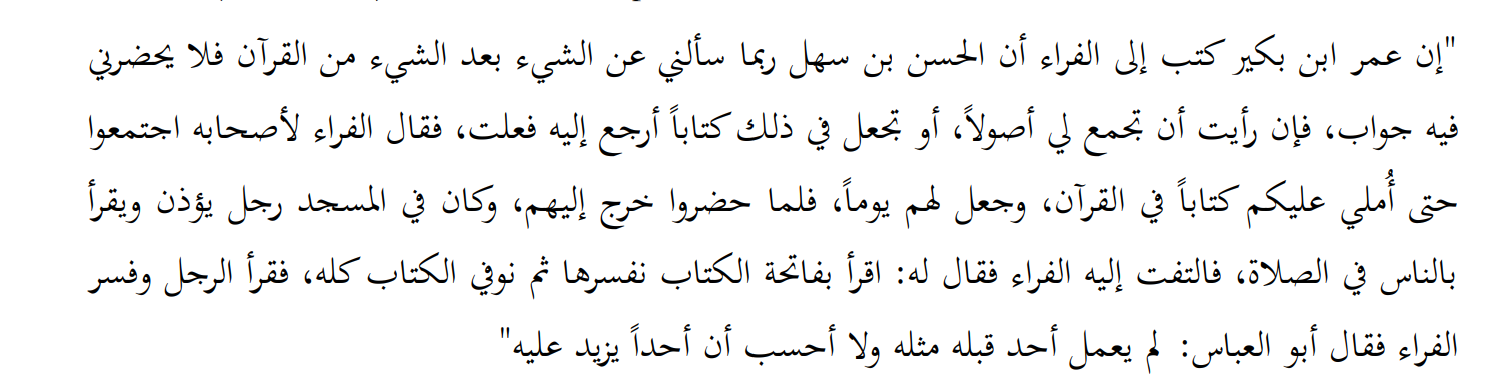
"Ümer İbn Bukeyr, el-Ferrâ'ya şöyle yazdı: Hasan İbn Sehl, Kur'ân'dan bana art arda birçok soru sorabilir, ama hepsinin cevabını hatırlayamam. Bence esas noktaları bir araya getirip bir kitapta toplamalısın ki ona başvurabileyim. Bunun üzerine el-Ferrâ' öğrencilerine dedi ki: Toplanın, Kur'ân hakkında bir kitabı size imlâ edeyim. Onlara bir gün süre verdi. Geldiklerinde onların yanına gitti. Camide ezan okuyan ve namazda cemaatle Kur'ân okuyan bir adam vardı. El-Ferrâ' adama döndü ve dedi ki: Kitabın Fâtiha suresini oku, onu açıklayacağız, sonra bütün kitap hakkında geniş biçimde konuşacağız. Adam okudu ve el-Ferrâ' tefsir yaptı. Ebu'l-Abbâs dedi ki: Ondan önce hiç kimse onun yaptığı gibi bir şey yapmadı ve sanmıyorum ki hiç kimse ona bir şey ekleyebilsin."
“Umar ibn Bukayr wrote to al-Farra' that al-Hasan ibn Sahl perhaps may ask me one thing after another from the Qur’ān but I will not be able to recall all the answers. I think you should bring together the essential points and compile them in a book I will refer to it, so al-Farra' said to his students; gather together so that I can dictate to you a book about the Qur’ān. He gave them a day. When they came he went to them, in the mosque there was man giving azan and reciting the Qur’ān with the people in prayer. Al-Farra' turned to him and said: recite the opening chapter of the Qur’ān (fatihatul kitab), we will explain it and then we will speak fully about the whole book. The man recited and al-Farra' made tafsīr. Abu al-'Abbas said: no one did anything like him before and I don't think anyone can add to that.'
Ardından Ibn Jarir el-Taberî (ö. 310 H.) geldi ve ünlü tefsirini yazdı. Ibn Jarir'in tefsirinden önce, İbn Cureyc'in tefsiri gibi, birçok tefsir meşhur oldu. Onun durumu, kendilerine ulaşan her şeyi, sahih ile zayıf rivayetleri ayırt etmeksizin derleyen ilk muhaddislerin durumuydu. Onlar, "İbn Cureyc'in amacı sahihlik değildi; aksine her ayet hakkında nakledilen her şeyi, sahih olsun zayıf olsun, rivayet etmiştir" demişlerdir. Bu tefsirler arasında es-Süddî'nin (ö. 127 H.) tefsiri ile Mukâtil'in (ö. 150 H.) tefsiri de vardır. Abdullah b. el-Mübârek, Mukâtil'in tefsiri hakkında şöyle demiştir: "Tefsiri ne kadar güzel; keşke güvenilir (sika) olsaydı." Bunların arasında Muhammed b. İshak'ın tefsiri de vardır. O, Yahudi ve Hristiyanlardan nakil yapardı ve Vehb b. Münebbih, Ka'b el-Ahbâr ve başkalarının sözlerini aktarırdı; bunlar Tevrat, İncil ve bunların şerhlerinden rivayet ederlerdi. Bu tefsirler bize ulaşmamıştır; ancak İbn Cerîr et-Taberî bunların çoğunu toplamış ve kitabına dahil etmiştir. Daha sonra müfessirler birbiri ardınca geldi ve Kur'an'ı eksiksiz ve düzenli bir biçimde, tam ve sistemli kitaplarda açıkladılar.
Then, after him came Ibn Jarir al-Tabari (d.310 A.H.) who wrote his famous tafsīr. A number of tafsīrs before the tafsīr of Ibn Jarir became well known such as the tafsīr of Ibn Jurayj. His situation was the situation of the first muhaddithin who compiled everything that reached them without differentiating between the correct (Sahih) and incorrect reports. They said 'that Ibn Jurayj's aim was not authenticity; rather he reported everything that was reported about every ayah whether it was correct (Sahih) or weak (saqim).' Also from these tafsīrs is the tafsīr of al-Suddi (d.127 A.H.) and the tafsīr of Muqatil (d.150 A.H.). 'Abd Allah ibn al-Mubarak said about the tafsīr of Muqatil: How excellent is his tafsīr, if only he were reliable (thiqa).' Amongst them is also the tafsīr of Muhammad ibn Ishaq. He used to transmit from the Jews and Christians and he used to quote sayings of Wahb ibn Munabbih, Ka'b al-Ahbar and others, who reported thing from the Torah, Bible and their commentaries. These tafsīrs have not reached us, although Ibn Jarir al-Tabari has collected most of it and included it in his book. Then came mufassirun one after another explaining the Qur’ān in an complete and well-ordered manner in books that were complete and systematic.
Ancak tefsirlere bakan herkes, müfessirlerin tefsire farklı açılardan yaklaştığını görecektir. Bazıları Kitap'ın üslup ve anlamlarına, onun belagat (retorik) açısından içerdiği şeylere bakmaya ilgi duymuş, böylece diğer konuşma türlerine kıyasla sözün en yüksek ve seçkin biçimlerini bilmek istemişlerdir. Bu yüzden tefsirlerinde belagat yönü öne çıkmıştır. Bunlardan biri, el-Keşşaf adlı tefsirinde Muhammed b. ez-Zemahşerî'dir. Bazıları ise iman esaslarını incelemiş, İslam'a karşı çıkanlarla mücadele etmiş ve muhaliflerle tartışmıştır; bunun örneği, ünlü tefsiri et-Tefsîrü'l-Kebîr'deki Fahreddin er-Râzî'dir. Bazıları da şer'î hükümleri incelemiş ve bunları ayetlerden çıkarmaya yönelmiştir. Dolayısıyla ilgilerini ahkâm ayetlerine yöneltmişlerdir; meşhur tefsiri Ahkâmü'l-Kur'ân'ın sahibi, el-Cessas olarak bilinen Ebû Bekr er-Râzî gibi. Bazıları ise kıssalara yönelmiş, Kur'ân kıssalarına tarih kitaplarından ve İsrâiliyyat'tan ekleme yapmış ve az ya da çok duydukları her şeyi, şeriata aykırı olanları, akla uymayanları veya anlamı kesin olan Kur'ân ayetlerine ters düşenleri gözden geçirmeden toplamaya başlamışlardır. Bunun bir örneği, Bâbü't-te'vîl fî meâni't-tenzîl adlı tefsirini yazan, el-Hâzin olarak bilinen sûfî Alâeddin Ali b. Muhammed el-Bağdâdî'dir. Bazıları da kendi mezhebini desteklemekle uğraşmış ve ayetleri, kendi grubunu destekleyen görüşlere uygun şekilde açıklamıştır; Şeyh et-Tibrisî'nin et-Tefsîrü'l-Beyân'ı ve Şeyh et-Tûsî'nin et-Tibyân adlı tefsiri gibi. Bu ikisi de akâid ve ahkâm konusunda Şia'nın ve kendi mezheplerinin görüşlerini desteklemiştir. Bir de yalnızca ayetlerin ve Kur'ân hükümlerinin açıklanması amacıyla, herhangi bir bakış açısı gözetmeksizin tefsirle ilgilenenler olmuştur. Onlar, tefsirleri tefsir kitaplarının özü sayılan müfessirlerdir. Ayrıca tefsir ve diğer konularda imamlar kabul edilirler. Mesela İbn Cerir et-Taberi'nin tefsiri, Ebû Abdullah Muhammed el-Kurtubi'nin tefsiri, en-Nesefi'nin tefsiri ve diğerleri gibi. Bu çağda ve gerileme döneminin sonlarında yazılan tefsirler, örneğin Muhammed Abduh'un tefsiri, Tantavi Cevheri'nin tefsiri ve Ahmed Mustafa el-Merâğî'nin tefsiri ve diğerleri ise tefsir literatürünün parçası sayılmazlar ve onlara güven duyulmaz. Çünkü Muhammed Reşid Rıza'nın şu ayetin tefsiri gibi, birçok ayetin açıklamasında Allah'ın dinine dair bir risk bulunmaktadır:
However, anyone who inspects the tafaseer will find that the mufassirun approached the tafsīr from various perspectives. Some were interested in looking at the styles and meanings of the Book and whatever it included in terms of the forms of rhetorics (balaagha) to know the highest and distinguished forms of speech as compared to other types of speech. So the rhetorical aspect prevailed in their tafsīrs. One of those people is Muhammad ibn al-Zamakhshari in his tafsīr entitled al-Kashaf. There were those who looked into the foundations of belief, the fighting of pretenders and debating those who disagreed (with Islam) like Fakhr al-Din al-Razi in his famous tafsīr: al-Tafsīr al-Kabir. And some of them studied the Sharī’ah rules and were interested in deducing them from the verses. So they channelled their interest towards the verses of ahkām like Abu Bakr al-Razi commonly known as al-Jassas in his well known tafsīr Ahkām al-Qur’ān. There were those who went after stories and added to the Qur’ānic stories from the books of history and israiliyyat (Judaica) and began to collect everything they heard however meagre or abundant without revising the things that contradicted the Sharī’ah, did not agree with the mind or contradicted Qur’ānic ayāt which are definite in meaning. One such person is 'Ala' al-Din 'Ali ibn Muhammad al-Baghdadi, the sufi otherwise known as al-Khazin who did this in his tafsīr Bab al ta'weel fi ma'ani al-tanzeel. And there were those that concerned themselves with supporting their mazhab (school) and explaining the verses in accordance with whatever supports their faction like the tafsīr al-Bayan of al-Shaykh al-Tibrisi and the tafsīr al-Tibyan of al-Shaykh al-Tusi. Both of them supported the views of the Shi'a and their mazhab regarding belief ('aqaid) and ahkām. And there were those that were only concerned with the tafsīr in order to explain the verses and rulings of the Qur’ān regardless of any perspective. They are the mufassirun whose tafsīrs are considered the essence of the books of tafsīr. And they are considered the imams of tafsīr and other topics. Like the tafsīr of Ibn Jarir al-Tabari, the tafsīr of Abu 'Abd Allah Muhammad al-Qurtubi, and the tafsīr of al-Nasafi and others. As for the tafsīrs written in this age and towards the end of the period of decline like the tafsīr of Muhammad 'Abduh, the tafsīr of Tantawi Jawhari and the tafsīr of Ahmad Mustafa al-Muraghi and others, they are not considered part of the tafsīr literature and nor is there any trust put in them. This is because there is a risk in the deen of Allah in the explanation of many verses like Muhammad Rasheed Ridha’s tafsīr of the verse:
"Kim Allah'ın indirdiğiyle hükmetmezse, işte onlar fasıklardır." [TMQ Mā’idah: 44]
“And whosoever does not judge by what Allahhas revealed, such are the Fasiqun (transgressors)” [TMQ Mā’idah: 44]
Hint Müslümanlarına İngiliz kanunlarını benimseme ve İngiliz hâkimlerinin hükümlerine boyun eğme izni verdi. Şeyh Muhammed Reşid Rıza, Mānār adıyla yaygın olarak bilinen, Kur'ân-ı Kerîm tefsirinin altıncı cildinde, Mâide suresinin tefsirinde, Allah'ın şu sözünü açıklarken bunu zikretmiştir:
He permitted the Muslims of India to adopt English laws and submit to the rulings of English judges. Shaykh Muhammad Rasheed Ridha mentioned in volume six of the Tafsīr of the Noble Qur’ān widely known as al-Manar in the tafsīr of sura al- Mā’idah when he explained His saying:
"Kim Allah'ın indirdiğiyle hükmetmezse, işte onlar fasıklardır (yoldan çıkanlardır)." [TMQ Mā’idah: 44]
“And whosoever does not judge by what Allah has revealed, such are the Fasiqun (transgressors)” [TMQ Mā’idah: 44]
Sayfa 406-409'da kendisine şu soru soruldu:
In pages 406-409 he was asked:
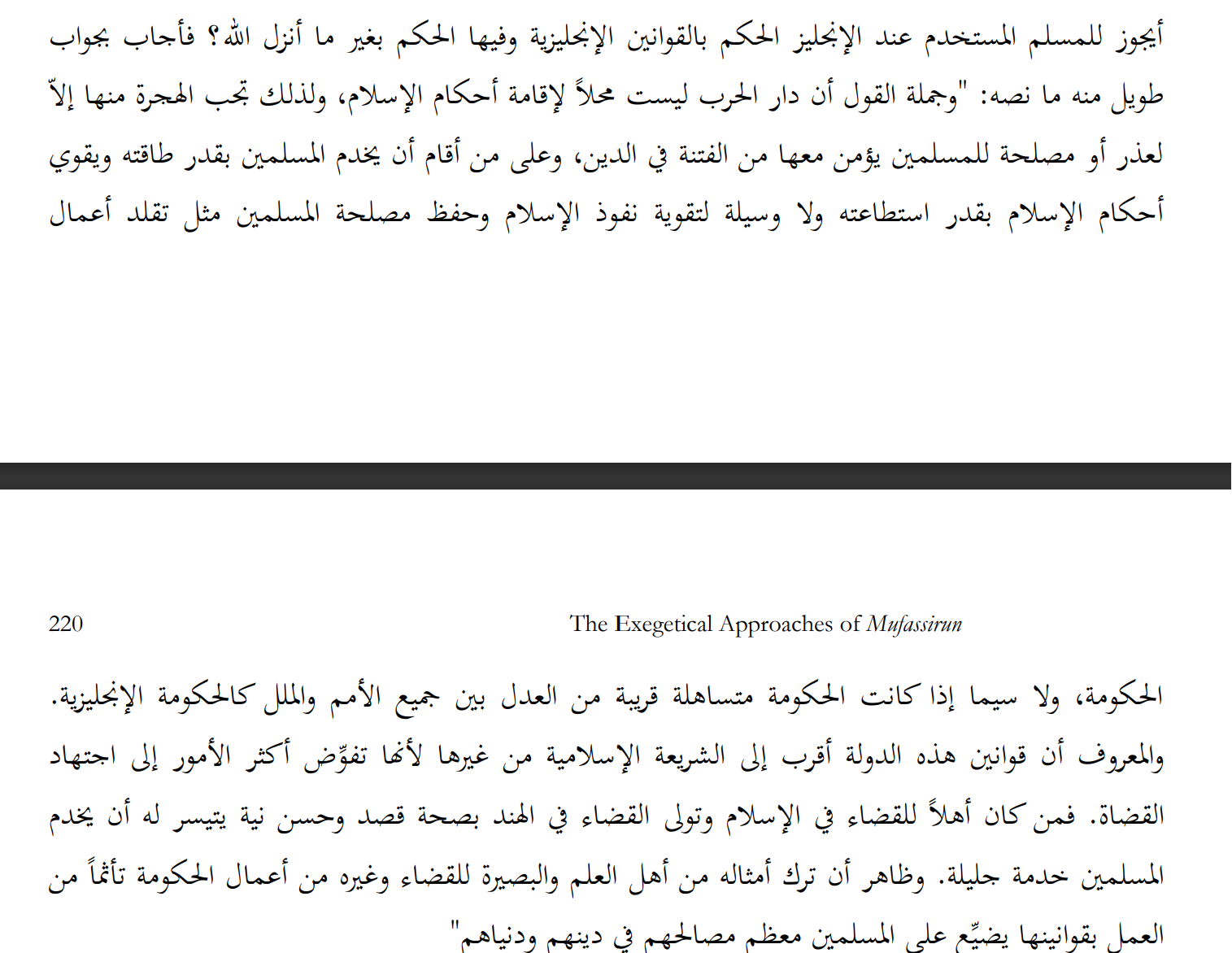
Bir Müslüman'ın, bazıları Allah'ın indirdiğinden başka ile hükmetmeyi içeren İngiliz kanunlarıyla hükmetmek üzere İngilizler tarafından istihdam edilmesi caiz midir? Kendisi uzun bir cevap verdi: "Kısaca, savaş yurdu (dârü'l-harb) İslam kurallarının uygulanacağı bir yer değildir; bu nedenle, dinindeki fitneden (imtihandan) güvende olacağı bir özür veya Müslümanlar için bir fayda bulunmadıkça hicret etmek farzdır. (Hindistan'da) ikamet eden kişinin, gücü yettiğince Müslümanlara hizmet etmesi ve İslam kurallarını elinden geldiğince güçlendirmesi gerekir. İslam'ın etkisini güçlendirmenin ve Müslümanların menfaatlerini korumanın, özellikle hükümet, İngiliz hükümeti gibi tüm insanlar ve dinler arasında hoşgörülü ve oldukça adil ise, hükümet görevlerini üstlenmekten başka bir yolu yoktur. Bu ülkenin kanunlarının, çoğu meseleyi hâkimlerin İctihadına bıraktığı için diğerlerinden daha çok İslam Şeriatı'na yakın olduğu bilinmektedir. Dolayısıyla İslam'da hâkim olmaya layık olan ve doğru bir amaç ve iyi niyetle Hindistan'da yargı veya başka bir hükümet görevine talip olan kimse, Müslümanlara büyük bir hizmette bulunabilir. Açıktır ki, ilim ve basiret sahibi kişilerin, İngilizlerin kanunlarına göre çalıştıkları için günah sayılarak yargıdan ve diğer hükümet görevlerinden çekilmeleri, Müslümanların dinleri ve dünyaları bakımından menfaatlerini zayi edecektir."
Is it permitted for a Muslim to be employed by the English to rule by English laws some of which constitutes ruling by other than what Allah has revealed ? He gave a long reply: 'In short, the abode of war (dar al-harb) is not a place for the establishment of the rules of Islam, therefore it is obligatory to make hijra unless there is an excuse or benefit for the Muslims due to which he will be safe from the fitna (test) on his deen. It is incumbent on the one who resides (in India) to serve the Muslims according to the best of his abilities and to strengthen the rules of Islam as much as he can. And there is no means of strengthening the influence of Islam and protecting the interests of the Muslims except by assuming the government posts especially if the government is lenient and fairly just between all people and religions like the English government. It is well known that the laws of this country are closer to the Islamic Sharī’ah than others because it delegates most matters to the Ijtihād of judges. So whoever is qualified to be a judge in Islam and takes up a post in the judiciary in India with the correct aim and good intention, it is possible for him to do a great service for the Muslims. It is obvious that the abandonment of the judiciary and other government posts by the people of knowledge and insight due to being sinful for working according to their (i.e The English) laws will forfeit the interests of the Muslims in their deen and dunya.'
Sonra şöyle dedi:
Then he said:
Bütün bunlardan açıkça anlaşılmaktadır ki, bir Müslümanın İngiliz hükümetinde, Hindistan'da "ve bunun gibi diğer benzer işlerde" çalışmayı kabul etmesi ve onların kanunlarına göre hüküm vermesi, İslam'a destek olmanın ve Müslümanların menfaatlerini korumanın amaçlandığı bir azimet (asıl hüküm) bulunmadığı takdirde, iki kötülükten daha hafif olanını işleme ilkesi kapsamına giren bir ruhsattır (rukhsa)…
“It is obvious from all of this that the Muslim's acceptance to work in the English government in India 'and any other similar work' and his ruling according to their laws is a dispensation (rukhsa) which comes under the principle of doing the lesser of two evils if there is no 'azeema by which support of Islam and protecting the interests of Muslims is intended…”
Benzer şekilde, Tantavî Cevherî'nin tefsiri de öyledir; bu tefsirde modern bilimlerin ve disiplinlerin Kur'an'da bulunduğunu belirtmiş ve Kur'an'ın bu tür şeyleri açıkladığını göstermek için tefsirini kuşlar ve hayvanların resimleriyle doldurmuştur. Mustafa Zeyd'in tefsiri de öyledir; onda melekleri ve şeytanları yorumlayarak varlıklarını reddetmiştir. Dolayısıyla bu tefsiriyle küfre girmiş ve kendisini İslam'ın dışına çıkarmıştır. Bu tefsirler ve benzerleri Müslümanlar tarafından tefsir kitabı sayılmaz, açıklamaları da dikkate alınmaz.
Much similar is the tafsīr of Tantawi Jawhari where he mentioned that there are modern sciences and disciplines in the Qur’ān and he filled his tafsīr with pictures of birds and animals to demonstrate that the Qur’ān did explain such things. And the tafsīr of Mustafa Zayd in which he interpreted and rejected the existence of angels and Shayateen. So he committed kufr by his tafsīr and took himself outside of Islam. These tafsīrs and their likes are not considered books of tafsīr by the Muslims and nor are their explanations given any consideration