26. Müminin Kâfirlerle Dostluğu
26. The Believer's Befriending The Disbelievers
Allah (SWT) şöyle buyurmuştur:
Allah (swt) said:
"Mü'minler, mü'minleri bırakıp kâfirleri dost edinmesinler; kim bunu yaparsa, Allah'la hiçbir ilgisi kalmaz; ancak onlardan bir korkuya uğramanız hâli müstesnadır. Allah sizi kendisine karşı uyarır ve dönüş ancak Allah'adır." {Âl-i İmrân, 3/28}
“Let not the believers take the disbelievers as friends instead of believers, and whoever does that is not of Allah in anything except if you fear from them something to be feared. And Allah warns you against Himself and to Allah is the return” [TMQ 3:28].
Yakub ve Sehl bunu (taqiyyah) olarak okurlar; bu, El-Hasan ve Mucahid'in kıraatidir. Diğerleri ise (tuqat) olarak okur. El-Kamusu'l-Muhit'te şöyle denilmektedir: '(At-tawqiyya), (al-kalau) ve korunmaktır. (Taqa) bir şeyden sakındım, onu (taqa) ettim, (taqi) ederim, (taqa) eder ve o (tiqa) olarak (taqi) eder; tıpkı (kisa) gibi, onu korktum anlamındadır.' Ayetteki bu metin konusunu belirler; kelimenin (taqiyyah) olan bu dilsel anlamı ise, şer'i bir anlamı tesis edilmediği için, ayette ne anlama geldiğini belirler. Dolayısıyla ayeti dilsel anlamıyla yorumlamayı gerektirir. Ayet, genelliği ve ayrıntılarıyla yalnızca bu temel üzerine anlaşılır. Sebeb-i nüzulüne dair hadislerde gelenlere gelince, eğer sahih iseler, ayette gelenlerin ayrıntılarına yol gösterirler; ancak ayetin konusunu, ne de cümlelerinin anlamını dile ve şeriata göre değiştirmezler. Ayetin konusu, cümlesinde açıktır; bu da mü'minlerin kâfirleri dost edinmeleri, yani onlara dost gibi davranmalarıdır. Metin şöyledir:
Ya’qub and Sahl recite it as (taqiyyah) which is the recitation of Al-Hasan and Mujahid, while the rest (recite it) as (tuqat). It is said in Al-Qamus Al-Muheet: ‘(At-tawqiyya) is (al-kalau) and protection. I do (taqa) something and I did (taqa) it and do (taqi) it (taqa) and he (taqi) it (tiqa) like (kisa) is I feared it.’ This text in the ayah specifies its subject and this linguistic meaning of the word (taqiyyah) specifies what this word means in this ayah in meaning since no Shari’ah meaning was established for it. So it specifies interpreting it with its linguistic meaning. Upon this basis alone is the ayah understood in its generality and details. As for what came in the ahadith of the circumstances of its revelation, if authenticated, guides to the details of what came in the ayah but would not change its subject neither the meaning of its sentences according to the language and Shar’a. The subject of the ayah is clear in its sentence which is believers befriending the disbelievers i.e. treating them as friends. The text is:
"Mü'minler, mü'minleri bırakıp kâfirleri dost edinmesinler." [TMQ 3:28].
“Let not the believers take the disbelievers as friends instead of believers” [TMQ 3:28].
Bir ayet ya da hadis belirli bir konu hakkında geldiyse, o zaman o konuya özgüdür ve başka hiçbir şeyi kapsamaz. Burada söz konusu olan, müminlerin kâfirlerle dostluk kurması meselesidir; bu konuda kesin bir dille yasaklayan ayet gelmiştir. Üstelik bu konuda tek ayet de değildir; Allah'ın şu sözü gibi pek çok ayet gelmiştir:
If the ayah or ahadith came about a specific subject, then it is specific to this subject and does not include anything else. The issue is the issue of believers befriending disbelievers for which came the ayah decisively prohibiting it. Nor is this the only ayah upon this subject; there have come numerous ayahs like Allah’s statement:
"Münafıklara, onlar için acı veren bir azap olduğunu müjdele. Mü'minleri bırakıp kâfirleri (evliyâ) edinenlere" [TMQ 4:138-139].
“Give tidings to the hypocrites that for them is a painful punishment. Those who take the disbelievers as (awliya) instead of believers” [TMQ 4:138-139].
Ve Allah'ın şu sözü:
And Allah’s statement:
"Ey iman edenler, mü'minleri bırakıp kâfirleri dost (evliya) edinmeyin." [TMQ 4:144]
“O you who believe, do not take the disbelievers as (awliya) instead of disbelievers” [TMQ 4:144]
Ve Onun (swt) şu sözü:
And His (swt) statement:
Allah'a ve Ahiret Günü'ne iman eden bir topluluğun, Allah'a ve Elçisi'ne karşı çıkanları sevdiğini bulamazsın. [TMQ 58:22]
“You will not find a people who believe in Allah and the Day of Judgement loving those who oppose Allah and His Messenger” [TMQ 58:22]
Ve Onun (SWT) buyurduğu söz
And His (swt) statement
"Yahudi ve Hristiyanları (evliya) edinmeyin" [TMQ 5:51]
“Do not take the Jews and Christians as (awliya)” [TMQ 5:51]
Ve O'nun şu sözü:
And His statement:
“Benim düşmanımı ve kendi düşmanınızı dost edinmeyin” [TMQ 60:1]
“Do not take my enemy and your enemy as (awliya)” [TMQ 60:1]
Konu, mü'minlerin kâfirlerle dostluk kurmasıyla ilgili konudur ve ayetin geri kalanı konuyu ayrıntılandırmaktadır. Çünkü Allah (SWT), mü'minlerin kâfirleri dost edinmesini yasaklamış ve bu yasağı kesin bir kararlılıkla bağlamıştır: Bunu yapan, yani kâfirleri dost edinen kişiden Allah berîdir. Sonra bu kesin yasaktan bir durumu istisna etmiştir: Mü'minin kâfirden zarar korkusu taşıdığı durum. Bu durumda, zararı önlemek için kâfirlerle dostluk kurması caizdir. Bu, Müslüman, kâfirlerin otoritesi altında ve işinde yenilmiş durumda olduğunda geçerlidir; yani kâfirden duyulan korku, onunla dostluk kurmaya izin verir. Korku ortadan kalkarsa dostluk kurmak haram olur. Buna göre mesele, dostluk gösterip başka bir şeyi gizlemek değil, Müslüman işinde yenilmiş ve kâfirden korkuyorken bu durumu, onunla dostluk kurmanın genel yasağından istisna etmektir. Ayetin anlamı şudur: Mü'minlerin kâfirleri kendilerine dost edinmelerine, onlardan yardım istemelerine, onlara dayanmalarına, onlarla dostluk kurup aralarında sevgi bulunmasına dair kesin yasak. Böylece mü'minlere, mü'minler yerine kâfirleri dost edinmeleri yasaklanmış, sonra bu yasaktan bir durum istisna edilmiştir: Kâfirlerin hâkimiyeti altında bulunulan ve onlardan korkulan durum. Bu durumda, onların kötülüğünü ve zararını önlemek için onlara sevgi gösterilmesi ve onlarla dostluk kurulması caizdir. Yani korku ve onların yönetimi altında olma halinde onları dost edinmek caizdir. Bunun dışında kesinlikle caiz değildir. Bu hüküm yalnızca kâfirler hakkında ve mü'minlerle ilişkileri bağlamındadır; çünkü ayet, Mekke'deki müşriklerle dostluk ilişkisi kurmuş mü'minlerin durumu hakkında nazil olmuştur. Medine'deki Müslümanları, Mekke'deki müşriklerle dostluk kurmaktan men etti; bütün müminleri de men etti, ancak işleri zayıf düşmüş olan ve Mekke'de bulunan müminleri bunun dışında tuttı. Onları, yakınlarında bulunan kâfirlerin zararından korkmaları sebebiyle bu kapsamın dışında bıraktı. Ayetin konusu budur, anlamı budur ve ondan çıkarılan şer'î hüküm de budur: Müminlerin kâfirlerle her türlü dostluk biçiminde dostluk kurmaları yasaktır; yardım, sevgi, destek vb. Çünkü "evliya" kelimesi ayette genel olarak gelmiş ve bütün anlamlarını kapsamaktadır. Onlardan korkulan durumda, yani kâfirlerin Müslümanlara üstün gelip Müslümanların işlerinin zayıfladığı durumda, onlarla dostluğa izin verilmesi de vardır; tıpkı Mekke'deki Müslümanların müşriklerle içinde bulunduğu durum gibi. Ayetin başka bir anlamı yoktur ve bundan çıkarılan bu hükmün dışında başka bir hüküm de yoktur. Bazılarının "takiyye"nin, bir Müslümanın zarar göreceğinden veya gerçeğini ve içindekini bileceğinden korktuğu herhangi bir kimse karşısında, gizlediğinin tersini göstermesi olduğu yönündeki sözüne gelince, bu sözü saf bir hatadır. Ayet bunun hiçbirini göstermez; çünkü "Ancak onlardan bir korkuya uğrarsanız (tuqāt)" yani "onlardan korkacağınız bir şeyden korkarsanız" anlamındadır. "Ettaqaytu" bir şeyden korktum demektir ve "tuqāt" ile "takiyye" aynı anlamdadır. Bu istisna, müminlerin mümin yerine kâfirlerle dostluk kurmalarının yasaklanmasından çıkarılmıştır; dolayısıyla onunla sınırlı kalır, dışındakine uygulanmaz.
"Allah'a ve Ahiret Gününe iman eden bir topluluğun, Allah'a ve Peygamberine karşı gelenleri sevdiğini bulamazsın." [TMQ 58:22]
‘You will not find a people who believe in Allah and the Last Day loving those who oppose Allah and His Messenger’ [TMQ 58:22]
Ve Onun (swt) şu sözü:
And His (swt) statement:
Yahudileri ve Hıristiyanları dost edinmeyin. [TMQ 5:51]
‘Do not take the Jews and Christians as friends’ [TMQ 5:51]
Ve Onun (swt) şu sözü:
And His (swt) statement:
"Benim düşmanımı ve senin düşmanını dost edinme." [TMQ 60:1]
‘Do not take my enemy and your enemy as friends.’ [TMQ 60:1]
Ve Onun (swt) şu sözü:
And His (swt) statement:
"Benim düşmanımı ve senin düşmanını dost edinme." [TMQ 60:1]
‘Do not take my enemy and your enemy as friends.’ [TMQ 60:1]
Onun (swt) şu sözü:
His (swt) statement:
"Müminler yerine" [TMQ 28:53]
‘Instead of believers’ [TMQ 28:53]
Bu, müminlerle dostluğun farz kılındığını ifade eder ve bu ayet, kâfirleri dost edinmenin, onlara müminlere karşı yardım etmenin yasaklandığına dair bir yasaktır. Ayrıca kâfirlere iyilik ve sevgi göstermenin yasaklanması anlamında olduğu da söylenmiştir. İbn Abbas'tan rivayet edilmiştir: "Evliyâ" (awliyâ), "veliyy" (waliyy) kelimesinin çoğuludur; veliyy, kendi yaptığından hoşnut olan kimseye, destek ve yardımla emreden kişidir. Bu da iki şekilde gerçekleşir: Birincisi, desteklenen kişiye destek veren yardımcı; ikincisi ise kendisine destek verilen kişi. Allah'ın (SWT) şu buyruğu da böyledir:
Means that friendship is obliged with believers, and this is a prohibition from befriending disbelievers and assisting them against believers. And it is said (that it is) a prohibition of treating the disbelievers with kindness and friendliness. It is narrated from ibn Abbas: "friends" (awliya) is the plural of "friend (waliyy) who is the one who commands the one pleased with his action with assistance and support, and it occurs in two ways. Firstly, the designated supporter with support and the other who is the supported. So His (swt) statement:
"Allah, iman edenlerin dostudur" [Bakara 2:257
‘Allah is the friend of those who believe’ [TMQ 2:257
Yani, onların yardımcıları ve destekçileridir. Allah'ın desteğiyle, mü'min de Allah'ın dostudur denir; yani Allah'ın desteğiyle desteklenen kimsedir. O'nun şu sözü: "Kim bunu yaparsa" demek, mü'minler yerine kâfirleri dost edinen kimse demektir. "O, hiçbir şeyde Allah'tan değildir" yani Allah'ın (c.c.) dostlarından değildir ve Allah (c.c.) ondan uzaktır. Ayrıca denir ki, o hiçbir şekilde Allah'ın velayetinden (dostluğundan) değildir. Sonra istisna yaparak buyurdu:
Means their helpers and supporters by His support, and it is said that the believer is the friend of Allah i.e. one assisted by His support. His statement: ‘whoever does that’ means whoever takes disbelievers as friends instead of believers ‘then he is not of Allah in anything’ i.e. he is not from the friends of Allah (swt) and Allah (swt) is absolved of him, and it is said he is not from the friendship (wilayah) of Allah in anything. Then He excluded and said:
"Eğer onlardan bir korku duyarsanız, o zaman..."
‘except if you fear from them something to be feared’
Bunun istisnası şudur: Kâfirler üstün gelir ve mü'minler yenilirse, mü'min onlardan korkar; eğer onlarla anlaşma gösterir veya onlarla arkadaşlığını iyi yürütmezse (zarar görme endişesi taşır). İşte o zaman, onlardan korunmak için bir tedbir (takiyye) olarak ve bunu inanarak değil, kendisini koruma amacıyla, dili ile onlara olan sevgisini göstermesi ve onlara uyması caizdir. Bu ayette, kişinin kendisi hakkında korku olduğunda dinde takiyyenin caiz olduğuna dair bir işaret vardır. Ashabımız, zaruret zamanlarında her konuda caiz olduğunu ve çoğu zaman da iyilik ve barıştırma çeşitleri için farz olabileceğini söylemişlerdir. Ancak bir mü'mini öldürme gibi fiillerde veya bilinen ya da en olası gördüğü şeylerde, yani dinde bozgunculuğa (ifsad) yol açan durumlarda caiz değildir. Şeyh el-Mufîd, takiyyenin bazen vacip olduğunu ve farz hâline geldiğini, bazen caiz olduğunu ve müstehap hâline geldiğini söylemiştir. Bazen de vacip olmaksızın caizdir; bazen onu terk etmekten daha iyi olabilir; bazen de onu terk etmek daha iyi olabilir, ancak onu yapan kimse, terk etmesiyle kınanmaktan kurtulur ve bu konuda affedilir. Şeyh Ebû Ca'fer et-Tûsî ise rivayetlerin zahirî anlamının, can korkusu olduğunda takiyyenin vacip olduğunu gösterdiğini ve bunun yanında hakkı açıkça söylemeye ruhsat verildiğine dair rivayet edildiğini belirtmiştir. El-Hasan rivayet etmiştir ki…
means except that if the disbelievers are victorious and the believers defeated so the believer fears them if he does not show his agreement with them or make good his companionship with them. At that time, it is allowed for him to show his affection for them with his tongue and compliance to them as a precaution (taqiyyah) from them and protection for himself without believing that. In this ayah there is an indication that taqiyyah is permitted in the deen when there is fear over oneself and our companions say it is permitted in all matter at times of necessity and often it becomes obligatory for the variety of kindness and reconciliation, but it is not permitted from the actions in killing a believer or what is known or he considers most probable that it is spoiling (istifsad) in the deen. Al-Mufid said that it is obligatory at times and becomes fard, and it is permitted at times and becomes recommended. And it is permitted at time without obligation and it becomes at times better than leaving it; and it could at times be better to leave it even though its performer is excused and forgiven over it by leaving the blame over it. Sheikh Abu Ja’far At-Tusi said that the apparent meaning of the narrations indicate that it is obligatory during fear of one’s life, and it has been narrated that a dispensation in allowing speaking clearly the truth thereupon. Al-Hasan narrated
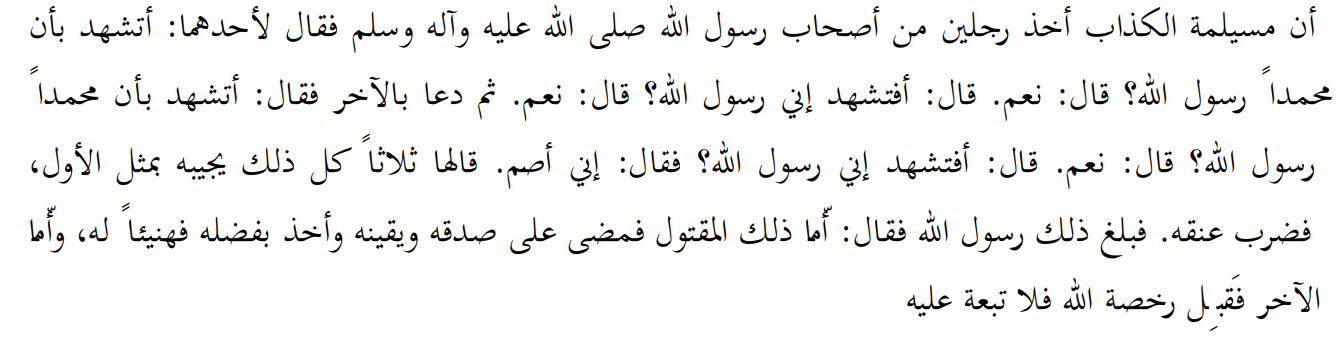
Yalancı Museylime, Allah'ın Resulü'nün (sav) Sahabeleri'nden iki adamı yanına aldı ve onlardan birine şöyle dedi: "Muhammed'in Allah'ın Resulü olduğuna şahitlik ediyor musun?" O da: "Evet" dedi. Musaylime: "Peki, benim de Allah'ın Resulü olduğuma şahitlik ediyor musun?" dedi. O: "Evet" dedi. Sonra diğerini çağırdı ve ona: "Muhammed'in Allah'ın Resulü olduğuna şahitlik ediyor musun?" dedi. O: "Evet" dedi. Bunun üzerine Musaylime: "Peki, benim de Allah'ın Resulü olduğuma şahitlik ediyor musun?" dedi. Adam: "Ben sağır oldum (bunu duymuyorum)" dedi. Musaylime bunu üç kez tekrarladı; adam her seferinde ilkine benzer şekilde cevap verdi, bunun üzerine Musaylime onun boynunu vurdu. Bu durum Allah'ın Resulü'ne ﷺ ulaştırıldığında şöyle buyurdu: "Öldürülene gelince, o hakkını ve inancını ortaya koydu, faziletini aldı; hayırlı olsun ona. Diğerine gelince, Allah'ın ruhsatını kabul etti; bu yüzden ona bir sorumluluk yoktur."
‘That Musaylimah the liar took two men of the Sahabah of the Messenger of Allah (saw) and said to one of them: Do you bear witness that Muhammad is a Messenger of Allah? He said: Yes. He said: Then do you bear witness that I am a Messenger of Allah? He said: Yes. Then he called for the other and said: Do you bear witness that Muhammad is a Messenger of Allah? He said: Yes. Then he said: Then do you bear witness that I am a Messenger of Allah? He said: I am deaf (to that). He said it thrice each time answering him like the first so he struck off his neck. This was conveyed to the Messenger of Allah who said: As for the one killed, he executed his truth and conviction, and he took his virtue so may it be good for him. As for the other, he accepted the concession of Allah so there is no liability on him.’
Buna göre takiyye bir ruhsattır ve açıkça hakkı söylemek bir fazilettir” (et-Tabersî'nin sözü burada sona erer).
Accordingly taqiyyah is a dispensation and speaking clearly the truth is a virtue” (At-Tabarsi’s speech ends).
Buna göre, iki farklı ekol mensubu olan iki müfessir, et-Taberî ile et-Taberisî'nin sözlerinden, ayetin anlamını anlattıkları şekliyle üzerinde anlaştıkları görülmektedir: Bu, müminlerin kâfirlerle dostluk kurmalarının yasaklandığı, müminlerin kâfirlerin zararından korktukları durumun ise bu yasağın dışında tutulduğu anlamına gelmektedir. Et-Taberî'nin sözlerine bakın: "Ancak onlardan bir korkulacak şeyden (tuqat) korkarsanız" (yani) "Ancak onların egemenliğinde olur ve canlarınız konusunda onlardan korkarsanız, dillerinizle onlara dostluk gösterirsiniz." Et-Taberisî'nin sözlerine de bakın: "Sonra istisna yaptı ve dedi ki: 'Ancak onlardan bir korkulacak şeyden korkarsanız.' Anlamı şudur: Kâfirler galip, müminler mağlup olduğunda ve mümin, onlarla anlaştığını göstermez ve onlarla dostluğunu iyi yürütmezse onlardan korkar. O zaman, ihtiyat olarak ve canını korumak için diliyle onlara sevgisini göstermesi ve onlara uyması caizdir." İki müfessir, konunun müminlerin kâfirlerle dostluğunun yasaklanmasından istisna edilmesi ve bununla sınırlı olması konusunda hemfikirdir. Ancak et-Taberisî, konunun dışında kalan bir şeyi takip etmiş ve ayeti, dinde can korkusuyla takiyyenin caiz olduğuna delil saymıştır. Oysa bu, ayette bulunmaz; çünkü ayetin konusu müminlerin kâfirlerle dostluğunun yasaklanması ve kâfirlerin Müslümanlara üstün geldiği durumda korkmalarının bu yasaktan istisna edilmesidir. Bu durumda dostluğa izin verilmesi, dinde takiyye değildir ve can korkusuyla sınırlı değildir, çünkü istisna geneldir: "Ancak onlardan bir korkulacak şeyden korkarsanız" (yani) "Ancak onlardan korkulacak neyse ondan korkarsanız." Zemahşerî, el-Keşşâf'ta şöyle demiştir:
Accordingly it is shown from the words of the two mufasireen, At-Tabari and At-Tabarsi, who are of two different schools of thought, their agreement upon explaining the meaning of the ayah as it came in that it is a prohibition for believers befriending disbelievers and excluding the situation of believers fearing the harm of the disbelievers from this prohibition. Look at the words of At Tabari: “except if you fear from them something to be feared (tuqat)’ (i.e.) except if you are in their authority and you fear them over your lives so you show them friendship with your tongues.” And look at the words of At-Tabarisi: “Then He excluded and said: ‘except if you fear from them something to be feared’ and the meaning is except if the disbelievers are victorious and believers defeated so the believer fears them if he does not show his agreement with them and does not make good his friendship with them. At that time it is allowed for him to show his love for them by his tongue and compliance to them as a precaution and in protection of his soul.” The two mufasireen agree that the subject is excluding the prohibition of believers befriending disbelievers and that it is limited to that. Except that At-Tabarisi followed upon that which is outside the subject and made the ayah an evidence that taqiyyah is permitted in the deen during for one’s life which is not present in the ayah since its subject is the prohibition of believers befriending disbelievers and excluding the situation of fear of the disbelievers when they defeat the Muslims in allowing their friendship in this situation. It is not taqiyyah in the deen nor is it specified to fear over life because the exclusion is general “except if you fear from them something to be feared” (i.e.) except if you fear from them what is to be feared from. Az-Zamakhshari said in Al Kashaf
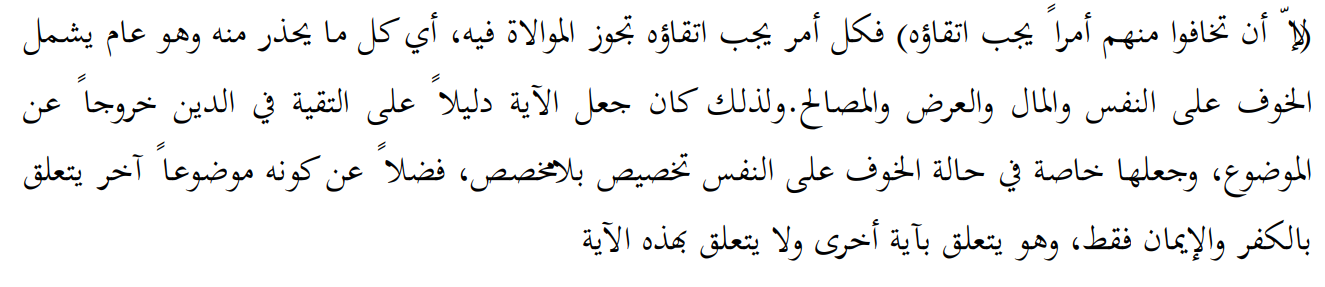
"Kecek yalnızca onlardan bir şeyden korkarsanız, ki o şey korunmayı gerektirir" yani korunulması gereken herhangi bir şey, onunla dost olunmasına izin verir; bu da onlardan korktuğunuz her şeyi, yani can, mal, namus ve çıkarlara ilişkin korkuyu kapsayan genel bir durumdur. Buna göre bu ayeti, dinde takiyye için bir delil kılmak, konunun dışında bir şeydir; ayrıca korkuyu yalnızca can korkusuna hasretmek, bir tahsis delili olmaksızın tahsis etmektir. Üstelik bu, yalnızca küfür ve iman konusuyla ilgili başka bir meseledir ki o da başka bir ayetle ilgilidir ve bu ayetle ilgili değildir.
“Except if you fear from them a matter which requires protection from” so any matter which must be protected from permits befriending it i.e. all that you fear them which is general covering fear over life, wealth, honour and interests. Accordingly making the ayah an evidence for (taqiyyah) in the deen outside the subject, and making it specific in the situation of fear over life is specification without a specifying (evidence). This is besides it being another subject relating to kufr and iman only which is related to another ayah and it is not related to this ayah.
At-Tabarisi'nin, "Ashabımız, zaruret halinde her konuda caizdir dediler" sözüne gelince, onun Al-Mufid'den naklettiği, bunun farz olup olmadığına dair ifadeler, herhangi bir delile dayanmayan soyut sözlerdir. Ayet, At-Tabarisi'nin kendi tefsirine göre bile bunu hiçbir şekilde göstermemektedir. Ne Kitap'tan, ne Sünnet'ten, ne de Sahabe icmasından başka bir delil getirmiştir. Bu nedenle reddedilir ve değerlendirmeye alınacak düzeyden düşer. Ayrıca, kâfirlerle dostluk kurmanın, onlardan korkulan durumda caiz olduğu söylendiğinde, güce sahip zalim ya da azgın yöneticiye boyun eğmenin daha öncelikli olduğu da söylenmiş değildir. Bu söylenmemiştir, çünkü daha öncelikli olan, sözün anlamıdır; bu ise bundan değildir ve onunla bir bağlantı kurulmasına dair herhangi bir genişleme de yoktur. Bu, Allah'ın şu sözü gibi değildir:
As for the statement of At-Tabarisi: “Our companions said (it is) permitted in all matters during necessity” then what he quotes from Al-Mufid of its being obligatory or not obligatory to the last of what he mentioned is abstract speech of any evidence. The ayah does not indicate this in any way even according to At-Tabarisi’s own tafsir, nor did he come with any other evidence neither from the Book or Sunnah or Ijma’a of the Sahabah, hence it is rejected and falls from the rank of consideration. Nor is it said that if befriending disbelievers in the situation of fear of them is allowed then compliance with the unjust or transgressor ruler with power is of greater precedent. This is not said because that which is of greater precedent is the sense of the speech and this is not from it nor is their any extention of any connection with it. It is not like Allah’s statement:
Onlardan öyle biri vardır ki, ona bir dinar emanet etsen, sana geri vermez. [TMQ 3:75]
“Among them is one whom if you entrust him with a Dinar would not return it to you” [TMQ 3:75]
Bu da, Allah'ın şu sözü gibi değildir:
Nor is it like Allah’s statement:
"Ehl-i kitap arasında öyleleri vardır ki, kendisine bir kıntar emanet etsen, sana geri verir." [TMQ 3:75]
“And of the People of the Book is one whom if you entrusted with a qintar will return it to you” [TMQ 3:75].
Bu, zalimin kâfir kategorisinden ve onların sınıfından olmadığı için böyledir; ayrıca bu âyette yasaklanan dostluk, müminler yerine dost edinmektir. Yetkili, zalim ve azgın yönetici, müminlerdendir; ondan zulmün ortaya çıkması ya da azgınlığın onu kaplaması, ondaki imân vasfını ortadan kaldırmaz. Dolayısıyla bu konu, küfür-öncesi (akbar) kıyas araştırmasına girmez ve bu yüzden daha büyük nazarın, delil olarak kullanılacak şekilde buna dâhil olması da söz konusu değildir.
This is because the transgressor is not from the category of the disbeliever or from their class, and because the friendship prohibited in this ayah is befriending instead of the believers. The unjust and transgressor ruler with power is among the believers injustice occurring from him or the transgression covering him does not negate the description of iman from him. Hence this subject does not enter in the research of greater precedent, so accordingly the greater precedent does not come into it such that it is used as a witness.
Ayrıca güç sahibi, zalim ve haddi aşan bir yöneticiyle dostluk kurmak, güvenlik durumunda da korku durumunda da eşit ölçüde caizdir; çünkü o bir mü'mindir ve mü'minlerle dostluk kurmak kesinlikle caizdir. Şu ayetteki "mü'minler" kelimesi: "Mü'minleri bırakıp..." genel olup bütün mü'minleri kapsar. Zalim ya da haddi aşan yöneticiyle, ya da fâsıklar ve günahkârlarla (füccâr) dostluğu yasaklayan hiçbir nass gelmemiştir; aksine nasslar yalnızca kâfirlerle dostluğu yasaklamada özeldir. Üstelik zalim yöneticiye, günah ve cihad dışındaki konularda itaat etmek farz kılınmıştır; cihadda onun sancağı altında savaşmak farzdır ve fâsık bir imamın arkasında namaz kılmak caizdir. Bunların hepsi, onunla dostluğun caiz olduğuna dair en güçlü delillerdir. Yasak olan, yöneticinin zulmünden ve fâsıkın fıska olan hoşnutluktur. Buna göre, mü'min bir kişinin güçlü, zalim ya da haddi aşan bir yöneticinin ya da muhaliflerinin karşısında, içinde sakladığının tersini göstermesi anlamına gelen takiyye reddedilir; böyle yapmak haramdır, çünkü nifaktır ve bütün nifak yasaktır.
Moreover the befriending of the unjust and transgressor ruler with power is allowed in the situation of security and the situation of fear equally because he is a believer and befriending believers is definitely allowed because the word “believers” in His statement: “instead of believers” is general covering all believers. There did not come any text prohibiting befriending the unjust or transgressor ruler or befriending transgressors and the wicked (fujjar); rather the texts are specific in prohibiting the befriending of disbelievers. More than that, the obedience to the unjust ruler is obliged in other than sin and jihad is obliged under his banner and it is allowed to pray behind the Imam in prayer if he is a transgressor which are of the greatest indication regarding permitting their friendship. What is prohibited is the pleasure with the injustice of the ruler and the transgression of the transgressor. Accordingly taqiyyah is rejected when it is a believer showing opposite to what he hides in front of powerful unjust or transgressor ruler or opponent in the opinion or similar, and doing it is haram as it is hypocrisy and all hypocrisy is forbidden.
“Ancak zorlanan ve kalbi imanda mutmain olan kimse hariç” [TMQ 16:106].
“Except the one who is compelled and his heart is content upon iman” [TMQ 16:106].
Bazı müfessirler bunu şu âyetle ilişkilendirir: "Ancak onlardan bir korkuya uğramanız hâli müstesna." Bu âyetten, küfrü göstermenin ve imanı gizlemenin dostluk kapsamına girdiğini ve buna "takiyye" denen şeyin dahil edildiğini çıkarırlar. Bazıları ise bundan, dostluğun yalnızca canın tehlikede olduğu durumda caiz olduğunu, diğer durumlarda caiz olmadığını çıkarır. Bu, saf bir hatadır. Çünkü: "Zorlanan ve kalbi imanla huzur bulan kimse müstesna" âyetinin konusu ve durumu başkadır. Bu âyetin konusu, kesin ve muhakkak bir öldürülme tehlikesi bulunan durumda İslam'dan dönmek (irtidat)tir; olası bir tehlike değil. "Ancak onlardan bir korkuya uğramanız hâli müstesna" âyetinin konusu ise kâfirlerle her türlü dostluğu yasaklamak ve bu dostluğun, korkulan bir zararın bulunduğu hâllerde caiz olmasını dışlamaktır. Bu zarar can, mal, menfaat veya herhangi bir zarar korkusu olabilir. Yani iki âyet iki farklı durumu ve iki farklı konuyu ayırır; biri diğerinin içine girmez ve durum ile konu farkı nedeniyle birbirine bağlanmazlar. Müslüman, kâfirlerin hâkimiyetinde ve onlar karşısında işi üzerinde aciz bir durumda olduğunda, onlara uyum göstermek amacıyla İslam'dan dönmesi caiz değildir. Aksine, dinin hükümlerini yerine getiremiyorsa, onlarla caiz olan dostluğun dışında bir yol olarak hicret etmesi kendisine farzdır. Ancak Müslümanlar onun canı konusunda kesin bir ölümden korkarsa ve küfre zorlanırsa, o zaman küfrü göstermesi ve imanı gizlemesi caizdir. Bunun dışında ise âyetin metni gereğince caiz değildir.
Some mufasireen link it with the ayah: “except if you fear from them something to be feared” and deduce from it the entering of showing kufr and hiding iman in the category of friendship and making it to enter what they call (taqiyyah), with some deducing from it that friendship is allowed in the situation of fearing for one’s life only but not in other (situations). This is pure error because the ayah: “except the one who is compelled and his heart is content upon iman” has a different situation and a different subject as its subject is apostasy from Islam in the situation where there exists fear of definite, confirmed killing not probable and the subject of the ayah: “except if you fear from them something to be feared” is prohibiting befriending disbelievers in all its types and excluding the permissibility of this befriending in the situation of there existing what is feared from whether it was fear over life, wealth, interest or any harm. It distinguishes between the two situations and two subjects such that one does not enter into the other nor are they linked with it due to the difference in situation and subject. When the Muslim is under the authority of disbelievers defeated over his matter before them, it is not permitted for him to apostatise from Islam as a show of compliance to them; rather it is obligatory upon him to emigrate if he is unable to perform the rules of his deen contrary to befriending them which is allowed. However if the Muslims fear over his life a confirmed death and he is forced upon kufr then it is permitted for him to show kufr and hide iman, and other than that it is not permitted because of the text of the ayah:
"Kim imanından sonra Allah'ı inkâr ederse — zorlanan ve kalbi imanla huzur bulmuş olan hariç..." [TMQ 16:106]. Wait, that's not faithful enough to the structure. Here is the corrected translation: "İmanından sonra Allah'ı inkâr eden kimse — zorlanmış olup kalbi imanda yatışık olan hariç — ..." [TMQ 16:106].
“Whoever disbelieves in Allah after his iman except the one who is compelled and his heart is content upon iman.” [TMQ 16:106].
Konu, iman sonrasındaki küfrün, yani İslam'dan irtidadın konusudur ve durum da ölümden korkma durumudur. Fakihlerin "el-ikrahu'l-mülci" (sığınak zorlaması) dediği şey budur; Şer'in, zorlananın hükmün dışında tutulduğu her durumda kabul ettiği tek zorlama budur. Şer'in dışarıda bıraktığı zorlama ise sığınak zorlamasıdır, yani kesin ölümden korkma durumudur. Bu, ölümden korkarak irtidat eden Müslümanlar hakkında indirilen ayetle de güçlenmektedir. Rivayet edilmiştir ki bu ayet Ammar bin Yasir hakkında inmiştir. Taberi şöyle demiştir: "Muhammed bin Sa'd bana rivayet etti ve dedi ki: Amcam bana rivayet etti ve dedi ki: Babam bana, dedesinden, İbn Abbas'tan rivayet etti; Allah'ın, 'İmanından sonra Allah'ı inkar eden kimse -ancak zorlanan ve kalbi imanla huzur bulan müstesna-' buyruğu, ayetin sonuna kadar. Bu, müşriklerin Ammar bin Yasir'i dövüp işkence etmelerinden, sonra da onu bırakmalarından dolayıydı. Bunun üzerine Resulullah'a ﷺ döndü ve Kureyş'ten karşılaştığı şeyi ve söylediklerini ona bildirdi. Bunun üzerine Allah (c.c.) mazeretini zikrederek şunu indirdi: 'İmanından sonra Allah'ı inkar eden kimse...' ta 'büyük azap'a kadar." Beşşar bize rivayet etti ve dedi ki: Yezid bize rivayet etti ve dedi ki: Said bize Katade'den rivayet etti: 'İmanından sonra Allah'ı inkar eden kimse -ancak zorlanan ve kalbi imanla huzur bulan müstesna-' ve dedi ki: Bize, bu ayetin, Benu'l-Muğîre'nin yakaladığı ve Meymun kuyusuna sokup, 'Allah'ı inkar et' dediği Ammar bin Yasir hakkında indiği anlatıldı. Ammar da onların dediğini yaptı, kalbi ise zorlanmış haldeydi. Bunun üzerine Allah (c.c.) şunu indirdi: 'Ancak zorlanan ve kalbi imanla huzur bulan müstesna.' Ve et-Taberî dedi ki: İbnü'l-A'lâ bize rivayet etti ve dedi ki: Muhammed bin Sevr bize Ma'mer'den rivayet etti, o da Abdulkerim el-Cezerî'den, o da Ebû Ubeyd bin Muhammed bin Ammar bin Yâsir'den rivayet etti; o şöyle dedi:
So the subject is the subject of kufr after iman i.e. the subject of apostasy from Islam, and the situation is the situation of fearing death. This is what the fuqaha term as alikrah almulji (compulsion of refuge) which is the only compulsion considered by the Shar’a in all situations in which the rule is lifted from the one compelled. The compulsion which the Shar’a excluded is the compulsion by refuge i.e. the situation of fearing definite death. This is strengthened in the ayah that was revealed about Muslims who apostatised fearing death. It was narrated that this ayah was revealed about Ammar bin Yasir. At-Tabari said: “Muhammad bin S’aad related to me and said: My paternal uncle related to me and said: My father related to me from his father from ibn Abbas that His statement: ‘Whoever disbelieves in Allah after his belief except the one who is compelled and his heart is content upon iman’ to the end of the ayah. This was because the polytheists struck Ammar bin Yasir and punished him then left him. So he returned to the Messenger of Allah (saw) and informed him about what he met with from Quraysh and what he said. So Allah (swt) revealed his mention of his excuse: ‘Whoever disbelieves in Allah after his iman’ until His statement ‘great punishment.’ Bashr related to us and said: Yazid related to us and said: Saeed related to us from Qatadah: ‘Whoever disbelieves in Allah after his belief except the one who is compelled and his heart is content upon iman’ and said: It was mentioned to us that it was revealed about Ammar bin Yasir whom Banu Al-Mughira captured and covered him in the well of Maymun and said: Disbelieve in Allah, so he followed them in that and his heart was compelled. So Allah (swt) revealed His statement: ‘except the one who is compelled and his heart is content upon iman.’ And At-Tabari said: Ibn Abd al-‘Ala related to us and said: Muhammad bin Thawr related to us from Mu’ammar from Abdulkareem Al-Juzri from Abu Ubayd bin Muhammad bin Ammar bin Yasir who said:
Müşrikler Ammar bin Yasir'i yakaladılar ve istediklerinden bir kısmını söyleyinceye kadar ona işkence ettiler. Bunu Peygamber ﷺ'e anlattı ve Peygamber ﷺ şöyle buyurdu: "Kalbini nasıl buldun?" O da dedi ki: "İman üzere emin." Peygamber ﷺ buyurdu ki: "Eğer tekrar ederlerse, sen de tekrar et."
The polytheists took Ammar bin Yasir and punished him until he said to them in some of what they wished. He mentioned that to the Prophet (saw) and the Prophet (saw) said: How did you find your heart? He said: Secured upon iman. The Prophet (saw) said: If they repeat, then you repeat.”
Bu hadisler, ayetin nüzul sebebinin Ammar olayı olduğunu ve konusunun İslam'dan dönme (irtidat) olduğunu göstermektedir. Ona özgü durum, öldürülme korkusunun kesin olmasıdır; bu tek başına bunu güçlendirmeye yeterlidir ve bunun şu ayetle bir ilgisi yoktur: "Ancak onlardan korktuğunuz bir şey varsa (bu başka)." Şu ayet: "Ancak zorlanan ve kalbi imanla huzur bulan müstesnadır" Mekke'de, iman konusunda indirilmiştir. Şu ayet ise: "Ancak onlardan korktuğunuz bir şey varsa" Medine'de, mü'minlerin kâfirleri dost edinmelerinin yasaklanmasından, korkulan bir şeyden korkulması durumunun istisna tutulması konusunda inmiştir. Buna göre bu ayet, o konuda uygulanabilir değildir.
These ahadith indicate that the circumstance of revelation of the ayah is the incident of Ammar and its subject is apostasy from Islam. The situation specific to it is the definite fear of killing which alone is sufficient to strengthen that it has no relationship with the ayah: “except if you fear from them something to be feared.” The ayah: “except the one who is compelled and his heart is content upon iman” was revealed in Makkah on the subject of iman, and the ayah: “except if you fear from them something to be feared” is Madinan revealed on the subject of excluding the situation of fearing what is to be feared from the prohibition of believers befriending disbelievers. Accordingly this ayah is not applicable on that subject.
Geriye, kesin öldürülmekle tehdit edilen kişiye ilişkin hüküm kalıyor: Kişi, ölümden korunmak için küfrü göstermesi ve imanını gizlemesi mi daha faziletlidir, yoksa ölüme yol açsa bile imanında direnmesi mi daha iyidir? Cevap şudur: Ölüme yol açsa bile imanında direnmek daha iyidir, çünkü küfrü gösterme ruhsatı bir kolaylık ve zorluğu kaldıran bir izindir; imanı korumak ise ‘azîmet’tir, yani asıl olan hükümdür. Bu nedenle daha faziletlidir. Rivayet edilmiştir ki...
There remains the rule regarding the one threatened with confirmed killing: Is it more virtuous to show kufr and hide iman so as to be safe from death or is it better to persevere upon his iman even if it leads to death? The answer is that persevering to iman even if it leads to death is better because the permissibility of showing kufr is a dispensation and lifts difficulty, and preserving the iman is (‘azeemah) which is the principle therefore it is better. It is narrated

Musaylimah, iki adamı yanına aldı ve onlardan birine şöyle dedi: "Muhammed hakkında ne dersin?" O da, "Allah'ın Resulü," dedi. Musaylimah, "Peki ya benim hakkımda ne dersin?" dedi. "Sen de," dedi. Bunun üzerine onu serbest bıraktı. Diğerine de şöyle dedi: "Muhammed hakkında ne dersin?" O, "Allah'ın Resulü," dedi. Musaylimah, "Peki ya benim hakkımda ne dersin?" dedi. O, "Ben sağırım," dedi. Bu soruyu üç kez tekrarladı, adam da aynı cevabı tekrarladı; bunun üzerine onu öldürdü. Bu haber Allah'ın Resulü ﷺ'e ulaştı ve şöyle buyurdu: "Birincisi, Allah'ın ruhsatını almıştır. İkincisi ise hakikati açığa vurmuştur, bu yüzden ona selam olsun."
“That Musaylimah took two men and said to one of them: What do you say about Muhammad? He said: A Messenger of Allah. He said: Then what do you say of me? You as well. So he left him free. He said to the other: What do you say of Muhammad? He said: A Messenger of Allah. He said: Then what do you say of me? He said: I am dumb. He repeated it thrice and he repeated his answer, so he killed him. That reached the Messenger of Allah (saw) so he said: As for the first, he took the dispensation of Allah. As for the second, he exposed the truth so blessed be he.”
Bu, sabreden ve imanına sımsıkı bağlı kalan kişiyi, Allah'ın (swt) ruhsatından faydalanan ve öldürüleceğinden korkarak, kesin bir öldürülme tehdidi karşısında küfür izhar eden kişiye tercih ettiğini açıkça göstermektedir.
This is explicit in preferring the one who was patient and stuck to iman over the one who took the dispensation of Allah (swt) and showed kufr fearing for his life from a confirmed killing.
Bu, kendisinden küfür istenen kişiyle ilgilidir. Ondan daha az olan bir şey istendiğinde, örneğin İslam davetini terk etmek veya bir günah işlemek ya da buna benzer bir şey, bu ayetten bir ruhsat çıkarılmaz. Buna göre, Allah Müslümana küfür göstermeyi mubah kılmışsa, küfürden daha az olan şeyin daha evlâ olduğu söylenmez. Bu söylenmez, çünkü isyan küfrün cinsinden değildir ve bu yüzden daha evlâ olma yoluyla araştırmaya girmez. Benzer şekilde, küfür ile günah arasında kıyas yapılmaz, çünkü kıyas gerçekleşene kadar bir illet mevcut değildir. Ancak kesin bir öldürülme karşısında canından korkan ve kendisinden günah işlemesi ya da küfürden daha az bir şey yapması istenen kişi için, canını kurtarmak amacıyla bunu yapması caizdir ve üzerinde bir günah yoktur. Bu, Peygamberimizin ﷺ şu sözüne dayanmaktadır:
This is regarding the one from whom kufr is demanded. As for the one from whom is sought less than that like leaving the Islamic da’wah or performing a sin or something similar; permissibility is not taken from this ayah. Accordingly it is not said that if Allah permitted the Muslim to show kufr, then what is lesser than kufr is of greater precedent. This is not said because disobedience is not from the species of kufr, so it does not enter the research by greater precedent. Similarly an analogy between kufr and sin is not performed since there does not exist a reason until analogy occurs. However as for the one who fears for his life over confirmed killing and it is sought from him sin or doing less than kufr, it is permitted for him to do so to save his life and there is no sin upon him. This is due to his (saw) statement:
"Ümmetimden hata, unutkanlık ve zorlanarak yapılan şeyler kaldırılmıştır."
“Lifted from my Ummah is the mistake, forgetfulness and what is compelled upon it”
Yani günah ve sorumluluk kalkar, hükmün kalkması da, yani bunu yapmanın caiz olması anlamına gelir. Ancak bu, yalnızca bir durumda geçerlidir: kesin ve doğrulanmış öldürülme tehdidinin olduğu durumda; fakihlerin "el-ikrahu'l-mülci" (sığınak yoluyla zorlama, yani kaçış imkânı olmayan zorlama) dediği durumda. Şeriatın her koşulda dikkate aldığı tek zorlama budur ve zorlananın üzerinden, boşanma, nikâh, ticaret ve diğer işlemler ve akitler gibi hükümler de kalkar. Peygamber ﷺ'in ifadesi olan "ve üzerine zorlanılan şey" de işte bu el-ikrahu'l-mülci'dir.
I.e. the blame and sin is lifted, and the rule is lifted, which means the permissibility of doing it. However (this is) only in one situation which is the situation of definite, confirmed killing which is what the fuqaha called alikrah almulji (compulsion by refuge) which is the only compulsion considered by the Shar’a in all conditions in which there is lifted from the one compelled like divorce, marriage, trade and other actions and contracts. His statement “and what is forced upon it” which is alikrah almulji (compulsion by refuge).