Bunun üzerine onlar öyle yaptılar ve birçok nüsha yazdıklarında, Osman asıl sahifeleri Hafsa'ya geri verdi. Osman, yazdıkları nüshalardan birer nüshayı her Müslüman eyalete gönderdi ve Kur'an'a ait diğer tüm malzemelerin, ister parça halindeki sahifeler ister tam nüshalar olsun, yakılmasını emretti. Yapılan nüsha sayısı yediydi. Yedi mushaf Mekke'ye, Şam'a, Yemen'e, Bahreyn'e, Basra'ya ve Kûfe'ye gönderildi, bir nüsha ise Medine'de muhafaza edildi.
They did so, and when they had written many copies, 'Uthman returned the original manuscripts to Hafsa . 'Uthman sent one copy of what they have copies to every Muslim province, and ordered that all the other Qur’ānic materials, whether written in fragmentary manuscripts or whole copies, be burnt. The number of copies made was seven. The seven mushaf’s were sent to Makkah, al-Sham, Yemen, Bahrain, Basra, Kufah, and one copy was kept in Madinah.
Dolayısıyla Osman'ın yaptığı iş Kur'an'ı derleme değil, Allah Elçisi'nden olduğu gibi aktarılmış olanın yalnızca kopyalanması ve yazıya geçirilmesinden ibaretti. Müminlerin annesi Hafsa'nın elinde bulunan korunmuş nüshadan yedi nüsha çıkarmaktan başka bir şey yapmadı ve insanları bu tek yazım üzerinde birleştirdi; bunun dışında herhangi bir yazım veya okuyuş biçimini yasakladı. Mesele bu nüsha üzerinde yazım ve okuyuş olarak kesinleşti. Bu, vahiy indiğinde Allah Elçisi ﷺ'in huzurunda yazılan sahifelerin yazımı ve okuyuşudur. Ayrıca Ebu Bekir'in derlemiş olduğu nüshanın ta kendisidir. Bundan sonra Müslümanlar bu nüshadan kopya çıkarmaya başladılar, başka bir nüshadan değil. Yazımıyla birlikte Osman'ın mushafından başka bir şey kalmadı. Matbaacılar ortaya çıktığında mushaf, aynı yazım ve okuyuşla bu nüshadan basıldı.
Therefore, 'Uthman's action was not the compilation of the Qur’ān rather it constituted in only the copying and transcription of the same thing transcribed from the Messenger of Allah as it was. He did not do anything other than make seven copies from the preserved copy in the possession of Hafsa , the mother of the Believers and unite the people on this single script and forbade any other script or dictation other than it. The matter was settled on this copy as a script and dictation. It is the same script and dictation in which the sheets were written as was written in the presence of Allah's Messenger when the revelation was revealed. And it is the same copy which Abu Bakr had compiled. Then the Muslims began to make copies from this copy and not any other copy. Nothing remained except the mushaf of 'Uthman in its script. When printers came about, the mushaf was printed from this copy with the same script and dictation.
Ebu Bekir'in derlemesi ile Osman'ın derlemesi arasındaki fark şudur: Ebu Bekir'in derlemesi, Kur'an'ın hafızlarından (ezberleyenlerinden) herhangi biri öldüğünde Kur'an'dan bir şeyin kaybolmasından duyulan korku üzerine gerçekleşti; sebebi, Kur'an sayfalara yazılmış olmasına rağmen tek bir kitap gibi bir araya toplanmamış olmasıydı. Bu yüzden sayfalar halinde derlendi. Osman'ın derlemesi ise, Kur'an'ın bazı yönlerinde, kimilerinin kendi lehçelerinde okumasıyla farklılıkların artması ve bunun kimilerinin diğerlerini hata yapmakla suçlamasına yol açması üzerine gerçekleşti. Meselenin büyüyeceğinden korkuldu ve bunun üzerine o sayfalar tek bir mushafa kopyalandı.
Elimizde bulunan bu mushaf, Allah Resulü'ne ﷺ vahyedilen mushafın aynısıdır; Allah Resulü'nün ﷺ huzurunda yazılan sayfalarda yazılmış olanın aynısıdır. Ebu Bekir'in sayfalar bir araya getirildiğinde topladığı mushafın da aynısıdır. Osman'ın yedi nüsha çıkarttığı ve geri kalanlarının yakılmasını emrettiği mushaf da aynı mushaftır. Ayetlerin birbiriyle ilişkisindeki dizilişi, surelerdeki yerleri, yazılışı ve imlası bakımından aynı Yüce Kur'an'dır.
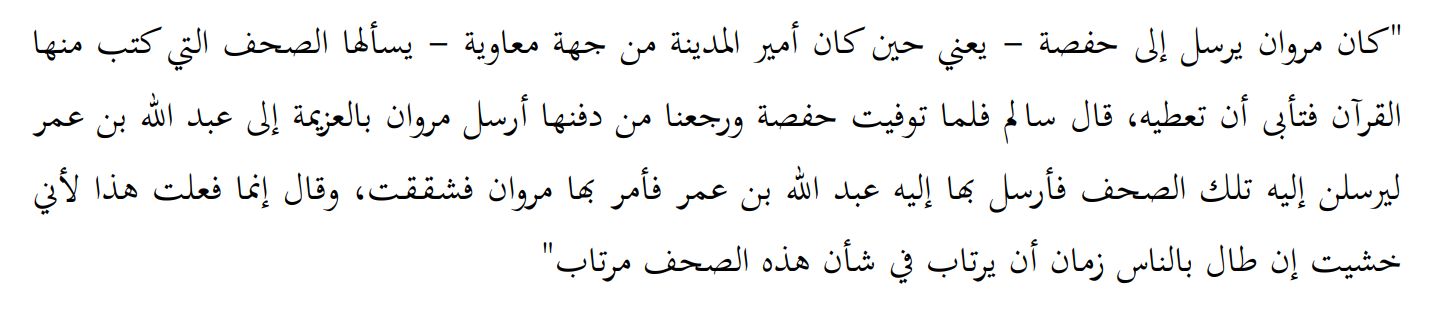
Allah Resulü'nün ﷺ vahiyden yazdırdığı, sayfaları bir araya getirilip sonra kopyalanan nüsha ise Müminlerin Annesi Hafsa'nın ﷺ elinde korunmuştur; Mervan Medine valisi olana kadar orada kalmıştır. Mushafın nüshaları her yere yayıldığı için önemsiz görülmüş ve Mervan onu yırtmıştır.
İbn Şihab rivayet etti: Salim İbn Abdullah İbn Ömer ona haber verdi:
The difference between the compilation of Abu Bakr and that of 'Uthman is that the compilation of Abu Bakr took place due to the fear that something would be lost from the Qur’ān if any of its carriers (memorisers) were lost, the reason being that even though it was written on sheets but it had not been collected in one place like a single book. Thus, it was compiled in pages. The compilation of 'Uthman took place because the differences increased regarding certain aspects of the Qur’ān which some read in their own dialects and this led some to accuse others of making an error. It was feared that the matter would escalate therefore those sheets were copied into one mushaf. The mushaf that we now have before us is the same mushaf revealed to the Messenger of Allah and it is the same one which was written in the sheets which were written in the presence of the Messenger of Allah . And it is the same mushaf that Abu Bakr brought together when the sheets were compiled in one place. And it is the same one from which 'Uthman transcribed the seven copies and ordered that the rest be burned. And it is the same Noble Qur’ān in its verse arrangement in relation to each other and their arrangment in their respectives Sura’s, script and dictation. As for the copy dictated by the Messenger of Allah from the revelation, whose sheets were compiled together and then copied it remained protected in the possession of Hafsa , the mother of the believers until Marwan became the Wali (governor) of Madinah and he tore it up since it was not considered important because copies of the mushaf had spread everywhere. Ibn Shihab narrated that Salim ibn 'Abd Allah ibn 'Umar informed him: