17.8 Halifenin Atanma Yöntemi
17.8 The Method To Appoint The Khalifah
Şeriat, Ümmet'e bir Halife atamayı farz kıldığında, Halifenin nasıl atanacağını da belirlemiştir. Bu yöntem Kur'an, Sünnet ve Sahabe'nin (ra) icmaıyla sabittir ve bu yöntem bey'attır. Dolayısıyla Halifenin atanması, kendisine yapılan bey'at ile gerçekleşir. Bu yöntemin bey'at olduğuna delil, Müslümanların Peygamber'e (sav) yaptıkları bey'attan ve Peygamber'in (sav) bize İmam'a bey'at etmemizi emretmesinden anlaşılmaktadır. Müslümanların Peygamber'e (sav) yaptıkları bey'at, onun peygamberliği üzerine değil, yönetim üzerineydi; çünkü bu, bir fiil üzerine yapılan bey'attı, bir inanç üzerine değil. Dolayısıyla Peygamber (sav), peygamber ve elçi sıfatıyla değil, bir yönetici sıfatıyla bey'at almıştır. Çünkü Peygamberliğin ve risaletin kabulü bir inanç meselesidir, bir bey'at meselesi değildir; bu yüzden bey'at ancak onun Devlet Başkanı olması yönüyle olabilirdi. Bey'at, Kur'an'da ve hadislerde zikredilmiştir. Allah (sb) şöyle buyurmuştur:
When the Shari’ah made it obligatory upon the Ummah to appoint a Khalifah, it also defined the method by which the Khalifah is appointed. This method is proven by the Qur’an, the Sunnah and the Ijma’a of the Sahabah (ra), and this method is the bay’ah. So the appointment of the Khalifah is carried out by the bay’ah to him. The Proof that this method is the bay’ah is confirmed from the bay’ah of the Muslims to the Prophet (saw) and from the order of the Prophet (saw) for us to give bay’ah to the Imam. The bay’ah of the Muslims to the Prophet (saw) was not on his Prophethood; rather it was on ruling, since it was a bay’ah over action and not a bay’ah on belief. So the Prophet (saw) was given the bay’ah in his capacity as a ruler and not as a Prophet and a Messenger. Because the acknowledgement of the Prophethood and the Message is a matter of belief and not a bay’ah, so the bay’ah could only have been for him in his capacity as the head of the State. The bay’ah was mentioned in the Qur’an and the ahadith. Allah (swt) said:
"Ey Peygamber! İnanmış kadınlar sana gelip, Allah'a hiçbir şeyi ortak koşmayacaklarına, hırsızlık yapmayacaklarına, zina etmeyeceklerine, çocuklarını öldürmeyeceklerine, ellerinin ve ayaklarının arasında uydurdukları hiçbir iftirayı ortaya atmayacaklarına ve sana uygun olan hiçbir konuda karşı gelmeyeceklerine dair biat etmek üzere gelirlerse, onların biatını kabul et." [TMQ 60:12]
"O Prophet, if the believing women come to give you a bay’ah that they will not associate anything as partners to Allah, not to steal, not to commit adultery, not to kill their children, not to produce any lie that they have devised between their hands and feet, nor disobey you in what is right then give them the bay’ah" [TMQ 60:12]
Allah (SWT) da şöyle buyurmuştur:
Allah (swt) also said:
Muhammed ﷺ'e bey'at edenler gerçekten yalnızca Allah'a bey'at ederler. Allah'ın eli, onların ellerinin üstündedir.
"Lo! Those who give bay’ah to you (Muhammad) they give bay’ah only to Allah. The hand of Allah is above their hands"
Buhari rivayet etti: İsmail bize Malik'in bana, Yahya bin Said'den naklettiğini aktardı; Yahya şöyle dedi: "Ubade bin Velid bana, babasının kendisine Ubade bin es-Samit'ten (ra) naklettiğini bildirdi; o şöyle dedi:"
Al-Bukhari reported: Ismail related to us that Malik related to me from Yahya bin Said who said: “Ubadah bin Waleed informed me that my father informed me from ‘Ubadah bin as-Samit (ra) who said:
ve bu bağlılığımız üzerine: Hem işimiz rahat ve güçlü olduğunda hem de yorgun olduğumuzda, ona kulak verip itaat edeceğimize; yöneticiye karşı savaşmayacağımıza ve ona başkaldırmayacağımıza; bulunduğumuz her yerde hakkı ayakta tutacağımıza ya da hakkı söyleyeceğimize; Allah yolunda ise kınayanların kınamasından korkmayacağımıza.
“that we would listen to and obey him both at the time when we were active and at the time when we were tired and that we would not fight against the ruler or disobey him, and would stand firm for the truth or say the truth wherever we might be, and in the Way of Allah we would not be afraid of the blame of the blamers.
Buhârî rivayet etti: Ali bin Abdullah bize rivayet etti; Abdullah bin Yezid bize rivayet etti; Sa'îd (yani İbn el-Müseyyeb) bize rivayet etti ve dedi ki: Ebû Akîl Zehra bin Ma'bed bana dedesi Abdullah bin Hişam'dan rivayet etti; Abdullah bin Hişam Peygamber ﷺ'e şahitlik etmişti. Annesi Zeynep, Hamîd'in kızı, onu Allah'ın Resulü ﷺ'ün yanına götürdü ve dedi ki: "Ey Allah'ın Resulü, onun biatını al." Peygamber ﷺ şöyle buyurdu:
Al-Bukhari reported: Ali bin Abdullah related to us that Abdullah bin Yazeed related to us that Saeed (who is ibn al-Musayyib) who said: Abu ‘Aqeel Zahrah bin Ma’bad narrated to me from his grandfather ‘Abdullah bin Hisham who witnessed the Prophet (saw) that his mother Zaynab, daughter of Hameed, took him to the Messenger of Allah (saw) and said: “O Messenger of Allah, take his pledge. The Prophet (saw) said:
"O bir çocuktu; başını sıvazladı ve onun için dua etti."
“He is a child, and rubbed (wiped) his head and said du‘a for him.”
Buhârî dedi ki: Abdan bin Ebû Hamza bize Âmeş'ten, o Ebû Sâlih'ten, o da Ebû Hureyre'den (ra) rivayet etti; Ebû Hureyre şöyle dedi: Allah'ın Elçisi ﷺ şöyle buyurdu:
Al-Bukhari said: ‘Abdan bin Abu Hamza related to us from Al-‘Amash from Abu Salih from Abu Hurairah (ra) who said: The Messenger of Allah (saw) said:

(Kıyamet Günü Allah'ın onlarla konuşmayacağı, onları günahlarından arındırmayacağı ve onlar için acı verici bir azap bulunan üç tür insan vardır: Bunlar, (1) yol üzerinde ihtiyacından fazla suyu bulunup bunu yolculardan esirgeyen kimse; (2) bir İmama (yöneticiye) biat eden ve bunu yalnızca dünyevi menfaat için yapan, İmam ona istediğini verirse biatına bağlı kalan, vermezse biatını yerine getirmeyen kimse; (3) ikindi namazından sonra bir malı başka birine satan ve "Bunun için şu kadar fiyat teklif edildi" diyerek Allah adına yalan yere yemin eden, alıcının ona inanıp o malı satın aldığı, oysa satıcıya gerçekte böyle bir fiyat teklif edilmediği kimse.)
“(There will be three types of people whom Allah will neither speak to them on the Day of Resurrection nor will purify them from sins, and they will have a painful punishment: They are, (1) a man possessed superfluous water (more than he needs) on a way and he withholds it from the travelers. (2) a man who gives a pledge of allegiance to an Imam (ruler) and gives it only for worldly benefits, if the Imam gives him what he wants, he abides by his pledge, otherwise he does not fulfill his pledge; (3) and a man who sells something to another man after the `Asr prayer and swears by Allah (a false oath) that he has been offered so much for it whereupon the buyer believes him and buys it although in fact, the seller has not been offered such a price..”
Bu üç hadisten, bey'atın halifenin atanma yöntemi olduğu açıkça anlaşılmaktadır. Ubade'nin hadisi, Peygamber'e (saw) dinleyip itaat etmek üzere bey'at ettiğini bildirmekte, bu da bir yöneticiye yapılan bey'attır. Abdullah bin Hişam'ın hadisi ise Peygamber'in (saw) onun bey'atını, henüz olgunlaşmamış olduğu için kabul etmediğini bildirmekte; bu da bey'atın yönetime dair olduğunu göstermektedir. Ebu Hureyre'den (ra) rivayet edilen hadisten ise bunun bir İmam'a yapılan bey'at olduğu açıktır. Hadisteki "İmam" kelimesi belirsizdir, yani herhangi bir İmam'ı kapsamaktadır. İmam'a bey'at verilmesinden bahseden başka hadisler de vardır. Müslim'de Abdullah bin Amr yoluyla rivayet edildiğine göre Peygamber (saw) şöyle buyurmuştur:
From these three ahadith it is explicit that the bay’ah is the method of appointing the Khalifah. The hadith of ‘Ubadah states that he gave bay’ah to the Prophet (saw) to listen and obey and this is a bay’ah to a ruler. The hadith of ‘Abdullah bin Hisham states that the Prophet (saw) rejected his bay’ah because he was not mature which indicates that it is a bay’ah on ruling. From the hadith reported by Abu Hurairah (ra) it is evident that it is a bay’ah to the Imam. The word ‘Imam’ in the hadith is undefined i.e. any Imam. There are other ahadith which refer to giving bay’ah to the Imam. It is reported in Muslim via Abdullah bin ‘Amru that the Prophet (saw) said:
"Kim bir imama el vererek ve kalbinin meyvesini vererek biat ederse, gücü yettiğince ona itaat etmelidir. Eğer başka biri ona karşı çıkmaya gelirse, bu sonuncunun boynunu vurun."
“Whoever gave bay’ah to an Imam giving him his handshake and the fruit of his heart should obey him as much as he can. If another person comes to dispute with him, strike the neck of the latter”.
Müslim, Ebu Said el-Hudrî'den rivayet eder. Ebu Said şöyle demiştir: Peygamber ﷺ şöyle buyurdu:
Also Muslim narrates from Abu Said al-Khudri who said: The Prophet (saw) said:
"Eğer iki halifeye bey'at verilirse, sonuncusunu öldürün."
“If a bay’ah is given to two Khalifahs kill the latter of them.”
Ve Müslim, Ebu Hâzim'in şöyle dediğini rivayet etmiştir: "Ebu Hureyre'ye (ra) beş yıl refakat ettim ve onun Peygamber'den (ﷺ) rivayet ettiğini işittim; Peygamber (ﷺ) şöyle buyurmuştur:"
And Muslim narrated that Abu Hazim who said: “I accompanied Abu Hurairah (ra) for five years and heard him narrate from the Prophet (saw) who said:
"Peygamberler İsrailoğulları'nı yönetirdi. Bir peygamber öldüğünde yerine başka bir peygamber geçerdi, ancak benden sonra peygamber yoktur. Halifeler olacak ve sayıca çok olacaklar." Sahabeler sordular: "Bize ne emredersin?" Buyurdu: "Onlara sırayla biat edin ve haklarını verin. Şüphesiz Allah, onlara emanet ettiği şeyler hakkında onlara soracaktır."
“The Prophets ruled over the children of Israel. Whenever a Prophet died another Prophet succeeded him, but there will be no Prophet after me. There will be Khulafaa and they will number many. They asked: What then do you order us? He said: Fulfill the bay’ah to them one after the other and give them their due. Surely Allah will ask them about what He entrusted them with.”
Kur'an ve Sünnet'teki metinler açıktır ki halifenin atanma yöntemi bey'attır. Bütün Sahabe bunu anladı ve buna uydu. Böylece Ebu Bekir (ra), Benu Saide avlusunda özel bir bey'at aldı, ardından camide genel bir bey'at verildi. Camide ona bey'at etmeyenler, ki onların bey'atı da geçerli sayılır, daha sonra bey'at ettiler; tıpkı Ali bin Ebi Talib (ra) gibi. Ömer (ra) Müslümanlardan bey'at aldı, Osman (ra) da Müslümanlar tarafından bey'at aldı ve Ali (ra) de Müslümanlar tarafından bey'at aldı. Dolayısıyla Müslümanlar için halife atamanın tek yöntemi bey'attır.
So the texts from the Qura'n and the Sunnah are clear that the method of appointing the Khalifah is the bay’ah. All the Sahabah understood this and followed it. So Abu Bakr (ra) was given a special bay’ah in the courtyard of Banu Sa‘ida, and a public bay’ah in the mosque, those who did not give him the bay’ah in the mosque and whose bay’ah is considered gave it later on like ‘Ali bin Abu Talib (ra). ‘Umar (ra) was given the bay’ah from the Muslims, ‘Uthman (ra) also was given the bay’ah by the Muslims and ‘Ali (ra) was given the bay’ah by the Muslims as well. So the bay’ah is the only method to appoint a Khalifah for the Muslims.
Bay'at'ın uygulamasına dair pratik ayrıntılar, Peygamber (sav) vefat ettikten hemen sonra atanan dört Halife'nin atanmasında açıkça görülmektedir. Bunlar Ebu Bekir (ra), Ömer (ra), Osman (ra) ve Ali (ra)'dır. Tüm Sahabe (ra) bunu kabul etmiş ve onaylamıştır. Eğer bu Şeriat'a aykırı olsaydı, kesinlikle reddederlerdi; çünkü Müslümanların refahı ve İslam devletinin devamı, bağlı olduğu en önemli konuyla ilgilidir. Bu Halifelerin atanmasında olanları takip eden herkes, Benî Sâide avlusunda bazı Müslümanların tartıştığını görecektir; adaylar yalnızca Sa'd (ra), Ebu Ubeyde (ra), Ömer (ra) ve Ebu Bekir (ra) idi ve yapılan tartışmanın sonucunda Ebu Bekir (ra)'e bey'at verildi. Ertesi gün Müslümanlar camiye çağrıldı ve ona bey'at ettiler. Bu bey'at sonucunda Ebu Bekir (ra) Müslümanların Halifesi oldu. Ebu Bekir (ra), hastalığının ölümle sonuçlanacağını hissettiğinde, bir sonraki Halife'nin kim olabileceği konusunda Müslümanlara danıştı. Bu istişarelerdeki görüşler yalnızca Ali (ra) ve Ömer (ra) üzerinde yoğunlaştı. Üç ay boyunca bu istişareleri sürdürdü. Bunları tamamladığında ve Müslümanların çoğunluğunun görüşünü öğrendiğinde, kendisinden sonra Ömer (ra)'in Halife olacağını onlara bildirdi. Ölümünün hemen ardından Müslümanlar camiye geldi ve Ömer (ra)'e Hilafet bey'atı verdiler; dolayısıyla o, istişarelerle ya da Ebu Bekir (ra)'in bildirmesiyle değil, Müslümanlardan gelen bu bey'at ile Halife oldu. Ömer (ra) bıçaklandığında, Müslümanlar ondan kendisi için bir halef atamasını istediler, ancak o reddetti. Israr ettiklerinde, meseleyi Sahabe'den altı kişiye bıraktı. Ardından vefat ettiğinde, adaylar aralarından Abdurrahman bin Avf (ra)'i temsilci olarak atadılar. O, Müslümanların görüşüne başvurdu ve onlara danıştı. Sonra Osman (ra)'e bey'atı ilan etti. Müslümanlar ayağa kalkarak Osman (ra)'a biat ettiler ve böylece o, Abdurrahman (ra)'ın açıklamasıyla değil, Müslümanların biatiyle halife oldu. Daha sonra Osman (ra) öldürüldü ve Medine ile Kûfe'deki Müslümanların çoğunluğu Ali bin Ebu Talib (ra)'a biat etti; böylece o da Müslümanların biatiyle halife oldu.
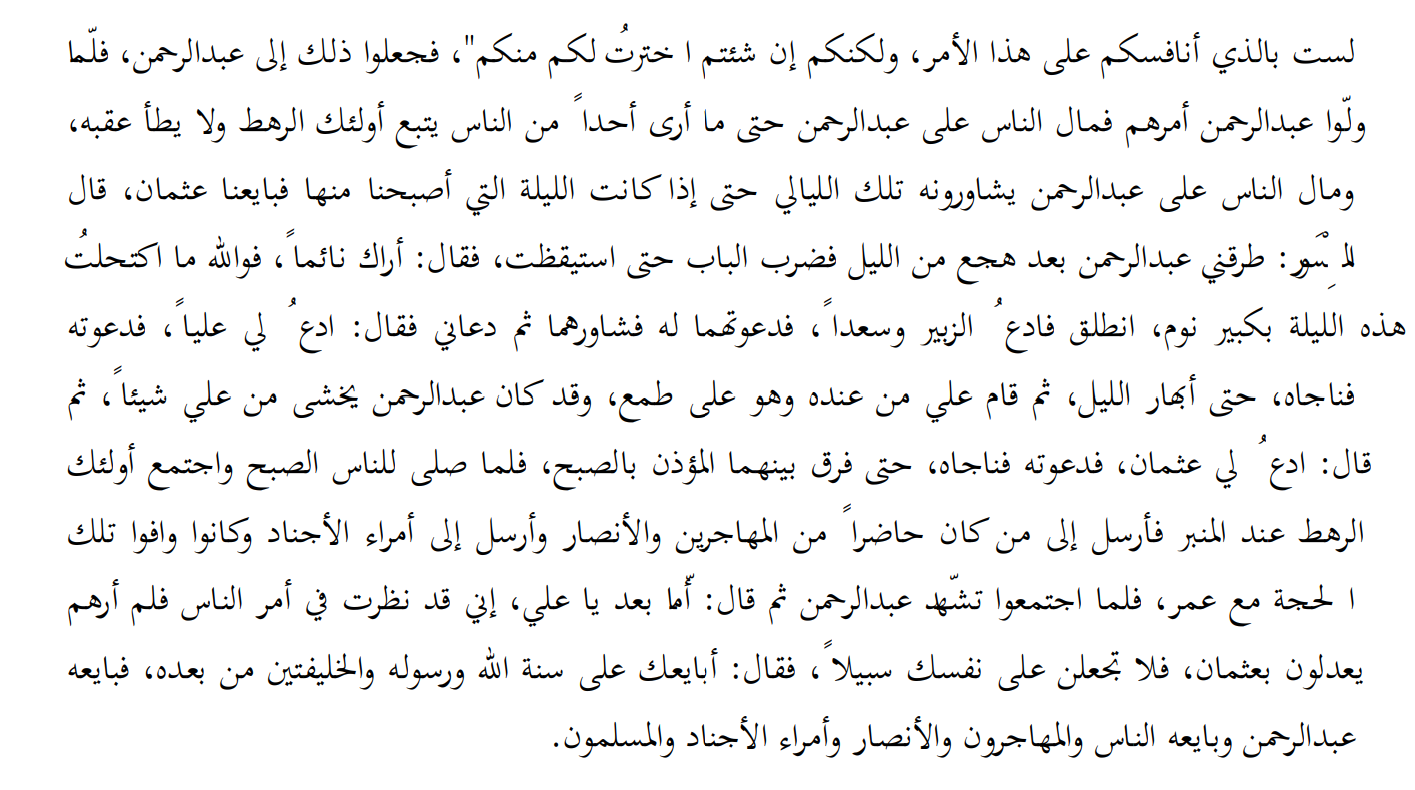
“Ben bu konuda sizinle yarışan biri değilim, ama isterseniz aranızdan birini sizin için seçebilirim.” Bunun üzerine bu görev ‘Abdurrahman’a verildi. ‘Abdurrahman bu işle sorumlu tutulunca insanlar ona yöneldi; öyle ki bu grubu izleyen ya da onların ardınca giden birini görmedim. İnsanlar o geceler boyunca ‘Abdurrahman’a danışmak için ona yöneldiler; sabaha kadar uyanık kaldık ve ‘Uthman’a bey‘at ettik. el-Miswar şöyle anlatır: ‘Abdurrahman gecenin bir kısmı geçtikten sonra kapıma geldi ve uyanana kadar kapıyı çaldı. Dedi ki: “Seni uyur halde görüyorum. Allah’a yemin ederim ki bu gece pek uyku tutmadı gözlerimi. Kalk, Ez-Zübeyr ve Sa‘d’ı çağır.” Onları ona davet ettim. Onlarla istişare etti. Sonra beni çağırıp dedi ki: “‘Ali’yi benim için çağır.” Onu çağırdım. Onunla gecenin karanlığı dağılana kadar fısıldaşarak konuştu. ‘Ali, bazı umutlarla ondan ayrıldı; ‘Abdurrahman ise ‘Ali’den bir şeyden çekiniyordu. Sonra, “‘Uthman’ı benim için çağır” dedi. Onu da çağırdım. Sabah ezanı okununca, ona fısıldaşarak konuşmaya devam etti, sonra ayrıldılar. Sabah namazını insanlara kıldırdıktan sonra, altı kişilik grup minber yanında bir araya geldi. Hazır bulunan bütün Muhacirleri ve Ensarı çağırttı; o yıl ‘Umar ile birlikte hac yapan ordu komutanlarını da çağırttı. Bir araya gelindiğinde ‘Abdurrahman şehadet kelimelerini okudu ve dedi ki: “Ey ‘Ali! İnsanların durumunu değerlendirdim ve onların ‘Uthman’a denk tutabilecekleri hiç kimseyi görmedim. O halde kendini bu konuyla üzmesin.” Sonra ‘Uthman’a dönerek dedi ki: “Allah’ın Kitabı, Resulü’nün sünneti ve ondan sonra gelen iki halifenin yolu üzere sana bey‘at ediyorum.” Böylece ‘Abdurrahman, Muhacirler, Ensar, ordu komutanları ve Müslümanların geri kalanı ona bey‘at etti.
“I am not one who competes with you for this matter but if you wish I could choose for you one from among you. So they assigned this to ‘Abdurrahman . When they charged ‘Abdurrahman with this matter, people turned to him to the extent that I did not see any one who followed this group or stepped behind them. The people turned to ‘Abdurrahman consulting him in those nights until the night of which we woke up in the morning and gave our pledge to ‘Uthman. Al-Miswar said: ‘Abdurrahman knocked at my door, after a part of the night had passed, until I woke up. He said: I see you sleeping. By Allah, my eyes did not find much sleep tonight. Set forth and call Az-Zubair and Sa‘d. I invited them to him. He consulted with them. Then he called me and said: Call ‘Ali for me, so I called him. He carried on a whispered conversation with him until the night faded away. Then ‘Ali left him with some expectations, and ‘Abdurrahman was afraid about something from ‘Ali. Then he said call ‘Uthman for me, so I called him. He carried on whispered conversation with him until they departed as the muezzin called for fajr prayer. After he led the people in the fajr prayer, and the group of six persons met near the minbar (pulpit), he sent for all the Muhajirs and Ansar who were present (in Madinah) and sent for the leaders of the army who delivered the pilgrimage that year with ‘Umar. When they met, ‘Abdurrahman recited the two testimonies of faith (shahadahs) and said: O ‘Ali! I viewed the matter of the people and did not see them equalling anyone to ‘Uthman, so do not let anything disturb yourself. And he said (to ‘Uthman): I give you the bay’ah upon the way of Allah, His Messenger and the two Khulafaa who came after him. So ‘Abdurrahman, the Muhajirs, the Ansar, the leaders of the army and rest of the Muslims gave him the bay’ah.”
Bu nedenle halifelik için adaylar, ‘Umar (ra)’ın Müslümanların talebi üzerine belirlediği grupla sınırlandırılmıştır. ‘Abdurrahman bin ‘Avf (ra), halifelik için adaylıktan kendini çektikten sonra, kimin halife olacağı konusunda Müslümanların görüşünü almıştır. Ardından, onlarla istişare ettikten sonra, halk tarafından istenen kişinin adını açıklamıştır. Halkın istediği kişinin adını açıklamasının ardından ona bey‘at verilmiş ve bu bey‘at ile halife olmuştur. Dolayısıyla halifenin atanmasına ilişkin şer‘î hüküm, adayları Müslümanların çoğunluğunun görüşünü temsil eden kişilerle sınırlamaktır. Sonra bu isimler Müslümanlara duyurulur ve hepsi için halife olacak adaylardan birini seçmeleri istenir. Ardından Müslümanların çoğunluğunun kimi seçtiği belirlenir ve her bireyin bizzat ona oy verip vermediğine bakılmaksızın, tüm Müslümanlardan ona bey‘at alınır. Yöntem budur; çünkü Sahabe'nin, ‘Umar (ra)’ın halifelik adaylarını belirli altı kişiyle sınırlandırmasına dair icmâı, ‘Abdurrahman (ra)’ın kendileri için kimin halife olacağı konusunda tüm Müslümanların görüşünü alması hususunda Sahabe'nin icmâı ve ‘Abdurrahman (ra)’ın Müslümanlar tarafından halife seçilen kişi olarak açıkladığı kişiye bey‘at edilmesi konusundaki icmâ, onun şu sözüyle açıkça ortadadır:
So the nominees for the Khilafah were limited to the group named by ‘Umar (ra) after the Muslims had asked him to do so. ‘Abdurrahman bin ‘Auf (ra), after he withdrew himself from the nomination to the Khilafah, took the opinion of the Muslims about who would be the Khalifah. He then announced the name of the person who the Muslims wanted after consulting with them. After he announced the name of the person who the people wanted, the bay’ah was given to him and he became the Khalifah by this bay’ah. Therefore the hukm shari’ concerning the appointment of the Khalifah is to limit the nominees for the Khilafah by those who represent the opinion of the majority of Muslims. Then their names are displayed to the Muslims and they are asked to select one of the nominees to be Khalifah for all. Then it is determined whom the majority of the Muslims have chosen, and the bay’ah from all the Muslims is taken for him, whether each person had specifically chosen him or not. This is the method because of the Ijma’a of the Sahabah about ‘Umar (ra) limiting the nominees for the Khilafah to six specific persons, and the consensus of the Sahabah that ‘Abdurrahman (ra) takes the opinion of all the Muslims about who will be the Khalifah for them, and the consensus to give the bay’ah to the one who ‘Abdurrahman (ra) announced as the person elected by Muslims as a Khalifah is clear when he said:
“İnsanların eğilimlerine baktım ve hiç kimseyi Osman ile eşit tutmadıklarını fark ettim.”
“I have looked at the people's tendencies and noticed that they do not consider anybody equal to `Uthman.”
Bu maddelerin tümü, halifenin atanmasına ilişkin şer'i hükmü açıklığa kavuşturmaktadır.
All of these points clarify the hukm shari’ concerning the appointment of the Khalifah.
Üzerinde durulması gereken iki mesele kalmıştır. Bunlardan biri, Halifeyi kimlerin atadığıdır: Halifeyi nüfuzlu kişiler mi atar, yoksa belirli bir sayıda Müslüman mı? Yoksa Halifeyi bütün Müslümanlar mı atar? İkinci mesele, bu yüzyılda gerçekleşen seçimlerdeki uygulamalar, örneğin gizli oy, oy sandıkları ve oyların sayımıdır. Bu uygulamalar İslam'a uygun mudur ve İslam bunlara izin verir mi, vermez mi?
Two issues remain to be examined. One of them is who are the Muslims who appoint the Khalifah? Are they the influential people or a certain specific number of Muslims? Or do all of the Muslims appoint the Khalifah? The second issue concerns the actions occurring in this century in elections such as secret ballots, polling boxes and counting votes. Are these matters consistent with Islam and does Islam allows them or not?
Birinci mesele hakkında: Allah (c.c.), yönetim yetkisini Ümmet'e vermiştir ve Halife'nin atanmasını tüm Müslümanların hakkı ve görevi kılmıştır. Bunu belirli bir grubun diğerlerini dışlayarak hakkı kılmamış, ne de bir cemaatin diğer bir cemaati bir kenara bırakarak hak sahibi kılmamıştır; çünkü biat, tüm Müslümanlar üzerine bir görevdir. Peygamber ﷺ şöyle buyurmuştur:
As for the first issue, Allah (swt), has given the authority to the Ummah and he (swt) made the appointment of the Khalifah a right and duty for all Muslims; and He did not make it a right for one particular group excluding another, nor for a jama‘ah leaving another jama‘ah aside, since the bay’ah is a duty upon all the Muslims. The Prophet (saw) said:
"Kim bir biat (bağlılık sözü) olmaksızın ölürse, boynunda bir biat bulunmadan ölmüş olur, cahiliye ölümüyle ölmüş olur" — ancak bunu daha doğal şekilde şöyle çevirebilirim: "Kim boynunda bir biat bağı bulunmadan ölürse, cahiliye ölümüyle ölmüş olur."
“Whoever dies without having a pledge upon his neck would die the death of jahiliyyah”,
Bu, her Müslüman için geneldir. Bu nedenle nüfuz sahibi kişiler halifeyi atama konusunda münhasır bir hakka sahip değildir ve geri kalan Müslümanları göz ardı edemezler. Belirli kişilerin de münhasır bir hakkı yoktur. Aksine bu hak, hiçbir istisna olmaksızın bütün Müslümanlara aittir; fasıklar (fasık kimseler) ve münafıklar da buna dahildir, yeter ki bunlar olgun Müslümanlar olsunlar. Çünkü bu konudaki şer'i nass genel bir biçimde gelmiştir ve onu belirli kişilere hasretleyecek (sınırlandıracak) hiçbir şey gelmemiştir; ancak henüz buluğ çağına ulaşmamış gençlerin biat etmesinin reddedilmesi bunun istisnasıdır. Dolayısıyla nass genel olarak alınmalıdır.
And this is general for every Muslim. Therefore, the influential people do not possess the exclusive right to appoint the Khalifah and cannot ignore the rest of the Muslims. Nor do specific persons have the exclusive right. Rather, this right is for all the Muslims with no exception, it even includes the fajirs (wicked people) and munafiqeen (hypocrites), provided they are mature Muslims because the Shari’ah text came in a general form in this instance and nothing came to limit it (make it specific to certain people) except the refusal of the pledge from the young who have not yet reached the age of puberty. So the text has to be taken generally.
Ancak tüm Müslümanların bu hakkı kullanması bir şart değildir. Bu bir görev olmakla birlikte, bey'at farz olduğu için farz-ı kifayedir, farz-ı ayn değildir. Dolayısıyla Müslümanlardan bazıları bu görevi yerine getirirse, görev diğer Müslümanlardan düşer. Ancak bütün Müslümanlar, bu haklarını kullanıp kullanmamalarından bağımsız olarak, halifenin seçiminde haklarını kullanabilecek imkâna sahip olmalıdır. Başka bir deyişle, her Müslüman halifenin seçilmesinde katılabilmelidir. Dolayısıyla mesele, Allah'ın (c.c.) Müslümanlara yüklediği halifeliğin kurulması görevinin, bu görev üzerlerinden düşecek şekilde Müslümanlara imkân tanınmasıdır. Mesele, bu görevin yerine getirilmesine tüm Müslümanların fiilen katılması değildir. Çünkü Allah'ın (c.c.) emrettiği görev, Müslümanlar için rızalarıyla bir halifenin kurulmasıdır ve bunun her Müslüman tarafından bizzat yerine getirilmesi gerekmez. Bundan iki sonuç çıkar: Bunlardan birincisi, halifenin kurulmasında tüm Müslümanların rızasının sağlanmış olmasıdır. İkincisi ise, atamada tüm Müslümanların rızasının sağlanmamış olmasıdır. Her iki durumda da Müslümanlara (atamaya katılma) imkânı tanınmış olmaktadır.
However, it is not a condition that all Muslims practise this right. While it is a duty, because the bay’ah is fard, it is fard kifayah (obligation of sufficiency) and not fard ain (individual obligation). Thus, if some of the Muslims fulfill it, the duty drops from the rest of the Muslims. But all Muslims must be enabled to practice their right in electing the Khalifah, regardless of whether they use their right or not. In other words, every Muslim must be able to participate in selecting the Khalifah. So the issue is to enable the Muslims to carry out the duty of establishing the Khalifah which Allah (swt) prescribed upon them, in such a way that this duty falls (from their shoulders). The issue is not the actual participation of all the Muslims in conducting this duty. This is because the duty which Allah (swt) has prescribed is to establish the Khalifah for the Muslims by their consent, and it is not a requirement for all Muslims to perform it. Two matters result from this: One of them is that the consent of all the Muslims in the establishment of the Khalifah is achieved. Secondly, the consent of all the Muslims about the appointment is not achieved. The Muslims are however enabled (to participate in the appointment) in both cases.
"Prensip olarak, bir yasaklama delili bulunmadıkça şeyler mübahtır."
“In Principle things are permitted unless there exists an evidence of prohibition.”
Metot (tarîkah) ile üslup arasındaki fark şudur: Metot, kendisi bir asıl olarak görülen ya da kökeni hakkında genel bir delil bulunmayan bir amelin dalı olan bir eylemdir; bunun delili ise yalnızca ona özgüdür. Üslup ise bir eylemin dalı olan, yani asıl olan bir eylemin dalı olan bir eylemdir ve bu asıl hakkında genel bir delil yoktur. Bu nedenle metot, bir Şeriat delenine dayanmak zorundadır, çünkü o bir Şeriat hükmüdür; dolayısıyla ona uyulması gerekir ve hükmü mübah (caiz) olmadıkça Müslümanların onda bir seçim hakkı yoktur. Bu, bir Şeriat delenine dayanmayan ve aslının hükmüne dahil olan üslup ile farklıdır. Bu nedenle, Resûlullah (sallallahu aleyhi ve sellem) bir üslup kullanmış olsa bile, belirli bir üsluba uymak farz değildir.
The difference between method (tareeqah) and style is that the method is an action which is considered by itself as an origin, or a branch to an action that does not have a general evidence for its origin; rather its evidence is specific to it. The style is an action which is a branch to an action—i.e. the origin—upon which there is no general evidence. Therefore, the method must depend upon a Shari’ah evidence because it is a Shari’ah rule, thus it must be adhered to and Muslims have no choice concerning it unless its rule is ibaha (of permissibility). This is different from the style which does not depend on a Shari’ah evidence; rather it is included in the rule of its origin. Therefore, it is not obligatory to follow a particular style even if the Messenger (saw)
Aksine bir Müslüman, eylemin yerine getirilmesine yol açtığı ve böylece eylemin bir dalı hâline geldiği sürece herhangi bir üslubu kullanabilir. Bu nedenle üslubun, eylemin türüyle belirlendiği söylenmiştir.
did so. Rather a Muslim is allowed to use any style as long as it leads to the performance of the action, and thus it becomes a branch to the action. Thus it is said that the style is defined by the type of action.