21.2 Casusluk
21.2 Spying
Casusluk, haberleri araştırmaktır. Dilde "haberi casusladı ve haber hakkında casusluk yaptı" denir ve bundan "casus" kelimesi türer. Bir kimse haberleri araştırırsa, açık ya da gizli bilgileri araştırmış olsun, haberi casusluk etmiş ve casus olmuş olur. Bilgiyi araştırmada gizli, yani sır olmasının bir şart olması gerekmez; casusluk, gizli ya da açık, yani sır olan ve olmayan haberleri araştırmaktır. Ancak bir kimse araştırma yapmadan, bunun için eylemi haber araştırması ya da yayımlamak üzere bilgi toplama olmadan, ya da haberlerle ilgilenmeden, olayları doğal olarak görüyorsa, bu durumların hepsi haber araştırması olmadığı, eylemleri arasında haber araştırması bulunmadığı sürece casusluk değildir. Bu durumlarda haberleri takip etse bile casusluk sayılmaz; çünkü casusluk olan bilgi araştırması, takip ve inceleme onu incelemek amacıyla yapıldığında gerçekleşir. Bilgiyi toplamak için takip eden kimse ise onu incelemek amacıyla değil, halka yayımlamak için toplar. Buna göre gazete ve haber ajanslarının muhabirleri gibi haberleri takip edip toplayan kimselere, eğer işleri casusluk değilse ve gazete ve ajansların muhabirliğini bir araç olarak kullanmıyorlarsa, casus denmez. Bu durumda casus olması, haberleri takip eden bir muhabir olmasından değil, işinin casusluk olmasından ve muhabirliği bir örtü olarak araç edinmesindendir; birçok muhabirin durumu böyledir, özellikle de aralarındaki savaşan kâfirlerin durumu. Haberleri araştıran istihbarat birimlerinin memurları, istihbarat ofisi ve benzerlerinin görevlileri ise işleri casusluk olduğu için casustur.
Spying is investigating information. It is said in the language “spied the news and spying it (is) investigating regarding it” and from it is the spy. If the man investigates information then he has spied it and he is a spy, whether he investigates open or hidden information. It is not a condition in investigating information that it be hidden i.e. secret so that it is spying; rather spying is investigating news whether secret or open i.e. secret and non-secret. Whereas if he sees things naturally without investigation and without his action being investigation of news, or collection of information to publish it or is concerned with news, all this is not spying as long at it is not investigating news and investigating news is not part of his actions. Even if he follows news in these situations, it is not spying because investigating of information which is spying is only where following and scrutinising it is for the objective of examining it. As for the one who follows information to collect it, he does not scrutinize it for the objective of examining it but rather he collects it to publish it to the people. Accordingly it is not said about the one who follows news and collects it like the correspondents of gazettes and news agencies that they are spies, except if their work is spying and they take the correspondence of gazettes and agencies as a tool. In this situation he is a spy not because of his being a correspondent who is following the news but rather because his work is spying and he takes correspondence as a tool for cover as is the situation with many correspondents and particularly the belligerent disbelievers among them. As for the officers of investigative departments and the investigative office and their like who investigate news, they are spies because their work is spying.
Casusluğun gerçeği ve casusun gerçeği budur. Casusluğun hükmü, casus olunan kişilere göre değişir. Eğer Müslümanlara veya Müslümanlar gibi devletin vatandaşı olan zimmilere casusluk yapılıyorsa, bu haramdır ve caiz değildir. Eğer savaşan kâfirlere casusluk yapılıyorsa, bunlar fiilen savaşan olsun ya da hükmen savaşan sayılsın, bu Müslümanlar için caizdir ve Halife üzerine farzdır. Müslümanlara ve İslam Devleti'nin vatandaşlarına casusluk yapmanın haram olduğu ise Kur'an'da açıkça delillendirilmiştir. Allah (SWT) şöyle buyurmuştur:
This is the reality of spying and the reality of the spy. As for the rule of spying, it differs according to those spied upon. If it is spying upon Muslims or dhimmis who are citizens like Muslims, then it is haram and not allowed. If it is spying upon belligerent disbelievers, whether they are belligerent in actual fact or by rule, this is allowed for Muslims and obligatory upon the Khalifah. As for spying upon Muslims and citizens of the Islamic State being haram, this is established by the Qur’an explicitly. Allah (swt) said:
"Ey iman edenler! Zannın çoğundan sakının; çünkü zanların bir kısmı günahtır. Ve casusluk yapmayın." [TMQ 49:12]
“O you who believe avoid much suspicion (dhann) as some suspicion is sin and do not spy” [TMQ 49:12]
Allah yasağı ayette, yani casusluğu yasakladı. Bu yasak, kendisi için olsun başkası için olsun, devlet için olsun bireyler ya da gruplar için olsun, casusluğu yapan yönetici olsun yönetilen olsun, her türlü casusluğu kapsayan genel bir yasaktır. Sözün genelliği, casusluk sayılan her şeyi kapsar.
So Allah prohibited spying in the ayah. This prohibition is general covering all spying whether it is spying for himself or anyone, whether it is for the State or individuals or groups, and whether the one performing it i.e. the spying is the ruler or the ruled. The speech is general covering everything applying upon it that it is spying.
Burada bir soru ortaya çıkıyor: Müslüman'ın bir teftiş dairesinde, bir soruşturma veya araştırma dairesinde ya da işi, veya işinin bir kısmı casusluk olan diğer dairelerde görev alması caiz midir? Cevap duruma göre değişir. Eğer görev, Müslümanları veya Müslümanların vatandaşı olan zimmîleri gözetlemekse, o zaman açık Kur'an nassıyla haramdır. Bu, zimmî için de Müslüman için olduğu gibi yasaktır; çünkü Dârü'l-İslâm'daki zimmî, akide ve ibadetlerle ilgili olanlar dışında, İslâm hükümlerini kendisi hakkında uygulamakla mükelleftir ve bu konu bunların dışında değildir. Eğer daire, Müslüman topraklarına girip güvence verilmiş veya antlaşma yapılmış olanların arasından, savaşan kâfirleri gözetliyorsa, bu caizdir; çünkü savaşan kâfirler, fiilen savaşan da olsalar hükmen savaşan da olsalar, topraklarında da olsalar bizim topraklarımızda da olsalar, onları gözetlemek caizdir. Buna göre teftiş veya soruşturma daireleri ve benzerlerinin varlığı haram değil, aksine farzdır; haram olan, bu dairelerde Müslümanları veya Müslümanların vatandaşı olan zimmîleri gözetlemektir. Devlet için Müslümanları ve diğer vatandaşları gözetleyecek bir daire bulundurması caiz değildir; aksine bu, onlara karşı yasaklanmıştır. Devletin çıkarının, vatandaşların bilgilerini bilmesini ve böylece komploları ortaya çıkarıp suçlulara ulaşmayı gerektirdiği de söylenemez; çünkü devlet bunu polis ve gece devriyesi yoluyla bilebilir, casusluk yoluyla değil. Akıl bir şeyde fayda görür veya görmezse bu, onu yasaklamak veya helal kılmak için bir gerekçe değildir; yalnızca Şâri'in fayda gördüğü şey faydadır. Kur'an âyetleri bir şeyi açıkça yasakladığında, o şeyde fayda olup olmadığı üzerine tartışmaya, onu akılla helal kılmaya yer kalmaz; çünkü açık Kur'an nassı karşısında böyle bir fayda hiçbir değer taşımaz. Kur'an şöyle buyurmaktadır: "Tecessüs etmeyin"; bu, casusluğun yasaklanması anlamındadır ve ayetin işaret ettiği ve kelimelerinin açık anlamının dışında bir anlama gelmesi mümkün değildir. Bu ayetin genelliğini belirleyen ya da ondan bir şeyi çıkaran bir delil gelmemiştir. Dolayısıyla ayet genelliğini korur ve her türlü casusluğu kapsar; bu nedenle vatandaşlar üzerinde yapılan her türlü casusluk haramdır.
Here a question arises: Is it allowed for the Muslim to work as an officer in an inquiry department or an investigative department or other departments whose work, or some of it, is spying? The response depends. If it is an office to spy upon Muslims or dhimmmis who are citizens like Muslims, then it is haram by the explicit Qur’anic text. It is prevented for the dhimmi like it is prevented for the Muslim as the dhimmi in Dar al-Islam is addressed to implement the Islamic rules upon himself except what relates to creeds and worships, and this is not part of that. If the office is spying upon belligerent disbelievers who enter our lands from the ones who have been granted security or the ones under covenant, then it is allowed as it is allowed to spy upon belligerent disbelievers whether they are belligerent in practice or by the rule and whether they are in their lands or ours. Accordingly the existence of inquiry or investigative departments and their like is not haram but obligatory and what is prohibited (haram) in them is spying upon Muslims or dhimmis who are citizens of Muslims. It is not allowed for the State to have a department to spy upon Muslims and the rest of the citizens; rather this is forbidden against them. Nor is it said that the State’s interest requires knowing the citizens’ information so as to expose conspiracies and lead to criminals because the State can know this via the method of police and night patrol not via the method of spying. Just because the mind sees benefit or not in something it is not a reason for forbiddance or allowance; only what the Shar’a sees as benefit is benefit. When the Qur’anic ayat come explicitly forbidding anything there remains no place for discussion whether there is benefit in it to reason it into making it halal, as there is no value in that in front of the explicit Qur’anic text. The Qur’an says: “Do not spy” meaning prohibition of spying, and there is no way to understand other than what the ayah indicates and the clear meaning of its words. There came no evidence specifying the generality of this ayah or excluding something from it, so it remains in its generality covering all spying so all spying upon the citizens is haram.
"Bu kitabımın içine baktığında, Mekke ile Taif arasındaki Nakhlah'a inene kadar git. Kureyş'i gözetle ve bizim için haberlerini öğren."
“When you look into this book of mine, go until you descend upon Nakhlah between Makkah and Taif. Lie in wait for Quraysh and find out their news for us.”
Bu kitapta Resûlullah ﷺ, Abdullah bin Cahş'a Kureyş'i gözetlemesini ve onlara dair haberleri kendisine bildirmesini emretmiştir. Ancak arkadaşlarına, yolculuğa çıkıp çıkmama konusunda seçenek tanımıştır; Abdullah'a ise bu görevi yerine getirmek farz kılınmıştır. Dolayısıyla Resûlullah ﷺ, hepsinden gözetleme yapmalarını istemiş, ancak Abdullah'ı zorunlu kılmış, diğerlerine ise seçenek bırakmıştır. Bu, bir grubun lideriyle ilgili talebin kesin bir talep, onunla birlikte olan diğerleriyle ilgili talebin ise kesin olmayan bir talep olduğuna delildir. Ayrıca bu, Müslümanların düşman hakkında gözetleme yapmasının caiz olduğuna da delildir. Düşman üzerine gözetleme yapmak, İslam ordusunun ondan vazgeçemeyeceği işlerdendir. Düşman hakkında gözetleyiciler bulunmadan savaş için bir ordunun oluşturulması mümkün değildir; dolayısıyla ordu içinde gözetlemenin bulunması, devlet üzerine, (min bâbi) kategorisinden olmak üzere vacip olur.
In this book the Messenger (saw) command Abdullah bin Jahsh to spy for him upon Quraysh and to inform him of their news. However he gave a choice to his companions whether to travel or not; as for him (Abdullah), it was obliged upon him to execute the operation. So the Messenger had requested all to perform spying but obliged Abdullah and gave a choice to the rest. This is evidence that the request in relation to the leader of a group is a decisive request, and in relation to the rest together with him it is an indecisive request. It is also evidence that spying by Muslims upon the enemy is allowed. Spying upon the enemy is from the matters which the Islamic army cannot do without. It is not possible to accomplish the formation of an army for war without there being spies for it upon the enemy, so the presence of spying in the army becomes obligatory upon the State from the category (min bab) of
"Bir farzın yerine getirilmesi, ancak onsuz gerçekleşemeyen şey de farzdır."
“That without which an obligation cannot be fulfilled is obligatory.”
Casusluğun hüküm bakımından haram, mubah ya da farz olması ile ilgili hüküm budur. Casusun, harbî kâfirler adına casusluk yapması durumunda cezalandırılmasına gelince, bu, casusun uyruğuna ve dinine göre farklılık gösterir. Harbî kâfir casus olduğunda, onun hükmü tek ve kesin bir söz olarak öldürülmektir ve onun için bunun dışında bir hüküm yoktur. Sadece casus olduğu bilindiği anda, yani casus olduğunun salt olarak ispatlanmasıyla öldürülür. Bu, Buhârî'nin Seleme bin el-Ekva'dan rivayet ettiği hadise dayanmaktadır; Seleme şöyle demiştir:
This is the rule of spying in relation to it being haram or allowed or obligatory. As for the rule on punishing the spy who spies for the belligerent disbelievers, this differs in relation to the citizenship of the spy and his deen. As for the belligerent disbeliever when he is a spy, his rule is killing as one decisive word and there is no rule for him other than that. He is killed merely upon knowing he is a spy i.e. upon mere proving that he is a spy. This is due to what Al-Bukhari narrated from Salamah bin Al-Akwa’ who said:
Yolculuğu sırasında Peygamber'e ﷺ müşriklerden bir casus geldi. Peygamber ﷺ ashabıyla oturup konuşuyordu, sonra acele etti. Peygamber ﷺ şöyle buyurdu: "Onu arayın ve öldürün." Ben onlardan önce ona ulaştım ve onu öldürdüm, bunun üzerine ganimetini bana bağışladı.
“There came to the Prophet (saw) a spy of the polytheists while he was travelling. He sat with his (saw) Sahabah discussing then he hastened. The Prophet (saw) said: Seek him and kill him. I preceded them to him and killed him, so he gifted me his booty.”
Ve Müslim'de İkrime'den şu lafızlarla rivayet edilmiştir:
And in Muslim it has been narrated from Ikrimah with the words:
"Eyerin kayışından bir deri parçası alıp deveyi onunla bağladı, sonra insanlarla birlikte yemek yemeye ve (merakla etrafına) bakmaya başladı. Durumumuz kötüydü, çünkü bazılarımız yaya idi (binecek hayvanımız yoktu). Derken, aceleyle bizi bırakıp gitti."
“He took a strip of leather from its girth and tethered the camel with it and then he began to take food with the people and look (curiously around). We were in a poor condition as some of us were on foot (being without any riding animals). All of a sudden, he left us hurriedy”
Ve Ebu Nuaym'in El-Mustahrec'deki rivayetinde, Yahya bin el-Hamanî yoluyla, Ebu el-Umeys'ten gelen rivayette,
And in the narration of Abu Nu’aym in Al-Mustakhraj via the way of Yahya bin Al-Hamani from Abu Al-‘Umays
“Onu geçin, çünkü o bir casus.”
“Overtake him for he is a spy.”
Kesin olarak belirtildiği üzere Elçi ﷺ, yalnızca kendisine casus olduğu dair bir şeyin ileri sürülmesi üzerine, şöyle buyurmuştur:
The is explicit in that the Messenger (saw) on the basis of merely being established before him that he is a spy said
"Onu bulun ve öldürün"
“Find him and kill him”
Bu, bu talebin kesin bir talep olduğu anlamına gelir. Dolayısıyla hükmü, tek ve kesin bir kelimeyle öldürülmektir ve bu hüküm, bir antlaşması veya emân güvencesi bulunan ya da mu'ahid veya musta'man olmayanlar da dahil olmak üzere, tüm savaşan kâfirler için geneldir. Hepsi casus olduklarında öldürülmeleri gereken savaşan kâfirlerdir.
This is a connotation that the request is a decisive request. So its rule becomes killing as one decisive word and it is general for all belligerent disbelievers whether he is under a covenant or with a pledge of security or other than a mu’ahid or musta’man. All are belligerent disbelievers whose rule is to be killed if they are spies.
Ama zimmî kâfirler söz konusu olduğunda, casusluk yaptıklarında durum incelenir. Zimmete girerken casusluk yapmamaları ve casusluk yaparlarsa öldürüleceklerinin şart koşulmuş olması hâlinde, bu şart uygulanır. Dolayısıyla casusluk yaparsa, şarta göre öldürülür. Ancak bu şart kendisine konulmamışsa, Halife'nin cezası olarak öldürmeyi belirlemesi caizdir; bu nedenle casusluk yaparsa, Ahmed'in Furrat bin Hayyân'dan rivayet ettiği hadise dayanarak öldürülür.
As for the dhimmi disbelievers when he is a spy, then it is looked into. If it was made a condition when he entered into the dhimma that he should not spy and if he spied he will be killed, then the condition is acted upon. So if he became a spy, he is killed according to the condition. However, if that is not made a condition upon him then it is allowed for the Khalifah to make killing as his punishment so he is killed if he becomes a spy due to what Ahmad narrated from Furrat bin Hayyan

Peygamber'in (sav) onun öldürülmesini emrettiği ve onun bir zimmî olduğu rivayet edilmiştir. Ebu Süfyân için casusluk yapmış ve bir müttefikti. Bir gün Ensâr'dan bir topluluğun yanından geçerken: "Ben bir Müslümanım" dedi. Onlar: "Müslüman olduğunu iddia ediyor" dediler. Bunun üzerine Allah'ın Resûlü ﷺ şöyle buyurdu: "Aranızda inancına güvendiğimiz adamlar vardır. Bunlardan biri de Furrat bin Hayyân'dır."
“That the Prophet (saw) commanded his killing and he was a dhimmi. He was a spy for Abu Sufyan and an ally. So he passed by a circle of the Ansar and said: ‘I am a Muslim.’ They said: ‘He claims he is a Muslim’ so the Messenger of Allah (saw) said: ‘There are men among you whom we trust to their belief. Among them is Furrat bin Hayyan.”
Bu, Resûlullah'ın (ﷺ) zimmî bir casusun öldürülmesini emrettiğini açıkça belirtmektedir. Ancak bu, harbî bir kâfir casus olduğunda olduğu gibi İmam'a vacip olmayıp, İmam'a mübah kılınmıştır. Zimmî casusun devlet tarafından öldürülmesinin mübah, vacip olmadığına dair delil şudur: Hadisteki talep kesinlik ifade eden bir karine ile bağlantılı değildir; dolayısıyla bu, kesin olmayan bir taleptir. Talebin kesin olmadığını gösteren bir karine de şudur: Hadisin metni, Resûlullah'ın (ﷺ) Ferrât'ın casus olduğunu bilmesinin ardından onu öldürmekte acele etmediğini göstermektedir. Oysa Selemetü'bnü'l-Ekvâ' hadisinde geçen harbî kâfir hakkında, onun casus olduğu Peygamber'in huzurunda sabit olur olmaz, Peygamber (ﷺ) onun öldürülmesini emretmiş ve Müslümanlara: "Onu arayın ve öldürün." buyurmuştur. Acele etmediğine dair delil ise şudur: Resûlullah (ﷺ) onu tanıyordu; bu durum hadisteki "o bir zimmîydi ve casustu" sözünde, yani tanınıyordu anlamında ve Resûlullah'ın "Onlardan biri Ferrâtü'bnü Hayyân'dır." sözünde görülmektedir. Buna ek olarak Resûlullah (ﷺ), harbî kâfir hakkında "Onu arayın ve öldürün." buyurmuşken, Ferrât'ın durumunda öldürülmesini emretmiş ama Müslümanlardan onu aramalarını istememiştir. Bu iki durum arasındaki farklılık açıktır: Harbîyi öldürme talebi kesin bir taleptir, zimmîyi öldürme talebi ise kesin olmayan bir taleptir ve bu, zimmî casusun öldürülmesinin de öldürülmemesinin de mübah olduğunu gösterir.
This is explicit that the Messenger commanded the killing of a dhimmi spy. However this is allowed for the Imam and not obligatory upon him as is the case when the spy if he is a belligerent disbeliever. The evidence that the killing of a dhimmi spy by the State is allowed and not obligatory is that the hadith is not associated with a connotation indicating decisiveness so it is an indecisive request. There is a connotation which indicates the non-decisiveness in the request which is that the text of the hadith indicates that the Messenger (saw) did not hasten to kill Furrat after the mere knowledge that he is a spy whereas the belligerent disbeliever mentioned in the hadith of Salama bin Al-Akwa’, the Prophet had commanded his killing upon it being merely established before him that he is a spy and he said to the Muslims: “Seek him and kill him.” The evidence that he did not hasten to kill him is that the Messenger (saw) used to know him, which appears in the saying of the hadith “he was a dhimmi and he was a spy” i.e. he was known, and (also) the saying of the Messenger “of them is Furrat bin Hayyan.” In addition to that, the Messenger said in the matter of the belligerent disbeliever: “Seek him and kill him” whereas in the matter of Furrat bin Hayyan he commanded his killing but did not request the Muslims to seek him. It is clear therein the distinction between both of them in that the request to kill the belligerent is a decisive request and the request to kill the dhimmi is an indecisive request which indicates the permissibility of killing the dhimmi spy and the permissibility of not killing him.
Aranızda, inancına güvendiğimiz kimseler vardır ve Furrat bin Hayyan da bunlardandır.
“Among you are men whom we trust them to their belief, and Furrat bin Hayyan is among them”
Dolayısıyla onu öldürmekten alıkoymanın gerekçesi ('illet), onun Müslüman olmasıdır. Buhârî, Ali bin Ebî Tâlib (ra)'den şöyle rivayet etmiştir:
So the reason (‘illah) abstaining from killing him is his becoming a Muslim. Al-Bukhari narrated from Ali bin Abu Talib (ra) said:
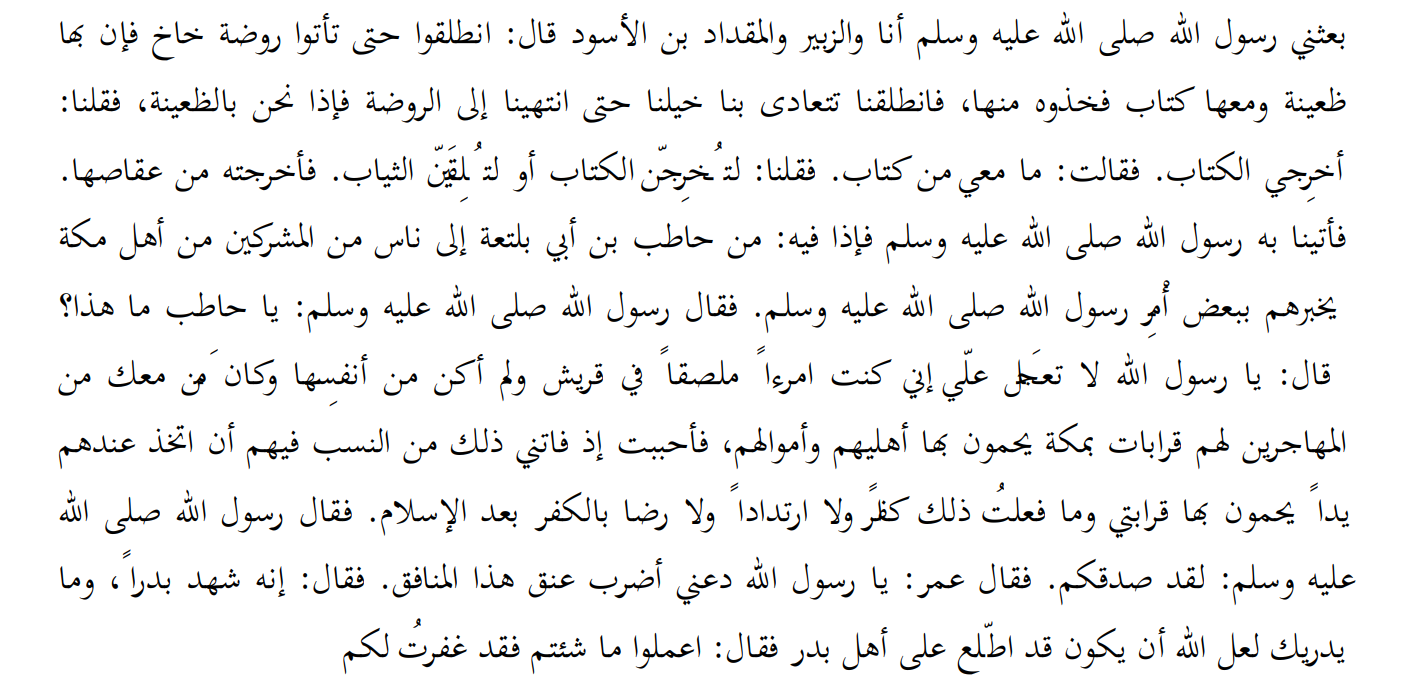
Allah'ın Elçisi (sav) beni, Zübeyr bin el-Avvam'ı ve Mikdad bin el-Esved'i gönderdi ve şöyle buyurdu: "Hah bahçesine varana kadar yürüyün. Orada bir kadın ve yanında bir mektup olan bir deve taşıtı olacak; ondan mektubu alın." Biz atlarımızla hızlı bir yürüyüşle yola çıktık ve bir kadın taşıtının bulunduğu bahçeye vardık. Dedik ki: "Mektubu çıkar." Kadın: "Yanımda hiçbir mektup yok" dedi. Bunun üzerine dedik ki: "Mektubu çıkaracaksın, yoksa elbiselerini çıkaracağız." Bunun üzerine kadın mektubu saçının örgüsünün arasından çıkardı. Mektubu Allah'ın Elçisi'ne (sav) getirdik; içinde şöyle yazıyordu: "Hatib bin Ebi Belta'a'dan Mekke halkından bazı kimselere, Allah'ın Elçisi'nin (sav) işlerinden bazılarını bildirmek üzere." Allah'ın Elçisi (sav) şöyle buyurdu: "Bu nedir, ey Hatib?" Hatib dedi ki: "Ey Allah'ın Elçisi, bana acele etme. Ben Kureyş'e bağlı bir adamdım, ama onlardan (yani kabileden) değildim. Yanında bulunan Muhacirlerin Mekke'de ailelerini ve mallarını koruyan akrabaları var. Ben de onlarla olan ilişkim kopacak olursa, akrabalarımı koruyacak bir el edinmek istedim. Ne küfür ettim, ne dinden döndüm, ne de İslam'dan sonra küfre razı oldum." Bunun üzerine Allah'ın Elçisi (sav) buyurdu: "Size doğruyu söylemiştir." Ömer dedi ki: "Ey Allah'ın Elçisi, bu münafığın boynunu vurmama izin ver." Peygamber (sav) buyurdu: "Bu adam Bedir'de bulundu. Allah'ın Bedir ehline bakıp 'Dilediğinizi yapın, sizi bağışladım' buyurmuş olabileceğini bilemezsin."
“The Messenger of Allah (saw) sent me, Az-Zubayr bin Al-‘Awwam and Al-Miqdad bin Al-Aswad and said: ‘Go forth until you reach the garden of Khakh. There will be a woman’s litter and with her is a book, so take it from her.’ So we went with our horses in a rapid gait until we ended in the garden where there was a woman’s litter. We said: ‘Remove the book’ and she said: ‘There is no book with me.’ So we said: ‘You will remove the book or we will remove the clothes’ so she removed it from her plaits. We brought it to the Messenger of Allah (saw) and therein was: ‘From Hatib bin Abu Balta’ah to some people of the people of Makkah informing them with some of the matter of the Messenger of Allah (saw). So the Messenger of Allah (saw) said: ‘What is this, O Hatib?’ He said: ‘O Messenger of Allah, do not be hasty with me. I was a man allied to Quraysh, and I was not from her body (i.e. tribe). Those with you from the Muhajirin have relatives in Makkah who protect their families and property. So I wished if the relation with them escaped me that I take a hand with which to protect my relatives. Nor did I commit disbelief or apostasy nor was I pleased with disbelief after Islam. So the Messenger of Allah (saw) said: ‘He has spoken the truth to you.’Umar said: ‘O Messenger of Allah, leave me to strike the neck of this hypocrite.’ He said: “He witnessed Badr, and you do not know but that Allah may have overlooked the people of Badr and said: ‘Do whatever you wish for I have forgiven you.’”
Hatib hakkındaki bu hadiste, onun Müslümanlara karşı casusluk yaptığı ve Peygamberin onu öldürmediği sabit olmuştur; bu da Müslüman casusun öldürülmediğine delalet eder. Bu hükmün yalnızca Bedir ehline özgü olduğu söylenmemelidir, çünkü hadis onun Bedir ehlinden olmasıyla illetlendirilmiştir. Bunun söylenmemesi gerekir; zira metin illetlendirmeyi gerektiren bir unsurla gelmiş ve bağlamı, illetin ondan anlaşılacağı şekildeyse dahi, Ahmed'in Ferrat bin Hayyan hakkındaki hadisinde ondan öldürme kaldırılmıştır; çünkü o, zimmî iken Müslüman olmuştur. Bu da bu hadisin illetini geçersiz kılar ve onu bir gerçekliğin tasviri haline getirir, zira Ferrat bin Hayyan Bedir ehlinden değildir. Ayrıca Ebu Davud'daki Ferrat bin Hayyan hadisinin senedinde Ebu Hammam ed-Dallal Muhammed bin Muhabbib bulunduğu ve onun hadislerinin delil sayılmadığı, ayrıca Sufyan es-Sevri'den rivayet ettiği de söylenmemelidir. Bunun söylenmemesi gerekir; çünkü Ahmed bu hadisi Sufyan bin Büşr bin es-Serri el-Basri'den rivayet etmiştir ve o, Buhari ile Müslim'in hadisiyle delil kabul etmeyi ittifakla benimsedikleri kimselerdendir. Dolayısıyla hadis sabittir ve ondan hüküm çıkarılır; Müslüman casusun öldürülmediğine, fakat kadının veya halifenin görüşüne göre hapis veya başka bir cezayla cezalandırılacağına dair bir delildir.
It was established in this hadith about Hatib that he was a spy against the Muslims and the Messenger did not kill him, which indicates that the Muslim spy is not killed. One should not say that the rule is specific to the people of Badr because the hadith is reasoned (mu’allil) on his being of the people of Badr. This should not be said became even if the text came with what requires reasoning and its context was in a way that reasoning is understood from it; nevertheless (in) the hadith of Ahmad about Furrat bin Hayyan, killing was lifted from him because he became a Muslim after he was a dhimmi which invalidates the reasoning of this hadith and makes it a description of a reality because Furrat bin Hayyan was not from the people of Badr. Nor should one say that the hadith of Furrat bin Hayyan in Abu Dawud has Abu Hammam Ad-Dalal Muhammad bin Muhabbib in its chain and his hadith are not considered as proofs, and he is narrating from Sufyan Ath-Thawri. One should not say this because Ahmad has narrated this hadith from Sufyan bin Bushr bin As-Sirri Al-Basri, and he is from those whom Al-Bukhari and Muslim agreed to consider as proof with his hadith. So the hadith is established and is extrapolated upon, and it is an evidence that the Muslim spy is not killed but is punished with imprisonment or something else according to the view of the judge or Khalifah.
Tüm bunlar, Müslümanlara ve zimmîlere karşı, savaşan kâfir düşman adına casusluk yapmayla ilgilidir. Müslümanlara casusluk yapmak ise düşman, yani savaşan kâfir için değil, fakat casusluğun kendisi için ya da Müslümanlar veya Devlet için yapılıyorsa, bu durum haramdır. Yine de Şeriat bu günah için belirli bir ceza belirlemediğinden, cezası takdiri bir ceza (ta'zîr) olur.