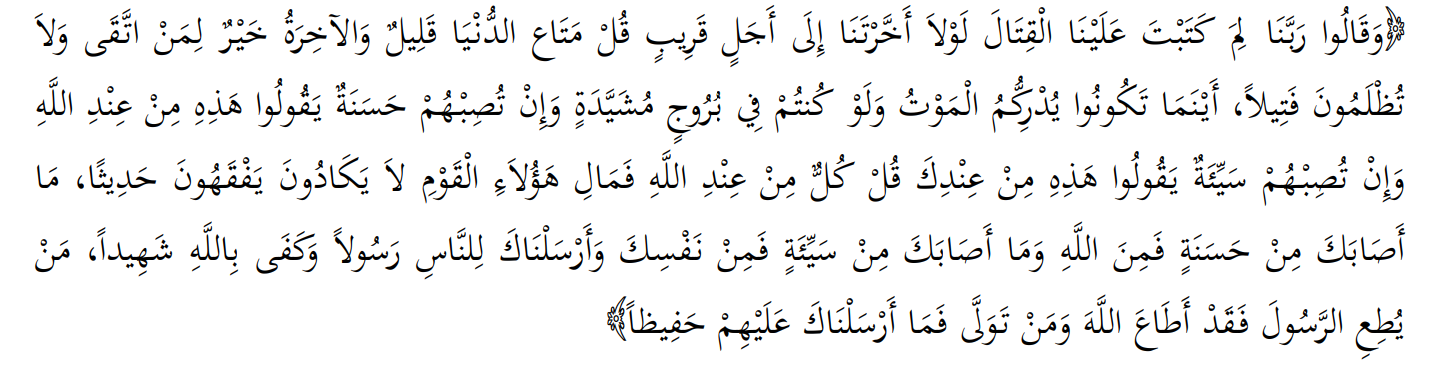
Yani öznenin, yaptıkları şey değil, başlarına gelen şey olduğu anlaşılır. Dolayısıyla bu, el-kaza ve'l-kader çalışmasıyla ilgili değildir.
So the subject is what befalls them and not what they are doing. Thus it has nothing to do with the study of al-qadā’ wa‘l-qadar.
Bu nedenle, yukarıda anlatılanların hiçbiri kader (el-kadâ' ve'l-kader) konusunun incelenmesiyle ilgili değildir; bu kavramın kapsamına girmezler ve yukarıda anlatılanlarla hiçbir ilişkileri yoktur. Aksine, bir mana olarak kader, Mu'tezile aracılığıyla aktarılan Yunan felsefesinden gelmiştir; Mu'tezile de bu konuda bir görüş ortaya koymuştur. Ehl-i Sünnet ve Cebriyye onları reddetmiş, Ehl-i Sünnet ayrıca Cebriyye'yi de çürütmüştür. Tartışma aynı anlam çerçevesinde yürütülmüş ve aynı öncüller üzerine bina edilmiştir. Dolayısıyla mesele, Yunan felsefesinden gelen bir anlam/kavramdır ve Müslümanlarla, Yunan felsefesiyle donanmış kâfirler arasında yapılan tartışmalarda öne çıkmıştır. Bu anlam akideyle ilgilidir; dolayısıyla istenen, bu anlam hakkında İslam'ın görüşünü ortaya koymaktır. Mu'tezile bir görüş ileri sürmüş, Cebriyye onları reddederek başka bir görüş ortaya koymuştur. Ehl-i Sünnet ise hepsini reddetmiş ve kendi görüşünü bildirmiştir; bu görüşün iki görüşün arasından çıkmış üçüncü bir görüş olduğunu söylemiş ve onu "dışkı ile kan arasından çıkan, içilmesi tatlı saf süt" diye tarif etmişlerdir.
Therefore, all that has been mentioned above has nothing to do with the study of al-qadā’ wa‘l qadar; they do not come under its meaning and have no relation whatsoever with what has been mentioned above. Rather, al-qadā’ wa‘l-qadar as a meaning has come from Greek philosophy which was transmitted by the Mu'tazilah who gave an opinion with regards to it. Ahl al-Sunnah and the Jabriyyah refuted them and Ahl al-Sunnah (also) made a refutation of the Jabriyyah. The discussion was confined to the same meaning and preceded upon the same premise. Thus the issue is a meaning/sense that came from Greek philosophy and it came to the fore in the debate which used to take place between the Muslims and the kuffar who used to be armed with the Greek philosophy. It is a meaning which has a relevance to the ‘aqīdah (creed), thus what is desired is to give Islam's opinion regarding this meaning. The Mu'tazilah gave an opinion and the Jabriyyah refuted them and gave another opinion. Ahl al-Sunnah refuted all of them and gave an opinion, and said about it that it is a third opinion which has come out from the two opinions and they described it as ‘the pure milk, sweet to drink, that comes out from between excrement and blood’.
Bu nedenle, Yunan felsefesinden gelen tartışma konusu ortaya çıkmış ve bilinir hale gelmiştir. Konu akideyle ilgili olduğundan, Müslüman bu konuda inancının ne olduğunu açıkça bilmelidir. Müslümanlar gerçekten de görüşlerini ortaya koymuş ve üç düşünce okulu ortaya çıkmıştır. Dolayısıyla kadâ ve kader meselesini, kadâ veya kaderin dilsel ve şer'î anlamda ne ifade ettiğine havale etmek caiz değildir; ayrıca kadâ veya kadere, sadece varsayımdan, tasavvurdan veya hayalden kaynaklanan bir anlam yüklemek ve örneğin kadânın yalnızca tümeller üzerindeki genel hüküm, kaderin ise tikel yönler ve ayrıntılar üzerindeki genel hüküm olduğunu söylemek, ya da kaderin şeyler için ezeli bir plan, kadânın ise o ön takdir ve plana göre gerçekleşen yaratma ve icra olduğunu ileri sürmek de caiz değildir. Çünkü bu, salt bir hayal, varsayım ve belli dilsel ve şer'î ifadeleri, onlara uymadıkları hâlde uygulama girişimidir; zira bu ifadeler genel anlamlara işaret eder. Delil olmaksızın bu iki kelimeyi belirli anlamlarla sınırlamak ise keyfî bir davranış olur.
Therefore, the subject of discussion, which came from the Greek philosophy, became known, and since it is related to the ‘aqīdah (creed), the Muslim must be clear as to what his belief is regarding this subject. The Muslims did actually state their opinion and three schools of thought arose. Thus it is not allowed to refer the issue of al-qadā’ wa‘l-qadar to what has come of the meaning of al-qadā’ or al-qadar, linguistically and in the Sharī’ah, nor is it allowed to imagine or conceive for al-qadā’ or ‘al-qadar any meaning from mere supposition, conception or imagination, and to say, for example, that al-qadā’ is the universal judgement on only the universals and al qadar is the universal judgement on the partial aspects and its details, or to say that al-qadar is the eternal plan for things and al-qadā’ is the execution and creation according to that predetermination and plan. Indeed, this is not allowed because this is mere imagination, assumption and a failed attempt of applying certain linguistic and shar’i expressions because they do not apply to it, they rather indicate general meanings; . It would then be an arbitrary action to restrict the two words to these specific meanings without evidence.
Benzer şekilde, el-kadā ve'l-kader'in Allah'ın sırlarından biri olduğunu ve bunu tartışmanın yasaklandığını iddia etmek caiz değildir; çünkü onun Allah'ın sırlarından biri olduğunu gösteren hiçbir şer'î nass yoktur. Üstelik konu, hakkında bir görüş bildirilmesi gereken duyularla algılanabilir bir meseledir; dolayısıyla nasıl olur da incelenemeyeceği söylenebilir?! Bunun yanında, konu akli bir araştırma niteliğindedir ve duyularla algılanabilir bir gerçeklik olarak akıl tarafından incelenen meselelerle ilgilidir; ayrıca Allah'a iman ile de ilişkilidir. Bu nedenle, konu olarak konulan ve akide (itikat) bölümü haline gelen anlamıyla el-kadā ve'l-kader incelenmelidir.
Similarly, it is not allowed to claim al-qadā’ wa‘l-qadar is a secret from amongst the secrets of Allah and that we have been forbidden to discuss it, because there is no shar’i text to say that it is one of the secrets of Allah , not to mention the fact that the subject matter is sensorially perceivable, for which an opinion must be given, so how can it be said that it cannot to be studied?! In addition to the fact that it is a rational inquiry and a subject which relates to matters that are studied by the intellect as a reality that is sensorially-perceivable; and since it relates to the imān in Allah . Thus, al-qadā’ wa‘l-qadar, in the meaning placed as the subject matter and which became part of the ‘aqīdah (creed) must be studied.
Kader (al-qadā’ ve’l-kader) meselesi, yani al-qadā’ ve’l-kader meselesi, kulların fiilleri ve şeylerdeki sıfatlar meselesidir. Çünkü bahsi geçen mesele, kulun fiilleri ve bu fiillerden ortaya çıkanlar, yani kulun şeylerde meydana getirdiği sıfatlardır: bunlar Allah'ın yaratması mıdır? Onları yaratıp var eden O mudur? Yoksa kul mudur? Onları yaratıp var eden kul mudur?
Mu'tezile'nin tamamı, kulun kendi fiillerini yaratan olduğunu söyledi: fiili yaratan ve var eden kuldur. Sıfatlar konusunda ise ihtilaf ettiler. Bazıları, insanın neden olduğu bütün sıfatları yaratanın ve onları var edenin kul olduğunu söyledi. Diğerleri sıfatlar arasında ayrım yaptı. Bunlardan bir kısmı, şeylerde kul tarafından yaratılan ve onun tarafından var edilen sıfatları kabul ederken, bir kısmı şeylerde Allah tarafından yaratılan ve O tarafından var edilen sıfatları kabul etti.
Cebriyye'ye gelince, onlar Allah'ın insanın bütün fiillerini ve insanın şeylerde neden olduğu bütün sıfatları yarattığını söylediler. Var eden O'dur; kulun fiilin yaratılmasında ve şekillendirilmesinde ya da şeyde sıfatın meydana getirilmesinde hiçbir rolü yoktur.
Ehl-i Sünnet ise kulun fiillerinin ve kulun şeylerde meydana getirdiği sıfatların Allah tarafından yaratıldığını söyledi. Ancak Allah'ın bunları, kulun fiili işlediği ve sıfatı meydana getirdiği durumda yarattığını belirttiler. Yani Allah bunları, kulun kudret ve iradesi bulunduğunda yaratır; fakat bu, kulun kendi kudret ve iradesiyle olmaz.
The question of al-qadā’ wa‘l-qadar, or in other words, the issue of al-qadā’ wa‘l-qadar, is the actions of the servants and the attributes of things. This is because the issue mentioned is the actions of the servant and what arises from these actions, that is, the attributes brought about by the servant in things: are they the creation of Allah ? Is He the one who has created them and brought them into being? Or is it the servant? Is the servant the one who created them and brought them into being? The Mu'tazilah, all of them, said that the servant is the one who creates his own actions: he is the one who creates the action and brings it into being. They differed about the attributes. Some of them said that the servant is the one who creates all of the attributes that are caused by man and he is the one who brings them into existence. Others differentiated between the attributes. Some of these made them as being created in things by the servant and brought into existence by him and part of them made them as being created in things by Allah and brought into existence by Him. As for the Jabriyyah, they said that Allah creates all the actions of man as well as all the attributes caused by man in things. He is the one who brings them into existence; the servant has nothing to do with the creation and formation of the action or in causing the attribute in the thing. Ahl us-Sunnah said that the actions of the servant and the attributes caused in things by the servant are created by Allah . But they said that Allah creates them while the servant performs the action and the servant causes the attribute. So Allah creates them when the servant has the ability and will and not by his own ability and will.
Mesele budur: el-kadâ ve'l-kader meselesi. Bu konuda ileri sürülen görüşlerin bir özeti verilmiştir. Bu görüşleri inceleyen herkes, tartışmanın üzerine kurulduğu temeli bilmelidir ki tartışma ortak bir zeminde yürüsün. Böylece sonuç, tartışmanın temelinin gerektirdiği şekilde olacak ve yanlış olmayacaktır.
El-kadâ ve'l-kader tartışmasının temeli, kulun fiilinin yaratıcısının kul mu yoksa Allah mı olduğu meselesi değildir; ne de Allah'ın iradesinin kulun fiiline bağlı olduğu ve dolayısıyla bu iradeyle birlikte var olması gerektiği meselesidir. Yine temel, Allah'ın kulun belirli bir fiili işleyeceğini bilmesi veya Onun ilminin kulu kuşatması, ya da bu fiilin Levh-i Mahfuz'da yazılı olduğu ve kulun yazılana göre hareket etmek zorunda olduğu meselesi de değildir. Gerçekten, tartışmanın temeli kesinlikle bunlardan hiçbiri değildir; çünkü bunların ceza ve mükâfat açısından konuyla bir ilgisi yoktur. Bunlar, yokluktan yaratılış, iradenin bütün ihtimallere taalluku, her şeyi kuşatan ilim ve Levh-i Mahfuz açısından meseleyle ilgilidir. Bu ise bir fiilin karşılığında ödül ve ceza olması konusundan oldukça farklıdır.
El-kadâ ve'l-kader sorusunun üzerine kurulduğu tartışma konusu, bir fiilin karşılığında ödül ve cezâ olması meselesidir; yani insan, ister iyi ister kötü olsun, bir fiili yapmakla yükümlü müdür, yoksa bir seçim hakkı var mıdır? Ve insanın bir fiili işleme konusunda seçim hakkı var mıdır, yoksa hiç seçim hakkı yok mudur? Kulların davranışlarını inceleyen kişi, insanın iki alan içinde yaşadığını görür: biri, davranışının bölgesinde bulunan ve kendisinin hakim olduğu alan; bu alanda eylemleri tamamen kendi tercihiyle gerçekleşir. Diğeri ise onun üzerinde hakim olan alandır; insan bu alanın sınırları içinde varlığını sürdürür ve bu alanda meydana gelen eylemler, ister ondan kaynaklansın ister üzerine düşsün, onun tercihi dışında gerçekleşir.
This is the issue - the issue of al-qadā’ wa‘l-qadar – and this is a summary of the opinions that have been opined about it. Anyone who scrutinises these views must know the basis on which the discussion has been built such that the discussion is on a common basis. Thus the outcome will be as required by the basis of the discussion and it will not be an incorrect one. The basis of the discussion in al-qadā’ wa‘l-qadar is not the action of the servant in terms of whether he created the action or Allah created it, nor is it the will of Allah in that His will is conditional on the action of the servant so it must exist with this will, nor is it the Knowledge of Allah in terms of Him knowing that the servant will do such and such an action or that His Knowledge encompasses the servant, or that this action of the servant is written in the Lawh al-Mahfūdh so he must act according to what has been written. Indeed, the basis of the discussion is definitely none of these things, because they have no relation to the subject from the perspective of reward and punishment; they are related to the question from the perspective of formation from nothing, the connection of the will to all possibilities, the all-encompassing Knowledge of all things and the Lawh al-Mahfūdh. This is quite different from the subject of the reward and punishment for an action.The topic of discussion on whose basis the question of al-qadā’ wa‘l qadar is built is the issue of reward and punishment for an action, that is, is man obliged to perform an action, good or evil, or does he have a choice? And, does man have the choice to perform an action, or does he have no choice? The person who scrutinises the actions of the servants sees that man lives within two spheres: one which he dominates, the sphere that is present within the region of his conduct, and within which his actions happen absolutely by his choice; the other (sphere) dominates him; he exists within its domain, and the actions that occur within it, whether they originate from him or fall upon him, occur without his choice.
Böylece, insanı egemenliği altına alan alanın içine giren fiiller üzerinde insanın ne bir seçimi vardır ne de bunların varlığı üzerinde; bunlar iki türdür: birincisi evrenin yasalarının bir gereği olan türdür, ikincisi ise evrensel yasalarca zorunlu kılınmayan türdür, her ne kadar oluşan her şey bu yasalardan kaynaklanmıyor olsa da. Evren yasalarının zorunlu kıldığı fiillere gelince, insan bunlara tamamen boyun eğer; bunlara zorunluluk olarak uyar, çünkü o, belirli bir düzene tabi olan ve değişmeyen Evren ve Hayat ile birlikte hareket eder. Dolayısıyla insanın bu alandaki fiilleri onun iradesi dışında meydana gelir, bu fiillerde zorlanır ve bir seçimi yoktur. Bu hayata iradesi dışında gelmiştir ve iradesi dışında da ayrılacaktır; yalnızca kendi bedenini kullanarak uçamaz, doğal haliyle suyun üzerinde yürüyemez, gözlerinin rengini, başının şeklini ya da bedeninin büyüklüğünü kendisi seçemez. Gerçekten de bütün bunları yaratan Allah'tır; yaratılmış insanın hiçbir etkisi veya ilgisi olmaksızın. Çünkü Allah, Evrenin yasalarını yaratmış, onların evreni düzenlemesini sağlamış ve evrenin, değiştirme yeteneği olmaksızın bunlara göre hareket etmesini kılmıştır. İkinci türe gelince, bunlar insanın kontrolünün ötesinde gerçekleşen, kaçınamadığı ve evren yasalarıyla ilgisi bulunmayan fiillerdir; bunlar ya istemeden onun aracılığıyla ya da onun üzerine gerçekleşen ve kaçınamadığı fiillerdir; örneğin birinin bir kişinin üzerine düşüp onu öldürmesi, ya da birinin bir kuşa ateş ederken istemeden bir insana isabet edip onu öldürmesi, ya da bir araba, tren veya uçağın, olayları önlemenin hiçbir imkânı olmaksızın kazaya uğraması ve bunun sonucunda yolcuların ölmesi gibi. Bu örneklerin hepsi, bir insandan ya da onun üzerine meydana gelen fiillerdir; evren yasalarına bağlı olmakla birlikte, iradesi dışında ve kontrol etme gücünün dışında gerçekleşmişlerdir ve insanı egemenliği altına alan alanın içindedirler. İnsanın egemenliği altındaki alanda gerçekleşen tüm eylemlere kaza denir; çünkü bunları yalnızca Allah takdir etmiştir ve kul bu eylemlerde irade özgürlüğü vermemiştir; bunlar hakkında onun bir seçimi yoktur. Bu nedenle insan, bu eylemlerden sorumlu tutulmaz; bunlarda insan açısından bir fayda ya da zarar bulunsun, ya da bunlar onun hoşuna gitsin ya da gitmesin, yani bunların insana göre iyi ya da kötü olması fark etmez. Bu eylemlerdeki iyiyi ve kötüyü yalnızca Allah bilir, çünkü insanın bunlar üzerinde bir etkisi yoktur; insan bunları bilmez, bunların nasıl ortaya çıktığını da bilmez ve bunları engellemeye ya da gerçekleştirmeye kesinlikle gücü yetmez. Bu yüzden bunlar için bir sevap ya da ceza yoktur. İşte kaza budur ve bu nedenle eylemin kaza ile gerçekleştiği söylenir. İnsanın bu kazaya iman etmesi ve bu kazanın, Yüce ve Ulu Allah'tan olduğuna inanması gerekir.
Thus, the actions that fall within the sphere that dominates man, man has no choice in them or in their existence; they are of two types: a type which is a requirement of the laws of the universe, and a type not necessitated by the universal laws, even though all the things (that occur) may not emanate from these laws. As for the actions necessitated by the laws of the universe, man submits to them totally; he acts according to them as a matter of compulsion, because he moves with the Universe and Life, which are subjected to a specific regulation, which does not change. Subsequently, man's actions in this sphere occur without his will, he is forced in these actions and has no choice. He came to this life without his will and he will leave it without his will; he cannot fly merely by the use of his own body, nor can he walk in his natural form on water, nor choose for himself the colour of his eyes, the shape of his head or the size of his body. Indeed, it was Allah who created all of this without any influence or relation from the created man, because Allah created the laws of the Universe, made them regulate the universe and made the universe act according to them without having the ability to change. As for the second type, they are actions which happen beyond man's control, which he cannot avoid and which are not related to the laws of the universe; they are the actions which occur either unintentionally through him or upon him and which he cannot avoid, such as if someone falls on a person and thus kills him, or if someone shoots at a bird and unintentionally hits a person and kills him, or if a car, train or plane should crash, without any possibility to avoid the incidents, and as a result the passengers die. All these examples are actions which occurred from a man or upon him - though they are bound by the laws of the universe - they happened without his will and outside his ability to control them, and they are within the sphere that dominates man. All the actions which occur within the sphere that dominates man are termed qadā, because Allah alone has decreed them, and has not given the servant the freedom of will in such actions; he has no choice with regards to them. Therefore man is not reckoned on these actions, whether, with respect to man, there is benefit or harm in them or like or dislike, that is, regardless of whether they are, according to man, good or bad; Allah alone knows the good and bad in these actions, because man has no influence on them; he does not know them or how they are brought into existence, and he is absolutely unable to avoid and bring them about. Therefore there is no reward or punishment for them. Thus this is qadā’, and it is therefore said that the action happened by qadā’. It is upon man to have imān in this qadā’ and that this qadā’ is from Allah , the Glorified and Exalted.
Kişinin hâkimiyet alanına giren fiillere gelince, bu, kişinin Allah'ın Şeriatı olsun ya da başka herhangi bir sistem olsun, seçtiği sisteme göre tercih yaparak ilerlediği alandır. Bu alan, insanın yaptığı ya da insanın içinde yer aldığı fiillerin iradesiyle gerçekleştiği alandır. Böylece insan dilediği zaman yürür, yer, içer ve yolculuk yapar; aynı şekilde dilediği zaman bunların hiçbirinden de kaçınır. Ateşle yakar, bıçakla keser; tercihine göre hareket eder; üreme, mülkiyet ve açlık içgüdülerini dilediği gibi tatmin eder. Tüm bunları, seçimiyle yapar ya da yapmaktan kaçınır. Dolayısıyla insan, bu alan içinde gerçekleşen fiillerden sorumludur. Bu nedenle ödül hak eden fiil için ödüllendirilir, ceza hak eden fiil için cezalandırılır. Bu fiillerin kaza ile bir ilgisi yoktur ve kaza da bunlarla ilgili değildir; çünkü bu fiilleri kendi iradesi ve seçimiyle üstlenen insandır. Dolayısıyla irade ve seçime dayanan fiiller, el-kaza kapsamına girmez.
As for the actions that occur in the sphere that man dominates, it is the sphere in which he proceeds with choice according to the system he chooses, whether it is the Sharī’ah of Allah or any other. This sphere is the one in which actions carried out by man or involving him occur by his will. Thus he walks, eats, drinks and travels anytime he likes; likewise he refrains from doing any of these things whenever he likes; he also burns with fire and cuts with a knife when he chooses, and he satisfies his instincts of procreation, ownership and hunger as he likes. All this he performs or abstains from, by his choice. Therefore, man is accountable on actions which occur within this sphere. Thus, he is rewarded for the action deserving reward and is punished for the action deserving punishment. These actions have nothing to do with qadā’ nor does it have anything to do with them because man is the one who undertook them with his own will and choice. Therefore, actions of choice do not come under al-qadā’.
Kader, insanın hakimiyet alanında veya kendisine hakim olan alanda, evrenin, insanın ve hayatın maddesi aracılığıyla şeyler üzerinde veya şeylerden meydana gelen ve bir etki doğuran, yani eylemden bir sonucun ortaya çıktığı fiillerle ilgilidir. Dolayısıyla insanın şeylerde sıfatlar bakımından meydana getirdiği bu mekanizma, insan tarafından mı yaratılmıştır yoksa Allah tarafından mı, tıpkı şeylerin kendilerini yarattığı gibi? Bu konuyu inceleyen kimse, şeylerde meydana gelen bu olguların insanın fiilinden değil, şeylerin sıfatlarından olduğunu görecektir. Bunun delili, insanın bu etkileri, ancak şeyin sahip olduğu ilgili sıfata sahip olan şeylerde oluşturabilmesidir. İlgili sıfata sahip olmayan şeylerde ise insan istediğini oluşturamaz. Dolayısıyla bu olgular insanın fiillerinden değil, şeylerin sıfatlarındandır.
As for al-qadar, it relates to the actions, whether they occur in the sphere which man dominates or in the sphere which dominates him, which occur from or on things through the matter of the universe, man and life, and cause an effect, that is, something results from the action; so this mechanism that man causes in things in terms of attributes, is it created by man or by Allah just as He has created the things themself. The one who scrutinises this issue will find that these matters which are caused in things are from the attributes of the things, not from the action of man, as evidenced by the fact that man is not able to form them (i.e these effects) except in the things which possess the (relevant) attribute amongst its attributes. As for the things which do not have the (relevant) attribute amongst their attributes, man is not able to cause in them what he wants. Therefore these matters are not from the actions of man but from the attributes of the things.
Böylece Allah, şeyleri yaratmış ve bunlara, onlardan Onun koyduğundan başka bir şeyin çıkmasının mümkün olmayacağı biçimde nitelikler [kaddara] koymuştur. Örneğin hurma çekirdeğine, ondan elma değil hurma ağacının büyümesi niteliğini koymuş; insan spermine de başka bir hayvan değil insanın oluşması niteliğini koymuştur. Allah, şeylerde belirli nitelikler yaratmıştır; örneğin ateşte yakma niteliğini, odunda tutuşma niteliğini ve bıçakta kesme niteliğini yaratmıştır. Bu nitelikleri, Evrenin Kanunlarına uygun olarak nesnelerin ayrılmaz ve sürekli bir parçası kılmıştır. Bu niteliklerin artık mevcut olmadığı görüldüğünde, bu Allah'ın onları ortadan kaldırdığı anlamına gelir; böyle bir olay olağandışıdır ve yalnızca peygamberler için bir mucize olarak gerçekleşir.
Aynı şekilde, Allah nesnelere nitelikler yarattığı gibi, insanda da içgüdüler ve organik ihtiyaçlar yaratmış; nesnelere nitelikler verdiği gibi, içgüdü ve organik ihtiyaçlara da belirli nitelikler vermiştir. Dolayısıyla üreme içgüdüsünde cinsel eğilimi, organik ihtiyaçlarda ise açlık niteliğini yaratmıştır. Evren kanunlarına göre bu nitelikleri onlara bağlamıştır. Allah'ın nesnelerde, içgüdülerde ve organik ihtiyaçlarda yarattığı bu belirli nitelikler "el-kader" olarak adlandırılır; çünkü şeyleri, içgüdüleri ve organik ihtiyaçları yalnız Allah yaratmış ve onlardaki niteliklerini belirlemiştir. Böylece insanda cinsel arzu oluştuğunda, gözünü açtığında gördüğü, yukarıya atıldığında taşın yukarı çıkması ve aşağıya atıldığında aşağı düşmesi, bütün bunlar insanın eylemiyle değil, Allah'ın eylemiyle gerçekleşir. Yani şeylerin tabiatında böyle olmak vardır; Allah onları yaratmış ve onlarda belirli nitelikler yaratmıştır. Dolayısıyla bu nitelikler Allah'tandır, insandan değildir. İnsanın bunlarla bir ilgisi yoktur ve onları hiçbir şekilde etkileyemez. Bu, kader demektir. Kaza ve kader konusunda kader, insanın şeylerde meydana getirdiği niteliklerdir denir. İnsanın, bu şeylerde nitelikleri belirleyenin Allah olduğuna iman etmesi gerekir.
Thus, Allah has created the things and set [qaddara] in them attributes in a manner that nothing else is possible to come from them except what He has set in them, such as setting in the date pit (the attribute) of growing date palm from it and not apple, and such the human sperm to result in humans not any other animal. Allah has created specific attributes in things, for example, He created in fire the attribute of burning, in wood the attribute of catching fire, and in the knife the attribute of cutting. He made the attributes an essential and perpetual part of the objects in accordance with the Laws of the Universe. When it appears that the attributes are no longer present, it means Allah has stripped them off, and such an event would be unusual; it only happens to the prophets as a miracle for them. Likewise, in the manner that Allah created attributes for the objects, He created in man instincts and organic needs and, as He created attributes in objects, He created in the instincts and organic needs specific attributes. Hence, in the procreational instinct Allah created the sexual inclination, and in the organic needs He created the attribute of hunger. He made these attributes adhere to them according to the laws of the universe. The particular attributes that Allah the Exlated has created in objects, instincts and organic needs are called al-qadar, because Allah alone created the things, instincts and organic needs and determined in them their attributes. Thus when the sexual desire occurs in man, when he sees upon opening his eyes and when the stone goes up when thrown upwards and down when thrown downward, all of this is not by man’s action, rather it is by the action of Allah ; meaning that it is from the nature of the things to be so, that is, Allah created them and created particular attributes in them, thus they (the attributes) are from Allah and are not from man; man has nothing to do with them, nor can he effect them in any way. This is al-qadar, and it is thus said that al-qadar in the subject of al-qadā’ wa‘l-qadar is the attributes of the things which man causes in them. It is upon man to have imān in that the one who determined the attributes in these things is Allah .
Dolayısıyla el-kaza ve'l-kader, insanın hâkim olduğu alanda gerçekleşen fiillerdir; bunların Kevnî Kanunların bir gereği olup olmadığına, insandan sadır olup olmadığına ya da ona isabet edip etmediğine bakılmaksızın, ve sonuçta nesnelerde ortaya çıkan niteliklerdir. El-kaza ve'l-kader'e iman etmenin anlamı, hayırlısı da şerrisi de Allah'tan olmak üzere, onun iradesi dışında kendisinden sadır olan ya da kendisine isabet eden ve onu defetmeye gücü yetmeyen fiillere ve insanın nesnelerde meydana getirdiği niteliklerin Allah'tan olduğuna, kuldan olmadığına ve onun bunlarla hiçbir ilgisinin bulunmadığına iman etmektir.
Bu nedenle, insanın tercih hakkına sahip olduğu fiiller el-kaza ve'l-kader konusunun dışında tutulur; çünkü bu fiiller insanın seçimiyle ondan sadır olur veya ona isabet eder. Allah insanı yaratıp nesnelere, içgüdülere ve organik ihtiyaçlara nitelikler yerleştirdiğinde ve insanda ayırt edici akıl yarattığında, fiili yapma ya da yapmama konusunda ona seçim hakkı vermiş, onu yapmaya ya da yapmamaya zorlamamıştır. Ayrıca şeylerin niteliklerinde ya da içgüdü ve organik ihtiyaçlarda, insanı fiili yapmaya ya da yapmamaya mecbur kılacak bir şey de koymamıştır. Dolayısıyla insan, Allah'ın kendisine verdiği ayırt edici akıl sayesinde fiili yapmayı ya da ondan kaçınmayı tercih eder. Allah, sorumluluğun ölçüsü olarak (sağlam) aklı kılmıştır. Bu yüzden iyilik yapana bir karşılık tayin etmiştir; çünkü aklı Allah'ın emirlerini yerine getirmeyi ve yasaklarından kaçınmayı seçmiştir. Kötülük yapana da ceza tayin etmiştir; çünkü aklı Allah'ın emirlerine karşı gelmeyi ve yasakladığını işlemeyi seçmiştir. Dolayısıyla bu tür fiillerden dolayı hesaba çekilmesi doğru ve adildir; çünkü insanın fiilleri yapma konusunda seçim hakkı vardır ve buna zorlanmamıştır. El-kaza ve'l-kader ise bu meselede hiçbir rol oynamaz; mesele, insanın fiilini seçimiyle yapmasıdır. Bu nedenle insan, kazandığından sorumludur,
Hence al-qadā’ wa‘l-qadar are the actions which occur in the sphere that dominates man, irrespective of whether they are a requirement of the Laws of the Universe or not, or if they emanate from him or fall upon him, and the attributes which results in the objects. The meaning of imān in al-qadā’ wa‘l-qadar, both the good and the bad thereof being from Allah , is (having) imān in that the actions which occur from him or upon him against his will, and he has no power to drive them away, and the attributes which man causes in the object are from Allah and are not from the servant, nor does he have anything to do with them. Thus the actions with regards to which man has a choice are excluded from the subject of al-qadā’ wa‘l-qadar, because these actions occur from man or upon him by his choice, and because when Allah created man and created the attributes in the objects and in the instincts and the organic needs, and created in man the distinguishing intellect, He gave him the choice to carry out the action, or abstain from it, and He did not oblige him to do or not do it. Nor did He make in the attributes of things, or in the instincts and organic needs anything that obliges man to do or not to do the action. Therefore man has the choice to carry out the action or abstain from it by way of the distinguishing mind that Allah bestowed him with, and He made the (sound) intellect the criteria of the accountabilty. Therefore He set for man reward for doing good, because his mind chose to carry out the orders of Allah and abstain from his prohibitions, and He also set for him punishment for doing bad, because his mind chose to disobey the the orders of Allah and commit what He had prohibited. So his accounting on such actions is true and just, because man has the choice to carry out the actions and is not compelled to do so; and al qadā’ wa‘l-qadar has nothing to do with this matter, it is a question of the man himself doing his action by choice. Therefore man is accountable for what he earns,