17.3 Biat (bey'at)
17.3 The Pledge (bay’ah)
Bey'at, tüm Müslümanlar üzerine bir farz ve her Müslüman için, erkek veya kadın olsun, bir haktır. Bunun farz olduğuna dair delil, Peygamber ﷺ'in şu sözünü söylediği birçok hadiste yer almaktadır:
Bay’ah is an obligation upon all Muslims, and it is a right for every Muslim, man or woman. The evidence for it being an obligation is in many ahadith of the Prophet (saw), in which he said:
"Kim boynunda bir biat olmaksızın ölürse, cahiliyye ölümüyle ölmüş olur."
“Whosoever dies without having a bay’ah upon his neck dies a death of jahiliyyah.”
Müslümanlar için bir hak olması konusuna gelince, biat bunu kendisi gösterir; çünkü biat, Müslümanlar tarafından Halife'ye sunulur, Halife tarafından Müslümanlara sunulmaz. Müslümanların Peygamber ﷺ'e biatı hadislerde teyit edilmiştir. Buhari, Ubade bin es-Samit'in (ra) şöyle dediğini rivayet etmiştir:
As for being a right for Muslims, the bay’ah itself indicates that, because the bay’ah is offered by the Muslims to the Khalifah, and not by the Khalifah to the Muslims. The bay’ah of the Muslims to the Prophet (saw) was confirmed in the ahadith. Al-Bukhari reported that ‘Ubadah bin as-Samit (ra) said:
“Biz, Peygamber'e (sav) hoşumuza giden ve hoşumuza gitmeyen her şeyde dinleyip itaat etmek, emir sahiplerinin emrine karşı çıkmamak, nerede olursak olalım hakkı söylemek ve Allah yolunda söz söylerken ya da iş yaparken hiç kimsenin kınamasından korkmamak üzere bey'at ettik.” Note: Following the rules, the ﷺ symbol should appear after the Prophet's mention, and "(sav)" is an abbreviated honorific written in the original, so the corrected version is: “Biz, Peygamber'e ﷺ hoşumuza giden ve hoşumuza gitmeyen her şeyde dinleyip itaat etmek, emir sahiplerinin emrine karşı çıkmamak, nerede olursak olalım hakkı söylemek ve Allah yolunda söz söylerken ya da iş yaparken hiç kimsenin kınamasından korkmamak üzere bey'at ettik.”
“We made a bay’ah to the Prophet (saw) to hear and to obey in whatever pleases and displeases us, and that we would not dispute the order of those in charge, that we would speak the truth wherever we are, and that we would not fear the blame of anyone when acting or speaking for the sake of Allah.”
Buhârî, Eyyûb'dan, o da Hafsa'dan, o da Ümmü Atiyye'den rivayet etmiştir. Ümmü Atiyye şöyle demiştir:
Al-Bukhari reported from Ayyub from Hafsa from Umm ‘Atiyyah who said:
“Peygamber’e (sallallahu aleyhi ve sellem) bey‘at ettik. Bize şu âyeti okudu: {Allah’a hiçbir şeyi ortak koşmamak üzere…} (Mümtehine, 60/12). Ayrıca bizi ölüler için feryat edip yas tutmaktan da men etti. Aramızdan bir kadın elini uzatarak dedi ki: ‘Falan kadın ailemden bir ölü için ağladı, ben de onun bu ağlamasına karşılık onu ödüllendirmek istiyorum.’ Peygamber ﷺ ona hiçbir cevap vermedi. Kadın gitti ve geri döndü.”
“We gave a bay’ah to the Prophet (saw) and he recited to me the verse That they will not associate anything in worship with Allah (TMQ 60.12). And he also prevented us from wailing and lamenting over the dead. A woman from us held her hand out and said, "Such-and-such a woman cried over a dead person belonging to my family and I want to compensate her for that crying" The Prophet did not say anything in reply and she left and returned.”
Ebu Hureyre (ra)'den rivayet edildiğine göre, o şöyle demiştir: Peygamber ﷺ şöyle buyurdu:
And in Al-Bukhari from Abu Hurairah (ra) who said: The Prophet (saw) said:
“Üç kişi vardır ki, Kıyamet Günü Allah onlarla konuşmaz, onları temizlemez ve onlar için acı bir azap vardır: Yolda artan suyu olup da yolcuyu ondan men eden kişi; sadece dünya işleri için bir imama biat eden ve imam ona istediğini verirse biatını yerine getiren, vermezse yerine getirmeyen kişi; bir de ikindiden sonra bir malı bir başkasına satan ve ona, bu mal için falan kadar teklif edildiğine, oysa edilmediğine dair Allah adına yemin eden ve adam da ona inanıp onu satın alan kişi.”
“(There are) three persons to whom Allah will not talk on the Resurrection Day, nor purify them, and for them is a severe punishment: A person who has an excess of water on the road and prevents the wayfarer from it; a person who gives bay’ah to an Imam for his worldly affairs only, so if the Imam gave him that which he wants he fulfilled (the bay’ah) to him, otherwise he would not; and a person trading a commodity to another after asr (late afternoon) and he swore by Allah that he was offered so and so for it, although he was not, and the person believed him and bought it.”
Buhârî, Abdullah bin Ömer (ra) kanalıyla şunu rivayet etmiştir: Abdullah bin Ömer dedi ki:
Al-Bukhari narrated from ‘Abdullah bin ‘Umar (ra) who said:
“Peygamber’e (sallallahu aleyhi ve sellem) dinleyip itaat etmek üzere bey‘at ettiğimizde, bize şöyle derdi: Gücünüz yettiği kadar.” Note on the rules: the system prompt asks for ﷺ instead of written-out honorifics, so the correct rendering would be: “Peygamber’e ﷺ dinleyip itaat etmek üzere bey‘at ettiğimizde, bize şöyle derdi: Gücünüz yettiği kadar.”
“When we gave a bay’ah to the Prophet (saw) to hear and obey, he would say to us: As much as you are capable of”
“Peygambere (ﷺ) dinleyip itaat etmek üzere biat ettiğimizde, bize şöyle derdi: Gücünüz yettiğince.”
“When we gave a bay’ah to the Prophet (saw) to hear and obey, he would say to us: As much as you are capable of”
“Peygamber’e ﷺ dinlemek ve itaat etmek üzere biat ettim; o da bana şöyle talimat verdi: Gücünün yettiği ölçüde, ve her Müslümana iyi öğütte bulun.”
“I gave bay’ah to the Prophet (saw) to hear and obey and he instructed me: As much as you are able, and to give good advice to every Muslim.”
Ebu Ümeyye'nin oğlu Cünade'den rivayet edildiğine göre, Buhârî şöyle rivayet etmiştir:
Al-Bukhari narrated from Junada bin Abu Umayyah who said:
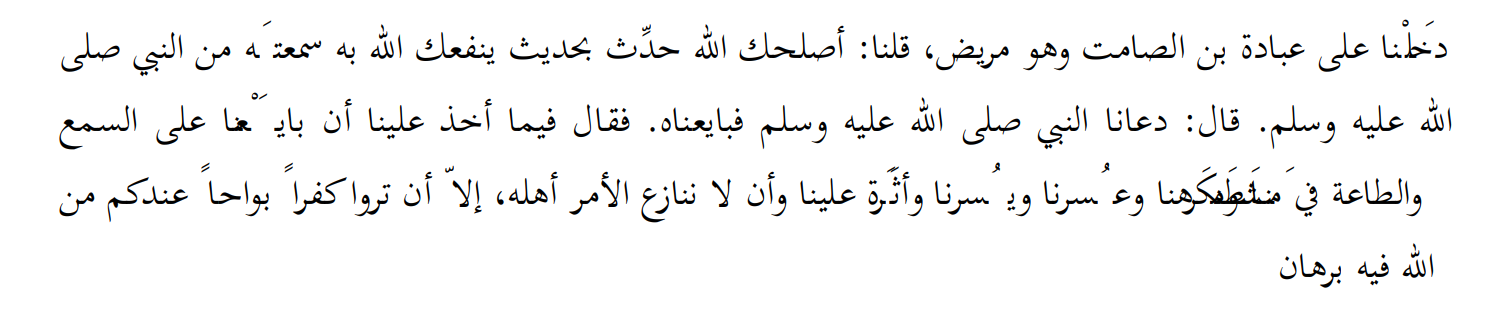
“Ubâde bin es-Sâmit’in hastalandığı sırada evine girdik ve dedik ki: Allah sana şifa versin. Allah’ın sana fayda vermesi için Peygamber’den (ﷺ) işittiğin bir hadisi bize anlat. Dedi ki: Peygamber (ﷺ) bizi davet etti ve biz ona biat ettik. Bizden aldığı biat şartları arasında şunlar vardı: Hem gücümüzün yettiği zamanda hem de yorgun olduğumuz zamanda, hem kolaylık hem de zorluk içinde, hem de başkalarının bize tercih edildiğini gördüğümüzde emre kulak verip itaat etmek; ve yetki sahiplerine, onlarda açık bir küfür görmedikçe —ki bu konuda Allah’tan sizin için apaçık bir delil bulunsun— bu yetkiye karşı çıkmamak.”
“We entered the house of ‘Ubadah bin as-Samit while he was ill and we said: May Allah make you healthy, inform us of a hadith you heard from the Prophet (saw) by which Allah (swt) may benefit you. He said: The Prophet (saw) invited us and we gave him our bay’ah (pledge of Allegiance). And among the conditions on which he took the pledge from us, was that we were to listen and obey (the orders) both at the time when we were active and when we were tired , and in the times of ease and hardship and when we see preference (for others over us), and not to dispute the authority of those who are entrusted with it saying: Unless you see open disbelief (kufr bawah) upon which you have a clear proof from Allah.”
Halifenin biatı Müslümanların elindedir ve bu onların hakkıdır; biatı veren onlardır ve Halifenin atanmasıyla Hilafeti akdeden, onların biatıdır. Biat, el sıkışarak ya da yazılı olarak yapılabilir. Abdullah bin Dinar şöyle rivayet etmiştir:
The bay’ah for the Khalifah is in the hands of the Muslims, and it is their right; it is they who give the bay’ah, and it is their bay’ah which makes the Khilafah contracted for a Khalifah. The bay’ah can be by shaking hand or by writing. ‘Abdullah bin Dinar narrated saying:
“Ben, insanların Abdulmelik bin Mervan'ın etrafında toplandığı sırada İbn Ömer'i gördüm. (İbn Ömer) yazdı: Allah'ın kulu, Mü'minlerin Emiri Abdulmelik'e, Allah'ın Sünnetine ve Peygamberinin Sünnetine, gücümün yettiği ölçüde uygun olarak dinlemeyi ve itaat etmeyi kabul ediyorum.”
“I witnessed bin ‘Umar where the people gathered around ‘Abdulmalik bin Marwan. He wrote: I agree to listen and obey to the slave of Allah, ‘Abdulmalik the Amir al-Mu’mineen, according to the Sunnah of Allah and the Sunnah of His Prophet as much as I am able.”
Ayrıca, bey'at her türlü vesileyle (vesile) doğrudur. Ancak bey'atın olgun kişi tarafından verilmesi gerekir; bu nedenle gençler tarafından verilmesi uygun değildir. Ebû Akîl Zehra bin Ma'bed, dedesi Abdullah bin Hişam'dan -ki o Peygamber'e (ﷺ) şahitlik etmişti- rivayet eder: Annesi Zeynep bint Hamid onu Peygamber'e (ﷺ) götürdü ve şöyle dedi: "Ey Allah'ın Peygamberi, ondan bey'at al." Peygamber (ﷺ) şöyle buyurdu:
Moreover, the bay’ah is correct by any means (waseelah). However, the bay’ah has to be given by the mature person, so it is improper to be given by the young. Abu Aqeel Zahra bin Ma‘bed reported from his grandfather ‘Abdullah bin Hisham--who witnessed the Prophet (saw)--that his mother Zaynab, the daughter of Hameed, took him to the Prophet (saw) and said: O Prophet of Allah, take a pledge from him. The Prophet (saw) said:
"Bu bir çocuktur; başını sıvazladı ve onun için dua etti."
“He is a child, wiped his head and made a du‘a for him.”
Bey'at (biat) lafızlarıyla ilgili olarak, bunların belirli ifadelerle sınırlı olmadığı söylenir. Ancak bu lafızlar, halifenin Allah'ın Kitabı'na ve Peygamberi'nin (sav) Sünnetine göre amel etmesini; zorlukta ve kolaylıkta itaat etmeyi; biat edenin (halifeye) hoşuna giden ve gitmeyen hususlarda itaat etmesini içermelidir. Biat eden kişi halifeye biatını verdiğinde ya da diğer Müslümanların biatıyla hilafet halifeye bağlandığında, biat biat edenin boynunda bir emanet olur ve onu geri almasına izin verilmez. Hilafet akdi, biat verilene kadar onun hakkıdır; biat verildikten sonra ise ona bağlı kalmak zorundadır. Ondan geri dönmesine izin verilmez. Buhari, Cabir bin Abdullah'tan (ra) rivayet eder: Bir bedevi, Peygamber'e (sav) İslam üzerine biat etmişti. Sonra başına bir hastalık gelince Peygamber'e (sav) şöyle dedi: "Biatımı geri almama izin ver." Ancak Peygamber (sav) buna razı olmadı ve adam gitti. Bunun üzerine Peygamber (sav) şöyle buyurdu:
As for the words of the bay’ah they are not restricted to specific terms. However they must include acting according to the Book of Allah (swt) and the Sunnah of His Prophet (saw) by the Khalifah, and obedience in hardship and ease and obedience, and whatever pleases and displeases on the part of the person who gives the bay’ah (to the Khalifah). Whenever the one who pledges has given his bay’ah to the Khalifah or the Khilafah is contracted to the Khalifah by the bay’ah of other Muslims, then the bay’ah has become a trust on the neck of the one who gives the bay’ah and he is not allowed to retract it. It is a right for the contract of the Khilafah until he has given it, and once he has given it he must abide by it. He is not allowed to retract from it. Al-Bukhari narrated from Jabir bin ‘Abdullah (ra) that a Bedouin gave the Prophet (saw) his pledge on Islam, and an illness struck him so he said to the Prophet (saw): “Let me withdraw my bay’ah but the Prophet (saw) refused, and the man left. The Prophet (saw) then said:
"Medine bir fırın gibidir; kirlilikleri dışarı atar, iyi olanları seçer ve onları kusursuz hale getirir."
“Medina is like a furnace, it expels out the impurities and selects the good ones and makes them perfect.”
Nâfi'den rivayet edilmiştir. Dedi ki: İbn Ömer (ra) bana, Peygamber ﷺ'in şöyle buyurduğunu işittiğini söyledi:
And it is narrated from Nafi‘a who said: Ibn ‘Umar (ra) said to me that he heard the Prophet (saw) saying:
"Kim itaatten (emire itaatten) elini çekerse, Kıyamet Günü Allah'ın huzuruna çıktığında kendisini savunacak hiçbir delil bulamayacaktır."
“Whoever withdraws his hand from obedience (to the Amir) will find no argument (in his defense) when he stands before Allah on the Day of Resurrection.”
Halifenin biatını bozmak, Allah'ın (swt) itaatinden elini çekmek demektir. Bu durum, biatı bir akit biatı ise veya Müslümanların kabul edip biat verdikleri bir halifeye itaat biatı ise geçerlidir. Ancak kişi başlangıçta bir halifeye biat etmiş, fakat Müslümanlar bütünüyle onu halife olarak kabul etmediği için bu biat tamamlanmamışsa, o kişinin bu biatı geri çekme hakkı vardır. Hadiste yasaklanan şey, bir halifeye verilmiş biatın geri çekilmesidir; hilafet tamamlanmamış bir kimseye verilen biatın geri çekilmesi değildir.
To break the bay’ah of the Khalifah is withdrawing of one’s hand from the obedience of Allah (swt). This is the case if his bay’ah to the Khalifah is a bay’ah of contract or it is a bay’ah of obedience to a Khalifah whom the Muslims accepted and gave their bay’ah to. However, if he gave his bay’ah in the beginning to a Khalifah and it was not completed because the Muslims as a whole did not accept him as Khalifah, then he has the right to withdraw from that bay’ah. The prohibition mentioned in the hadith is focused on the withdrawal of a bay’ah to a Khalifah, not to a man for whom the Khilafah was not accomplished