17.9 Şer'î Hükümler, Halifelik İçin Belirli Bir Kişiyi Tayin Etmemiştir
17.9 The Shar'a Did Not Designate A Specific Person For The Khilafah
Peygamber'in (sav) kendisinden sonra belirli bir kişiyi halife olarak tayin ettiği görüşü, Şer'i nasslara aykırıdır. Peygamber'in (sav) kendisinden sonra Kıyamet gününe kadar belirli kişileri halifeler olarak atadığı yönündeki ifade ise İslami nasslara daha da aykırıdır.
The view that the Messenger (saw) designated a specific person to be the Khalifah after him contradicts the Shari’ah texts. And the statement that the Messenger (saw) nominated certain persons to be Khulafaa after him until the Day of Judgement is even more contradictory to the Islamic texts.
Peygamber'in (sav) kendisinden sonra birini halife olarak tayin ettiği görüşünün geçersiz olduğuna gelince, bu birçok yoldan açıkça anlaşılmaktadır:
As for invalidating (the opinion) that the Messenger (saw) nominated the Khilafah for someone after him, this is apparent in numerous ways:
Birincisi: Bu, bay'at ile çelişir; çünkü bir kişiyi aday göstermek, Müslümanlara onların kendilerine hangi kişinin Halife olacağını bildirmek anlamına gelir. Dolayısıyla Halife bilinmiş olur ve bay'atı, Halifenin atanma yöntemi olduğu için, bay'atı teşri' etmeye gerek kalmaz. Eğer kişi önceden atanmışsa, onu atamanın yöntemini göstermeye de gerek kalmaz, çünkü o zaten atanmıştır. Bay'atın Halifeye itaat bay'atı olduğu da söylenemez; çünkü Şer'i, Halifeye ve ulu'l-emre itaati, bay'at metninden ayrı birçok başka nasta açıkça emretmiştir. İtaat, Müslümanlardan açıkça istenmiştir. Bay'at ise Müslümanlardan başka taleplerde istenmiştir; bu talepler itaat olarak değil, Hilafet için bir akit olarak ele alınmıştır. Her ne kadar itaat anlamını içersin. Bay'atın, onu nakleden tüm hadislerdeki anlamı itaat değildir; aksine, bay'atla bağlanan kişiye liderlik vermek ve bu liderliğe boyun eğmeye hazırlanmaktır. Bu nedenle bay'atı Hilafetin atanması için bir şart kılmak, Resûlullah ﷺ'in sonrasında belirli bir kişiyi Halife olarak atamasıyla çelişir. Ayrıca, sahih hadislerde gelen bay'at lafızları, herhangi bir kişi için, tahsis edilmeden ve genel (âm) olarak, kayıt konulmadan ve mutlak olarak gelmiştir. Eğer belirli bir kişi için bay'at anlamına gelseydi, genel ve mutlak olmazlardı. Hadislerin lafızları şöyledir:
First: This contradicts the pledge (bay’ah) since nominating a person means informing the Muslims as to who will be the Khalifah over them. Hence the Khalifah would be known so there would remain no need for legislating (tashri’) the pledge as the pledge is the method of appointing the Khalifah. So if he has already been appointed in advance, there remains no need to demonstrate the method of appointing him as, in fact, he has already been appointed. Nor can it be said that the pledge is the pledge of obedience to the Khalifah since the Shar’a has enunciated the obedience to the Khalifah and those in charge (ulu al-amr) in many other texts distinct from the text of the pledge. Obedience has been explicitly requested from Muslims; as for the pledge, it has been requested from Muslims in other request(s) not in consideration as being (merely) obedience, though it does include the meaning of obedience, but in consideration as being a contract for the Khilafah. Its meaning in all the ahadith that mentioned it is not obedience, rather it is about giving leadership to the one who is pledged and preparing to submit to this leadership. So making the pledge a condition for appointing the Khilafah contradicts the Messenger (saw) nominating a specific person to be Khalifah after him. Moreover, the words of the pledge which came in the correct (Saheeh) ahadith came in a general manner (‘aam) without specification (takhsees), and unrestricted (mutlaq) without any restriction (taqyeed), for anyone. Were they to mean the pledge for a specific person they would not have been general and unrestricted. The word(s) of the ahadith are:
"Boynunda bir biat olmaksızın ölen kimse,"
“He who dies without a pledge on his neck,”
"Kim bir imama biat ederse,"
“Whosoever pledges an Imam,”
Ve
And
Bir imama biat eden kimse.
“A man who pledges an Imam.”
Peygamberimizin (sav) belirli bir kişiyi kendisinden sonra halife olarak tayin ettiğini savunan görüş, biata dair genel ve kayıtsız ifadeyle çelişir ve onu geçersiz kılar. Bu nedenle, biatın halifeyi atamanın bizzat yöntemi olduğu, halifenin atanmasının ise biattan ayrı olduğu, bu yüzden önce halifenin atanıp ardından ona biat verildiği söylenemez; çünkü biat halifeyi atamanın yöntemidir ve bu, onun atanmasıyla birebir aynı olduğu anlamına gelmez. Ayrıca önce halifenin atanması ve bu atamanın tanınmasının, biattan önce zorunlu olduğu da söylenemez; zira bu, halifeyi atamanın başka bir yöntemi bulunduğu ve biatın yalnızca ona itaat içn olduğu anlamına gelir. Oysa biata dair hadislerin tamamı, biatın halifeyi atamanın yöntemi olduğunu ve bunun dışında bir yol bulunmadığını gösterir. Peygamberimizin (sav) şu sözünü dikkate alın:
The opinion that the Messenger (saw) designated a specific person to become Khalifah after him contradicts and invalidates the generality and unrestricted nature of the pledge. Therefore, it cannot be said that this means that the ba’yah is the very way of appointing the Khalifah while the appointment of the Khalifah is separate to the ba’yah, this is why the Khalifah is appointed first & then the ba’yah is given to him; one should not say this because the ba’yah is the method of appointing the Khalifah and this does not mean that it is exactly the same as his appointment. Nor should one say that it is compulsory to first appoint the Khalifah and acknowledge his appointment before giving him the ba’yah as this would mean that there is another method for appointing the Khalifah such that the ba’yah is merely for his obedience, whereas the ahadith about the ba’yah all indicate that it is the method to appoint the Khalifah and there is no other way. Consider his (saw) statement:
“Kim ki boynunda bir biat olmaksızın ölürse”;
“Whoever dies without a pledge on his neck”;
Ölen kimsenin biat yoluyla İmamını tayin etmemiş olması, açıkça anlaşılan bir durumdur ve bu, hiçbir şekilde bir İmama itaat etmeden ölen kimse anlamına gelmez. Bu da gösteriyor ki bu hadiste Peygamber ﷺ, halifenin tayin edilme yöntemini kastetmekte olup sadece itaati kastetmemektedir. Ayrıca onun ﷺ şu sözünü de dikkate alın:
It is quite explicit in meaning that whoever dies without appointing his Imam via the pledge and it does not mean in any way whoever dies without obeying an Imam. This indicates that in this hadith the Prophet means the method of appointing the Khalifah and does not mean mere obedience. Also consider his (saw) statement:
"İki halifeye biat verildiğinde, sonuncuyu öldürün";
“When the pledge is given to two Khalifahs, kill the latter”;
Bu, iki halifenin atanması hâlinde sonradan atananın öldürülmesi gerektiğini açıkça belirtmektedir. Benzer şekilde, Peygamber ﷺ'in tüm hadisleri, halifenin atanma yönteminin bu olduğunu açıkça ortaya koymaktadır. Peygamber ﷺ'in hadisleri, mutlak itaati değil, kayıtsız şartsız itaati kastetmemektedir; aksine, halifenin bu yöntemle atandığını ve atanan halifeye itaat edilmesi gerektiğini ifade etmektedir. Ayrıca, ne rivayet ne de anlam bakımından, ba'yah dışında bir halife atama yöntemini gösteren sahih tek bir hadis dahi yoktur.
This is explicit that if two Khalifahs are appointed, kill the later of them. Likewise all ahadith of the Prophet are explicit that it is the method of appointing the Khalifah. The ahadith of the Prophet are explicit in not meaning mere obedience or unrestricted (mutlaq) obedience; rather, they mean following the one appointed as the Khalifah with their meaning that this is the method of appointing the Khalifah. Further, there is not even one authenticated hadith, whether in narration or meaning, which demonstrates a method of appointing the Khalifah other than the ba’yah.
İkinci: Peygamber (sav)'den, insanlar arasında halifelik konusunda ihtilafların ve anlaşmazlıkların çıkacağını ve bu konuda rekabet olacağını belirten hadisler rivayet edilmiştir. Eğer Peygamber (sav)'den belirli bir kişinin atanmasına dair bir nass bulunsaydı, o nassın varlığında ihtilaf çıkmazdı veya Peygamber (sav) insanların o kişiyle çekişeceğini bildirirdi. Oysa nassların gelmesi, insanların aralarında ihtilaf edeceğini bildirmiş, ayrıca bu ihtilafı çözmenin yolunu ve halifelik meselesini çözümlemenin yöntemini de açıklamıştır. Müslim, Sahih'inde şöyle rivayet etmiştir: Vehb bin Bakiyye el-Vasıti bana rivayet etti, Halid bin Abdullah el-Cuzeyri bize Ebu Nadra'dan, o da Ebu Said el-Hudri'den naklen anlattı; Ebu Said şöyle dedi: Allah'ın Resulü (sav) şöyle buyurdu:
Second: Ahadith have been narrated from the Messenger (saw) indicating that there will be disputes and contentions among people about the Khilafah and competition over it. If there was a text from the Messenger (saw) concerning the appointment of a (specific) person, there would not arise a dispute in the presence of that text or the Messenger (saw) would state that people would dispute with that person. Whereas the texts came saying that people would dispute between themselves and it also clarified the method to resolve this dispute and settle the issue of the Khilafah. Muslim narrated in his Saheeh: Wahab bin Baqiyyat al-Wasiti narrated to me that Khalid bin Abdullah al-Juzairi told us from Abu Nadhra from Abu Saeed al-Khudri who said: The Messenger of Allah (saw) said:
“İki halifeye bey‘at verilirse, sonuncusunu öldürün.”
“If the pledge is given to two Khalifahs, kill the latter of them.”
Müslim, Sahih'inde şöyle de rivayet etmiştir: Züheyr bin Harb ve İshak bin İbrahim bana rivayet etti; İshak, "Bize haber verildi" dedi, Züheyr ise şöyle dedi: Bize Cerir, El-A'meş'ten, o Zeyd bin Vehb'den, o da Abdurrahman bin Abdurrabb el-Ka'ba'dan rivayet etti, o şöyle dedi: Mescide girdim. Abdullah bin Amr bin el-As, Kâbe'nin gölgesinde oturuyordu ve etrafında insanlar toplanmıştı. Ben de onlara katıldım ve onunla birlikte oturdum. Şöyle dedi: Bir yolculukta Allah'ın Resulü ﷺ ile birlikteydik ve bir konaklama yerinde durduk. Allah'ın Resulü ﷺ'ün müezzini toplu namaz için ezan okudu. Bunun üzerine hepimiz Allah'ın Resulü ﷺ'ün huzurunda toplandık. Allah'ın Resulü ﷺ de şöyle buyurdu:
Muslim also said in his Saheeh: Zuhayr bin Harb and Ishaq bin Ibrahim narrated to me, with Ishaq saying we were informed and Zuhayr said it was narrated to us by Jareer, from Al-‘Amash from Zaid bin Wahhab from Abdurrahman bin Abdurrabb al-Ka’aba who said: I entered the mosque and Abdullah bin ‘Amru bin al-‘Aas was seated in the shade of the Ka’aba with people gathered around him. So I joined them and sat with him. He said: We were with the Messenger of Allah (saw) in a voyage and we stopped at an encampment when an announcer (mu’adhin) of the Messenger of Allah (saw) announced the collective prayer. So we all gathered before the Messenger of Allah (saw) who said:

“Benden önce gelen hiçbir peygamber yoktur ki, ümmetine bildiği en hayırlı şeyi göstermesi ve bildiği en kötü şeyden onları sakındırması kendisine farz kılınmamış olsun. ... Kim bir imama biat eder, elini ve kalbinin meyvesini ona verirse, gücü yettiğince ona itaat etsin. Eğer başka biri gelip onunla çekişirse, diğerinin boynunu vurun.”
“There was no Prophet before me except that it was obligatory upon him to guide his Ummah to the best that he knew for them and warn them of the worst he knew for them until he said: Whoever pledged an Imam, giving him the clasp of his hand and the fruit of his heart, should obey him as much as he can. If another comes to dispute with him, strike the neck of the other person.”
Müslim de Sahih'inde şöyle rivayet etmiştir: Muhammed bin Beşşar bize rivayet etti; Muhammed bin Ca'fer bize rivayet etti; Şu'be bize, Ferrat el-Kazzaz'dan, o da Ebu Hazm'dan rivayet etti ki o şöyle demiştir: Ebu Hureyre'nin yanında beş yıl kaldım ve onun Peygamber ﷺ'den rivayet ettiğini işittim; Peygamber ﷺ şöyle buyurmuştur:
Muslim also narrated in his Saheeh: Muhammad bin Bashar narrated to us that Muhammad bin Ja’far narrated to us that Shu’ba narrated to us from Furrat al-Qazzaz from Abu Hazm who said: I remained with Abu Hurayra for five years and heard him narrate from the Prophet (saw) who said:
İsrailoğulları'nın, işlerini siyasetçiler gibi yürüten peygamberleri vardı (tasusuhum). Bir peygamber öldüğünde, onu bir başkası izlerdi. Ancak benden sonra peygamber yoktur, fakat halifeler olacak ve bunlar çok olacaktır. Dediler ki: Bize ne emredersin? Buyurdu ki: Biat sözünü birbiri ardınca yerine getirin.
“The children of Israel had Prophets taking care of their affairs as politicians (tasusuhum). Whenever one Prophet died, another followed him. However, there will be no Prophet after me but there will be Khulafaa who will be many. They said: What do you command us? He said: Fulfil the pledge one after the other.”
Müslim, Sahîh'inde şöyle rivayet etmiştir: Osman bin Ebî Şeybe bize rivayet etti; Yûnus bin Ebî Ya'fûr onlara babasından, o da Arfece'den rivayet etti; Arfece şöyle dedi: Allah'ın Elçisi ﷺ'in şöyle buyurduğunu işittim:
Muslim narrated in his Saheeh: Uthman bin Abu Shayba narrated to us that Yunus bin Abu Ya’fur narrated to them from his father from Arfaja who said he heard the Messenger of Allah (saw) saying:
“Kim, bütün işleriniz tek bir adamın yönetiminde birleşmişken, isyan çıkarmak veya birliğinizi bölmek niyetiyle ortaya çıkarsa, onu öldürün.”
“Whoever finds when all your affairs have been united under one man, intending to incite rebellion or divide your unity, kill him.”
Bu, hilafetin tüm Müslümanların hakkı olduğu ve herkesin onun için yarışabileceği anlamına gelir. Bu durum, Elçi'nin (sav) kendisinden sonra halife olması için belirli bir kişiyi tayin ettiği görüşüyle çelişmektedir.
This means that the Khilafah is the right of all Muslims such that anyone can contend for it. This contradicts the (saying that) the Messenger (saw) nominated a specific person to be the Khalifah after him.
Üçüncüsü: Halife anlamına gelen "İmam" kelimesiyle gelen hadisler, bu kelimeyi belirtisiz bir biçimde kullanmıştır; belirtili bir biçimde geldiğinde ise ya cins "el"i ile belirtili gelmiş ya da bir topluluk ismine bağlanmıştır. "El" ile belirtili gelen ihtimallerde, cümlenin delaleti ile bu "el" cins "el"idir. Peygamber ﷺ şöyle buyurmuştur:
Third: The ahadith which came with the word Imam denoting the Khalifah came with this word in an unspecified form; and when it came in an specified one, it either came specified with “the” (“al”) of the species or related to a collective noun. In the possibilities which came specified with “al”, it was the “al” of species by evidence of the sentence. The Messenger said:
“İmama biat eden kimse”,
“Whoever pledges an Imam”,
"…adil olmayan bir İmam'a karşı durdu",
“…stood against an unjust Imam”,
"Benden sonra imamlar olacak."
“there will be Imams after me.”
Ve şöyle dedi:
And he said:
"İmam, insanlar üzerinde bir çoban (râʿî) olan ve tebaasından sorumlu olan kişidir."
“The Imam is the one who is a guardian (ra’i) over the people and he is responsible for his citizens”,
Şüphesiz İmam, arkasında savaşılan ve onun sayesinde korunulan bir kalkandır.
“Verily the Imam is a shield from behind whom they fight and by whom they are protected”
ve dedi ki:
and he said:
"…Müslümanların İmamına",
“…to the Imam of the Muslims”,
"En iyi imamlarınız",
“The best of your Imams”,
"…en kötü imamlarınızdan."
“…the worst of your Imams.”
Tüm bunlar, Elçi'nin (sav) halifenin kim olacağı konusunu, belirli bir kişiyi tayin etmeden, belirsiz bıraktığına işaret etmektedir. Elçi'nin (sav) hilafet için belirli bir kişi tayin etmediği, bunun yerine tüm Müslümanların bir hakkı olarak bıraktığı, açıkça bu işarettedir. Buna, bazı nasların çoğul (cem') ifadeyle geldiği eklendiğinde, imamın belirli bir kişi olmasını reddeden açık bir nas ortaya çıkmaktadır.
All this indicates that the Messenger (saw) left the issue concerning who would be the Khalifah after him unspecified without specifying him. This is explicit in its indication that the Messenger (saw) did not designate a specific person for the Khilafah but rather left it as a right for all Muslims. When you add to this that some texts came with the collective (jam’u) language, this becomes a clear text in negating the Imam being a specific person.
Dördüncüsü: Sahabe (ra), zamanlarında aralarından kimin halife olacağı konusunda ihtilaf etti. Kişiler arasındaki bu ihtilaf, Elçinin (sav) halifelik için belirli bir kişiyi tayin etmediğinin delilidir. İhtilaf edenlerin arasında, Elçinin (sav) halifeliklerini dile getirdiği kişiler de vardır; bunlar Ebu Bekir (ra) ve Ali (ra)'dir. Aralarındaki bu ihtilafa rağmen, bunlardan hiçbiri halifeliğin kendisine ait olduğuna dair Elçiden (sav) bir nass bulunduğunu ileri sürmedi; sahabeden hiçbiri de belirli kişiler için genel olarak bir nass olduğunu öne sürmedi. Eğer herhangi bir nass olsaydı, onlar birbirleriyle tartışırdı; dolayısıyla hiçbir nassa dayanarak tartışmamaları, halifelik için belirli bir kişiye ait bir nassın bulunmadığı anlamına gelir. Ayrıca, kendilerinden sonra bilinen ancak onlara ulaşmamış bir nass olduğu da söylenemez; çünkü dinimizi sahabeden alırız. Kur'an'ı bize ulaştıran ve hadisleri bize rivayet edenler onlardır. Dolayısıyla sahabeden gelen bir nass ya da herhangi bir rivayet yoksa, bu hiçbir şekilde kabul edilmez. Onlardan gelen her şeyi alır, onlardan gelmeyeni ise bir kenara atarız. Elçiden (sav) sonra halife için bir nass olup olmadığı meselesinde görürüz ki, Ebu Bekir (ra) ve Ali (ra) dahil tüm sahabe, istisnasız olarak, belirli bir kişi için halifelikle ilgili bir nassın bulunmadığı konusunda ittifak etmiştir; çünkü konuşmanın gerekliliğine ve eğer varsa nassı zikretmenin zorunluluğuna rağmen bunu dile getirmemişlerdir. Bu da Elçinin (sav) halifelik için bir kişiyi tayin etmesinin geçersizliğini gösterir. Nassı dile getirmemelerinin, Müslümanların birliğini korumak için alınan bir tedbirden kaynaklandığı da söylenemez; çünkü bu, Allah'ın bir hükmünü gizlemek ve tam da acilen gerektiği anda, özellikle Müslümanlar için bu kadar önemli bir konuda, onu tebliğ etmemek anlamına gelir. Bu din içinde gizlenme, Allah'ın dininde, Resulullah'ın (sav) Sahabileri'nden (ra) çıkmış olması mümkün değildir.
Fourth: The Sahabah (ra) differed in their time about the persons to be the Khalifah among them. This difference among persons is evidence that the Messenger (saw) did not designate a specific person for the Khilafah. Among the very people who differed are those of whom it is said that the Messenger enunciated upon their Khilafah, namely: Abu Bakr (ra) and Ali (ra). Despite their differences, none of them ever argued that there was a text from the Messenger (saw) that the Khilafah is for him nor did any of the Sahabah (ra) argue that there was a text for certain people in general. Were there any text, they would have argued with them; so their failure to argue using any text means that there is no text for a specific person for the Khilafah. Nor should anyone say that there is a text which was known after them but it did not reach them, because we take our deen from the Sahabah (ra). They are the ones who conveyed the Qur’an, and narrated the hadith, to us. So if there is no text or any text from the Sahabah (ra), then it is not recognised in any way. We take whatever came from them while throwing away whatever did not come from them. In relation to the issue of a text for a Khalifah after the Messenger (saw), we find that all the Sahabah (ra) without exception including Abu Bakr (ra) and Ali (ra) agreed upon the absence of any text for a specific person for the Khilafah due to their failure to mention this despite the need for speaking and the necessity for mentioning the text if it existed. This indicates the invalidity of the Messenger (saw) designating a person for the Khilafah. Nor should one say that the failure to mention the text was due to the precaution to preserve the unity of the Muslims for this means hiding a rule of Allah and not delivering it at the very time it was urgently required, particularly in such an important matter for the Muslims. This hiding in the deen of Allah is not possible to come from the Sahabah (ra) of the Messenger of Allah (saw).
"Eğer bir halife atarsam, gerçekten benden daha hayırlı biri de bir halife atamıştır, yani Ebu Bekir'i. Eğer atamazsam, benden daha hayırlı biri de atamamıştır, yani Allah'ın Resulü ﷺ."
“If I appoint a Khilafah, verily one better than me did appoint a Khalifah i.e. Abu Bakr. And if I do not, then one better than me did not i.e. the Messenger of Allah (saw).”
Muslim, İbn Ömer'den rivayet etmiştir ki Ömer bin el-Hattab (ra) şöyle demiştir:
Muslim narrated from bin Umar that Umar bin al-Khattab (ra) said:
Gerçekten Allah ‘azze ve celle dinini koruyacaktır. Eğer bir halife atamazsam, Allah'ın Resulü de atamamıştı; eğer atarsam, Ebu Bekir de atamıştı.
“Verily Allah ‘azza wa jall will preserve the deen. If I do not appoint a Khalifah, verily the Messenger of Allah (saw) did not appoint; and if I do appoint, verily Abu Bakr did appoint.”
Bu, Elçi'nin (sav) bir halife atamadığının açık bir metnidir. Ayrıca bunun Ömer'in görüşü olduğunu söylemek de doğru olmaz; çünkü bir sahabi "Elçi (sav) şunu yaptı ya da yapmadı; onun zamanında şöyle idik ya da onun zamanında şöyle şöyle vardı" dediğinde, bu, yalnızca bir sahabinin görüşü değil, delil olarak kullanılan bir hadistir. Üstelik Ömer (ra) bunu Sahabe'nin (ra) işitebileceği ve görebileceği bir ortamda söylemiştir; Ali (ra) da oradaydı ve bu söz kendisine ulaştığında buna karşı çıkmadı, bu da Ömer'in (ra) rivayet ettiği konuda onların mutabakat içinde olduğunu gösterir.
This is a clear text that the Messenger (saw) did not appoint a Khalifah. Nor should one say that this is Umar’s opinion for when a companion says, ‘The Messenger (saw) did this or did not do this or we were in his time like this or there was in his time such and such’, this is a hadith used as evidence not merely a companion’s view. Moreover, Umar said this within the hearing and sight of the Sahabah (ra), and Ali (ra) was present and this statement reached him and he did not oppose it, which indicates their agreement upon what Umar (ra) narrated.
Bütün bunlar, halifelik için belirli bir kişiyi tayin eden açık bir nassın bulunmadığı varsayımına dayanmaktadır. Belirli bir kişinin halifeliğe tayin edildiğini ileri sürenlerin getirdiği nasslara gelince, bunlar arasında Resûlullah ﷺ'in kendisinden sonra halife olması için Ebû Bekr (ra)'i tayin ettiğini gösteren rivayetler bulunduğu gibi, Ali (ra)'yi kendisinden sonra halife tayin ettiğini gösteren rivayetler de vardır. Bunları sunmalı ve içeriklerini açıklamalıyız.
This is all with respect to the absence of any specific text designating a specific person for the Khilafah. As for the texts brought by those who say that there are texts designating a specific person, among these texts are those brought to indicate that the Messenger appointed Abu Bakr (ra) to become Khalifah after him whereas others are brought to indicate that he appointed Ali (ra) as the Khalifah after him. We must present them and explain their contents.
Ve Peygamber'in (sav) Ebu Bekir'i (ra) atadığını söyleyenlerin getirdiği rivayetler ikiye ayrılır: Birincisi, Peygamber'in (sav) Ebu Bekir'i (ra) övdüğü, ancak onun atandığına dair hiçbir işaret içermeyen rivayetlerdir. İkincisi ise bazılarının Peygamber'in (sav) Ebu Bekir'i (ra) atadığını, bazılarının da onu tayin ettiğini delil çıkarımıyla ileri sürdüğü rivayetlerdir. Bunlardan bazılarını örnek olarak sunarak onların yöntemini ortaya koyacağız; ancak hiçbirinin övgü anlamının ötesine geçmediğini belirtelim.
As for the texts brought by those who say the Messenger (saw) appointed Abu Bakr (ra), they are divided into two: One portion in which the Messenger (saw) praises Abu Bakr (ra) wherein there is nothing to indicate that the Messenger (saw) appointed him. The other portion is one wherein some deduce by deduction that the Messenger (saw) appointed Abu Bakr (ra) while others deduce that he nominated Abu Bakr (ra). We will present their model by presenting some of them, noting that none of them exceed the meaning of praise.
"Şüphesiz bana, sohbetiyle ve malıyla en çok iyilik eden kişi Ebu Bekir'dir. Rabbimden başkasını halîl (samimi dost) edinseydim, Ebu Bekir'i edinirdim; fakat (onun yerine) İslam kardeşliği ve onun sevgisi vardır. Mescitte, Ebu Bekir'in kapısı dışında, açık kalan hiçbir kapı bırakılmamalıdır."
“Verily the most gracious of people to me in his companionship and wealth is Abu Bakr. Were I to take an intimate friend (khaleel) other than my Lord, I would have taken Abu Bakr (ra) but instead there is the brotherhood of Islam and its love. There should not remain in the mosque any door but that it should be closed except for the door of Abu Bakr.”
Muslim de bu hadisi farklı bir lafızla rivayet etmiştir, ancak bunlara benzer lafızlardadır. Bu hadiste, birinin Ebu Bekir'i (ra) halife olarak atadığı sonucuna varmasını sağlayacak hiçbir şey yoktur. İçerdiği tek şey, Resulullah'ın (ﷺ) Ebu Bekir'e (ra) övgüsüdür; Resulullah (ﷺ) ise birçok sahabiyi adlarıyla övmüştür. Ömer (ra), Osman (ra), Ali (ra), Sa'd bin Ebi Vakkas (ra), Talha (ra), Zübeyr bin Avvam (ra), Ebu Ubeyde bin el-Cerrah (ra), Hasan (ra) ve Hüseyin (ra), Zeyd bin Harise (ra), Üsame bin Zeyd (ra), Abdullah bin Cafer (ra), Hatice (ra), Aişe (ra), Resulullah'ın (ﷺ) kızı Fatıma (ra), Ümmü Seleme (ra), Bilal (ra) ve başkalarını övdüğüne dair hadisler de gelmiştir. Övgünün kendisi, hiçbir şekilde halifeliğe atanmayı göstermez.
Muslim also narrated this hadith but with different wording, although similar to these ones. There is nothing in this hadith to make a person say that he appointed Abu Bakr (ra) as Khalifah. All that it contains is praise for Abu Bakr (ra) from the Messenger (saw), and the Messenger (saw) praised many companions by name. There have come ahadith with praise for Umar (ra), Uthman (ra), Ali (ra), Sa’d bin Abu Waqqas (ra), Talha (ra), Az-Zubayr (ra), Abu ‘Ubaydah bin al Jarrah (ra), Al-Hassan (ra) and Al-Hussein (ra), Zayd bin Haritha (ra), Usama bin Zayd (ra), Abdullah bin Ja’far (ra), Khadija (ra), Aisha (ra), Fatima (ra) daughter of the Prophet (saw), Umm Salamah (ra), Bilal (ra) and others. Praise by itself does not in any way whatsoever indicate appointment to be Khalifah.
Ebu Bekir'in (ra) halifeliğini bazılarının çıkardığı hadislere gelince, bunlar, içerdiklerini tek tek sunup açıklayacağımız dört hadistir. Bu hadisler şunlardır:
As for the ahadith from which some deduced the Khilafah of Abu Bakr (ra), they are four ahadith which we will present and clarify all that they contain. These ahadith are:
Birinci: El-Buhari, Kasım bin Muhammed'in (ra) şöyle dediğini rivayet etmiştir:
First: Al-Bukhari narrated from Al-Qasim bin Muhammad (ra) who said:
Âişe şöyle dedi: "Ah başım!" Bunun üzerine Allah'ın Resulü ﷺ şöyle buyurdu: "Bu gerçekleşse ve ben sağ olsaydım, senin için bağışlanma diler ve dua ederdim." Âişe şöyle dedi: "Bu ciddi bir konu. Allah'a yemin ederim ki, ben öldüğümü ve bu gerçekleştiğini, sonra da kalan günlerini eşlerinden bazılarıyla mutlu bir evlilik içinde geçirmeyi istediğini düşünüyorum." Peygamber ﷺ şöyle buyurdu: "Aksine, asıl ağrıyan benim başımdır. Ebu Bekir'i ve oğlunu çağırıp ona bir söz (ahd) vermeyi niyetlendim ya da planladım ki, hiç kimse bir şey söylemesin ve hiçbir istekli bir şey temenni etmesin. Sonra şunu dedim: Allah reddeder ve müminler engeller ya da Allah engeller ve müminler reddeder."
“Aisha said: O my head so the Messenger of Allah (saw) said: If it were to happen and I were alive, I would ask for you to be forgiven and pray for you. Aisha said: That is a serious matter. By Allah, I believe that you would like my death so that it if happened, you would spend the rest of your days wedded happily with some of your wives. The Prophet (saw) said: Rather it is my head which is heavy. I intended or planned to send for Abu Bakr and his son so as to give him a promise (‘ahd) so that no person will speak or a wisher wish. Then I said that Allah will reject and the believers prevent that or Allah will prevent and the believers reject.”
Müslim, bu hadisi Âişe (ra)'dan, onun ifadesiyle şu lafızla rivayet etmiştir: Allah'ın Elçisi ﷺ hastalığında bana şöyle buyurdu:
Muslim narrated this hadith from Aisha (ra) in this wording from her: The Messenger of Allah (saw) said to me in his illness:
“Babanız Ebu Bekir'i ve kardeşinizi bana çağırın, bir kitap yazayım; zira birinin temenni edeceğinden ya da bir konuşanın 'Ben daha üstünüm (ya da önceliğe sahibim)' diyeceğinden korkuyorum. Ama Allah reddedecek; mü'minler de öyle, Ebu Bekir hariç.”
“Call for me your father, Abu Bakr, and your brother so that I write a book for I fear that a wisher will wish or a speaker say: I am better (or take precedence). But Allah will reject, and so the believers, except for Abu Bakr.”
İkincisi: Buhari, Muhammed bin Cübeyr bin Mut'im'den, onun babasından naklettiğine göre şöyle demiştir:
Secondly: Al-Bukhari narrated from Muhammad bin Jubayr bin Mut’im from his father who said:
Bir kadın Peygamber'in (saw) yanına gelmiş ve ona bir konu hakkında konuşmuştur; o da kadına kendisine geri dönmesini emretmiştir. Kadın şöyle demiştir: Ey Allah'ın Elçisi, ya gelip sizi bulamazsam — sanki ölümü kastediyordu — ne olacak? Bunun üzerine Peygamber ﷺ şöyle buyurmuştur: Beni bulamazsan, Ebu Bakr'a git.
“A woman came to the Prophet (saw) and spoke to him about something; and he commanded her to return to him. She said: O Messenger of Allah, what if I came and did not find you—as if she meant death—so he said: If you do not find me, then go to Abu Bakr.”
Müslim, bu hadisi Muhammed bin Cübeyr bin Mut'im'in babasından naklettiği şu sözlerle rivayet etmiştir:
Muslim narrated this hadith from Muhammad bin Jubayr bin Mut’im from his father in the words:
Bir kadın Allah'ın Elçisi'ne (sav) bir şey sordu ve ona geri dönmesini emretti. Kadın dedi ki: Ey Allah'ın Elçisi, gelip sizi bulamazsam ne olacak? —Babam dedi ki: Sanki kastettiği ölümdü— bunun üzerine (Peygamber ﷺ) şöyle buyurdu: Beni bulamazsan, o zaman Ebu Bekir'e git.
“A woman asked the Messenger of Allah (saw) something and he commanded her to return to him. She said: O Messenger of Allah, what if I come and do not find you—My father said: As if she meant death—so he said: If you do not find me, then go to Abu Bakr.”
Üçüncüsü: Buhârî, müminlerin annesi Âişe'den (ra) rivayet etmiştir,
Thirdly: Al-Bukhari narrated from Aisha (ra), the mother of the believers,
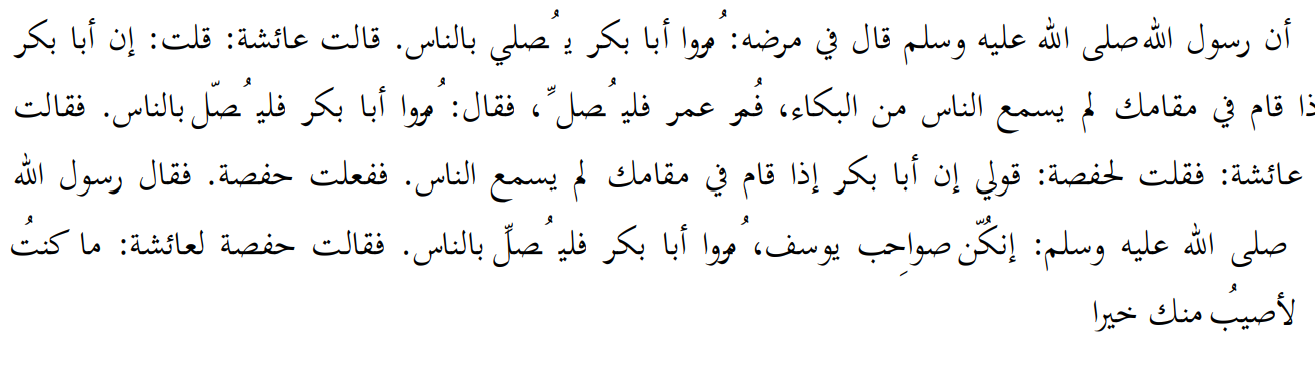
Allah'ın Resulü'nün hastalığı sırasında bana şöyle dediğini aktarmıştır: "Ebu Bekir'e insanlara namaz kıydırmasını emret." Aişe dedi ki: Dedim ki: "Ebu Bekir senin yerinde durduğunda, ağlamasından dolayı insanlar onu duymaz, bu yüzden Ömer'e namaz kıydırmasını emret." Resulullah ﷺ dedi ki: "Ebu Bekir'e insanlara namaz kıydırmasını emret." Aişe dedi ki: Hafsa'ya dedim ki: "Ebu Bekir senin yerinde durduğunda insanlar onu duymaz, de bunu." Hafsa da öyle yaptı. Allah'ın Resulü ﷺ dedi ki: "Siz Yusuf'un yoldaşlarına benziyorsunuz. Ebu Bekir'e insanlara namaz kıydırmasını emret." Hafsa, Aişe'ye dedi ki: "Senin sayesinde asla bir hayır elde edemeyeceğim!"
“That the Messenger of Allah (saw) told me during his illness: Command Abu Bakr to lead the people in prayer. Aisha said: I said: When Abu Bakr stands in your place, people do not hear him for his crying so command Umar to lead prayers. He said: Command Abu Bakr to lead people in prayer. Aisha said: I said to Hafsa: Say that when Abu Bakr stands in your place, the people do not hear, and she did that. The Messenger of Allah (saw) said: You are like the companions of Yusuf. Command Abu Bakr to lead the people in prayer. Hafsa said to Aisha: I will never achieve any good through you!”
Dördüncüsü: Müslim, İbn Ebî Müleyke'nin şöyle dediğini rivayet etmiştir:
Fourthly: Muslim narrated from bin Abu Mulkiyya who said:

“Hz. Aişe'ye şöyle sorulduğunu duydum: Allah'ın Elçisi ﷺ, eğer bir halife atasaydı, kimi onun ardından halife atardı? O da şöyle dedi: Ebu Bekir. Ona: Peki Ebu Bekir'den sonra kim? diye soruldu. O: Ömer, dedi. Sonra ona: Peki Ömer'den sonra kim? diye soruldu. O da: Ebu Ubeyde bin el-Cerrah, dedi ve orada durdu.”
“I heard Aisha being asked: Whom would the Messenger of Allah (saw) have appointed as Khalifah after him had he so appointed? She said: Abu Bakr. She was asked: Then whom after Abu Bakr? She said: Umar. She was then asked: Then whom after Umar? She said: Abu ‘Ubaydah bin al-Jarrah, and she stopped at that.”
Bu ahadislerin hiçbiri, Peygamber ﷺ'in Ebu Bekir (ra)'i halife olarak atadığına dair uygun bir delil değildir. Birinci hadis iki sebepten dolayı reddedilir. Birincisi, Peygamber ﷺ şöyle buyurmuştur:
All these ahadith are not suitable evidence for the Messenger (saw) appointing Abu Bakr (ra) as Khalifah. The first hadith is rejected for two reasons: The first is that the Messenger (saw) said:
"Arzuladığı veya niyet ettiği"
“I wished or intended”
Ama o böyle yapmadı, dolayısıyla bu bir delil değildir. Çünkü şer'î delil, Resulullah'ın (sallallahu aleyhi ve sellem) sözü, fiili veya takriridir; bunların dışında kalan hiçbir şey şer'î delil sayılmaz. İkincisi, Aişe (radıyallahu anha) Ebu Bekir'in kızıdır; bu hadis mevcut olsaydı, Ebu Bekir'i (radıyallahu anh) bilgilendirirdi. Ensar, aralarından bir halife seçmek üzere biat etmek için toplandığında, Ebu Bekir'in Sakîfe avlusuna giderek onlarla tartışması sırasında bu hadisle karşı çıkardı. Bu nedenle bu hadis reddedilmiştir (merduddur) ve Ebu Bekir'in (radıyallahu anh) halife olarak atanmasına delil olmaya elverişli değildir.
But he did not do so, so this is not an evidence. For the evidence is the Messenger’s (saw) saying, action or silent consent; anything other than these is not considered Shari’ah evidence. Secondly, Aisha (ra) is Abu Bakr’s daughter so were this hadith present she would have informed Abu Bakr (ra). Then he would have argued with it when he went to the courtyard (saqeefa) to contend with the Ansar when they gathered to pledge allegiance to a Khalifah amongst them. Therefore this hadith is rejected (mardud) and is unsuitable to be an evidence for the appointment of Abu Bakr (ra) as Khalifah.
İkinci hadise gelince, bu hadis Ebu Bekir'in (ra) halife olarak atandığına delalet etmez, çünkü kadın "Eğer seni bulamazsam" demiştir; dolayısıyla onu bulamamış olması, bir savaşta ya da başka bir işte bulunmaması nedeniyle olabilir. Onun "Eğer seni bulamazsam" sözüyle senin vefat ettiğini kastettiğine dair hadiste bir şey yoktur. Hadiste geçen "Sanki ölümü kastediyormuş gibi" sözleri Cübeyr'in sözleri ve onun anlayışıdır. Dolayısıyla Peygamber'in (sav), kadın gelip de Ebu Bekir'i bulamazsa ona gitmesi yönündeki emri, Ebu Bekir'in Peygamber'den (sav) sonra halife olarak atanmasına delil değildir. Kadının anlayışını ölüm anlamında almak zorunda kalsak bile, bu sözler Ebu Bekir'i Peygamber'den (sav) sonra halife olarak belirlemez. Üçüncü hadise gelince, bu, namaz konusunda bir atama olup başka bir şey değildir. Namaz konusunda atanmak, yönetim (hukm) konusunda atanmak anlamına gelmez. Onların "Allah'ın Resulü onunla din işinde razı olmuştur, o halde dünya işinde de onunla razı olmamız gerekmez mi?" sözüne gelince, bu onların anlayışıdır ve yanlıştır, çünkü namaz ile yönetim arasında büyük bir fark vardır. Namazda imam olmaya uygun olan herkes, yönetimde lider olmaya da uygun değildir. Üstelik metin namaza özgüdür; bu yüzden başka şeyleri kapsamaz ve metnin özgüllüğü (hususiyyet) nedeniyle başka şeylere de yorumlanmamalıdır.
As for the second hadith, it does not indicate the appointment of Abu Bakr (ra) as Khalifah because the woman said: “If I did not find you”; so it is correct that she failed to find him due to his absence in a war or any other matter. There is nothing in it to indicate that she meant by her words “If I did not find you” that you had died. The words which came in the hadith “As if she meant death” are the words of Jubayr and his understanding. So the Messenger’s command for her to go to Abu Bakr (ra) if she came and did not find him is no proof for the appointment of Abu Bakr (ra) as Khalifah after the Messenger (saw). Even if we were compelled to take her understanding to mean death, these words still would not designate Abu Bakr as Khalifah after him (saw). As for the third hadith, this is the appointment over prayer and nothing else. Appointment over prayer does not mean appointment in authority (hukm). As for their statement: “The Messenger of Allah was pleased with him in a matter of the deen, so should we not be pleased with him in a matter of the world (dunya)”; this is their understanding, and it is erroneous because there is a large difference between prayer and ruling. Not all who are suitable to become a leader (Imam) in prayer are suitable to be a leader in ruling. Moreover, the text is specific to prayer so it does not encompass other things, nor should it be taken to mean other things due to the specificity (khususiyya) of the text.

"Allah Resulü ﷺ şöyle buyurdu: Yarın bayrağı, Allah'ın onun elleriyle fetih vereceği birine vereceğim." Dedi ki: "Bu yüzden insanlar bayrağın kime verileceğini düşünerek geceyi geçirdiler. Sabah olunca herkes, bayrağın kendilerine verilmesi umuduyla erkenden Allah Resulü ﷺ'in yanına gitti. Ancak Peygamber ﷺ, 'Ali bin Ebi Talib nerede?' diye sordu. Dediler ki: 'Ey Allah'ın Resulü, gözleri ağrıyor.' Dedi ki: 'Onu bana çağırın.' Geldiğinde, Peygamber ﷺ gözlerine tükürdü ve onun için dua etti. Sanki hiç ağrısı olmamış gibi iyileşti ve Peygamber ﷺ ona bayrağı verdi."
“That the Messenger of Allah (saw) said: I will give the flag (rayah) tomorrow to someone by whose hands Allah will conquer. He said: So the people spent the night thinking which one of them it would be given to. When people woke up, they went early in the morning to the Messenger of Allah (saw) hoping it would be given to them, but he said: Where is Ali bin Abi Talib? They said: His eyes are paining O Messenger of Allah. He said: Send for him to come to me. When he came, he spit in his eyes and prayed for him. He was cured as if he never had pain, and he gave him the flag.”
Müslim, bu hadisi Ebû Hureyre'den şu sözlerle rivayet etmiştir:
Muslim narrated this hadith from Abu Hurairah with the words:

Allah'ın Elçisi (saw) Hayber günü şöyle buyurdu: "Bu bayrağı Allah'ı ve Elçisini seven, Allah'ın kendisi eliyle fetih vereceği birine vereceğim." Ömer bin el-Hattab dedi ki: "O güne kadar hiçbir zaman liderlik istememiştim, ancak o gün. Kendimi bu iş için çağrılacağımı umarak gözümde canlandırmıştım." Dedi ki: "Allah'ın Elçisi ﷺ Ali bin Ebi Talib'i çağırdı ve bayrağı ona verdi."
“The Messenger of Allah (saw) said on the day of Khayber: I will give this flag to someone who loves Allah and His Messenger by whose hands Allah will conquer. Umar bin al-Khattab said: I had never wished for leadership except for that day. He said: I visualised it hoping that i would be called for it. He said: The Messenger of Allah (saw) called Ali bin Abi Talib and gave him the flag.”
Buhârî, Ali'nin (ra) faziletleri babında rivayet etmiştir ki Allah'ın Resulü ﷺ Ali'ye (ra) şöyle buyurdu:
Al-Bukhari narrated in the chapter of virtues of Ali (ra) that the Messenger of Allah (saw) said to Ali (ra):
"Sen bendensin, ben de sendenim."
“You are of me and I am of you.”
Müslim, Âmir bin Sa'd bin Ebî Vakkâs'tan (ra), o da babasından (ra) rivayet etmiştir: Muâviye bin Ebî Süfyân (ra), Sa'd'a (ra) şöyle emretti: "Ebû Turâb'a (ra) sövmekten seni alıkoyan nedir?" O şöyle dedi: "Resûlullah'ın (ﷺ) onun hakkında söylediği üç şeyi hatırladığımda, ona asla sövmeyeceğim. Bunlardan birinin bana ait olması, kırmızı develerden daha sevgilidir. Resûlullah (ﷺ) onu bazı savaş seferlerinde geride bırakmıştı. Bunun üzerine Ali (ra) ona şöyle dedi: 'Ey Allah'ın Resûlü (ﷺ), beni kadınlar ve çocuklarla birlikte mi geride bırakıyorsun?' Resûlullah (ﷺ) ona şöyle dedi:"
Muslim narrated from ‘Amir Bin S’ad bin Abi Waqqas (ra) from his father who said: Muawiya bin Abu Sufyan (ra) commanded S’aad (ra) saying: What has prevented you from insulting Abu Turab (ra)? He said: When I remember three (things) which the Messenger of Allah (saw) said of him, I will never insult him. That I should have even one of these is more beloved to me than red camels. The Messenger of Allah (saw) left him behind in some of his war expeditions, so Ali (ra) said to him: O Messenger of Allah (saw), have you left me behind with women and children? The Messenger of Allah (saw) said to him:
“Benim yanımda Musa'nın yanındaki Harun'un konumunda olmak senin hoşuna gitmez mi; yalnız benden sonra bir peygamber yoktur?”
“Are you not pleased to be in the same status next to me like the status of Harun next to Musa, except that there is no Prophet after me.”
Hayber günü onun şöyle dediğini de duydum:
I also heard him say on the day of Khayber:
"Bayrağı, Allah'ı ve Resulünü seven, Allah ve Resulünün de sevdiği bir adama vereceğim.ﷺ
‘I will give the flag to a man who loves Allah and His Messenger, and whom Allah and His Messenger love.
O dedi ki: Ona doğru hareket ettik ve o dedi ki:
He said: We moved for it and he said:
"Ali'yi çağırın." Ali getirildi ve gözleri ağrıyordu. Gözlerine tükürdü ve bayrağı ona verdi; Allah onun eliyle fetih nasip etti.
“Call Ali, so he was brought and he had sore eyes. He spit in his eyes and gave him the flag, and Allah conquered through him.’
Ve bu ayet indirildiğinde:
And when this verse was revealed:
De ki: "Gelin, bizler oğullarımızı ve sizin oğullarınızı çağıralım" [TMQ 3:61],
Say: Come and let us call our sons and your sons [TMQ 3:61],
Allah'ın Elçisi ﷺ Ali (ra), Fatıma (ra), Hasan (ra) ve Hüseyin (ra)'ı çağırdı ve şöyle buyurdu:
The Messenger of Allah (saw) called Ali (ra), Fatima (ra), Hassan (ra) and Husain (ra) and said:
"Allah'ım, bu benim ailem."
‘O Allah, this is my family.’”
Müslim, Sehl bin Sa'd'dan rivayet etmiştir ki, o şöyle demiştir: Mervan ailesinden bir adam Medine'nin valisi olarak atandı. Sehl bin Sa'd'ı çağırdı ve ona Ali'ye (ra) sövmesini emretti. Sehl bbunu reddetti. Bunun üzerine kendisine şöyle denildi: "Eğer reddediyorsan, o zaman şunu söyle: Allah Ebu Turab'a (ra) lanet etsin." Sehl şöyle dedi: "Ali'nin (ra) bana göre Ebu Turab'dan daha sevgili bir ismi yoktur ve bu isimle çağrıldığında sevinirdi." Kendisine şöyle denildi: "Bize, onun neden Ebu Turab diye çağrıldığına dair olayı anlat." Bunun üzerine şöyle dedi: "Allah'ın Resulü ﷺ, Fatıma'nın evine geldi, ancak onu evde bulamadı. Bunun üzerine şöyle buyurdu:"
Muslim narrated from Sahl bin S’aad who said: A man from the family of Marwan was appointed (as ruler) over Madinah. He said: He called Sahl bin S’aad and commanded him to insult Ali (ra). He said: Sahl refused, so it was said to him: If you refuse, then say: Allah curse Abu Turab (ra). Sahl said: Ali (ra) has no name more beloved to me than Abu Turab (ra), and he would be pleased when called by it. It was said to him: Inform us of the incident as to why he was called Abu Turab (ra), so he said: The Messenger of Allah (saw) came to Fatima’s house and did not find him in the house, so he said:
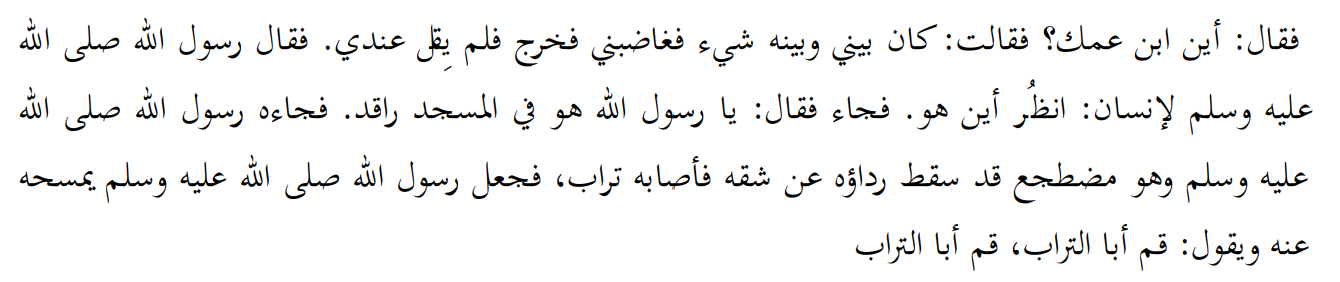
"Amcanın oğlu nerede?" Dedi ki: Onunla benim aramda bir şey olmuştu, beni kızdırdı ve bana haber vermeden çıkıp gitti. Bunun üzerine Allah'ın Elçisi ﷺ birine şöyle dedi: "Git, nerede olduğunu öğren." Adam geri dönüp dedi ki: Ey Allah'ın Elçisi, mescitte uzanıp dinleniyor. Allah'ın Elçisi ﷺ yan yatmış hâlde olduğu yere geldi. Üzerindeki rida vücudundan kaymış, üzerine toz toprak bulaşmıştı. Allah'ın Elçisi ﷺ onun üzerindeki toprağı silmeye başladı ve şöyle dedi: "Kalk, ey Ebu Turab."
“Where is the son of your paternal uncle?” She said: There was something between him and me, and he made me angry and left without telling me. So the Messenger of Allah (saw) said to someone: “Go find out where he is.” He came back and said: O Messenger of Allah, he is resting in the mosque. So the Messenger of Allah (saw) came to him while he was reclining. His cloak had fallen from his body and dirt had touched him, so the Messenger of Allah (saw) began wiping it off him while saying: “Stand up, O Abu Turab.”
Müslim, Adiyy bin Sabit'ten, onun da Darr'dan rivayet ettiğine göre, Ali şöyle dedi:
Muslim narrated from ‘Adiyy bin Thabit from Dharr who said: Ali said:
"Tohumu yarıp canlı bir şey yaratan Allah'a yemin ederim ki, Peygamber ﷺ bana, bana yalnızca mümin olanın sevgi besleyeceğine, yalnızca münafık olanın ise bana kin tutacağına dair bir söz verdi."
“By Him Who split up the seed and created something living, the Prophet (may peace and blessings be upon him) gave me a promise that no one but a believer would love me, and none but a hypocrite would nurse grudge against me..”
Bu hadislerde, Resûl'ün (sav) Ali'yi (ra) kendisinden sonra halife olarak atadığı yönünde bir sonuca varmaya imkân verecek hiçbir şey yoktur. Hayber hadisi, Allah Resûlü'nden (ﷺ) gelen bir övgüdür. Resûlullah'ın (ﷺ) Ali'ye (ra) yönelik sözü:
There is nothing in these ahadith to make someone say that the Messenger (saw) appointed Ali (ra) to be Khalifah after him. The hadith of Khayber is praise from the Messenger of Allah. The Messenger’s (saw) statement to Ali (ra):
"Sen bendendin ve ben de sendenim"
“You are of me and I am of you”
Peygamber'in (saw) övgüsü... Hadis-i Sa'd'a gelince, içinde şu ifade geçmektedir: Wait, let me reconsider: the rule says ﷺ must be written after every mention of the Prophet, and (saw) should be replaced by ﷺ, and "Messenger of Allah" should get ﷺ, and "(saw)" written as abbreviation should be replaced. So: Bu bir Allah Resûlü'nün ﷺ övgüsüdür. Gelelim Sa'd'ın hadisine; onda şu ifade geçmektedir:
Is a praise from the Messenger of Allah (saw). As for the hadith of S’aad in which came:
“Musa’ya karşı Harun’un konumuna sahip olmanız beni memnun etmez mi?”
“Are you not pleased to have the status before me as that of Harun with Musa”,
Bu konu, konuyla ilgili hadislerin ikinci kategorisinde ele alınacaktır. Bu kategoride Hayber hadisi de yer almaktadır; bu hadis bir övgüdür, ayrıca Ali (ra), Fatıma (ra), Hasan (ra) ve Hüseyin (ra)'in Peygamber ﷺ'in ehli olduğunu belirten kısım da bir övgüdür. Sehl bin Sa'd hadisi de bir övgüdür. Tıpkı Allah'ın Resulü ﷺ'in Ali (ra)'yi övmesi gibi, Sahabeden başkalarını da övmüştür. Peygamber ﷺ'in bir kişiyi övmesi, hiçbir şekilde onun tayin edildiğini göstermez.
This subject will be discussed in the second category of the ahadith on the topic. In it is also the hadith of Khayber which is a praise and in it is that Ali (ra), Fatima (ra), Hassan (ra) and Husain (ra) are his family which is a praise, and the hadith of Sahl bin S’ad is a praise. Just like the Messenger of Allah (saw) praised Ali (ra), he also praised others among his Sahabah (ra). The Messenger’s praise for a person does not in any way indicate his appointment.
İkinci kategori hadislere gelince, yani bazılarının Resûlullah'ın (sav) Ali'nin kendisinden sonra halife olacağını açıkça belirttiğini anladığı hadisler; bunlar dört metinde özetlenmiştir:- 1- Buhârî, Mus'ab bin Sa'd'dan, o da babasından rivayet etmiştir
As for the second category of ahadith which are those from which some deduced that the Messenger (saw) stated textually that Ali would be the Khalifah after him, they are summarised in these four texts:- 1- Al-Bukhari narrated from Mus’ab bin S’ad from his father
Allah'ın Elçisi'nin (sav) Tebük'e doğru yola çıkıp Ali'yi yerine atadığı, bunun üzerine Ali'nin: "Beni kadınlar ve çocuklarla birlikte geride mi bırakıyorsun?" dediği, Peygamber ﷺ'in de şöyle buyurduğu: "Benimle olan konumunun, Harun'un Musa ile olan konumu gibi olmasından hoşnut değil misin? Ancak benden sonra bir peygamber yoktur."
“That the Messenger of Allah (saw) left for Tabuk and appointed Ali, so he said: Do you leave me behind along with women and children? He said: Are you not pleased to have the same status with me as Harun had with Musa, except that there is no Prophet after me?”
Müslim, Âmir bin Sa'd bin Ebî Vakkâs'tan (ra), o da babasından naklederek şöyle dedi: Allah'ın Resûlü ﷺ, Ali'ye (ra) şöyle buyurdu:
Muslim narrated from ‘Amir bin S’ad bin Abi Waqqas (ra) from his father who said: The Messenger of Allah (saw) said to Ali (ra):
"Sen bana, Musa'ya karşı Harun'un konumu gibisin; ancak benden sonra hiçbir peygamber yoktur." ﷺ Hmm, I should only put ﷺ after mentions of the Prophet Muhammad, and here the quote is his own words, so the honorific belongs after his speech ending mention. Since the sentence itself doesn't name him, the correct output is: "Sen bana, Musa'ya karşı Harun'un konumu gibisin; ancak benden sonra hiçbir peygamber yoktur."
“You are to me of the same status as Harun was to Musa, except that there is no Prophet after me.”
Ve Müslim, İbrahim bin Sa'd'ın Sa'd'dan naklettiğine göre Peygamber ﷺ Ali'ye (ra) şöyle buyurdu:
And Muslim narrated from Ibrahim bin S’ad from S’ad that the Prophet (saw) said to Ali (ra):
"Musa'ya Harun'un sahip olduğu konumun aynısını bana karşı taşıman seni hoşnut etmez mi?"
“Are you not pleased to have the same relation with me as Harun had with Musa”
İbn İshak rivayet ederek şöyle demiştir: Allah'ın Resulü (sav), Ali bin Ebi Talib'i (ra) ailesine bakması ve onu gözetmesi için geride bıraktı. Münafıklar yalan haberler yaymaya başladı ve ona şöyle dediler: Onu, kendisine zor geldiği ve onun için kolaylaşsın diye geride bırakmaktan başka bir sebeple bırakmadı. Münafıklar böyle söyleyince Ali bin Ebi Talib (ra) silahlarını alıp yola çıktı, El-Curf'ta konaklamış olan Allah'ın Resulü'ne (sav) yetişinceye kadar yürüdü ve dedi ki: Ey Allah'ın Peygamberi (sav), münafıklar, beni, bana zor geldiği ve benim için kolaylaşsın diye geride bıraktığını iddia ediyorlar. Resulullah ﷺ şöyle buyurdu:
Ibn Ishaq narrated by saying: The Messenger of Allah (saw) left behind Ali bin Abi Talib (ra) to look after and supervise his family. The hypocrites started spreading false rumors and said to him that: He (saw) did not leave him behind except for the reason that it was hard on him and so that it could become easy for him. When the hypocrites said that, Ali bin Abi Talib (ra) took his weapons and moved out until he met the Messenger of Allah (saw) who was encamped at Al-Jarf and said: O Prophet of Allah (saw), the hypocrites claimed that you left me behind because it was hard for me and to make it easy for me. He said:

“Yalan söylediler; aksine, arkamda bıraktıklarım yüzünden seni geride bıraktım. Öyleyse geri dön ve benim adıma ailemi ve kendi ailenin işlerini gözet.” “Ey Ali, Musa'nın yanında Harun'un sahip olduğu konuma benim yanımda sahip olmak, ancak benden sonra hiçbir peygamber gelmeyecek olması dışında, sana hoş gelmiyor mu?” Note: The original has no mention of the Prophet's name or title in this passage, so no ﷺ is added here.
“They lied; rather I left you behind due to what I left behind me so return and supervise my family and your family on my behalf. Are you not pleased, O Ali, to have the same status before me as Harun had before Musa except that there is no Prophet after me?”
Ali Medine'ye döndü ve Allah'ın Elçisi ﷺ yolculuğuna devam etti. Es-Seyyid Abdulhüseyn Şerefüddin, "El-Murâcaât" adlı kitapta şunu zikretmiştir: Cabir bin Abdullah'ın rivayet ettiği hadis; o şöyle demiştir: Allah'ın Elçisi ﷺ şöyle buyurdu:
So Ali returned to Madinah and the Messenger of Allah (saw) continued on his journey. As-Sayyid Abd al-Husain Sharaf ud-Deen mentioned the following in the book “Al-Muraja’at ”: “The hadith of Jabir bin Abdullah who said: The Messenger of Allah (saw) said:
"Ey Ali, şüphesiz mescitte bana helal olan şey sana da helaldir ve benimle olan ilişkin, Musa ile Harun'un ilişkisi gibidir; ancak benden sonra peygamber yoktur."
O Ali, verily it is allowed for you in the mosque what is allowed for me, and your relation with me is that of Harun with Musa except that there is no Prophet after me.”
2. Müslim, Yezid bin Hayyan'dan rivayet etmiştir ki o şöyle demiştir: Hüseyin bin Sebre ve Ömer bin Müslim ile birlikte Zeyd bin Erkam'a (ra) gittik. Yanında oturduğumuzda Hüseyin ona şöyle dedi: "Gerçekten, ey Zeyd, pek çok hayra ulaştın. Allah'ın Resûlü'nü (sav) gördün, hadisini dinledin, onunla birlikte savaştın ve onun arkasında namaz kıldın. Gerçekten, ey Zeyd, pek çok hayra ulaştın. Bize, ey Zeyd, Allah'ın Resûlü'nden (sav) işittiklerini anlat." Zeyd şöyle dedi: "Ey kardeşimin oğlu, Allah'a yemin olsun ki ben yaşlandım ve vaktim yaklaştı. Allah'ın Resûlü'nden (sav) anladığım bazı şeyleri unuttum. Bu yüzden size anlattığım her şeyi kabul edin, anlatmadığım şeyler konusunda beni zorlamayın." Sonra şöyle dedi: "Bir gün Allah'ın Resûlü (sav) bizim önümüzde, Mekke ile Medine arasında Hum denilen suyun başında ayağa kalkıp konuştu. Allah'a hamd edip O'nu överek, öğüt verip hatırlattıktan sonra şöyle buyurdu:"
2. Muslim narrated from Yazid bin Hayyan who said: I left with Husain bin Sabra and Umar bin Muslim to Zayd bin Arqam (ra). When we sat with him, Husain said to him: “Verily, O Zayd, you met a great deal of good. You saw the Messenger of Allah (saw), heard his hadith, fought with him and prayed behind him. Verily, O Zayd, you met a great deal of good. So relate to us, O Zayd, of what you heard from the Messenger of Allah (saw). He said: O son of my brother, by Allah I have become old and my time has approached. I have forgotten some of that, which I understood from the Messenger of Allah (saw), so accept whatever I relate to you and do not force me on that which I do not relate. Then he said: The Messenger of Allah (saw) stood one day before us speaking at the waters known as Khum between Makkah and Madinah. He thanked Allah, praised Him, exhorted and reminded then said:
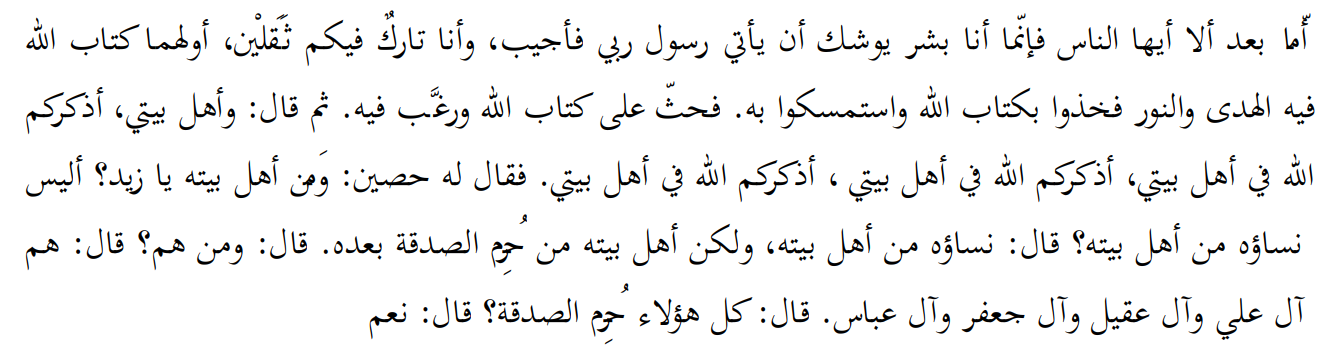
"Şimdi asıl konumuza gelelim. Ey insanlar! Ben de bir insanım. Rabbimden bir elçinin (ölüm meleğinin) gelmesi yakındır ve Allah'ın çağrısına icabet ederek (aranızdan ayrılacağım). Ancak aranızda iki değerli şey bırakıyorum: Birincisi, içinde hidayet ve nur bulunan Allah'ın Kitabı'dır. Öyleyse Allah'ın Kitabı'na sımsıkı sarılın ve ona bağlı kalın." Ardından (bizi) Allah'ın Kitabı'na sarılmaya teşvik etti ve şöyle dedi: "İkincisi ise ehl-i beytimdir. Size ehl-i beytim hakkında (görevlerinizi) hatırlatırım." Husayn, Zeyd'e şöyle sordu: "Ehl-i beyti kimlerdir? Eşleri onun ehl-i beyti değil midir?" Bunun üzerine Zeyd şöyle dedi: "Eşleri de ehl-i beytindendir; ancak burada ehl-i beyti, kendilerine sadaka (zekât) almanın haram kılındığı kimselerdir." Husayn, "Onlar kimlerdir?" diye sordu. Zeyd şöyle cevap verdi: "Ali'nin aileleri, Ali'nin soyundan gelenler; Akil'in aileleri, Akil'in soyundan gelenler; Ca'fer'in soyundan gelenler ve Abbas'ın soyundan gelenlerdir." Husayn, "Bunlar, kendilerine sadaka (zekât) almanın haram kılındığı kimselerdir." dedi. Zeyd de, "Evet." dedi.
" Now to our purpose. O people, I am a human being. I am about to receive a messenger (the angel of death) from my Lord and I, in response to Allah's call, (would bid good-bye to you), but I am leaving among you two weighty things: the one being the Book of Allah in which there is right guidance and light, so hold fast to the Book of Allah and adhere to it. He exhorted (us) (to hold fast) to the Book of Allah and then said: The second are the members of my household I remind you (of your duties) to the members of my family. He (Husain) said to Zaid: Who are the members of his household? Aren't his wives the members of his family? Thereupon he said: His wives are the members of his family (but here) the members of his family are those for whom acceptance of Zakat is forbidden. And he said: Who are they? Thereupon he said: 'Ali and the offspring of 'Ali, 'Aqil and the offspring of 'Aqil and the offspring of Ja'far and the offspring of 'Abbas. Husain said: These are those for whom the acceptance of Zakat is forbidden. Zaid said: Yes.”
As-Sayyid Abd al-Husain Sharaf ud-Deen, “Al-Muraja’at” adlı kitabında, Et-Taberani'nin senediyle, hakkında sened sahihliği konusunda icmâ bulunan bir rivayette, Zeyd bin Erkam'dan (ra) naklettiği şu hadisi zikretmiştir. Zeyd bin Erkam (ra) şöyle demiştir: Allah'ın Elçisi ﷺ, Gadîr-i Hum'da bazı ağaçların altında konuşmuş ve şöyle buyurmuştur:
As-Sayyid Abd al-Husain Sharaf ud-Deen mentioned in his book “Al-Muraja’at” this hadith via the following narration which At-Tabarani narrated through a chain whose authenticity is unanimously accepted from Zayd bin Arqam (ra) who said: The Messenger of Allah (saw) spoke at Ghadeer Khum underneath some trees and said:
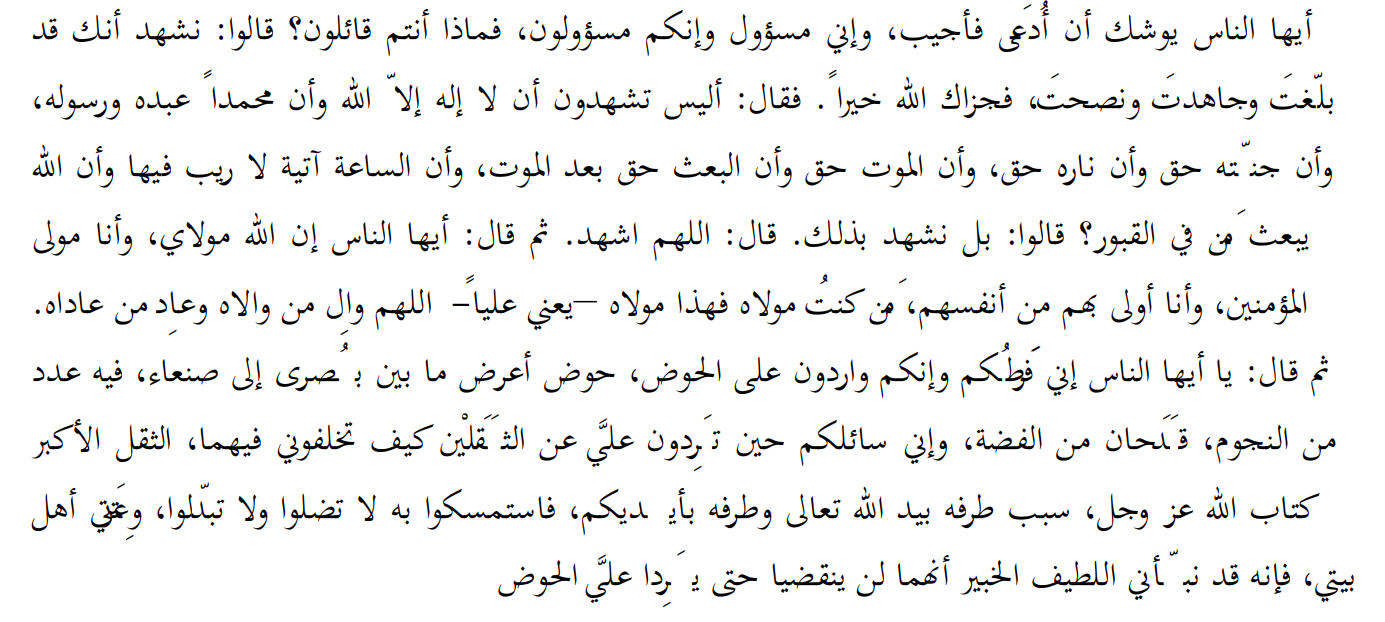
“Ey insanlar! Yakında çağrılacağım ve (ölümü kastederek) buna icabet edeceğim. Şüphesiz ben de sorumluyum, siz de sorumlusunuz. Peki ne diyeceksiniz?” Dediler ki: “Şahitlik ederiz ki siz tebliğ ettiniz, mücadele ettiniz ve öğüt verdiniz; Allah size hayırlısıyla karşılık versin.” Buyurdu ki: “Allah'tan başka ilah olmadığına, Muhammed'in O'nun kulu ve elçisi olduğuna; Cennetin hak, Cehennemin hak olduğuna; ölümün hak, ölümden sonra dirilişin hak olduğuna; Kıyamet'in (Hesap Günü'nün) şüphesiz geleceğine ve Allah'ın kabirlerindekilerin hepsini diriltceğine şahitlik etmiyor musunuz?” Dediler ki: “Evet, şahitlik ederiz.” Sonra buyurdu ki: “Ey insanlar! Şüphesiz Allah benim velimdir ve ben müminlerin velisiyim; öyle ki, onların kendi nefislerinden daha çok hakkı bana aittir. Kim beni dost edinirse, bu da onun velisidir -yani Ali'dir. Ey Allah'ım, onu dost edinene dost ol, onu düşman edinene düşman ol.” Sonra buyurdu ki: “Ey insanlar! Şüphesiz ben sizi bırakıp gideceğim ve beni Havuz'da bulacaksınız; Basra'dan San'a'ya olan mesafeden daha geniş bir havuz. Onda yıldızların sayısınca gümüş kadehler vardır. Şüphesiz ben, bana geldiğinizde, iki ağır emanet hakkında size soracağım: Benden sonra onlara nasıl sahip çıktınız? Daha ağır ve daha büyük olanı, Allah'ın Kitabı'dır; bir ucu Allah'ın elinde, diğer ucu sizin elinizdedir. Sapmamanız ve değişikliğe uğramamanız için ona sımsıkı sarılın. Diğeri ise Utre'm, yani Ehl-i Beytim'dir. Şüphesiz Latif ve Her Şeyi Bilen (swt) bana haber verdi ki, onlar Havuz başında bana kavuşuncaya kadar asla birbirlerinden ayrılmayacaklar.”
“O people, it is about to be that I am called and I will respond (indicating death). Verily, I am accountable and you are accountable, so what will you say? They said: We will testify that you conveyed, struggled and advised so may Allah recompense you well. He said: Do you not bear witness that there is no deity but Allah and Muhammad is His slave and Messenger, that Paradise is true and Hellfire is true, that death is true and resurrection after death is true, that the Hour (of Judgement) will come without any doubt, and that Allah will resurrect all those in their graves? They said: Yes, we do bear witness. Then he said: O people, verily Allah is my Patron and I am the patron of the believers such that I take precedence before them over their own selves. Whoever takes me as his patron then this one is his patron—meaning Ali. O Allah, befriend whoever befriends him and take as enemy whoever takes him as an enemy. Then he said: O people, verily I will leave you and you will find me at the Cistern, a cistern wider than the distance from Basra to Sana’a. In it are tumblers of silver the number of stars. Verily I will ask you when you come before me on the two weighty things, how you took care of them after me. The weightier and greater one is the Book of Allah ‘azza wa jalla, a (sabab) of which one end is in the hands of Allah and the other in your hands. Hold tightly to it so that you do not go astray or change, and my Utra (household), the people of my house. Verily The Kind & All-Knowing (swt) has informed me that they will never seperate until they come before me at the cistern (fountain)”
(Bu, As-Sayyid Abdülhüseyn Şerafüddin'in naklettiklerinin sonudur.) Ve Şeyh Abdülhüseyn Ahmed el-Emînî en-Ncefî, "El-Gadîr" adlı kitabında şunları belirtmiştir: "Hac ibadetlerini tamamlayıp, sözü edilen topluluklarla birlikte Medine'ye doğru yola çıktığında, Medine, Mısır ve Irak halkının yollarının ayrıldığı Cuhfe'deki Gadîr-i Hum'a ulaştı. Bu, Zilhicce ayının on beşinci günüdü ve güvenilir Cebrail, Allah'tan (c.c.) şu ayetle indi:"
(This is the end of what As-Sayyid Abd al-Husain Sharaf ud-Deen mentioned). And Shaikh Abd al-Husain Ahmad Al-Ameeni An-Najafi stated the following in his book “Al Ghadeer”: “When he finished his rites of worship i.e. the Prophet (saw) and left for Madinah, together with the mentioned group(s) of people, he reached Ghadeer Khum in Al-Jahfa where the roads branch for the people of Madinah, Egypt and Iraq. This was the 15th day of Dhul-Hijja and Jibril, the trustworthy, descended to him from Allah (swt) with His saying:
"Ey Elçi, Rabbinden sana indirileni tebliğ et" [TMQ 5:67]
‘O Messenger, deliver what was revealed to you from your Lord” [TMQ 5:67]
Ve Allah ona (Ali'ye, ra) ayağa kalkmasını ve insanlara, onun velayeti ve herkesin üzerindeki itaat yükümlülüğü hakkında indirilenleri bildirip duyurmasını emretti. İnsanların ilk grubu Al-Cahfa'ya yakındı; bunun üzerine Allah'ın Resulü ﷺ önden gidenlerin geri dönmesini, geride kalanların ise o yerde toplanmasını emretti ve insanların beş büyük ağacın altına konaklamasını yasakladı. İnsanlar konaklayıp o ağaçların altında bulunanlar öğle namazı için ezan okunana kadar ayakta durunca, Resulullah ﷺ onlara yöneldi ve ağaçların altında namaz kıldırdı. Güneşin çok sıcak olduğu bir gündü; kavurucu sıcaktan dolayı bir adam pelerininin bir kısmını yüzüne, bir kısmını ayaklarının altına koymuştu. Allah'ın Resulü ﷺ ise güneşten korunmak için sumra ağacının üzerine asılmış bir giysiyle gölgeleniyordu. Namazını bitirince, bir devenin hörgücünün üzerinde insanların ortasında durup konuşmak için ayağa kalktı; herkesin duyabileceği yüksek bir sesle konuştu ve şöyle buyurdu ﷺ:
And He commanded him to cause Ali (ra) to stand to let the people know and inform what was revealed regarding his patronage and the obligation of obedience upon every one. The first of the people were close to Al-Jahfa so the Messenger of Allah (saw) commanded those who had proceeded to return and enclosed those who had delayed at that place, and he prohibited people from encamping beneath the five large trees. When the people took camp and those underneath them (the trees) stood until the dhuhr prayer was announced, he headed for them and prayed beneath them. It was a sizzling day where a man placed some of his cloak upon his face and some under his feet due to the severe heat, and the Messenger of Allah was shaded by a garment upon the sumra tree due to the sun. When he (saw) finished his prayer, he stood to speak in the middle of the people on the hump of a camel and he spoke with a raised tone with every one hearing him and he (saw) said
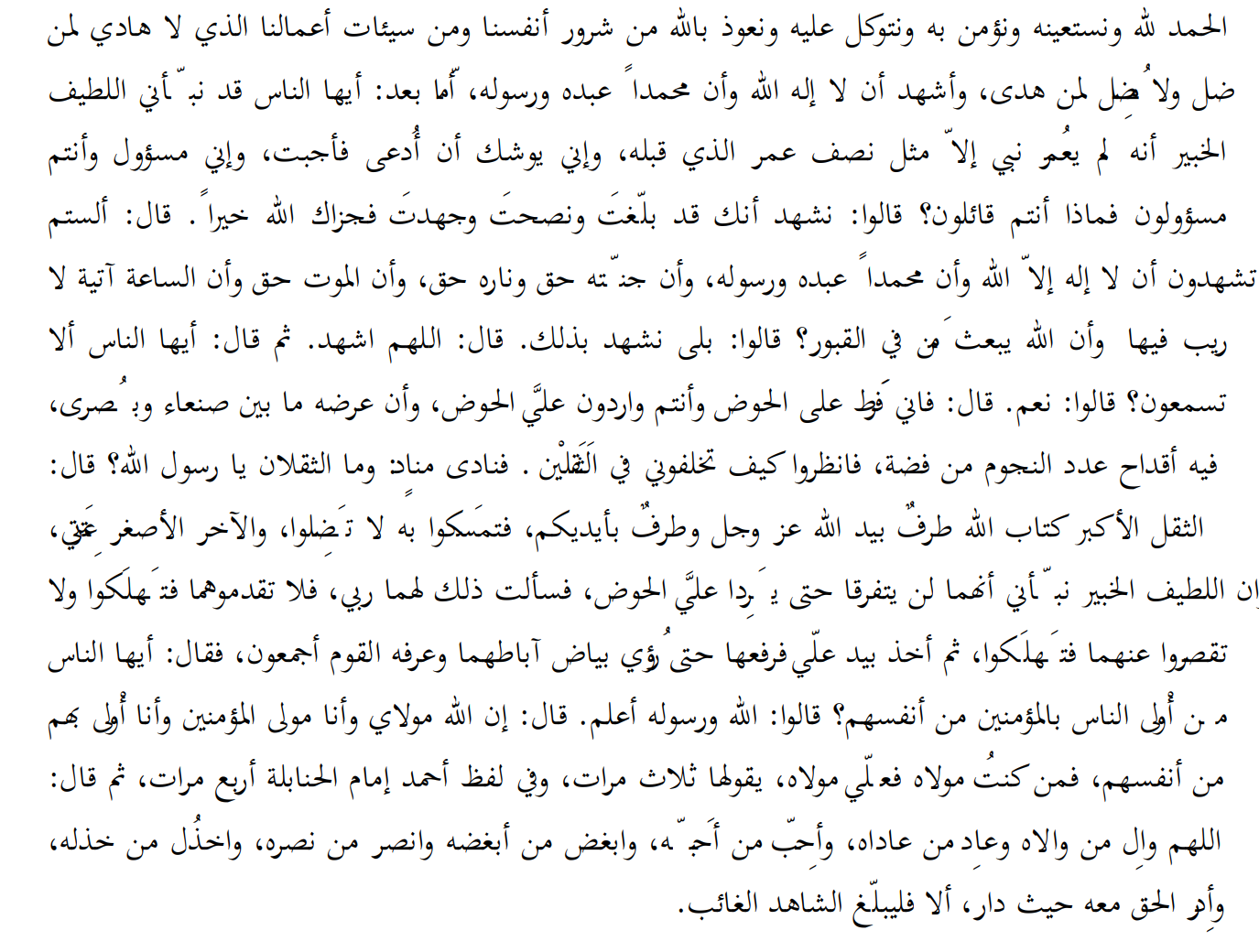
Hamd, yalnızca Allah'a aittir; O'ndan yardım dileriz, O'na iman ederiz ve O'na tevekkül ederiz. Nefislerimizin şerrinden ve kötü amellerimizden Allah'a sığınırız. Allah'ın doğru yola ilettiğini kimse saptıramaz, saptırdığını ise kimse doğru yola iletemez. Şahitlik ederim ki Allah'tan başka ilah yoktur ve Muhammed ﷺ O'nun kulu ve elçisidir. Şimdi gelelim konuya. Ey insanlar! Şüphesiz Lütufkâr ve Her Şeyi Bilen (c.c.) bana, bir peygambere, ondan önceki peygamberin ömrünün yarısından fazla ömür vermediğini bildirmiştir. Gerçekten de yakında çağrılacağım ve icabet edeceğim. Şüphesiz ben de sorumluyum, siz de sorumlusunuz; o halde ne diyeceksiniz? Dediler ki: Şahitlik ederiz ki sen tebliğ ettin, öğüt verdin ve çaba gösterdin; Allah sana en güzel mükâfatı versin. Bunun üzerine buyurdu: Şahitlik etmez misiniz ki Allah'tan başka ilah yoktur, Muhammed ﷺ O'nun kulu ve elçisidir, O'nun cenneti haktır, cehennemi haktır, ölüm haktır, kıyametin şüphesiz geleceği haktır ve Allah kabirde olanları diriltecektir? Dediler: Evet, buna şahitlik ederiz. Buyurdu: Ey Allah'ım, sen de şahit ol. Sonra buyurdu: Ey insanlar, dinlemeyecek misiniz? Dediler: Evet. Buyurdu: Şüphesiz ben havuzun (Kevser) başına gideceğim ve siz de huzurumda havuzun başına getirileceksiniz. Genişliği Sana'a ile Basra arasındaki mesafe kadar olan bu havuzda, yıldızların sayısı kadar gümüş kadehler vardır. Benden sonra iki ağır emanete nasıl davranacağınıza dikkat edin. Bir duyurucu seslendi: Ey Allah'ın Elçisi, iki ağır emanet nedir? Buyurdu: İki ağır emanetten büyük olanı Allah'ın Kitabı'dır; bir ucu Allah'ın elinde, diğer ucu ise sizin ellerinizdedir, o halde ona sımsıkı sarılın ki sapmayasınız. Diğer, daha küçük olanı ise Ehl-i Beytimdir (itretim). Lütufkâr ve Her Şeyi Bilen (c.c.) bana, Ali havuzun başına gelinceye kadar bunların benden ayrılmayacağını bildirmiştir ve ben bunu Rabbimden istedim. Öyleyse onların önüne geçmeyin ve onları ihmal etmeyin; bunu yaparsanız helak olursunuz. Sonra elini Ali'nin eline uzattı ve koltuk altları görünene kadar kaldırdı, böylece herkes onu tanıdı. Ve şöyle dedi: "Ey insanlar, müminlere kendi nefislerinden önce kim daha yetkilidir?" Dediler ki: "Allah ve Elçisi en iyi bilendir." Dedi ki: "Gerçekten Allah benim mevlamdır ve ben de müminlerin mevlasıyım; öyle ki onlara kendi nefislerinden önce ben daha yetkiliyim. Kimin mevlası benim ise, Ali de onun mevlasıdır." Bunu üç kez söyledi; İmam Ahmed'in, Hanbelilerin imamının sözlerinde ise dört kez söylemiştir. Sonra şöyle dedi: "Ey Allah'ım, onu dost edinene dost ol, onu düşman edinene düşman ol. Onu sevene sev, ona buğz edene buğz et, ona yardım edene yardım et, onu terk edene de terk et ve hak, onun bulunduğu yerde onunla birlikte olsun. Gerçekten, hazır bulunan şahit, bulunmayana bildirsin."
"All praise is due to Allah whom we ask for help, believe in and depend upon. We ask Allah to protect us from the evils of our souls and bad deeds, the One whom none can guide whom He causes to go astray or misguide whom He guides. I bear witness that there is no god but Allah and Muhammad is His slave and Messenger. As for what follows: O people, verily the The Kind & All-Knowing (swt) has informed me that He does not grant longevity to a Prophet except half the like of the one before him. Verily it is about to be that I will be called and I will respond. Verily I am accountable and you are accountable, so what will you say? They said: We bear witness that verily you have conveyed, advised and struggled so may Allah reward you well. He said: Do you not bear witness that there is no god but Allah and that Muhammad is His slave and Messenger that His paradise is true and His hellfire is true, that death is true, that the Hour will come without any doubt and that Allah will resurrect those in the graves? They said: Yes, we bear witness to this. He said: O Allah, do bear witness. Then he said: O people, will you not listen? They said: Yes. He said: Verily I will go to the cistern (alkauthar) and you will be presented at the cistern, whose breadth is that between Sana’a and Basra, before me. In it are cups of silver the number of which are the number of stars, so look how you take care of the two weighty things after me. An announcer announced: And what are the two weighty things, O Messenger of Allah? He said: The greater of the two weighty things is the Book of Allah, one end of which is in the hand of Allah and the other in your hands so hold fast to it and you will not go astray. The other smaller one is my household (‘utra). Verily the Kind & All-Knowing (swt) informed me that they will not go away until Ali reaches the cistern and I asked that from my Lord. So do not precede them or neglect them and if you do so you will perish. Then he took the hand of Ali and raised it until their armpits were seen and everyone recognised him and he said: O people, who takes precedence before the believers over their own selves? They said: Allah and His Messenger know best. He said: Verily Allah is my Patron (mawla) and I am the patron of the believers such that I take precedence before them over their own selves. So whoever has me as his patron then Ali is his patron. He said this three times, and in the words of Imam Ahmad, Imam of the Hanbalis, four times. Then he said: O Allah, befriend whoever befriends him and become an enemy to whoever takes him as an enemy. Love whoever loves him and hate whoever hates him, support whoever supports him and abandon whoever abandons him, and let the truth be with him wherever he is resides. Verily, let the witness who is present inform the (one who is) absent.’”
3. Peygamber'in (sav) Ali'nin (ra) hilafetini açıkça bildirdiğini savunanlar, kitaplarında bazı hadisler rivayet etmişlerdir. Bu hadislere gelince, bunların rivayet zincirlerini araştırma konusu yapmayacağız; çünkü iki şeyh, Buhari ve Müslim, bunları rivayet etmemiştir ve bunlar güvenilir râvilerden nakledilmemiştir, çoğu da uydurma hadislerdendir. Ayrıca, "Bu hadisler sizden önce güvenilir râvilerle rivayet edilmemişti, ama bizden önce güvenilir râvilerle rivayet edilmiştir" diyerek, hadisin sahih olduğu kabul edilen kişinin bunu delil olarak kullanması yönündeki tartışmaları da konumuz yapmayacağız. Bunun yerine, araştırmanın konusu olarak rivayetler içinde geçtiği şekliyle metinlerin kendisini ele alacağız. Peygamberin (sav) Ali'yi kendisinden sonra halife tayin ettiğini bu metinlerden çıkarmışlardır; bu hadisler "velayet" hadisleri olarak bilinir. Bunlardan bazılarını sunacağız, geri kalanları da aynı anlamı ve hatta aynı ifadeleri taşımaktadır.
3. Those who say that the Messenger (saw) clearly announced the Khilafah of Ali (ra) narrated ahadith in their books. As for these ahadith, we will not make the place of research in them their narrations, despite the fact that the two sheikhs Al-Bukhari and Muslim did not narrate them, nor were they narrated via any trustworthy narrators and most of them are among the fabricated ahadith. We will not make their narrations the subject of research such that they say that these ahadith were not narrated by trustworthy narrators before you but were narrated by trustworthy narrators before us so that the one for whom the hadith is authenticated uses it as an evidence. We will not make that the domain of research; rather we will make the matter of research the texts themselves as they came in the narrations. These are the texts from which they deduced that the Messenger (saw) appointed Ali to be the Khalifah after him—and these ahadith are known as the ahadith of “wilayah”—from which we will present some of them and the rest carry the same meaning and even the same wordings.
a) Ebû Dâvûd et-Tayâlisî, İbn Abbâs'tan (ra) rivayet etmiştir ki Allah'ın Resulü ﷺ, Ali bin Ebi Talib'e (ra) şunu söylemiştir:
a) Abu Dawud At-Tayalisi narrated from ‘Ibn Abbas (ra) that the Messenger of Allah (saw) said to Ali ibn Abi Talib (ra):
"Sen, benden sonra tüm müminlerin velisisin."
“You are the waliy of all believers after me.”
b) Kanz al-’Ammal'da İmran bin Husayn'dan rivayet edilmiştir ki o şöyle demiştir: Allah'ın Elçisi ﷺ bir sefer birliği gönderdi ve bunların başına Ali bin Ebi Talib'i (ra) tayin etti. Ali (ra), ganimetin beşte birinden (humus) bir cariye kendisine ayırdı. Birlik üyeleri bunu ondan kabul etmediler. Dördü, onun hakkında Peygamber ﷺ'e şikâyette bulunmaya karar verdi. Geldiklerinde, dördünden biri ayağa kalkıp şöyle dedi: "Ey Allah'ın Elçisi ﷺ, Ali'nin (ra) şunu bunu yaptığını görmüyor musun?" Peygamber ﷺ ondan yüz çevirdi. İkincisi ayağa kalkıp aynı şeyi söyledi, o da ondan yüz çevirdi. Üçüncüsü ayağa kalkıp aynı şeyi söyledi, o da ondan yüz çevirdi. Dördüncüsü ayağa kalkıp, daha önce söylenenlerin aynısını söyledi. Allah'ın Elçisi ﷺ yüzünde öfkesi belli olarak onlara döndü ve şöyle buyurdu:
b) It has been narrated in Kanz al-’Ammal from Imran bin Husain who said that the Messenger of Allah (saw) sent an expedition and appointed Ali bin Abi Talib (ra) over them. He chose for himself a slave girl from the fifth (khums) and they rejected this from him. Four of them agreed to complain about him to the Prophet (saw) so, when they came, one of the four stood and said: O Messenger of Allah (saw), do you not see that Ali (ra) did such and such, and he (saw) turned away from him. The second stood and said the same, so he turned away from him. The third stood and said the same, so he turned away from him. And the fourth stood and said the same as they had said. The Messenger of Allah (saw) turned towards them with anger visible in his face and said:
Ali hakkında benden ne istiyorsun? Şüphesiz Ali bendendir ve ben de ondanım; o, benden sonra her mümini yöneten velidir.
What do you want for me with regards to Ali? Verily Ali is from me and I am from him, and he is the waliy of every believer after me.”
c) Ve ‘Amru bin Maymun’dan, ‘İbn Abbas (ra)’ın şöyle dediğini nakleden uzun bir hadiste: Allah’ın Elçisi ﷺ falancayı Tevbe Suresi ile gönderdi. Ardından Ali (ra)’yi onun peşinden gönderip sureyi ondan almasını istedi ve şöyle buyurdu:
c) And in a long hadith from ‘Amru bin Maymun from ‘Ibn Abbas (ra) who said: The Messenger of Allah (saw) sent so and so with Surah At-Tawbah. He then sent Ali (ra) after him to take it from him and said:
"Bunu, benden olan ve ben de ondan olan bir adamdan başkası almamalıdır."
“No one should take it except a man who is from me and I am from him.”
d) Vehhab bin Hamza'dan İkanzü'l-Ummal: Ali (ra) ile yolculuk yaptım ve ondan sert bir tavır gördüm; bu yüzden dönüşte bunu şikayet edeceğimi söyledim. Döndüğümde Ali (ra)'yi Allah'ın Resulü ﷺ'ye andım ve o şöyle buyurdu:
d) IKanz al-’Ammal from Wahhab bin Hamza who said: I travelled with Ali (ra) and I saw harshness from him, so I said that when I will return I will complain about it. So I returned and mentioned Ali (ra) to the Messenger of Allah (saw) and he said:
"Bu sözü Ali için söyleme, çünkü o senin benden sonraki velin/dostundur."
“Do not say this for Ali, as he is your waliy after me.”
e) İbn Abbas'tan rivayet edildiğine göre Allah'ın Resulü ﷺ şöyle buyurmuştur: Kanzü'l-Ummal'de
e) In Kanz al-’Ammal from ‘ibn Abbas who said: The Messenger of Allah (saw) said:
"Kim benim hayatımı yaşamaktan hoşnut olur, benim ölümümü ölmek ve Rabbimin suladığı Adn cennetinde kalmak isterse, benden sonra Ali'yi veli edinsin."
“Whoever is pleased to live my life, die my death and to reside in the paradise of Eden irrigated by my Lord then let him befriend Ali as a waliy after me.”
f) Muntahab'ül-Kenz'de Ziyad bin Mutarrif'ten rivayet edilmiştir. Şöyle demiştir: Allah'ın Resulü ﷺ'in şöyle buyurduğunu işittim:
f) In Muntakhab al-Kanz from Zayyad bin Mutarraf who said: I heard the Messenger of Allah (saw) saying:
"Kim benim hayatımı yaşamak, ölümümü ölmek ve Rabbim tarafından bana vaat edilen cennete girmek ister—ki o, ebedi bir cennettir—o hâlde benden sonra Ali'yi ve onun evlatlarını dost edinsin. Şüphesiz onlar sizi hidayet kapısından asla çıkarmayacak ve dalalet kapısına asla sokmayacaklardır."
“Whoever would like to live my life, die my death, and enter the paradise promised to me by my Lord—and it is an eternal paradise—then let him befriend Ali and his descendants after me. Verily they will never remove you from the door of guidance nor enter you into the gate of misguidance.”
g) Kanz al-‘Ummal'de Ammar bin Yasir'den rivayet edilmiştir. O şöyle demiştir: Allah'ın Resulü ﷺ şöyle buyurdu:
g) In Kanz al-’Ammal from Ammar bin Yasir who said: The Messenger of Allah (saw) said:
"Bana iman eden ve bana güvenen herkese, Ali bin Ebi Talib'in velayetini vasiyet ediyorum. Kim onunla dost olursa, bana dost olmuştur; kim bana dost olursa, Allah'a dost olmuştur. Kim onu severse, beni sevmiştir; kim beni severse, Allah'ı sevmiştir. Kim ona buğz ederse, bana buğz etmiştir; kim bana buğz ederse, Allah'a buğz etmiştir."
“I bequeath whoever believes in me and trusts me with the wilayah of Ali bin Abi Talib. Whoever befriends him has befriended me and whoever befriends me has befriended Allah. Whoever loves him has loved me, and whoever loves me has loved Allah. Whoever hates him has hated me, and whoever hates me has hated Allah.”
h) Yine el-Kenz'de Ammar'dan merfu bir hadis olarak rivayet edilmiştir:
h) Also in Al-Kanz from Ammar it has been narrated in a marfu hadith :
“Ey Allah'ım, kim bana inanır ve bana güvenirse, Ali bin Ebi Talib'i dost edinsin. Şüphesiz onun velayeti benim velayetimdir ve benim velayetim Allah Teâlâ'nın velayetidir.” ﷺ
“O Allah, whoever believes and trusts in me, let him befriend Ali bin Abi Talib. Verily his wilayah is my wilayah and my wilayah is the wilayah of Allah ta’ala.”
4. Peygamber'in (sav) Ali'nin (ra) halifeliğini açıkça ilan ettiğini anlatanlar bazı hadisler rivayet etmişlerdir. Bu hadisleri güvenilir hiçbir kimse rivayet etmemiş olup çoğu uydurma hadislerdir. Bunları, onları rivayet edenler için sahih olduğu iddia edilsin diye rivayet yönünden incelemek amacıyla sunmuyoruz. Aksine, metinlerini, metinlerinde geçenlere göre inceleme konusu yapmak amacıyla sunuyoruz. Bu hadisler, Peygamber'in (sav) Ali (ra) ile kardeşliğini ve onu kendisinden sonra mirasçı kılmasını içermektedir. Bunlardan birkaçını sunuyoruz, geri kalanı da aynı anlamı ve hatta aynı lafızları taşımaktadır.
4. There are ahadith narrated by those who say that the Messenger (saw) openly declared the Khilafah of Ali (ra). These ahadith have not been narrated by any trustworthy person and most of them are fabricated ahadith. We present them not to research them from the angle of their narration so that they are claimed to be authenticated for those who narrate them. Rather we present them to make the point of research their texts according to what came in their texts. These ahadith contain the brotherhood of the Messenger (saw) with Ali (ra), and making him the heir after him. We present a few of them with the remainder carrying the same meaning and even the same wordings.
a) Peygamber ﷺ Muhacirler arasında kardeşlik tesis etti ve kendisi için Ali'yi (ra) seçti. İlk kardeşlik hadisinin devamında şöyle geçer: "Bunun üzerine Ali dedi: Ey Allah'ın Resulü ﷺ, canım bedenimden çıkıyor ve sırtım kırıldı; sizin benden başkasıyla, ashabınızla yaptığınızı gördüğümde böyle oldu. Eğer bu, bana karşı öfkenizin bir işareti ise, yalnızca size şikâyet eder ve affınızı dilerim." Allah'ın Resulü ﷺ şöyle buyurdu:
a) The Prophet (saw) established a brotherhood between the Muhajirin and chose Ali (ra) for himself. In what came of the hadith of the first brotherhood, “so Ali said: O Messenger of Allah (saw), verily my soul left me and my spine has been broken when I saw you do what you did with your companions other than me. If this is a sign of your anger with me, then I complain only to you and beg your pardon. The Messenger of Allah (saw) said:
"Beni hakla gönderen Allah'a yemin olsun ki, seni yalnızca kendim için bıraktım. Bana karşı, Musa'ya karşı Harun'un konumu gibisin, ancak benden sonra peygamber yoktur. Sen benim kardeşim ve mirasçımsın." Adam şöyle sordu: "Sizden ne miras alacağım?" Dedi ki: "Peygamberlerin benden önce neyi miras bıraktıklarını (almak istiyor musun)? Rablerinin Kitabını ve peygamberlerinin Sünnetini."
By the One who sent me with truth, I only left you for myself. You are to me of the status of Harun to Musa except that there is no Prophet after me. You are my brother and inheritor. He said: What will I inherit from you. He said: What did the Prophets inherit before me, the Book of their Lord and the Sunnah of their Prophets.”
b) Peygamber (saw) hicretten beş ay sonra Muhâcirîn ile Ensâr arasında kardeşlik kurdu; ancak Ali (ra) ile Ensâr'dan hiçbiri arasında kardeşlik kurmadı, bilakis onu (Ali'yi) kendisi için seçti. Bu, ikinci kardeşlik hadisinde gelmiştir.
b) The Prophet (saw) made a brotherhood between the Muhajirin and the Ansar five months after the hijrah, but he did not make a brotherhood between Ali (ra) and any of the Ansar; rather he chose him (Ali) for himself. It came in the hadith of the second brotherhood
Peygamber (sav) Ali'ye şöyle dedi: "Muhacirler ile Ensar arasında kardeşlik kurduğumda, seninle onlardan hiçbiri arasında kardeşlik kurmadığım için bana kızdın mı? Benim için, Musa'ya Harun'un konumu gibi olmandan hoşnut değil misin? Ancak benden sonra bir peygamber yoktur."
“That the Messenger (saw) said to Ali: Did you become angry at me when I made a brotherhood between the Muhajirin and Ansar but did not make a brotherhood between you and any of them? Are you not pleased to be similar to the status of Harun to Musa for me except that there is no Prophet after me”
c) Rivayet edildiğine göre Elçi ﷺ bir gün yüzü sevinçle parlayarak ashabının yanına çıktı. Bunun üzerine Abdurrahman bin Avf (ra) ona sordu ve o şöyle buyurdu:
c) It is narrated that the Messenger (saw) went out one day to his companions with his face brightened so Abdurrahman bin Awf (ra) asked him and he said:
"Rabbim bana kardeşim ve amcamın oğlu ve kızım hakkında müjdeli bir haber verdi: Allah, Ali ile Fatıma'yı evlendirecek."
“Good news came to me from my Lord about my brother and paternal uncle’s son and my daughter, that Allah will marry Ali with Fatima.”
Sayyide Nisa'nın (kadınların efendisi) evliliği için layık bir damat düşünülürken, Peygamber ﷺ şöyle buyurdu:
When the sayyid Annisa’s (leader of the women) deserving groom for her marriage was being considered, the Prophet (saw) said:
"Ey Ümmü Eymen, kardeşimi benim için çağır." Ümmü Eymen dedi ki: "O senin kardeşin, yine de onunla (kızını) evlendiriyor musun?" Dedi ki: "Evet, ey Ümmü Eymen." Bunun üzerine Ümmü Eymen, Ali'yi çağırdı ve o geldi.
“O Umm Ayman, call my brother for me. She said: He is your brother yet you are marrying him (to your daughter)? He said: Yes, O Umm Ayman. So she called Ali and he came.”
Ve Peygamber bir gün onunla, kardeşi Ca'fer ile Zeyd bin Harise arasındaki bir hüküm hakkında konuştu ve şöyle dedi: ﷺ
And the Prophet (saw) spoke to him one day regarding a judgement between him, his brother Ja’far (saw) and Zayd bin Haritha (saw), saying:
"Ey Ali, sen de bana kardeşim, oğlumun babası ve benden, benim için olansın."
“As for you, O Ali, (you are) my brother, the father of my son, and from me and for me.”
d) Elçi (sav), bir gün Ali'ye (ra) şöyle bir söz verdi:
d) The Messenger (saw) promised to Ali (ra) one day saying:
"Sen benim kardeşimsin ve veziримsin. Borçlarımı ödeyeceksin, üstlendiğim sözleri yerine getireceksin ve sorumluluklarımı tamamlayacaksın." Note: "wazeer" is rendered as "vezir" (with the Turkish spelling "veziriм" corrected below). "Sen benim kardeşimsin ve vezirimsin. Borçlarımı ödeyeceksin, üstlendiğim sözleri yerine getireceksin ve sorumluluklarımı tamamlayacaksın."
“You are my brother and my wazeer. You will repay my debts, fulfill my commitments and complete my responsbilities.”
3) Kanz al-'Ammal'da, o (ﷺ) şöyle buyurmuştur
3) In Kanz al-’Ammal, he (saw) said
"Cennetin kapısına şöyle yazılmıştır: Allah'tan başka ilah yoktur, Muhammed Allah'ın Resulüdür ﷺ, Ali Allah'ın Resulünün kardeşidir ﷺ."
“It is written on the gate of Paradise: There is no god but Allah, Muhammad is the Messenger of Allah, Ali is the brother of the Messenger of Allah.”
Bu dört metin, bazı Müslümanların Resulullah'ın (sav) Ali'yi (ra) kendisinden sonra halife tayin ettiği, yani onu halife kıldığı sonucuna vardıkları metinlerdir. Bunları tek tek ele alalım:
These four texts, which are the texts in which the Messenger (saw) made him (Ali) of the status of Harun to Musa, the text that he left the Book of Allah and His progeny, the text of wilayah, and the text of brotherhood, are the texts from which some Muslims deduced that the Messenger (saw) appointed Ali (ra) i.e. made him the Khalifah after him. Let us take them text by text:
Birinci metne gelince, Musa'ya karşı Harun'un konumuna Ali'yi yerleştiren metin, Peygamber (sav)'in önünde söylendiği durumun ve sözlerinin incelenmesiyle anlamı açıklığa kavuşur. Durumuna gelince, Peygamber (sav) bu hadisi Tebuk Savaşı günü söyledi. Bu olayda Peygamber (sav), Medine'de yerine Muhammed bin Mesleme'yi (ra) Müslümanların işlerini denetlemek ve yönetimi yürütmek üzere görevlendirdi; efendimiz Ali'yi (ra) ailesinin başına getirdi ve onları gözetmesini emretti. Münafıklar onun hakkında dedikodu yaptılar ve dediler ki: Onu geride bırakmadı ancak kendisine zor geldiği için, onu rahatlatmak istedi. Münafıklar bunu söyleyince, Ali (ra) silahını alıp yola çıktı, Cürf'te konaklamış olan Peygamber (sav)'e yetişene kadar devam etti ve dedi ki:
As for the first text, which is the text which made Ali at the status of Harun to Musa before the Messenger (saw), its meaning is clarified though studying the occcasion in which it was said and studying its wording. As for the occasion, the Messenger (saw) said this hadith on the day of the battle of Tabuk. Therein the Messenger (saw) appointed in Madinah in his place Muhammad bin Maslamah (ra) to supervise the Muslims’ affairs and administer the rule, and appointed our master Ali (ra) over his family and commanded him to supervise them. The hypocrites shook him and said: He did not leave him behind except because it had become hard on him he wanted to make it easy for him. When the hypocrites said this, Ali (ra) took his weapon and left until he met the Messenger (saw) who was encamped at Al-Jarf and said:
“Ey Allah'ın Peygamberi, münafıklar, seni bir yük olarak gördüğün ve onu benden hafifletmek istediğin için beni geride bıraktığını iddia ettiler.” Bunun üzerine ﷺ şöyle buyurdu: “Yalan söylediler; aksine, seni arkamda bıraktığım şeyler sebebiyle geride bıraktım. Öyleyse geri dön ve ailem ile senin ailen üzerinde benim yerime geç. Ey Ali, Musa'ya karşı Harun'un konumuna sahip olmandan hoşnut değil misin; yalnız benden sonra bir peygamber yoktur.”
“O Prophet of Allah, the hypocrites claimed that you left me behind because you found a burden on meand wished to make it light for me. He (saw) said: They lied, rather I left you behind due to what I left behind me. So return and take my place over my family and your family. Are you not pleased, O Ali, that you are of the same status to me as Harun to Musa except that there is no Prophet after me?”
Resulullah ﷺ yolculuğuna devam etti. Ali'nin (ra) Resulullah ﷺ katındaki konumunun, Harun'un Musa katındaki konumu gibi olduğuna dair hadis, Ali'nin (ra) kendi ifadesinin delil olmasıyla, Resulullah ﷺ'in onu kendi ailesinin başına getirmesiyle ilgilidir.
So the Messenger of Allah (saw) continued on his travel. The hadith about Ali (ra) being the same status for the Messenger (saw) as Harun for Musa concern to his (saw)’s appointing him over his (saw) family by the evidence of Ali’s (ra) own statement:
"Beni kadınlar ve çocuklarla birlikte geride mi bırakıyorsun?"
“Do you leave me behind with women and children?”
Olayın gerçeği şudur: Ali (ra), Peygamber'in (ﷺ) ailesi üzerinde görevlendirilmiştir; bu nedenle bunun hilafet üzerinde görevlendirilme anlamına geldiği söylenemez. Özellikle de Peygamber'in (ﷺ) yerine Muhammed bin Mesleme'yi yönetici olarak atadığı ve Ali'ye (ra) "Benim ailem ve senin ailen" dediği bilindiğinde, Ali'yi ailesinin gözetmeni olarak belirlediği açıktır. Dahası, Peygamber'in (ﷺ) savaşa çıkarken sahabilerinden birini yönetim üzerinde görevlendirmesi, bu kişinin onun yerine halife olduğu anlamına gelmez. Bunun kanıtı, Peygamber'in (ﷺ) savaşlarda birçok kişiyi görevlendirmiş olmasıdır. El-'Aşeyre savaşında Ebu Seleme bin Abdülesed'i Medine üzerine, Safvan savaşında Zeyd bin Harise'yi (ra) Medine üzerine, Benu Lihyan savaşında İbn Ümmü Mektum'u (ra) Medine üzerine atamıştır; bunun gibi örnekler çoktur. Peygamber'in (ﷺ) savaşlarından dönene kadar Medine'yi yönetmek üzere birini atamış olması, onun hilafet üzerine atandığını göstermez. Dolayısıyla onun Ali'yi yalnızca ailesi üzerine atamış olması ve savaşından dönene kadar başka birini yönetimde görevlendirmiş olması da mümkündür.
The reality of the incident is that he was appointed over his family so it cannot be taken to mean that he was appointed over the Khilafah, particularly when it is known that he (saw) appointed Muhammad bin Maslamah as the ruler in his place and specified Ali (ra) to supervise over his family when he said to him, “my family and your family.” Moreover, the Messenger’s (saw) appointment of one of his companions over the rule when he left for battle does not mean that this appointed person is the Khalifah in his place by the evidence that the Messenger (saw) appointed many in the battles. In the battle of Al-‘Asheera he appointed Abu Salamah bin Abd al-Asad over Madinah, in the battle of Safwan he appointed Zayd bin Haritha (ra) over Madinah, in the battle Banu Lahyan he appointed ibn Umm Maktum (ra) over Madinah, and so on. The appointment by the Messenger (saw) of someone to rule over Madinah until he returns from his battles does not indicate that means his appointment over the Khilafah, so what if he appointed him only over his family while appointing another in authority until he returns from his battle.
Bu, tayinle ilgili olarak. Peygamber'in (sav) sözüne gelince:
This is in relation to the appointment. As for the saying of the Messenger (saw):
"Harun'un Musa ile olan konumu gibi olmaktan memnun değil misin?"
“Are you not pleased to be similar to the status of Harun with Musa?”
"Razı değil misin ki, sana, Musa'nın Harun'a emanet ettiği gibi, sen de benim yerime emanet edildin"? Bunun anlamı, Ali'nin (ra) Harun ile benzerliğidir; benzerlik yönü ise atanmadır, yani Peygamber ﷺ'in seni (geride) bırakırken ya da atarken senin benzerliğin, Musa'nın Harun'u atadığı zamanki benzerliğe benzer. Hadisin sözlerinin anlamı budur ve bu sözlerin başka bir anlamı yoktur. Bu anlam, Ali'nin (ra) Peygambere ﷺ söylediği söz nedeniyle belirlenmiş ve tek anlam hâline gelmiştir.
The meaning of its words is: Are you not pleased that there is for you, in what you are appointed over, what Harun supervised for Musa. It is the resemblance of Ali (ra) with Harun in the way of resemblance being the appointment i.e. your similitude in my appointing you (or leaving you behind) is similar to that of Harun when Musa appointed him. This is the meaning of the words of the hadith and these words do not have any other meaning. This meaning is specified and becomes the only meaning due to Ali’s (ra) saying to the Messenger:
“Beni çocuklarla ve kadınlarla birlikte geride mi bırakıyorsun?”
“Do you leave me behind with children and women?”
Resululullah'ın şu sözüyle:
With the Messenger’s statement:
"Harun'un Musa ile olan konumu gibi, bana olan akrabalığından hoşnut değil misin?"
“Are you not pleased to be related to me similar to the status of Harun with Musa?”
Bu, Ali'nin (ra) sorusuna ve onun ifadesine bir cevap olarak gelmiştir. Bu hadisin ne anlama geldiğini anlamak için, Musa'nın Harun'u görevlendirmesi meselesinde Yüce Kur'an'a dönmek gerekir; bunun ne olduğunu görmek için. Yüce Kur'an'a döndüğümüzde, bu olayın Kur'an'da şu metinde zikredildiğini görürüz:
This came in response to this question of Ali (ra) and as a response to his statement. To understand what is meant by this hadith one must return to the Glorious Qur’an to see within the issue of Musa’s appointing Harun to see what it is. Returning to the Glorious Qur’an, we find that this event is mentioned in the Qur’an in the following text:
“Ve Musa'ya otuz gece vaat ettik ve buna on gece daha ekledik; böylece Rabbinin belirlediği süre, kırk gece tamamlandı. Musa kardeşi Harun'a dedi ki: 'Benim yerime halkım arasında bulun, ıslah et (yani halkı Allah'a itaat etmeye ve yalnız O'na kulluk etmeye çağır) ve bozguncuların yoluna uyma.'” [TMQ 7:142]
“And we appointed for Mûsâ (Moses) thirty nights and added (to the period) ten (more), and he completed the term, appointed by his Lord, of forty nights. And Mûsâ (Moses) said to his brother Hârûn (Aaron): "Replace me among my people, act in the right way (by ordering the people to obey Allâh and to worship Him Alone) and follow not the way of the Mufsidûn (mischief-makers)” [TMQ 7:142].
Hadisin anlamı şöyle olur: "Seni ailem üzerine, Musa'nın kavmi üzerine Harun'u atadığı gibi atamam sana hoş gelmez mi? Böylece bu atama sebebiyle, Musa'ya karşı Harun'un konumunda olursun." Dolayısıyla hadisin amacı, bu atamadan hoşnutsuzluk duyarak geldiği için Ali'nin kalbini teskin etmek ve aynı zamanda Ali'ye (ra), Musa'nın yokluğunda Harun'un kavmi üzerinde onun yerini aldığı gibi, Peygamber ﷺ'in de yokluğunda ailesi üzerinde onun yerini alacağını bildirmektir. Gelelim onun sözüne:
So the hadith’s meaning becomes: Are you not pleased that I appoint you over my family like Musa appointed Harun over his people, so that you become before me of the status of Harun to Musa due to the appointment? So the hadith’s intent is to pacify our master Ali’s heart as he came displeased by this appointment, and at the same time it informs Ali (ra) that he will take his (saw) place over his family when he is absent just like Harun took Musa’s place over his people when he was absent. As for his saying:
"Benden sonra hiçbir peygamber yoktur" istisnası hariç.
“Except that there is no Prophet after me”
Bu, benzerliğin peygamberlik bakımından olduğu anlamını ortadan kaldırır; çünkü Harun da bir peygamberdi ve kendisi, bir başka peygamber olan (Musa) gıyabındayken onun yerini alan bir peygamberdi. Bu yüzden Resulullah ﷺ, peygamberliği istisna tutmuştur; böylece Ali'nin peygamberlik bakımından da aynı mertebede olduğu şeklindeki herhangi bir vehmin önüne geçilmiştir. Ayrıca, onun şu sözü de (söylenmemelidir),
This negates the resemblance of Prophethood because Harun was a Prophet (saw) so he was a Prophet (saw) taking the place of another Prophet (saw) when he was absent. So the Messenger (saw) excluded Prophethood to remove any imagination that he is of the same status in Prophethood. Nor should one say that his statement,
“Benden sonra peygamber yoktur”
“No Prophet after me”
"Ölümümden sonra" anlamına gelir, çünkü bu sözler Harun'un Musa'nın hayatı boyunca yapılan bir atamayla ilgilidir. Zira Harun, Musa ile birlikte hayatı boyunca bir peygamberdi; Musa'nın hayatta olup gıyabında, onun yerine kavmi üzerinde halifesiydi, ölümünden sonra değil. Peygamber ﷺ, "Benden sonra hiçbir peygamber yoktur" sözüyle yalnızca şunu kastetmiştir: Harun, Musa'nın yokluğunda, o hayattayken bir peygamberdi; bu sözüyle Ali (ra)'den peygamberliği nefyetmek istemiştir. Ayrıca Resulullah ﷺ, Hâkim'in rivayet ettiği sahih bir hadiste, Harun'un Musa'nın hayatı boyunca vefat ettiğini bize bildirmiştir. Dolayısıyla ölümden sonraki bir atama meselesi ortaya çıkmaz, çünkü Harun ve Musa'da böyle bir şey yoktu. Benzetme yapılan bu ikisi olduğuna göre, benzeyenler olan Peygamber ﷺ ve Ali (ra)'de de böyle bir durum yoktur.
Means after my death as the words are related to appointment during his life. This is because Harun was a Prophet along with Musa during his life not after his death; he was his deputy (khalifa) over his people while he (Musa) was absent during his life not after his death. So the Messenger only made his statement: “Except that there is no Prophet after me” because Harun was a Prophet during Musa’s absence while he lived; so he made this statement in order to negate Prophethood from Ali (ra). Moreover, the Messenger of Allah (saw) informed us in an authenticated hadith narrated by Al-Hakim that Harun died during Musa’s life. So there does not raise the issue of appointment after death as it did not exist in Harun and Musa, who are those with whom resemblance is made, thus it does not exist in the Prophet (saw) and Ali (ra) who are the resemblers.
Bu hadisin anlamı, Halifelik için bir atamaya dair herhangi bir işaret içermez; Peygamber'in (sav) bu hadisle, kendi vefatından sonra Ali'yi (ra) Müslümanlar üzerine açıkça halife olarak belirlediğini ifade etmek istediği hiçbir şekilde anlaşılamaz. Tartışılan hadis, Tebuk Savaşı sebebiyle Peygamber'in (ﷺ) gıyabında, onun ailesi üzerine Ali'nin (ra) atanmasıyla ilgilidir. Bu hadisin içinde gelen diğer rivayetlere gelince, yani onun (ﷺ) şu sözü:
This is the hadith’s meaning nor does it contain any indication to appointment for the Khilafah nor can it be understood in any way that the Messenger (saw) intended by this hadith to clearly state and make Ali (ra) the Khalifah over the Muslims after the Messenger’s (saw) death. The hadith discussed is related to the appointment of Ali (ra) over the Messenger’s (saw) family during his absence due to the battle of Tabuk. As for the remaining narrations which came in this hadith i.e. his (saw) saying:
"Musa'ya göre Harun'un konumunda olmak, bana göre sana düşen konum değil mi?" Hmm, that is not quite faithful. A closer rendering: "Musa'ya göre Harun'un mertebesinde olmanı, benim yanımda olmanı istemez misin?"
“Are you not please to be before me of the status of Harun with Musa?”
Bazı rivayetler, Buhari ve Müslim'in Âmir ve İbrahim b. Sa'd'dan, onların da babasından aldıkları sahih rivayetler gibidir; bazıları ise sahih değildir, ancak hepsi aynı metinle gelmiştir. Bu, hadisin Tebük'te ve başka zamanlarda söylendiği anlamına gelir. Buna verilen cevap şudur: Sahih rivayetler, olaydan ayrılmış, yalnızca Peygamber'in (ﷺ) sözünü içeren rivayetlerdir ve bu, söz konusu olayın Tebük olayından başka bir olay olduğu anlamına gelmez. Hadis ravileri ve derleyicileri sık sık bir hadisin ya da bir olayın yalnızca bir kısmını, delil yerine kadar kısaltarak nakleder. Hadisin Tebük olayından ibaret olmayıp Tebük'te ve başka zamanlarda söylendiğini kabul etsek bile, bu, Peygamber'in (ﷺ) Tebük'te ve başka zamanlarda Hz. Ali'yi (ra) ailesi üzerine kalıcı olarak tayin ettiği anlamına gelmez; ayrıca Peygamber'in (ﷺ) vefatından sonra Halifelik üzerine (Allah yüzünü şerefli kılsın) tayin edildiği anlamına da gelmez. Hadisin lafzının ve manasının açıklaması yalnızca şunu gösterir: Musa'nın yokluğunda Harun'un onun yerine geçmesi gibi, benim yokluğumda ailemin başına seni tayin etmemden hoşnut değil misin? Ancak Harun bir peygamberdi, sen ise bir peygamber değilsin, çünkü benim peygamberliğimden sonra peygamber yoktur. Bu, Müslim'in Âmir b. Sa'd'dan, onun da babasından naklettiği rivayette geçmektedir.
Some of them are authenticated narrations like those by Al-Bukhari and Muslim in their hadith from ‘Amir and Ibrahim, the two sons of S’ad, while others are not authenticated, but all of them came with the same text. This means that the hadith was said in Tabuk and at other times. The response to this is that the authentic narrations are a narration which is a part of the incident i.e. narrations with the Messenger’s (saw) words alone separated from the incident which does not mean that it is an incident other than the incident of Tabuk. Narrators and collectors of hadith frequently narrate a part of a hadith or a part of an incident, shortening it to the place of evidence. Even if we accept that the hadith was not only about the incident of Tabuk but was said in Tabuk and other times, then this would mean that the Messenger (saw) appointed our master Ali (ra) over his family permanently during Tabuk and at other times; nor would it mean his appointment (may Allah ennoble his face) over the Khilafah after the Messenger’s (saw) death. All that the explanation of the hadith’s word and meaning indicate is: Are you not pleased that I appointed you over my family during my absence just like Harun supervised for Musa during his absence, except that Harun was a Prophet and you are not a Prophet because there is no Prophet after my Prophethood. This came in Muslim’s narration from Amir bin S’ad from his father:
"Harun'un Musa'ya göre taşıdığı konumda bana göre olmanızdan hoşnut değil misiniz; ancak benden sonra peygamber yoktur."
“Are you not pleased that you become before me of the status of Harun with Musa except that there is no Prophet after me”
i.e. sonra peygamberliğimden sonra. Bu, Resulullah'ın (sallallahu aleyhi ve sellem) Ali'yi (radıyallahu anh), Harun'un Musa ile olan konumuna benzer şekilde kendisine nispetle benzettiği benzetmedir: yani atama, başka hiçbir şey değil; gaibliği sırasındaki atama, başka hiçbir şey değil; ve hadisin metninde tamamıyla geldiği gibi ailesi üzerindeki atama. Bir hadisin çok tekrar edilmesi, anlamını değiştirmez ve ona başka bir anlam vermez. Tebük'teki atama, kuşkusuz kanıtlandığı üzere yalnızca Resulullah'ın (sallallahu aleyhi ve sellem) ailesi üzerinedir. Tebük dışındaki diğer rivayetler ise, Tebük'te zikredilen metni lafız ve anlam bakımından aynen nakletmişlerdir; ancak Tebük olayındaki kayıtlamayı, yani aileyi zikretmemişlerdir. Hatta hiçbir kayıtlama zikretmemişlerdir. Bu nedenle onları Tebük rivayetinde zikredilene göre değerlendiririz. Çünkü Tebük rivayeti aileyle sınırlıdır, diğer rivayetler ise atamada herhangi bir kayıtlamadan uzaktır. Dolayısıyla kayıtlanmamış olanı kayıtlanmış olana göre ölçeriz. Diğer rivayetlerin genel olduğunu söylemek de doğru değildir; çünkü hadisin lafızları genel lafızlardan değildir. "Razı olmaz mısın?" rivayetinde, "Şüphesiz sen" rivayetinde, "Sen" rivayetinde ve benzerlerinde, bütün bu lafızlar Harun'un Musa ile olan konumu gibi belirli bir konuma özgüdür; bu konum genel bir konum değildir. Yalnız, Harun'un Musa'ya olan konumu bazı rivayetlerde herhangi bir kayıt olmaksızın mutlak olarak gelmiş, bazı rivayetlerde ise aileyle kayıtlanmıştır. Bu nedenle mutlak olanı kayıtlı olana göre ölçeriz; böylece bütün rivayetler aileyle sınırlı kabul edilmiş olur.
i.e. after my Prophethood. This is the similitude with which the Messenger (saw) compared Ali (ra) in relation to him just like Harun in relation to Musa i.e. the appointment and nothing else, appointment during his absence and nothing else, and appointment over his family as came in the hadith’s text in its entirety. The frequency with which a hadith is repeated does not change its meaning to give it an alternative meaning. So the appointment in Tabuk was only over the Messenger’s (saw) family as is proven without doubt, while the other narrations in other than Tabuk conveyed the same text mentioned in Tabuk in words and meaning without mentioning the restriction in the incident of Tabuk i.e. the family. Rather, they do not mention any restriction at all thus we measure them upon what was mentioned in the narration of Tabuk. This is because the narration of Tabuk is restricted to the family while the other narrations are free of any restriction in the appointment so we measure the unrestricted upon the restricted. Nor should one say that the other narrations are general as the words of the hadith are not from the general words as the texts of all the narrations whether the narration: “Are you not pleased” or the narration: “Verily you” or the naration: “You” and the similar which is of the weightage of Harun with Musa; all these words are specific to a specific status which is of the status of Harun with Musa which is not of the general status. Except that the status of Harun to Musa came unrestricted in some of the narrations which were not restricted by any restriction, while they were restricted to the family in some of the narrations so we measure the unrestricted upon the restricted such that all the narrations are restricted to the family.
“Ve ailemden bana bir yardımcı tayin et; kardeşim Hârûn'u. Onunla gücümü artır. Ve onu (Allah'ın Mesajını iletme ve peygamberlik görevimde) işimin ortağı kıl.” [TMQ 20:29]
“And appoint for me a helper from my family, Hârûn (Aaron), my brother. Increase my strength with him, And let him share my task (of conveying Allâh's Message and Prophethood” [TMQ 20:29].
Bu durumda, Harun'un Musa'ya olan konumu ve halifelik atanması bakımından bu konuya yer yoktur; çünkü bu, Musa'nın (a.s.) kardeşinin kendisine yardımcı olması ve onunla birlikte peygamberlik verilmesi için Allah'a (c.c.) yaptığı bir duadır. Musa'nın Allah'a (c.c.) Harun'u kendisiyle ortak kılması için dua ettiği hususlar peygamberlik ve risalet idi; dolayısıyla ortaklık yalnızca bu konularda gerçekleşmiştir, hükümranlıkta değil. Zira Musa yönetici değil, yalnızca bir peygamberdi. Ayrıca bu istek, onun işinde yardım ve ortaklık talebiydi; bir atama (yönetimde görevlendirme) talebi değildi.
There is no place for them in relation to the status of Harun to Musa nor the appointment as the Khalifa since it is a prayer which Musa Made to Allah to make his brother an assistant to him and to give him the Prophethood along with him because the matters which Musa prayed to Allah (swt) to associate Harun with him upon were Prophethood and the Message so the association was only in these matters not the rule, as Musa was not a ruler but only a Prophet. Moreover, the request was a request for assistance for him and associating him in his matter, not a request for his appointment (in rule).
Bunların hepsinin ötesinde, bu hususlar Musa'nın Harun'a olan konumuna işaret etmez; bilakis Musa'nın Harun'a olan konumuna işaret eden şey, onu yokluğunda kavmi üzerine atamasıdır. Dolayısıyla onun Musa'dan önceki konumu, Musa'nın yokluğunda kavmiyle ilgilenmesidir. Peygamber ﷺ'in "Harun'un Musa'ya olan konumu gibi" sözünde, peygamberlikte yardımcılık ve ortaklık için bir yer yoktur; aksine bu ifadenin anlamı yalnızca kavim üzerine atanmakla sınırlıdır ve metinler bundan başka bir anlam taşımaz.
Above all this, these matters are not an indication to the status of Musa to Harun; rather an indication for the status of Musa to Harun is his appointing him over his people during his absence; so his status before him is that he took care of his people during his absence. There is no existence for assistance and association in the Prophethood in the statement of the Messenger: “of the status of Harun to Musa” infact the meaning is restricted to the appointment over the people and the texts do not carry any meaning other than this.
Musa'nın bir hükümdar olduğu söylenmiştir; çünkü kendisine, içinde çözümler ve cezalar bulunan, hükmetmek için bir Şeriat indirilmiştir. Ayrıca Beytü'l-Makdis'i ele geçirmeyi amaçlayan bir ordunun komutanıydı; halkı ona şöyle dediğinde:
It has been said that Musa was a ruler because a Shari’ah was revealed to him to rule by ,as there are solutions and punishments within it, and he was a leader of an army which intended to occupy Bait al-Maqdis when his people said to him:
"Sen ve Rabbin gidip savaşın" [TMQ 5:24],
You and your Lord go and fight” [TMQ 5:24],
Musa'nın kavmi üzerine Harun'u görevlendirmesi, peygamberlik ve yönetim yetkisinde bir görevlendirme idi demek. Buna verilen cevap şudur: Musa ﷺ bir hükümdar değildi; Kur'an'da veya başka yerde, İsrailoğulları (Benî İsrâil) üzerine kuvvet ve yetkiyle hükümleri uyguladığı ya da onların üzerinde bir yönetici olduğu rivayet edilmemiştir. Benî İsrâil'i Musa'nın Şeriatı ile yönetenler, Musa'nın kendisi veya onun hayatı süresince değil, ondan sonra gelen Davud, Süleyman ve diğer krallar gibi peygamberlerdi. Musa'nın ordular üzerindeki liderliğine gelince, bu hiç gerçekleşmedi. Mâide Sûresi'nin 19. ayetinden 26. ayetine kadar olan ayetlerde, Musa'nın ordular üzerindeki liderliğini gösteren hiçbir şey yoktur; aksine bu ayetlerde, Musa ﷺ'nın kavmine Mukaddes Topraklara girmelerini emrettiği, ancak onların bunu reddettiği, orada iri yarı ve saldırgan bir halkın bulunduğunu, bu devlere dair onlar oradan çıkana kadar asla girmeyeceklerini söyledikleri, Musa ﷺ ve Rableri'nden gidip savaşmalarını istedikleri, ancak Musa ﷺ'nın gitmediği ve sonucunda kırk yıl çölde sürgün edildikleri anlatılır. Musa ﷺ'ya cezalar ve çözümlerle birlikte Şeriatın vahyedilmesine gelince, bu, Musa ﷺ'nın bunlarla hükmettiği anlamına gelmez; gerçek şu ki, o bunu getirdi ve Benî İsrâil'e tebliğ etti. Onları Beytü'l-Makdis'e götürmeye çalıştı, ancak çölde yoldan saptılar ve onun dönemi sona erene kadar istikrara kavuşamadılar. Sürgün cezaları bitip yerleştikten sonra, aralarındaki krallar ve peygamberler tarafından Musa'nın Şeriatı ile yönetildiler; bu da Kur'an'da birden fazla surede belirtilmiştir. Üstelik Harun'un görevlendirildiği ayetler açıktır: Bu, Musa'nın Rabbiyle buluşmak üzere gittiği zamanda, onun adına peygamberlik üzerine yapılmış bir görevlendirmedir; bu da A'râf Sûresi'nin 141. ayetindedir.
So his appointment of Harun over his people was an appointment in Prophethood and also in authority. The response to this is that Musa was not a ruler, nor is it narrated in the Qur’an or elsewhere that he would execute the rules upon the children of Israel (Banu Israil) by strength and the authority or that he was a ruler over them. Those who ruled Banu Israil with the Shari’ah of Musa were not Musa himself or in his lifetime, rather it was those Prophet who came after him like Dawud, Sulayman and other kings. As for Musa’s leadership over the armies, it never occurred. The ayaat which are in Surah Al-Maidah from ayah 19 to ayah 26 do no have anything within them which indicates Musa’s leadership over the army; rather what is within them is that Musa (as) requested his people to enter the Holy Land. They refused and said to him that there are giant aggressive people within it so they would never enter until these giants left; they asked him and his Lord to go and fight but he did not go so the result was their exile for fourty years in the wilderness. As for the revelation of the Shari’ah to Musa (as) with solutions and punishments, this does not mean that Musa (as) ruled with these; rather the reality is that he came with it and conveyed it to Banu Israil. He tried to take them to Bait al-Maqdis but they strayed in the wilderness and they did not stabilise until his period had ended. After their punishment with the exile ended, they moved and were ruled by kings and Prophets among them by the Shari’ah of Musa, which is stated by the Qur’an in more than one Surah. Moreover, the ayaat in which Harun was appointed are explicit that it was an appointment on behalf of Musa in Prophethood when Musa went to meet Allah (swt), which is in Surah Al-‘Araf from ayah 141:
“Ve Musa'ya otuz gece vaat ettik ve buna on gece daha ekledik; böylece Rabbinin belirlediği süre, kırk gece tamamlandı. Musa kardeşi Harun'a dedi ki: 'Benim yerime halkım arasında bulun, ıslah et (yani halkı Allah'a itaat etmeye ve yalnız O'na kulluk etmeye çağır) ve bozguncuların yoluna uyma.'” [TMQ 7:142]
“And we appointed for Mûsâ (Moses) thirty nights and added (to the period) ten (more), and he completed the term, appointed by his Lord, of forty nights. And Mûsâ (Moses) said to his brother Hârûn (Aaron): "Replace me among my people, act in the right way (by ordering the people to obey Allâh and to worship Him Alone) and follow not the way of the Mufsidûn (mischief-makers)” [TMQ 7:142].
"Musa, kavminden yetmiş adam seçti" [TMQ 7:155].
“And Musa chose from his people seventy men” [TMQ 7:155].
Bütün bunların hepsi Peygamberlik ve onunla ilgili görevlendirme, Musa'nın levhaları atması ve Benî İsrail'in buzağıya tapmaya yönelmesi gibi konularla ilgilidir; bunların hiçbirinin hükümran olma ve yönetimle en ufak bir ilgisi yoktur. Bunların yönetim ve otoriteyle ilişkili olduğundan şüphelenmek mümkün değildir; dolayısıyla Musa'nın bir hükümdar olduğuna dair hiçbir delil yoktur ve onun Harun'u hiç yönetimde görevlendirmediği de sabittir.
All of these are related to the Prophethood and appointment in it, and the throwing of the tablets (by Musa), and the Banu Israil taking to worship the calf and the like; there is nothing within them with the slightest relationship to rule and authority. It is not possible to suspect that it is related with the rule and authority, so there is no evidence that Musa was a ruler and he never appointed Harun in the rule at all.
Bu, Tebük olayı gibi bir sebeple veya hiçbir sebep olmaksızın gelmiş olan, Resulullah'ın (sallallahu aleyhi ve sellem) hayatı boyunca yokluğunda Ali'yi (radıyallahu anh) ailesinin başına getirdiğini, tıpkı Musa'nın hayatı boyunca yokluğunda Harun'u kavminin başına getirdiği gibi, gösteren nakledilmiş tüm hadislerin anlamıdır. Resulullah'ın (sallallahu aleyhi ve sellem) Ali'yi (radıyallahu anh) bu şekilde görevlendirmesiyle Ali, Resulullah'a (sallallahu aleyhi ve sellem) göre Musa'ya karşı Harun'un konumuna benzer bir konuma geldi. Bu hadislerin hiçbirinde, Resulullah (sallallahu aleyhi ve sellem) vefat ettikten sonra Ali'nin (radıyallahu anh) Müslümanlar üzerinde yönetimde halife olacağına dair bir işaret yoktur.
This is the meaning of all the revealed ahadith whether they came with a cause like the incident of Tabuk or without any cause, which indicate that the Messenger (saw) made Ali (ra) supervise his family while he was absent during his lifetime similar to how Musa made Harun supervise his people while he was absent during his lifetime. With this action i.e. the Messenger’s (saw) appointment of Ali (ra), Ali became to the Messenger (saw) comparable to the status of Harun to Musa. There is no indication in these ahadith that the Messenger (saw) stated that Ali (ra) would become the Khalifah over the Muslims in ruling after the Messenger of Allah (saw)’s death.
Ayrıca ikinci metne ve Gadir-i Hum hadisine gelince, Müslim'in rivayet ettiği sahih nakilde, Müslümanları Allah'ın Kitabına ve Resulullah'ın ﷺ ehl-i beytine sımsıkı sarılmaya, onlara iyi davranmaya, onları onurlandırmaya ve incitmemeye teşvik etmektedir. Bu rivayet içinde Resulullah ﷺ'in ehl-i beytini hilafete tayin ettiğine dair hiçbir işaret yoktur. Hadiste şöyle denilmektedir: "Ehl-i beytime gelince, size Allah hakkında ehl-i beytim hususunda tavsiyede bulunurum." Bunda, Resulullah ﷺ'in ehl-i beytini vefatından sonra insanlar üzerinde hükümranlık yapacak halifeler kıldığını gösteren hiçbir şey yoktur. Sözlerinin açık lafzı (mantuk) ve anlamı, ehl-i beytini veya onlardan birini kendisinden sonra hilafet yoluyla Müslümanlara hükmetmeleri için tayin ettiği asla anlaşılamayacak kadar nettir. İkinci ve üçüncü rivayetlere ve onlara benzeyen bütün rivayetlere gelince, bunlar içinde geçen hükmü değiştirmez. Bu rivayetlerde iki husus vardır. Birincisi, onun şu sözünde Allah'ı velî kılmasıdır:
Gerçekten Allah benim velimdir ve ben mü'minlerin velisiyim, öyle ki onlara kendi canlarından daha yakınım. Bu nedenle kimin velisi olduysam, işte onun velisi de budur, yani Ali'dir. Allah'ım, onu dost tutanı dost tut ve ona düşman olanlara düşman ol.
“Verily Allah is my Patron, and I am the patron of the believers such that I am dearer to them than their own souls. So the one for whom I am his patron, then this is his patron meaning Ali. O Allah, befriend whoever befriends him and be an enemy to whoever is an enemy to him.”
İkinci mesele ise, onun soyuna iyi amellerde bulunmaları yönünde nasihat ederek şöyle demesidir:
As for the second matter, this is that he advised his progeny to undertake good deeds by saying:
"Ve soyum, ehl-i beytim; çünkü şüphesiz, Lütuf sahibi ve Her şeyi bilen olan (Allah) bana, onların havuzun başına varıncaya kadar asla sona ermeyeceklerini bildirdi."
“And my progeny, the people of my house, for verily the kind and All knowing informed me that they will never end until they arrive at the cistern.”
Bu hadislerin tamamında, bunca sayıda ve farklı rivayetlerine rağmen, bu iki meselenin dışında bir şey yoktur. Birinci mesele olan dostluk (velayet) konusuna gelince, bu metnin hemen ardından gelen ve (velayet) hadisleri üzerine yapılacak tartışmada ele alacağız. İkinci meseleye gelince, bu, Müslümanlara Peygamber ﷺ'in soyuna, yani ehl-i beytine iyi davranmalarını, onlara ikramda bulunmalarını, onları saygıyla karşılamalarını ve incitmemelerini tavsiye etmekten farklı değildir; çünkü onlardan sorguya çekileceklerdir. Ayrıca, ev halkı ile Allah'ın (c.c.) Kitabı'nın Kıyamet Gününe kadar birbirine bağlı kalacağı da söylenmektedir. Bu hadiste ve Gadir-i Hum hadisinde, Müslümanlara Peygamber ﷺ'in soyuna iyilik etmeleri tavsiyesinden fazla bir şey yoktur; Hz. Ali'nin (r.a.) veya ehl-i beytinin, Resulullah ﷺ'in vefatından sonra hilafete tayin edildiğine işaret eden hiçbir şey yoktur. Gadir-i Hum hadisinde, Resulullah ﷺ'in önceki tüm rivayetlere göre söylediği sözde tayin nerededir?
There is nothing other than these two matters in all these ahadith, despite all their number and differing narrations. As for the first matter, which is the friendship, we shall discuss it during the discussion upon the ahadith of (wilayat) directly after this text. As for the second matter, it does not differ from being an advice to Muslims to be good to his progeny,, the people of his house, by being gracious to them, honouring and not annoying them as they will be questioned about them. Also that the family of the house and the Book of Allah (swt) will remain linked until the Day of Judgement. There exists nothing in this ahadith and the ahadith of Ghadeer Khum more than advising Muslims to do good to his progeny; there is nothing within in it indicating the appointment of Ali (ra), or the people of his house, over the Khilafah after the death of the Messenger of Allah (saw). Where is the appointment in the Messenger’s (saw) statement according to all previous narrations narrated in the hadith of Ghadeer Khum:
"Şüphesiz ben, bana geldiğinizde sizlere iki ağır emanet hakkında soracağım: Allah'ın Kitabı ve benim itretim, ehl-i beytim."
“Verily I will question you when you reach me about the two weighty matters, the Book of Allah and my (‘utra), the family of my house”
Veya onun şu sözü:
Or his statement:
"Şüphesiz ben size iki ağır emanet bıraktım: Allah Teâlâ'nın Kitabı ve soyum (itret)."
“Verily I have left for you two weighty matters, the Book of Allah ta’ala and my progeny (‘utra)”
Veya
Or
"Şüphesiz ben size iki değerli şey bırakıyorum: Allah'ın Kitabı ve benim itretim (‘itre), evimin ehli olan aile fertleri."
“Verily I leave for you two weighty things, the Book of Allah and my progeny (‘utra), the family of my house”
Or:
Or:
"İki mesele konusunda benim yerime geçerken dikkatli ol."
"Be careful how you take my place over the two matters”
Or:
Or:
"Onlardan önde gitmeyin ki helak olursunuz, onları geride bırakmayın ki helak olursunuz."
“Do not go ahead of them so that you perish nor neglect them so that you perish.”
Hadisin metinlerinde, Müslümanları Peygamber'in (sav) soyunu hatırlatmaya ve onlara iyi davranmaya teşvik etmekten başka bir şey var mıdır? Bundan, onların Allah Resulü'nün (sav) vefatından sonra Müslümanlar üzerinde hilafet yönetiminde halife olduğunu anlayan var mıdır? Bu çıkarım nereden alınmıştır? Söylenen sözlerin lafzından mı, yoksa anlamlarından mı? Dolayısıyla Hum hadisinde Ali'nin (ra), ya da onun ailesinden kimselerin hilafete atandığına dair bir delil yoktur; bu yüzden bundan hüküm çıkarmak geçersizdir.
Is there more in these texts than reminding the Muslims about his progeny (saw) and exhorting them to be good to them? Does anyone understand from this that this means that they are the Khulafaa in ruling over Muslims after the Messenger of Allah (saw)’s death? From where is this taken? From the stated text of the words or their meanings? Thus there is no evidence in the hadith of Khum for the appointment of Ali (ra), or the people of his family, over the Khilafah; so deducing through it fails.
Üçüncü metin, yani velayetle ilgili hadisler: Bu hadisler bu ifadelerle, Buhârî ve Müslim'in iki Şeyh'i tarafından rivayet edilmemiştir. Üstelik bu hadisler, Ali'nin tayini için delil olarak dayanan kimseler katında sahih kabul edilse bile, sundukları metinler böyle bir tayinin çıkarılmasına hiçbir şekilde elverişli değildir. Bütün sözleri ancak şundan ibarettir:
As for the third text, which is the ahadith of (wilayah), these ahadith by these words were not narrated by the two Sheikhs Al-Bukhari and Muslim. Moreover, even if these ahadith are authenticated before those who rely upon them as evidence for Ali’s appointment, the texts they present cannot possibly be used to deduce such appointment. All their words are no more than
"Benden sonra her müminin velisi"
“The waliy of every believer after me”,
"Benden sonraki velin"
“Your waliy after me”,
"Sen benden sonra her mü'minin veliyisin."
“You are the waliy of every believer after me”,
"Benden sonra mü'minlerin velisi",
“The waliy of the believers after me”,
"Muhakkak ki o, benden sonra sizin veliyyiniz (velisidir)",
“Verily he is your waliy after me”,
"Benden sonra Ali'yi veli edinsin",
“Let him take Ali as waliy after me”,
"Benden sonra Ali'yi ve onun soyunu veli olarak alsın"
“Let him take Ali and his descendants as waliy after me”,
"Kim onu veli edinirse, beni veli edinmiş olur"
“Whoever takes him as waliyy has taken me as waliy”,
"Muhakkak ki onun velayeti, benim velayetimdir"
“Verily his wilayah is my wilayah”,
"Onunla dost olanla dost ol."
“Befriend whoever befriends him.”
Bütün bu kelimeler ve benzerleri, diğer tüm rivayetlerdeki kelimeler, el-veliyy, el-mevla ve el-muvalat kelimelerinden farklı değildir; bu yüzden onlar (el-velayet) hadisi olarak bilinirler. Bunların hepsinin yorumu Gadir-i Hum hadisindedir.
All these words and their like from all the rest of the narrations do not differ from the word al waliyy, al-mawla and al-muwalat; so they are known as the hadith of (al-wilayah). The interpretation of all of them is in the hadith of Ghadeer Khum:
"Ey Allah'ım, onu veli edinenlerin velisi ol, ona düşman olanlara da düşman ol."
“O Allah, be a waliyy for those who take him as waliy, and be an enemy for those who take him as an enemy.”
Buradaki anlam, onları desteklemek, onlarla birlikte olmak ve onlara karşı dostluk (el-vela) ile sevgi beslemektir. Kur'an'da "velî" ve "tevellâ" kelimeleri geçmektedir. Allah (SWT) şöyle buyurmuştur:
The meaning here is their support and that they be with him and bear friendship (al-wala) and love for them. The word “waliyy” and “tawallaa” have come in the Qur’an. Allah (swt) said:
"O (swt) salihleri (es-salihin) korur (yatawalla)." Wait, let me correct that to follow the instructions exactly: the original says "He (swt)", which is written as "(swt)" and kept as is. The translation: "O (swt) salihleri (es-salihin) korur (yatawalla)." [TMQ 7:196]
“He (swt) protects (yatawalla) the righteous (as-saliheen)” [TMQ 7:196]
Ve:
And:
"Kim Allah'a, Resulü'ne ve iman edenlere velayet ederse (yatawalla), muhakkak ki Allah'ın hizbi galip gelecek olanlardır."
“And whoever protects (yatawalla) Allah and His Messenger and the beleivers, verily the party of Allah are the victorious”
Ve:
And:
Şüphesiz sizin velinizi Allah, Elçisi ve iman edenler. [TMQ 5:55]
“Verily your only waliy is Allah and His Messenger and those who believe” [TMQ 5:55]
Ve:
And:
"Onun (Şeytan'ın) tek yetkisi, onu veli edinenler üzerinedir." [TMQ 16:100]
“His (Satan) only authority is over those who take him as waliy” [TMQ 16:100]
Ve:
And:
"Allah, iman edenlerin velisidir." [TMQ 2:257]
“Allah is the waliy of the believers” [TMQ 2:257]
Ve:
And:
"Onların O'na karşı hiçbir veli yoktur." [TMQ 6:70]
“They do not have against Him any waliy” [TMQ 6:70]
Ve:
And:
"Kim Şeytanı veli edinirse" [TMQ 4:119]
“And whoever takes Satan as his waliy” [TMQ 4:119]
Ve:
And:
"Yahudileri ve Hristiyanları evliya edinmeyin" [TMQ 5:51]
“Do not take the Jews and Christians as awliyaa” [TMQ 5:51]
Ve:
And:
Gerçekten Biz, onun velisi için bir yol takdir ettik. [TMQ 17:33]
“Verily We have ordained for his waliy a way” [TMQ 17:33]
Ve:
And:
Şüphesiz benim velim Allah'tır. [TMQ 7:196]
“Verily my waliy is Allah” [TMQ 7:196]
Ve:
And:
"Bunun sebebi, Allah'ın iman edenlerin velisi olması ve kâfirlerin ise hiçbir velisinin bulunmamasıdır." [Muhammed 47/11].
“That is because Allah is the waliy of those whose believe and the disbelievers had no waliyy” [TMQ 47:11].
Arapça dilinde: "el-veliyy" (dost), düşmanın zıddıdır; bu yüzden "onu dost edindi" denir. "El-mevla" yardımcı ve efendi (es-seyyid) anlamındadır. Dostluk, düşmanlığın zıddıdır. Veliyy ayrıca küçüğün işlerini üstlenen kişidir; tıpkı baba ve dede gibi. Nikâh akdinin, malların ve yetimin velisi, işi üstlenen ve onun kefili olan kişidir. Lisânü'l-Arab sözlüğünde şöyle denir: "El-veliyy, Allah'ın (sübhânehu ve teâlâ) isimlerinden biridir; O, Yardımcıdır (En-Nâsır), kâinatın ve bütün varlıkların işlerini üstlenen (El-Mütevellî) ve onların üzerinde gözetleyici olan (El-Kâim)'dir." Ayrıca şöyle denilmiştir: "Veliyy, doğru olan (es-sıddîk), yardımcı, tabi olan (et-tâbi') ve sevilen kişidir." Ebu'l-Abbas, Peygamber'in (ﷺ) "Ben kimin mevlâsıysam, Ali de onun mevlâsıdır" sözü hakkında şöyle demiştir: Yani beni seven ve dost edinen, onu da dost edinmelidir. Bunların hiçbiri hüküm ve yetki anlamına gelmez. Bu hadisi, Ali'nin (ra) halifeliği için açık bir nass olduğunu söyleyen yorumcular bile, "mevla" kelimesinin dilsel olarak hüküm ve yetki anlamına geldiğini gösterecek açık bir anlam ortaya koyamamaktadırlar. Örneğin Şeyh Abdulhüseyin Ahmed el-Emînî en-Necefî, "el-Ğadîr" adlı kitabında Gadîr hadisini açıklarken şunu söyler: "Bu noktada araştırmacı için, 'mevla' kelimesinin bir şeyde en uygun ve en layık olan anlamına geldiğini kabul etmekten başka bir sığınak kalmamıştır; hatta bunun kelimenin anlamlarından biri olduğunu ve dilsel olarak birden çok anlamı olan bir kelime olduğunu kabul etsek bile." "Mevla" kelimesi yirmi yedi anlamda kullanılmıştır ve bunların arasında hüküm ve yetki anlamı yer almaz. O dedi: "Mevla" kelimesinin yirmi yedi anlama kadar ulaşan manalarını bildiğimize göre, hadiste bu anlamlardan, kendi bağlamına uygun olmayan bir anlamla gelmesi mümkün değildir. Bu anlamlar şunlardır:
In the (Arabic) language: the friend (al-waliyy) is opposite to the enemy so it is said: He took him as a friend. The (mawla) is the supporter and the master (as-sayyid). Friendship is opposite to enemity. And the waliy: One who takes care of affairs of the minor like the father and grandfather. The waliy of the marriage contract, the properties and the orphan is the one who takes care of the affair and becomes his sponsor. In the Mu’jam Lisan al-‘Arab (an Arabic dictionary): “Al-waliy is among the names of Allah (swt) who is the Helper (An-Nasir) and he is the One in Charge (Al-Mutawalli) of the affairs of the universe and all creatures, the Supervisor (Al-Qaim) over them.” And it said: “The waliy is the truthful (as-siddiq), the Helper, the follower (at-tab’i) and the beloved.” Abu Al-‘Abbas said about his statement (saw): “The one for whom I am his (mawla), then Ali is his (mawla)”i.e. whoever loves and befriends me should befriend him. None of this is the meaning of rule (hukm) and authority (sultan). Even the interpreters of this hadith who say that it is a clear text for the Khilafah of Ali (ra) are unable to come with any clear meaning in the language that the word “mawla” means the rule and authority linguistically. For example, Sheikh Abd al-Husain Ahmad Al-Amini An-Najafi says the following in his book “Al Ghadeer” in explaining the hadith of Al-Ghadeer: “At this point there no longer remains for the researcher any refuge from committing suicide that “mawla” came with the meaning of the foremost suitable in something even if we condescend that this is one of its meaning and that linguistically it is a word with several meanings.” The word “mawla” came with twenty seven meanings without mentioning the rule and authority among them. He said: After we know about the meanings of “mawla” which reach up to twenty seven meanings, it is not possible that it comes with a meaning in the hadith except with that which conforms to it in meaning, (and these meanings) are:
Gerçekten, bu özel meselede dil, edebiyat sözlükleri ve Arapça sözlükler üzerinde geniş bir araştırma yaptıktan sonra üzerinde durduğumuz görüş şudur: "el-mevla" kelimesinin hakikat anlamı, bu anlamların hepsini bir araya toplayan ve her birinden dikkatle alınan şeyden başka olamaz.
“Verily that which we consider in this specific issue after researching in the deluge of the language, the dictionaries of literature and the dictionaries of Arabic is that the reality of the meaning of “al-mawla” cannot be but the foremost suitable in something which collect these meanings collectively and is taken from each one of them with a manner of attention.”
Buradan anlaşılıyor ki kelime, hükümdar anlamında gelmemiştir ve "el-muvalat" da hükümranlık anlamında gelmemiştir; ne Kur'an'da, ne Hadis'te, ne de dilde böyle bir anlamda kullanılmıştır. Kelimeler ya dilsel anlamlarıyla ya da Şeriat anlamlarıyla yorumlanır. Öyleyse bu hadisin, "veliy" ve "muvalat" kelimelerinin Ali (r.a.) ve ailesine halifeliğin verilmesi anlamına geldiği yorumu nereden alınmıştır? Bu hadislerden çıkarım yapan kimselerin "veliy" ve "muvalat" kelimelerine verdiği hiçbir anlamda, metinlerin hiçbirinde hükümeti denetlemek anlamına gelen bir ifade yoktur. "Veliy" kelimesini "emr" kelimesiyle birleştirirsek anlamı hükümdar olur ve "veliyyü'l-emr" denir. Ancak "el-velayet" hadisleri diye adlandırdıkları hadislerde, rivayetlerinin hiçbirinde ya da başka hiçbir rivayette "veliy" kelimesiyle birlikte "emr" kelimesi gelmez. Bu da hadislerden, Resulullah'ın (ﷺ) ardından halifeliğin üstlenilmesi anlamını ortadan kaldırır.
So it is apparent from this that the word did not come with the meaning of ruler and that “al muwalat” did not come with the meaning of rule, neither in the Qur’an or Hadith or the language. Words are interpreted either by their linguistic or Shari’ah meanings, so from where was the explanation of this ahadith taken that the “waliy” and “muwalat” means giving the Khilafah to Ali (ra) and his family? When we follow those who deduced by these ahadith in any of the meanings of “waliy” and “muwalat”, there never comes the meaning of supervising the rule in any of the texts. It is true that if we relate the word “waliy” with the word “amr”, then its meaning becomes the ruler and it is said “waliyy al-amr”. In the ahadith which they call the ahadith of “al-wilayah”, the word “amr” never comes together with the word “waliy” in any of their narrations, or any other narrations, which negates the meaning of taking care of the Khilafah after the Messenger of Allah (saw) from the ahadith.
Doğrudur ki "wilayah" kelimesi tek başına, ne "mawla", "waliy" ya da "muwalat" kelimeleri, yardım (nusra) ve otorite, yani yönetim anlamları dahil birçok anlama gelen bir kelimedir. Kanz al-'Ammal'de geçen ve "wilayah" kelimesiyle gelen hadis, bu hadisi delil olarak kullananların rivayet ettiği şekliyle, dilin ifade ettiğine göre yönetim anlamına gelebileceği söylenebilir. Buna verilen cevap şudur: Bu kelime hadiste, hadisin metninin gösterdiği üzere, dost edinmek anlamında gelmiştir. Onu delil olarak kullananların rivayet ettiğine göre hadisin metni şöyledir:
It is true that the word “wilayah” alone not the words “mawla” or “waliy” or “muwalat” is a word with many meanings including support (nusra) and authority i.e. the rule. In the ahadith which they narrated is the hadith mentioned in Kanz al-’Ammal which came with the word “wilayah” so one may say this means rule according to what the language states. The response is that this word came in the hadith by the meaning of taking as a friend which is indicated by the hadith’s text. Its text, according to what is narrated by those who use it as evidence, is:
"Ey Allah'ım, kim bana iman eder ve bana güvenirse, Ali bin Ebi Talib'i dost edinsin; çünkü onun velayeti benim velayetimdir ve benim velayetim Allah Teâlâ'nın velayetidir."
“O Allah, whoever believes in me and trusts me, let him befriend Ali bin Abi Talib for verily his wilayah is my wilayah and my wilayah is the wilayah of Allah ta’ala.”
Bu metin, Hz. Peygamber'in (sav) kendisine iman eden herkesin Ali'yi (ra) dost edinmesini istediğini ve kim ona destek olursa Peygamber'e (sav) destek olmuş olacağını, kim de Peygamber'e (sav) destek olursa Allah'a (cc) destek olmuş olacağını belirttiğinden, anlamının destek olmak olduğunu açıklamaktadır. "Velayet" kelimesinin anlamı budur ve bu yüzden "fe" harfiyle ifade edilmiştir.
This text specifies that its meaning is support as the Messenger (saw) requested that whoever believes in him (saw) to befriend Ali (ra) because whoever supports him supports the Messenger (saw) and whoever supports the Messenger (saw) supports Allah (swt). This is the meaning of the word “wilayah” and this is why it was expressed by the word “faa”:
"Çünkü gerçekten onun velayeti, benim velayetimdir."
“For verily his wilayah is my wilayah.”
Sultan vermek ile beni vermenin aynı şey olduğunu anlamak mümkün değildir; aksine tek anlaşılması gereken, ona destek olan kimsenin bana destek olmuş olduğudur. Böylece açıkça ortaya çıkıyor ki, Ali (ra)'nın Resulullah ﷺ'den sonra her mü'minin "veliyy"i ve "mevlası" olduğunu, onlara "muvalat" yapmaları ve onunla dost olmaları gerektiğini, çünkü onun "velayet"inin "velayet" olduğunu bildiren bütün hadisler, dil ve Kur'ân metinlerine göre, adı geçen hadislerde yer alan kelimenin anlamı ya da cümledeki konumu açısından, yönetimi üstlenmek anlamına alınamaz. Dolayısıyla bunlar, Resulullah ﷺ'nin Ali (ra)'yı kendisinden sonra halifeliğe atadığına delil değildir ve bu metinlerle tartışmaları boşa çıkar. Burada iki hususa dikkat etmemiz gerekir. Bunlardan birincisi, kelimenin belli bir kökten çekimlenmiş olması, bu kökün bütün çekimlerinin anlamca birleşik olduğu ve birinin diğerinin anlamını taşıdığı anlamına gelmez. Dilde bir anlam için birden fazla kelime bulunabilir ya da bir kelime, Araplar'ın koyduğu tek bir anlamı verir ve bu anlamı başka bir kelimeye vermez. Çekimde kelimelerin benzerliği, anlamda benzerlik demek değildir; aksine kelime, çekim kalıbına bakılmaksızın Araplar'ın ona koyduğu anlamı taşır. "Ca'e" (جَاءَ) ve "ecae" (أَجَاءَ) kelimeleri aynı kökten gelmektedir; buna rağmen "ca'e"nin anlamı "geldi", "ecae"nin anlamı ise "sığınma verdi, sığınak oldu"dur. Nun harfi kesreli olan "en-nedhvu" (النِّضْوُ) bitkin deve anlamına gelirken, nun harfi ötreli olan "en-nedhvu" (النَّضْوُ) elbise anlamına gelir. "mevla" kelimesi, bir şeyin sahibi, işinin sorumlusu ve kişiler arasında en öncelikli olan anlamına gelebildiği için bunun hükümranlık ve yönetim anlamına geldiğini söylemek doğru değildir; çünkü "veliyyü'l-emr" ifadesi, aynı kalıptan gelmesi dolayısıyla hükümranlık ve yönetim anlamına gelir. "Mevla", "veliyyü'l-emr"den anlam bakımından farklıdır; tıpkı işin sorumlusu ve işin temsilcisinin "veliyyü'l-emr"den farklı olması gibi. "Veliyyü'l-emr" yalnızca yönetici için özeldir, oysa "mevla"nın yöneticiden başka anlamları olan birçok kullanımı vardır ve hiçbiri yönetici anlamına gelmez. İşlerde temsilci, her işte sorumlu olan kişi demektir; yöneticiyi özel olarak kastetmez ve dilin bu anlamı ona koymadığı için ondan yönetici anlamı çıkarılamaz. Mesele, Araplar'ın kelimeye koyduğu anlam üzerinden kabul edilir; kelime grubundan veya çeşitli delillerden birinin anlayabileceği şeyden değil. Dolayısıyla Araplar "mevla" kelimesini hükümranlık ve yönetim anlamında kullanmadıkça, onu böyle yorumlamak asla mümkün değildir. Bu birinci husustur. İkinci husus ise genel olarak bağlamdan doğan çağrışımdır. Ancak kimse, Araplar'ın açık ifadelerinde kelimeye koymadıkları bir anlamı veremez. Çağrışımlar, toplu bir kelimenin anlamlarından birini belirler ya da o kelimenin karşıtından ayırarak başka bir anlama yöneltir; fakat Araplar'ın koymadığı yeni bir anlam yaratmaz. "Mevla" kelimesi, "Iki Ağır Emanet" hadisi veya Hum hadisi olarak bilinen hadiste geçmiştir ve Müslümanların Resulullah'a (sallallahu aleyhi ve sellem) duydukları güvenden hareketle onlara güvenmeleri yönünde teşvik içeren cümlelerde çağrışımlar bulunmaktadır. Ancak bu, dil bu anlamı koymadığı sürece, Ali'nin (radıyallahu anh) Resulullah'tan (sallallahu aleyhi ve sellem) sonra yönetici olduğu yeni bir anlam kazandırmaz. Buradan açıkça anlaşılmaktadır ki, "mevlâ" ve "veliyy" kelimeleriyle gelen Hum hadisi ve diğer rivayetler, Ali (ra)'nın halife olduğu sonucuna götüremez; çünkü Araplar bu kelimeye bu anlamı açıkça yüklememişlerdir.
"Sen benim kardeşimsin ve mirasçımsın",
“You are my brother and inheritor”,
"Kardeşim ve amcamın oğlu",
“My brother and paternal uncle’s son”,
"Kardeşim ve oğlumun babası",
“My brother and father of my son”,
"Benden ve benim için",
“From me and for me”,
"Kardeşim ve yardımcım (vezir), borçlarımı ödeyen, verdiğim sözü yerine getiren ve sorumluluklarımdan kurtaran kişi."
“My brother and assistant (wazeer) who repays my debts, fulfills my promise and frees me from by responsibilities”
Ali, Allah'ın Elçisi'nin ﷺ kardeşidir.
“Ali is the brother of the Messenger of Allah.”
Bunların hiçbirinden, herhangi bir şekilde bir atamanın çıkarılamayacağı açıktır. Çünkü bunlar, bir çift arasındaki bağa dair ifadelerden öteye geçmez; birincisi, ikinciyle arasındaki aşırı yakınlığı (kardeşi olduğunu söyleyerek) ifade eder. Resûlullah ﷺ, Ali (ra)'ye duyduğu aşırı yakınlığı, onu kardeşi olarak çağırması, ondan olduğunu söylemesi, onun yardımcısı olması ve borçlarını ödemesi ile dile getirmiştir. Bu, genel bir mesele değildir ve hükümet veya halifelikle ilgili de değildir. Ali (ra)'nin Resûlullah ﷺ'in kardeşi ya da oğlu olduğunda ısrar etsek bile, bu, onun ardından halife olduğu anlamına gelmez. Resûlullah ﷺ'in Ali'ye söylediği:
All of these are words and sentences from which one cannot possibly deduce the appointment in any way. This is because they do not go beyond matters linked between a pair, the first expressing the extreme closeness of the second to him by (saying he is) his brother. The Messenger (saw) expressed his extreme closeness to Ali (ra) to him by calling him his brother and saying that he is from him, is his assistant and repays his debts. This is not any general matter nor does it relate to the rule or Khilafah. Even if we insist that Ali (ra) is the Messenger’s (saw) brother or his son, this does not indicate its meaning to be that he is the Khalifah after him. His statement to Ali that:
"Sen benim kardeşim ya da oğlum ya da yardımcımsın"
“You are my brother or son or assistant”
Veya benzeri şeylerin, halifelik atamasıyla ilgili hükümle dil ya da şeriat açısından hiçbir ilgisi yoktur ve halifelik üzerine atamaya dair herhangi bir delalet taşımazlar. Bu hadisler, Resulullah'ın (ﷺ) Ali'ye (ra) kendisinden sonra halifelik vaat ettiğinin delili olamaz; dolayısıyla delil olarak yeterli değildirler. Üçüncü türe gelince, Resulullah'ın (ﷺ) Ali'yi (ra) kendisinden sonra halife olarak atadığını açıkça bildiren nasslar vardır. Bunlar iki hadistir: Birincisi, "El-Gadir" kitabının yazarının bir rivayetinde yer alan Gadir Hum hadisinin bir rivayetidir; ikincisi ise onların "ev hadisi" diye adlandırdığı hadistir. "El-Gadir" kitabının yazarının rivayetine gelince, kitabının başında "benim varisim ve halifem" ifadelerini zikretmeden bir rivayet nakletmiş, ardından Taberi'ye nispet ettiği ve bu ifadeleri açıkça içeren başka bir rivayeti sonradan zikretmiştir. Nitekim "El-Gadir" kitabının yazarı Şeyh Abdülhüseyin Ahmed el-Emini en-Necefi, kitabında "Kitabu'l-Aziz'de El-Gadir" başlığı altında şöyle demiştir: "Hafız Ebu Ca'fer Muhammed bin Cerir et-Taberi, 310 hicri yılında vefat etmiş olup, Kitabu'l-Vilaye'de Gadir hadisinin senetleri arasında, Zeyd bin Erkam'dan (ra) rivayet etmiştir. Zeyd (ra) şöyle demiştir: 'Resulullah (ﷺ), Veda haccından dönerken Gadir Hum'a vardığında, güneş çok sıcak iken öğle vaktinde durdu. Ağaçların altına çadırların kurulmasını emretti. Cemaat namazına çağırdı ve biz toplandık. Uzun bir hutbe irad etti ve şöyle buyurdu: "Allah (azze ve celle) bana şunu vahyetti: ..."
Or other similar things have no relationship in any way whatsoever, either in the language or the Shari’ah, to the rule or carry any indication relating to the appointment over the Khilafah. These ahadith are not suitable to be evidence that the Messenger (saw) promised Ali (ra) the Khilafah after him, and accordingly they do not fulfil as evidence. As for the third type in which clear texts(s) came that the Messenger (saw) appointed Ali (ra) to become Khalifah after him, they are two ahadith: the first is one of the narrations of the hadith of Ghadeer in one narration by the writer of the book “Al-Ghadeer” and the second is the hadith which they call the hadith of the house. As for the narration of the writer of the book of “Al Ghadeer”, he mentioned a narration in the beginning of his book without mentioning the words “my heir and Khalifah” and then mentioned another later narration which he ascribed to At Tabari which came with the words “my heir and Khalifah” explicitly. So he, Sheikh Abd al Husain Ahmad Al-Amini An-Najafi, the writer of the book “Al-Ghadeer” said in his book under the chapter “Al-Ghadeer in the Book of Al-‘Aziz”: “Al-Hafidh Abu Ja’far Muhammad bin Jareer At Tabari who died in 310 Hijri narrated in his narration in the book of “Al-Wilayah” among the chains of the hadith of Al-Ghadeer from Zayd bin Arqam (ra) who said: ‘When the Prophet (saw) stopped at Ghadeer Khum in his return from the farewell pilgrimage at the time of forenoon when the sun was very hot, he commanded to assemble the tents around the lofty trees which were assembled. He called for the collective prayer so we gathered. He gave a lengthy khutbah and said: “Verily Allah (swt) revealed to me:
"Rabbinden sana indirilenleri tebliğ et; eğer bunu yapmazsan, O'nun elçiliğini yerine getirmemiş olursun. Allah seni insanlardan koruyacaktır." [TMQ 5:67]
‘Convey what has been revealed to you from your Lord And if you don’t then you have not delivered his message and Allah will protect you from the people’ [TMQ 5:67]
Cebrail, Rabbim adına bana emretti ki bu şahitlik noktasında durayım ve tüm beyazlara ve siyahlara (yani tüm insanlara) bildireyim: Ali bin Ebi Talib benim kardeşimdir, varisimdir, halifemdir ve benden sonra imamdır.
Jibril commanded me ob behalf of my Lord that I stand at this witness point and inform all white and black persons (i.e. all people) that Ali bin Abi Talib is my brother, heir, Khalifah and the Imam after me.’”
Bu, Gadir-i Hum hadisinin rivayetlerinden biridir ve metninin anlamı nedeniyle, içinde Peygamber'den sonraki vasiyet, tayin ve liderlik hakkında söylenenler, birçok sebeple, hiçbir dayanağı olmaksızın geçersiz sayılarak reddedilmektedir; bunlardan bazıları şunlardır:
This is one of the narrations of the hadith of Ghadeer Khum, and due to the meaning of its text it is rejected so that what is said within it of the bequest, appointment and leadership after the Messenger is void without any basis for many causes such as:
1. Bu ayet veda haccında değil, Hudeybiye yılında Fetih Suresi'nden sonra nazil olmuştur. Bu ayet, Fetih Suresi'nden sonra inen Maide Suresi'ndendir; Fetih Suresi ise Peygamber (sav) Hudeybiye Antlaşması'ndan dönerken nazil olmuştur. Mushaf'a bir bakış, ayetin nüzul zamanını açıkça gösterir: "Ey Peygamber, sana Rabbinden indirileni tebliğ et" ayeti ve bunun Fetih'ten sonra indiğini gösterir. Dolayısıyla ayet veda haccından dört yıl önce inmiştir ve tüm rivayetlerde Gadir-i Hum hadisiyle ilgisi yoktur; çünkü Gadir-i Hum hadisinin bütün rivayetleri bunun veda haccında gerçekleştiğini söyler. Bu tek başına bu hadisi reddetmek ve içinde iddia edilen vasiyet ve tayinle ilgili kısmının geçersizliğini ortaya koymak için yeterlidir.
1. This ayah was not revealed in the farewell pilgrimage, rather it was revealed after Surah Al Fath in the year of Hudaybiyya. This ayah is from Surah Al-Maidah which was revealed after Surah Al-Fath, and Surah Al-Fath was revealed during his (saw) return from the Treaty of Hudaybiyya. One glance to the Mushaf shows clearly the time of the revelation of the ayah: “O Prophet, convey what has been revealed to you” and shows it was revealed after Al-Fath. So the ayah was revealed four years before the farewell pilgrimage and has no relationship with the hadith of Ghadeer Khum in all the narrations since all narrations of the hadith of Ghadeer Khum say that it happened in the farewell pilgrimage. This alone is enough to reject this hadith and certify its invalidity of what is claimed within it about the testament and appointment.
2. Ayetin anlamı, açık ifadesinde ve Elçinin Rabbi tarafından kendisine indirilenleri tebliğ etmekle emrolunduğu anlayışında berraktır; Rabbinden kendisine indirilen ise İslam Risaleti'dir. Aynı ayetteki "Eğer bunu yapmazsan, O'nun Risaletini tebliğ etmiş olmazsın" sözü, yani eğer sana indirileni tebliğ etmezsen, gerçekten O'nun Risaletini tebliğ etmemiş olursun, bunu tek ve başka hiçbir anlam olmaksızın kasdedilen anlam olarak belirlemektedir. Bu, "Sana indirilen" ifadesinin murat ettiğinin Allah'ın Risaleti olduğu ve başka hiçbir şey olmadığı konusunda açık bir nastır. Dahası, Kur'an'da "tebliğ etmek" (ballığ) kelimesi geçtiğinde her zaman Allah'ın (swt) Risaletini tebliğ etmek anlamına gelir ve Kur'an'da hiçbir zaman başka bir anlamla gelmemiştir. Allah (swt) şöyle buyurmuştur:
"Ve Allah'ın mesajını tebliğ ettiler." [TMQ 33:39]
“And they conveyed the message of Allah” [TMQ 33:39]
Ve:
And:
“Size Rabbimin mesajını iletiyorum” [TMQ 7:62]
“I convey to you the message of my Lord” [TMQ 7:62]
Ve:
And:
"Rabbimin mesajını size iletiyorum" [TMQ 72:28]
“I convey the message of my Lord” [TMQ 72:28]
Also, whenever the words
Also, whenever the words
"Sana indirilen" [TMQ 5:64]
“What was revealed to you” [TMQ 5:64]
Bu âyetler Kur'an'da indirilmiştir; maksadı Şeriat'tir ve Kur'an'da başka bir anlamla gelmez. Allah (SWT) şöyle buyurmuştur:
These ayat were revealed in the Qur’an, the purpose is the Shari’ah and it does not come with any other meaning in the Qur’an. Allah (swt) said:
"Sana indirilene ve senden önce indirilene iman eden kimseler" [TMQ 2:4]
“And those who believe in what was revealed to you and what was reveeld before you” [TMQ 2:4]
Ve:
And:
"Sana indirilene iman ederiz" [TMQ 2:91
“We believe in what was revealed to you” [TMQ 2:91
Ve:
And:
"Allah'a ve bize indirilene, İbrahim'e indirilene inandık" [TMQ 2:136]
“We believed in Allah and what was revealed to us and what was revealed to Ibrahim” [TMQ 2:136]
Ve:
And:
Ve şüphesiz Ehl-i Kitap'tan öyle kimseler vardır ki, Allah'a ve size indirilene, bir de kendilerine indirilene iman ederler. [TMQ 3:199]
“And verily among the people of the Book are those who believe in Allah and what was revealed to you and what was revealed” [TMQ 3:199]
Ve:
And:
"Bizden sadece Allah'a ve bize indirilene ve daha önce indirilene iman ettiğimiz için mi bize öfkeleniyorsunuz?" [TMQ 5:59]
“Are you angry with us except that we believed in Allah and what was revealed to us and what was revealed earlier?” [TMQ 5:59]
Ve:
And:
"Keşke Tevrat'ı ve İncil'i ve Rableri tarafından kendilerine indirilenleri hakkıyla uygulasalardı." [TMQ 5:66]
“If only they had established the Torah and Gospel and what was revealed to them from their Lord” [TMQ 5:66]
Ve:
And:
Rabbiniz katında Tevrat'ı ve İncil'i ve Rabbinizden size indirilenleri uygulamadıkça bir şey üzerine değilsiniz. Ama Rabbinden sana indirilen, onlardan birçoğunun azgınlığını ve küfrünü elbette artıracaktır. [TMQ 5:68]
“Until you establish the Torah and Gospel and what was revealed to you from your Lord. But what was revealed to you from your Lord will only increase the excess and disbelief of many of them” [TMQ 5:68]
Ve:
And:
"Peygambere indirilene kulak verdiklerinde, gözlerinin gözyaşıyla dolup taştığını görürsün." [TMQ 5:83]
“When they heard what was revealed to the Messenger you see their eyes flowing with tears” [TMQ 5:83]
Ve Kur'an'ın tüm ayetlerinde de böyledir. Şu ayete gelince:
And so in all the ayat of the Qur’an. As for the ayah:
"Sana indirileni tebliğ et." [TMQ 5:67]
“Convey what was revealed to you” [TMQ 5:67 ],
Önceki ayette ve sonraki ayette, "indirilen şey" ifadesi aynı anlamda, yani Şeriat anlamında geçmiştir. Hatta bir sonraki ayetteki kelimeler de aynıdır:
In the ayah before and in the ayah after it was mentioned the words “what was revealed” with one meaning i.e. the Shari’ah. Even the words in the following ayah are the same:
“Rabbinizden sana indirilene” [TMQ 5:67].
“What was revealed from your Lord” [TMQ 5:67].
Bütün bunlar, "Sana indirilenleri tebliğ et" [TMQ 5:67] sözündeki "sana indirilen"in İslam Şeriatı olduğunu belirtmeye yöneliktir. Bu, Kur'an'ın tüm ayetlerinde "tebliğ et" ve "sana indirilen" bu iki ifadeyi takip eden herkes için açıktır.
All this goes to specify the meaning of “what was revealed to you” in His saying: “Convey what was revealed to you” [TMQ 5:67] to be the Islamic Shari’ah. This is clear to all who follow these two words, “convey” and “what was revealed to you”, in all the ayat of the Qur’an.
3. Ayetteki “indirilen” kelimesi, O’nun, “sana indirilen” sözünde geçen, meçhul sigada kurulmuş bir fiil-i mâzî-i mebnî-li-mechûldür; bundan murat, Rabbinden kendisine daha önce gelmiş olan, yani vahyden ona gelmiş ve Rasûlullah’a (s.a.v.) indirilmiş olan her şeyi tebliğ etmesidir. Dolayısıyla Allah (c.c.) Rasûlüne (s.a.v.) daha önce kendisine indirilmiş olanı insanlara tebliğ etmesini emreder. Böylece anlam, ayetin nüzulüyle birlikte gelen belirli bir meseleyi değil, ayetin nüzulünden önce indirilmiş bir şeyi tebliğ etmek olur; yani ayetin o yüzden indirildiği ve onun tebliğ edilmesinin emredildiği bir husus değildir. Bu nedenle Rasûlullah (s.a.v.) onu vasiyet ve tayin diye yorumlamıştır. Bu sebeple hadisi ayetin tefsiri kılmak mümkün değildir; çünkü ayetin nüzul sebebi olan hadis, ayetin hadiste anlatılan olay üzerine indiğini söyler; yani ayet, olay gerçekleştiği anda bir şey üzerine nazil olmuştur. Oysa ayet açıkça, ayetin indirilmesinden önce gerçekleşmiş bir şeyin tebliğini ifade etmektedir. Bu yüzden hadis, nüzul sebebi olmaya uygun değildir.
3. The word “revealed” in His saying: “what was revealed to you” is a past participle verb built upon an ambigous (f’il madhi mubni li al-majhul) which means that what is intended from him is to convey all that has already been revealed to him from his Lord i.e. what came to him from the revelation and revealed to the Messenger (saw); so Allah (swt) commands the Messenger (saw) to convey to the people what has previously been revealed to him. So the meaning becomes to convey something revealed before the ayah’s revelation not to convey a specific matter which came with the ayah’s revelation such that the ayah was revealed because of it and he was commanded to convey it so the Messenger translated it to mean the testament and appointment. Therefore it is not possible to make the hadith an explanation for the ayah as the hadith which became the cause of the ayah’s revelation says that the ayah was revealed upon the incident mentioned by the hadith, so it was revealed upon something at the time of its happening. Whereas the ayah is explicit that it is the conveyance of something that occurred before the ayah was revealed. Therefore the hadith is not suitable to be the cause of the revelation.
4. "Ma" (ne) sözcüğünün "sana indirilen" ifadesindeki kullanımı, ism-i mevsul (ilgi zamiri) ya da kastedilen nekra (belirsiz isim) olabilir; bu nedenle "sana indirilen şey" tek bir hüküm de olabilir, birden çok konu ve hüküm de olabilir. Yani anlamı, sana indirilen tek bir hükmü tebliğ etmek de olabilir, Bizim (SWT) sana indirdiğimiz çeşitli konu ve hükümlerin tümünü tebliğ etmek de olabilir. Bu iki anlamdan hangisini belirleyecek olan, bağlamsal çağrışımdır. Ayetin yalnızca okunması, incelenmesi bir yana, şunu açıkça gösterir: "O zaman O'nun elçiliğini tebliğ etmemiş olursun" ifadesindeki "O'nun elçiliği" sözü, "ma"nın anlamının sana indirilenin tamamı, yani Allah'ın (SWT) elçiliği olduğunu ortaya koymaktadır. Bu, "ma"nın anlamının sana indirilen tek bir hüküm olduğu görüşünü kesin olarak çürütür; üstelik "O'nun elçiliği" ifadesi, "sana indirilen"in anlamını Allah'ın elçiliği olarak açıklamıştır.
Allah seni insanlardan koruyacaktır. Şüphesiz Allah, kâfir olan topluluğu doğru yola iletmez. [TMQ 5:67]
“Allah will protect you from the people. Verily Allah does not guide the disbelieving folk” [TMQ 5:67]
Bu, Allah'ın Resulü'ne (sav) yönelik bir güvence ve O'nun (swt) mesajını tebliğ etmesi sonucunda kendisine dokunacak zarardan bir emniyettir. Bu güvence, yalnızca tek bir hükmün tebliğinden kendisine dokunacak bir zarar yüzündendir diye değildir; aksine tüm mesajın kâfirlere tebliğinden ve özellikle bu tebliğin savaşla birlikte yapıldığı durumlardan dolayıdır. Ayetin sonunun anlamı şudur: Allah, bu mesajı cihadla tebliğ ederken seni insanların zararından koruyacaktır; çünkü ayet indiğinde mesajın tebliğ yöntemi cihaddı, yani kılıçla savaştı. Onun (swt), Ali'nin (ra) halifeliğe getirilmesini kıskananlardan seni koruyacağı, yani onların görüşüne göre Ebu Bekir'den (ra), Ömer'den (ra), Osman'dan (ra) ve benzerlerinden seni koruyacağı anlamına gelmesi mümkün değildir; çünkü ayetteki koruma “insanlar”dandır, mü'minlerden değildir. “İnsanlar” ifadesinin kâfirler olarak belirlendiği, ayetin sonundaki ifadesiyle açıktır:
Is an assurance from Allah to the Messenger (saw) and safety to him from the harm which will affect him as a result of delivering His (swt) message. This assurance is not because of harm which will affect him from delivering one rule, rather from conveying the entire message to the disbelievers and particularly where its conveyance is accompanied by fighting. The meaning of the end of ayah is that Allah will protect you in conveying this message by jihad from the harm of the people because when the ayah was revealed, the method of delivering the message was jihad i.e. fighting with swords. It is not possible that it is meant that He (swt) will protect you from those envious of Ali (ra) in making the Khilafah for him i.e. protect you according to their view from Abu Bakr (ra), Umar (ra), Uthman (ra) and their like as the protection in the ayah is from the people not believers. The meaning of “the people” is specified to be the disbelievers by His statement in concluding the ayah:
"Şüphesiz Allah, kâfir olan topluluğu doğru yola iletmez." [TMQ 5:67].
“Verily Allah will not guide the disbelieving folk” [TMQ 5:67].
Allah'ın (SWT) Elçisi'ne (ﷺ) verdiği, onu kâfirlerin zararından koruyup tebliğ ettiği şeyleri muhafaza edeceğine dair bu vaadi, ayetteki tebliğin İslam'ın tebliği anlamına geldiğini belirtmektedir. Şöyle denilmiştir: "Allah'ın 'Sana indirileni tebliğ et' sözünün, Elçi (ﷺ) pratikte tebliğ ederken bir anlamı yoktur." Buna verilen cevap şudur: Bu tebliğ emri, iki ihtimalden birinden ayrı değildir: Ya Elçi (ﷺ) mesajı gizlemiş ve tebliğ etmemiştir, ya da mesajın kendilerine ulaştırılmadığı insanlar vardır ve bu yüzden onlara tebliğin yapılmaması, dünyaya tebliğin yapılmaması sayılmıştır. Bu emrin, ona indirilmiş belirli bir hükmü gizlemesi ya da mesajın tamamlanması için gerekli olan tek bir hükmü tebliğ etmesi anlamına gelmesi mümkün değildir; zira tek bir hükmün gizlenmesi, tüm mesajın gizlenmesi gibi, Elçi'nin (ﷺ) peygamberliğini ve risaletini zedeler. Dolayısıyla belirli tek bir hükmün gizlenmesi anlamına gelmesi imkânsızdır. Ayrıca ayet şöyle demektedir:
So this promise from Allah (swt) to His Messenger (saw) to protect and preserve him from the harm of disbelievers in conveying what was revealed to him specifies that the meaning of the conveyance in the ayah is the conveyance of the message of Islam. It has been said that there is no meaning in His statement: “Convey what was revealed to you” while he is conveying in practice. The response to this is that this command to convey does not depart from one of two matters: Either the Messenger has concealed the message without conveying it, or there are people to whom the message has not been conveyed so the absence of conveyance to them is considered the absence of conveyance to the world. It is impossible for this command to mean his concealing a specific rule revealed to him which he did not convey or conveyance of one rule without which the message is not complete because the concealment of one rule will denigrate the Messenger’s (saw) Prophethood and his message like the concealment of the entire message, so it is impossible for it to mean the concealment of one specific rule. Also the ayah says:
“Ve eğer bunu yapmazsan, O'nun risaletini tebliğ etmiş olmazsın.” [TMQ 5:67]
“Then you would not have conveyed His message” [TMQ 5:67].
Bu, tebliğin olmadığı anlamına gelmez; belirli bir hükmü tebliğ etmediği anlamına da gelmez. Çünkü bir hükmün tebliği, risaletin tebliği sayılır. Peygamber ﷺ ilk günden itibaren, her hükmü vahyedildiği şekilde tebliğ etti; öyle ki her hükmün tebliği, tebliğin kendisi sayıldı. Bu nedenle bu cümlenin anlamının belirli bir hükmü tebliğ etmemesi olması imkânsızdır; cümlenin anlamı, risaleti tebliğ etmediğidir. Peygamber ﷺ'in risaleti tebliğ etmemesi imkânsız olduğuna ve bu ayetten önce de tebliğ yaptığı kanıtlandığına göre, ayetin vahyinin anlamı şudur: Kendilerine risalet ulaştırılmamış insanlar vardır; onlara tebliğ edilmemesi, dünyaya tebliğ edilmemesi sayılır. Risaletin tebliği ise ancak dünyaya tebliğ olduğunda tebliğ sayılır. Bunun üzerine Allah ﷻ ona, bu risaletin kendilerine ulaşmadığı insanlara tebliğ etmesini, yani dünyaya tebliğ edip tebliğ sayılana kadar ulaştırmasını ve bu tebliğin cihad yoluyla yapılmasını emretti. Bu anlamı, ayetin Hudeybiye Antlaşması'ndan sonra Peygamber ﷺ'e vahyedilmiş olması güçlendirmektedir. Quraysh, o zamana kadar Peygamber ﷺ'in davet konusunda cihad ettiği başlıca düşman idi; dolayısıyla onlarla yapılan antlaşma, cihad yoluyla tebliğin durdurulduğunu düşündürebilirdi. Bunun üzerine Allah, onu Araplardan, Romalılardan, Farslardan, Kıptilerden ve diğerlerinden, kendisine tebliğ etmediği geri kalan insanlara cihad yoluyla tebliğe devam etmesini emretti; böylece tebliği dünyaya risalet tebliği olur ve bu mesajın tebliği evrensel sayılır. Uygulamada olan da budur. Bu ayetin indirilmesinin ardından Elçi (sav) Hayber'deki Yahudilerle savaştı, Mute savaşının hazırlığını yaptı, büyük bir orduyla Tebük'e gidip orada kaldı, Mekke'yi fethetti ve Fars krallarına, Kıptilere, Rum'a ve diğer krallara mektup yazdı; bunlar, O'nun şu sözünün vahyinin anlamını ondan açıklığa kavuşturdu:
This negates the conveyance which means that he has not delivered the message not that he has not conveyed a specific rule, in particular the conveyance of one rule is considered the conveyance of the message. The Messenger (saw) from the first day onwards conveyed the rules according to their revelation such that the conveyance of each rule was considered the conveyance. Thus it is impossible for the meaning to be not conveying one specific rule; rather the sentence’s meaning is that he has not conveyed the message. Since it is impossible for him to not convey the message, and it has been proven that before the ayah he was (already) conveying, the meaning of the ayah’s revelation becomes that there are people to whom the message has not been conveyed such that the absence of conveyance to them is considered absence of conveyance to the world. And the message’s conveyance is not considered conveyance except if it is conveyance to the world. Due to this Allah (swt) commanded him to convey the message to the people whom it has not reached i.e. convey it to the world until it is considered conveyance and that this conveyance be by the method of jihad. This meaning is strengthened (by the fact) that the ayah was revealed to the Messenger (saw) after the Treaty of Hudaybiyya. Quraysh used to be the chief enemy whom the Messenger (saw) fought with in spreading the da’wa until that time, so the treaty with them would perhaps lead one to understand the stopping of conveyance via jihad. So Allah commanded him to continue the conveyance via the method of jihad to the rest of the people whom he has not conveyed to among the Arabs, Romans, Persians, Copts and others such that his conveyance becomes conveyance of the message to the world so that the conveyance of this message is considered universal. This is what occurred in practice. After the revelation of this ayah the Messenger (saw) fought the Jews at Khayber, prepared the battle of Mu’tah, went with a large army to Tabuk and remained there, conquered Makkah, and wrote to the kings of Persia, the Copts, Rome and other kings which clarified from him the meaning of the revelation of His statement:
"Sana indirileni tebliğ et" [TMQ 5:67].
“Convey what was revealed to you” [TMQ 5:67].
Ve:
And:
“Ve eğer bunu yapmazsan, O'nun risaletini tebliğ etmiş olmazsın.” [TMQ 5:67]
“Then you would not have conveyed His message” [TMQ 5:67].
Ve:
And:
"Allah seni insanlardan koruyacaktır" [TMQ 5:67].
“Allah will protect you from the people” [TMQ 5:67].
Ve:
And:
"Şüphesiz Allah, kâfir olan topluluğu doğru yola iletmez." [Maide 5:67].
“Verily Allah will not guide the disbelieving folk”. [TMQ 5:67].
Kanz al-‘Ummal'de rivayet edilen ve Nehcü'l-Belağa'da açıklanan ev hadisi, özetle şöyledir: Ne zaman
As for the hadith of the house as narrated in Kanz al-‘Ammal and as explained in Nahj al-Balagha, it is summarised as followed: When
"Ve en yakın akrabanı uyar." [TMQ 26:214]
“And warn your nearest kinsfolk" [TMQ 26:214]
…nazil olduğunda, Elçi (saw) Ali'yi (ra) yemek hazırlamaya ve Abdülmuttalib'in ailesini çağırmaya davet etti; Ali (ra) da bu emirleri yerine getirdi. İnsanlar doyup rahatladıktan sonra Elçi ﷺ onların önünde durup konuşmaya başladı.
was revealed, The Messenger (saw) called Ali (ra) to prepare food and call the family of Abd al-Muttalib so Ali (ra) executed these commands. After the people had become satisfied and relaxed, the Messenger stood before them speaking:
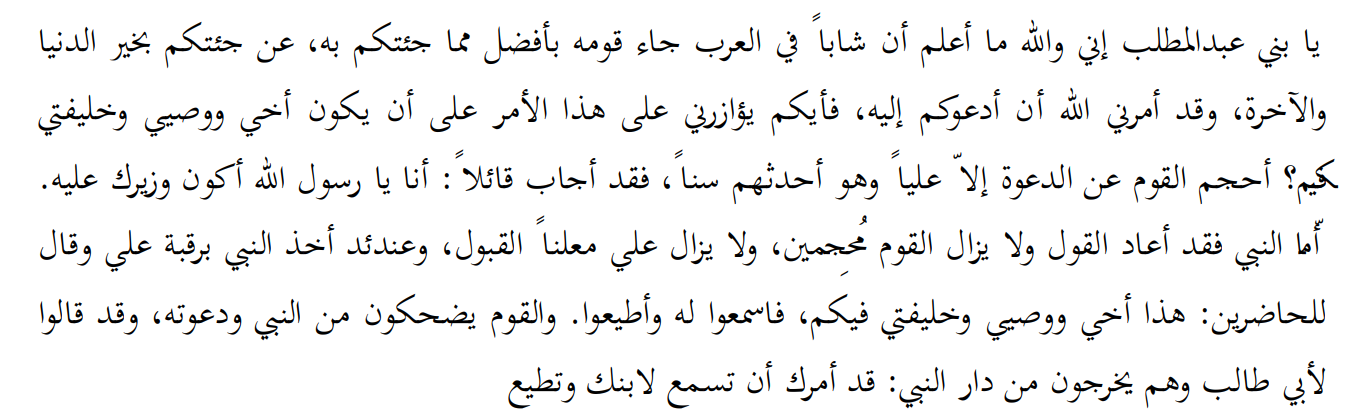
"Ey Abdülmuttalib oğulları, Allah'a yemin ederim ki, Araplar arasında kavmine, getirdiğimden daha hayırlı bir şey getiren hiçbir genç tanımıyorum. Gerçekten ben size bu dünyanın ve ahiretin iyiliğini getirdim. Allah bana sizi Kendisine çağırmamı emretti. Peki, bu işte bana kim yardım edecek ki o benim kardeşim, mirasçım ve aranızdaki halifem olsun?" İnsanlar davetten uzak durdu. Yalnızca aralarında en genç olan Ali cevap verdi ve şöyle dedi: "Ben, ey Allah'ın Elçisi, bu işte size yardımcı olacağım." Elçi sözünü tekrarladı, insanlar yine uzak durdu. Ali ise kabulünü ilan etmeye devam etti. Bunun üzerine Elçi, Ali'nin boynunu tuttu ve orada bulunanlara şöyle dedi: "Bu, aranızda kardeşim, mirasçım ve halifem. Onu dinleyin ve ona itaat edin." İnsanlar Peygamber'le ve onun davetiyle alay ettiler; Elçi'nin evinden çıkarken Ebu Talib'e şöyle dediler: "Sana oğlunu dinlemeni ve ona itaat etmeni emretti."
O Banu Abd al-Muttalib, by Allah I do not know any youth among the Arabs who has come to his people with a thing better than what I have come to you with. Verily I have come to you with the good of this world and the Hereafter. Allah has commanded me to call you to Him, so which one of you will assist me in this matter so that he may become my brother, inheritor and my Khalifah among you? The people kept away from the da’wa except Ali, the youngest among them, who responded saying: I, O Messenger of Allah, will be your assistant upon this matter. The Messenger repeated his statement and the people remained away while Ali continued announcing his acceptance. So the Messenger took the neck of Ali and said to those present: This is my brother, inheritor and my Khalifah among you so listen to him and obey. The people laughed at the Prophet and his invitation, and said to Abu Talib while leaving the Messenger’s house: ‘He has commanded you to listen to your son and obey him.’”
Bu, delil olarak kendisine dayanan kimselerin rivayet ettiği "ehl-i beyt hadisinin" özetidir.
This is the summary of the hadith of the house as narrated by those who depend upon it as evidence.
El-Buhari, şu olayı rivayet etmiştir: o gün
Al-Bukhari narrated the incident of the day when
"Ve en yakın akrabanı uyar." [TMQ 26:214]
“And warn your nearest kinsfolk” [TMQ 26:214]
Bu ayetin, Peygamber'in (sav) Safa tepesine çıktığı ve yemek hazırlanmasından söz edilmeden indirildiği rivayet edilmiştir. İmam Ahmed bin Hanbel, Müsned'inde iki hadis rivayet etmiştir: Biri, bu ayetin indiği gün yemek hazırlanmasından söz etmeden anlatır; diğeri ise ayetin indiği gün yemek hazırlandığını belirtir. Önce bu metinleri göstereceğiz, ardından ne içerdiklerini açıklayacağız.
Was revealed (saying) that the Messenger (saw) stood upon (Mount) Safa, without mentioning the preparation of food. Ahmad bin Hanbal narrated in his Musnad two hadiths, one about the preparation of food without mentioning it was the day in which “And warn your nearest kinsfolk” was revealed and another mentioning that the preparation of food was on the day the ayah was revealed. We will show these texts first then explain what they contain.
Buhârî, İbn ‘Abbas'tan (ra) rivayet etmiştir ki o şöyle demiştir: Eğer
Al-Bukhari narrated from Ibn ‘Abbas (ra) who said: When
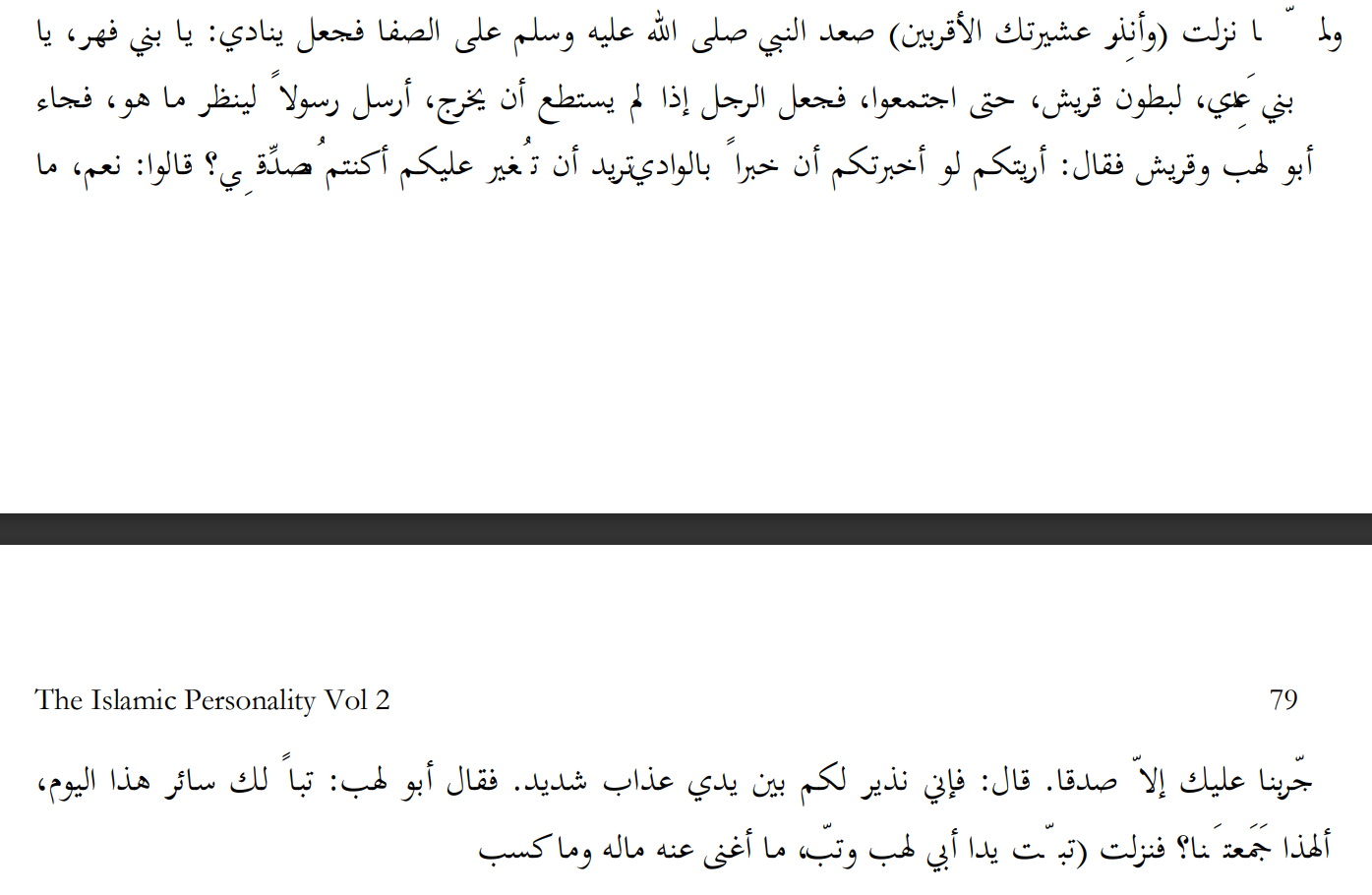
"Ve yakın akrabanı uyar" âyeti indirildiğinde, Elçi Safa tepesine çıktı ve şöyle seslendi: "Ey Benî Fihr, ey Benî Adiyy!" Kureyş'in bütün kabilelerini çağırdı, ta ki hepsi bir araya toplandı. Gelemeyenler ise ne olduğunu öğrenmek için birini gönderdi. Ebû Leheb ve Kureyş geldi. Peygamber ﷺ şöyle buyurdu: "Size vadinin ardında, sizi ansızın basmak niyetiyle atlıların (adamların) bulunduğunu söylesem, bana inanır mısınız?" Dediler ki: "Evet, sen bizde hiçbir zaman yalancılık görmedik, sadece doğru söylediğini gördük." Bunun üzerine Peygamber ﷺ: "Şüphesiz ben, şiddetli bir azap öncesinde size bir uyarıcıyım!" dedi. Ebû Leheb ise: "Bütün gün boyunca kahrolasıca olasın! Bizi bunun için mi topladın?" dedi. Bunun üzerine "Ebû Leheb'in iki eli kurusun (Ebû Leheb'in, Peygamber ﷺ'in amcası, kahrolsun) ve kendisi de kurusun! Malı da çocukları da ona fayda vermeyecek!" [TMQ 111:1-2] âyeti indi.
“And when And warn your nearest kinsfolk was revealed, the Messenger stood upon Safa and started announcing: O Banu Fihr, O Banu Adiyy for all the (butun) of Quraysh until they gathered together. Whoever was unable to go had sent a messenger to see what was happening. Abu Lahab and Quraysh came and he said: ‘If I told you there were horses (men) in the valley intending to attack you suddenly, would you believe me?’ They said: Yes, we have not tried you in anything except to find you saying the truth. He said: Verily, I am a warner to you before a severe punishment! Abu Lahab said: Woe be upon you for the rest of the day. Is it because of this that you gathered us? So “Perish the two hands of Abû Lahab (an uncle of the Prophet [sal-Allâhu 'alayhi wa sallam]) and perish he!, His wealth and his children will not benefit him!” [TMQ 111:1-2] was revealed”
Bu durum, yemek hazırlama olayının "Ve en yakın akrabalarını uyar" ayetinin indiği güne ait olmadığını gösterir; çünkü hadisin metninde geçen olaylarla uyuşmamaktadır. Ahmed bin Hanbel, Müsned'inde şöyle rivayet etmiştir: 'Affân bize rivayet etti, Ebû Avâne bize rivayet etti, Osman bin el-Muğîre'den, o Ebû Sâdık'tan, o Rabî'a bin Nâcid'den, o da Ali (ra)'den rivayet etti ki şöyle dedi: Allah'ın Resûlü ﷺ, Benî Abdulmuttalib'i bütün kollarıyla bir araya topladı ya da çağırdı, yiyip içsinler diye. Onlar için bir miktar yemek hazırladı, doyuncaya kadar yediler. Yemek, dokunulmamış gibi kaldı. Sonra safranlı bir içecek istedi, onlar doyuncaya kadar içtiler ve içecek de dokunulmamış gibi kaldı. Sonra ﷺ şöyle buyurdu:
This indicates that the incident of the preparation of food was not on the day in which “And warn your nearest kinsfolk” was revealed as it does not concur with what occurred in the hadith’s text. Ahmad bin Hanbal said in his Musnad: ‘Affan related to us that Abu Awana related to us from Uthman bin al-Mughira from Abu Sadiq from Rabi’a bin Najidh from Ali (ra) who said: The Messenger of Allah (saw) gathered or called Banu Abd al-Muttalib in all their groups to eat and drink. He prepared for them a quantity of food which they ate until they were satisfied. He said: The food remained as if it had not been touched. Then he called for a saffron drink which they drank until they will full, and the drink remained as if it had not been touched. Then he (saw) said:

“Ey Abdulmuttalib oğulları, ben size ve bütün insanlığa özel olarak gönderildim. Şimdi bu ayetten (işaretten) gördüğünüzü gördünüz; aranızdan hanginiz bana kardeşim ve yoldaşım olmak üzere biat edecek?” Dedi. Hiçbiri ayağa kalkmadı. Bunun üzerine, grubun en küçüğü olmama rağmen ben ayağa kalktım. O da, “Otur!” dedi. Bunu üç kez tekrarladı; her seferinde ben ayağa kalktım ve o da “Otur!” dedi. Üçüncü seferde elini elimle çarptı.
“O Banu Abd al-Muttalib, I have been sent specifically to you and to humanity in general. You have now seen of this sign (ayah) what you saw, so which one of you will give me a pledge in order to become my brother and companion?’ He said: None of them stood, so I stood for him though I was the youngest of the group and he said: Sit down. He repeated it three times following which I stood for him and he said ‘Sit down’, until the third time he struck my hand with his hand.”
Bu durum, bu olayda "Ve en yakın akrabalarını uyar" ayetinin inişine dair bir an olmadığını açıkça ortaya koymaktadır. Ayrıca Elçi (sav) akrabalarına İslam'ı sunmuş, kim Müslüman olursa onun kardeşi ve arkadaşı olacağını söylemiş, Ali'ye (ra) ise hiçbir şey demediğini göstermektedir.
This clarifies that there is no moment in this incident of the revelation of “And warn your nearest kinsfolk”, and that the Messenger (saw) offered Islam to them so that whoever became a Muslim would become his brother and companion and that he did not say anything to Ali (ra).
İkinci rivayete gelince, İmam Ahmed bin Hanbel Müsned'inde şöyle rivayet etmiştir: "Esved bin Amir bize rivayet etti, Şerik bize Ammeş'ten, o Minhal'den, o İbad bin Abdullah el-Esedî'den, o da Ali'den rivayet etti; Ali şöyle dedi: 'Ve yakın akrabalarını uyar' ayeti indiğinde Resulullah ﷺ evinin ailesini topladı. Otuz kişi toplandı; yediler, içtiler. Sonra onlara ﷺ şöyle buyurdu:"
As for the second narration, Ahmad bin Hanbal narrated in his Musnad: “Aswad bin Amir related to us that Shareek related to us from Al-‘Amash from Al-Minhal from ‘Ibad bin Abdullah al Asadi from Ali who said: When the ayah “And warn your nearest kinsfolk” was revealed, the Messenger (saw) gathered the family of his house. Thirty people gathered; they ate and drank then he (saw) said to them:
"Borçlarımı ve vaatlerimi kim üstlenecek ki Cennette benimle birlikte olsun ve ailem üzerinde benim halifem olsun?" Şerîk'in adını vermediği bir adam dedi ki: "Ey Allah'ın Elçisi ﷺ, siz bir okyanus (bahr) gibiydiniz, öyleyse bunu kim üstlenebilir?" Sonra bir başkası da aynısını söyledi. Bunu evinin ailesine teklif etti; bunun üzerine Ali (RA) dedi ki: "Ben (üstlenirim)."
"Which one will guarantee my debts and promises so as to be with me in Paradise, and he will be my Khalifah over my family? A man, whom Shareek did not name, said: O Messenger of Allah, you were an ocean (bahr) so who could take care of this? Then another said (the same?). He offered that to the family of his house, so Ali (RA) said: I (will).”
Bu iki metinde "halef" (varis) veya "halife" kelimesi hiçbir şekilde geçmemektedir. Bunun yerine yalnızca "halife" kelimesi, ailesiyle sınırlı olarak geçmektedir; ailesi üzerindeki bu halifelik, yönetim veya liderlik makamındaki hilafet değildir ve onunla hiçbir ilgisi yoktur. Bu metinler Sahih kitaplarında gelmiştir; benzer lafızlar ve birleşik anlamlarla pek çok rivayette yer almıştır ve bunların hiçbirinde "varis" veya "hilafet" kelimeleri geçmemiştir. Sahih kitaplarının derleyicilerinden veya güvenilir râvilerden hiçbirinden, Ali'ye veya başka birine ilişkin olarak, hiçbir hadiste "varis" veya "halifenin varisi" kelimeleri hiçbir şekilde geçmemiştir. Dolayısıyla bu iddia, Sahih kitaplarında hiçbir delili bulunmadığı için delilsiz kalır.
The word inheritor or Khalifah does not appear in these two texts in any way at all. Rather it is only the word Khalifah which appears restricted to his family, and the Khilafah over the family is not the Khilafah in the post of rule or leadership nor does it have any relationship with that. These are the texts which came in the Saheeh books, and they came in numerous narrations with similar wordings and unified meanings, and there did not appear in any of them the words inheritor or Khilafah. There has never appeared, either via any of the compilers of the Saheeh (books of ahadith) or any of the trustworthy narrators, in even one hadith the word(s) inheritor of Khalifah in any way at all either in relation to Ali or anyone else, so the evidence falls due to the absence of any evidence for it in the Saheeh books.
Ali'nin halifeliğine dair ileri sürenlerin "hadisü'd-dar" adını verdikleri rivayete gelince, bu rivayet, bu rivayetin anlatımı (rivayeti) bakımından dirayet yönünden reddedilmiştir. Bir hadis, dirayet yönünden anlamına göre, rivayet yönünden ise senedine göre reddedilir. Dolayısıyla senedi veya anlamı bakımından reddedilmişse dikkate alınamaz ve delil olma özelliğini yitirir. Anlamının reddedilmesine gelince, bunun birçok sebebi vardır; bunlardan bazıları şunlardır:
As for the text narrated by those who contend about the appointment of Ali which they named the hadith of the house, this text with this narration (riwayah) is rejected in its meaning (Dirayah).A hadith is rejected in its dirayah based on its meaning, and its narration based on its chain. So if it is rejected in its chain or meaning then it cannot be considered and it falls as evidence. As for rejecting its meaning, this is due to many reasons including:
Birincisi: Bu hadiste, Peygamber (sav) davetinde Abdülmuttalib ailesinin yardımını, hilafetin/yönetimin kendilerinden sonra onlara ait olması şartıyla istediği görülmektedir. Bu görüş iki açıdan geçersizdir: Birincisi, bu durum, bir kabilenin Müslüman olmaları halinde yönetimin kendisinden sonra onlara ait olması talebini reddettiği olayda Peygamber'in (sav) sözü ve fiiliyle çelişmektedir; o, bu talebe şöyle cevap vermiştir:
"Yetki Allah'a aittir ve O (swt) onu dilediği yere koyar."
“Authority is a matter which belongs to Allah, and He (swt) will place it where He wishes.”
İbn Hişam, Peygamber'in (sav) Siyer'i hakkındaki kitabında şöyle rivayet etmiştir: İbn İshak dedi ki: Ez-Zührî rivayet etti ki, Benî Âmir bin Sa'sa'a'ya rastladı, onları Allah azze ve celle'ye davet etti ve kendisini onlara sundu. Aralarında Bayciret bin Ferra adıyla anılan bir adam ona şöyle dedi: Vallahi, Kureyş'ten bu genci alıp onunla Araplara üstün gelirsem, onlar (yani Arapları) onunla yiyip bitireceğim. Sonra dedi ki: Eğer senin işini desteklemek üzere sana biat etsek, sonra Allah sana karşı çıkanlara karşı zafer verse, senden sonra idare bizim olacak mı? Dedi ki: "İdare Allah'ındır, onu dilediği yere koyar." Bunun üzerine ona dedi ki: Biz boyunlarımızı senin için mi feda edelim, sonra Allah (sbhü ve teâlâ) zafer verince idare başkasına mı geçsin? O halde senin işine ihtiyacımız yok. Ve onu reddettiler. Peki Elçi (sav) nasıl "İş Allah'ındır ve onu dilediği yere koyar" diyebilir, yani hilafet ve ondan sonraki idare işi, ve sonra Abdulmuttalib oğullarına şöyle diyebilir:
Ibn Hisham narrated in his book of the Sirah of the Prophet (saw): Ibn Ishaq said that Az-Zuhri narrated that he met Banu Amr bin Sa’sa’ah so he invited them to Allah ‘azza wa jalla and offered himself to them. One man among them, whom they called Bayjirat bin Furra, said to him: By Allah, if I were to take this youth from the Quraysh, I will eat (i.e. conquer) the Arabs through him. Then he said: What if we were to pledge to support your matter then Allah will grant you victory over those who oppose you. Will the rule be with us after you? He said: “The rule is for Allah and He places it where He wills.” He said: So he said to him: Will we sacrifice our throats for you, then when Allah (swt) grants you victory the rule becomes for someone else? Then we have no need of your matter, and they rejected him.” How can the Messenger (saw) say: “The matter belongs to Allah and He will place it where He wills” i.e. the matter of the Khilafah and the rule after him, yet he says to Banu Abd al-Muttalib:
“Aranızdan hanginiz bu işte bana yardım edecek ki kardeşim, vârisim ve aranızda halifem olsun?”
“Which one of you will assist me upon this matter so that he may become my brother, inheritor and Khalifah among you?”
Bu bir açık çelişki değil mi? Zorunlu olarak, bu iki ifadeden birinin reddedilmesi gerekir. Çünkü ev hadisi hakkında söylendiğine göre, o, ... zamanında vuku bulmuştur.
Is this not a clear contradiction? Inevitably, it is necessary that one of these two statements be rejected. Since it is said of the hadith of the house that it occurred when
“En yakın akrabalarını uyar.” [TMQ 26:214]
“Warn your nearest kinsfolk” [TMQ 26:214]
"Vahyedildi", yani Elçinin (ﷺ) peygamberliğinin üçüncü yılında ve hadis:
Was revealed i.e. the third year of the messenger ship and the hadith:
"Emir Allah'a aittir ve onu dilediği yere koyar."
“The matter belongs to Allah and He places it where He wills”
Peygamber (sav) kabilelere kendisini sunduğunda, yani Resûlullah'ın (sav) gemisinden sonraki onuncu yılda ve dolayısıyla "evin hadisi"nden sonra; reddedilen de bu "evin hadisi"dir. İkinci yöne gelince: Peygamber (sav) bu hadiste, Müslüman olmaları için kâfirlere bir şey teklif etmiştir; hatta Müslüman olmalarının karşılığı olarak onlara en büyük şeyi, yani kendisinden sonra bütün Müslümanlar üzerindeki hilafeti teklif etmiştir. Bu durum, Peygamber'in (sav) davetteki uygulamasına ve şer'î kurallara aykırıdır. Peygamber (sav), insanları İslam'a doğru din olduğu için davet ederdi; onun, İslam'a girmeleri karşılığında kâfire küçük ya da büyük herhangi bir şey teklif ettiği, zayıf bir hadis yoluyla bile hiçbir zaman rivayet edilmemiştir. Kalpleri İslam'a ısındırılacak olanlara gelince, bunlar zekâttan verilen, devleti onlar aracılığıyla güçlendirmek amacıyla kendilerine verilen Müslümanlardır; İslam'a girsinler diye verilen kâfirler değildir. Ayrıca İslam'a girmeleri karşılığında kâfirlere bir şey vermek de caiz değildir.
when the Messenger (saw) offered himself to the tribes i.e. in the tenth year after the messenger ship and therefore after the hadith of the house; so it is the hadith of the house which is rejected. As for the second side, it is that the Messenger (saw) in this hadith offered something to the disbelievers so that they may become Muslims, rather he offered them the greatest thing which is the Khilafah after him over all Muslims as the price for their entering into Islam. This contradicts the Messenger’s action in his da’wa and the Shari’ah rules. The Messenger would invite people to Islam because it is the correct deen and it has never been narrated from him, even through a weak hadith that he offered anything whether small or large to a kafir in exchange for his entering into Islam. As for those whose hearts are to be reconciled, they are Muslims who are given from the zakat in order to strengthen the State through them, not kuffar who are given so that they enter Islam. Nor is it allowed to give something to kuffar in exchange for their entering Islam.
İkincisi: Hadiste, Resulullah (sav)'in kâfirleri İslam'a davet etmek amacıyla bir düğün ziyafeti ve yemek hazırladığı, onları İslam'a girmeleri için bir yemek etrafında topladığı; ancak zaten İslam'ı kabul etmiş olan Ali (ra) için yemek hazırlamadığı anlatılmaktadır. Dolayısıyla bu kimseler İslam'ı reddeder ve İslam'ın karşılığında kendisinden sonra yönetimin onlara ait olduğunu kabul etmezlerse, Ali (ra) için orada kabul beyanında bulunacak bir yer yoktur; çünkü o zaten Müslümandır, İslam'a davet edilmemektedir ve kendisine yönelik bir söz de yoktur. Bu yüzden bu toplantıda, ona şöyle demesine uygun bir yer bulunmamaktadır:
Secondly: The hadith mentions that the Messenger (saw) prepared a wedding feast and meal for kuffar in order to invite them to Islam, and he gathered them around a meal so that they may enter Islam and he did not prepare food for Ali (ra) who had already accepted Islam. So if these people reject Islam and reject that the rule becomes theirs after him in exchange for Islam, there is no place there for Ali (ra) for giving his acceptance as he is not being invited to Islam because he is already a Muslim, and there is no speech addressed to him. This is why there is no place in this gathering such that he says to him:
"Bu benim kardeşim, mirasçım ve aranızdaki halifem; ona kulak verin ve itaat edin."
“This is my brother, inheritor and my Khalifah among you so listen to him and obey”
Üçüncüsü: Hadis, bu grubun İslam'ı reddettiğini, Peygamber'in teklifini tekrarlamasına rağmen İslam'a girmeleri karşılığında hükmün kendilerinden sonra onlara ait olması fikrini de reddederek İslam'ı red etmeye devam ettiğini belirtmektedir. Onlar kâfir olarak kaldılar, o halde Resulullah ﷺ onlara hitap ederken nasıl ....
Since he is not the target of the address or the negotiation. Thirdly: The hadith mentions that the group rejected Islam, and despite him repeating his offer they persisted in rejecting Islam and rejecting that the rule becomes theirs after him in exchange for entering Islam. They remained kuffar so how could the Messenger (saw) say to them in addressing them:
"Bu, aranızdaki halifem" (Bu, aranızdaki halifem)
“This is my Khalifah among you”
Onları, kâfir olduklarını ve İslam'ı reddettiklerini bilirken, ona itaat etmeleri ve sözünü dinlemeleri yönünde emretmek? Ve kâfir oldukları hâlde onların arasında nasıl halife olabilir?
Commanding them with hearing and obeying him while he knows they are kuffar who have rejected Islam? And how could he be the Khalifah among them while they are kuffar?
Dördüncüsü: Onların naklettikleri rivayet şöyledir:
Fourthly: The narration they narrate says:
"Bu benim kardeşim, mirasçım ve aranızdaki halifem; ona kulak verin ve itaat edin."
“This is my brother, inheritor and my Khalifah among you so listen to him and obey”
Bu hitap, sözün "Ey Abdülmuttalib oğulları" diye başlamasından dolayı Abdülmuttalib'in ailesine yöneliktir. Dolayısıyla bu, onlara özgüdür; çünkü onu, "ve sizin aranızda halifem" dediği için, Abdülmuttalib'in ailesi üzerine halife kılmıştır, Müslümanların halifesi olarak değil. Açık metin de bunu göstermektedir. Burada, "lafzın genelliği esas alınır, olayın sebebinin özelliği değil" denilemez; çünkü bu, bir sebep (sebeb) değil, belirli bir olaydır. Üstelik sözün kendisi de genel değil, özeldir: "Ey Abdülmuttalib oğulları" ve "aranızda halifem" ifadeleri böyledir. Bu nedenle, belirli bir olay olması ve genel ifadelerin bulunmaması sebebiyle hükmün bu olayla sınırlandırılması gerekir.
This is an address to the family of Abd al-Muttalib since the words started with his saying “O Banu Abd al-Muttalib.” So it is specific to them as he made him a Khalifah over them i.e. over the family of Abd al-Muttalib not the Khalifah of the Muslims since he said, “and my Khalifah over you.” Thus he is not the Khalifah for the Muslims as is depicted by the explicit text. Nor can one say here that the lesson is by the generality of the text not the specificity of the cause since this is a specific incident not a cause (sabab) not mentioning that the words are also specific and not general: “O Banu Abd al-Muttalib”, “my Khalifah among you” so the specification is demanded due to this being a specific incident not a cause, and also due to the absence of general words.
Bu dört hususun yalnızca biri bu hadisin uydurma olduğunu ve çelişkisini ortaya koymaya yeter; dirayet açısından da bu hadisin rivayetini reddetmek zorunludur. Bu nedenle açıklık kazanmıştır ki Resûlullah (sallallahu aleyhi ve sellem), Ali'yi (radıyallahu anh) kendisinden sonra halife yapacağını açıkça belirtmemiştir. Bütün bunlardan anlaşılmaktadır ki, Resûlullah'ın (sallallahu aleyhi ve sellem) kendisinden sonra hilafete bir kişiyi tayin ettiğini savunanların rivayet ettiği hadisler reddedilmiş hadislerdir; delil olarak dayanılmaya elverişli değildirler, dolayısıyla düşerler. Resûlullah'ın (sallallahu aleyhi ve sellem) kendisinden sonra hilafetin başına birini tayin ettiğine dair hiçbir delil kalmamıştır; aksine bunun tersine delil sabit olmuştur. Yani Resûlullah (sallallahu aleyhi ve sellem) bu konuyu, kimi istedilerse seçmeleri hususunda Müslümanlara bırakmış, ancak halifenin nasıl atanacağına dair yöntemi onlara belirtmiştir.
Just one of these four matters suffices to reveal the falsehood of this hadith and its contradiction, and it is obligatory to reject its narration (dirayah). Therefore it is clarified that the Messenger (saw) did not explicitly state making Ali (ra) the Khalifah after him. From all this it becomes clear that the ahadith narrated by those who argue that the Messenger (saw) designated a person for the Khilafah after him are rejected ahadith unsuitable to depend upon as evidence so they fall. There remains no evidence that the Messenger (saw) designated anyone to be in charge of the Khilafah after him; rather the evidence has been established contrary to that i.e. that the Messenger (saw) left the matter to the Muslims to choose whom they want in relation to the person but he specified for them the method for appointing the Khalifah.