2.7 अल-क़ज़ा व अल-क़द्र
2.7 Al-qadā’ Wa‘l-qadar
अल-क़ज़ा वल-क़द्र, इस नाम में, यानी दो शब्दों को एक अर्थ के लिए एक साथ जोड़ने से, एक विशेष संदर्भ रखता है; यानी अल-क़ज़ा को अल-क़द्र से जोड़ना, जिससे ये दोनों ऐसी दो सहवर्ती बातें बन जाती हैं जिनमें से एक दूसरे से अलग नहीं हो सकती, और इनका एक ऐसा अर्थ है जो केवल इन्हीं के लिए विशिष्ट है। इसमें इस अर्थ के अलावा कुछ और शामिल करना सही नहीं है, जिसका प्रयोग सहाबा या ताबिईन ने नहीं किया। शरई और भाषाई ग्रंथों का अध्ययन करने से तथा सहाबा, ताबिईन और उनके बाद के उलेमा के कथनों को देखने से स्पष्ट होता है कि अल-क़ज़ा वल-क़द्र शब्द एक साथ, सहाबा या ताबिईन में से किसी ने भी किसी विशेष पारिभाषिक [इस्तिलाही] अर्थ में प्रयोग नहीं किए, और न ही ये क़ुरआन या हदीस में किसी विशेष पारिभाषिक अर्थ के साथ एक साथ आए हैं; हालाँकि ये अपने भाषाई अर्थ में एक साथ आए हैं, जैसा कि अल-बज़्ज़ार ने जाबिर की हदीस से, हसन सनद के साथ, नबी ﷺ के हवाले से रिवायत किया कि उन्होंने फ़रमाया:
Al-qadā’ wa‘l-qadar, with this name, that is, by connecting two words together for one meaning, has a specific referent; that is, al-qadā’ linked to al-qadar, by making them two concomitant matters whereby one is not separable from the other, and they have a meaning that is exclusive to them. It is not correct to include in it other than this meaning which has not been used by the Sahabah or the Tabi’een. By studying the shar’i and linguistic texts and studying the sayings of the Sahabah, Tabi’een and those who came after them from the Ulama’, it is apparent that the terms al qadā’ wa‘l-qadar together, have not been used with a specific technical [istilāhī] meaning by any of the Sahabah or Tabi’een, nor have they come together with a specific technical meaning in the Qur’ān or the Hadīth; though they have come together in their linguistic meaning in what al Bazzār reported from the hadīth of Jabir with a hasan chain on the authority of the Prophet (PBUH) that he said:
“मेरी उम्मत के अधिकतर लोग अल्लाह के क़ज़ा और उसकी क़दर के साथ, अपनी जानों [अनफ़ुस] के साथ मरते हैं।” — यह वाक्य इस तरह अनुवादित होगा: “मेरी उम्मत के अधिकतर लोग अल्लाह के क़ज़ा और उसकी क़दर के अनुसार, अपनी जानों [अनफ़ुस] के साथ मरते हैं।”
“Most of my Ummah die after the qadā’ of Allaah and his qadar with the souls [anfūs].”
इसलिए यह पारिभाषिक अर्थ, जो इस नाम की ओर संकेत करता है, केवल मुतकल्लिमून (उलमा-ए-कलाम) के यहाँ मिलता है, पहली सदी बीत जाने के बाद और यूनानी दर्शन के अनुवाद के बाद। यह सहाबा के समय में मौजूद नहीं था, और न ही इन दोनों शब्दों को किसी विशेष पारिभाषिक अर्थ के लिए एक नाम के रूप में लेने पर कोई मतभेद या चर्चा थी। सहाबा के पूरे दौर में मुसलमान ‘अल-क़ज़ा वल-क़दर’ को नहीं जानते थे, यद्यपि ‘क़ज़ा’ शब्द अकेले आया था और ‘क़दर’ शब्द भी अकेले हदीसों में आया था, जैसे ऊपर उल्लिखित जाबिर की हदीस में दोनों शब्द एक साथ आए थे। लेकिन इन सभी स्थितियों में ये शब्द भाषाई अर्थ में आए हैं, पारिभाषिक अर्थ में नहीं। शब्द ‘क़ज़ा’ क़ुनूत की हदीस में आया है। अल-हसन ने कहा, अल्लाह के रसूल ﷺ ने मुझे ऐसे शब्द सिखाए जिन्हें मैं वितर की नमाज़ के क़ुनूत में पढ़ता हूँ, फिर उन्होंने क़ुनूत की दुआ का उल्लेख किया, जिसके शब्द ये हैं,
Therefore this terminological meaning which alludes to this name is not found except from the Mutakallimūn, after the first century had passed and after the translation of the Greek philosophy. It did not exist in the time of the Sahabah nor was there any dispute or discussion of those two terms as one name for a specific technical meaning. Throughout the era of the Sahabah the Muslims did not know of ‘al-qadā’ wa‘l-qadar’ though the word qadā’ had come on its own and the word qadar had come on its own in the ahadīth just as the two had come together in the aforementioned hadīth of Jabir, but in all of these cases they had come in the linguistic meaning. They have not come in the technical meaning. The word qadā’ has come in the hadīth of al-qunut. Al-Hasan said, the Messenger of Allah (PBUH) taught me words I say in the qunut of the witr, then he mentioned the du’a of qunut, of which is,
"...और जो तूने फ़ैसला किया है उससे मुझे बचा, क्योंकि तू ही फ़ैसला करने वाला है और तुझ पर कोई फ़ैसला नहीं किया जाता।" [Reported by al-Darimi , Narrated by al-Hasan ibn Ali]
“...and save me from what You have decreed, for You are the one Who Decrees and you are not decreed upon,” [Reported by al-Darimi , Narrated by al-Hasan ibn Ali]
उसका अर्थ है, "हे अल्लाह, जो तूने फ़ैसला किया है उसकी बुराई से मुझे बचा, क्योंकि तू ही फ़ैसला करता है, और तुझ पर कोई फ़ैसला नहीं करता।" जिब्रील की हदीस की कुछ रिवायतों में शब्द "क़द्र" आया है। उन्होंने कहा,
Its meaning is, protect me from the evil of what you have judged, for you judge what you wish and no one judges over you. The word qadar has come in the hadīth of Jibrīl in some of its narrations: He said,
और अल-क़दर पर ईमान रखना, उसकी अच्छाई और बुराई दोनों के साथ। [Reported by Muslim, Narrated by Umar ibn al-Khattab]
“And to believe in al-qadar, the good and the bad thereof”, [Reported by Muslim, Narrated by Umar ibn al-Khattab]
और उनके इस कथन में
And in his saying
"…अगर तुम पर कोई मुसीबत आए तो यह न कहो कि 'अगर मैंने ऐसा किया होता तो ऐसा और ऐसा हो जाता', बल्कि यह कहो कि 'अल्लाह ने तक़दीर में लिखा था और उसने वही किया जो उसने चाहा'।" [Reported by Muslim, Narrated by Abu Hurairah]
“…If anything befalls you do not say, ‘had I done (this), it would have been such-and-such, but rather say, ‘Allah determined [qaddara] and He did what He willed,’”[Reported by Muslim, Narrated by Abu Hurairah]
इन दोनों हदीसों में "क़दर" शब्द का अर्थ अल्लाह की तक़दीर (निर्धारण) और उसके ज्ञान से है, अर्थात् तुम्हें यह मानना चाहिए कि अल्लाह ने चीज़ों को लौहे-महफ़ूज़ में लिख दिया है और वह उनके अस्तित्व में आने से पहले ही उन्हें जानता है, चाहे वे अच्छी हों या बुरी; और यह कहना कि अल्लाह ने इसे लौहे-महफ़ूज़ में लिख दिया है और वह इसके अस्तित्व में आने से पहले ही इसे जानता था और उसने वही किया जो वह चाहता था। "अल-क़ज़ा" शब्द का वह अर्थ, जिसमें यह इस हदीस में या कहीं और आया है, मुसलमानों के बीच विवाद का विषय नहीं रहा; उन्होंने इसके शब्दों या इसके अर्थ के संबंध में कोई बहस नहीं की।
The meaning of the word qadar in these two ahadīth is the Determination [taqdīr] and Knowledge of Allah , that is, that you should believe that the things have been written by Allah in the Lawh al-Mahfūdh and He knows of them before they come into existence, whether they be good or bad; and say Allah has written this in the Lawh al-Mahfūdh and he knew it before it came into being and he did what he wished. The word al-qadā’ in the meaning which it came in this hadīth or anywhere else it came was not disputed by the Muslims; they did not have discussions with regards to its wording or its import.
जहाँ तक उन दो हदीसों में बताए गए अर्थ में "क़दर" शब्द का सवाल है, यूनानी दर्शन के मुसलमानों में आने से पहले, मुसलमान इसके बारे में न तो असहमत थे और न ही इसके शब्द या अर्थ को लेकर उनमें कोई बहस थी। लेकिन जब मुसलमानों में यूनानी दर्शन आया, तो कूफ़ा से एक समूह उठा और उसने कहा: कोई क़दर नहीं है, यानी कोई ऐसा नहीं जो पूर्व-निर्धारण करे, और सब कुछ बिना किसी पूर्व-निर्धारण के घटित होता है। इन्हें क़दरिय्याह कहा गया, और ये वही लोग हैं जो क़दर को नकारते हैं और कहते हैं कि अल्लाह ने चीज़ों की मूल बातें बनाईं और फिर उन्हें छोड़ दिया, इसलिए उसे उनके विवरण [जुज़इय्यात] का ज्ञान नहीं है। यह क़ुरआन के स्पष्ट पाठ के विरुद्ध है, जिसमें आया है कि अल्लाह सब चीज़ों का सृष्टिकर्ता है, छोटी हों या बड़ी, मूल हों या शाखाई, और उसने हर चीज़ का उसके अस्तित्व में आने से पहले निर्धारण किया है, यानी उसने उसे लौहे-महफ़ूज़ में लिखा है, अर्थात् वह उसके होने से पहले ही उसे जानता था। उसने फ़रमाया:
As for the word qadar in the meaning mentioned in those two ahadīth, the Muslims, before the presence of Greek philosophy, did not disagree about it or have discussions with regards to its wording or import. But after the presence of the Greek philosophy amongst the Muslims, a group from Kufa arose and said: there is no qadar, that is, there is no one who (pre)determines and everything occurs without any previous determination; they were called the Qadariyyah and they are the ones who deny the qadar and say that Allah created the fundamentals of things and then left them, so He does not have knowledge of their particulars [juz'iyāt]. This is contrary to what has come in the clear text of the Qur’ān which states that Allah is the Creator of all things, small or big, fundamental or branchial, and that He determined everything before its existence, that is, He wrote it in the Lawh al-Mahfūdh, that is, He knew it before it came to be. He said:
उसने हर चीज़ को पैदा किया है और वह हर चीज़ का पूरा ज्ञान रखने वाला है। [TMQ-An’ām: 101]
“He created all things and He is the All-Knower of everything” [TMQ-An’ām: 101]
और
And
और वह जानता है जो कुछ धरती में है और समुद्र में है। कोई पत्ता नहीं गिरता, मगर वह उसे जानता है। धरती के अंधेरों में कोई दाना नहीं, और न कोई ताज़ा या सूखा चीज़ है, मगर वह एक स्पष्ट किताब (लौहे-मुबीन) में लिखी हुई है। [TMQ-An’ām: 59]
“And He knows whatever there is in the Earth and in the sea: not a leaf falls, but He knows it. There is not a grain in the darkness of the Earth nor anything fresh or dry, but is written in a Clear Record.” [TMQ-An’ām: 59]
लेकिन यह मतभेद और बहस केवल 'अल्लाह की क़दर' के संबंध में है, यानी उसके इल्म के संबंध में। क़दरिय्या का दावा था कि अल्लाह चीज़ों की मूल बातों को जानता है, लेकिन उनके आंशिक पहलुओं को नहीं जानता, जबकि इस्लाम कहता है कि अल्लाह चीज़ों की मूल बातों को भी जानता है और उनके आंशिक पहलुओं को भी। अतः अल्लाह की क़दर, यानी उसके इल्म के संबंध में होने वाली चर्चा, अल्लाह के इल्म के विषय से संबंधित है। यह विषय अल-क़दा' वल-क़दर के विषय से भिन्न है। यह एक अलग बहस है, जो अल-क़दा' वल-क़दर की बहस से अलग है। इसकी वास्तविकता, जो घटित हुई, वही रहती है, यानी यह अल-क़दा' वल-क़दर के विषय से एक अलग विषय है।
However, this disagreement and discussion is only with respect to the ‘qadar of Allah’ in terms of His Knowledge. So the Qadariyyah claimed that Allah knows the fundamentals of things but not their partial aspects, whilst Islam states that Allah knows the fundamentals of things as well as their partial aspects. Thus, the discussion with respect to the qadar of Allah , that is, His Knowledge, is about the subject of Allah's Knowledge. It is a subject different to that of al-qadā’ wa‘l-qadar. It is a different discussion, separate from the discussion of al-qadā’ wa‘l-qadar. Its reality that took place is the same, that is, it is a different subject to that of al-qadā’ wa‘l-qadar.
अतः यह बात स्पष्ट रूप से दिखाई देती है कि शब्द "अल-क़ज़ा" और "अल-क़दर" में से प्रत्येक अपने-आप में एक विशिष्ट अर्थ लिए हुए आया है। इनका "अल-क़ज़ा वल-क़दर" के अध्ययन से कोई संबंध नहीं है। दूसरे शब्दों में, शब्द "अल-क़ज़ा" अपने सभी भाषाई और शरई अर्थों के साथ, जो शरीअत देने वाले (अल्लाह) की ओर से आए हैं, तथा शब्द "अल-क़दर" अपने सभी भाषाई और शरई अर्थों के साथ, जो शरीअत देने वाले की ओर से आए हैं, इन शब्दों में से किसी का भी, चाहे अकेले उल्लेख किया गया हो या एक साथ, "अल-क़ज़ा वल-क़दर" की चर्चा से कोई संबंध नहीं रखते। उनके अर्थ उन्हीं भाषाई और शरई अर्थों तक सीमित हैं जिनके साथ वे आए हैं।
Thus, it is plainly apparent that the words al-qadā’ and al-qadar have each come on their own with each having a specific meaning. They do not have any relation with the study of al-qadā’ wa‘l qadar. In other words, the word al-qadā’ in all its linguistic and shar’i meanings that have come from the Legislator, and the word al-qadar in all its linguistic and shar’i meanings that have come from the Legislator, have no relation to any of these terms, whether mentioned alone or together, in the discussion of al-qadā’ wa‘l-qadar. They are confined with regards to their meaning, to that what they come with from the linguistic and shar'i meanings.
जो आयतें अल्लाह के ज्ञान को प्रदर्शित करते हुए आई हैं, वे वही हैं जो सभी चीज़ों के संबंध में अल्लाह के ज्ञान की सर्वव्यापी प्रकृति को दर्शाती हैं, जैसे उसका यह कथन:
The ayāt which have come in demonstrating the Knowledge of Allah are the ones that indicate the all-encompassing nature of Allah's Knowledge with regards to all things, thus His saying:
"पृथ्वी पर या तुम्हारे अपने अंदर कोई भी विपत्ति नहीं आती, परंतु वह हमारे उसे अस्तित्व में लाने से पहले एक किताब में लिखी हुई होती है। निश्चय ही यह अल्लाह के लिए आसान है।" [TMQ-Hadīd: 22]
“No calamity befalls on the Earth or in yourselves but is inscribed in a Book, before We bring it into existence. Indeed, that, upon Allah, is easy” [TMQ-Hadīd: 22]
और उनका यह कथन,
And His saying,
"कहो: 'हमें वही पहुँचेगा जो अल्लाह ने हमारे लिए लिख दिया है। वही हमारा मौला है।' और ईमान वालों को अल्लाह पर ही भरोसा करना चाहिए।" [TMQ Tawba: 51]
“Say: ‘Nothing shall ever happen to us except what Allah has ordained for us. He is our Mawla.’ Then in Allah let the believers put their trust” [TMQ Tawba: 51]
और उनका यह कथन,
And His saying,
"आकाशों में या धरती में, अणु के भार के बराबर भी कोई चीज़ उसके ज्ञान से छिपी नहीं रहती, न उससे छोटी और न उससे बड़ी, परन्तु वह एक स्पष्ट किताब में (लिखी हुई) है।" [TMQ Saba: 3]
“Escapes not from His Knowledge even the weight of an atom, in the Heavens or in the Earth, or less than that, or greater, but it is in a Clear Book” [TMQ Saba: 3]
और उनका यह कथन,
And His saying,
वही है जो रात में तुम्हारी आत्माएँ ले लेता है, और जो कुछ तुम दिन में करते हो उसे वह जानता है, फिर वह तुम्हें दिन में उठा देता है ताकि नियत अवधि पूरी हो जाए, फिर उसी की ओर तुम्हारा लौटना है। फिर वह तुम्हें बता देगा कि तुम क्या करते रहे थे। [TMQ An’ām: 60]
“It is He, Who takes your souls by night, and (Who) has knowledge of all that you have done by day, then He raises (wakes) you up again that a term appointed be fulfilled, then unto Him will be your return. Then He will inform you what you used to do” [TMQ An’ām: 60]
ये आयतें रसूलुल्लाह ﷺ पर उतारी गईं, और सहाबा ने इन्हें याद किया और समझा, लेकिन उनके मन में अल-क़ज़ा व अल-क़द्र पर चर्चा करने का विचार नहीं आया। इसके अलावा, इन आयतों के शब्द, इनका अर्थ और इनसे मिलने वाला संकेत यह बताते हैं कि ये अल्लाह के ज्ञान के स्पष्टीकरण के लिए हैं और इनका अल-क़ज़ा व अल-क़द्र के अध्ययन से कोई संबंध नहीं है। इसी तरह यह आयत,
These verses were revealed to the Messenger (PBUH) and they were memorised and understood by the Sahabah, it did not occur to them to discuss al-qadā’ wa‘l-qadar. Furthermore, the wording, understanding and indication of these verses states that they are a clarification about the Knowledge of Allah and have no relation to the study of al-qadā’ wa‘l-qadar. Similarly the ayah,
"और यदि उन्हें कोई भलाई पहुँचती है, तो कहते हैं, 'यह अल्लाह की ओर से है', और यदि उन्हें कोई बुराई पहुँचती है, तो कहते हैं, 'यह तेरी ओर से है'। कह दो: 'सब कुछ अल्लाह की ओर से है'; तो इन लोगों को क्या हो गया है कि ये कोई बात समझने के क़रीब भी नहीं आते?" [TMQ-Nisā’: 78]
“And if some good reaches them, they say, ‘This is from Allah’, but if some evil befalls them, they say, ‘This is from you’. Say: ‘All things are from Allah’; so what is wrong with these people that they fail to understand any word?’ [TMQ-Nisā’: 78]
यह अल-क़ज़ा वा'ल-क़दर की चर्चा से संबंधित नहीं है, क्योंकि यह उन काफ़िरों का खंडन है जिन्होंने बुराई और भलाई में फ़र्क़ किया। उन्होंने बुराई को रसूल ﷺ की ओर से और भलाई को अल्लाह की ओर से ठहराया। अतः अल्लाह ने यह कहकर उनका खंडन किया कि हर चीज़ अल्लाह की ओर से है। यहाँ चर्चा उस भलाई की नहीं है जो इंसान करता है और उस बुराई की नहीं है जिसका वह पीछा करता है; बल्कि चर्चा लड़ाई और मौत की है। स्वयं आयत और उससे पहले की आयत इसे स्पष्ट करती है:
It has nothing to do with the discussion of al-qadā’ wa‘l-qadar because it is a refutation of the kuffār who differentiated between bad and good. Thus, they made bad to come from the Messenger and good from Allah . So Allah refuted them by declaring that everything is from Allah . The discussion is not about the good that a human being does and the evil that he pursues; rather the discussion is about fighting and death. The ayah itself and that what precedes it clarifies this:
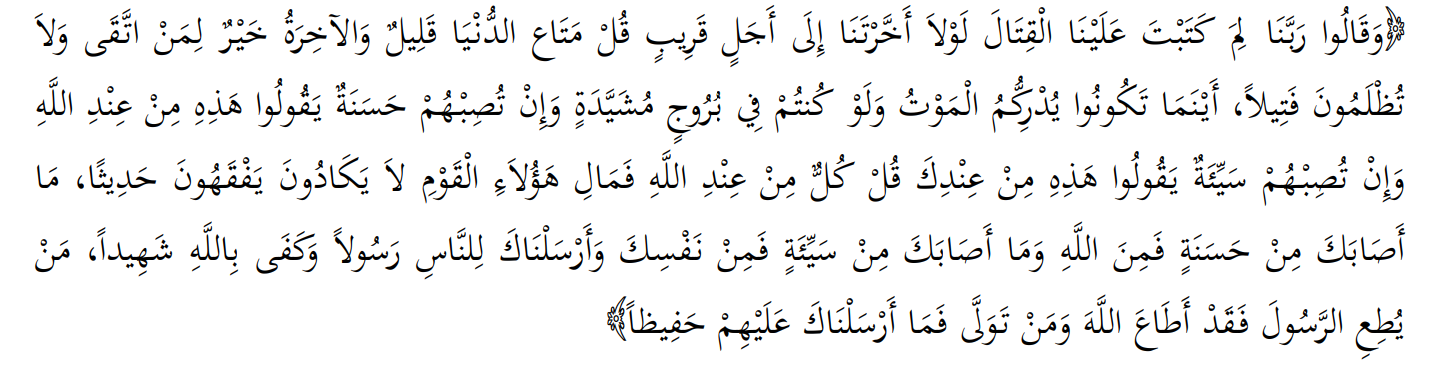
वे कहते हैं: "हे हमारे रब! तूने हम पर जिहाद (लड़ाई) क्यों फ़र्ज़ कर दिया? काश तू हमें थोड़ी मोहलत और दे देता!" कहो: "दुनिया का फ़ायदा थोड़ा है, और आख़िरत उस व्यक्ति के लिए बेहतर है जो अल्लाह से डरता है, और तुम्हारे साथ ज़रा भी ज़ुल्म नहीं किया जाएगा। तुम जहाँ कहीं भी हो, मौत तुम्हें आ पकड़ेगी, चाहे तुम मज़बूत और ऊँचे बुर्जों में ही क्यों न हो!" और अगर उन्हें कोई भलाई पहुँचती है तो कहते हैं, "यह अल्लाह की तरफ़ से है," और अगर उन्हें कोई बुराई पहुँचती है तो कहते हैं, "यह तेरी (ऐ मुहम्मद ﷺ) वजह से है।" कहो: "सब कुछ अल्लाह की तरफ़ से है," तो इन लोगों को क्या हो गया है कि कोई बात समझने के क़रीब भी नहीं आते? तुम्हें जो भी भलाई पहुँचती है, वह अल्लाह की तरफ़ से है, और जो बुराई पहुँचती है, वह तुम्हारे अपने नफ़्स की तरफ़ से है। और हमने तुम्हें (ऐ मुहम्मद ﷺ) सब लोगों के लिए रसूल बनाकर भेजा है, और गवाह के तौर पर अल्लाह काफ़ी है। जिसने रसूल की इताअत की, उसने दरअसल अल्लाह की इताअत की, और जिसने मुँह मोड़ा, तो हमने तुम्हें उन पर निगहबान बनाकर नहीं भेजा है। [TMQ-Nisā’: 77-80]
“They say: Our Lord! Why have you ordained for us fighting? Would that you have granted us respite for a short period?’ Say: ‘Short is the enjoyment of this world. The Hereafter is (far) better for him who fears Allah, and you shall not be dealt with unjustly in the least. Wheresoever you may be, death will overtake you even if you are in fortresses built up strong and high! And if some good reaches them, they say, ‘This is from Allah,’ but if some evil befalls them, they say, ’This is from you.’ Say: ‘All things are from Allah’, so what is wrong with these people that they fail to understand any word? Whatever of good reaches you, is from Allah, but whatever of evil befalls you, is from yourself. And We have sent you (O Muhammad) as a Messenger to mankind, and Allah is sufficient as Witness. He who obeys the Messenger, has indeed obeyed Allah, but he who turns away, then we have not sent you as a watcher over them.” [TMQ-Nisā’: 77-80]
तो विषय वह है जो उन पर घटित होता है, न कि वह जो वे करते हैं। इसलिए इसका अल-क़दा वल-क़दर के अध्ययन से कोई संबंध नहीं है।
So the subject is what befalls them and not what they are doing. Thus it has nothing to do with the study of al-qadā’ wa‘l-qadar.
इसलिए, ऊपर जो कुछ बताया गया है, उसका अल-क़ज़ा वल-क़दर के अध्ययन से कोई संबंध नहीं है; वे इसके अर्थ के अंतर्गत नहीं आते और ऊपर बताई गई बातों से उनका कोई भी सरोकार नहीं है। बल्कि, अल-क़ज़ा वल-क़दर एक अर्थ के रूप में यूनानी दर्शन से आया, जिसे मुअतज़िला ने आगे बढ़ाया और इस पर अपनी राय दी। अह्ल अस-सुन्नह और जब्रिया ने उनका खंडन किया, और अह्ल अस-सुन्नह ने जब्रिया का भी खंडन किया। यह चर्चा उसी अर्थ तक सीमित रही और उसी आधार पर आगे बढ़ी। अतः यह मुद्दा उस अर्थ/भाव से संबंधित है जो यूनानी दर्शन से आया और मुसलमानों तथा उन काफ़िरों के बीच होने वाली बहसों में सामने आया, जो यूनानी दर्शन से लैस होते थे। यह अर्थ अक़ीदह (आस्था) से संबंधित है, इसलिए अपेक्षित यह है कि इस अर्थ पर इस्लाम का दृष्टिकोण बताया जाए। मुअतज़िला ने एक राय दी, जब्रिया ने उसका खंडन करते हुए दूसरी राय दी। अह्ल अस-सुन्नह ने उन सबका खंडन किया और अपनी राय दी, और कहा कि यह तीसरी राय है जो उन दोनों रायों के बीच से निकली है, और उन्होंने इसे "वह शुद्ध दूध, पीने में मीठा, जो गोबर और खून के बीच से निकलता है" कहकर वर्णित किया।
Therefore, all that has been mentioned above has nothing to do with the study of al-qadā’ wa‘l qadar; they do not come under its meaning and have no relation whatsoever with what has been mentioned above. Rather, al-qadā’ wa‘l-qadar as a meaning has come from Greek philosophy which was transmitted by the Mu'tazilah who gave an opinion with regards to it. Ahl al-Sunnah and the Jabriyyah refuted them and Ahl al-Sunnah (also) made a refutation of the Jabriyyah. The discussion was confined to the same meaning and preceded upon the same premise. Thus the issue is a meaning/sense that came from Greek philosophy and it came to the fore in the debate which used to take place between the Muslims and the kuffar who used to be armed with the Greek philosophy. It is a meaning which has a relevance to the ‘aqīdah (creed), thus what is desired is to give Islam's opinion regarding this meaning. The Mu'tazilah gave an opinion and the Jabriyyah refuted them and gave another opinion. Ahl al-Sunnah refuted all of them and gave an opinion, and said about it that it is a third opinion which has come out from the two opinions and they described it as ‘the pure milk, sweet to drink, that comes out from between excrement and blood’.
इसलिए, यूनानी दर्शन से निकला वह विषय-चर्चा जाना-पहचाना हो गया, और चूँकि यह ‘अक़ीदah (आस्था) से संबंधित है, इसलिए मुसलमान को स्पष्ट होना चाहिए कि इस विषय पर उसका विश्वास क्या है। मुसलमानों ने वास्तव में अपनी राय बताई और विचार की तीन धाराएँ उभरीं। अतः al-qadā’ wa‘l-qadar के मामले को al-qadā’ या al-qadar के उस अर्थ की ओर लौटाना जायज़ नहीं है जो भाषा में और शरीअत में आया है, और न ही al-qadā’ या al-qadar के लिए केवल अनुमान, कल्पना या मनगढ़ंत सोच से कोई अर्थ गढ़ना और कहना जायज़ है, जैसे यह कहना कि al-qadā’ केवल सार्वभौमिक चीज़ों पर सार्वभौमिक फ़ैसला है और al-qadar आंशिक चीज़ों और उनके विवरणों पर सार्वभौमिक फ़ैसला है, या यह कहना कि al-qadar चीज़ों के लिए शाश्वत योजना है और al-qadā’ उसी पूर्वनिर्धारण और योजना के अनुसार निष्पादन और सृजन है। वास्तव में यह जायज़ नहीं है, क्योंकि यह केवल कल्पना और धारणा है, और कुछ भाषाई और शरई शब्दों को उन पर लागू करने का असफल प्रयास है, जबकि वे उन पर लागू नहीं होते, बल्कि सामान्य अर्थों की ओर संकेत करते हैं। तब बिना प्रमाण के दोनों शब्दों को इन विशेष अर्थों तक सीमित करना मनमानी कार्रवाई होगी।
"हर व्यक्ति अपनी कमाई के बदले गिरवी है," [TMQ Muddathir: 38]
“Every soul is a pledge for what it earns,” [TMQ Muddathir: 38]