2.15 De Openbaring
2.15 The Revelation
Elke en iedere moslim moet geloven in openbaring, aangezien dit een fundamenteel aspect van het geloof is. Het bewijs voor openbaring is echter niet rationeel, maar wordt aanvaard op basis van authentieke teksten. Omdat openbaring geen tastbare sensatie of realiteit heeft, kan het verstand de geldigheid ervan niet verifiëren. Daarom zal elke poging om openbaring aan te tonen door middel van het intellect onjuist zijn, aangezien het niet mogelijk is om het verstand te gebruiken om iets te bewijzen zonder een tastbare realiteit.
Each and every Muslim must believe in revelation, as it is a fundamental aspect of belief. However, the evidence for revelation is not rational, rather it is accepted on the basis of authentic texts. Since revelation does not have a tangible sensation or reality, the mind cannot verify its validity. Therefore every attempt to prove revelation by means of the intellect will be incorrect, as it is not possible to use the mind to prove something without a tangible reality.
Vandaar dat, zoals eerder vermeld, het bewijs voor openbaring niet intellectueel is; het is eerder gevestigd op basis van authentieke overleveringen. De definitieve tekst van de Qur’ān bevestigt dat de boodschapper Muhammad ﷺ openbaring ontving. Allah (SWT) zegt,
Hence, as mentioned earlier, the evidence for revelation is not intellectual; rather it is established on the basis of authentic narrations. The Definite text of the Qur’ān verifies that the messenger Muhammad recieved revelation. Allah says,
"Hetzelfde geldt voor Allah, de Eervolle, de Alwijze, die openbaart aan jou en aan hen die voor jou waren." [TMQ Shura: 3]
"Likewise Allah, the Honourable, the all-wise, reveals to you and to those before you." [TMQ Shura: 3]
"En evenzo hebben Wij u met Onze opdracht iets verkwikkends geopenbaard." [TMQ Shura:52]
"And likewise we have revealed to you an invigorate thing by our command." [TMQ Shura:52]
"En hij spreekt niet uit eigen begeerte. Het is inderdaad een openbaring die hem is ingegeven" [TMQ Najm: 3]
"And he doesn't utter from his own desire. Indeed it is an inspired inspiration" [TMQ Najm: 3]
"Zonder twijfel, o profeet! Wij hebben aan u openbaring gezonden zoals Wij die aan Noah en de profeten na hem hebben gezonden." [TMQ Nisa: 163]
"Undoubtedly, O prophet! We have sent revelation to you as we sent it to Noah and the prophets after him." [TMQ Nisa: 163]
"En volg dat wat aan jou is geopenbaard en wees geduldig totdat Allah beslist, en Hij is de beste van rechters." [TMQ 10:109]
"And follow that which is revealed to you and have patience until Allah decrees and He is the best of judges." [TMQ 10:109]
De openbaring die op de Boodschapper ﷺ neerdaalde, kende drie toestanden; alle profeten vóór hem ontvingen de openbaring uitsluitend via deze en niet op een andere wijze. Deze toestanden vallen allemaal onder de openbaring die Allah (SWT) in de Qur'ān uitlegt. Hij (SWT) zegt,
The revelation that descended on the messenger had three states, all prophets before him recieved the revelation through these only and not another. These states are all categorised under the revelation which Allah explains in the Qur’ān. He says,
"En het is niet passend voor een mens dat Allah tot hem spreekt behalve door openbaring, of dat de mens aan de andere zijde van de sluier van majesteit is, of door het sturen van boodschappers en het inspireren van wie Hij wil." [TMQ Shura: 51]
"And it is not fit for any man that Allah should speak to him but through revelation, or that the man may be at the other side of the veil of grandeur, or by sending messengers and inspiring whom he wills." [TMQ Shura: 51]
Dat wil zeggen, Allah (SWT) communiceert alleen met de mens door middel van inspiratie, door verbaal contact via een sluier of door het sturen van boodschappers. De openbaring die op de profeet ﷺ neerdaalde, kende twee toestanden. Hij ﷺ informeerde hierover toen hij eenmaal werd gevraagd: "Hoe komt de openbaring tot u?" Hij ﷺ antwoordde:
That is, Allah only communicates with man through inspiration, through verbal contact via a veil or by sending messengers. The revelation that descended upon the messenger had two states. He informed about them when he was once asked, "How does the revelation come to you?" He replied,
"Soms komt het als het gerammel of het rinkelen van een bel, wat het zwaarst voor mij is, en wanneer het mij verlaat, heb ik alles opgenomen. En soms komt de engel naar mij in de gedaante van een man en spreekt hij tot mij, en ik ben me bewust van wat er wordt gezegd." [Bukhari]
"Sometimes it comes like the clattering or the jingling of a bell which is severest on me and when it leaves me, I have absorbed everything. And sometimes the angel comes to me in a form of a man and speaks to me and I am aware of what is being said." [Bukhari]
Deze twee toestanden zijn als volgt: Ten eerste — de engel inspireert de profeet ﷺ door middel van een aanwijzing en zonder woorden of taal te gebruiken. De openbaring wordt in de geest van de profeet ﷺ geïnspireerd, precies zoals hij ﷺ zei,
These two states are as follows: Firstly- the angel inspires the prophet by indication and without using words or language. The revelation is inspired into the mind of the prophet , just as he said,
"Ruh Al-Quds (Jibril) heeft mij ingegeven dat geen ziel zal sterven voordat het zijn Rizq en zijn Ajal heeft voltooid. Vrees daarom Allah (SWT), o mensen, en verwerven de middelen om het goede te doen." [Extraced by AlHakim]
"Ruh Al-Quds (Jibril) inspired in to me that no soul shall die until it has completed its Rizq and its Ajal. Therefore fear Allah O people and acquire the means to do good" [Extraced by AlHakim]
Ook de Boodschapper ﷺ kreeg tijdens zijn dromen visioenen die hij van Allah (SWT) ontving, zowel in de staat van bewustzijn als in de slaap. Een deel daarvan werd hem ingegeven terwijl hij wakker was, en hij had bepaalde visioenen in zijn dromen, die allemaal openbaringen waren. Zoals de moeder der gelovigen, Aisha zei,
Also the messenger whilst dreaming had visions that he received from Allah both in the states of consciousness and sleep. Some of it was inspired to him whilst he was awake and he would have certain visions in his dreams all of which were revelation. As the mother of the believers, Aisha said,
"Ten eerste begon de Boodschapper ﷺ ware visioenen in zijn slaap te zien. Elk visioen dat hij had, was zo waar als de ochtend helder is."
"Firstly, the messenger began seeing true visions in his sleep. Every vision he had was true as clear as the morning."
De Boodschapper ﷺ voelde ook dat er een vorm van openbaring aanstaande was, maar het kwam niet. Aisha vertelde dat Harith ibn Hashim de Boodschapper ﷺ vroeg: "O Boodschapper, hoe komt de openbaring tot u?" De Boodschapper ﷺ zei,
The messenger would also feel that some form of revelation was about to come, but it didn't come. Aisha narrated that Harith ibn Hashim asked the messenger , "O messenger, how does the revelation come to you?" The messenger said,
"Soms komt het als het gerinkel van een bel, wat het zwaarst voor mij is, en wanneer het mij verlaat, heb ik alles opgenomen." [Bukhari]
"Sometimes it comes like the clattering /jingling of a bell which is severest on me and when it leaves me, I have absorbed everything." [Bukhari]
Al deze variaties, zoals inspiratie, dromen, openbaring zonder spraak en alles wat hiermee vergelijkbaar is, vormen één toestand en vallen onder de uitspraak van Allah ,
All these variations i.e. inspiration, dream, revelation without talk and everything similar constitute one state and fall within the saying of Allah ,
"Niets anders dan openbaring" [TMQ Shura: 51]
"Nothing but revelation" [TMQ Shura: 51]
Omdat het taalkundig gezien, wanneer de werkwoordsvorm "openbaren aan iemand" wordt gebruikt, betekent dat om aan te geven of het hoofd te schudden. Zo openbaart Allah (SWT) aan hem en inspireert Hij hem. Allah (SWT) zegt,
Because linguistically when the verb "to reveal to someone" is used it means to indicate or shake ones head. Thus Allah reveals to him and inspires him. Allah says,
"En jouw Heer inspireerde de bij," [TMQ Nahl: 68]
"And your lord inspired the bee", [TMQ Nahl: 68]
Zo is de inspiratie aan de bij: de inspiratie en de aangeboren kennis in het hart van de bij.
Thus the inspiration to the bee is: the inspiration and the innate knowledge within the bee’s heart.
De tweede staat is de openbaring die is geïnspireerd door middel van mondelinge communicatie van de engel. Het wordt mondeling overgebracht aan de Profeet ﷺ nadat hij door middel van doorslaggevend bewijs heeft geleerd dat dit een openbaring is en dat de boodschapper de engel is, namelijk Jibril. Allah (SWT) zegt,
The second state is the revelation inspired by means of oral communication from the angel. It is transmitted orally to the prophet after he learns through decisive evidence that this is revelation and the message bearer is the angel, i.e. Jibril. Allah says,
"De betrouwbare geest is ermee neergedaald. Op jouw hart, opdat jij kunt waarschuwen." [TMQ Shuara: 193]
"The trusted spirit has descended with it. On your heart that you may warn." [TMQ Shuara: 193]
Met andere woorden, Allah (SWT) stuurt Jibril, die spreekt met de boodschapper, die tegelijkertijd zowel hoort als zijn woorden bewaart. Aisha (RA) overleverde dat de Profeet ﷺ zei,
In other words, Allah sends Jibril who speaks with the messenger who simultaneously both hears and preserves his words. Aisha narrated that the prophet said,
"En soms komt de engel naar mij in de gedaante van een man en hij spreekt tegen mij, en ik ben me bewust van wat hij zegt." [Bukhari]
"And sometimes the angel comes to me as a man and he talks to me and I am conscious of what he is saying." [Bukhari]
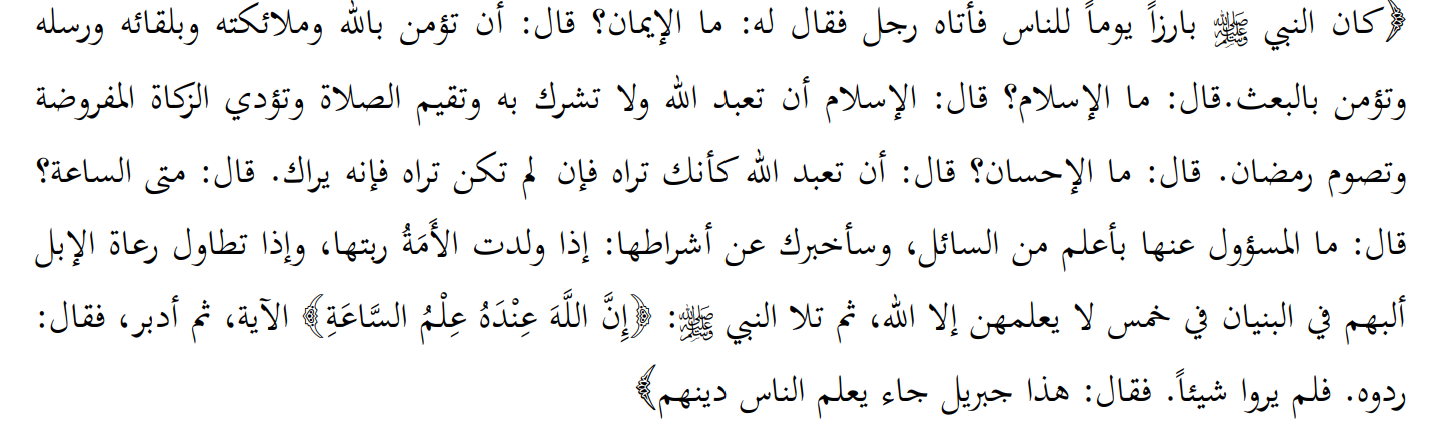
Abu Hurairah overleverde dat de Profeet ﷺ op een dag bij de mensen was toen een persoon kwam en hem ﷺ vroeg: "Wat is Emaan?" Hij ﷺ zei: "Het is het geloof in Allah (SWT), Zijn engelen, de ontmoeting met Hem (SWT), Zijn boodschappers en de opstanding." Hij vroeg: "Wat is Islam?" Hij ﷺ zei: "Islam is dat je Allah (SWT) aanbidt en geen afgoderij (Shirk) pleegt, de gebeden verricht, de voorgeschreven armenbelasting (Zakah) betaalt en dat je vast in de ramadan." Hij zei: "Wat is Ihsaan?" Hij ﷺ zei: "Dat je Allah (SWT) aanbidt alsof je Hem ziet, en als je Hem niet kunt zien, dan dat Hij jou zeker ziet." Hij zei: "Wanneer vindt het Uur plaats?" Hij ﷺ zei: "Degene die erover bevraagd wordt, weet niet meer dan de vragensteller. Ik zal je de tekenen ervan vertellen. Wanneer de moeder haar meester zal baren en wanneer de herder hoge gebouwen zal bouwen. Het is een van de vijf zaken die niemand zal weten, behalve Allah (SWT)." Vervolgens reciteerde de Profeet ﷺ de vers (Ayah): "Voorwaar, Allah heeft de kennis van het Uur." Daarna draaide de man zich om en vertrok hij. De Profeet ﷺ zei tegen de metgezellen (Sahabah) dat ze hem moesten roepen, maar zij zagen niets. Hij ﷺ zei: "Dit was Jibril, hij kwam om de mensen hun religie (Deen) te leren." [Bukhari]
Abu Hurairah narrated that the prophet was with the people one day when a person came and asked him, "What is Emaan?" He said, "It is the belief in Allah , his angels, in the meeting with him , his messengers and the resurrection." He asked, "What is Islam?" He said, "Islam is that you worship Allah and do not commit Shirk, establish the prayer, pay the enjoined Zakat and you fast in Ramadan." He said, "What is Ihsaan?" He said, "That you worship Allah as if you see him, and if you can not see him, surely he sees you." He said, "When is the hour?" He said, "The one questioned about it knows no better then the questioner. I will tell you of its signs. When the mother will give birth to her Master and when the shepherd will build tall buildings. It is one of the five things that no one will know them except Allah ." Then the prophet recited the Ayat, "Indeed Allah has the knowledge of the hour." Then the man turned and left. The prophet said to the Sahaba call him but they didn't see anything. He said, "This was Jibril, he came to teach people their Deen." [Bukhari]
Er zijn een aantal incidenten vermeld in overleveringen (Hadith) waarin Jibril neerdaalde en met de profeet ﷺ sprak en hij luisterde. Dit was een vorm van openbaring voor de boodschapper, aangezien de engel de boodschapper de betekenissen vertelde in de vorm van een gesprek. De openbaring door woorden en betekenis is beperkt tot de Edele Qur’ān. Wat betreft openbaring door betekenis, de boodschapper ﷺ zou dit uitdrukken door zijn eigen woorden te gebruiken, door toepassing, d.w.z. zijn handelingen, of door stilte, en dit is de profetische traditie (Sunnah).
There are a number of incidents mentioned in Ahadith in which Jibril descended and talked to the prophet and he would listen. This was a form of revelation for the messenger, as the angel would tell the messenger the meanings in the form of a conversation. The revelation by words and meaning is restricted to the Noble Qur’ān. As for revelation by meaning, the messenger would express this by using his own words, through application i.e. his actions, or by silence and this is the Sunnah.
De Hadith Qudsi wordt beschouwd als profetische traditie (Sunnah), omdat hoewel de betekenis is geopenbaard van Allah (SWT), de woorden afkomstig zijn van de Profeet ﷺ. De woorden van de Hadith Qudsi zijn niet van Allah (SWT), omdat de woorden die van Allah (SWT) zijn, specifiek voor de Qur'ān zijn en dit wordt bewezen door de onnavolgbaarheid ervan. Hoewel de profetische traditie (Sunnah) voorkomt in de vormen van inspiratie, een droom en direct in het hart wordt geworpen, komt het ook voor zowel in waakzaamheid als in een dialoog tussen Jibril en de Boodschapper ﷺ.
The Hadith Qudsi is regarded as Sunnah because although its meaning is revealed from Allah its words are from the prophet . The words of the Hadith Qudsi are not from Allah because the words that are from Allah are specifically for the Qur’ān and this is proven by its inimitability. Although the Sunnah comes in the forms of inspiration, dream and is cast directly in the heart, it also comes both in wakefulness and as a dialogue between Jibril and the messenger .
De Qur’ān is alleen geopenbaard via de boodschapper ﷺ, omdat de woorden ervan van Allah (SWT) zijn. Er zijn talrijke ayats die de openbaring van de Qur’ān beschrijven. Allah (SWT) zegt,
The Qur’ān is only revealed through the messenger because its words are from Allah . There are numerous ayats detailing the revelation of the Qur’ān. Allah says,
"En Wij hebben de Koran in het Arabisch aan u geopenbaard" [TMQ Shura:7]
"And we have revealed the Quran to you in Arabic" [TMQ Shura:7]
"En wat Wij aan u hebben geopenbaard (o Muhammad ﷺ) van het Boek, dat is de (absolute) waarheid" [TMQ Fatir: 31]
" And what We have revealed to you (O Muhammad [saw]) of the Book, it is the (very) truth " [TMQ Fatir: 31]
Het boek waarnaar wordt verwezen is de Qur’ān en “min” dient hier om representatie aan te geven.
The book referred to is the Qur’ān and “min” here is to indicate representation.
“Deze Qur'ân is aan mij geopenbaard, opdat ik daarmee jullie kan waarschuwen en degenen die het bereikt.” [TMQ An’aam: 6]
“This Qur'ân has been revealed to me that I may therewith warn you and whomsoever it may reach " [TMQ An’aam: 6]
"Wij vertellen u (Muhammad ﷺ) het beste van de verhalen door Onze Openbaringen aan u, van deze Qur'ân" [TMQ Yoosuf: 3]
" We relate to you (Muhammad [sal-Allâhu 'alayhi wa sallam]) the best of stories through Our Revelations to you, of this Qur'ân" [TMQ Yoosuf: 3]
"En recite wat aan jou (o Muhammad ﷺ) is geopenbaard uit het Boek (de Qur'ân) van jouw Heer. Niemand kan Zijn Woorden veranderen," [TMQ alKahf: 27]
" And recite what has been revealed to you (O Muhammad PBUH) of the Book (the Qur'ân) of your Lord. None can change His Words, " [TMQ alKahf: 27]
Het is de Qur’ān. Er zijn ook andere āyāt die de openbaring in het algemeen vermelden, inclusief de profetische traditie (Sunnah). Bijvoorbeeld, Allah (SWT) zegt,
It is the Qur’ān. There are other ayats as well, which mention the revelation in general including the Sunnah. For example, Allah says,
“Als ik geleid blijf, dan is dat vanwege de Openbaring van mijn Heer aan mij” [TMQ As-saba: 50]
" If I remain guided, it is because of the Revelation of my Lord to me” [TMQ As-saba: 50]
En Hij (SWT) zegt,
And He says,
"Voorwaar, Wij hebben de Openbaring aan u gezonden (o Muhammad ﷺ), zoals Wij de Openbaring aan Nûh (Noah) en de profeten na hem hebben gezonden" [TMQ Nisa: 163]
" Verily, We have sent the Revelation to you (O Muhammad [saw]) as We sent the Revelation to Nûh (Noah) and the Prophets after him" [TMQ Nisa: 163]
En Hij (SWT) zegt,
And He says,
"En volg dat wat u van uw Heer aan u is geopenbaard. Voorwaar, Allâh is Alwetend over wat u doet" [TMQ Ahzaab: 2]
"And follow that which is revealed to you from your Lord. Verily, Allâh is Well-Acquainted with what you do" [TMQ Ahzaab: 2]
Deze twee genoemde toestanden zijn besproken in de teksten, de derde toestand wordt vermeld in Zijn zeggen,
These two mentioned states have been discussed in the texts, The third state is mentioned in His saying,
"Of van achter een sluier" [TMQ Shura: 51]
"Or from behind a veil” [TMQ Shura: 51]
Dit is wat er gebeurde met Musa . Dit vers (Ayah) verwijst naar het incident waarbij Allah (SWT) tegen Musa sprak van achter een sluier. Dat wil zeggen, net zoals een persoon achter een sluier spreekt met enkele hoogwaardigheidsbekleders en mensen van aanzien. Hij spreekt van achter een sluier en hoewel men de stem van de ander hoort, ziet men hem niet. Dit is de wijze waarop Allah (SWT) tegen Musa sprak.
This is what happened with Musa . This Ayat is indicating to the incident in which Allah spoke to Musa from behind a veil. That is, just as the veiled person speaks with some dignitaries and with people of distinction. He speaks from behind a veil and although one hears the other person’s voice, he does not see him. This is the manner in which Allah spoke with Musa .
Een dergelijk incident deed zich slechts één keer voor bij de profeet ﷺ tijdens de al-Isra wal-Miraj, wat niet alleen is vermeld in een authentieke overlevering (Hadith), maar ook is aangegeven door soera al-Najm. Allah (SWT) zegt,
Such an incident only occurred once with the prophet during the al-Isra wal-Miraj, which has not only been mentioned in an authentic Hadith, but has also been indicated by Sura al-Najm. Allah says,
"Het is slechts een openbaring die is geopenbaard. Hij is (deze Qur'ân) onderwezen door een machtige in kracht [Jibril]. Eén die vrij is van enig gebrek in lichaam en geest, en toen rees hij (Jibril) op en werd hij stabiel. Terwijl hij [Jibril] in het hoogste deel van de horizon was, kwam hij [Jibril] naderbij en kwam hij dichterbij, en was hij op een afstand van twee booglengtes of (zelfs) dichterbij. Dus openbaarde (Allah) aan Zijn dienaar [Muhammad ﷺ via Jibril {as}] wat Hij heeft geopenbaard." [TMQ Najm: 4-10]
"It is only a Revelation revealed.He has been taught (this Qur'ân) by one mighty in power [Jibril].One free from any defect in body and mind then he (Jibrîl) rose and became stable.While he [Jibrîl)] was in the highest part of the horizon, Then he [Jibrîl] approached and came closer, And was at a distance of two bows' length or (even) nearer. So (Allâh) revealed to His slave [Muhammad [saw] through Jibrîl [as]] whatever He revealed." [TMQ Najm: 4-10]
Met uitzondering van deze gebeurtenis, namelijk al-Isra wal-Miraj, daalde de openbaring neer op de Profeet ﷺ in de vorm van een inspiratie en via een boodschapper.
With the exception of this event i.e. al-Isra wal-Miraj, the revelation descended upon the prophet in the form of an inspiration and through a messenger.
Alle vormen van openbaring zijn vormen van bewijs. De communicatie tussen de engel en de boodschapper door middel van spraak, aanwijzing of gesprek is een duidelijke openbaring. Inspiratie en visioenen zijn duidelijke openbaringen, en het feit dat Allah (SWT) tot de profeten spreekt is eveneens een vorm van openbaring. Deze openbaring is een categorisch bewijs, aangezien het is overgeleverd in de meest authentieke en definitieve teksten met een definitieve betekenis.
All the types of revelation are forms of evidence. The communication between the angel and the messenger by talk or indication or conversation is a clear revelation. The inspiration and visions are clear revelations and Allah speaking to the prophets is also a form of revelation. This revelation is a categorical proof as it has been reported in the most authentic and definite texts of definite meaning.