9. Wetenschap en Cultuur
9. Science And Culture
In de Arabische taal wordt gezegd: de man heeft kennis (*‘ilm*) verkregen. Dit betekent dat hij de ware werkelijkheid van kennis (*‘ilm*) heeft bereikt. Hij heeft kennis van een zaak verkregen, wat betekent dat hij er zich bewust van is geworden, wat inhoudt dat hij over een zaak is geïnformeerd of ermee bekend is geraakt. Ook wordt er in de taal gezegd: Hij heeft begrip verkregen (*thaqifa*), wat betekent dat hij bekwaam is geworden, waardoor hij opgeleid en beschaafd (*thaqif*) is. Hij heeft een taal begrepen (*thaqifa*), wat betekent dat hij deze snel heeft beheerst en begrepen. Deze taalkundige betekenissen vormen de basis voor het gebruik van woorden. Echter, als deze woorden worden gebruikt om andere betekenissen aan te duiden die gerelateerd zijn aan de taalkundige betekenis, dan is dat toegestaan, zoals in het geval van het overnemen van het woord *fa’il* (onderwerp) in de grammatica bijvoorbeeld. De taalkundige betekenis (van de woorden) was overheersend, en dit is de reden waarom de ouderen het woord *‘ilm* toepasten op alle vormen van kennis zonder onderscheid te maken tussen de wetenschappen en disciplines. Daarna begonnen mensen intellectuele en natuurwetenschappelijke disciplines te beschouwen als algemeen voor alle mensen, terwijl andere traditionele (tekstuele) disciplines werden beschouwd als specifiek voor de natie van waaruit ze werden overgedragen. Vervolgens begon zowel wetenschap (*‘ilm*) als cultuur (*thaqafa*) te worden gedefinieerd volgens verschillende specifieke disciplines, waarbij ze terminologische betekenissen kregen die verschilden van hun taalkundige betekenissen. Volgens deze terminologie hebben zij de volgende betekenis: Wetenschap (*‘ilm*) is de kennis die wordt verkregen door observatie, experiment en onderwijs, zoals natuurkunde, scheikunde en de rest van de empirische wetenschappen; en cultuur (*thaqafa*) is de kennis die wordt verkregen door middel van overlevering, leren en deductie, zoals in (de studie van) geschiedenis, talen, islamitische jurisprudentie (Fiqh), filosofie en de rest van de niet-empirische disciplines. En er zijn andere niet-empirische disciplines die als wetenschappen (‘ilm) worden beschouwd, ook al vallen ze binnen de cultuur, zoals rekenkunde, techniek en industrie; hoewel ze onder cultuur (thaqafa) vallen, worden ze beschouwd als onderdeel van wetenschap omdat ze universeel zijn voor alle mensen en niet specifiek zijn voor één bepaalde natie. Op een vergelijkbare manier worden zaken uit de cultuur die gerelateerd zijn aan ambachten die op industrie lijken, zoals handel en scheepvaart, beschouwd als onderdeel van wetenschap en zijn zij universeel. Wat de kunsten betreft, zoals schilderkunst, beeldhouwkunst en muziek, deze maken deel uit van de cultuur. Zij volgen een bepaald standpunt, wat een specifieke cultuur is. Het verschil tussen cultuur (thaqafa) en wetenschap (‘ilm)
In Arabic language it is said: the man has obtained (‘alima) knowledge (‘ilm). This means that he attained the true reality of knowledge (‘ilm). He gained knowledge of a thing means he became cognisant of it, which means that he became informed of a matter or acquainted with it. Also in the language it is said: He has gained comprehension (thaqifa), which means that he has become proficient, thus he is educated and cultured (thaqif). He has understood (thaqifa) a language (means) he has mastered and understood it swiftly. These linguistic meanings are the basis of the use of words, However if these words were used to indicate other meanings that relate to the linguistic meaning then that is permitted, like in the case of the adoption of the word fa’il (subject) in grammar for example. The linguistic meaning (of the words) was prevailing and this is why the ancients used to apply the word ‘ilm on all forms of knowledge without differentiating between the sciences and disciplines. Then people began to consider intellectual and natural disciplines as being general to all people whilst other traditional (textual) disciplines were considered specific to the nation from which it was transferred. Subsequently, each of science (‘ilm) and culture (thaqafa) began to be defined according to different specific disciplines, acquiring terminological meanings which were different to their linguistic meanings. According to this terminology they have the following meaning: Science (‘ilm) is the knowledge which is acquired through observation, experimentation and education like physics, chemistry and the rest of the empirical sciences and culture (thaqafa) is the knowledge which is acquired by way of transmission, learning and deduction as in (the study of) history, languages, jurisprudence (fiqh), philosophy and the rest of the non-empirical disciplines. And there are other non-empirical disciplines which are included as sciences (‘ilm) even though they come within culture such as arithmetic, engineering and industry; even though they come under culture (thaqafa) they are regarded as part of science because they are universal to all people and not specific to any one nation. In a similar way anything from the culture related to crafts which resemble industry such as trade and shipping; they are considered to be part of science and they are universal. As for the arts such as; painting, sculpture and music they are part of culture. They follow a particular viewpoint; which is a specific culture. The difference between culture (thaqafa) and science (‘ilm)
is dat wetenschap universeel is voor alle naties en niet specifiek voor enige natie met uitsluiting van een andere natie. Wat betreft cultuur (thaqafa), dit kan specifiek zijn, toegeschreven aan de natie waaruit het voortkwam, of het kan deel uitmaken van de specifieke en bijzondere kenmerken van een natie, zoals literatuur en biografieën van helden, en hun filosofie met betrekking tot het leven, of het kan universeel zijn zoals handel, scheepvaart, enzovoort. Daarom wordt wetenschap universeel overgenomen van alle naties omdat het universeel is en niet specifiek voor een bepaalde natie. Wat betreft cultuur (thaqafa) dient een natie te beginnen met haar eigen cultuur, wanneer zij deze heeft bestudeerd en ervan op de hoogte is, totdat het zich in hun geest heeft gefocust, en dan kunnen zij andere culturen bestuderen. De moslims maakten vroeger onderscheid tussen de wetenschappen die een persoon zelfstandig verwierf en de wetenschappen die hij van anderen ontving. Ibn Khaldun zegt in zijn boek al-Muqaddima:
is that science is universal to all nations and not specific to any nation to the exclusion of another nation. As for culture (thaqafa) it might be specific, being ascribed to the nation from which it resulted or it may be part of the nation’s specific and particular characteristics such as literature and biographies of heroes, and their philosophy concerning life or they may be universal such as trade, shipping etc. Therefore, science is adopted universally from all nations because it is universal and not specific to any particular nation. As for culture (thaqafa) the nation should begin with its own culture, when she has studied it and is cognisant of it until it becomes focused in their minds then they can study other cultures. The Muslims used to differentiate between the sciences which a person used to attain by himself and the sciences he used to receive from others. Ibn Khaldun says in his book al-Muqaddima:
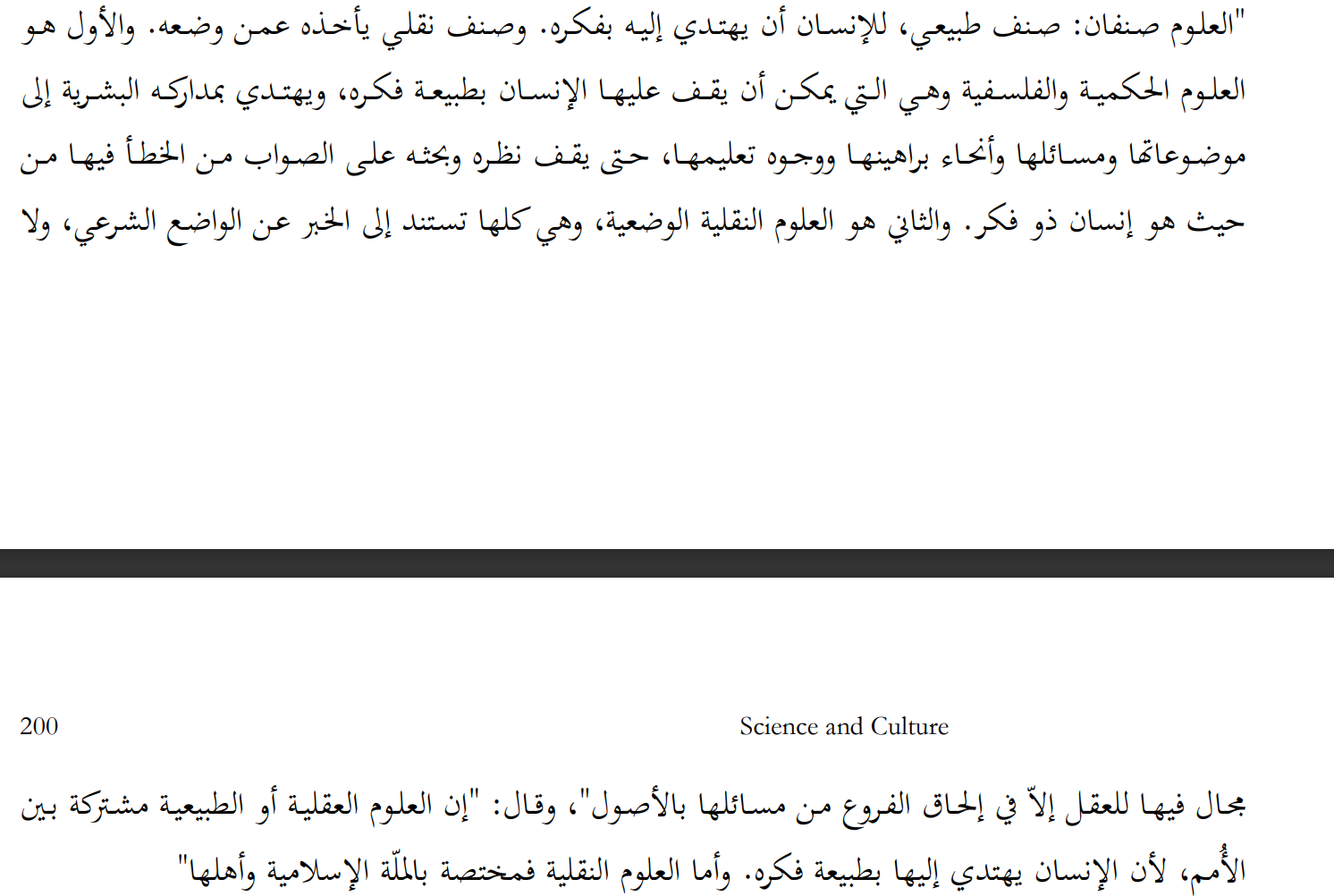
“De wetenschappen zijn van twee soorten: een natuurlijke soort waarmee de mens tot inzicht komt door zijn eigen denken, en een tekstuele soort die hij overneemt van degene die het heeft geschreven. De eerste zijn de filosofische en aforistische wetenschappen, die hij door middel van zijn denken kan zoeken en waarbij hij via menselijke vermogens wordt geleid naar de onderwerpen en kwesties ervan, en naar alle beslissende bewijzen en aspecten van de leer ervan. Zo dat hij in zijn onderscheidingsvermogen en studie het juiste van het onjuiste kan onderscheiden, in zijn capaciteit als een menselijk wezen dat beschikt over het vermogen tot denken. De tweede zijn de tekstuele en geschreven wetenschappen. Deze zijn afhankelijk van de overlevering die afkomstig is uit een islamitische (Shar’i) bron. Het verstand heeft in dit opzicht geen ruimte, behalve om de vertakkingen (furu') te relateren aan de usul (fundamenten).”
“The sciences are of two types: A natural type which is for man to arrive at through his thinking and a textual type which he takes from the one who authored it. The first are the philosophical and aphoristic sciences which he can seek by his thought and be guided through the human faculties to its subjects and issues and all its decisive proofs and aspects of its teachings. So as in his discernment and study he attains the correct (opinion) from the incorrect, in his capacity as a human being possessing the faculty of thought. The second are the textual and written sciences. They depend on the report coming from a shar’i source. The mind has no scope in this regard except to relate the branch issues to the usul (foundation)”.
Hij zei ook: “De rationele of natuurwetenschappen zijn gemeenschappelijk voor alle naties, aangezien de mens deze op natuurlijke wijze bereikt via zijn denken. Wat de tekstuele wetenschappen betreft, deze zijn specifiek voor de islamitische religie en haar volgelingen.” Het lijkt erop dat wat Ibn Khaldun bedoelde met het specificeren van de tekstuele wetenschappen voor de islamitische millah slechts een voorbeeld was, omdat ook naties buiten de islamitische natie tekstuele wetenschappen hebben die specifiek voor hen zijn, zoals hun wetgeving en taal. De uitspraak van Ibn Khaldun geeft niet aan dat hij een onderscheid maakte tussen wetenschap en cultuur. Het geeft enkel aan dat hij een onderscheid maakte tussen tekstuele en rationele wetenschappen. Zijn opmerkingen zijn geen bewijs om te zeggen dat de moslims onderscheid maakten tussen wetenschap en cultuur; ze zijn eerder een bewijs dat de moslims enkel onderscheid maakten tussen disciplines. Zo verdeelden zij deze in twee secties. Hun verdeling was echter gebaseerd op hun algemene verwerving en niet op de wijze van verwerving. Zo benoemden zij deze als rationele wetenschappen, d.w.z. verworven via het verstand. En tekstuele wetenschappen, verworven uit de tekst. Mensen vandaag de dag maken echter onderscheid tussen disciplines op basis van de wijze waarop zij zijn ontvangen. Zo passen zij de term ‘wetenschap’ (‘ilm) toe op alles wat via de empirische methode wordt verworven, en passen zij de term ‘cultuur’ (thaqafa) toe op alles wat door andere middelen dan de empirische methode wordt verworven.
He also said “The rational or natural sciences are common to all nations since man arrives at them naturally through his thought. As for the textual sciences they are specific to the Muslim religion and its adherents.” It appears that what Ibn Khaldun meant by specifying the textual sciences with the Islamic millah was only an example because nations other than the Islamic nation as well have textual sciences specific to them such as their legislation and language. Ibn Khaldun’s statement does not indicate that he distinguished between science and culture. It only indicates that he distinguished between textual and rational sciences. His comments are not an evidence to say that the Muslims used to differentiate between science and culture rather they are an evidence to prove that the Muslims used only to differentiate between disciplines. Thus, they divided them into two sections. However their division was in terms of their general acquisition and not in terms of the manner of acquisition. So they designated them as rational sciences i.e, acquired via the mind. And textual sciences acquired from the text. However, people today differentiate between disciplines in terms of the manner in which they were received. Thus, they apply the term ‘science’ (‘ilm) on anything that is acquired through the empirical method and they apply the term ‘culture’ (thaqafa) on anything acquired by means other than the empirical method