17. Das Kalifat
17. The Khilafah
Das Chilafa ist die allgemeine bzw. übergeordnete Führung für alle Muslime der Welt, um die Gesetze der islamischen Scharia durchzusetzen und die Da'wa des Islam in die Welt zu tragen. Sie hat dieselbe Bedeutung wie die Imamah, denn Imamah und Chilafa bedeuten dasselbe. Mehrere saheeh Ahadith erwähnen beide Begriffe mit derselben Bedeutung. Keiner der beiden Begriffe hat in einem Scharia-Text, d. h. im Qur'an oder in der Sunnah, jemals eine andere Bedeutung als der andere, da diese beiden (Quellen) die einzigen Quellen der Scharia sind. Es ist nicht verpflichtend, am Begriff Chilafa oder Imamah festzuhalten, vielmehr ist es verpflichtend, an der Bedeutung des Begriffs festzuhalten.
The Khilafah is the general or overall leadership for all the Muslims in the world in order to establish the laws of the Islamic Shari’ah and to carry the da’wa of Islam to the world. It is the same as the Imamah, as the Imamah and Khilafah have the same meaning. Several saheeh ahadith mention them with the same meaning. Neither of the two terms has ever come with any meaning different from the other in any Shari’ah text i.e. the Qur’an or the Sunnah, as these two (sources) are the only Shari’ah sources. It is not compulsory to hold to the term of Khilafah or Imamah, but rather it is compulsory to hold to the meaning of the term.
Die Errichtung des Kalifats ist eine Pflicht für alle Muslime in allen Regionen der Welt. Ihre Errichtung ist, wie die Erfüllung jeder anderen Pflicht, die Allah (SWT) den Muslimen auferlegt hat, eine unausweichliche Angelegenheit, bei der es weder Wahl noch Nachsicht gibt. Die Vernachlässigung ihrer Erfüllung gehört zu den schwersten Sünden, für die Allah (SWT) mit den härtesten Strafen bestraft.
Establishing the Khilafah is an obligation upon all Muslims in all regions of the world. Establishing it, like the performing of any obligation that Allah (swt) obliged upon Muslims, is an inevitable matter without choice or leniency in it. Negligence in performing it is one of the worst sins for which Allah (swt) punishes with the strictest of the punishments.
Die Belege für die Errichtung des Kalifats über alle Muslime (stammen) aus: dem Qur'an, der Sunnah und dem Ijmāʿ as-Ṣaḥāba.
The evidence for establishing the Khilafah upon all Muslims (come from): The Qura'n, The Sunnah and Ijmaa as-Sahabah.
Was den Koran betrifft, so hat Allah (swt) dem Gesandten (ﷺ) befohlen, zwischen den Muslimen nach allem zu richten, was Er (swt) ihm offenbart hat, und Sein Befehl (swt) an ihn war in entschiedener Weise. Allah (swt) wandte sich an den Propheten ﷺ mit den Worten:
As for the Qura'n, Allah (swt) has ordered the Messenger (saw) to rule between Muslims by all that He (swt) revealed to him (saw), and His order (swt) to him was in a decisive manner. Allah (swt) addressed the Prophet (saw) saying:
„Und richte zwischen ihnen nach dem, was Allah herabgesandt hat, und folge nicht ihren Gelüsten, indem du dich von der Wahrheit abwendest, die zu dir gekommen ist." [TMQ 5:48]
"And rule between them by that which Allah revealed to you, and do not follow their vain desires away from the truth which came to you" [TMQ 5:48]
Und Er (swt) sprach:
And He (swt) said:
„Und richte zwischen ihnen nach dem, was Allah herabgesandt hat, und folge nicht ihren Gelüsten, und hüte dich, dass sie dich nicht von einem Teil dessen abbringen, was Allah dir herabgesandt hat." [TMQ 5:49]
"And rule between them by that which Allah revealed to you and do not follow their whims, and beware (be on the alert) that they may deviate you away from even some part of what Allah revealed to you" [TMQ 5:49]
Die Rede Allahs (swt) an den Propheten (saw) ist eine Rede an seine Umma, es sei denn, es gibt einen Beleg, der die Rede auf ihn (saw) beschränkt. In diesem Fall gibt es keinen solchen Beleg, daher richtet sich die Anrede an alle Muslime, das Hukm (die Herrschaftsordnung) zu errichten. Die Errichtung des Khalifats bedeutet nichts anderes als die Errichtung der Herrschaftsordnung und der Autorität. Außerdem hat Allah (swt) den Muslimen zur Pflicht gemacht, denen zu gehorchen, die die Autorität innehaben, also dem Herrscher, was darauf hinweist, dass die Existenz desjenigen, der die Autorität innehat, für die Muslime verpflichtend ist. Allah (swt) sagte:
The speech of Allah (swt) to the Prophet (saw) is a speech to his Ummah unless there is evidence which limits the speech to him (saw). In this case there is no such evidence, so the address is to all the Muslims to establish the rule (hukm). The establishment of the Khalifah does not mean other than the establishment of the rule and the authority. Moreover, Allah (swt) made it obligatory upon Muslims to obey those in authority i.e. the ruler, which indicates that the existence of the one in authority is obligatory upon Muslims. Allah (swt) said:
„O ihr, die ihr glaubt, gehorcht Allah und gehorcht dem Gesandten und denen unter euch, die Autorität innehaben" [TMQ 4:59]
"O you who believe obey Allah and obey the Messenger and those in authority amongst you" [TMQ 4:59]
Allah (SWT) befiehlt keinen Gehorsam gegenüber jemandem, der nicht existiert. Daraus folgt, dass die Existenz der Person in Autorität geboten ist. Wenn Allah (SWT) den Gehorsam gegenüber den Trägern der Autorität gebietet, so gebietet Er (SWT) damit deren Einsetzung. Die Folge der Einsetzung des Herrschers ist die Verwirklichung des Scharia-Urteils (hukm shar'i), und das Unterlassen seiner Einsetzung führt zur Vernachlässigung des Scharia-Urteils (hukm shar'i). Somit ist seine Existenz geboten, denn das Unterlassen seiner Einsetzung gehört zu den verbotenen Dingen, d. h. zur Vernachlässigung des Scharia-Urteils (hukm shar'i).
Allah (swt) does not order obedience to someone who does not exist. This indicates that the existence of the person in authority is obligatory. When Allah (swt) commands obedience to those in authority then He (swt) is commanding their establishment. The result of establishing the ruler is the establishment of the Shari’ah rule (hukm shar’i) and the failure to establish it will result in neglecting the Shari’ah rule (hukm shar’i). Thus his existence is obligatory as the result of the failure to establish it is will be from the prohibited matters i.e. the neglect of the Shari’ah rule (hukm shar’i).
Was die Sunnah betrifft, berichtete Nafi‘: Abdullah bin ‘Umar sagte zu mir, dass er den Propheten ﷺ sagen hörte:
As for the Sunnah, Nafi‘ reported saying: Abdullah bin ‘Umar said to me that he heard the Prophet (saw) saying:
„Wer seine Hand vom Gehorsam zurückzieht, wird Allah am Tag der Auferstehung treffen, ohne einen Beweis für sich zu haben, und wer stirbt, ohne ein Treuegelöbnis (bay'ah) auf seinem Nacken zu haben, stirbt einen Tod der Unwissenheit (jahiliyyah)."
“Whoever removes his hand from obedience will meet Allah on the Day of Resurrection without having any proof for him, and whoever dies without a pledge of allegiance (bay’ah) on his neck dies a death of ignorance (jahiliyyah).”
Der Prophet (ﷺ) hat es jedem Muslim zur Pflicht gemacht, eine Bay'ah am Hals zu haben, und er hat beschrieben, dass wer ohne eine Bay'ah am Hals stirbt, einen Tod der Dschahiliyyah stirbt. Die Bay'ah darf nur für den Khalifah sein, und niemand sonst. Der Prophet (ﷺ) hat es jedem Muslim zur Pflicht gemacht, eine Bay'ah zu einem Khalifah am Hals zu haben, doch er hat es nicht jedem Muslim zur Pflicht gemacht, dem Khalifah die Bay'ah zu geben. Die Pflicht ist das Vorhandensein einer Bay'ah am Hals jedes geeigneten Muslims, d. h. das Vorhandensein eines Khalifah, der dementsprechend eine Bay'ah am Hals jedes Muslims verdient. Es ist also die Anwesenheit des Khalifah, die jedem Muslim eine Bay'ah auf den Hals legt, unabhängig davon, ob der Muslim ihm tatsächlich (persönlich) die Bay'ah gegeben hat oder nicht. Daher ist dieser Hadith des Propheten (ﷺ) ein Beweis dafür, dass die Einsetzung des Khalifah eine Pflicht ist, und kein Beweis dafür, dass das Geben der Bay'ah verpflichtend ist. Dies gilt, weil vom Propheten (ﷺ) getadelt wurde, dass ein Muslim bis zu seinem Tod keine Bay'ah am Hals hat, er hat aber nicht das Fehlen der Bay'ah getadelt. Muslim überliefert von Al-'Araj von Abu Hurairah (ra), vom Propheten (ﷺ), der sagte:
So the Prophet (saw) made it compulsory upon every Muslim to have a bay’ah on his neck, and described that whoever dies without a bay’ah on his neck that he dies a death of jahiliyyah. The bay’ah cannot be for anyone except the Khalifah. The Prophet (saw) made it obligatory upon every Muslim to have on his neck a bay’ah to a Khalifah, yet he did not make it an obligation upon every Muslim to give bay’ah to a Khalifah. The duty is the existence of a bay’ah on the neck of every eligible Muslim i.e. the existence of a Khalifah who accordingly deserves a bay’ah upon the neck of every Muslim. So it is the presence of the Khalifah which places a bay’ah on the neck of every Muslim, whether the Muslim actually gave a bay’ah to him (in person) or not. Therefore, this hadith of the Prophet (saw) is evidence that the appointment of the Khalifah is an obligation and not a proof that giving the bay’ah is obligatory. This is so because what was rebuked by the Prophet (saw) was the absence of a bay’ah on the neck of a Muslim until he dies, but he did not rebuke the absence of the bay’ah. Muslim narrated from Al-’Araj from Abu Hurairah (ra) from the Prophet (saw) who said:
„Wahrlich, der Imam ist ein Schild, hinter dem die Menschen kämpfen und durch den sie sich schützen.“
“Behold, the Imam is a shield from behind whom the people fight and by whom they protect themselves.”
Und Muslim berichtete von Abu Hazim, der sagte:
And Muslim reported from Abu Hazim who said:
„Ich begleitete Abu Hurairah fünf Jahre lang und hörte ihn berichten, dass der Prophet ﷺ sagte: Die Propheten herrschten über die Kinder Israels. Wann immer ein Prophet starb, folgte ihm ein anderer Prophet nach, doch nach mir wird kein Prophet mehr kommen. Es wird Khulafaa geben, und sie werden zahlreich sein. Sie fragten: Was befiehlst du uns dann? Er sagte: Erfüllt ihnen die Bay'ah nacheinander und gebt ihnen ihr gebührendes Recht. Gewiss wird Allah sie nach dem fragen, was Er ihnen anvertraut hat.“
“I accompanied Abu Hurairah for five years and heard him reporting from the Prophet who said: The Prophets ruled over the children of Israel. Whenever a Prophet died another Prophet succeeded him, but there will be no Prophet after me. There will be Khulafaa and they will number many. They asked: What then do you order us? He said: Fulfil the bay’ah to them one after the other and give them their due right. Surely Allah will ask them about what He entrusted them with.”
Und von Ibn ʿAbbās, vom Propheten ﷺ, der sagte:
And from bin ‘Abbas from the Prophet (saw) who said:
„Wenn jemand an seinem Amir etwas sieht, das ihm missfällt, so soll er geduldig bleiben. Denn wahrlich: Wer sich von der Obrigkeit (sultan, Autorität des Islam) auch nur um eine Handspanne entfernt und daraufhin stirbt, der stirbt einen Tod der Dschahiliyya."
“If anyone sees in his Amir something that displeases him let him remain patient. For, behold, he who separates himself from the sultan (authority of Islam) by even so much as a hand span and dies thereupon, has died a death of jahiliyyah”.
In diesen Ahadith informiert der Prophet (saw) uns, dass Herrscher die Angelegenheiten der Muslime führen werden, und sie beinhalten die Beschreibung des Khalifah als Schild, d. h. als Schutz. Die Beschreibung des Imam als Schild ist also eine Information über die Vorteile der Anwesenheit des Imam, und damit ist sie ein Befehl zum Handeln. Denn wenn die Information, die Allah (swt) und der Prophet (saw) überliefern, einen Tadel enthielt, dann ist sie ein Verbot, und wenn sie ein Lob enthielt, dann ist sie ein Befehl zum Handeln. Wenn die befohlene Handlung notwendig ist, um ein Hukm Shar'i (Scharia-Urteil) umzusetzen, oder wenn durch ihre Vernachlässigung ein Hukm Shar'i vernachlässigt würde, dann ist dieser Befehl bindend. In diesen Ahadith liegt außerdem die Information, dass diejenigen, die die Angelegenheiten der Muslime führen, Khulafa' sind, was auf einen Befehl hinweist, sie einzusetzen. Sie enthalten auch ein Verbot für Muslime, sich von der Autorität zu trennen, was auf die Pflicht der Muslime hinweist, sich selbst eine Autorität, d. h. eine Herrschaft, einzusetzen. Darüber hinaus befahl der Prophet (saw) den Muslimen, dem Khalifah zu gehorchen und gegen diejenigen zu kämpfen, die seine Autorität als Khalifah bestreiten, was auf einen Befehl hinweist, einen Khalifah einzusetzen und sein Khilafah zu schützen, indem man gegen jeden kämpft, der mit ihm streitet. Muslim überlieferte, dass der Prophet ﷺ sagte:
In these ahadith, the Prophet (saw) informs us that leaders will run the affairs of Muslims, and they include the description of the Khalifah as a shield i.e. a protection. So the description of the Imam as a shield is informative of the benefits of the presence of the Imam, thus it is a command for action. This is because if the information conveyed by Allah (swt) and the Prophet (saw) contained rebuke then it is a command of prohibition, and if it contained praise then it is a command for action. If the ordered action is necessary to implement a hukm shari’ (Shari’ah rule), or by its negligence a hukm shar‘i will be neglected, then this command is decisive. In these ahadith there is information also that those who run the affairs of Muslims are Khulafaa, which indicates an order to appoint them. They also include a prohibition for Muslims to separate from the authority, which indicates the obligation upon Muslims to appoint an authority for themselves i.e. ruling. Moreover, the Prophet (saw) ordered the Muslims to obey the Khalifah and to fight those who dispute his authority as Khalifah, which indicates an order to appoint a Khalifah and to protect his Khilafah by fighting against whosoever disputes with him. Muslim reported that the Prophet (saw) said:
„Wer einem Imam den Treueid leistet, indem er ihm die Hand reicht und die Frucht seines Herzens gibt, soll ihm gehorchen, solange er dazu in der Lage ist. Und wenn ein anderer kommt, um ihm die Herrschaft streitig zu machen, so sollt ihr diesem Mann den Hals abschlagen."
“He who pledged allegiance to an Imam giving him the clasp of his hand and the fruit of his heart shall obey him as long as he can, and if another comes to dispute with him you have to strike the neck of that man.”
Der Befehl, dem Imam zu gehorchen, ist also ein Befehl, ihn einzusetzen, und der Befehl, gegen diejenigen zu kämpfen, die ihm streitig machen, ist ein Beleg dafür, dass dieser Befehl entscheidend ist, um die Existenz eines einzigen Kalifen aufrechtzuerhalten.
So the command to obey the Imam is an order to establish him, and the command to fight those who dispute with him is evidence that this command is decisive in maintaining the presence of one Khalifah.
Was den Ijma' der Sahaba (ra) betrifft, so waren sie sich alle darin einig, dass es notwendig ist, nach dem Tod des Propheten (saw) einen Nachfolger bzw. Kalifen einzusetzen, und sie waren sich alle einig, nach dem Tod eines jeden von ihnen einen Nachfolger für Abu Bakr, dann für 'Umar und dann für 'Uthman zu bestimmen. Der Ijma' der Sahaba (ra), einen Kalifen einzusetzen, zeigte sich nachdrücklich darin, dass sie nach dem Tod des Propheten (saw) die Bestattung des Propheten (saw) verzögerten, während sie damit beschäftigt waren, ihm einen Nachfolger zu bestimmen, obwohl die Bestattung des Verstorbenen fard ist und es denjenigen, die für seine Bestattung zuständig sind, haram ist, sich mit anderem zu beschäftigen, bis sie die Bestattung vollendet haben. Die Sahaba (ra) waren verpflichtet, sich mit den Vorbereitungen für die Bestattung des Propheten (saw) zu beschäftigen; stattdessen beschäftigten sich einige von ihnen mit der Bestimmung eines Kalifen statt mit der Bestattung, und einige andere schwiegen zu dieser Beschäftigung und beteiligten sich an der Verzögerung der Bestattung um zwei Nächte, obwohl sie die Verzögerung hätten verhindern und den Propheten (saw) hätten bestatten können. Dies war also ein Ijma' darüber, sich mit der Einsetzung eines Kalifen statt mit der Bestattung des Toten zu beschäftigen. Das könnte nicht rechtmäßig sein, es sei denn, die Einsetzung eines Kalifen ist verpflichtender als die Bestattung des Toten. Ferner waren sich alle Sahaba (ra) während ihres ganzen Lebens über die Pflicht zur Einsetzung eines Kalifen einig. Obwohl sie sich über die Person uneinig waren, die als Kalif gewählt werden sollte, waren sie sich nie über die Einsetzung eines Kalifen uneinig, weder als der Prophet (saw) starb, noch als einer der Rechtgeleiteten Kalifen starb. Daher ist der Ijma' der Sahaba ein klarer und starker Beweis dafür, dass die Einsetzung eines Kalifen verpflichtend ist.
As for the Ijma’a of the Sahabah (ra) they all agreed upon the necessity to establish a successor or Khalifah to the Prophet (saw) after his death, and they all agreed to appoint a successor to Abu Bakr, then to ‘Umar, then to ‘Uthman, after the death of each one of them. The Ijma’a of the Sahabah (ra) to establish a Khalifah manifested itself emphatically when they delayed the burial of the Prophet (saw) after his death while engaged in appointing a successor to him, despite the fact that the burial of the dead person is fard, and that it is haram upon those who are supposed to prepare for his burial to engage themselves in anything else until they complete the burial. The Sahabah (ra) were obliged to engage themselves in preparing the burial of the Prophet (saw), instead some of them engaged themselves in appointing a Khalifah rather than carrying out the burial, and some others kept silent on this engagement and participated in delaying the burial for two nights despite their ability to deny the delay and their ability to bury the Prophet (saw). So this was an Ijma’a to engage themselves in appointing a Khalifah rather than to bury the dead. This could not be legitimate unless the appointment of a Khalifah is more obligatory than the burial of the dead. Also, all the Sahabah (ra) agreed throughout their lives upon the obligation of appointing a Khalifah. Although they disagreed upon the person to be elected as a Khalifah, they never disagreed upon the appointment of a Khalifah, neither when the Prophet (saw) died, nor when any of the Khulafaa ar-Rashidun died. Therefore the Ijma’a of the Sahabah is clear and strong evidence that the appointment of a Khalifah is obligatory.
„Was zur Erfüllung einer Pflicht (Wadschib) notwendig ist, ist selbst eine Pflicht.“
‘What is necessary to accomplish a wajib (duty) is itself a wajib’
Somit ist auch die Errichtung eines Kalifats nach diesem göttlichen Grundsatz verpflichtend.
So the establishment of a Khalifah is also compulsory according to this divine principle.
Daraus wird aus diesen Belegen deutlich, dass die Errichtung der Herrschaft und der Autorität unter den Muslimen fard ist, und es wird ebenso deutlich, dass die Einsetzung eines Khalifah, der die Leitung der Herrschaft und der Autorität übernimmt, den Muslimen zur Pflicht gemacht ist, um die Regeln der Shari'ah umzusetzen, und nicht bloß um der Herrschaft und der Autorität selbst willen. Denke darüber nach, was Muslim von seinem Ausspruch ﷺ über ʿAwf bin Mālik überliefert hat:
Therefore, it is clear from these evidences that the establishment of the rule and the authority amongst Muslims is fard, and it is also clear that the appointment of a Khalifah who takes the charge of the rule and the authority is compulsory upon Muslims in order to implement the Shari’ah rules and not merely for the sake of rule and authority in themselves. Reflect upon what Muslim narrated of his saying (saw) via ‘Awf bin Malik:
„Die besten eurer Imame (Führer) sind diejenigen, die ihr liebt und die euch lieben, die für euch beten und für die ihr betet; und die schlechtesten eurer Imame sind diejenigen, die ihr hasst und die euch hassen, und die ihr verflucht und die euch verfluchen.“ Man fragte den Gesandten Allahs ﷺ: „Sollen wir ihnen nicht mit den Schwertern entgegentreten?“ Er sagte: „Nein, nicht solange sie unter euch das Gebet (salat, d. h. den Islam) verrichten.“
“The best of your Imams (leaders) are those whom you love and they love you, who pray for you and you pray for them; and the worst of your Imams are those whom you hate and they hate you and you curse them and they curse you. The Messenger of Allah (saw) was asked: Should we not face them with the swords? He said: No, not as long as they establish salat (meaning Islam) among you.”
Dieser Hadith gibt klar Auskunft über gute und schlechte Herrscher und untersagt deutlich, ihnen mit dem Schwert entgegenzutreten, solange sie die Religion aufrechterhalten, denn das Verrichten des Gebets (Salat) zeigt, dass die Religion bewahrt wird und nach ihr regiert wird.
This hadith is clear in informing about the good and bad leaders, and clear in prohibiting confronting them with the sword as long as they establish the deen, since establishing the salat (prayer) indicates upholding of the deen and ruling by it.
Die Pflicht für Muslime, einen Khalifah zu bestellen, der die Gesetze des Islam durchsetzt und seinen Ruf verbreitet, ist eine Angelegenheit, an deren Gewissheit in den authentischen Texten der Scharia kein Zweifel besteht. Sie ist zudem eine verpflichtende Aufgabe, da Allah (swt) es den Muslimen zur Pflicht gemacht hat, die Herrschaft des Islam zu errichten und die Ehre der Muslime zu schützen. Diese Pflicht ist jedoch eine Gemeinschaftspflicht: Wenn einige Angehörige der Umma sie erfüllen, ist die Pflicht erfüllt, und die Verantwortung fällt von den übrigen Angehörigen der Umma ab. Wenn aber ein Teil der Umma nicht in der Lage ist, die Pflicht zu erfüllen, obwohl sie die Handlungen ausführt, die sie vorbereiten, dann bleibt die Verantwortung auf allen Muslimen, und die Pflicht bleibt auf jedem Muslim lastend, solange die Muslime ohne einen Khalifah sind.
So the obligation upon Muslims to appoint the Khalifah who establishes the laws of Islam and conveys its call is a matter which has no doubt with regard to its certainty in the sound texts of Shari’ah. Moreover, it is an obligatory duty due to the fact that Allah (swt) made it fard upon Muslims to establish the rule of Islam and to protect the honour of Muslims. However, this duty is a collective one, so if some people of the Ummah accomplished it, the fard is fulfilled and thus responsibility drops from the rest of the Ummah. And if part of the Ummah was unable to achieve the fard, though they carried out the actions which establish it, then the responsibility remains upon all the Muslims, and the fard remains upon every Muslim as long as Muslims are without a Khalifah.
Die Unterlassung, für die Muslime einen Kalifen einzusetzen, gehört zu den größten Sünden, denn sie bedeutet, eine der wichtigsten Pflichten des Islam nicht zu erfüllen, von der die Umsetzung der Religion (ad-Din) abhängt; ja, selbst die Existenz des Islam im Schlachtfeld des Lebens hängt davon ab. Daher begehen die Muslimmer insgesamt eine große Sünde, wenn sie es unterlassen, für alle Muslime einen Kalifen einzusetzen. Und würden sie alle übereinkommen, ohne einen Kalifen zu bleiben, so würde die Sünde auf alle Muslime in allen bewohnten Regionen (der ganzen Welt) fallen. Wenn sich jedoch einige Muslime daran machen, einen Kalifen einzusetzen, und die anderen nicht, so fällt die Sünde von den Schultern derer ab, die damit begonnen haben, einen Kalifen einzusetzen, wobei die Fard-Pflicht dennoch auf ihnen bleibt, bis der Kalif eingesetzt ist. (Dies gilt) weil das Engagement für die Einsetzung der Pflicht die Sünde für die Verzögerung ihrer Einsetzung zur rechten Zeit und für ihre Nichteinsetzung beseitigt, und zwar aufgrund des eigenen Einsatzes für ihre Verwirklichung und der Abneigung gegen das, was ihn daran hindert, sie umzusetzen.
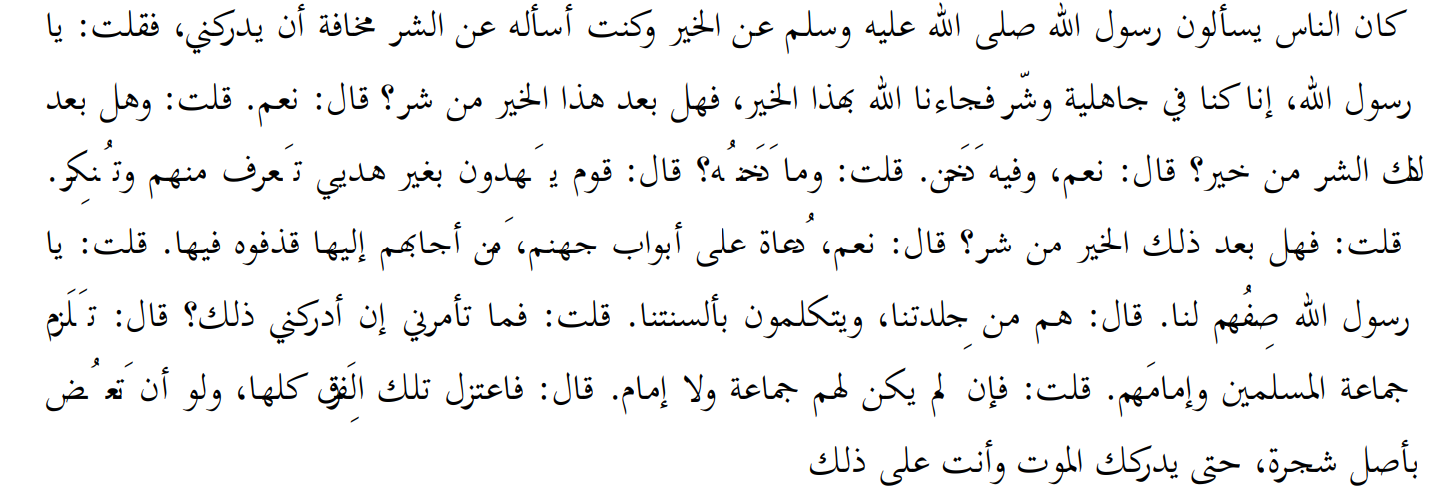
„Die Leute pflegten den Propheten Allahs (saw) nach dem Guten zu fragen, und ich pflegte ihn nach dem Bösen zu fragen, aus Furcht, dass es mich treffen könnte. Also sagte ich: O Prophet Allahs! Wir lebten in den Zeiten der Unwissenheit (Dschahiliyya) und des Unheils, dann brachte Allah uns dieses Gute. Gibt es nach diesem Guten irgendein Unheil? Er (saw) sagte: Ja. Ich sagte: Wird es nach jenem Unheil irgendein Gutes geben? Er sagte: Ja, und es hat einen Rauch (dukhan). Ich sagte: Was ist sein Rauch? Er sagte: Menschen, die leiten, aber nicht nach meiner Rechtleitung. Du erkennst einige von ihnen und lehnst einige ab. Ich sagte: Wird es nach jenem Guten irgendein Unheil geben? Er sagte: Ja, Rufer (du'at), die an den Toren der Hölle einladen. Wer ihrer Einladung folgt, den werfen sie in sie (die Hölle). Ich sagte: O Prophet Allahs, beschreibe sie uns. Er sagte: Sie sind von unserer eigenen Haut (aus unserem Volk) und sprechen unsere Sprache. Ich sagte: Was befiehlst du mir zu tun, wenn mich diese Sache trifft? Er sagte: Halte an der Gemeinschaft (jama'ah) der Muslime und an ihrem Imam fest. Ich sagte: Was ist, wenn die Muslime weder eine Gemeinschaft noch einen Imam haben? Er sagte: Dann trenne dich von all diesen Gruppen, selbst wenn du an der Wurzel eines Baumes beißen musst, bis dich der Tod in diesem Zustand ereilt.“
“The people used to ask the Prophet of Allah (saw) about the good and I used to ask him about the bad in fear that it might catch me. So I said: O Prophet of Allah! We were in times of jahiliyyah and mischief then Allah brought us this good, so is there any mischief after this good? He (saw) said: Yes. I said: Will there be any good after that mischief? He said: Yes, and it has smoke (dukhan). I said: What is its smoke? He said: People guiding but not on my guidance. You recognise some (from them) and deny some. I said: Will there be any mischief after that good? He said: Yes, callers (du’at) who invite at the doors of Hellfire. They throw him into it (hell) whoever accepted their invitation. I said: O Prophet of Allah, describe them to us. He said: They are of our own skin (of our people) and talk our language. I said: What do you order me to do if that (matter) caught me? He said: Adhere to the jama‘ah of Muslims and their Imam. I said: What if the Muslims have no jama‘ah nor an Imam? He said: Then separate from all those groups, even if you (have to) bite the root of a tree till death comes to you as such.”
Dieses Hadith ist in seiner Aussage eindeutig: Der Prophet (saw) befahl den Muslimen, an der Jama'ah der Muslime festzuhalten und an ihrem Imam, und diejenigen zu meiden, die zu den Toren der Hölle einladen. Der Fragende fragte ihn, was er in der Situation tun solle, in der die Muslime keinen Imam und keine Jama'ah haben, woraufhin der Prophet ﷺ ihm befahl, sich von all diesen Gruppen zu trennen, sich weder von den Muslimen loszusagen noch sich von dem Bemühen um die Einsetzung eines Imams fernzuhalten. Sein Befehl lautet also klar: „Trenne dich von all diesen Gruppen“, und er betonte die Trennung von diesen Gruppen sogar so sehr, dass er sich von ihnen zurückziehen solle, selbst wenn er dafür den Stamm eines Baumes umklammern müsse, bis der Tod zu ihm kommt. Sein Sinn ist, an deiner Religion festzuhalten und dich von den irreführenden Predigern fernzuhalten, die an den Toren der Hölle stehen. In diesem Hadith gibt es keine Entschuldigung und keine Erlaubnis (für irgendjemanden), das Bemühen um die Errichtung eines Kalifats aufzugeben. Er bezieht sich vielmehr allein auf das Gebot, an der Religion festzuhalten und die Prediger am Höllentor zu verlassen, und die Sünde bleibt auf ihm, wenn er sich nicht um die Errichtung eines Kalifats bemüht. Er wird also angewiesen, die irreführenden Gruppen zu verlassen, um seine Religion vor den Predigern der Irreführung zu bewahren, selbst wenn er dafür an der Wurzel eines Baumes festhalten müsste, nicht aber, sich von der muslimischen Gemeinschaft zu distanzieren und das Bemühen um die Durchsetzung der Gesetze der Religion und die Einsetzung eines Imams für die Muslime aufzugeben.
This hadith is clear in its expression that the Prophet (saw) ordered the Muslims to adhere to the jama‘ah of Muslims and to adhere to their Imam, and to leave those who invite people to the doors of hell. The questioner asked him what he has should do in relation to those callers at the doors of Hellfire in the situation wherein the Muslims have no Imam and no jama‘ah; thereupon the Prophet (saw) ordered him to separate from all these groups, not to disassociate himself from the Muslims nor to abstain from the action for establishing an Imam. So his order is clear “Separate from all those groups”, and he emphasised the separation from those groups even to the extent that his isolation from them would make him clench to the trunk of a tree until death comes to him. Its meaning is to adhere to your deen and keep away from the misguiding callers who are at the doors of Hellfire. In this hadith there is no excuse or permission (for anybody) to abandon the work for establishing a Khalifah, it is, rather, confined to the command of adhering to the deen and abandoning the callers at the doors of hell, and the sin will remain on him if he does not work to establish a Khalifah. So he is ordered to abandon the misguiding groups in order to save his deen from the callers of the misguidance, even if he had to bite the root of a tree, but not to distance himself from the Muslim community and abandon the work for establishing the laws of the deen and establishing an Imam for Muslims.
„Der Gesandte Allahs ﷺ sagte: Es wird eine Zeit kommen, in der das beste Eigentum eines Muslims Schafe sein werden, die er auf die Gipfel der Berge und an die Orte des Regenfalls (Täler) treibt, um mit seiner Religion vor den Versuchungen (fitan) zu fliehen.“
“The Messenger of Allah (saw) said: A time will come that the best property of a Muslim will be sheep which he will take on the top of mountains and the places of rainfall (valleys) so as to flee with his religion from afflictions (fitan)”
Das bedeutet nicht, dass man sich von der muslimischen Gemeinschaft absondern, die Gesetze der Religion (Din) nicht mehr praktizieren und einen Kalifat für die Muslime errichten soll, wenn es auf Erden kein Kalifat gibt. Es enthält lediglich eine Erklärung dessen, welches der beste Besitz des Muslims in Zeiten der Prüfung ist; es ermutigt nicht zur Trennung von den Muslimen und zur Isolation von den Menschen.
This does not mean that one should isolate oneself from the Muslim community, abandon practising the laws of the deen and establishing a Khalifah for Muslims when there is no Khilafah on earth. All that it contains is an explanation of what is the best wealth of the Muslim at the times of affliction; it does not encourage separation from the Muslims and isolation from the people.
Demnach hat kein Muslim auf dieser Erde eine Entschuldigung, die Pflicht zur Errichtung des Din zu vernachlässigen, die Allah (SWT) angeordnet hat, nämlich die Errichtung eines Kalifats für die Muslime, wenn es auf der Erde kein Kalifat gibt, wenn niemand da ist, der die Strafen (Hudud) Allahs (SWT) vollzieht, um die Heiligtümer Allahs (SWT) zu schützen, und niemand da ist, der die Gesetze des Din umsetzt und die muslimische Gemeinschaft unter dem Banner von La ilaha illa Allah, Muhammad ur-Rasul Allah ﷺ vereint. Im Islam gibt es keine Erlaubnis, die Arbeit für diese Pflicht aufzugeben, bis sie tatsächlich vollendet ist.
Accordingly, no Muslim on the face of this earth has an excuse to abandon the duty of establishing the deen which Allah (swt) has ordered, that is, the establishment of a Khalifah for Muslims when there is no Khilafah on the earth, when there is no one to implement the punishments (hudood) of Allah (swt) to protect the sanctities of Allah (swt), and no one to implement the laws of the deen and unify the Muslim community under the banner of La ilaha illa Allah, Muhammad ur-Rasul Allah. There is no permission in Islam to abandon the work for this duty until it is indeed completed.