2.15 Die Offenbarung
2.15 The Revelation
Jeder Muslim muss an die Offenbarung glauben, da sie ein grundlegender Bestandteil des Glaubens ist. Der Beweis für die Offenbarung ist jedoch nicht rational, sondern wird auf der Grundlage authentischer Texte angenommen. Da die Offenbarung keine greifbare Wahrnehmbarkeit oder Wirklichkeit besitzt, kann der Verstand ihre Gültigkeit nicht überprüfen. Daher ist jeder Versuch, die Offenbarung mittels des Intellekts zu beweisen, fehlerhaft, da es nicht möglich ist, mit dem Verstand etwas ohne greifbare Wirklichkeit zu beweisen.
Each and every Muslim must believe in revelation, as it is a fundamental aspect of belief. However, the evidence for revelation is not rational, rather it is accepted on the basis of authentic texts. Since revelation does not have a tangible sensation or reality, the mind cannot verify its validity. Therefore every attempt to prove revelation by means of the intellect will be incorrect, as it is not possible to use the mind to prove something without a tangible reality.
Daher ist, wie zuvor erwähnt, der Beweis für die Offenbarung nicht intellektueller Natur; vielmehr gründet er sich auf authentische Überlieferungen. Der eindeutige Text des Qur'ān bestätigt, dass der Gesandte Muhammad ﷺ Offenbarung empfangen hat. Allah sagt:
Hence, as mentioned earlier, the evidence for revelation is not intellectual; rather it is established on the basis of authentic narrations. The Definite text of the Qur’ān verifies that the messenger Muhammad recieved revelation. Allah says,
Ebenso offenbart Allah, der Erhabene, der Allweise, dir und denen vor dir. [TMQ Shura: 3]
"Likewise Allah, the Honourable, the all-wise, reveals to you and to those before you." [TMQ Shura: 3]
Und ebenso haben Wir dir auf Unseren Befehl hin einen lebensspendenden Geist offenbart. [TMQ Shura:52]
"And likewise we have revealed to you an invigorate thing by our command." [TMQ Shura:52]
Und er spricht nicht aus eigener Neigung. Es ist nur eine Offenbarung, die ihm eingegeben wird. [TMQ Najm: 3]
"And he doesn't utter from his own desire. Indeed it is an inspired inspiration" [TMQ Najm: 3]
„Zweifellos, o Prophet! Wir haben dir Offenbarung eingegeben, so wie Wir sie Noah und den Propheten nach ihm eingegeben haben." [TMQ Nisa: 163]
"Undoubtedly, O prophet! We have sent revelation to you as we sent it to Noah and the prophets after him." [TMQ Nisa: 163]
„Und folge dem, was dir offenbart wird, und sei geduldig, bis Allah entscheidet; und Er ist der beste aller Richter." [TMQ 10:109]
"And follow that which is revealed to you and have patience until Allah decrees and He is the best of judges." [TMQ 10:109]
Die Offenbarung, die auf den Gesandten herabkam, hatte drei Zustände, und alle Propheten vor ihm empfingen die Offenbarung ausschließlich auf diese Weise und auf keine andere. Diese Zustände fallen alle unter die Offenbarung, die Allah im Qur'an erklärt. Er sagt:
The revelation that descended on the messenger had three states, all prophets before him recieved the revelation through these only and not another. These states are all categorised under the revelation which Allah explains in the Qur’ān. He says,
„Und es steht keinem Menschen zu, dass Allah mit ihm spricht, außer durch Offenbarung, oder hinter einem Schleier, oder durch die Sendung eines Gesandten, der dann mit Seiner Erlaubnis offenbart, was Er will. Gewiss, Er ist erhaben und weise." — *Hinweis: Dieser Satz entspricht der Sure 42, Vers 51, und ist daher in Qur'an-Sprache wiedergegeben.* [TMQ Shura: 51]
"And it is not fit for any man that Allah should speak to him but through revelation, or that the man may be at the other side of the veil of grandeur, or by sending messengers and inspiring whom he wills." [TMQ Shura: 51]
Das heißt, Allah kommuniziert mit dem Menschen nur durch Eingebung, durch Rede hinter einem Schleier oder durch das Senden eines Gesandten. Die Offenbarung, die auf den Gesandten herabkam, hatte zwei Zustände. Er ﷺ hat über sie informiert, als er einmal gefragt wurde: „Wie kommt die Offenbarung zu dir?“ Er ﷺ antwortete:
That is, Allah only communicates with man through inspiration, through verbal contact via a veil or by sending messengers. The revelation that descended upon the messenger had two states. He informed about them when he was once asked, "How does the revelation come to you?" He replied,
„Manchmal kommt es wie das Klirren oder das Läuten einer Glocke, und dies ist für mich am schwersten zu ertragen; und wenn es mich verlässt, habe ich alles in mich aufgenommen. Und manchmal kommt der Engel zu mir in Gestalt eines Mannes und spricht zu mir, und ich begreife, was gesagt wird.“ [Bukhari]
"Sometimes it comes like the clattering or the jingling of a bell which is severest on me and when it leaves me, I have absorbed everything. And sometimes the angel comes to me in a form of a man and speaks to me and I am aware of what is being said." [Bukhari]
Diese beiden Zustände sind wie folgt: Erstens – der Engel gibt dem Propheten ﷺ die Eingebung durch Andeutung und ohne Worte oder Sprache. Die Offenbarung wird in den Geist des Propheten ﷺ eingegeben, so wie er ﷺ sagte:
These two states are as follows: Firstly- the angel inspires the prophet by indication and without using words or language. The revelation is inspired into the mind of the prophet , just as he said,
„Ruh Al-Quds (Jibril) hat mir eingegeben, dass keine Seele stirbt, bevor sie ihren Rizq und ihren Ajal vollständig erhalten hat. Darum, o ihr Menschen, fürchtet Allah und erwerbt die Mittel zum Guten." [Extraced by AlHakim]
"Ruh Al-Quds (Jibril) inspired in to me that no soul shall die until it has completed its Rizq and its Ajal. Therefore fear Allah O people and acquire the means to do good" [Extraced by AlHakim]
Auch der Gesandte (ﷺ) hatte im Traum Visionen, die er von Allah empfing, sowohl im Wachzustand als auch im Schlaf. Manches davon wurde ihm im Wachzustand eingegeben, und er hatte bestimmte Visionen in seinen Träumen, die allesamt Offenbarung waren. Wie die Mutter der Gläubigen, Aisha (ﷺ), sagte,
Also the messenger whilst dreaming had visions that he received from Allah both in the states of consciousness and sleep. Some of it was inspired to him whilst he was awake and he would have certain visions in his dreams all of which were revelation. As the mother of the believers, Aisha said,
Zunächst begann der Gesandte ﷺ, in seinem Schlaf wahrhaftige Visionen zu sehen. Jede Vision, die er hatte, war so klar wie das Morgenlicht.
"Firstly, the messenger began seeing true visions in his sleep. Every vision he had was true as clear as the morning."
Der Gesandte spürte ebenfalls, dass eine Form der Offenbarung bevorstand, doch sie kam nicht. Aischa berichtete, dass Harith ibn Haschim den Gesandten fragte: „O Gesandter, wie kommt die Offenbarung zu dir?“ Der Gesandte ﷺ sagte:
The messenger would also feel that some form of revelation was about to come, but it didn't come. Aisha narrated that Harith ibn Hashim asked the messenger , "O messenger, how does the revelation come to you?" The messenger said,
„Manchmal kommt es wie das Klingeln einer Glocke, was mir am schwersten fällt, und wenn es mich verlässt, habe ich alles in mich aufgenommen." [Bukhari]
"Sometimes it comes like the clattering /jingling of a bell which is severest on me and when it leaves me, I have absorbed everything." [Bukhari]
All diese Arten – Eingebung, Traum, Offenbarung ohne Rede und alles Ähnliche – bilden einen einzigen Zustand und fallen unter den Ausspruch Allahs,
All these variations i.e. inspiration, dream, revelation without talk and everything similar constitute one state and fall within the saying of Allah ,
„Nichts als Offenbarung" [TMQ Shura: 51]
"Nothing but revelation" [TMQ Shura: 51]
Weil im Sprachgebrauch das Verb „jemandem offenbaren" bedeutet, andeuten oder mit dem Kopf winken. So offenbart Allah ihm und gibt ihm ein. Allah sagt:
Because linguistically when the verb "to reveal to someone" is used it means to indicate or shake ones head. Thus Allah reveals to him and inspires him. Allah says,
„Und dein Herr offenbarte der Biene", [TMQ Nahl: 68]
"And your lord inspired the bee", [TMQ Nahl: 68]
So ist die Eingebung an die Biene: die Eingebung und das angeborene Wissen im Herzen der Biene.
Thus the inspiration to the bee is: the inspiration and the innate knowledge within the bee’s heart.
Der zweite Zustand ist die Offenbarung, die durch mündliche Übermittlung vom Engel eingegeben wird. Sie wird dem Propheten ﷺ mündlich übermittelt, nachdem er durch eindeutige Beweise erkannt hat, dass dies Offenbarung ist und der Überbringer der Botschaft der Engel ist, also Dschibril. Allah sagt:
The second state is the revelation inspired by means of oral communication from the angel. It is transmitted orally to the prophet after he learns through decisive evidence that this is revelation and the message bearer is the angel, i.e. Jibril. Allah says,
Der vertrauenswürdige Geist ist damit herabgekommen. Auf dein Herz, damit du warnst. [TMQ Shuara: 193]
"The trusted spirit has descended with it. On your heart that you may warn." [TMQ Shuara: 193]
Mit anderen Worten: Allah sendet Dschibril, der mit dem Gesandten spricht, und dieser hört und bewahrt zugleich seine Worte. Aischa berichtete, dass der Prophet ﷺ sagte:
In other words, Allah sends Jibril who speaks with the messenger who simultaneously both hears and preserves his words. Aisha narrated that the prophet said,
„Und manchmal kommt der Engel zu mir in Gestalt eines Mannes, er spricht mit mir, und ich bin mir dessen bewusst, was er sagt.“ [Bukhari]
"And sometimes the angel comes to me as a man and he talks to me and I am conscious of what he is saying." [Bukhari]
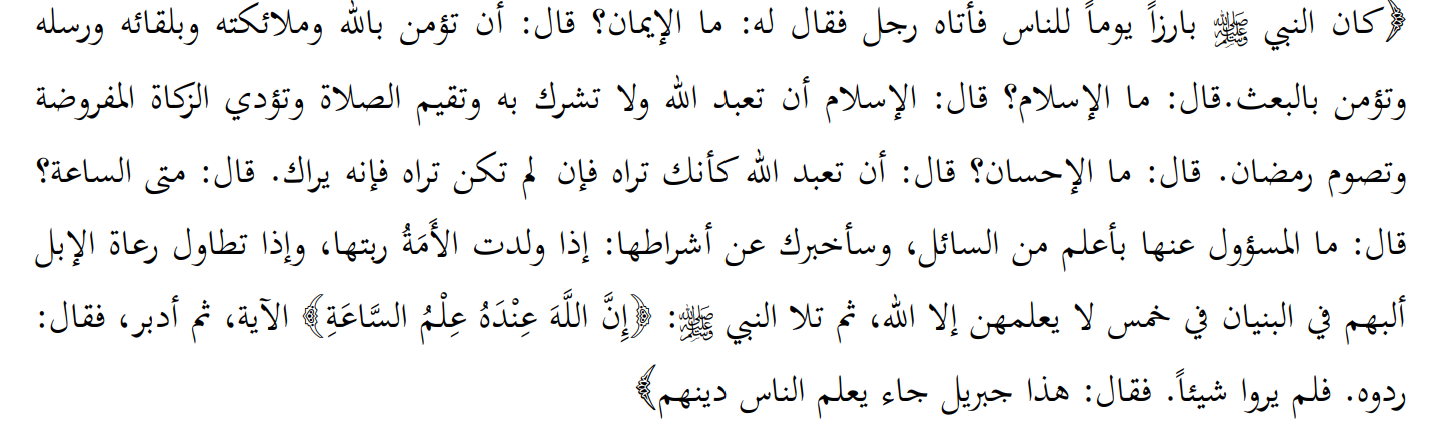
Abu Hurairah berichtete, dass der Prophet ﷺ eines Tages bei den Menschen saß, als eine Person kam und ihn fragte: „Was ist Iman?" Er ﷺ sagte: „Iman ist der Glaube an Allah, an Seine Engel, an die Begegnung mit Ihm, an Seine Gesandten und an die Auferstehung." Er fragte: „Was ist Islam?" Er ﷺ sagte: „Islam bedeutet, dass du Allah allein verehrst und nichts Ihm beigesellst, das Gebet verrichtest, die vorgeschriebene Zakat entrichtest und im Ramadan fastest." Er fragte: „Was ist Ihsan?" Er ﷺ sagte: „Dass du Allah so verehrst, als würdest du Ihn sehen, und wenn du Ihn nicht siehst, so sieht Er dich doch." Er fragte: „Wann ist die Stunde?" Er ﷺ sagte: „Der Gefragte weiß darüber nicht mehr als der Fragende. Ich werde dir jedoch von ihren Zeichen erzählen: Wenn die Sklavin ihre Herrin gebärt und wenn die Hirten hohe Gebäude errichten. Sie gehört zu den fünf Dingen, die niemand kennt außer Allah." Dann rezitierte der Prophet ﷺ den Vers: {Gewiss, bei Allah ist das Wissen um die Stunde.} Daraufhin wandte sich der Mann um und ging fort. Der Prophet ﷺ sagte zu den Gefährten: „Ruft ihn zurück!" Doch sie sahen nichts. Er ﷺ sagte: „Das war Dschibril; er kam, um den Menschen ihre Religion zu lehren." [Bukhari]
Abu Hurairah narrated that the prophet was with the people one day when a person came and asked him, "What is Emaan?" He said, "It is the belief in Allah , his angels, in the meeting with him , his messengers and the resurrection." He asked, "What is Islam?" He said, "Islam is that you worship Allah and do not commit Shirk, establish the prayer, pay the enjoined Zakat and you fast in Ramadan." He said, "What is Ihsaan?" He said, "That you worship Allah as if you see him, and if you can not see him, surely he sees you." He said, "When is the hour?" He said, "The one questioned about it knows no better then the questioner. I will tell you of its signs. When the mother will give birth to her Master and when the shepherd will build tall buildings. It is one of the five things that no one will know them except Allah ." Then the prophet recited the Ayat, "Indeed Allah has the knowledge of the hour." Then the man turned and left. The prophet said to the Sahaba call him but they didn't see anything. He said, "This was Jibril, he came to teach people their Deen." [Bukhari]
Es gibt eine Reihe von Vorfällen, die in Ahadith überliefert sind, bei denen Jibril herabstieg, mit dem Propheten ﷺ sprach und dieser zuhörte. Dies war eine Form der Offenbarung für den Gesandten ﷺ, indem der Engel ihm die Bedeutungen in Form eines Gesprächs mitteilte. Die Offenbarung durch Worte und Bedeutung ist auf den Edlen Qur'ān beschränkt. Bei der Offenbarung nur der Bedeutung drückte der Gesandte ﷺ dies mit seinen eigenen Worten aus, durch die Anwendung, also seine Handlungen, oder durch Schweigen, und dies ist die Sunnah.
There are a number of incidents mentioned in Ahadith in which Jibril descended and talked to the prophet and he would listen. This was a form of revelation for the messenger, as the angel would tell the messenger the meanings in the form of a conversation. The revelation by words and meaning is restricted to the Noble Qur’ān. As for revelation by meaning, the messenger would express this by using his own words, through application i.e. his actions, or by silence and this is the Sunnah.
Der Hadith Qudsi gilt als Sunnah, weil zwar sein Sinn von Allah offenbart ist, seine Worte jedoch vom Propheten ﷺ stammen. Die Worte des Hadith Qudsi stammen nicht von Allah, denn die Worte, die von Allah stammen, sind ausschließlich dem Qur'an vorbehalten, was durch seine Unnachahmlichkeit belegt wird. Obwohl die Sunnah in Form von Eingebung, Traum und unmittelbar ins Herz geworfen kommt, kommt sie auch im Wachzustand und als Zwiegespräch zwischen Dschibril und dem Gesandten ﷺ.
The Hadith Qudsi is regarded as Sunnah because although its meaning is revealed from Allah its words are from the prophet . The words of the Hadith Qudsi are not from Allah because the words that are from Allah are specifically for the Qur’ān and this is proven by its inimitability. Although the Sunnah comes in the forms of inspiration, dream and is cast directly in the heart, it also comes both in wakefulness and as a dialogue between Jibril and the messenger .
Der Qur’ān wurde nur durch den Gesandten offenbart, weil seine Worte von Allah stammen. Es gibt zahlreiche Verse, die die Offenbarung des Qur’āns beschreiben. Allah (SWT) sagt:
The Qur’ān is only revealed through the messenger because its words are from Allah . There are numerous ayats detailing the revelation of the Qur’ān. Allah says,
„Und Wir haben dir den Koran auf Arabisch offenbart." [TMQ Shura:7]
"And we have revealed the Quran to you in Arabic" [TMQ Shura:7]
„Und was Wir dir (o Muhammad ﷺ) vom Buch offenbart haben, das ist die (reine) Wahrheit." [TMQ Fatir: 31]
" And what We have revealed to you (O Muhammad [saw]) of the Book, it is the (very) truth " [TMQ Fatir: 31]
Das Buch, auf das hier Bezug genommen wird, ist der Qur'ān, und „min“ dient hier dazu, Repräsentation anzuzeigen.
The book referred to is the Qur’ān and “min” here is to indicate representation.
„Dieser Qur'an wurde mir offenbart, damit ich euch und jeden, den er erreicht, damit warne." [TMQ An’aam: 6]
“This Qur'ân has been revealed to me that I may therewith warn you and whomsoever it may reach " [TMQ An’aam: 6]
„Wir erzählen dir, [Muhammad ﷺ], die beste der Geschichten durch Unsere Offenbarung an dich, diesen Qur'ân." [TMQ Yoosuf: 3]
" We relate to you (Muhammad [sal-Allâhu 'alayhi wa sallam]) the best of stories through Our Revelations to you, of this Qur'ân" [TMQ Yoosuf: 3]
„Und verlies, was dir von dem Buch deines Herrn offenbart wurde (o Muhammad ﷺ). Niemand kann Seine Worte ändern.“ [TMQ alKahf: 27]
" And recite what has been revealed to you (O Muhammad PBUH) of the Book (the Qur'ân) of your Lord. None can change His Words, " [TMQ alKahf: 27]
Es ist der Qur’ān. Es gibt auch weitere Verse, die die Offenbarung im Allgemeinen erwähnen, einschließlich der Sunnah. Zum Beispiel sagt Allah:
It is the Qur’ān. There are other ayats as well, which mention the revelation in general including the Sunnah. For example, Allah says,
„Wenn ich rechtgeleitet bleibe, so ist es durch die Offenbarung meines Herrn an mich.“ [TMQ As-saba: 50]
" If I remain guided, it is because of the Revelation of my Lord to me” [TMQ As-saba: 50]
Und Er sagt,
And He says,
„Wahrlich, Wir haben dir (o Muhammad ﷺ) die Offenbarung eingegeben, so wie Wir Nuh (Noah) die Offenbarung eingegeben haben und den Propheten nach ihm." [TMQ Nisa: 163]
" Verily, We have sent the Revelation to you (O Muhammad [saw]) as We sent the Revelation to Nûh (Noah) and the Prophets after him" [TMQ Nisa: 163]
Und Er sagt,
And He says,
„Und folge dem, was dir von deinem Herrn offenbart wird. Wahrlich, Allah ist über das, was ihr tut, wohlunterrichtet." [TMQ Ahzaab: 2]
"And follow that which is revealed to you from your Lord. Verily, Allâh is Well-Acquainted with what you do" [TMQ Ahzaab: 2]
Diese beiden genannten Zustände wurden in den Texten behandelt. Der dritte Zustand wird in Seinem Ausspruch erwähnt:
These two mentioned states have been discussed in the texts, The third state is mentioned in His saying,
„Oder von hinter einem Schleier“ [TMQ Shura: 51]
"Or from behind a veil” [TMQ Shura: 51]
Dies geschah mit Musa. Dieser Vers verweist auf den Vorfall, bei dem Allah mit Musa hinter einem Schleier sprach. Das gleicht dem, wie ein Verschleierter mit einigen Würdenträgern und angesehenen Personen spricht: Er spricht hinter einem Schleier, und obwohl man die Stimme des anderen hört, sieht man ihn nicht. Auf diese Weise sprach Allah mit Musa.
This is what happened with Musa . This Ayat is indicating to the incident in which Allah spoke to Musa from behind a veil. That is, just as the veiled person speaks with some dignitaries and with people of distinction. He speaks from behind a veil and although one hears the other person’s voice, he does not see him. This is the manner in which Allah spoke with Musa .
Ein solcher Vorfall hat sich mit dem Propheten ﷺ nur einmal ereignet, nämlich während der Isra und Mi'radsch, was nicht nur in einem authentischen Hadith erwähnt, sondern auch in der Sure an-Nadschm angedeutet wird. Allah (SWT) sagt:
Such an incident only occurred once with the prophet during the al-Isra wal-Miraj, which has not only been mentioned in an authentic Hadith, but has also been indicated by Sura al-Najm. Allah says,
"Es ist nur eine Offenbarung, die offenbart wird. Er wurde von einem Mächtigen an Kraft gelehrt [Dschibril]. Einem, der frei von jedem Mangel an Körper und Verstand ist. Dann erhob er sich [Dschibril] und stand fest. Während er [Dschibril] im höchsten Teil des Horizonts war, näherte er sich und kam näher, und er war in einer Entfernung von zwei Bogenlängen oder (sogar) noch näher. So offenbarte (Allah) Seinem Diener [Muhammad ﷺ durch Dschibril (as)] alles, was Er offenbarte." [TMQ Najm: 4-10]
"It is only a Revelation revealed.He has been taught (this Qur'ân) by one mighty in power [Jibril].One free from any defect in body and mind then he (Jibrîl) rose and became stable.While he [Jibrîl)] was in the highest part of the horizon, Then he [Jibrîl] approached and came closer, And was at a distance of two bows' length or (even) nearer. So (Allâh) revealed to His slave [Muhammad [saw] through Jibrîl [as]] whatever He revealed." [TMQ Najm: 4-10]
Abgesehen von diesem Ereignis, nämlich al-Isra wal-Miraj, ist die Offenbarung dem Propheten ﷺ in Form einer Eingebung und durch einen Boten herabgekommen.
With the exception of this event i.e. al-Isra wal-Miraj, the revelation descended upon the prophet in the form of an inspiration and through a messenger.
Alle Arten der Offenbarung sind Beweismittel. Die Verständigung zwischen dem Engel und dem Gesandten, sei es durch Rede, Hinweis oder Gespräch, ist eine eindeutige Offenbarung. Die Eingebung und die Visionen sind eindeutige Offenbarungen, und dass Allah zu den Propheten spricht, ist ebenfalls eine Form der Offenbarung. Diese Offenbarung ist ein kategorischer Beweis, da sie in den authentischsten und eindeutigsten Texten mit bestimmter Bedeutung überliefert ist.
All the types of revelation are forms of evidence. The communication between the angel and the messenger by talk or indication or conversation is a clear revelation. The inspiration and visions are clear revelations and Allah speaking to the prophets is also a form of revelation. This revelation is a categorical proof as it has been reported in the most authentic and definite texts of definite meaning.