17.3 Das Treuegelöbnis (Bay'ah)
17.3 The Pledge (bay’ah)
Die Bay'ah ist eine Pflicht für alle Muslime, und sie ist ein Recht für jeden Muslim, Mann oder Frau. Der Beweis dafür, dass sie eine Pflicht ist, findet sich in zahlreichen Ahadith des Propheten ﷺ, in denen er sagte:
Bay’ah is an obligation upon all Muslims, and it is a right for every Muslim, man or woman. The evidence for it being an obligation is in many ahadith of the Prophet (saw), in which he said:
„Wer stirbt, ohne ein Treuegelöbnis (bai'ah) auf seinem Nacken zu haben, stirbt den Tod der Unwissenheit (jahiliyyah).“
“Whosoever dies without having a bay’ah upon his neck dies a death of jahiliyyah.”
Was das Recht der Muslime betrifft, so zeigt schon die Bay'ah selbst dies, denn die Bay'ah wird von den Muslimen dem Khalifah geleistet und nicht vom Khalifah den Muslimen. Die Bay'ah der Muslime an den Propheten ﷺ ist in den Ahadith bestätigt. Al-Bukhari überliefert, dass 'Ubadah bin as-Samit (ra) sagte:
As for being a right for Muslims, the bay’ah itself indicates that, because the bay’ah is offered by the Muslims to the Khalifah, and not by the Khalifah to the Muslims. The bay’ah of the Muslims to the Prophet (saw) was confirmed in the ahadith. Al-Bukhari reported that ‘Ubadah bin as-Samit (ra) said:
„Wir leisteten dem Propheten ﷺ den Treueeid (Bay'ah), dass wir hören und gehorchen wollen, sowohl in dem, was uns gefällt, als auch in dem, was uns missfällt, dass wir den Anordnungen derer, die die Verantwortung tragen, nicht widersprechen wollen, dass wir die Wahrheit sagen wollen, wo immer wir uns befinden, und dass wir uns beim Handeln oder Sprechen um Allahs willen vor dem Tadel niemandes fürchten wollen.“
“We made a bay’ah to the Prophet (saw) to hear and to obey in whatever pleases and displeases us, and that we would not dispute the order of those in charge, that we would speak the truth wherever we are, and that we would not fear the blame of anyone when acting or speaking for the sake of Allah.”
Al-Bukhari überlieferte von Ayyub, von Hafsa, von Umm ‘Atiyyah, die sagte:
Al-Bukhari reported from Ayyub from Hafsa from Umm ‘Atiyyah who said:
„Wir leisteten dem Propheten ﷺ den Treueeid (Bai'ah), und er rezitierte mir den Vers: {dass sie Allah nichts an Anbetung beigesellen werden} (TMQ 60.12). Und er untersagte uns auch das Klagen und Wehklagen um die Toten. Da streckte eine Frau aus unserer Mitte ihre Hand aus und sagte: ‚Die und die Frau hat um einen Verstorbenen aus meiner Familie geweint, und ich möchte ihr für dieses Weinen vergelten.‘ Der Prophet ﷺ sagte darauf nichts, und sie ging und kehrte zurück.“
“We gave a bay’ah to the Prophet (saw) and he recited to me the verse That they will not associate anything in worship with Allah (TMQ 60.12). And he also prevented us from wailing and lamenting over the dead. A woman from us held her hand out and said, "Such-and-such a woman cried over a dead person belonging to my family and I want to compensate her for that crying" The Prophet did not say anything in reply and she left and returned.”
Und in Al-Bukhari von Abu Hurairah (ra), der sagte: Der Prophet ﷺ sagte:
And in Al-Bukhari from Abu Hurairah (ra) who said: The Prophet (saw) said:
„(Es gibt) drei Personen, mit denen Allah am Tag der Auferstehung nicht sprechen wird, die Er auch nicht reinigen wird, und für sie gibt es eine schwere Strafe: Eine Person, die auf dem Weg überschüssiges Wasser hat und dem Reisenden den Zugang dazu verwehrt; eine Person, die einem Imam nur um weltlicher Angelegenheiten willen den Treueeid (bay'ah) leistet – erhält sie von ihm, was sie will, so erfüllt sie den Treueeid, andernfalls tut sie es nicht; und eine Person, die nach dem Asr-Gebet (am späten Nachmittag) eine Ware an einen anderen verkauft und bei Allah schwört, ihr sei dafür dies und das geboten worden, obwohl dem nicht so war, und jener ihm glaubt und sie kauft.“
“(There are) three persons to whom Allah will not talk on the Resurrection Day, nor purify them, and for them is a severe punishment: A person who has an excess of water on the road and prevents the wayfarer from it; a person who gives bay’ah to an Imam for his worldly affairs only, so if the Imam gave him that which he wants he fulfilled (the bay’ah) to him, otherwise he would not; and a person trading a commodity to another after asr (late afternoon) and he swore by Allah that he was offered so and so for it, although he was not, and the person believed him and bought it.”
Al-Bukhari berichtete von ‘Abdullah bin ‘Umar (ra), der sagte:
Al-Bukhari narrated from ‘Abdullah bin ‘Umar (ra) who said:
„Als wir dem Propheten ﷺ den Treueeid gaben, zu hören und zu gehorchen, sagte er zu uns: Soweit ihr dazu in der Lage seid.“
“When we gave a bay’ah to the Prophet (saw) to hear and obey, he would say to us: As much as you are capable of”
„Als wir dem Propheten ﷺ den Treueeid ablegten, zu hören und zu gehorchen, sagte er zu uns: Soweit ihr dazu imstande seid.“
“When we gave a bay’ah to the Prophet (saw) to hear and obey, he would say to us: As much as you are capable of”
„Ich habe dem Propheten ﷺ den Treueeid (Bai'ah) geleistet, zu hören und zu gehorchen, und er trug mir auf: Soweit du es vermagst, und jedem Muslim aufrichtig zu raten.“
“I gave bay’ah to the Prophet (saw) to hear and obey and he instructed me: As much as you are able, and to give good advice to every Muslim.”
Al-Bukhari überlieferte von Junada bin Abu Umayyah, der sagte:
Al-Bukhari narrated from Junada bin Abu Umayyah who said:
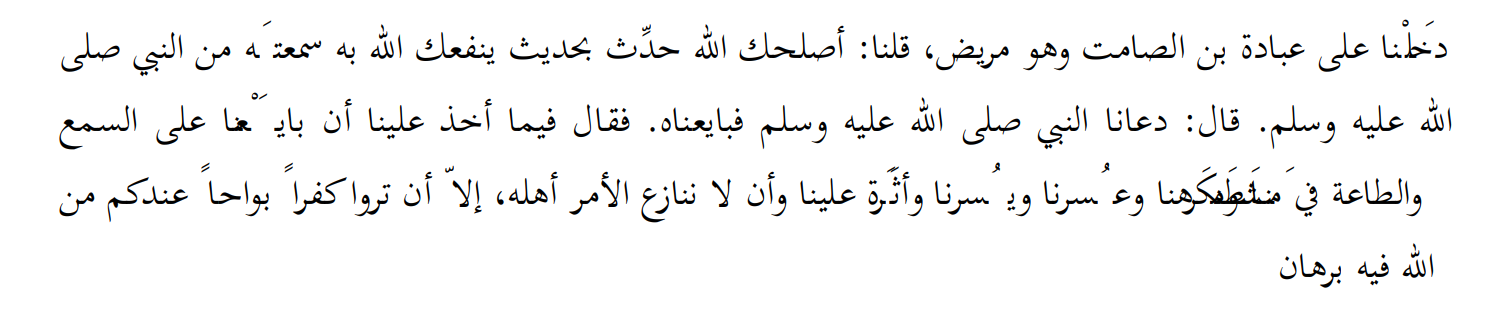
„Wir traten in das Haus von ‘Ubadah ibn as-Samit, als er krank war, und wir sagten: Möge Allah dich gesund machen. Berichte uns einen Hadith, den du vom Propheten ﷺ gehört hast, durch den Allah dir nützen möge. Er sagte: Der Prophet ﷺ rief uns, und wir leisteten ihm den Treueid (Bai'ah). Unter den Bedingungen, auf die er uns den Treueid abnahm, war, dass wir gehorchen und zuhören sollten (den Anordnungen), sowohl wenn wir aktiv waren als auch wenn wir müde waren, in Zeiten des Wohlstands und der Not, und wenn wir Bevorzugung (anderer vor uns) sehen, und dass wir die Autorität derer, denen sie übertragen wurde, nicht anfechten sollten, indem wir sagten: Außer wenn ihr offenen Unglauben (kufr bawah) seht, für den ihr einen klaren Beweis von Allah habt.“
“We entered the house of ‘Ubadah bin as-Samit while he was ill and we said: May Allah make you healthy, inform us of a hadith you heard from the Prophet (saw) by which Allah (swt) may benefit you. He said: The Prophet (saw) invited us and we gave him our bay’ah (pledge of Allegiance). And among the conditions on which he took the pledge from us, was that we were to listen and obey (the orders) both at the time when we were active and when we were tired , and in the times of ease and hardship and when we see preference (for others over us), and not to dispute the authority of those who are entrusted with it saying: Unless you see open disbelief (kufr bawah) upon which you have a clear proof from Allah.”
Die Bay'ah für den Kalifen liegt in den Händen der Muslime, und sie ist ihr Recht; sie sind es, die die Bay'ah geben, und ihre Bay'ah ist es, die das Kalifat für einen Kalifen rechtswirksam macht. Die Bay'ah kann durch Handschlag oder schriftlich erfolgen. ‘Abdullah bin Dinar überlieferte und sagte:
The bay’ah for the Khalifah is in the hands of the Muslims, and it is their right; it is they who give the bay’ah, and it is their bay’ah which makes the Khilafah contracted for a Khalifah. The bay’ah can be by shaking hand or by writing. ‘Abdullah bin Dinar narrated saying:
„Ich war Zeuge, als Ibn ‘Umar dabei war, wie die Leute sich um ‘Abdulmalik ibn Marwan versammelten. Er schrieb: Ich erkläre mich bereit, dem Diener Allahs, ‘Abdulmalik, dem Amir al-Mu’mineen, zu hören und zu gehorchen, gemäß der Sunnah Allahs und der Sunnah Seines Propheten ﷺ, soweit ich dazu imstande bin.“
“I witnessed bin ‘Umar where the people gathered around ‘Abdulmalik bin Marwan. He wrote: I agree to listen and obey to the slave of Allah, ‘Abdulmalik the Amir al-Mu’mineen, according to the Sunnah of Allah and the Sunnah of His Prophet as much as I am able.”
Außerdem ist die Bay'ah auf jeden Fall gültig (waseelah). Allerdings muss die Bay'ah von einer mündigen Person geleistet werden; es ist daher nicht angebracht, dass sie von einem Jugendlichen geleistet wird. Abu Aqeel Zahra bin Ma'bed berichtete von seinem Großvater 'Abdullah bin Hisham – der den Propheten ﷺ miterlebt hat –, dass seine Mutter Zaynab, die Tochter von Hameed, ihn zum Propheten ﷺ brachte und sagte: O Prophet Allahs, nimm ihm die Bay'ah ab. Der Prophet ﷺ sagte:
Moreover, the bay’ah is correct by any means (waseelah). However, the bay’ah has to be given by the mature person, so it is improper to be given by the young. Abu Aqeel Zahra bin Ma‘bed reported from his grandfather ‘Abdullah bin Hisham--who witnessed the Prophet (saw)--that his mother Zaynab, the daughter of Hameed, took him to the Prophet (saw) and said: O Prophet of Allah, take a pledge from him. The Prophet (saw) said:
„Er ist ein Kind“, strich ihm über den Kopf und betete für ihn.
“He is a child, wiped his head and made a du‘a for him.”
Was die Worte des Treueides (bay'ah) betrifft, so sind sie nicht an bestimmte Formulierungen gebunden. Sie müssen jedoch einschließen, dass der Khalifah nach dem Buch Allahs (swt) und der Sunnah Seines Propheten ﷺ handelt, sowie Gehorsam in Bedrängnis und in Leichtigkeit und Gehorsam in dem, was den Bewerber des Treueides (dem Khalifah gegenüber) erfreut und was ihm missfällt. Sobald jemand dem Khalifah seinen Treueid gegeben hat oder das Khilafah durch den Treueid anderer Muslime dem Khalifah übertragen wurde, ist der Treueid zu einer Verpflichtung auf dem Nacken dessen geworden, der ihn gegeben hat, und es ist ihm nicht erlaubt, ihn zurückzunehmen. Er ist ein Recht des Vertrags der Khilafah, bis er ihn gegeben hat, und sobald er ihn gegeben hat, muss er sich daran halten. Es ist ihm nicht erlaubt, davon zurückzutreten. Al-Bukhari überliefert von Jabir bin 'Abdullah (ra), dass ein Beduine dem Propheten ﷺ seinen Treueid auf den Islam gab, dann aber suchte ihn eine Krankheit heim, und so sagte er zum Propheten ﷺ: „Lass mich meinen Treueid zurücknehmen", doch der Prophet ﷺ lehnte ab, und der Mann ging fort. Der Prophet ﷺ sagte daraufhin:
As for the words of the bay’ah they are not restricted to specific terms. However they must include acting according to the Book of Allah (swt) and the Sunnah of His Prophet (saw) by the Khalifah, and obedience in hardship and ease and obedience, and whatever pleases and displeases on the part of the person who gives the bay’ah (to the Khalifah). Whenever the one who pledges has given his bay’ah to the Khalifah or the Khilafah is contracted to the Khalifah by the bay’ah of other Muslims, then the bay’ah has become a trust on the neck of the one who gives the bay’ah and he is not allowed to retract it. It is a right for the contract of the Khilafah until he has given it, and once he has given it he must abide by it. He is not allowed to retract from it. Al-Bukhari narrated from Jabir bin ‘Abdullah (ra) that a Bedouin gave the Prophet (saw) his pledge on Islam, and an illness struck him so he said to the Prophet (saw): “Let me withdraw my bay’ah but the Prophet (saw) refused, and the man left. The Prophet (saw) then said:
„Medina ist wie ein Schmelzofen; er stößt die Unreinheiten aus, wählt die Guten aus und macht sie vollkommen.“
“Medina is like a furnace, it expels out the impurities and selects the good ones and makes them perfect.”
Und es wird von Nafi‘a überliefert, der sagte: Ibn ‘Umar (ra) sagte zu mir, dass er den Propheten ﷺ sagen hörte:
And it is narrated from Nafi‘a who said: Ibn ‘Umar (ra) said to me that he heard the Prophet (saw) saying:
„Wer seine Hand vom Gehorsam (gegenüber dem Amir) zurückzieht, wird am Tag der Auferstehung, wenn er vor Allah steht, keinen Beweis (zu seiner Verteidigung) vorbringen können.“
“Whoever withdraws his hand from obedience (to the Amir) will find no argument (in his defense) when he stands before Allah on the Day of Resurrection.”
Den Treueschwur (Bay'ah) des Kalifen zu brechen bedeutet, die Hand von der Gehorsamspflicht gegenüber Allah (swt) zurückzuziehen. Dies trifft zu, wenn sein Treueschwur dem Kalifen ein Vertragsschwur ist oder ein Treueschwur des Gehorsams gegenüber einem Kalifen, den die Muslime angenommen und dem sie ihren Treueschwur gegeben haben. Hat er jedoch zu Beginn einem Kalifen den Treueschwur geleistet, und dieser wurde nicht vollendet, weil die Muslime insgesamt ihn nicht als Kalifen anerkannt haben, so hat er das Recht, sich von diesem Treueschwur zu lösen. Das im Hadith erwähnte Verbot bezieht sich auf die Aufkündigung eines Treueschwurs gegenüber einem Kalifen, nicht gegenüber einem Mann, dessen Kalifat nicht zustande gekommen ist.
To break the bay’ah of the Khalifah is withdrawing of one’s hand from the obedience of Allah (swt). This is the case if his bay’ah to the Khalifah is a bay’ah of contract or it is a bay’ah of obedience to a Khalifah whom the Muslims accepted and gave their bay’ah to. However, if he gave his bay’ah in the beginning to a Khalifah and it was not completed because the Muslims as a whole did not accept him as Khalifah, then he has the right to withdraw from that bay’ah. The prohibition mentioned in the hadith is focused on the withdrawal of a bay’ah to a Khalifah, not to a man for whom the Khilafah was not accomplished