2.13 Die Propheten und Gesandten
2.13 The Prophets And Messengers
„Prophet“ (nabi) und „Gesandter“ (rasul) sind zwei einander gegenübergestellte Begriffe, doch sie haben gemeinsam, dass beiden eine Scharia offenbart wird. Der Unterschied zwischen dem Gesandten und dem Propheten besteht darin, dass dem Ersteren eine Scharia eingegeben wird, die er zu verbreiten angewiesen ist, während dem Letzteren ebenfalls eingegeben wird, er aber angewiesen ist, die Scharia der Gesandten zu verbreiten. Mit anderen Worten: Der Gesandte ist angewiesen, die Scharia selbst zu verbreiten, während der Prophet die Scharia der Gesandten verbreitet.
‘Prophet’ (nabi) and ‘Messenger’ (rasul) are two contrastive terms but they share in the respect that a shari’a is revelaed to both of them. The difference between the Messenger and the prophet is that the former is inspired with a Sharī’ah which he is commanded to propagate, whereas the latter, i.e. the prophet is also inspired, but commanded to propagate the Sharī’ah of the messengers. In other words, the messenger is commanded to propagate the Sharī’ah himself, whilst the prophet propagates the Sharī’ah of the messengers.
Qadi al-Baydawi in seinem Kommentar zu dem Vers Allahs,
Qadi al-Baydawi in commentary of the saying of Allah ,
„Und Wir haben vor dir weder einen Gesandten noch einen Propheten gesandt, ohne dass, wenn er einen Wunsch hegte, der Satan einen Einfall in seinen Wunsch warf." [TMQ Hajj: 52]
"Never did we send an apostle or a prophet before thee, but, when he framed a desire" [TMQ Hajj: 52];
Er sagt: „Der Gesandte wird von Allah mit einer neuen oder erneuerten Scharia entsandt, zu der er die Menschen aufruft, während der Prophet von Allah entsandt wird, um die vorangegangene Scharia zu bestätigen.“ So war Musa ein Prophet, weil ihm eine Scharia offenbart wurde, und ein Gesandter, weil diese Scharia für seine Sendung bestimmt war. Aaron war hingegen ebenfalls ein Prophet, weil ihm eine Scharia offenbart wurde, aber er war kein Gesandter, da die ihm offenbarte Scharia nicht für seine Sendung bestimmt war, sondern für die Sendung Musas. Ebenso war Muhammad ﷺ ein Prophet und ein Gesandter, weil ihm eine Scharia offenbart wurde, die für seine Sendung bestimmt war ﷺ.
Says, ‘The messenger is sent by Allah with a revived or new Sharī’ah which he calls people to, whereas the prophet is sent by Allah to affirm the former Sharī’ah.’ Thus, Musa was a prophet because he was inspired with a Sharī’ah and a messenger because this Sharī’ah was for his mission. On the other hand, although Aaron was also a prophet because he was inspired with a Sharī’ah, he was not a messenger because the Sharī’ah, which was revealed to him was not for his mission, rather it was for the mission of Musa . By the same token, Muhammad was a prophet and a messenger because he was inspired with a Sharī’ah, which was for his mission.
Die Botschaft ist die Vermittlung zwischen Allah und den Dienern, um die Art und Weise zu erklären und zu verdeutlichen, wie die Bedürfnisse dieser Welt und des Jenseits erfüllt werden. Die Weisheit verlangt die Sendung von Gesandten, da sie Gesetze und Nutzen für die Menschen bringen.
The message is the mediation between Allah and the slaves in order to explain and clarify the method of satisfying the needs of this world and the hereafter. Wisdom necessitates the sending of messengers as they bring laws and benefits for people.
So ist die Sendung von Gesandten tatsächlich geschehen. Allah hat Gesandte aus den Reihen der Menschen erwählt und sie gesandt als Überbringer froher Botschaft vom Paradies und vom Lohn für die Gläubigen und Gehorsamen. Sie waren Warner vor dem Höllenfeuer und vor der Strafe für die Ungläubigen und Ungehorsamen, und sie haben den Menschen die Bedürfnisse und Erfordernisse dieser Welt und des Jenseits erklärt. Dies alles deshalb, weil der Verstand weder fähig ist, über Gut und Böse zu entscheiden, noch den Menschen selbst und seine Angelegenheiten zu begreifen.
Thus, the sending of Messengers has actually occurred. Allah appointed messengers from amongst mankind and sent them as bearers of glad tidings of paradise and reward to the people of belief and obedience. They were warners of the hell fire and punishment to people of disbelief and disobedience and they clarified the needs and requirements of this world and the hereafter for man. All because the mind is incapable of either deciding the good and bad or able to comprehend man himself and his affairs.
„Adam übertrat das Gebot seines Herrn, und so verfehlte er, was er begehrt hatte. Danach erwählte ihn sein Herr, wandte Sich ihm mit Seiner Barmherzigkeit zu und wies ihm den Weg zu Seiner bevorzugten Nähe." [TMQ Tā Hā: 121-2]
"Adam slipped the commandment of his Lord then what he had desired, did not get the way to it. Thereafter his Lord chose him and turned to him with his mercy and showed him the way to his favoured nearness" [TMQ Tā Hā: 121-2]
Die Bedeutung von „Ijtaba“ in diesem Zusammenhang ist „erwählen“, also ihn auserwählen. Der Qur'an belegt außerdem, dass Allah Adam sowohl bestimmte Dinge befohlen als auch bestimmte Dinge verboten hat. Daher sagt Allah:
The meaning of Ijtaba in this context means selecting him. The Quran also proves that Allah both commanded and prohibited Adam certain things. Hence Allah says,
Und Wir sprachen: „O Adam, wohne du und deine Gemahlin im Paradies, und esst davon reichlich, wo immer ihr wollt, doch nähert euch diesem Baum nicht, sonst gehört ihr zu den Frevlern." [TMQ Baqarah: 35]
"And we said, O Adam, dwell you and your wife in paradise and eat freely thereof where you will, but do not approach this tree lest you become of the transgressors" [TMQ Baqarah: 35]
Dies beweist kategorisch, dass es zu seiner Zeit keinen anderen Propheten gab. Daher war Adam ein Prophet durch Offenbarung und nichts weiter. Ein Prophet, dem eine Sharī’ah offenbart wurde, denn jedes Gebot [amr] oder Verbot [nahi] ist Sharī’ah. Da ihm also Offenbarung zuteilwurde, ist er ein Prophet.
This categorically proves that there was no other prophet during his time. Therefore, Adam was a prophet by revelation and nothing else. A prophet who was inspired with a Sharī’ah, as every commandment [amr] or prohibition [nahi] is Sharī’ah. Thus since he received inspiration he is a prophet.
Die zweite Quelle ist die Sunnah. At-Tirmidhi überlieferte von Abu Said al-Khudri, dass der Prophet ﷺ sagte:
The Second source is the Sunnah. Tirmidhi reported from Abu Said al-Khudri that the prophet said,
„Ich werde am Tag der Auferstehung der Anführer der Söhne Adams sein, doch ich rühme mich nicht. Ich werde das Banner des Lobes in meiner Hand tragen, doch ich rühme mich nicht. Und an jenem Tag werden alle Propheten von Adam an unter meinem Banner stehen.“ ﷺ
"I will be the leader of the sons of Adam on the day of resurrection but I do not boast. I will have the banner of al-Hamd in my hand but I do not boast and on that day, all the prophets from Adam will be under my banner."
Schließlich beweist auch der Konsens der Sahaba, dass Adam eine Prophet war.
Lastly, the consensus of the Sahaba also proves that Adam was a prophet.
Was die Prophetie Muhammads betrifft: Da er auch den Anspruch erhob, ein Prophet zu sein, und Wunder hervorbrachte, ist die Prophetie durch Mutawatir-Überlieferungen bekannt, die sie ohne jeden Zweifel bekräftigen. Was das Wunder betrifft, nämlich den Qur'an, so ist er die Rede Allahs, die die beredten und großen Redner Mekkas herausforderte und ihnen trotzte. Sie waren nicht in der Lage, der kürzesten Sure des Qur'an etwas entgegenzusetzen, obwohl sie sich darum bemühten. Dann wandten sie sich von ihren Mitteln des Widerspruchs durch Worte und Rhetorik ab, obwohl sie die besten und angesehensten Sprachkenner ihrer Zeit waren, und griffen zu Gewalt und Schwert. Nicht einer der ungläubigen Kuffar hat jemals berichtet, dass jemand imstande gewesen wäre, etwas dem Qur'an Ähnliches hervorzubringen, obwohl sie die Mittel gehabt hätten, diese Information weiterzugeben, falls sie erforderlich gewesen wäre. All dies beweist eindeutig, dass der Qur'an, also das Wunder, das Muhammad ﷺ gegeben wurde, von Allah stammt, und bestätigt ohne jeden Zweifel die wahre Behauptung des Propheten ﷺ.
As for the prophethood of Muhammad , as he also claimed prophethood and brought forth miracles, the prophethood is known by Mutawatir narrations, which substantiates it beyond any doubt. As for the miracle (i.e. the Qur’ān) it is the speech of Allah , which challenged and defied the eloquent and great speakers of Mecca. They were unable to oppose the shortest Sura of the Qur’ān, although they strived to do so. They then abandoned their styles of opposition from talk and rhetoric, even though they were the best and most revered linguists of their time, to force and the sword. Not even one of the disbelieving Kuffars ever related that someone was ever able to produce anything similar to the Qur’ān, despite the fact that they had the means to relate this information if required. All this categorically proves that the Qur’ān, i.e. the miracle given to Muhammad is from Allah and without any doubt verifies the true claim of the prophet .
Die Anzahl der Propheten und Gesandten ist unbekannt, weil Allah Seinen Gesandten darüber informiert.
The number of prophets and messengers are unknown because Allah informs his messenger,
Wir haben schon vor dir Gesandte entsandt; einige von ihnen haben wir dir berichtet, andere haben wir dir nicht berichtet. [TMQ Ghafir:78]
"We have sent messengers before you, we have mentioned some of their stories to you, whilst we have not mentioned others." [TMQ Ghafir:78]
Obwohl die Zahl in einigen Ahadith erwähnt wird, gehören die betreffenden Ahadith zur Kategorie der Ahad-Überlieferungen. Daher haben sie im ‘Aqīdah (Glaubenslehre) keinen Wert; d. h. sie bilden keinen Bestandteil der ‘Aqīdah. Selbst unter der Annahme, dass die Ahad-Ahadith alle Voraussetzungen der Usul al-Fiqh erfüllten, würden sie lediglich zu Vermutungen führen, und Vermutungen können nicht als Teil des Glaubens anerkannt werden. Deshalb beschränkt sich die Zahl auf die Propheten und Gesandten, die im Qur’ān erwähnt werden, denn das ist gewiss. Außerdem wird die Zahl der Propheten auch im Mutawatir-Hadith nicht genannt. Hinsichtlich der Propheten, die im Qur’ān erwähnt werden, sagt Allah:
Although the number has been mentioned in some Ahadith, the Ahadith in question are of the Ahad category. Thus they do not have any value in ‘aqīdah (creed); i.e. they do not form part of the ‘aqīdah (creed). Assuming that the Ahad Hadith met all the pre-requisites of Usul-al-fiqh, it would only lead to conjecture, and conjecture can not be accepted as part of belief. Therefore the number is limited to the prophets and messengers mentioned in the Qur’ān because that is definite. Moreover, the number of prophets is neither mentioned in the Mutawatir Hadith. In respect to the prophets mentioned in the Qur’ān, Allah says,
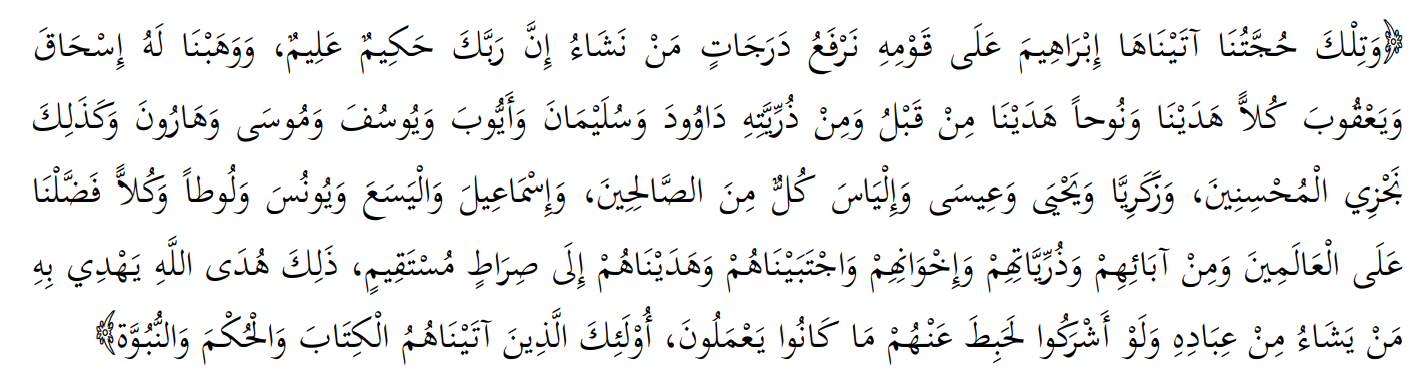
Und dies ist unser Beweis, den wir Abraham gegen sein Volk gaben: Wir erheben in Rängen, wen Wir wollen. Gewiss, dein Herr ist weise und wissend. Und Wir gaben ihm Ishaq und Yaqub, und Wir wiesen sie alle auf den rechten Weg, und Nuh wiesen Wir schon zuvor den Weg; und aus seiner Nachkommenschaft Dawud und Sulaiman und Ayyub und Yusuf und Musa und Harun. So belohnen Wir die Rechtschaffenen. Und Zakariyya, Yahya, Isa und Ilyas. Sie alle gehören zu den Auserwählten. Und Ismail und Al-Yasa, Yunus und Lut; und jeden Einzelnen von ihnen bevorzugten Wir vor den Menschen seiner Zeit. Und auch einige ihrer Väter und ihrer Nachkommen und einige ihrer Brüder; Wir erwählten sie und leiteten sie auf den geraden Weg. Das ist die Rechtleitung Allahs; Er leitet damit, wen Er will von Seinen Dienern. Und hätten sie Götzendienst betrieben, wäre gewiss alles, was sie getan hatten, nichtig geworden. Diese sind es, denen Wir das Buch, die Anordnung und das Prophetentum gaben. [TMQ An’ām: 83-89]
"And this is our argument that we gave to Abraham against his people, we raise in degrees whom we please, undoubtedly, your lord is wise, knowing. And we gave him Ishaq and Yaqub, we showed the path to all of them and showed the path to Nuh before them, and of his progeny, to Daud and Sulaiman and Ayub and Yusuf and musa and Haroon, and thus we recompense the righteous. And to Zakaria, Yahya, Isa and Ilyas. These are all entitled to be our near ones. And to Ismail and Yasa and Yunus and lot, and to each one we preferred above all in his time. And also to some of their fathers and their progeny and some of their brothers, and we chose them and showed them the straight path. This is the guidance of Allah. He gives whom he will of his bondmen, and if they would have committed polytheism, then surely all that they had already done would have been destroyed. These are they to whom we gave the book and order and prophet hood" [TMQ An’ām: 83-89]
„Und Ismael, Idris und Dhul-Kifl – sie alle gehörten zu den Geduldigen, die Wir in Unsere Barmherzigkeit aufnahmen. Gewiss, sie gehören zu den Rechtschaffenen." [TMQ Anbiya: 85-86]
"And Ismail and Idrees and Dhul-Kifl all were from the patient ones who we took into our mercy. Indeed they are from the righteous." [TMQ Anbiya: 85-86]
Und nach Madyan entsandten Wir ihren Bruder Schuʿaib. [TMQ Araf: 85]
"And to Madyan, we sent their brother Shu'aib." [TMQ Araf: 85]
„Und zu den Thamud entsandten Wir ihren Bruder Salih." [TMQ Araf: 73]
"And to Thamud, we sent their brother Salih." [TMQ Araf: 73]
Und zu den Ad sandten Wir ihren Bruder Hud. [TMQ Araf:65]
"And to A'ad, we sent their brother Hud." [TMQ Araf:65]
Und Wir sagten: „O Adam, wohne du und deine Frau im Paradies." [TMQ Baqarah: 35]
"And we said, o Adam dwell you and your wife in paradise." [TMQ Baqarah: 35]
Muhammad ist der Gesandte Allahs ﷺ. Diejenigen, die mit ihm sind, sind hart gegenüber den Kuffar und barmherzig untereinander. [TMQ Fath: 29]
"Muhammad is the messenger of Allah. Those with him are severe on the Kuffar and merciful between themselves." [TMQ Fath: 29]
Alle Propheten und Gesandten waren Übermittler von Allah, denn dies ist die Bedeutung von Prophetentum und Gesandtschaft. Sie sind wahrhaftig, Mahner für die Schöpfung, damit die Sendung und die Botschaft nicht vergeblich werden, und sie sind unfehlbar, was Lüge und Irrtum bei der Verkündigung betrifft, ebenso wie sie unfehlbar sind, jede Sünde zu begehen. Ferner gibt es weder im Qur'an noch in der Sunna des Propheten ﷺ einen eindeutigen [qat'i] textlichen Beleg, der über das Irren der Propheten nach ihrem Prophetentum und Gesandtentum berichtet. Was überliefert wurde, stammt entweder aus Ahadith, deren Überlieferung ungewiss ist [dhanni ath-thubut], oder aus Versen, deren Beweiskraft ungewiss ist [dhanni ad-dalala], und das Ungewisse [dhanni] kann den eindeutigen rationalen Beweis für die Unfehlbarkeit nicht außer Kraft setzen. Was den Qur'an über Adam offenbart, dass er von dem Baum gegessen habe, von dem Allah ihm zu essen untersagt hatte, widerspricht nicht der Forderung nach Unfehlbarkeit bei der Verkündigung der Botschaft an die Menschen auf der Erde, denn was sich bei Adam ereignete, geschah im Paradies, dessen Weisheit allein Allah bekannt ist. Daher ist dies eine gesonderte Angelegenheit (d. h. Adams Essen von der Frucht des Baumes), denn die Unfehlbarkeit bezieht sich auf die Verkündigung der Botschaft an die Menschen auf der Erde.
All the prophets and messengers were informers from Allah because this is the meaning of prophethood and messengerhood. They are truthful, admonishers to creation lest the mission and message become futile and they are infallible from lying and error in their propagation, just as they are infallible from committing any sin. Further there is no definite [Qati] textual evidence in the Qur’ān or the Sunnah of the prophet informing about the erring of the prophets after their Prophethood of Messengership. Whatever has been reported is either in the ahadith that are indefinite in their transmission [dhanni athuboot] or in the ayat that are indefinite in their evidence [dhanni ad-dalala] and the Indefinite [dhanni] cannot over ride the definite rational evidence on infallibility. As for what was revealed regarding Adam in the Qur’ān about him eating from the tree which Allah had prohibited him to eat from, this does not contradict the requirement of infallibility in the propogation of the message to the people on the earth because what happened from Adam was in the Paradise, the wisdom of which is only known to Allah . Therefore this is separate matter (i.e Adam’s eating of the fruit of the tree) because infallibility is related to the propogation of the message to the people on the earth.