Sie taten dies, und nachdem sie viele Abschriften angefertigt hatten, gab ʿUthmān die Originalhandschriften an Ḥafṣa zurück. ʿUthmān ließ je eine Abschrift von dem, was sie als Abschriften erstellt hatten, in jede muslimische Provinz senden und befahl, alle übrigen Qurʾān-Materialien, ob in fragmentarischen Handschriften oder in vollständigen Exemplaren, zu verbrennen. Die Zahl der angefertigten Abschriften betrug sieben. Die sieben Muṣḥafs wurden nach Makkah, al-Shām, Jemen, Bahrain, Basra und Kufa gesandt, und ein Exemplar wurde in Madinah aufbewahrt.
They did so, and when they had written many copies, 'Uthman returned the original manuscripts to Hafsa . 'Uthman sent one copy of what they have copies to every Muslim province, and ordered that all the other Qur’ānic materials, whether written in fragmentary manuscripts or whole copies, be burnt. The number of copies made was seven. The seven mushaf’s were sent to Makkah, al-Sham, Yemen, Bahrain, Basra, Kufah, and one copy was kept in Madinah.
Daher bestand die Tat 'Uthmāns nicht in der Sammlung des Qur'ān, sondern lediglich im Abschreiben und Niederschreiben des Gleichen, das vom Gesandten Allahs ﷺ überliefert worden war, so wie es war. Er tat nichts anderes, als sieben Abschriften von dem bewahrten Exemplar anzufertigen, das sich im Besitz Ḥafṣas, der Mutter der Gläubigen, befand, und die Menschen auf dieser einen Schrift zu vereinen, und er untersagte jede andere Schrift oder Diktierweise außer dieser. Die Angelegenheit wurde auf diesem Exemplar als Schrift und Diktierweise entschieden. Es ist dieselbe Schrift und Diktierweise, in der die Blätter niedergeschrieben wurden, in Anwesenheit des Gesandten Allahs ﷺ, als die Offenbarung herabgesandt wurde. Und es ist dasselbe Exemplar, das Abū Bakr ﷺ hatte sammeln lassen. Danach begannen die Muslime, Abschriften von diesem Exemplar anzufertigen und nicht von einem anderen. Es blieb nichts außer dem Muṣḥaf 'Uthmāns in seiner Schrift übrig. Als die Drucker aufkamen, wurde der Muṣḥaf von diesem Exemplar mit derselben Schrift und Diktierweise gedruckt.
Therefore, 'Uthman's action was not the compilation of the Qur’ān rather it constituted in only the copying and transcription of the same thing transcribed from the Messenger of Allah as it was. He did not do anything other than make seven copies from the preserved copy in the possession of Hafsa , the mother of the Believers and unite the people on this single script and forbade any other script or dictation other than it. The matter was settled on this copy as a script and dictation. It is the same script and dictation in which the sheets were written as was written in the presence of Allah's Messenger when the revelation was revealed. And it is the same copy which Abu Bakr had compiled. Then the Muslims began to make copies from this copy and not any other copy. Nothing remained except the mushaf of 'Uthman in its script. When printers came about, the mushaf was printed from this copy with the same script and dictation.
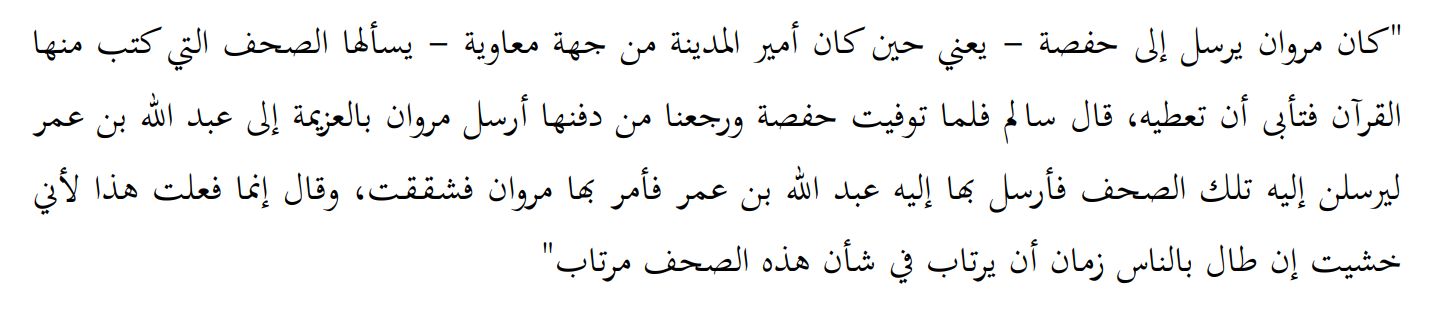
Der Unterschied zwischen der Sammlung Abu Bakrs und jener 'Uthmans besteht darin, dass die Sammlung Abu Bakrs aus der Furcht heraus erfolgte, dass etwas vom Qur'an verloren gehen könnte, wenn einige seiner Träger (Auswendigkönner) verloren gingen, denn obwohl er auf Blättern geschrieben war, war er nicht an einem Ort wie ein einzelnes Buch gesammelt worden. So wurde er in Blättern gesammelt. Die Sammlung 'Uthmans erfolgte, weil die Unterschiede hinsichtlich bestimmter Aspekte des Qur'ans zunahmen, da manche ihn in ihren eigenen Mundarten rezitierten, was dazu führte, dass einige anderen vorwarfen, einen Fehler zu machen. Man befürchtete, die Angelegenheit könnte eskalieren, daher wurden jene Blätter in ein einziges Mushaf kopiert. Das Mushaf, das wir heute vor uns haben, ist dasselbe Mushaf, das dem Gesandten Allahs offenbart wurde, und es ist dasselbe, das in den Blättern niedergeschrieben wurde, die in Gegenwart des Gesandten Allahs ﷺ geschrieben wurden. Und es ist dasselbe Mushaf, das Abu Bakr zusammenstellte, als die Blätter an einem Ort gesammelt wurden. Und es ist dasselbe, von dem 'Uthman die sieben Abschriften anfertigen ließ und anordnete, dass der Rest verbrannt werde. Und es ist derselbe edle Qur'an in seiner Versanordnung im Verhältnis zueinander und in ihrer Anordnung in den jeweiligen Suren, in Schrift und Diktat. Was die Abschrift betrifft, die der Gesandte Allahs ﷺ aus der Offenbarung diktierte, deren Blätter gesammelt und dann kopiert wurden, so blieb sie im Besitz Hafsas, der Mutter der Gläubigen, geschützt, bis Marwan Wali (Statthalter) von Madinah wurde und sie zerriss, da sie als nicht mehr bedeutsam galt, weil Abschriften des Mushafs überall verbreitet waren. Ibn Shihab berichtete, dass Salim ibn 'Abd Allah ibn 'Umar ihn informierte:
The difference between the compilation of Abu Bakr and that of 'Uthman is that the compilation of Abu Bakr took place due to the fear that something would be lost from the Qur’ān if any of its carriers (memorisers) were lost, the reason being that even though it was written on sheets but it had not been collected in one place like a single book. Thus, it was compiled in pages. The compilation of 'Uthman took place because the differences increased regarding certain aspects of the Qur’ān which some read in their own dialects and this led some to accuse others of making an error. It was feared that the matter would escalate therefore those sheets were copied into one mushaf. The mushaf that we now have before us is the same mushaf revealed to the Messenger of Allah and it is the same one which was written in the sheets which were written in the presence of the Messenger of Allah . And it is the same mushaf that Abu Bakr brought together when the sheets were compiled in one place. And it is the same one from which 'Uthman transcribed the seven copies and ordered that the rest be burned. And it is the same Noble Qur’ān in its verse arrangement in relation to each other and their arrangment in their respectives Sura’s, script and dictation. As for the copy dictated by the Messenger of Allah from the revelation, whose sheets were compiled together and then copied it remained protected in the possession of Hafsa , the mother of the believers until Marwan became the Wali (governor) of Madinah and he tore it up since it was not considered important because copies of the mushaf had spread everywhere. Ibn Shihab narrated that Salim ibn 'Abd Allah ibn 'Umar informed him: