que él dijo que el versículo había sido revelado en relación con el Mensajero de Allah ﷺ cuando intentaba ganar para el Islam a su tío Abu Talib. Luego llegaron los Tabi'un, después de los Sahabah, quienes transmitieron todo lo que los Sahabah habían mencionado de esta manera. Entre los Tabi'un hubo quienes explicaron los versículos del Noble Corán o señalaron la causa de la revelación, ya fuera por su propio Ijtihad en el tafsir o por haberlo oído (de otras autoridades). Después de los Tabi'un llegaron los 'Ulama, que ampliaron el tafsir y citaron relatos de judíos y cristianos. Los mufassirun se sucedieron unos a otros en cada época y generación, explicando el Corán y ampliando el tafsir en cada era sobre lo que había llegado antes. Los mufassirun comenzaron a prestar atención a los versículos para deducir de ellos normas y a explicar sus escuelas de pensamiento en términos de libre albedrío (ikhtiyar) y predestinación (jabr). Y comenzaron a explicar versículos que probaban sus opiniones según sus inclinaciones en la legislación, la teología escolástica ('ilm al-Kalam), la retórica (balaagha), la morfología (sarf) y la gramática, etc. Lo que se aprecia al examinar los tafsires de las distintas épocas desde el tiempo de los Sahabah hasta nuestros días es que el tafsir del Corán en cada época estuvo influido por el movimiento intelectual de su tiempo; presentaba un cuadro que reflejaba las opiniones, teorías y escuelas de pensamiento de la época. Rara vez hubo tafsires libres de la influencia de las opiniones, los pensamientos y las normas de su tiempo.
that he said the verse had been revealed concerning the Messenger of Allah when he tried to win over his uncle Abu Talib to Islam. Then came the Tabi'un after the Sahabah who reported everything the Sahabah mentioned in this manner. From among the Tabi'un there were those who explained the verses of the Noble Qur’ān or stated the cause of revelation, either as their own Ijtihād in tafsīr or by hearing it from (other authorities). After the Tabi'un the 'Ulama came and expanded the tafsīr and quoted reports from the Jews and Christians. The mufassirun succeeded one after another in every age and generation, who explained the Qur’ān and expanded the tafsīr in each age on what had come before. The mufassirun began to give their attention to the verses to deduce rulings from them and explain their schools of thought in terms of freewill (ikhtiyar) and predestination (jabr). And they began to explain verses proving their opinions according to their inclinations in legislation, scholasticism ('ilm al-Kalam), rhetorics (balaagha), declension (sarf) and grammar etc. What is apparent from an examination of the tafaseers through the different ages since the time of the Sahabah until now is that the tafsīr of the Qur’ān in every age was influenced by the scholarly movement of the time, it presented a picture which reflected the views, theories and schools of thought of the time. Seldom were there tafsīrs that were free from the influence of opinions, thoughts and rules of the time.
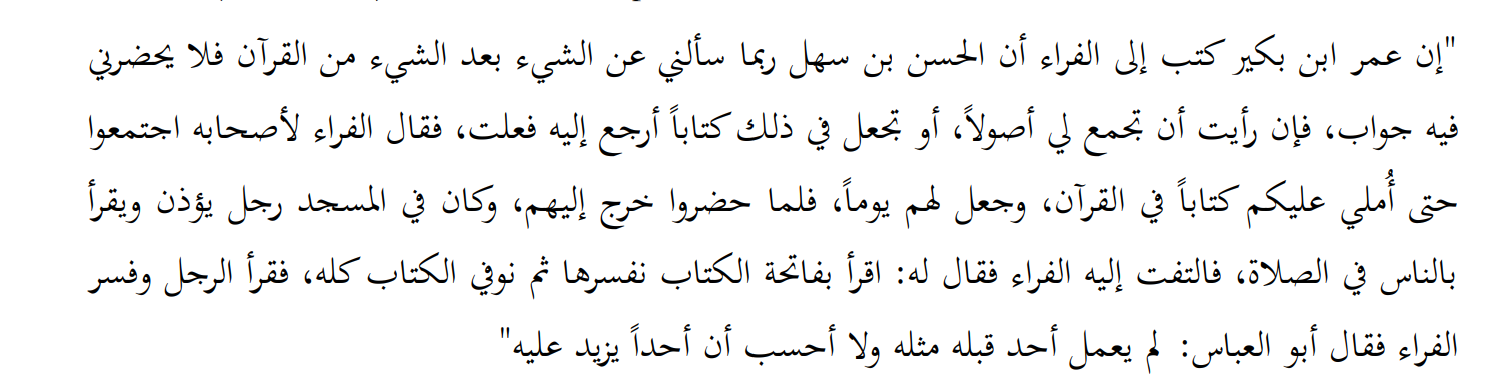
Sin embargo, no todos estos tafsīrs fueron compilados en libros desde el primer día en que surgieron los mufassirun, es decir, desde la época de los Sahabah. Más bien, fueron cambiando de una situación a otra a lo largo de las épocas. Al principio, el tafsīr formaba parte del ḥadīth y era uno de sus capítulos. El ḥadīth era el tema abarcador que englobaba todas las disciplinas islámicas. Así, el transmisor de un ḥadīth, del mismo modo que narraba un ḥadīth que contenía un dictamen legal, también narraba un ḥadīth que contenía el tafsīr de un aleya coránica. Luego, al comienzo de la época abasí y hacia el final de la época omeya, es decir, a comienzos del segundo siglo de la hégira, los autores empezaron a reunir bajo un mismo tema todos los ḥadīths semejantes y pertinentes, separándolos de otros temas. Así, disciplinas como el tafsīr y el fiqh, que el ḥadīth contenía, se separaron entre sí. Lo que resultó de las ciencias fue lo que resultó en cuanto al ḥadīth, la Sīrah, la jurisprudencia y el tafsīr. Así, surgió la ciencia del tafsīr, que llegó a ser una disciplina independiente y se estudiaba por sí misma. No obstante, los tafsīrs no adoptaron una forma organizada, en el sentido de que los versículos del Corán no se mencionaban de manera ordenada, como en la disposición del mushaf (Corán), seguidos de su tafsīr. Más bien, los tafsīrs narrados estaban dispersos aquí y allá. Eran tafsīr de versículos diversos, como ocurría con el ḥadīth. Esta situación continuó hasta que el tafsīr se separó del ḥadīth y empezó a erigirse como una ciencia en sí misma. Se escribió tafsīr para cada aleya del Corán o parte de una aleya, ordenando estos versículos según el orden del mushaf. El primero en emprender el tafsīr del Corán citando aleya tras aleya y explicándolas una tras otra fue al-Farrā' (m. 207 H.). Ibn al-Nadīm relata en su libro al-Fihrist que:
However, all of these tafsīrs were not compiled in books from the first day mufassirun came to exist i.e, from the time of the Sahabah. Rather, they changed from situation to situation through the ages. In the beginning, the tafsīr used to be a part of the hadīth and one of its chapters. The hadīth was the all-extensive topic which encompassed all the Islamic disciplines. So the transmitter of a hadīth just as he would narrate a hadīth containing a legal ruling he would also narrate a hadīth which contained the tafsīr of a Qur’ānic verse. Then writers, in the beginning of the Abbasid era and towards the end of the Umayyad era i.e, in the beginning of the second century hijri, began to bring together all the similar and relevant ahadīth under a topic and separate them from other topics. So the disciplines such as tafsīr and fiqh which the hadīth contains were separated from each other. What resulted from the sciences is what resulted in terms of hadīth, Sīrah, jurisprudence and tafsīr. Thus, the science of tafsīr came to exist and it became an independent science which was studied on its own. However, the tafsīrs did not take any organised form, in that verses of Qur’ān were not mentioned in an ordered manner like the arrangement found in the mushaf (Qur’ān) and then followed by their tafsīr. Rather the tafsīrs narrated were scattered here and there. They were tafsīr for miscellaneous verses as was the case with the hadīth. This situation continued until the tafsīr became separated from the hadīth and began to stand up as a science in its own right. Tafsīr was written for each ayah of the Qur’ān or part of an ayah, arranging these verses according to the order in mushaf. The first one to undertake the tafsīr of the Qur’ān quoting ayah after ayah and explain them one after another was al-Farra' (d.207 A.H.). Ibn al-Nadim reports in his book alFihirst that: