2.13 Los Profetas y Mensajeros
2.13 The Prophets And Messengers
«Nabí» (profeta) y «rasul» (mensajero) son dos términos contrastivos, pero comparten en que a ambos se les revela una sharí'a. La diferencia entre el mensajero y el profeta es que el primero recibe la inspiración de una Sharí'ah que se le ordena propagar, mientras que el segundo también recibe inspiración, pero se le ordena propagar la Sharí'ah de los mensajeros. Dicho de otro modo, el mensajero recibe la orden de propagar la Sharí'ah él mismo, mientras que el profeta propaga la Sharí'ah de los mensajeros.
‘Prophet’ (nabi) and ‘Messenger’ (rasul) are two contrastive terms but they share in the respect that a shari’a is revelaed to both of them. The difference between the Messenger and the prophet is that the former is inspired with a Sharī’ah which he is commanded to propagate, whereas the latter, i.e. the prophet is also inspired, but commanded to propagate the Sharī’ah of the messengers. In other words, the messenger is commanded to propagate the Sharī’ah himself, whilst the prophet propagates the Sharī’ah of the messengers.
Qadi al-Baydawi en su comentario sobre el dicho de Allah,
Qadi al-Baydawi in commentary of the saying of Allah ,
«Nunca enviamos antes de ti a ningún mensajero ni profeta sin que, cuando este formulaba un deseo, Satanás interfiriera en su deseo» [TMQ Al-Hayy: 52];
"Never did we send an apostle or a prophet before thee, but, when he framed a desire" [TMQ Hajj: 52];
Dice: «El mensajero es enviado por Allah con una Sharī'ah renovada o nueva a la que llama a las personas, mientras que el profeta es enviado por Allah para afirmar la Sharī'ah anterior». Así, Musa fue un profeta porque recibió una inspiración con una Sharī'ah, y un mensajero porque esta Sharī'ah era para su misión. Por otro lado, aunque Harún también fue un profeta porque recibió una inspiración con una Sharī'ah, no fue un mensajero, porque la Sharī'ah que le fue revelada no era para su misión, sino para la misión de Musa. De igual manera, Muhammad ﷺ fue un profeta y un mensajero porque recibió una inspiración con una Sharī'ah, la cual era para su misión.
Says, ‘The messenger is sent by Allah with a revived or new Sharī’ah which he calls people to, whereas the prophet is sent by Allah to affirm the former Sharī’ah.’ Thus, Musa was a prophet because he was inspired with a Sharī’ah and a messenger because this Sharī’ah was for his mission. On the other hand, although Aaron was also a prophet because he was inspired with a Sharī’ah, he was not a messenger because the Sharī’ah, which was revealed to him was not for his mission, rather it was for the mission of Musa . By the same token, Muhammad was a prophet and a messenger because he was inspired with a Sharī’ah, which was for his mission.
El mensaje es la mediación entre Allah y los siervos con el fin de explicar y aclarar el método para satisfacer las necesidades de este mundo y del más allá. La sabiduría exige el envío de mensajeros, pues ellos traen leyes y beneficios para las personas.
The message is the mediation between Allah and the slaves in order to explain and clarify the method of satisfying the needs of this world and the hereafter. Wisdom necessitates the sending of messengers as they bring laws and benefits for people.
Así, el envío de los Mensajeros ha tenido lugar efectivamente. Allah designó mensajeros de entre la humanidad y los envió como portadores de buenas nuevas del paraíso y de la recompensa para las personas de fe y obediencia. Fueron amonestadores del fuego del infierno y del castigo para las personas de incredulidad y desobediencia, y aclararon para el ser humano las necesidades y exigencias de este mundo y del más allá. Todo ello porque la mente es incapaz tanto de decidir lo bueno y lo malo como de comprender al ser humano mismo y sus asuntos.
Thus, the sending of Messengers has actually occurred. Allah appointed messengers from amongst mankind and sent them as bearers of glad tidings of paradise and reward to the people of belief and obedience. They were warners of the hell fire and punishment to people of disbelief and disobedience and they clarified the needs and requirements of this world and the hereafter for man. All because the mind is incapable of either deciding the good and bad or able to comprehend man himself and his affairs.
Adán desobedeció el mandato de su Señor, y lo que deseaba no alcanzó el camino hacia ello. Después, su Señor lo escogió, se volvió a él con Su misericordia y le mostró el camino hacia Su favorecida cercanía. [TMQ Tā Hā: 121-2]
"Adam slipped the commandment of his Lord then what he had desired, did not get the way to it. Thereafter his Lord chose him and turned to him with his mercy and showed him the way to his favoured nearness" [TMQ Tā Hā: 121-2]
El significado de «ijtiba» en este contexto es elegirle. El Corán también demuestra que Allah tanto ordenó como prohibió a Adán ciertas cosas. Por eso Allah dice,
The meaning of Ijtaba in this context means selecting him. The Quran also proves that Allah both commanded and prohibited Adam certain things. Hence Allah says,
{Y dijimos: ¡Oh Adán! Habita tú y tu esposa en el Paraíso, y comed de él en abundancia donde queráis, pero no os acerquéis a este árbol, pues seríais de los transgresores} [TMQ Baqarah: 35]
"And we said, O Adam, dwell you and your wife in paradise and eat freely thereof where you will, but do not approach this tree lest you become of the transgressors" [TMQ Baqarah: 35]
Esto demuestra categóricamente que no hubo otro profeta durante su tiempo. Por lo tanto, Adán fue profeta por revelación y nada más: un profeta al que se le inspiró una Sharī'ah, pues todo mandato [amr] o prohibición [nahi] es Sharī'ah. Así, puesto que recibió inspiración, es un profeta.
This categorically proves that there was no other prophet during his time. Therefore, Adam was a prophet by revelation and nothing else. A prophet who was inspired with a Sharī’ah, as every commandment [amr] or prohibition [nahi] is Sharī’ah. Thus since he received inspiration he is a prophet.
La segunda fuente es la Sunnah. Al-Tirmidhi relató de Abu Said al-Khudri que el Profeta ﷺ dijo:
The Second source is the Sunnah. Tirmidhi reported from Abu Said al-Khudri that the prophet said,
"Seré el líder de los hijos de Adán el día de la resurrección, pero no me jacto. Tendré en mi mano el estandarte de la alabanza, pero no me jacto; y ese día, todos los profetas, desde Adán, estarán bajo mi estandarte." ﷺ
"I will be the leader of the sons of Adam on the day of resurrection but I do not boast. I will have the banner of al-Hamd in my hand but I do not boast and on that day, all the prophets from Adam will be under my banner."
Por último, el consenso de los Sahaba también demuestra que Adam fue un profeta.
Lastly, the consensus of the Sahaba also proves that Adam was a prophet.
En cuanto a la profecía de Muhammad ﷺ, como él también afirmó ser profeta y trajo milagros, la profecía se conoce por narraciones mutawatir, que la confirman más allá de toda duda. En cuanto al milagro (es decir, el Corán), es la palabra de Allah (SWT), que desafió y retó a los elocuentes y grandes oradores de La Meca. No pudieron oponerse ni a la sura más corta del Corán, aunque se esforzaron por hacerlo. Entonces abandonaron sus métodos de oposición basados en la palabra y la retórica, aunque eran los lingüistas más destacados y venerados de su tiempo, y recurrieron a la fuerza y a la espada. Ni uno solo de los incrédulos kuffar relató jamás que alguien hubiera logrado producir algo semejante al Corán, a pesar de que tenían los medios para transmitir esa información si era necesario. Todo esto demuestra de manera categórica que el Corán, es decir, el milagro dado a Muhammad ﷺ, procede de Allah (SWT) y, sin lugar a dudas, verifica la veracidad de la afirmación del Profeta ﷺ.
As for the prophethood of Muhammad , as he also claimed prophethood and brought forth miracles, the prophethood is known by Mutawatir narrations, which substantiates it beyond any doubt. As for the miracle (i.e. the Qur’ān) it is the speech of Allah , which challenged and defied the eloquent and great speakers of Mecca. They were unable to oppose the shortest Sura of the Qur’ān, although they strived to do so. They then abandoned their styles of opposition from talk and rhetoric, even though they were the best and most revered linguists of their time, to force and the sword. Not even one of the disbelieving Kuffars ever related that someone was ever able to produce anything similar to the Qur’ān, despite the fact that they had the means to relate this information if required. All this categorically proves that the Qur’ān, i.e. the miracle given to Muhammad is from Allah and without any doubt verifies the true claim of the prophet .
El número de profetas y mensajeros es desconocido porque Allah le informó a Su mensajero ﷺ.
The number of prophets and messengers are unknown because Allah informs his messenger,
"Ciertamente, enviamos mensajeros antes de ti; a algunos de ellos te los hemos mencionado, y a otros no te los hemos mencionado." [TMQ Ghafir:78]
"We have sent messengers before you, we have mentioned some of their stories to you, whilst we have not mentioned others." [TMQ Ghafir:78]
Aunque el número ha sido mencionado en algunos Ahadith, dichos Ahadith son de la categoría Ahad. Por tanto, no tienen ningún valor en la ‘aqīdah (creencia); es decir, no forman parte de la ‘aqīdah. Suponiendo que el Hadith Ahad cumpliera todos los requisitos previos del Usul al-fiqh, solo conduciría a la conjetura, y la conjetura no puede aceptarse como parte de la creencia. Por lo tanto, el número se limita a los profetas y mensajeros mencionados en el Corán, porque eso es definitivo. Además, el número de profetas tampoco se menciona en el Hadith Mutawatir. En cuanto a los profetas mencionados en el Corán, Allah dice,
Although the number has been mentioned in some Ahadith, the Ahadith in question are of the Ahad category. Thus they do not have any value in ‘aqīdah (creed); i.e. they do not form part of the ‘aqīdah (creed). Assuming that the Ahad Hadith met all the pre-requisites of Usul-al-fiqh, it would only lead to conjecture, and conjecture can not be accepted as part of belief. Therefore the number is limited to the prophets and messengers mentioned in the Qur’ān because that is definite. Moreover, the number of prophets is neither mentioned in the Mutawatir Hadith. In respect to the prophets mentioned in the Qur’ān, Allah says,
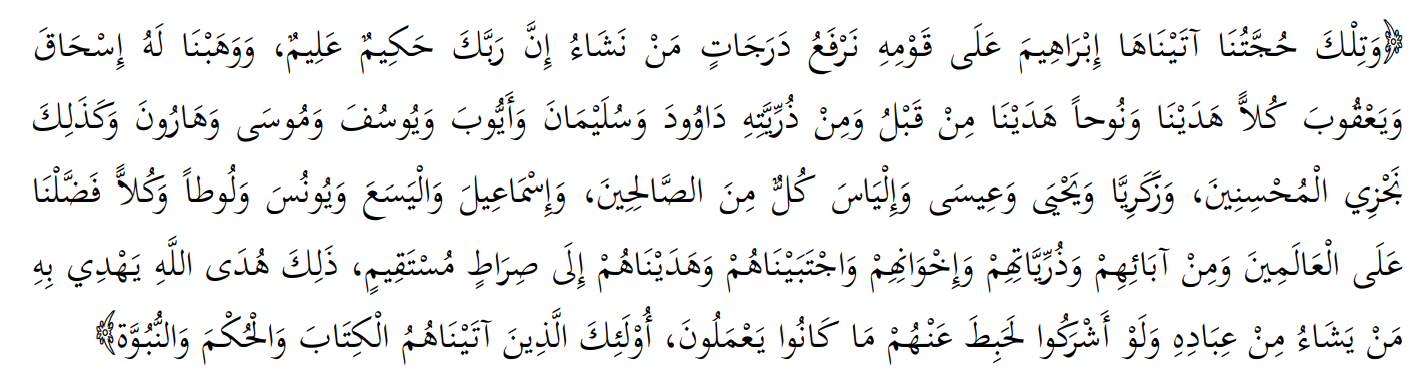
"Y este es nuestro argumento que dimos a Abraham contra su pueblo; elevamos en grados a quien queremos. Ciertamente, tu Señor es sabio y conocedor. Y le concedimos a Isaac y a Jacob; guiamos a todos ellos, y guiamos a Noé antes que ellos, y de su descendencia a David, Salomón, Job, José, Moisés y Aarón; así recompensamos a los que hacen el bien. Y a Zacarías, Juan, Jesús y Elías; todos ellos están entre los justos. Y a Ismael, Eliseo, Jonás y Lot, y a cada uno de ellos lo preferimos sobre los mundos en su tiempo. Y también a algunos de sus padres, de sus descendientes y de sus hermanos; los escogimos y los guiamos por el camino recto. Esta es la guía de Allah; guía con ella a quien Él quiere de Sus siervos. Y si hubieran asociado a otros con Allah, ciertamente se habría anulado todo lo que habían hecho. Estos son a quienes dimos el Libro, el mando y la profecía." [TMQ An’ām: 83-89]
"And this is our argument that we gave to Abraham against his people, we raise in degrees whom we please, undoubtedly, your lord is wise, knowing. And we gave him Ishaq and Yaqub, we showed the path to all of them and showed the path to Nuh before them, and of his progeny, to Daud and Sulaiman and Ayub and Yusuf and musa and Haroon, and thus we recompense the righteous. And to Zakaria, Yahya, Isa and Ilyas. These are all entitled to be our near ones. And to Ismail and Yasa and Yunus and lot, and to each one we preferred above all in his time. And also to some of their fathers and their progeny and some of their brothers, and we chose them and showed them the straight path. This is the guidance of Allah. He gives whom he will of his bondmen, and if they would have committed polytheism, then surely all that they had already done would have been destroyed. These are they to whom we gave the book and order and prophet hood" [TMQ An’ām: 83-89]
Y Ismaíl, Idrís y Dhul-Kifl, todos ellos estaban entre los pacientes a quienes admitimos en Nuestra misericordia. Ciertamente, ellos son de los justos. [TMQ Anbiya: 85-86]
"And Ismail and Idrees and Dhul-Kifl all were from the patient ones who we took into our mercy. Indeed they are from the righteous." [TMQ Anbiya: 85-86]
«Y a Madián enviamos a su hermano Shu'aib.» [TMQ Araf: 85]
"And to Madyan, we sent their brother Shu'aib." [TMQ Araf: 85]
"Y a Zamud enviamos a su hermano Salih." [TMQ Araf: 73]
"And to Thamud, we sent their brother Salih." [TMQ Araf: 73]
"Y a los 'Ad enviamos a su hermano Hud." [TMQ Araf:65]
"And to A'ad, we sent their brother Hud." [TMQ Araf:65]
Y dijimos: «¡Oh Adán! Habita tú y tu esposa en el Paraíso». [TMQ Baqarah: 35]
"And we said, o Adam dwell you and your wife in paradise." [TMQ Baqarah: 35]
Muhammad ﷺ es el Mensajero de Allah. Quienes están con él son severos con los incrédulos (kuffar) y misericordiosos entre sí. [TMQ Fath: 29]
"Muhammad is the messenger of Allah. Those with him are severe on the Kuffar and merciful between themselves." [TMQ Fath: 29]
Todos los profetas y mensajeros fueron informadores de parte de Allah, pues este es el significado de la profecía y de la mensajería. Son veraces, amonestadores para la creación, para que la misión y el mensaje no resulten vanos, y son infalibles en cuanto a la mentira y el error en su transmisión, del mismo modo que son infalibles frente a cometer cualquier pecado. Además, no existe en el Corán ni en la Sunnah del Profeta ﷺ ninguna evidencia textual definitiva [qati'] que informe sobre el extravío de los profetas después de su profecía y su mensajería. Todo lo que se ha transmitido se encuentra, o bien en los ahadiz cuya transmisión es incierta [dhanni al-zubut], o bien en los aleyas cuya evidencia es incierta [dhanni al-dalala], y lo incierto [dhanni] no puede prevalecer sobre la evidencia racional definitiva acerca de la infalibilidad. En cuanto a lo que fue revelado sobre Adán en el Corán, acerca de que comió del árbol que Allah le había prohibido comer, esto no contradice el requisito de la infalibilidad en la transmisión del mensaje a los hombres en la tierra, porque lo que ocurrió con Adán tuvo lugar en el Paraíso, cuya sabiduría solo Allah conoce. Por tanto, este es un asunto aparte (es decir, el hecho de que Adán comiera del fruto del árbol), pues la infalibilidad se relaciona con la transmisión del mensaje a las gentes en la tierra.
All the prophets and messengers were informers from Allah because this is the meaning of prophethood and messengerhood. They are truthful, admonishers to creation lest the mission and message become futile and they are infallible from lying and error in their propagation, just as they are infallible from committing any sin. Further there is no definite [Qati] textual evidence in the Qur’ān or the Sunnah of the prophet informing about the erring of the prophets after their Prophethood of Messengership. Whatever has been reported is either in the ahadith that are indefinite in their transmission [dhanni athuboot] or in the ayat that are indefinite in their evidence [dhanni ad-dalala] and the Indefinite [dhanni] cannot over ride the definite rational evidence on infallibility. As for what was revealed regarding Adam in the Qur’ān about him eating from the tree which Allah had prohibited him to eat from, this does not contradict the requirement of infallibility in the propogation of the message to the people on the earth because what happened from Adam was in the Paradise, the wisdom of which is only known to Allah . Therefore this is separate matter (i.e Adam’s eating of the fruit of the tree) because infallibility is related to the propogation of the message to the people on the earth.