21.6 Tratados de emergencia
21.6 Emergency Treaties
Los musulmanes pueden encontrarse en situaciones graves que los obligan a recurrir a asuntos que no están permitidos, pero la necesidad lo exige. El Estado Islámico puede caer en crisis internas o externas que lo obligan a suscribir tratados que no conducen directamente a transmitir la da'wah o a combatir en el camino de Allah (swt), pero que facilitan la creación de condiciones que permitirán transmitirla en el futuro, o que previenen el mal de detener la da'wah, o que preservan la entidad de los musulmanes. La necesidad obliga a suscribir este tipo de tratados; por tanto, es lícito para el Khalifah suscribirlos y son de obligado cumplimiento para los musulmanes. Estos tratados se dan en dos situaciones que los juristas (fuqaha) han establecido claramente, y son las siguientes:
Muslims can fall into severe situations which compel them to matters which are not allowed but the necessity obliges it. The Islamic State can fall into internal or external crises which compel it to contract treaties which do not lead directly to conveying the da’wah or fighting in the way of Allah (swt) but they facilitate creating conditions which will enable conveying it in the future or prevent the evil of stopping the da’wah or preserve the entity of the Muslims. Necessity compels these types of treaties to be contracted therefore it is allowed for the Khalifah to contract them and they are executed upon Muslims. These treaties occur in two situations which the jurisprudents (fuqaha) stated clearly, and they are:
La primera situación: Si algunas personas del pueblo de la guerra solicitan a los musulmanes un tratado por años específicos con la condición de que las personas de la guerra entreguen un kharaj cada año por una cantidad determinada y que no se les apliquen las normas islámicas en sus tierras; esto no se hace, pues equivale a consentir la incredulidad, a menos que el Estado no sea capaz de impedir la opresión y vea en este tratado un beneficio para los musulmanes; en ese caso, se permite concertarlo por necesidad. En esta situación no hay asistencia ni apoyo para ellos por parte del Estado Islámico, pues no están obligados por este tratado a cumplir las normas islámicas y no dejan de ser personas de la guerra cuando no obedecen las normas del Islam. Por tanto, no está obligado a los musulmanes asumir su apoyo. El Mensajero de Allah ﷺ hizo un tratado con Yuhanna bin Rub'ah mientras estaba en Tabuk, en los límites de Bilad ash-Sham. Lo dejó en su zona conservando su religión, y no entró bajo la bandera de los musulmanes y su gobierno. Este tratado de período limitado hace que la seguridad de este Estado quede garantizada por el Estado Islámico. Quien de los musulmanes entre en él, entra con la seguridad del tratado y no con una seguridad individual, y no le está permitido oponerse a sus habitantes. Quien de los ciudadanos de esta tierra entre en las tierras musulmanas, entra con la seguridad del tratado y no requiere una nueva seguridad distinta del tratado, ni se permite a nadie de los musulmanes oponérsele. No se impide a los comerciantes llevar mercancías a este Estado, salvo las herramientas empleadas en la guerra, como las armas y los materiales bélicos y lo similar a ello, pues son personas de la guerra aunque los musulmanes tengan un tratado con ellas.
The first situation: If some people of the people of war seek a treaty from the Muslims for specific years on condition that the people of war give kharaj every year for a specified amount and that the Islamic rules are not executed upon them in their lands; this is not done as it is consenting upon disbelief unless the State is not able to prevent oppression and sees in this treaty good for Muslims, then at this point it is allowed to contract it out of necessity. In this situation there is no assistance or support for them from the Islamic State because they are not compelled by this treaty with the Islamic rules and do not depart from being people of war when they do not obey the rules of Islam. So undertaking support for them is not obliged upon the Muslims. The Messenger of Allah (saw) made a treaty with Yuhanna bin Rub’ah while he was at Tabuk in the boundaries of Bilad AsSham. He left him in his zone upon his religion, and he did not enter under the banner of Muslims and their rule. This treaty of limited period makes the security of this State guaranteed by the Islamic State. Whoever enters it from the Muslims enters it with the security of the treaty and not an individual security, and it is not allowed for him to oppose its people. Whoever enters the Muslim lands from the citizens of this land enters with the security of the treaty and does not require a new security other than the treaty, nor is anyone from the Muslims allowed to oppose him. Traders are not prevented from carrying merchandise to this State except tools used in war like weapons and war materials and what is similar to this because they are people of war even if the Muslims have a treaty with them.
La segunda situación: Esta es lo opuesto a la primera situación, en la que los musulmanes pagan dinero a su enemigo a cambio de su silencio respecto a ellos. Los fuqaha mencionaron que si el enemigo sitia a los musulmanes y exige un tratado por años específicos con la condición de que los musulmanes paguen a los incrédulos una cantidad determinada cada año, no es correcto que el Khalifah acceda a ello debido a la indignidad y humillación que supone para los musulmanes, salvo en caso de necesidad. Esto ocurre cuando los musulmanes temen su propio exterminio y el Khalifah considera que hay beneficio en esta tregua. En ese punto, no hay daño en ello, debido a lo que fue narrado.
The second situation: This is opposite to the first situation wherein the Muslims pay money to their enemy in return for their silence regarding them. The fuqaha mentioned that if the enemy sieges the Muslims and require a treaty for specified years on condition that the Muslims pay the disbelievers a specific amount every year, it is not correct for the Khalifah to comply to them upon that due to the contemptibility and humiliation therein for Muslims except under necessity. This is (when) the Muslims fear extermination for themselves, and the Khalifah views there is good in this truce. At this point, there is no harm in that due to what was narrated
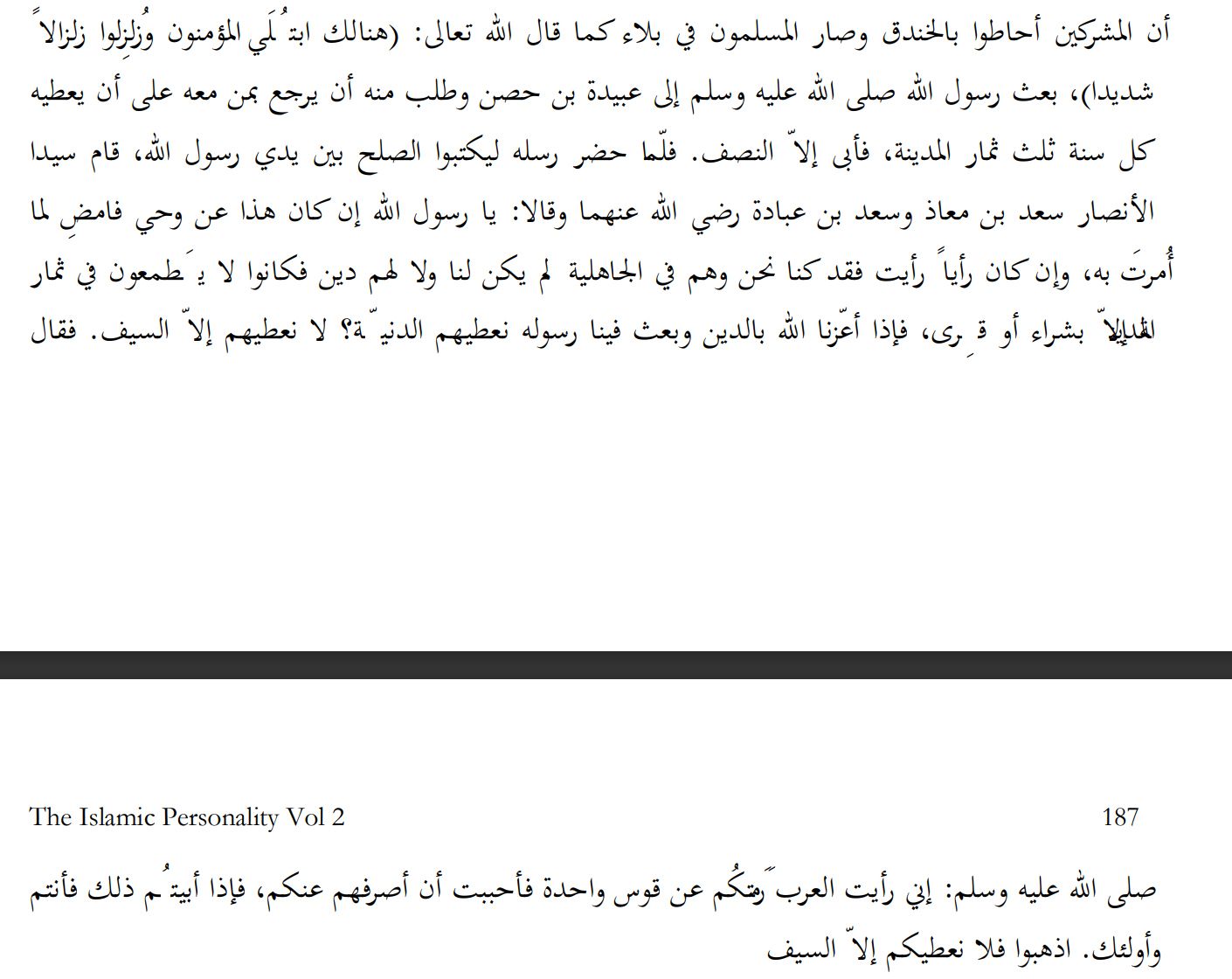
"Que los politeístas rodearon la trinchera y los musulmanes estuvieron en prueba, como dijo Allah (swt): ‘Allí los creyentes fueron puestos a prueba y sacudidos con una sacudida severa’ [TMQ 33:11]. El Mensajero de Allah ﷺ envió a ‘Uyaynah bin Hasan y le pidió que se retirara junto con quienes estaban con él, a cambio de darle un tercio de los frutos de Madinah, pero él se negó salvo a cambiar por la mitad. Cuando sus mensajeros se presentaron para redactar la tregua delante del Mensajero de Allah ﷺ, los dos jefes de los Ansar, S'aad bin ‘Ubadah y S'aad bin Mu’adh (ra), se levantaron y dijeron: ‘¡Oh Mensajero de Allah!, si esto es de la revelación, ejecuta lo que se te ha ordenado; pero si es una opinión que has considerado, entonces ellos y nosotros estábamos en la yahiliyyah, cuando ni ellos ni nosotros teníamos aún una religión, y no comían de los frutos de Madinah sino mediante compra o por hospitalidad. Entonces, cuando Allah nos honró con el deen y envió a Su Mensajero entre nosotros, ¿debemos darles este dunya siendo nosotros despreciables? No, no les daremos nada sino la espada’. Entonces dijo el Profeta ﷺ: ‘Vi a los árabes lanzando flechas desde un mismo arco, por eso quise apartarlos de vosotros. Si rechazáis eso, entonces ustedes y ellos. ¡Marchaos, pues no os daremos sino la espada!’"
“That the polytheists surrounded the trench and Muslims were in trial like Allah (swt) said: ‘Therein the believers were tested and shaken with a severe shaking’ [TMQ 33:11].The Messenger of Allah (saw) sent to ‘Uyaynah bin Hasan and requested that he return with those together with him upon giving him a third of the fruits of Madinah but he refused except a half. When his messengers appeared to write the truce in front of the Messenger of Allah, the two chiefs of the Ansar, S'aad bin ‘Ubadah and S'aad bin Mu’adh (ra) stood and they said: ‘O Messenger of Allah, if this is from revelation then execute what you are commanded with but if it is an opinion which you considered, then they and we were in jahiliyyah when neither they nor we had a religion yet they did not eat of the fruits of Madinah except through purchase or hospitality. So when Allah honoured us with the deen and sent His Messenger among us, should we give them this dunya while being contemptible? No, we will not give them except the sword. So he (saw) said: ‘I saw the Arabs shooting from one bow so I liked to divert them from you. If you reject that, then it is you and those. Go away for we will not give you except the sword!’”
Esto indica que el Mensajero de Allah ﷺ inicialmente se inclinó a la tregua debido a lo que percibió de la debilidad de los musulmanes. Cuando vio la fortaleza en ellos, gracias a lo que dijeron Sa'd bin 'Ubadah y Sa'd bin Mu'adh (que Allah esté complacido con ellos), se abstuvo de ello, lo cual indica que no hay daño en concertar un tratado con los incrédulos pagándoles dinero cuando existe peligro de daño. Esto se debe a que, si conquistaran a los musulmanes, se llevarían toda la riqueza y tomarían como cautivas (sabaya) a las familias, por lo que pagar parte de la riqueza para salvaguardar a los musulmanes, sus familias y su riqueza es menos denigrante y más beneficioso.
This indicates that the Messenger of Allah (saw) initially inclined to the truce due to what he sensed of the Muslims’ weakness. When he saw the strength in them due to what S'aad bin ‘Ubadah and S'aad bin Mu’adh (ra) said, he refrained from that which indicates that there is no harm from contracting a treaty with disbelievers paying them money when there is danger of harm. This is because if they conquered Muslims they would take all the wealth and the families as captives (sabaya), so paying some wealth to safeguard Muslims and their families and wealth is less contemptible and more beneficial.