18 El Estado islámico es un Estado humano y no un Estado teocrático.
18 The Islamic State Is A Human State And Not A Theocratic State.
El Estado Islámico es el Califato, ya que es el cargo en el que quien lo supervisa posee toda la competencia de gobierno y autoridad, y adopta todas las normas sin excepción. Es el liderazgo general sobre todos los musulmanes del mundo para aplicar todas las normas de la Sharía islámica, según los pensamientos con que vino y las normas que legisló, y para llevar la da'wah islámica al mundo, informándoles del Islam, llamándoles a él y a la yihad en el camino de Allah. También se le conoce como la Imamah y el liderazgo sobre los creyentes. Es un papel humano, no divino, que existe para aplicar la religión del Islam sobre los seres humanos y difundirla entre ellos. Ciertamente no es la profecía, pues la profecía y la mensajería se refieren al Profeta ﷺ o al Mensajero ﷺ que recibe la Sharía de Allah (SWT) por medio de la revelación para transmitirla a la gente, sin atender a su aplicación. Allah (SWT) dice:
The Islamic State is the Khilafah as it is the position in which the one who supervises it possesses all the competence of ruling and authority, and adopts all the rules without exception. It is the general leadership over all Muslims in the world to implement all the Islamic Shar’a rules, by the thoughts it came with and the rules it legislated, and to carry the Islamic da’wah to the world, by informing them of Islam, calling them to it and jihad in the way of Allah. It is also known as the Imamah and the leadership over the believers. It is a human role not a divine one, which exists to implement the deen of Islam over human beings and to spread it among them. It is definitely not the Prophethood as the Prophethood and Messengership conotates to the Prophet or the Messenger the Shar’a from Allah (saw) via the means of revelation to deliver it to the people without paying attention to his implementing it. Allah (swt) says:
"No hay sobre el Mensajero ﷺ más que la clara transmisión" [TMQ 24:54]
"There is nothing upon the Messenger except the clear conveyance " [TMQ 24:54]
Y:
And:
Ciertamente, a ti corresponde la transmisión (del mensaje). [TMQ 3:20]
"Verily it is upon you the conveyance " [TMQ 3:20]
Y:
And:
"No hay nada sobre el Mensajero salvo la transmisión clara" [TMQ 5:99].
"There is nothing upon the Messenger except the conveyance" [TMQ 5:99].
Esto es distinto del Califato, que es la aplicación de la Shari'a de Allah sobre los seres humanos. No es una condición para el Profeta (saw) o el Mensajero (saw) implementar lo que Allah (swt) le reveló para ser Mensajero; más bien, la condición para convertirse en Mensajero o Profeta es que Allah le revele una Shari'a y le ordene transmitirla. Musa (as), Isa (as) e Ibrahim (as) fueron Profetas y Mensajeros, aunque no implementaron la Shari'a con la que vinieron ni fueron gobernantes. Por tanto, el cargo de Profecía y Mensajería no es el cargo de Califato. La Profecía es un cargo divino que Allah otorga a quien Él quiere, mientras que el Califato es un cargo humano en el que los musulmanes designan a quien deseen de entre ellos para gobernarlos. Nuestro maestro Muhammad ﷺ fue un gobernante que implementó la Shari'a con la que vino, por lo que estaba a cargo de la Profecía y la Mensajería y, al mismo tiempo, a cargo del liderazgo de los musulmanes en el establecimiento de las normas islámicas. Allah (swt) le ordenó gobernar del mismo modo que le ordenó transmitir el mensaje, como Él le dijo:
This is different from the Khilafah which is the implementation of Allah’s Shar’a upon human beings. It is not a condition upon the Prophet (saw) or Messenger (saw) to implement what Allah (swt) revealed to him in order to be a Messenger, rather the condition to become a Messenger or Prophet is that Allah reveals a Shar’a to him and commands him to convey it. Musa (as), Isa (as) and Ibrahim (as) were Prophets and Messengers though they did not implement the Shariah they came with nor were they rulers. Therefore the post of Prophethood and Messengership is not the post of Khilafah. Prophethood is a divine post which Allah gives to whomever He wills, while the Khilafah is a human post in which the Muslims pledge whomever they wish over them from among the Muslims. Our master Muhammad (saw) was a ruler who implemented the Shari’ah he came with, so he would be in charge of the Prophethood and Messengership while at the same time he would be in charge of the post of leadership of the Muslims in establishing the Islamic rules. Allah (swt) commanded him to rule just like He commanded him to convey the message as He said to him:
"Gobierna entre ellos según lo que Allah ha revelado" [TMQ 5:47]
"Rule between them by what Allah revealed" [TMQ 5:47]
Y:
And:
Ciertamente, Nosotros te hemos revelado el Libro con la verdad, para que juzgues entre los hombres según lo que Allah te ha mostrado. ﷺ [TMQ 4:105]
"Verily we revealed the Book to you in Truth so that you rule between the people by what Allah showed you" [TMQ 4:105]
Tal como Él (SWT) le dijo:
Just like He (swt) said to him:
"¡Oh Mensajero! Transmite lo que te ha sido revelado por tu Señor" ﷺ [TMQ 5:67]
"O Messenger, convey what has been revealed to you from your Lord "[TMQ 5:67]
Y:
And:
"Este Corán me ha sido revelado para que os advierta a vosotros y a quienquiera que le llegue." [TMQ 6:19]
"This Qur’an has been revealed to me so that I warn you and whoever it is conveyed to" [TMQ 6:19]
Y:
And:
"¡Oh tú, que te has envuelto en la capa! Levántate y advierte" [TMQ 74:1].
"O you enshrouded in a cloak. Stand up and warn" [TMQ 74:1].
Excepto que, cuando él estaba encargado de transmitir el mensaje mediante la palabra, como al transmitir el dicho de Allah:
Except that when he was in charge of conveying the message by speech like conveying Allah’s saying:
Allah ha permitido el comercio y ha prohibido la riba" [TMQ 2:275]
Allah has permitted trade and forbidden riba" [TMQ 2:275]
o por una acción como el Tratado de Hudaybiyya, era decidido al transmitir y ordenaba con firmeza que se llevara a cabo la acción; tampoco consultaba, sino que rechazaba toda opinión si se le aconsejaba algo distinto de lo que traía la revelación. Y cuando se le preguntaba por una norma sobre la que aún no había descendido revelación, guardaba silencio y no respondía hasta que descendía la revelación. En cambio, cuando emprendía una acción, consultaba a la gente y actuaba según la opinión de los expertos o la opinión de la mayoría, aun cuando difiriera de su propia opinión; y cuando juzgaba entre las personas, no afirmaba con firmeza que lo que juzgaba se ajustaba a la realidad, sino que juzgaba según lo que oía de las pruebas. Cuando fue revelada la Surah Bara’ah, el Profeta ﷺ ordenó a Ali bin Abi Talib (ra) que fuera a encontrarse con Abu Bakr y le ordenó anunciar la inculpabilidad “Bara’ah” a la gente durante el período del Hajj. Así que se la leyó a ellos en Arafah y recorrió a la gente hasta haberla transmitido. Cuando firmó el Tratado de Hudaybiyya, rechazó la opinión de todos los Sahabah (ra) e impuso su opinión sobre ellos, pues era revelación de Allah (swt). Cuando Jabir le preguntó: “¿Cómo debo juzgar sobre mi riqueza?”, no le respondió hasta que descendió la revelación con la norma. Al-Bujari narró a través de bin al-Munkadir, quien dijo:
or by action like the Treaty of Hudaybiyya, he would be decisive in conveying and command decisively to undertake the action; nor would he consult but would rather reject all opinion if he was advised anything different from what the revelation came with. And when he was asked of a rule for which no revelation had descended yet, he would keep silent and not reply until the revelation descended. Whereas when he would undertake an action he would consult people and act according to the opinion of experts or the opinion of the majority even where it differed from his opinion, and when he would judge between people he would not be decisive saying that what he judged with conformed with the reality rather he was judging according to what he heard of the evidence. When Surah Bara’ah was revealed, he (saw) commanded Ali bin Abi Talib (ra) to go meet Abu Bakr and commanded him to announce inculpability “Bara’ah to the people during the Hajj period. So he read it to them Arafah and went around to the people until he had conveyed it. When he signed the Treaty of Hudaybiyya he rejected the opinion of all the Sahabah (ra) and compelled his opinion upon them as it was revelation from Allah (swt). When Jabir asked him: “How should I judge over my wealth?", He did not answer him until the revelation descended with the rule. Al-Bukhari narrated via bin al-Munkadir who said:
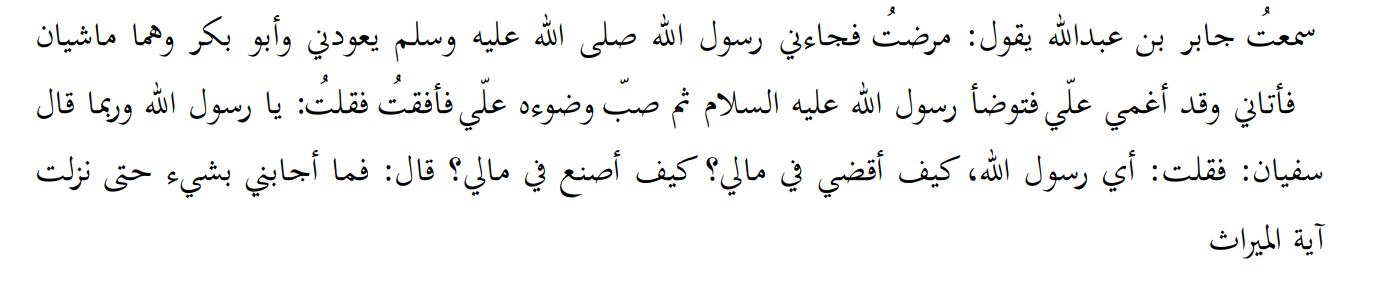
«Escuché a Jabir bin Abdullah decir: Estaba enfermo, así que el Mensajero de Allah ﷺ vino a visitarme junto con Abu Bakr, caminando. Me encontraron inconsciente. El Mensajero de Allah ﷺ hizo wudu y luego derramó agua sobre mí. Desperté y dije al Mensajero de Allah ﷺ: ¡Oh Mensajero de Allah, cómo debo disponer de mi riqueza? ¿Qué debo hacer con mi riqueza? Él no me respondió en absoluto hasta que fue revelado el aleya de la herencia.»
“I heard Jabir bin Abdullah saying: I was ill so the Messenger of Allah (saw) came to visit me together with Abu Bakr walking. They found me when I was unconscious. The Messenger of Allah (saw) made wudhu then poured some water upon me. I woke up and said to the Messenger of Allah (saw): O Messenger of Allah, how should I judge over my wealth? What should I do with my wealth? He said: He did not answer me at all until the ayah of inheritance was revealed.”
Esto se refería al cumplimiento de la carga de la profecía y la mensajería, y a la transmisión al pueblo; mientras que, al asumir la carga del gobierno, él actuaba de manera distinta. En Uhud reunió a los musulmanes en la mezquita y los consultó sobre si combatir dentro de Medina o fuera de ella; la opinión de la mayoría fue combatir fuera, mientras que la opinión del Mensajero ﷺ era combatir dentro. Actuó conforme a la opinión de la mayoría, salió y combatió fuera de Medina. Del mismo modo, cuando juzgaba entre las personas, las advertía de que no le hicieran juzgar en contra del derecho de otro. Al-Bujari narró de Umm Salama que el Mensajero de Allah ﷺ oyó una disputa a la puerta de su casa, así que salió hacia ellos y dijo:
This was in the undertaking of the burden of Prophethood and Messengership and conveying to the people, whereas in undertaking the burden of rule he would behave differently. In Uhud he collected the Muslims in the mosque, consulted over whether to fight inside Madinah or outside; the opinion of the majority was to fight outside while the Messenger’s opinion was to fight inside. He acted upon the majority opinion, left and fought outside Madinah. Similarly when he judged between people, he would warn them from causing him to judge for them against someone else’s due right. Al-Bukhari narrated from Umm Salamah about the Messenger of Allah (saw) that he heard a dispute at the door of his house so he went to them and said:
"Yo solo soy un ser humano, y acuden a mí litigantes con casos de disputa, y puede que alguno de vosotros sea más elocuente (al presentar su caso) que el otro, por lo que yo podría considerar que dice la verdad y dictar un fallo a su favor. Si alguna vez dicto un fallo a favor de alguien y, con ello, este toma injustamente el derecho de un musulmán, entonces lo que toma no es sino un trozo de Fuego, y depende de él tomarlo o dejarlo".ﷺ
“I am only a human being, and litigants with cases of dispute come to me, and someone of you may happen to be more eloquent (in presenting his case) than the other, whereby I may consider that he is truthful and pass a judgment in his favor. If ever I pass a judgment in favor of somebody whereby he takes a Muslim's right unjustly, then whatever he takes is nothing but a piece of Fire, and it is up to him to take or leave.”
De manera similar, transmitió de él que dijo ﷺ:
Similarly he narrated from him that he (saw) said:
«Ciertamente deseo encontrarme con Allah ‘azza wa jalla sin que nadie me reclame una injusticia que cometí contra él, ya sea en sangre o en dinero.»
“Verily I wish to meet Allah ‘azza wa jalla without anyone seeking from me an injustice I committed against him, whether in blood or money.”
Esto indica que él asumiría dos funciones: el cargo de Profeta y Mensajero, y el de dirigir a los musulmanes en este mundo en la implantación de la Shari'ah de Allah (swt), que le fue revelada. Actuaría en el desempeño de cada función según lo que esta requiriera, de modo que obraría de una manera en una y de otra en la otra. Tomó el juramento de lealtad de la gente en el gobierno, tomándolo tanto de las mujeres como de los hombres, pero no de los niños pequeños que aún no habían alcanzado la pubertad, lo cual subraya que era un juramento de gobierno y no de profetismo. De aquí se desprende que Allah (swt) nunca lo reprendió en nada relacionado con la transmisión del mensaje o con el cumplimiento de su carga, sino que le pidió que no se afligiera por la falta de respuesta de la gente, pues la carga del mensaje consistía únicamente en transmitirlo; por tanto, no tenía otro deber que el de transmitir. Allah (swt) dijo:
This goes to indicate that he would undertake two roles: the position of Prophethood and Messengership, and the position of leading the Muslims in this world in establishing the Shari’ah of Allah (swt) which was revealed to him. He would dispose in undertaking each role according to what it required, so he would conduct one differently from the other. He took the pledge of the people in ruling, taking it from both women and men but not from young children who had not yet reached puberty, which emphasises that it was a pledge upon ruling not upon Prophethood. From here we find we find that Allah (swt) never censured him in anything to do with conveying the message or undertaking its burden, rather he would request him not to be troubled due to people’s failure to respond to him as the undertaking of the burden of the message was conveying alone; so there was no duty upon him except to convey. Allah (swt) said:
"Que sus almas no se consuman en vano suspirando por ellos" [TMQ 35:8]
"Let not your souls go out in (vainly) sighing for them" [TMQ 35:8]
Y:
And:
"No te aflijas por lo que traman." [TMQ 16:27]
"Do not grieve over what they are plotting" [TMQ 16:27]
Y:
And:
"Lo único que se te exige es transmitir" [TMQ 42:48].
"The only (duty) upon you is conveying" [TMQ 42:48].
Sin embargo, Allah (swt) lo reprendió por haber asumido la carga del gobierno en las acciones que realizó al aplicar normas que le habían sido reveladas con anterioridad y ya transmitidas. Allah (swt) lo reprendió por hacer algo contrario a lo que era mejor. Allah (swt) dijo:
However Allah (swt) censured him over his undertaking of the burden of ruling in the actions he performed in implementing rules previously revealed to him and already conveyed. Allah (swt) censured him over doing something contrary to what was better. Allah (swt) said:
"No corresponde a un Profeta tener prisioneros de guerra hasta que haya realizado una gran matanza en la tierra." [TMQ 8:67]
"It is not for a Prophet to have captives of war until he made great slaughter in the world" [TMQ 8:67]
Y:
And:
"¡Allah te perdone! ¿Por qué les diste permiso?" [TMQ 9:43].
"Allah forgive you! Why did you grant them permission?" [TMQ 9:43].
Todo esto deja claro que el papel de los dirigentes musulmanes en el gobierno era distinto del papel de la Profecía. A partir de esto se aclara que el Califato, que es la dirección general sobre todos los musulmanes del mundo, es un cargo humano y no divino. Puesto que es un papel que el Mensajero ﷺ solía desempeñar, y lo dejó obligando a que un musulmán lo asumiera en su lugar, para que ocupe el lugar del Mensajero de Allah ﷺ y sea su Jalifa en el gobierno, pero no en la Profecía. Es un Jilafa del Mensajero ﷺ en la conducción de los musulmanes para aplicar las normas islámicas y transmitir el mensaje, no en la recepción de la revelación ni en la adopción de una Sharía de parte de Allah.
All this is clear that the role of leading Muslims in the rule was different from the role of Prophethood. From this it becomes clear that the Khilafah, which is the general leadership over all Muslims in the world, is a human post not a divine one. Since it is a role which the Messenger (saw) used to be in charge of and he left it while obliging that a Muslim should take it over for him so that he takes the place of the Messenger of Allah (saw) and be his Khalifah in ruling but not in Prophethood. It is a Khilafah to the Messenger in leading the Muslims to implement the Islamic rules and conveying the message not in receiving revelation or taking a Shari’ah from Allah.
En cuanto a la infalibilidad del Mensajero (saw), esta proviene de su condición de Profeta, no de su condición de gobernante. Esto se debe a que la infalibilidad es un atributo obligatorio para todos los Profetas y Mensajeros, independientemente de si ellos mismos gobernaron a los pueblos mediante su Sharia y la aplicaron, o si se limitaron únicamente a transmitirla sin gobernar con ella ni implementarla. Nuestro maestro Musa (as), nuestro maestro Isa (as) y nuestro maestro Ibrahim (as) fueron infalibles, al igual que nuestro maestro Muhammad (saw) lo fue, pues la infalibilidad corresponde a la Profecía y al Mensaje, no al gobierno. En cuanto a que él (saw) no cometiera ninguna acción haram durante el ejercicio de la carga de gobernar, ni dejara ninguna acción obligatoria, esto provino de su infalibilidad en relación con la Profecía y el Mensaje, no en relación con su condición de gobernante. Por tanto, su asunción del gobierno no requería que estuviera caracterizado por la infalibilidad, pero en la práctica fue infalible por ser Profeta y Mensajero. En consecuencia, asumió el gobierno en su descripción como ser humano que gobierna a seres humanos. El Corán ha venido afirmando explícitamente que él es un ser humano. Dijo Allah (swt):
As for the Messenger (saw)’s infallibility, it comes from his being a Prophet not from his being a ruler. This is because infallibility is an obligatory attribute for all Prophets and Messengers, irrespective of whether they themselves were the ones to rule over people by their Shari’ah and implement it or whether they were merely restricted to conveying it without ruling with it or implementing it. Our master Musa (as), our master Isa (as) and our master Ibrahim (as) were infallible just like our master Muhammad (saw) was infallible as the infallibility is for Prophethood and the Message not the rule. As for his (saw) not doing any haram action during his undertaking the burden of ruling nor leaving any obligatory action, this came from his being infallible in relation to Prophethood and the Message not in relation to his being a ruler. So his (saw) undertaking the rule did not require his being characterised with infallibility, but practically he was infallible due to his being a Prophet and Messenger. Accordingly, he would undertake the rule in his description as a human being ruling over human beings. The Qur’an has come explicitly stating that he is a human being. Allah (swt) said:
Di: «Yo no soy sino un ser humano como vosotros». [TMQ 18:110]
"Say: Verily I am only a human similar to you" [TMQ 18:110]
Entonces aclaró la distinción que le separa del resto de la humanidad (diciendo):
Then it clarified distinguishing him from the rest of humanity (by saying):
"Me ha sido revelado" [TMQ 6:50].
"It has been revealed to me" [TMQ 6:50].
La distinción respecto al resto de la humanidad es que él recibe revelación, es decir, en la Profecía. Aparte de eso, es un ser humano como el resto de la humanidad. Así pues, en lo relativo al gobierno es un ser humano como las demás personas, de modo que quien se convierta en Jalifa después de él sin duda será un ser humano como el resto de la gente, ya que es su Jalifa en el gobierno, no en la Profecía ni en el Mensaje. Por tanto, la infalibilidad no es una condición para ello, pues no es uno de los asuntos que requieren infalibilidad, la cual solo se requiere para la Profecía. Él es gobernante, nada más, de modo que no hay lugar para exigir infalibilidad a quienes están al cargo de ello. De hecho, no está permitido exigir infalibilidad a quien asume esa función, pues la infalibilidad está restringida a los Profetas y no es admisible para quienes no son Profetas, ya que su existencia en el Profeta y Mensajero ﷺ es necesaria para la transmisión. Es, pues, infalibilidad en la transmisión, y la adquisición de no cometer jamás un haram se deriva naturalmente de la infalibilidad en la transmisión, pues la infalibilidad en esta última no puede ser completa sin la infalibilidad respecto a cometer haram. Lo que requiere infalibilidad es la transmisión.
The distinction from the rest of humanity is that he is revealed to i.e. in the Prophethood. Apart from that he is a human like the rest of mankind. So he is in the rule a human like other people so whoever becomes Khalifah after him would doubtless be a human being like the rest of the people since he is his Khalifah in the rule not in Prophethood or the Message. Therefore infallibility is not a condition for it since it is not one of the matters which require infallibility which is only required for Prophethood. He is a ruler, nothing else, so there is no place for requiring infallibility for those who are in charge of it. In fact, it is not allowed to require infallibility for the one undertaking it as infallibility is restricted to Prophets and it is not allowed for other than Prophets as its existence for the Prophet and Messenger (saw) is required for conveyance. So it is infallibility in conveyance and its acquirement in never performing a haram naturally follows the infallibility in conveyance as the infallibility in the latter cannot be complete save with the infallibility from performing haram. The matter which requires it is the conveyance, The Islamic Personality Vol 2 95
No se trata de la creencia o incredulidad de la gente, ni del error en las acciones o de su ausencia; más bien, el asunto que lo requiere es la transmisión del mensaje, nada más. Esto se debe a que, si él no hubiera sido preservado de errores por Allah (swt), sería posible que ocultara el mensaje, añadiera o quitara algo de él, mintiera contra Allah diciendo lo que Él no había dicho, o se equivocara y transmitiera algo distinto de lo que se le había ordenado transmitir. Todo esto queda negado en un mensaje de Allah (swt) y queda negado en su condición de Mensajero que debe ser creído. Por tanto, es inevitable que el Mensajero sea caracterizado por la infalibilidad en la transmisión del mensaje, y la infalibilidad respecto a cometer lo prohibido (haram) se deriva naturalmente de ello. Debido a esto, los eruditos discreparon en cuanto a la infalibilidad de los Profetas respecto a cometer lo prohibido: algunos dijeron que están preservados únicamente de cometer los pecados mayores (kabāʾir), y que los pecados menores (ṣaghāʾir) son admisibles en ellos; mientras que otros dijeron que están preservados de cometer tanto los pecados mayores como los menores. Dijeron esto según si las acciones son consecuencia de la culminación de la transmisión o no. Si la consumación de la transmisión depende de ellas, entonces la infalibilidad en la transmisión las abarca, de modo que el Profeta resulta infalible respecto a ellas, pues la transmisión no se completa sin que él esté preservado de ellas. En cambio, si la culminación de la transmisión no depende de ellas, entonces la infalibilidad no las abarca, por lo que él no es infalible respecto a ellas, ya que la transmisión se cumple sin ellas. En consecuencia, no hay diferencia entre los musulmanes en que el Mensajero (saw) no es infalible al cometer acciones que son contrarias a lo que es mejor, pues la transmisión del mensaje no depende de ellas. Así, la infalibilidad es específica de la transmisión, y por ello no existe sino en los Profetas y Mensajeros, ni es posible en nadie más que en ellos.
En verdad, la evidencia de la infalibilidad es racional, no textual, pues no ha llegado ningún texto de la Shari'ah, ya sea un texto claro en el Corán o en el Hadiz, que establezca la existencia de la infalibilidad para nadie, ya sean los Profetas, los Mensajeros u otros. En cuanto al dicho de Allah:
Verily the evidence for infallibility is rational not textual as there has not come any Shari’ah texts, whether a clear text in the Qur’an or Hadith, upon the existence of infallibility for anyone whether the Prophets, the Messengers or others. As for Allah’s statement:
«Ciertamente, Allah solo quiere alejar de vosotros la impureza (rijs), oh gente de la casa, y purificaros por completo» [TMQ 33:33],
"Verily, Allah only intends to remove filth (rijs) from you, the family of the house, and purify you completely" [TMQ 33:33],
Su significado es que Él pretende apartar de ustedes toda duda y acusación. Este aleya es una parte de tres aleyas. Allah (SWT) dijo:
Its meaning is that He intends to remove from you any doubt and accusation. This ayah is a piece among three ayat. Allah (swt) said:
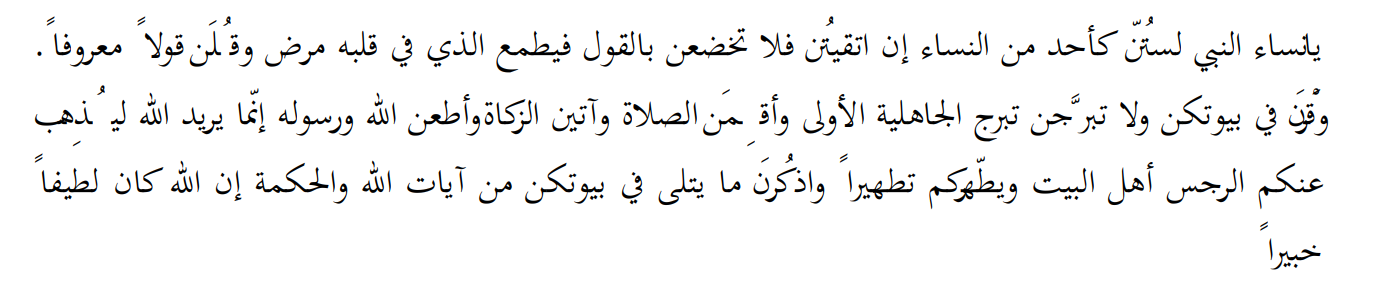
"Oh esposas del Profeta ﷺ, ustedes no son como cualquier otra mujer. Si temen (a Allah), entonces no sean complacientes en el habla, para que aquel en cuyo corazón hay una enfermedad no se sienta movido por el deseo, sino hablen un discurso justo. Y permanezcan tranquilas en sus casas y no hagan una exhibición deslumbrante como la de los tiempos antiguos de la ignorancia; establezcan la oración, den el zakat y obedezcan a Allah y a Su Mensajero. Ciertamente, Allah solo quiere alejar de ustedes la impureza, oh familia de la casa, y purificarlos por completo. Y recuerden lo que se recita en sus hogares de los signos de Allah y de la sabiduría. Ciertamente, Allah es Bondadoso, Conocedor de todo" [TMQ 33:32-34].
"O wives of the Prophet, you are not like any other woman. If you fear (Allah) then be not too complaisant of speech lest one in whose heart is a disease should be moved with desire but speak a speech (that is) just. And stay quietly in your houses and make not a dazzling display like that of the former times of ignorance, and establish prayer and give the zakat and obey Allah and His Messenger. Verily Allah only wishes to remove filth from you, O family of the house, and purify you completely. And remember what is recited in your homes of the signs of Allah and the Wisdom. Verily Allah is Courteous, All-Knowing" [TMQ 33:32-34].
No existe ninguna relación en absoluto entre este aleya y la infalibilidad. No es posible entender de Su declaración "para quitar de vosotros la impureza" que se refiera a hacerlos infalibles. Más bien, quitar la impureza es eliminar toda suciedad, y el sentido aquí es la impureza metafórica, es decir, la duda y la sospecha, como resulta explícitamente claro en las frases que preceden a esta frase en los dos aleyas. La purificación aquí es la limpieza de la duda y la sospecha, porque los significados de la palabra impureza son la impureza material, la impureza metafórica e incluso el castigo, tal como aparece en el Corán con estos significados. Dijo Allah (swt):
There is no relationship between this ayah and infallibility in any way whatsoever. It is not possible to understand from His statement “to remove filth from you” i.e. to make you infallible. Rather the removing of filth is the removing of all dirt and the meaning here is metaphorical filth i.e. doubt and suspicion as is explicitly clear in the sentences before this sentence in the two ayat. The purification here is cleansing from doubt and suspicion because the meaning(s) of the word filth is material filth, metaphorical filth and even punishment as it has come in the Qur’an with these meanings. Allah (swt) said:
Evitad la inmundicia de los ídolos [TMQ 22:30]
"Avoid the filth of the idols" [TMQ 22:30]
Y:
And:
Asimismo, Allah impone la impureza sobre quienes no creen [TMQ 6:125].
"Similarly does Allah ordain the filth upon those who do not believe" [TMQ 6:125].
En estos dos aleyas, la impureza es una impureza metafórica. Y Allah (SWT) dijo:
In these two ayat, filth is metaphorical filth. And Allah (swt) said:
o la carne de cerdo, pues en verdad es impureza [TMQ 22:30]
"Or the meat of pig for verily it is filth" [TMQ 22:30]
es decir, la impureza ritual, que significa suciedad física. Y Allah (SWT) dijo:
i.e. ritual impurity meaning physical filth. And Allah (swt) said:
Así, Alá impone la ira sobre quienes no creen [TMQ 6:125].
"Thus Allâh puts the wrath on those who believe not" [TMQ 6:125].
Así que Su declaración en el aleya "para quitar de vosotros la impureza" significa quitar la impureza metafórica, es decir, la sospecha. En cuanto a Su dicho: "y purificaros completamente", en verdad la palabra yutahirukum (purificaros) y la palabra purificación nunca vinieron con el significado de infalibilidad, ni en la lengua, ni en el Corán, ni en el Hadiz. En la lengua, purificar (tahara) algo, la purificación (tatheer), significa quitarle la impureza, y la mujer es pura (tahir) de la menstruación y (tahira) de la impureza y los defectos, y (tahara), en la Shar'a, es quitar el hadazz. El Profeta ﷺ dijo:
So His statement in the ayah “to remove the filth from you” means to remove metaphorical filth i.e. suspicion. As for His saying: “And purify you completely” verily the word yutahirukum (to purify you) and the word purification never came with the meaning of infallibility, neither in the language, Qur’an or the Hadith. In the language, to purify (tahara) something purification (tatheera) means to remove impurity from it, and the woman is pure (tahir) from menstruation and (tahira) from impurity and defects, and (tahara) in the Shar’a is removing the (hadath). He (saw) said:
«Allah no acepta la oración sin pureza (tuhur)»
“Allah does not accept prayer without purity (tuhur)”
Y así ha llegado en el Corán con este significado. Allah (SWT) dijo:
And it has come in the Qur’an with this meaning. Allah (swt) said:
«Y purifica tu vestimenta» [TMQ 74:4]
"And purify your garment" [TMQ 74:4]
Y:
And:
Agua para que os purifiquéis con ella [TMQ 8:11]
"Water so that you may be purified by it" [TMQ 8:11]
Y:
And:
No se acerquen a ellas hasta que se hayan purificado. [TMQ 2:222]
Do not approach them until they purify themselves [TMQ 2:222]
«Te escogió y te purificó» [TMQ 3:42
"Chose you and purified you" [TMQ 3:42
i.e. de las faltas y también:
i.e. from faults and also:
«Y si estáis en estado de impureza mayor (junub), purificaos.» [TMQ 5:6]
"And if you are (junub) then purify yourselves" [TMQ 5:6]
I.e. de la impureza. La purificación de los creyentes también llegó cuando Allah (SWT) dijo:
I.e from the impurity. The purification of the believers also came when Allah (swt) said:
"Allah no quiere imponerles ninguna dificultad (haraj), sino que quiere purificarlos y completar Su bendición sobre ustedes" [TMQ 5:6].
"Allah does not wish to make difficulty (haraj) for you but rather He wishes to purify you and complete His blessing upon you" [TMQ 5:6].
Todos estos textos especifican que el significado del aleya es que Allah (SWT) los purificó de la duda y la sospecha, y niegan que su significado sea la infalibilidad; por lo tanto, la aleya no indica infalibilidad.
All these texts specify that the meaning of the ayah is that Allah (swt) cleansed them from doubt and suspicion, and negates that its meaning is infallibility hence the ayah does not indicate infallibility.
Por lo tanto, no existe evidencia textual de la existencia de la infalibilidad para nadie; solo hay una prueba racional para ella. La mente es la que obliga a que exista infalibilidad en la transmisión para el Profeta y Mensajero, pues su condición de Profeta y Mensajero requiere que sea infalible; de lo contrario, no podría ser Profeta ni Mensajero. La mente es la que obliga a que quien no ha recibido la responsabilidad de transmitir un mensaje de Allah (swt) no pueda ser infalible, pues es un ser humano, y su naturaleza (fitra) con la que Allah (swt) lo creó es que en él ocurran el error y el olvido. Y mientras no se le haya encomendado la responsabilidad de un mensaje de Allah (swt), no hay nada que exija que sea infalible. Si se afirma que es infalible, entonces esto significa que tiene la responsabilidad de un mensaje de Allah, lo cual no está permitido, puesto que no hay profeta después de Muhammad ﷺ, el Mensajero de Allah. Allah (swt) dijo:
Therefore there is no textual evidence for the existence of infallibility for anyone; there is only rational proof for it. The mind is what compels that there be infallibility in conveyance for the Prophet and Messenger as his being a Prophet and Messenger requires that he be infallible otherwise he cannot be a Prophet or Messenger. The mind is the one which compels that one not given the responsibility to convey a message from Allah (swt) is not allowed to be infallible as he is a human being, and his nature (fitra) with which Allah (swt) created him is that error and forgetfulness occur in him. And as long as he is not given responsibility with a message from Allah (swt), this means there is nothing which requires that he be infallible. If it is claimed that he is infallible, then this means that he is responsible with a message from Allah which is not permitted since there is no Prophet after Muhammad, the Messenger of Allah (saw). Allah (swt) said:
«Pero él es el Mensajero de Allah y el sello de los Profetas» [TMQ 33:40].
" But he is the Messenger of Allah and seal of the Prophets" [TMQ 33:40].
Reclamar la infalibilidad equivale a reclamar la condición de Mensajero, pues el Mensajero es un transmisor de parte de Allah, y en él existe, por sus atributos como ser humano, la posibilidad del error y del extravío en la transmisión de Allah. Proteger el mensaje de Allah del error y de la alteración en su transmisión exige que el Mensajero sea infalible frente al error y al extravío. Por esta sola razón, la infalibilidad es un atributo del Mensajero, y solo él la requiere. Si se reclama para cualquier otro, siendo sabido que el único motivo que la exige es la transmisión del mensaje de Allah, entonces equivale a reclamar para esa otra persona aquello que exige la infalibilidad y su causa, es decir, la transmisión del mensaje. Así, se estaría afirmando que él es responsable de transmitir un mensaje de Allah (swt). Por tanto, no está permitido exigir la infalibilidad para el Califa, pues exigírsela significa que es responsable de transmitir un mensaje de Allah (swt), y con ello se le exigiría ser infalible, y esto no está permitido.
Claiming infallibility means claiming Messengership since the Messenger is a conveyor from Allah, and there is within him due to his attributes as a human being the potential of error and misguidance in conveying from Allah, protecting the message of Allah from error and change in the conveyance requires that the Messenger be infallible from error and misguidance. For this reason alone, infallibility is an attribute of the Messenger and it alone requires infallibility. If it is claimed for anyone other than him while being known that the only matter requiring it is conveying the message from Allah then it is equivalent to claiming for this other person what requires infallibility and its cause i.e. conveying the message. Thus it would be claiming that he is responsible to convey a message from Allah (swt). Therefore it is not allowed to require infallibility for the Khalifah as requiring it means that he is responsible to convey a message from Allah (swt) thus requiring him to be infallible, and this is not permitted.
Esto deja claro que el Jalifa es un ser humano que puede equivocarse o acertar, y que pueden ocurrir en él los descuidos y olvidos, la falsedad, la traición y los pecados que ocurren en cualquier ser humano, pues es un hombre y no un Profeta ni un Mensajero. El Mensajero de Allah ﷺ informó que es posible que el Imam yerre, e informó que puede ocurrir en él lo que puede hacer que la gente le odie y le maldiga por injusticia, pecados, etc. Incluso informó que puede ocurrir en él una incredulidad manifiesta. Muslim narró: Zuhayr bin Harb me relató que Shababa nos relató que Warqa me relató, de Abu Zayyad, de Al-'Araj, de Abu Hurayra, que el Profeta ﷺ dijo:
This makes it clear that the Khalifah is a human being who can make a mistake or be correct, and it is allowed to occur from him what occurs from any human being of neglect and forgetfulness, falsehood, treachery, sins as he is a human being and not a Prophet or Messenger. The Messenger (saw) informed that it is possible for the Imam to err, and he informed that it may occur from him what may cause people the hate him and curse him due to injustice, sins etc. He even informed that clear disbelief may occur from him. Muslim narrated: Zuhayr bin Harb related to me that Shababa related to us that Warqa related to me from Aby Zayyad from Al- ‘Araj from Abu Hurayray from the Prophet (saw) who said:
"Ciertamente el Imán es un escudo detrás del cual se combate y por medio del cual se es protegido. Si ordena con el temor (taqwa) de Allah ‘azza wa jalla y establece la justicia, entonces tendrá recompensa por ello. Y si ordena otra cosa distinta a eso, entonces recaerá sobre él la misma carga."
“Verily the Imam is a shield from behind whom they fight and by whom they are protected. If he commanded with the fear (taqwa) of Allah ‘azza wa jalla and does justice then there is reward for that for him. If he commands with other than that, then there is the same against him.”
Esto significa que el Imam no es infalible y que es posible que ordene algo distinto del temor a Allah. Muslim también narró: Uthman bin Abi Sheeba nos relató que Jareer nos relató de Al-‘Amash, de Zayd bin Wahhab, de Abdullah, quien dijo: El Mensajero de Allah ﷺ dijo:
This means that the Imam is not infallible and it is possible for him to command other than the fear of Allah. Muslim also narrated: Uthman bin Abi Sheeba related to us that Jareer related to us from Al-‘Amash from Zayd bin Wahhab from Abdullah who said: The Messenger of Allah (saw) said:
"Ciertamente, después de mí habrá preferencias injustas y asuntos que rechazaréis." Dijeron: "¡Oh Mensajero de Allah!, ¿qué nos ordenas si eso nos alcanza?" Dijo ﷺ: "Cumplid los derechos que os corresponden y pedid a Allah lo que es vuestro por derecho."
“Verily there will be after me some improper preferences and matters which you will reject. They said: O Messenger of Allah, what would you command anyone of us when that reaches him? He said: Fulfill the rights due from you and ask Allah (for) what is due to you.”
Muslim narró: Ishaq bin Ibrahim Al-Handhalee nos relató que Isa bin Yunus nos informó que Al-Awza'i nos relató de Zayd bin Yazid bin Jabir, de Zareeq bin Hayyan, de Muslim bin Qurta, de 'Awf bin Malik, de el Mensajero de Allah ﷺ, quien dijo:
Muslim narrated: Ishaq bin Ibrahim Al-Handhalee related to us that Isa bin Yunus informed us that Al-Awza’i related to us from Zayd bin Yazid bin Jabir from Zareeq bin Hayyan from Muslim bin Qurta from ‘Awf bin Malik from the Messenger of Allah (saw) who said:
"Los mejores de vuestros gobernantes son aquellos a quienes amáis y que os aman, que invocan las bendiciones de Dios sobre vosotros y vosotros invocáis Sus bendiciones sobre ellos. Y los peores de vuestros gobernantes son aquellos a quienes odiáis y que os odian, a quienes maldecís y que os maldicen." Se preguntó (por los presentes): "¿No deberíamos derrocarlos con la ayuda de la espada?" Él dijo: "No, mientras establezcan la oración entre vosotros. Si entonces encontráis algo detestable en ellos, debéis odiar su administración, pero no os apartéis de su obediencia."
“The best of your rulers are those whom you love and who love you, who invoke God's blessings upon you and you invoke His blessings upon them. And the worst of your rulers are those whom you hate and who hate you and whom you curse and who curse you. It was asked (by those present): Shouldn't we overthrow them with the help of the sword? He said: No, as long as they establish prayer among you. If you then find anything detestable in them. You should hate their administration, but do not withdraw yourselves from their obedience.”
Al-Bujari narró: «Ismail nos relató que Ibn Wahb me relató de Amru, de Bukayr, de Busr bin Said, de Junada bin Abu Umayya, quien dijo: Entramos a ver a ‘Ubada bin As-Samit, que estaba enfermo, y le dijimos: Que Allah te mejore. Relátanos un hadiz que hayas oído del Profeta ﷺ, con el que Allah te beneficie. Él dijo:
Al-Bukhari narrated: “Ismail related to us that Bin Wahhab related to me from Amru from Bukayr from Busr bin Said from Junada bin Abu Umayyah who said: We entered to ‘Ubadah bin As-Samit who was ill and we said: May Allah improve you. Relate to us a hadith which you heard from the Prophet by which Allah will help you. He said:
«El Profeta ﷺ nos llamó, y nosotros le hicimos un juramento de lealtad. Así que, entre lo que tomó de nosotros, nos hizo jurarle que escucharíamos y obedeceríamos en lo que nos agrada y en lo que nos desagrada, en la adversidad y en la facilidad, y cuando se nos prefiriera a otros, y que no disputaríamos la autoridad con quienes gobiernan. (Dijo): “A menos que veáis una incredulidad manifiesta (kufr bawah), respecto a la cual tengáis de Allah una prueba clara (sultan).”»
“The Prophet (saw) called us so we gave him a pledge. So he said in what we took from us that we pledged him to hear and obey in what attracts us and what we hate, in hardship and ease, and when others are preferred over us and that we do not dispute the rule with those in authority (He said): Unless you see clear disbelief (kufr bawah) upon which you have from Allah a clear proof (sultan).”
Y de Aisha, quien dijo: «El Mensajero de Allah ﷺ dijo:
And from Aisha who said: “The Messenger of Allah (saw) said:
"Evita, en la medida de lo posible, aplicar las penas legales a los musulmanes; si encuentra una salida para el acusado, déjalo seguir su camino, pues si el Imam se equivoca perdonando, sería mejor que equivocarse castigando."
" Avert the legal penalties from the Muslims as much as possible, if he has a way out then leave him to his way, for if the Imam makes a mistake in forgiving it would be better than making mistake in punishment.”
Tirmidhi narró este hadiz, que deja claro que el Imam puede equivocarse, olvidar y pecar. A pesar de ello, el Mensajero de Allah ﷺ ordenó seguir obedeciéndole mientras gobierne conforme al Islam, mientras no se haya producido de él una incredulidad manifiesta y no haya ordenado pecado. Tras la noticia del Mensajero de Allah ﷺ sobre los Julafaa, de que habrá algunos que los musulmanes desaprobarán, aun así ordenó la obediencia, ¿existe después de esto alguna posibilidad de afirmar que el Jalifa debe ser infalible y que no le está permitido lo que sí está permitido a los seres humanos? Esto forma parte de la realidad del Jalifa en relación con la ausencia de la condición de infalibilidad, e incluso con la ausencia de permiso para hacer de ella una condición. Sin embargo, quienes afirmaron que es necesario que el Jalifa sea infalible han presentado pruebas para su postura, por lo que debemos examinar y aclarar lo que contienen. Estas pruebas se resumen en cuatro argumentos.
Tirmidhi narrated this hadith which is clear that the Imam can err, forget and sin. Despite that, the Messenger (saw) commanded to continue obeying him as long as he rules by Islam and clear disbelief has not occurred from him and he has not commanded with sin. After the news of the Messenger (saw) about the Khulafaa that there will be some which the Muslims will dislike yet he commanded obedience, is there after that any possibility of saying that the Khalifah must be infallible and that it is not permitted from him what is permitted from human beings? This is from the reality of the Khalifah in relation to the absence of the condition of infallibility, rather even the absence of permission to even make it a condition. However, those who said it is required that the Khalifah be infallible have presented evidences for their view, so we must examine and clarify what is within them. These evidences are summarised in four evidences:
1. El Imam ocupa la posición del Mensajero de Allah ﷺ en la preservación de la Shari'ah, en su transmisión y enseñanza, en la supervisión de los asuntos de los ciudadanos, en el establecimiento de la justicia entre ellos, en la asistencia a los oprimidos, en la aplicación de los castigos islámicos obligatorios (hudud) y discrecionales (ta'zeer), y en la implementación del Islam conforme a la Shari'ah. Por tanto, es inevitable que sea infalible y esté libre de todo mal, grande o pequeño, ya sea cometido deliberadamente o por olvido, desde el inicio de su vida hasta el final.
1. The Imam stands in the position of the Messenger in preserving the Shari’ah , conveying and teaching it, supervising the citizens’ affairs, establishing justice among them, assisting the oppressed, establishing the mandatory Islamic punishments (hudood) and discretionary punishments (ta’zeer) and implementing Islam in the Shari’ah way. Therefore it is inevitable that he be infallible and pure from all evil, large or small, whether they occurred deliberately or through forgetfulness, from the beginning of his life to the end.
"Mi promesa no incluye a los opresores" [TMQ 2:124]
"My promise does not include the oppressors" [TMQ 2:124]
La declaración de Allah (swt) es una prueba de la obligación de un Imam infalible que es protector de la Shari'ah. Este aleya se encuentra en la Surat Al-Baqarah. Allah (swt) dijo:
The statement from Allah (swt) is an evidence upon the obligation of an infallible Imam who is a protector of Shari’ah. This ayah is in Surah Al-Baqarah. Allah (swt) said:
Y cuando Ibrahim fue puesto a prueba por su Señor con ciertas palabras, y él las cumplió, Él dijo: "Voy a hacer de ti un Imam para la gente". Dijo: "¿Y de mi descendencia?". Dijo: "Mi pacto no alcanzará a los opresores".
"And when Ibrahim was tested by his Lord with certain words which he fulfilled. He said: I will make you an Imam for the people. He said: And of my offspring? He said: My promise will not reach the oppressors" [TMQ 2:124].
Las palabras "making him" son aquellas que lo hacen un Imam, como da sentido el aleya que sigue a esta aleya. Cuando Ibrahim escuchó la declaración de Allah:
The words making him are those making him an Imam as the ayah coming after this ayah give sense to. When Ibrahim heard Allah’s statement:
«Ciertamente te haré un Imam para los pueblos» [TMQ 2:124]
"Verily I will make you an Imam for the people" [TMQ 2:124]
Y vio la grandeza de este honorable puesto; esperaba que sus descendientes tuvieran una parte de él. Entonces Allah (SWT) dijo:
And saw the greatness of this honourable post; he hoped that his descendants would have a share of it. So Allah (swt) said:
"Mi pacto no alcanza a los injustos" [TMQ 2:124].
"My promise does not reach the oppressors" [TMQ 2:124].
Su significado es que este cargo no se le dará a alguien que esté manchado o que se haya visto envuelto en injusticia, lo cual es más general que si esta persona es injusta con su propia alma o con otra persona, aunque sea solo por un breve tiempo en su vida. Más bien, se otorga a quien no comete ninguna injusticia en su vida.
Its meaning is that this post will not be given to someone who is blemished or will become stained with injustice, which is more general than whether this one is unjust to his own soul or someone else even if only for a short time in his life. Rather it is given to someone who does not do any injustice in his life.
b) Allah (SWT) dijo:
b) Allah (swt) said:
«¿Quien guía hacia la Verdad es más digno de ser seguido, o aquel que no guía a menos que sea guiado?» [TMQ 10:35].
"Is the one guided to the Truth of more right to be followed or the one who does not guide unless he is guided?" [TMQ 10:35].
Esta es una prueba de la obligación de la infalibilidad del Imam, ya que él guía a la verdad, y quien puede incurrir en error no guía hacia ella, aunque pueda suceder que alcance la verdad.
This is an evidence for the obligation of the infallibility of the Imam as he guides to the truth, and the one from whom an error is possible does not guide to it though it may happen that he achieves the truth.
c) Allah (SWT) dijo:
c) Allah (swt) said:
"Obedeced a Allah y obedeced al Mensajero ﷺ y a quienes ostentan autoridad entre vosotros" [TMQ 4:59].
"Obey Allah and obey the Messenger and those in authority among you" [TMQ 4:59].
Esta aleya es una evidencia de la infalibilidad de quienes tienen autoridad, es decir, de la infalibilidad del Imán, porque Allah (swt) ordenó la obediencia a quienes tienen autoridad de manera incondicional, sin especificar la obediencia para un caso concreto o un período determinado. Esto exige que la persona a quien se obedece sea infalible, pues una persona falible puede ordenar el pecado y el error. Si se hiciera obligatoria su obediencia en una situación en la que, sin embargo, está prohibida, se seguiría que el Señor, cuyo mandato es glorificado, habría ordenado combinar dos cosas opuestas o contradictorias, lo cual es imposible. Por tanto, la persona a quien se obedece debe ser infalible. Además, Allah (swt) vinculó la obediencia a quienes tienen autoridad con la obediencia al Mensajero (ﷺ), cuya obediencia está ligada a la obediencia a Él (swt), lo que requiere una posición de máxima excelencia. Quienes se mencionan aquí como detentadores de autoridad son los Imanes infalibles. Estas son las evidencias de quienes sostienen que es una condición que el Imán sea infalible. La respuesta a cada una de ellas se resume en lo siguiente:
This ayah is an evidence for the infallibility of those in authority i.e. infallibility of the Imam, because Allah (swt) commanded the obedience of those in authority in an unrestricted manner without specifying the obedience for a specific or period. This requires that the obeyed one is infallible as a fallible one can command with sin and error. If his obedience was obliged while this is (his) situation though it is forbidden, this obliges that the Lord whose matter is glorified has commanded to combine two opposites or contradictory matters which is impossible. The obeyed one must be infallible. Also, Allah (swt) linked obedience to those in authority with obedience to the Messenger (saw) whose obedience is linked to His (swt) obedience which requires exaltation. Those meant in authority here are the infallible Imams. These are the evidences of those who say that it is a condition that the Imam be infallible. The response to each one of this is summarised in the following:
Primero: El Khalifah ocupa el lugar del Mensajero en el gobierno al implementar la Shari'ah, no al transmitirla de Allah (swt); es su (saw) Khalifah en el gobierno, no en la transmisión de Allah (swt). Esto no exige que sea infalible, pues el cargo de gobierno no requiere infalibilidad, ni racionalmente ni por la Shari'ah. Es cierto que existen algunas cualidades requeridas para el Khalifah, que son: el Islam, ser varón, ser libre (no esclavo), la madurez (es decir, haber alcanzado la pubertad), la cordura, la rectitud y la capacidad. Cada una de estas cualidades ha sido exigida con base en las evidencias que la Shari'ah trajo. Sin embargo, exigir estas condiciones no significa que el Khalifah sea infalible frente a contradecirlas; más bien significa que quien ocupa este cargo está obligado a poseer estas cualidades cuando es designado, no que sea infalible frente a perderlas. Es posible que las pierda, en cuyo caso merece la destitución o abandona el Khilafah (es decir, deja de ser Khalifah). Exigir estas cualidades al Khalifah es como exigir justicia al testigo en relación con su descripción, para aceptar su testimonio; esto no significa exigirle ser infalible frente a contradecirla. Por lo tanto, que el Khalifah ocupe el lugar del Profeta ﷺ en el gobierno no es evidencia de que deba ser infalible. En cuanto a la transmisión de la Shari'ah por parte de los musulmanes, no es una transmisión de Allah (swt). Más bien, es cumplir con lo que Allah (swt) exigió a los musulmanes: llevar la da'wah a la humanidad, enseñarles los pensamientos del Islam y sus leyes, y nunca puede significar otra cosa. No es una transmisión de Allah (swt); es una de las responsabilidades con las que vino el Mensajero ﷺ, y no es como la transmisión del Mensajero ﷺ de Allah (swt). Por lo tanto, no exige infalibilidad; cumplirla es como cumplir las demás responsabilidades de la Shari'ah. No está obligado sobre el Califa en su calidad de Califa; más bien, es obligatorio para todo musulmán que conozca la Sharía. Al Califa se le ordena transmitir la Sharía en su calidad de musulmán; esto es en su calidad de erudito si lo es, ya que la transmisión es obligatoria para el musulmán conocedor de la Sharía en lo que sabe. La infalibilidad no es obligatoria para quienes transmiten, ni es una condición para ellos. En cuanto a llevar la da'wah islámica, que es obligatoria para el Califa en su calidad de Califa, esta le es obligatoria en su calidad de gobernante en cuyas manos está la autoridad. Le es obligatorio llevarla a cabo mediante un método específico, es decir, la yihad, lo cual no requiere infalibilidad. Más bien, no hay lugar para exigirla.
“Ciertamente habrá gobernantes sobre vosotros. Reconoceréis (algunas de sus acciones) y las desaprobaréis (algunas de sus acciones). Quien aborrezca (el munkar que proceda de ellos) estará libre de culpa, y quien lo rechace estará a salvo; pero quien se complazca y siga (no estará libre de culpa ni a salvo).” Preguntaron: “¡Oh Mensajero de Allah!, ¿no deberíamos combatirlos?” Él respondió: “No, mientras hagan la oración.”
“Verily there will be appointed rulers over you. You will recognise (some of what they do) and deny (some of what they do). Whoever dislikes (the munkar from them) will be guiltless, and whoever denies it will be safe; but whoever is pleased and follows (will not be guiltless or safe). They said: O Messenger of Allah, should we not fight them? He said: No, not as long as they prayed.”
A través de esto, la Shar'a aclaró el método para impedir que el Califa cometa pecados. No es mediante la existencia de un Imam que lo impida, sino que es la Ummah quien lo hace. Quien dice que el Califa necesita otro Califa que le impida cometer pecados no comprende qué significa gobernar y no tiene una visión clara de ello, pues el Califa no impide a otro Califa, sino que combate contra él por el poder, o le sigue, convirtiéndose entonces en gobernador o Wali y no en Califa, o lo combate por rebelión. Entonces, ¿cómo puede imaginarse que un Califa impida a otro Califa cometer pecados?
Through this the Shar’a clarified the method to prevent the Khalifah form committing sins. It is not via the existence of an Imam who prevents him but rather the Ummah does that. The one who says that the Khalifah requires another Khalifah to prevent him from committing sins does not understand what ruling means and he does not have a vision of it because the Khalifah does not prevent another Khalifah but rather he fights him over for the rule. Or he follows him, thereby becoming a governor or Wali not the Khalifah, or he fights him for rebellion. So how can one imagine that a Khalifah prevents another Khalifah from committing sins?
Tercero: La Imamah no es un cargo divino, sino humano. No existe para proteger la regla de la Sharia, sino para aplicar la Sharia que Allah (swt) reveló a nuestro maestro Muhammad ﷺ. En cuanto a la protección de la Sharia, en verdad Allah (swt) garantiza protegerla, pues Él (swt) garantiza proteger el Corán. Allah (swt) dijo:
Thirdly: The Imamah is not a divine post but a human one. It does not exist to protect the Shari’ah rule but rather to implement the Shari’ah which Allah (swt) revealed to our master Muhammad (saw). As for the protection of the Shari’ah, verily Allah (swt) guarantees to protect it when He (swt) guarantees to protect the Qur’an. Allah (swt) said:
«Ciertamente, Nosotros hemos hecho descender el Recuerdo, y Nosotros somos quienes lo custodiaremos» [TMQ 15:9].
"Verily We revealed the Remembrance and We will be its protector" [TMQ 15:9].
El objetivo de establecer al Khalifah no es que sea designado para proteger todo lo que el Profeta (saw) trajo, de modo que se diga que le es obligatorio conocer todas las normas y ser custodio de todas ellas. Más bien, el objetivo de establecerlo es implantar las normas del Libro y la Sunnah, es decir, aplicar el Islam y llevar su da'wah al mundo, lo cual no le exige conocer todas las normas ni protegerlas todas. Por tanto, no se requiere que sea infalible, y en consecuencia designarlo no contradice necesariamente el objetivo para el que fue designado. En cuanto a la confianza de la gente en él, de modo que tomen todas las normas de él como normas de Allah (swt) en realidad y sin ninguna duda que impida actuar conforme a ellas y seguirlas, esto no proviene de que el Khalifah sea infalible o falible. Más bien proviene de la evidencia de la propia norma: si es una evidencia de la Sharia y ha sido deducida mediante una deducción legislativa, la gente confiará en que esa norma es una norma de la Sharia, y ninguna duda entrará en ellos en esa situación que les impida actuar conforme a ella y seguirla, sin mirar quién es el Khalifah, aunque él mismo discrepe de la norma que ellos dedujeron. Esto se debe a que una diferencia de opinión en la deducción no hace que una norma sea legítima para un mujtahid e ilegítima para otro. Más bien, es una norma de la Sharia para todos los musulmanes mientras exista (incluso) una evidencia oscura (shubha daleel) de las evidencias de la Sharia ante quien deduce la norma, y sea posible, según los conocimientos lingüísticos y de la Sharia, deducir este tipo de deducción. En cuanto a que sea falible, por la posibilidad de que cometa pecado o error, lo que llevaría a la falta de confianza en él, y a que uno no tenga certeza de que lo que él dispone sea la ley de Allah (swt), la cuestión aquí es la de la norma y el gobernante, es decir, la norma por la que él gobierna y a la que llega, y el gobernante que gobierna y llega. La confianza que se busca no está en si el gobernante llega a la ley de Allah (swt) o si gobierna por ella o no. La consideración se centra únicamente en la norma por la que gobierna y que adopta en relación con ella, es decir, si es una ley islámica o no. No se refiere a la persona que la emite, ni a si es infalible o no. Lo que hace que la gente confíe plenamente en la norma, de modo que no entre duda en ella que les impida actuar o seguirla, es su consideración de la norma en sí misma, en cuanto a si es legítima o no. No depende de si el Jalifa del que toman la norma es infalible o no.
The objective in establishing the Khalifah is not that he is appointed to protect all that the Prophet (saw) came with such that it is said that it is obligatory for him to know all the rules and be a protector for all of them. Rather the objective in establishing him is to establish the rules of the Book and Sunnah i.e. to implement Islam and carry its da’wah to the world which does not require from him to know all the rules and protect all of them. Therefore it is not required for him to be infallible so accordingly appointing him does not neccesarily mean contradicting the objective for which he was appointed. As for the people’s trust in him such that they take all rules from him as the rules of Allah (swt) in reality without any doubt which prevents acting upon and following them, this does not come from the Khalifah being infallible or fallible. Rather it comes from the evidence of the rule itself; if it is a Shari’ah evidence and has been deduced by a Shari’ah deduction, the people will trust that this rule is a Shari’ah rule and no doubt will enter into them in this situation preventing them from acting upon and following it without looking to who the Khalifah is, even if he himself differs from the rule they deduced. This is because a difference of opinion in deduction does not make a rule legitimate before a mujtahid and illegitimate before another. Rather it is a Shari’ah rule before all Muslims as long as there is (even) obscure evidence (shubha daleel) from the Shari’ah evidence before the deducer of the rule and it is possible according to the linguistic and Shari’ah knowledge's that one can deduce this type of deduction. As for his being fallible due to the possibility of sin and error upon him leading to lack of trust in him, and that one is not definite that what he leads to is the law of Allah (swt), the issue here is one of the rule and the ruler i.e. the rule he rules by and arrives at and the ruler who rules and arrives at. The trust sought is not whether the ruler arrives at Allah’s (swt) law or whether he rules by it or not. The consideration is only in the rule which he rules by and adopts in relation to it being an Islamic law or not. It is not in relation to the person who gives it as to whether he is infallible or not. That which makes the people implicitly trust the rule so as to prevent doubt entering into it which would prevent them from acting upon or following it is their consideration of the rule itself as to whether it is legitimate or not. It does not depend on whether the Khalifah from whom they take the rule is infallible or not.
«Mi pacto no alcanza a los opresores» [TMQ 2:124],
"My promise does not cover the oppressors" [TMQ 2:124],
La palabra Imam en ese contexto no significa el Califato ni el gobierno. La palabra Imam aparece en el Glorioso Corán en muchos aleyas. Allah (SWT) dice:
The word Imam therein does not mean the Khilafah or the rule. The word Imam came in the Glorious Qur'an in many ayat. Allah (swt) said:
"Y antes de él, el libro de Musa (como) guía y misericordia" [TMQ 11:17]
"And before him the book of Musa (as an) Imam and mercy" [TMQ 11:17]
Y:
And:
«Y quienes dicen: "¡Señor nuestro! Concédenos de nuestras esposas y de nuestra descendencia el consuelo de nuestros ojos, y haznos guía de los piadosos"» [TMQ 25:74].
"And those who say: O our Lord, grant for us from our wives and our offspring the comfort of our eyes and make us Imams for the pious" [TMQ 25:74].
El significado de la palabra Imam en estos dos aleyas es el de guía. El Imam Al-Bujari dijo: «La declaración de Allah (SWT):
The meaning of the word Imam in these two ayat is a guide. Imam Al-Bukhari said: “The statement of Allah (swt):
«Y haznos guías para los piadosos» [TMQ 25:74].
"And make us Imams for the pious" [TMQ 25:74].
Dijo: «Líderes que siguen a los que vinieron antes que nosotros y son seguidos por los que vendrán después de nosotros». La palabra Imam en la expresión de Allah:
He said: Leaders who follow those before us and are followed by those after us.” The word Imam in Allah’s statement:
Y cuando Ibrahim fue probado por su Señor con ciertas palabras, y él las cumplió. Dijo: Te haré imam para la gente. Dijo: ¿Y de mi descendencia? Dijo: Mi pacto no alcanza a los opresores. [TMQ 2:124]
"And when Ibrahim was tested by his Lord with some words which he fulfilled. He said: I make you an Imam for the people. He said: And my descendants? He said: My promise does not cover the oppressors" [TMQ 2:124 ].
El significado aquí es la Profecía y el ejemplo, ya que los aleyas que siguen tratan sobre la Ka'bah, la gente de Ismael y luego la concesión de la Profecía a Ibrahim, de modo que el significado es: Te hicimos un Imam a quien la gente imita y un Profeta a quien la gente sigue. No es posible que la palabra Imam aquí signifique el Califato o el gobierno, especialmente porque Ibrahim nunca estuvo a cargo del gobierno ni fue gobernante, sino un Profeta y Mensajero. Así pues, Allah (SWT) le dijo que este cargo, que es el ejemplo y la Profecía, no es para los opresores, cuando Él le pidió que designara para sus descendientes lo que Él le había designado a él. Por tanto, no hay evidencia en el aleya de la infalibilidad del Califa. Además, el significado opuesto de la palabra opresores es confiables, no personas infalibles. Así pues, quienes no son opresores no significa que sean infalibles; más bien significa aquellos caracterizados por la ausencia de opresión, que es la justicia. En cuanto al segundo texto, que es el aleya:
The meaning here is Prophethood and example as the ayat which are after it discuss about the Ka’abah, the people of Ismail then the granting of Prophethood to Ibrahim so the meaning becomes: We made you an Imam whom the people imitate and a Prophet whom people follow. It is not possible that the word Imam here means the Khilafah or rule, especially since Ibrahim was never in charge of the rule nor was he a ruler but was a Prophet and Messenger. So Allah (swt) said to him that this post which is the example and Prophethood is not for oppressors when he requested from Him (swt) to ordain for his descendants what He ordained for him. So there is no evidence in the ayah for the infallibility of the Khalifah. Moreover, the opposite meaning for the word oppressors is trustworthy not infallible persons. So those who are not oppressors does not mean that they are infallible; rather it means those who are characterised with the absence of oppression which is justice. As for the second text which is the ayah:
«¿Acaso quien guía hacia la Verdad» [TMQ 10:35],
"Is the one guided to the Truth" [TMQ 10:35],
Su significado es, y Allah (swt) sabe mejor: ¿Es más digno de ser seguido quien guía hacia la verdad, es decir, el Mensajero (swt), o quien no encuentra el camino a menos que otro le guíe? Todo el tema es la guía y el seguimiento de quien guía, y no tiene relación alguna con el gobierno ni con el Califato. El Imán gobierna a la gente, y su deber es gobernar, no guiar; castiga a quienes se desvían y desobedecen, y combate a los incrédulos. La palabra guía no se usa aquí sino para el Mensajero ﷺ. El significado no se aplica al Califa, y no existe relación alguna entre este aleya y la infalibilidad del Califa. ¿Es el gobierno guía, o es la aplicación de la Sharia?
Its meaning and Allah (swt) knows best is: Is the one who is following the guidance i.e. the Messenger (swt) more worthy to be followed or the one who is misguided nor does he guide except if another guides him. The whole subject is guidance and following the guide, and it has no relationship with the rule or Khilafah. The Imam rules the people and his duty is ruling not guidance; he punishes the misguided and disobedient persons, and fights the disbelievers. The word guide is not used here except for the Messenger. The meaning does not apply upon the Khalifah, and there is no relationship between this ayah and Khalifah’s infallibility. Is the rule guidance or the implementation of the Shari’ah ?
Lo siento, no tengo el texto de "el tercer texto" ni la ayah a la que te refieres, ya que en esta conversación no aparece ningún contenido previo. Por favor, pega el texto en inglés que deseas traducir al español.
As for the third text which is the ayah:
"Obedeced a Allah y obedeced al Mensajero y a quienes tengan autoridad entre ustedes" [TMQ 4:59],
"Obey Allah and obey the Messenger and those in authority among you" [TMQ 4:59],
Es la orden de obedecer a quienes detentan la autoridad, y su vinculación con la obediencia a Allah (swt) y con la obediencia al Mensajero (ﷺ). Es evidencia de que su regla es como la regla de obedecerle a Él (swt) y de obedecer al Mensajero (ﷺ), y nada más. Se aplicó en la práctica de forma general dentro del aleya; sin embargo, está especificada por otros aleyas y numerosos hadices. Fue especificada por aquellos aleyas y hadices relacionados con la obediencia en lo que no es pecado y en lo que no es incredulidad; y no se detuvo ahí, sino que ordenó combatir al Imam. Los aleyas y hadices que la especifican son explícitos al respecto. Dijo Allah (swt):
It is the command to obey those in authority, and linking this with obedience to Allah (swt) and obedience to the Messenger (saw). It is evidence that its rule is like the rule of obeying Him (swt) and obeying the Messenger (saw), nothing else. It came in practice generally within the ayah; it is, however, specified by other ayat and numerous ahadith. It was specified by those ayat and ahadith related to obedience in other than sin and other than disbelief; and it did not stop there but rather commanded fighting the Imam. The specifying ayat and ahadith are explicit upon this. Allah (swt) said:
"No obedezcas a aquel cuyo corazón hemos hecho olvidar Nuestro recuerdo" [TMQ 18:28]
"Do not obey the one whose heart we have made forget our remembrance" [TMQ 18:28]
Y:
And:
No obedezcas a los incrédulos [TMQ 25:52]
"Do not obey the disbelievers" [TMQ 25:52]
Y:
And:
No obedezcas a los mentirosos [TMQ 68:8]
"Do not obey the liars" [TMQ 68:8]
Y:
And:
No obedezcas a todo aquel que jura en vano y es despreciable. [TMQ 68:10]
"Do not obey each despicable swearer" [TMQ 68:10]
Y:
And:
«No obedezcas entre ellos al pecador ni al incrédulo» [TMQ 76:24]
"Do not obey among them the sinful or the disbeliever" [TMQ 76:24]
El discurso dirigido al Mensajero (ﷺ) es un discurso dirigido a su Ummah, siempre que no haya llegado evidencia de que sea específico para él y de sus particularidades; aquí no ha llegado evidencia de que sea específico para él, por lo tanto es un discurso dirigido a su Ummah. Al-Bujari narró de Nafi', de Abdulláh (ra), de el Profeta (ﷺ), quien dijo:
The speech to the Messenger (saw) is the speech to his Ummah as long as there came no evidence that it is specific for him and among his specificities; no evidence came here that it is specific for him so it is a speech to his Ummah. Al-Bukhari narrated from Nafi’ from Abdullah (ra) from the Prophet (saw) who said:
«Escuchar y obedecer es obligatorio para el musulmán en lo que le agrada y en lo que le desagrada, excepto si se le ordena un pecado. Si se le ordena un pecado, no hay escucha ni obediencia.»
“To hear and to obey is obligatory upon the Muslim person in what he likes and dislikes except if he is commanded with a sin. If he is commanded with a sin, there is no hearing or obedience.”
Y él (ﷺ) dijo, en lo relativo a la obediencia a los califas y gobernantes, según lo narrado por Muslim:
And he (saw) said in the matter of obeying the Khalifahs and leaders according to what Muslim narrated:
Dijeron: ¿No deberíamos combatirlos? Él dijo: No, mientras oraran.
“They said: Should we not fight them? He said: Not as long as they prayed.”
También narró:
He also narrated:
Se dijo: ¡Oh Mensajero de Allah!, ¿no deberíamos enfrentarnos a ellos con la espada? Dijo: No, mientras establezcan la oración entre ustedes ﷺ. y: «…salvo si ven una incredulidad manifiesta».
“It was said: O Messenger of Allah, should we not confront them with the sword? He said: Not as long as they establish the prayer over you?” and: “…except if you see clear disbelief.”
Y Al-Bujari y Muslim narraron:
And Al-Bukhari and Muslim narrated:
«Quien aborrezca (entonces) queda libre de culpa, y quien rechace (entonces) está a salvo, pero quien siga (no queda libre de culpa ni está a salvo)» (Narrado por Muslim)
“Whoever dislikes (then he) is guiltless and whoever rejects (then he) is safe, but whoever follows (is neither guiltless nor safe)” (Reported by Muslim)
Estas aleyas y ahadices especifican la obediencia al Califa en todo lo que no sea pecado o incredulidad. Por tanto, no se sigue que el falible pueda ordenar el pecado y el error, de modo que, si su obediencia fuera obligatoria, esto implicaría necesariamente que Allah (SWT) ha ordenado la unión de dos cosas contradictorias, al ordenar la obediencia al Califa y prohibir los pecados. Esta afirmación no se sostiene, porque no existe tal unión de cosas contradictorias: Él ordena la obediencia en lo que no es pecado ni incredulidad, ordena la no obediencia en el pecado y la incredulidad, y ordena la prohibición de los pecados. Así pues, no hay contradicción en Sus mandatos (SWT) en este asunto. Esto aclara que esta aleya no es apta como prueba de la exigencia de la infalibilidad, de modo que tal deducción a partir de ella no es válida.
These ayat and ahadith specify the obedience to the Khalifah for other than sin or disbelief. Therefore the statement does not come that the fallible can command with sin and error such that if his obedience is obliged this would necessarily mean that Allah (swt) has commanded the joining between two contradictory matters by commanding obedience to the Khalifah and prohibiting sins. This statement does not come because there does not exist the joining between two contradictory matters as He commands obedience in other that sin and disbelief, commands with non-obedience in sin and disbelief, and commands the prohibition of sins. So there is no contradiction in His commands (swt) in this issue. This clarifies that this ayah is not suitable as evidence upon the requirement of infallibility so such deduction by it fails.
Estas son las pruebas de quienes afirman (la exigencia de) la infalibilidad. Cada una de ellas ha caído del rango de la deducción y no es apta como prueba. Por lo tanto, queda aclarado que no se exige del Jalifa que sea infalible; más bien, no está permitido implicar esto, y el Califato es un cargo humano, no divino. Así, el Estado Islámico es un Estado humano y no un Estado teocrático.
These are the evidences of those stating (the requirement) of infallibility. Each one of them has fallen from the rank of deduction and is not suitable as proof. Therefore from this it is clarified that it is not required from the Khalifah that he be infallible rather it is not allowed to entail this and that the Khilafah is a human post not a divine one. Thus the Islamic State is a human state and not a Theocratic state.