3.1 La compilación del Corán
3.1 The Compilation Of The Qur’ān
Se ha demostrado mediante pruebas decisivas y definitivas que, cuando el Profeta ﷺ falleció, todo el Corán había sido escrito en omoplatos (de animales), en palmas de dátil y en lukhaf (una piedra blanca, delgada y ancha). Todo ello se conservaba en los corazones de los Sahabah (que Allah esté complacido con ellos). Cuando se revelaba un aleya o aleyas, ordenaba que se escribieran de inmediato en su presencia. No impedía a los musulmanes escribir el Corán en otros materiales distintos de aquellos en los que dictaba a los escribas que anotaban la revelación. Muslim transmitió un hadiz de Abu Sa'id al-Judri en el que el Mensajero de Allah ﷺ dijo:
It has been proven by decisive and definite evidence that when the Prophet died the whole Qur’ān had been written on pieces of shoulder blades (of animals), palm risps and on lukhaf’s (a thin broad white stone). All of it was preserved in the hearts of the Sahabah (may Allah be pleased with them). When an ayah or ayāt would be revealed he would order that they be written down before him at once. He did not prevent the Muslims from writing the Qur’ān in other than what he used to dictate to the scribes who wrote down the revelation. Muslim reported a hadīth from Abu Sa'id al-Khudri that the Messenger of Allah said:
"No escriban nada de mí; quien haya escrito algo de lo que he dicho, aparte del Corán, que lo borre."
“Do not write down anything from me, whosoever writes anything I have said other than the Qur’ān let him erase it”
Lo que los escribas registraron de la revelación se reunió en hojas. Él dijo:
What the scribes wrote from the revelation was collected on sheets. He said:
Un Mensajero de Allah, que recita páginas purificadas (suhuf) (del Corán) [TMQ Bayyinah:2]
“A Messenger from Allah, reciting purified pages (suhuf) (of the Qur’ān)” [TMQ Bayyinah:2]
i.e., recitar hojas purificadas de falsedad, escritas a mano, verdaderamente auténticas y justas. Allah dijo:
i.e, reciting sheets purified from falsehood, honestly handwritten unequivocally true and just. Allah said:
"No, en verdad (los versículos del Corán) son una amonestación (tazkirah). Así que quien quiera, que preste atención a ella. (Está) en Registros custodiados con honor. Elevados en dignidad, purificados. En manos de escribas, nobles y obedientes." [TMQ ‘Abasa: 11-16]
“Nay, indeed it (verses of the Qur’ān) are an admonition (tazkirah). So whoever wills, let him pay attention to it. (It is) in Records held (greatly) in honour. Exalted (in dignity), purified. In the hands of scribes. Honourable and obedient” [TMQ ‘Abasa: 11-16]
Es decir, esta amonestación establecida en los registros es tenida (en gran estima) en honor ante Allah y exaltada en valor, libre de las manos de quienes son corruptos, y que han sido puestos por escrito por escribas temerosos de Dios. Él dejó todo lo que estaba escrito entre las dos tapas del mushaf, que había sido escrito ante él. 'Abd al-'Aziz b. Rufayya' narró:
i.e this admonition established in the records is held (highly) in honour with Allah and exalted in value, free from the hands of those that are corrupt and that they have been written down by God fearing scribes. He left everything that was written between the two covers of the mushaf which had been written down in front of him. 'Abd al-'Aziz b Rufayya' narrated:
«Shaddad bin Ma'qil y yo entramos a ver a Ibn 'Abbas. Shaddad bin Ma'qil le preguntó: "¿Dejó el Profeta ﷺ algo (además del Qur'ān)?" Él respondió: "No dejó nada excepto lo que hay entre las tapas (del Qur'ān)". Luego visitamos a Muhammad bin al-Hanafiyya y le hicimos la misma pregunta. Él respondió: "El Profeta ﷺ no dejó más que lo que hay entre las tapas (del Qur'ān)".
“Shaddad bin Ma'qil and I entered upon Ibn 'Abbas. Shaddad bin Ma'qil asked him, 'Did the Prophet leave anything (besides the Qur’ān)?' He replied. “He did not leave anything except what is between the bindings (of the Qur’ān).' Then we visited Muhammad bin al-Hanafiyya and asked him (the same question). He replied, 'The Prophet did not leave except what is between the bindings (of the Qur’ān)”
Se ha establecido un Ijma' (consenso) sobre el hecho de que todos los versículos del Corán, en sus respectivas suras (capítulos), fueron escritos directamente delante del Mensajero ﷺ en el momento en que la revelación le era descendida, y que fueron escritos en hojas (suhuf). El más grande de los Mensajeros ﷺ murió satisfecho con el Corán, su mayor milagro, que estableció la prueba para los árabes y para el mundo. No temió que los versículos del Corán se perdieran, porque Allah ha preservado el Corán con un texto explícito:
An Ijma' (consensus) has been established on the fact that all of the verses of the Qur’ān in their respective chapters (Sura’s) had been written down directly in front of the Messenger when the revelation was being revealed to him, and that they were written on sheets (suhuf). The greatest of the Messengers died content about the Qur’ān, his greatest miracle which established the proof for the Arabs and the world. He did not fear for the verses of the Qur’ān that they would be lost because Allah has preserved the Qur’ān with an explicit text:
«Ciertamente Nosotros: Somos Nosotros quienes hemos hecho descender el Dhikr (el Corán), y ciertamente Nosotros lo custodiaremos (de toda corrupción)». [TMQ Hijr: 9]
“Verily We: It is We who have sent down the Zikr (the Qur’ān) and surely, We will guard it (from corruption)” [TMQ Hijr: 9]
Porque estos versículos se conservaron de forma permanente gracias a que fueron puestos por escrito en vida del Profeta, y a que fueron preservados en los corazones de los Sahabah, y por el permiso concedido a los musulmanes para escribir el Qur’ān. Por esta razón, después de la muerte del Mensajero de Allah ﷺ, los Sahabah no sintieron la necesidad de recopilar el Qur’ān en un solo libro ni de ponerlo por escrito hasta que muchos de los Huffaz (memorizadores del Qur’ān) fueron muertos en las guerras de la Riddah. Debido a esto, 'Umar temió por la pérdida de las hojas (suhuf) y por la muerte de los Qurra' (quienes habían memorizado la totalidad del Qur’ān), lo que podría causar que algunos versículos se perdieran. Así que pensó en reunir las hojas escritas (en una sola compilación). Presentó su idea a Abu Bakr y así se llevó a cabo la compilación del Qur’ān. Se ha narrado por 'Ubayd ibn al-Sibaq que Zayd ibn Zaid al-Ansari dijo: Abu Bakr me mandó llamar después de las (grandes) bajas entre los guerreros de la batalla de Yamama (donde murió un gran número de Qurra'). 'Umar estaba presente con Abu Bakr, quien dijo: “'Umar vino a mí y me dijo: ‘Las personas han sufrido grandes bajas el día de la batalla de Yamama, y temo que haya más bajas entre los Qurra' (quienes saben el Qur’ān de memoria) en otros campos de batalla, por lo que una gran parte del Qur’ān podría perderse, a menos que lo recopiles. Y opino que deberías recopilar el Qur’ān’.” Abu Bakr añadió: “Le dije a 'Umar,
Because these verses had been preserved permanently via them being written down before him , and being preserved in the hearts of the Sahabah and by the permission granted to the Muslims to write down the Qur’ān. This is why after the death of the Messenger the Sahabah did not feel the need to compile the Qur’ān in one book or the need to write it down until many of the Huffaz (memorisers of the Qur’ān) had been killed in the Riddah wars. So due to this 'Umar feared for the loss of the sheets (suhuf) and the death of the Qurra' (Those who had committed the whole of the Qur’ān to memory), thereby causing some verses to be lost. So he thought about bringing the written sheets together (in one compilation). He presented his idea to Abu Bakr and so the compilation of the Qur’ān was performed. It has been narrated by 'Ubayd ibn al-Sibaq that Zayd b al-Thabit al-Ansari said: Abu Bakr sent for me after the (heavy) casualties among the warriors (of the battle) of Yamama (where a great number of Qurra' were killed). 'Umar was present with Abu Bakr who said, 'Umar has come to me and said, The people have suffered heavy casualties on the day of (the battle of) Yamama, and I am afraid that there will be more casualities among the Qurra' (those who know the Qur’ān by heart) at other battle-fields, whereby a large part of the Qur’ān may be lost, unless you collect it. And I am of the opinion that you should collect the Qur’ān.” Abu Bakr added, “I said to 'Umar ,
«¿Cómo puedes hacer algo que el Mensajero de Allah ﷺ no hizo?»
'How can you do something which Allah's Apostle did not do?'
"Umar dijo (a mí):
'Umar said (to me),
«Por Alá, realmente es algo bueno.»
'By Allah, it is (really) a good thing.'
Así que ‘Umar siguió intentando convencerme y persuadirme para que aceptara su propuesta, hasta que Allah me abrió el corazón a ella y tuve la misma opinión que ‘Umar». (Zayd b. al-Thabit añadió:) Umar estaba sentado con él (es decir, Abu Bakr) y no me hablaba. «Eres un joven sabio y no sospechamos de ti (de decir mentiras o de olvidadizo), y solías escribir la revelación (wahy) para el Mensajero de Allah ﷺ. Por tanto, busca el Corán y recógelo (en un solo manuscrito). Por Allah, si él (Abu Bakr) me hubiera ordenado mover una de las montañas de su lugar, no me habría resultado más difícil que lo que me ordenó sobre la recopilación del Corán». Les dije a ambos: «¿Cómo os atrevéis a hacer algo que el Profeta ﷺ no hizo?». Abu Bakr dijo: «Por Allah, es realmente algo bueno». Así que seguí discutiendo con él sobre ello, hasta que Allah me abrió el corazón para aquello que había abierto los corazones de Abu Bakr y de ‘Umar. Entonces comencé a localizar el material coránico y a recogerlo de los pergaminos, los omóplatos, los peciolos de las palmeras datileras y de las memorias de los hombres (que lo sabían de memoria). Encontré dos aleyas de la sura at-Tawba con Abu Juzayma, que no encontré con nadie más (y eran):
So ‘Umar kept on trying to convince me and persuade me to accept his proposal till Allah opened my heart for it and I had the same opinion as 'Umar.' (Zayd b al-Thabit added:) Umar was sitting with him (i.e Abu Bakr) and was not speaking to me). 'You are a wise young man and we do not suspect you (of telling lies or of forgetfulness): and you used to write the revelation (wahy) for Allah's Apostle . Therefore, look for the Qur’ān and collect it (in one manuscript). 'By Allah, if he (Abu Bakr) had ordered me to shift one of the mountains (from its place) it would not have been harder for me than what he had ordered me concerning the collection of the Qur’ān. I said to both of them, “How dare you do a thing which the Prophet has not done?' Abu Bakr said, 'By Allah, it is (really) a good thing So I kept on arguing with him about it till Allah opened my heart for that which He had opened the hearts of Abu Bakr and Umar . So I started locating the Qur’ānic material and collecting it from the parchments, scapula bones, leaf-stalks of date palms and from the memories of men (who knew it by heart). I found two Verses of Sura at-Tawba with Abu Khuzaima which I did not find with anybody else, (and they were):
«Ciertamente, ha llegado a vosotros un Mensajero de entre vosotros mismos. Le causa pesar que sufrais algún daño o dificultad» [TMQ Tawba: 128]
“Verily, there has come unto you a Messenger from amongst yourselves. It grieves him that you should receive any injury or difficulty” [TMQ Tawba: 128]
...hasta el final de la Sura Bara'ah. El manuscrito sobre el que se recopiló el Corán permaneció en poder de Abu Bakr hasta su fallecimiento, y luego en poder de 'Umar durante su vida, y finalmente permaneció con Hafsa bint 'Umar. La compilación de Zayd del Corán no consistió en lo que él había escrito a partir de los Huffaz (es decir, los memorizadores del Corán). Más bien, su compilación reunió lo que él mismo había escrito en presencia del Mensajero de Allah ﷺ. No colocaba una hoja junto a otra para compilarlas a menos que dos testigos dieran testimonio, por cada hoja que se le hubiera presentado, de que había sido escrita en presencia del Mensajero de Allah ﷺ. Además, no aceptaba una hoja a menos que cumpliera dos condiciones: primero, que estuviera presente en forma escrita con uno de los Sahabah; y segundo, que hubiera sido memorizada por uno de los Sahabah. Cuando las formas escrita y memorizada coincidían con la hoja que se pretendía compilar, la aceptaba; de lo contrario, no la aceptaba. Por ello se abstuvo de tomar el final de la sura al-Bara'ah hasta que lo encontró en forma escrita con Abu Juzayma, aunque Zayd mismo podía recordarlo. Se ha narrado a través de Yahya ibn 'Abd al-Rahman ibn Hatib que dijo:
until the end of Sura Bara'ah. The manuscript on which the Qur’ān was collected, remained with Abu Bakr till he passed away, and then with 'Umar during his lifetime, and finally it remained with Hafsa bint Umar . Zayd's compilation of the Qur’ān did not consist of what he wrote down from the Huffaz (i.e the memorisers of the Qu’ran). Rather his compilation brought together what he had written himself in front of the Messenger of Allah . He did not place one sheet/page with another sheet in order to compile them unless two witnesses testified, for every sheet that had been presented to him that it was written in the presence of the Messenger of Allah . Furthermore, he did not accept a sheet unless it met two conditions; firstly, that it was present in written form with one of the Sahabah. And second, that it had been memorised by one of the Sahabah. When the written and memorised forms concurred with the sheet that was intended to be compiled, he accepted it. Otherwise he did not accept it. This is why he refrained from taking the end of sura al-Bara'ah until he found it in written form with Abu Khuzayma even though Zayd could himself recall and remember it. It has been narrated via Yahya b 'abd al-Rahman ibn Hatib that he said:

"Umar (ra) se levantó y dijo: quien haya recibido algo del Corán del Mensajero de Allah ﷺ, que lo traiga. Solían escribirlo en hojas, tablillas y pencas de palmera. Ibn Hatib dijo: Él (Zayd) no aceptaba nada de nadie hasta que dos testigos hubieran dado testimonio de ello. Esto demuestra que Zayd no se conformaba con simplemente encontrar algo por escrito hasta que quien lo había recibido testificaba que lo había oído, a pesar de que Zayd ya lo tenía memorizado. Lo hacía debido a su extrema cautela".
“Umar (ra) stood up and said; whosoever has received anything of the Qur’ān from the Messenger of Allah , let him bring it forth. They used to write that on sheets, tablets and palm risps. Ibn Hatib said: He (Zayd) did not accept anything from anyone until two witnesses had given testimony to it. This shows that Zayd was not satisfied by merely finding something in written form until the one who received it testified that he had heard it despite the fact that Zayd had memorised it already. He used to do this due to his extreme caution”.
Así pues, el proceso de compilación no fue sino la reunión de hojas que ya habían sido escritas en presencia del Mensajero de Allah ﷺ en un solo libro entre dos cubiertas. El Corán solía escribirse en hojas, pero estas se guardaban por separado. Por ello, Abu Bakr las reunió en un solo lugar. Por eso, la orden de Abu Bakr de compilar el Corán no fue una orden de escribirlo en un solo mushaf, sino una orden de reunir en un mismo lugar las hojas que habían sido escritas en presencia del Mensajero ﷺ, y una orden de asegurarse de que estaban en la misma forma en que habían sido escritas, respaldándolo con los testimonios de dos testigos de que habían sido escritas delante del Mensajero de Allah ﷺ, de que estaban en posesión de los Compañeros en forma escrita y de que los habían memorizado. Estas hojas permanecieron conservadas en poder de Abu Bakr durante su vida, luego con 'Umar durante su vida, y después con Hafsa, hija de 'Umar, madre de los creyentes, de acuerdo con el legado de 'Umar. De todo ello se desprende que la compilación del Corán llevada a cabo por Abu Bakr constituyó únicamente la reunión de hojas que habían sido escritas en presencia del Mensajero de Allah ﷺ, y no fue una verdadera compilación del Corán. Y la memorización se refería a estas hojas, es decir, a los documentos que fueron escritos en presencia del Mensajero de Allah ﷺ, y no a la memorización del Corán. La reunión de tales piezas y su conservación no se hizo sino por precaución y empleando todos los esfuerzos en examinar la memorización de exactamente lo que había sido transmitido del Mensajero de Allah ﷺ. En cuanto al Corán en sí, este se conservaba en los corazones de los Compañeros y se memorizaba en su recuerdo. En la memorización se confió en una gran multitud de Compañeros, pues quienes lo memorizaban completa o parcialmente eran muchos.
Thus, the (process) of compilation was nothing other than the bringing together of sheets that had already been written in the presence of the Messenger of Allah into one book between two covers. The Qur’ān used to be written down on sheets but they were kept seperately. So Abu Bakr assembled them in one place. That is why Abu Bakr's order to compile the Qur’ān was not an order to write it down in one mushaf, rather it was an order to bring the sheets that had been written in the Messenger's presence together in one place and it was an order to make certain; that they are in the same form as they were by supporting it with the testimonies of two witnesses that they had been written in front of the Messenger of Allah and that they were in the possession of the Sahabah in written form and that they had memorised them. These sheets remained preserved in the possession of Abu Bakr during his life and then with 'Umar during his lifetime and them with Hafsa the daughter of 'Umar , the mother of the Believers in accordance with 'Umar's bequest. From this it becomes clear that Abu Bakr's compilation of the Qur’ān constituted only the bringing together of sheets that had been written in the presence of Allah's Messenger and it was not an actual compilation of the Qur’ān. And the memorisation was in regard to these sheets i.e the documents which were written in front of the Messnegr of Allah and not the memorisation of the Qur’ān. The bringing together of such pieces and their preservation was not done except by way of cautiousness and expending all efforts in examining the memorisation of exactly what had been reported from the Messenger of Allah . As for the Qur’ān itself, it was preserved in the hearts of the Sahabah and memorised in their memory. In memorization, dependence was put on a great multitude of Sahabah because those memorising it completely or partially were many.
«Y cumplid debidamente el hayy y la 'umra por Allah (wa atimmul hajja wal 'umrata lillah)» [TMQ Baqarah: 196]
“And perform properly the hajj and 'Umra for Allah (wa atimmul hajja wal 'umrata lillah)” [TMQ Baqarah: 196]
Y la otra lee:
And the other read:
«Y cumplid debidamente el Hach y la 'Umra hacia la Casa (de Allah)» (wa atimmul hajja wal 'umrata lil bayt)
''And perform properly the hajj and 'Umra to the House (of Allah)(wa atimmul hajja wal 'umrata lil bayt)”
Entonces Huzayfah se enfadó y sus ojos se pusieron rojos de ira. Se ha narrado de Huzayfah que dijo:
So Huzayfah became angry and his eyes went red with rage. It has been narrated about Huzayfah that he said:
La gente de Kufa se adhiere a la recitación de Ibn Mas'ud, y la gente de Basora se adhiere a la recitación de Abu Musa. ¡Por Allah! Si voy al Ameer al Mumineen (líder de los creyentes), le ordenaré que la convierta en una sola recitación. Así que viajó hasta 'Uthman.
The people of Kufah adhere to the recitation of Ibn Mas'ud and the people of Basra adhere to the recitation of Abu Musa . By Allah ! If I go to the Ameer al Mumineen (Leader of the Believers) I will order him to make it a single recitation. So he travelled to 'Uthman .
Según relató Ibn Shihab, Anas ibn Malik narró: Huzayfa bin al-Yaman llegó a Uthman en la época en que la gente de al-Sham y la gente de Iraq libraban una guerra para conquistar Armenia y Azerbaiyán. Huzayfa temía sus (de la gente de al-Sham e Iraq) diferencias en la recitación del Corán, así que le dijo a Uthman:
It has been reported by Ibn Shihab that Anas ibn Malik narrated: Huzayfa bin al-Yaman came to Uthman at the time when the people of al-Sham and the people of Iraq were waging a war to conquer Armenia and Azerbaijan. Hudhayfa was afraid of their (the people of al-Sham and Iraq) differences in the recitation of the Qur’ān, so he said to 'Uthman ,
«¡Oh Amīr al-Mu'minīn! Salva a esta nación antes de que discrepe sobre el Libro (el Qur'ān), como lo hicieron antes los judíos y los cristianos.»
'O Ameer Al Mumineen! Save this nation before they differ about the Book (Qur’ān) as Jews and the Christians did before.'
Entonces 'Uthman envió un mensaje a Hafsa diciendo:
So 'Uthman sent a message to Hafsa saying,
Envíennos los manuscritos del Corán para que podamos compilar los materiales coránicos en copias perfectas y les devolvamos los manuscritos.
Send us the manuscripts of the Qur’ān so that we may compile the Qur’ānic materials in perfect copies and return the manuscripts to you.
Hafsa la envió a 'Uzmán. Luego 'Uzmán ordenó a Zaid bin Zabit (ra), 'Abd Allah ibn al Zubair, Said ibn al-'As y 'Abd al-Rahman ibn Harith ibn Hisham que copiaran los manuscritos en ejemplares perfectos. 'Uzmán dijo a los tres hombres de Quraysh:
Hafsa sent it to 'Uthman . 'Uthman then ordered Zaid bin Thabit (ra), 'Abd Allah ibn al Zubair, Said ibn al-'As and 'Abd al-Rahman ibn Harith ibn Hisham to rewrite the manuscripts in perfect copies. 'Uthman said to the three Qurayshi men,
«En caso de que discrepes de Zaid ibn al-Thabit (ra) en cualquier punto del Corán, escríbelo en el dialecto de Quraysh, pues el Corán fue revelado en su lengua.»
'Incase you disagree with Zaid ibn al-Thabit (ra) on any point in the Qur’ān, then write it in the dialect of Quraysh, the Qur’ān was revealed in their tongue.'
Así lo hicieron, y cuando habían escrito muchas copias, 'Uthman devolvió los manuscritos originales a Hafsa. 'Uthman envió una copia de lo que tenían copiado a cada provincia musulmana, y ordenó que todos los demás materiales coránicos, ya fueran manuscritos fragmentarios o copias completas, fueran quemados. El número de copias realizadas fue de siete. Los siete mushaf fueron enviados a La Meca, al-Sham, Yemen, Bahréin, Basora y Kufa, y una copia se conservó en Medina.
They did so, and when they had written many copies, 'Uthman returned the original manuscripts to Hafsa . 'Uthman sent one copy of what they have copies to every Muslim province, and ordered that all the other Qur’ānic materials, whether written in fragmentary manuscripts or whole copies, be burnt. The number of copies made was seven. The seven mushaf’s were sent to Makkah, al-Sham, Yemen, Bahrain, Basra, Kufah, and one copy was kept in Madinah.
Por lo tanto, la acción de 'Uthman no consistió en la compilación del Corán, sino que se limitó a copiar y transcribir lo mismo que fue transcrito del Mensajero de Allah tal como era. No hizo nada más que hacer siete copias a partir del ejemplar conservado en poder de Hafsa, la madre de los creyentes, y unificar a la gente en esta única grafía, y prohibió cualquier otra grafía o dictado distinto de él. El asunto quedó zanjado en esta copia como grafía y dictado. Es la misma grafía y dictado en que se escribieron las hojas en presencia del Mensajero de Allah ﷺ cuando fue revelada la revelación. Y es la misma copia que Abu Bakr había compilado. Entonces los musulmanes comenzaron a hacer copias de esta copia y no de ninguna otra. No quedó nada salvo el mushaf de 'Uthman en su grafía. Cuando llegaron los impresores, el mushaf se imprimió a partir de esta copia con la misma grafía y dictado.
Therefore, 'Uthman's action was not the compilation of the Qur’ān rather it constituted in only the copying and transcription of the same thing transcribed from the Messenger of Allah as it was. He did not do anything other than make seven copies from the preserved copy in the possession of Hafsa , the mother of the Believers and unite the people on this single script and forbade any other script or dictation other than it. The matter was settled on this copy as a script and dictation. It is the same script and dictation in which the sheets were written as was written in the presence of Allah's Messenger when the revelation was revealed. And it is the same copy which Abu Bakr had compiled. Then the Muslims began to make copies from this copy and not any other copy. Nothing remained except the mushaf of 'Uthman in its script. When printers came about, the mushaf was printed from this copy with the same script and dictation.
La diferencia entre la recopilación de Abu Bakr y la de 'Uthman es que la recopilación de Abu Bakr tuvo lugar por temor a que se perdiera algo del Corán si alguno de sus portadores (memorizadores) falleciera, siendo la razón que, aunque estaba escrito en hojas, no había sido reunido en un solo lugar como un libro único. Así, fue compilado en páginas. La recopilación de 'Uthman tuvo lugar porque aumentaron las diferencias respecto a ciertos aspectos del Corán que algunos recitaban según sus propios dialectos, lo que llevó a que algunos acusaran a otros de cometer un error. Se temió que el asunto se agravara, por lo que aquellas hojas fueron copiadas en un solo mushaf. El mushaf que tenemos ahora ante nosotros es el mismo mushaf revelado al Mensajero de Allah ﷺ, y es el mismo que fue escrito en las hojas que se escribieron en presencia del Mensajero de Allah ﷺ. Y es el mismo mushaf que Abu Bakr reunió cuando las hojas fueron compiladas en un solo lugar. Y es el mismo a partir del cual 'Uthman transcribió las siete copias y ordenó que el resto fuera quemado. Y es el mismo Noble Corán en la disposición de sus versículos en relación unos con otros y en su ordenación dentro de sus respectivas suras, en su escritura y en su dictado. En cuanto a la copia dictada por el Mensajero de Allah ﷺ a partir de la revelación, cuyas hojas fueron compiladas juntas y luego copiadas, permaneció protegida en posesión de Hafsa, la madre de los creyentes, hasta que Marwan se convirtió en walí (gobernador) de Medina y la rompió, ya que no se consideraba importante porque las copias del mushaf se habían extendido por todas partes. Ibn Shihab narró que Salim ibn 'Abd Allah ibn 'Umar le informó:
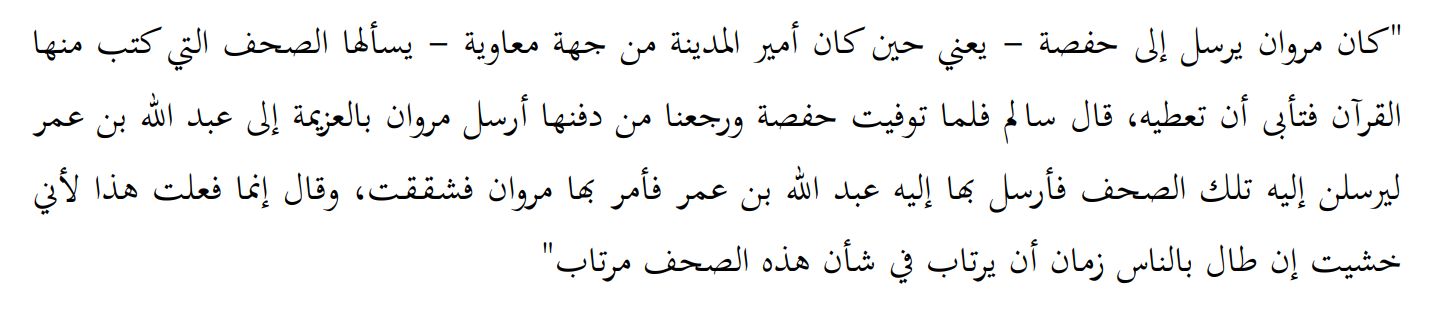
Que Marwán solía enviar por Hafsa, es decir, cuando era emir de Medina por parte de Mu'awiyya, pidiéndole los folios a partir de los cuales se había escrito el Corán. Ella se negó a dárselos. Salim dijo: Cuando murió Hafsa, mientras regresábamos de su entierro, Marwán comunicó a 'Abd Allah ibn 'Umar su firme decisión de que le enviara ese mushaf. Así que 'Abd Allah ibn 'Umar se lo envió. Marwán ordenó que fuera destruido. Dijo: Lo hice porque temí que, si permanecía entre la gente durante mucho tiempo, la gente acabaría teniendo dudas sobre esos folios.
‘That Marwan used to send for Hafsa – i.e when he was the amir of Madinah via Mu'awiyya - asking her for the sheets from which the Qur’ān was written. She refused to give him it. Salim said: When Hafsa died, while we were returning from her burial Marwan communicated his firm decision to 'Abd Allah ibn 'Umar that he send him that mushaf. So 'Abd Allah ibn 'Umar sent it to him. Marwan ordered it to be destroyed. He said: I did this because I feared that if it remained with people for a long time then people will have doubts regarding these sheets’.