2.7 Al-qadā’ Wa‘l-qadar
2.7 Al-qadā’ Wa‘l-qadar
Al-qadā’ wa‘l-qadar, con este nombre, es decir, mediante la unión de dos palabras para expresar un solo significado, tiene un referente específico; esto es, al-qadā’ vinculado a al-qadar, al constituir dos asuntos concomitantes, de modo que uno no es separable del otro, y tienen un significado que les es exclusivo. No es correcto incluir en él otro significado distinto de este, que no ha sido utilizado por los Sahabah ni por los Tabi’een. Al estudiar los textos legales [shar’i] y lingüísticos, y las palabras de los Sahabah, los Tabi’een y quienes les siguieron entre los Ulama’, resulta evidente que los términos al qadā’ wa‘l-qadar, juntos, no han sido empleados con un significado técnico [istilāhī] específico por ninguno de los Sahabah ni de los Tabi’een, ni han aparecido unidos con un significado técnico específico en el Corán o en el Hadiz; aunque sí han aparecido unidos en su significado lingüístico en lo que al-Bazzār transmitió del hadiz de Jabir, con una cadena hasan, de boca del Profeta ﷺ, quien dijo:
Al-qadā’ wa‘l-qadar, with this name, that is, by connecting two words together for one meaning, has a specific referent; that is, al-qadā’ linked to al-qadar, by making them two concomitant matters whereby one is not separable from the other, and they have a meaning that is exclusive to them. It is not correct to include in it other than this meaning which has not been used by the Sahabah or the Tabi’een. By studying the shar’i and linguistic texts and studying the sayings of the Sahabah, Tabi’een and those who came after them from the Ulama’, it is apparent that the terms al qadā’ wa‘l-qadar together, have not been used with a specific technical [istilāhī] meaning by any of the Sahabah or Tabi’een, nor have they come together with a specific technical meaning in the Qur’ān or the Hadīth; though they have come together in their linguistic meaning in what al Bazzār reported from the hadīth of Jabir with a hasan chain on the authority of the Prophet (PBUH) that he said:
«La mayoría de mi Umma muere después del qadā' de Allāh y de Su qadar con las almas [anfus].» ﷺ
“Most of my Ummah die after the qadā’ of Allaah and his qadar with the souls [anfūs].”
Por lo tanto, este significado terminológico que alude a este nombre no se encuentra sino entre los Mutakallimūn, después de que había transcurrido el primer siglo y tras la traducción de la filosofía griega. No existía en la época de los Sahabah, ni hubo disputa o discusión sobre esos dos términos como un solo nombre con un significado técnico específico. Durante la era de los Sahabah, los musulmanes no conocían la expresión «al-qadā’ wa‘l-qadar», aunque la palabra qadā’ había aparecido por sí sola y la palabra qadar había aparecido por sí sola en los ahadīth, del mismo modo que ambas aparecían juntas en el mencionado hadiz de Jabir, pero en todos estos casos aparecieron en su significado lingüístico y no en su significado técnico. La palabra qadā’ aparece en el hadiz de al-qunut. Al-Hasan dijo: el Mensajero de Allah ﷺ me enseñó unas palabras que digo en el qunut del witr, y luego mencionó la du’a del qunut, que dice:
Therefore this terminological meaning which alludes to this name is not found except from the Mutakallimūn, after the first century had passed and after the translation of the Greek philosophy. It did not exist in the time of the Sahabah nor was there any dispute or discussion of those two terms as one name for a specific technical meaning. Throughout the era of the Sahabah the Muslims did not know of ‘al-qadā’ wa‘l-qadar’ though the word qadā’ had come on its own and the word qadar had come on its own in the ahadīth just as the two had come together in the aforementioned hadīth of Jabir, but in all of these cases they had come in the linguistic meaning. They have not come in the technical meaning. The word qadā’ has come in the hadīth of al-qunut. Al-Hasan said, the Messenger of Allah (PBUH) taught me words I say in the qunut of the witr, then he mentioned the du’a of qunut, of which is,
"...y sálvame de lo que Tú has decretado, pues Tú eres Quien decreta y nadie decreta sobre Ti," [Reported by al-Darimi , Narrated by al-Hasan ibn Ali]
“...and save me from what You have decreed, for You are the one Who Decrees and you are not decreed upon,” [Reported by al-Darimi , Narrated by al-Hasan ibn Ali]
Su significado es: protégeme del mal de lo que has decretado, pues Tú decides lo que quieres y nadie decreta sobre Ti. La palabra qadar ha aparecido en el hadiz de Jibril en algunas de sus narraciones. Él dijo:
Its meaning is, protect me from the evil of what you have judged, for you judge what you wish and no one judges over you. The word qadar has come in the hadīth of Jibrīl in some of its narrations: He said,
«Y creer en el qadar, en su bien y en su mal», [Reported by Muslim, Narrated by Umar ibn al-Khattab]
“And to believe in al-qadar, the good and the bad thereof”, [Reported by Muslim, Narrated by Umar ibn al-Khattab]
Y en su dicho
And in his saying
«…Si te sobreviene algo, no digas: "Si hubiera hecho esto, habría sucedido tal o cual cosa", sino di: "Allah lo determinó [qaddara] y hizo lo que quiso".» [Reported by Muslim, Narrated by Abu Hurairah]
“…If anything befalls you do not say, ‘had I done (this), it would have been such-and-such, but rather say, ‘Allah determined [qaddara] and He did what He willed,’”[Reported by Muslim, Narrated by Abu Hurairah]
El significado de la palabra qadar en estos dos ahadīth es la Determinación [taqdīr] y el Conocimiento de Allah, es decir, que debes creer que las cosas han sido escritas por Allah en la Lawh al-Mahfūdh y que Él las conoce antes de que lleguen a existir, ya sean buenas o malas; y decir: Allah lo ha escrito en la Lawh al-Mahfūdh y lo conoció antes de que existiera, y Él hizo lo que quiso. La palabra al-qadā’ con el significado con que aparece en este hadīth, o en cualquier otro lugar donde aparezca, no fue objeto de disputa entre los musulmanes; no tuvieron discusiones con respecto a su forma ni a su alcance.
The meaning of the word qadar in these two ahadīth is the Determination [taqdīr] and Knowledge of Allah , that is, that you should believe that the things have been written by Allah in the Lawh al-Mahfūdh and He knows of them before they come into existence, whether they be good or bad; and say Allah has written this in the Lawh al-Mahfūdh and he knew it before it came into being and he did what he wished. The word al-qadā’ in the meaning which it came in this hadīth or anywhere else it came was not disputed by the Muslims; they did not have discussions with regards to its wording or its import.
En cuanto al término qadar en el sentido mencionado en esos dos ahadīth, los musulmanes, antes de la llegada de la filosofía griega, no discrepaban sobre él ni tenían debates acerca de su forma o de su significado. Pero después de la presencia de la filosofía griega entre los musulmanes, surgió un grupo en Kufa que dijo: no existe el qadar, es decir, no hay nadie que determine de antemano, y todo ocurre sin determinación previa; fueron llamados los Qadariyyah, y son quienes niegan el qadar y afirman que Allah creó los fundamentos de las cosas y luego las dejó, de modo que no tiene conocimiento de sus particularidades [juz'iyāt]. Esto contradice lo que ha llegado en el texto claro del Corán, que afirma que Allah es el Creador de todas las cosas, pequeñas o grandes, fundamentales o secundarias, y que Él determinó todo antes de su existencia, es decir, lo escribió en la Tablilla Protegida (al-Lawh al-Mahfūdh), o sea, lo conoció antes de que llegara a ser. Él dijo:
As for the word qadar in the meaning mentioned in those two ahadīth, the Muslims, before the presence of Greek philosophy, did not disagree about it or have discussions with regards to its wording or import. But after the presence of the Greek philosophy amongst the Muslims, a group from Kufa arose and said: there is no qadar, that is, there is no one who (pre)determines and everything occurs without any previous determination; they were called the Qadariyyah and they are the ones who deny the qadar and say that Allah created the fundamentals of things and then left them, so He does not have knowledge of their particulars [juz'iyāt]. This is contrary to what has come in the clear text of the Qur’ān which states that Allah is the Creator of all things, small or big, fundamental or branchial, and that He determined everything before its existence, that is, He wrote it in the Lawh al-Mahfūdh, that is, He knew it before it came to be. He said:
«Él creó todas las cosas y Él es el Conocedor de todo» [TMQ-An’ām: 101]
“He created all things and He is the All-Knower of everything” [TMQ-An’ām: 101]
Y
And
"Y Él sabe lo que hay en la tierra y en el mar: no cae una hoja sin que Él lo sepa. No hay ni un grano en las tinieblas de la tierra, ni nada fresco ni seco, que no esté escrito en un Libro evidente." [TMQ-An’ām: 59]
“And He knows whatever there is in the Earth and in the sea: not a leaf falls, but He knows it. There is not a grain in the darkness of the Earth nor anything fresh or dry, but is written in a Clear Record.” [TMQ-An’ām: 59]
Sin embargo, esta discrepancia y discusión se refiere únicamente al "qadar de Allah" en cuanto a Su Conocimiento. Así, los qadariyyah afirmaban que Allah conoce los fundamentos de las cosas, pero no sus aspectos particulares, mientras que el Islam sostiene que Allah conoce tanto los fundamentos de las cosas como sus aspectos particulares. Por tanto, la discusión acerca del qadar de Allah, es decir, de Su Conocimiento, trata sobre el tema del Conocimiento de Allah. Es un tema distinto al de al-qadā’ wa‘l-qadar. Es una discusión diferente, separada de la discusión sobre al-qadā’ wa‘l-qadar. Su realidad, tal como tuvo lugar, es la misma: es un tema distinto al de al-qadā’ wa‘l-qadar.
However, this disagreement and discussion is only with respect to the ‘qadar of Allah’ in terms of His Knowledge. So the Qadariyyah claimed that Allah knows the fundamentals of things but not their partial aspects, whilst Islam states that Allah knows the fundamentals of things as well as their partial aspects. Thus, the discussion with respect to the qadar of Allah , that is, His Knowledge, is about the subject of Allah's Knowledge. It is a subject different to that of al-qadā’ wa‘l-qadar. It is a different discussion, separate from the discussion of al-qadā’ wa‘l-qadar. Its reality that took place is the same, that is, it is a different subject to that of al-qadā’ wa‘l-qadar.
Así, resulta claramente evidente que las palabras al-qadā’ y al-qadar tienen, cada una por su cuenta, un significado específico. No guardan ninguna relación con el estudio de al-qadā’ wa‘l-qadar. En otras palabras, la palabra al-qadā’ en todos sus significados lingüísticos y legales (shar‘i) que proceden del Legislador, y la palabra al-qadar en todos sus significados lingüísticos y legales que proceden del Legislador, no tienen relación alguna con ninguno de estos términos, ya sea que se mencionen por separado o juntos, en la discusión de al-qadā’ wa‘l-qadar. Su significado se limita a lo que ellas expresan en sus significados lingüísticos y legales.
Thus, it is plainly apparent that the words al-qadā’ and al-qadar have each come on their own with each having a specific meaning. They do not have any relation with the study of al-qadā’ wa‘l qadar. In other words, the word al-qadā’ in all its linguistic and shar’i meanings that have come from the Legislator, and the word al-qadar in all its linguistic and shar’i meanings that have come from the Legislator, have no relation to any of these terms, whether mentioned alone or together, in the discussion of al-qadā’ wa‘l-qadar. They are confined with regards to their meaning, to that what they come with from the linguistic and shar'i meanings.
Los aleyas que han llegado para demostrar el conocimiento de Allah son aquellas que indican el carácter abarcador del conocimiento de Allah respecto de todas las cosas, como Su dicho:
"No calamity befalls on the Earth or in yourselves but is inscribed in a Book, before We bring it into existence. Indeed, that, upon Allah, is easy." Ninguna desgracia ocurre en la tierra ni en vosotros mismos sin que esté escrita en un Libro antes de que la hagamos existir. Ciertamente, eso es fácil para Allah. [TMQ-Hadīd: 22]
“No calamity befalls on the Earth or in yourselves but is inscribed in a Book, before We bring it into existence. Indeed, that, upon Allah, is easy” [TMQ-Hadīd: 22]
Y Su dicho,
And His saying,
«Di: "Nada nos sucederá salvo lo que Allah nos ha prescrito. Él es nuestro Mawla." Y que en Allah pongan su confianza los creyentes». [TMQ Tawba: 51]
“Say: ‘Nothing shall ever happen to us except what Allah has ordained for us. He is our Mawla.’ Then in Allah let the believers put their trust” [TMQ Tawba: 51]
Y Su dicho,
And His saying,
“No se escapa de Su Conocimiento ni el peso de un átomo, en los cielos o en la tierra, ni nada menor que eso, ni mayor, sino que está en un Libro claro” [TMQ Saba: 3]
“Escapes not from His Knowledge even the weight of an atom, in the Heavens or in the Earth, or less than that, or greater, but it is in a Clear Book” [TMQ Saba: 3]
Y Su dicho,
And His saying,
Es Él quien toma vuestras almas por la noche, y conoce lo que habéis hecho de día; luego os despierta para que se cumpla un término señalado, y luego hacia Él será vuestro retorno. Después os informará de lo que solíais hacer. [TMQ An’ām: 60]
“It is He, Who takes your souls by night, and (Who) has knowledge of all that you have done by day, then He raises (wakes) you up again that a term appointed be fulfilled, then unto Him will be your return. Then He will inform you what you used to do” [TMQ An’ām: 60]
Estos versículos fueron revelados al Mensajero de Allah ﷺ, y los Compañeros los memorizaron y comprendieron, sin que se les ocurriera discutir sobre al-qadā’ wa‘l-qadar. Además, la redacción, la comprensión y la indicación de estos versículos muestran que son una aclaración sobre el Conocimiento de Allah (SWT) y que no tienen relación alguna con el estudio de al-qadā’ wa‘l-qadar. Asimismo, el aleya,
These verses were revealed to the Messenger (PBUH) and they were memorised and understood by the Sahabah, it did not occur to them to discuss al-qadā’ wa‘l-qadar. Furthermore, the wording, understanding and indication of these verses states that they are a clarification about the Knowledge of Allah and have no relation to the study of al-qadā’ wa‘l-qadar. Similarly the ayah,
«Y si les llega algún bien, dicen: "Esto es de Allah", pero si les sobreviene algún mal, dicen: "Esto es por ti". Di: "Todo proviene de Allah"; ¿qué les pasa a estas gentes que no logran comprender palabra alguna?» [TMQ-Nisā’: 78]
“And if some good reaches them, they say, ‘This is from Allah’, but if some evil befalls them, they say, ‘This is from you’. Say: ‘All things are from Allah’; so what is wrong with these people that they fail to understand any word?’ [TMQ-Nisā’: 78]
No tiene nada que ver con la discusión sobre al-qadā’ wa‘l-qadar, pues es una refutación de los kuffār, que distinguían entre el mal y el bien. Así, atribuían el mal al Mensajero ﷺ y el bien a Allah . Entonces Allah los refutó declarando que todo proviene de Allah . La discusión no trata sobre el bien que hace el ser humano ni sobre el mal que persigue; más bien, la discusión trata sobre la lucha y la muerte. El propio aleya y lo que la precede lo aclaran.
It has nothing to do with the discussion of al-qadā’ wa‘l-qadar because it is a refutation of the kuffār who differentiated between bad and good. Thus, they made bad to come from the Messenger and good from Allah . So Allah refuted them by declaring that everything is from Allah . The discussion is not about the good that a human being does and the evil that he pursues; rather the discussion is about fighting and death. The ayah itself and that what precedes it clarifies this:
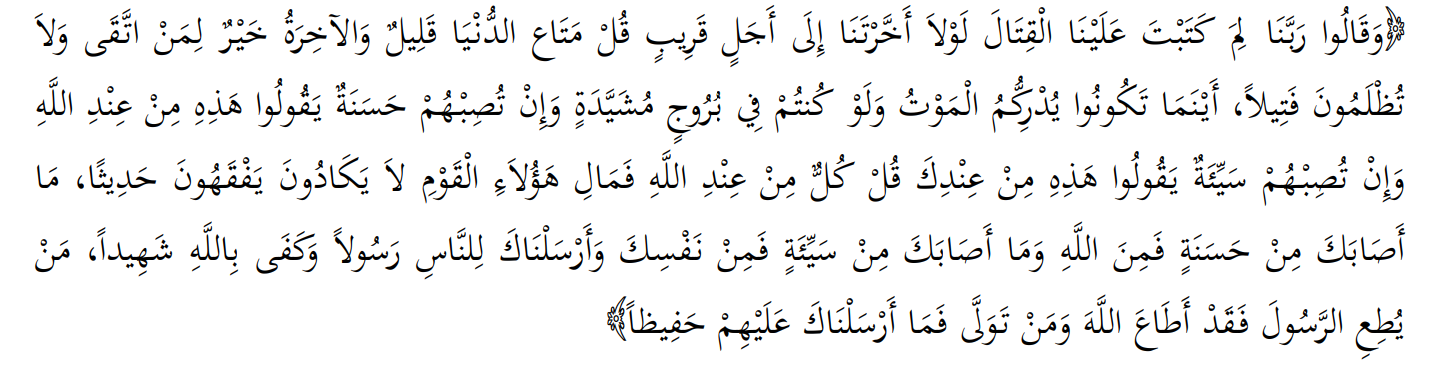
"Dicen: ¡Señor nuestro! ¿Por qué nos has prescrito el combate? ¡Ojalá nos hubieras concedido un plazo breve!». Di: «Breve es el disfrute de este mundo. La Otra Vida es mejor para quien teme a Allah, y no se os tratará injustamente en lo más mínimo. Dondequiera que estéis, la muerte os alcanzará, aunque estéis en fortalezas construidas sólidas y elevadas». Y si les llega algún bien, dicen: «Esto proviene de Allah»; pero si les sobreviene algún mal, dicen: «Esto proviene de ti». Di: «Todas las cosas provienen de Allah». ¿Qué les pasa a esta gente, que no logran entender palabra alguna? Cualquier bien que te alcance proviene de Allah, pero cualquier mal que te sobrevenga proviene de ti mismo. Y Nosotros te hemos enviado (¡oh Muhammad ﷺ!) como Mensajero a la humanidad, y Allah basta como testigo. Quien obedece al Mensajero, ha obedecido en verdad a Allah; pero quien se aparta, entonces no te hemos enviado como guardián sobre ellos." [TMQ-Nisā’: 77-80]
“They say: Our Lord! Why have you ordained for us fighting? Would that you have granted us respite for a short period?’ Say: ‘Short is the enjoyment of this world. The Hereafter is (far) better for him who fears Allah, and you shall not be dealt with unjustly in the least. Wheresoever you may be, death will overtake you even if you are in fortresses built up strong and high! And if some good reaches them, they say, ‘This is from Allah,’ but if some evil befalls them, they say, ’This is from you.’ Say: ‘All things are from Allah’, so what is wrong with these people that they fail to understand any word? Whatever of good reaches you, is from Allah, but whatever of evil befalls you, is from yourself. And We have sent you (O Muhammad) as a Messenger to mankind, and Allah is sufficient as Witness. He who obeys the Messenger, has indeed obeyed Allah, but he who turns away, then we have not sent you as a watcher over them.” [TMQ-Nisā’: 77-80]
Así que el sujeto es lo que les sobreviene y no lo que ellos están haciendo. Por tanto, esto no tiene nada que ver con el estudio de al-qadā’ wa‘l-qadar.
So the subject is what befalls them and not what they are doing. Thus it has nothing to do with the study of al-qadā’ wa‘l-qadar.
Por lo tanto, todo lo mencionado anteriormente no tiene nada que ver con el estudio de al-qadā’ wa‘l-qadar; no entra dentro de su significado y no guarda relación alguna con lo mencionado anteriormente. Más bien, al-qadā’ wa‘l-qadar, como concepto, procede de la filosofía griega, transmitida por los Mu'tazilah, quienes dieron una opinión al respecto. Ahl al-Sunnah y los Jabriyyah los refutaron, y Ahl al-Sunnah también refutó a los Jabriyyah. La discusión se limitó a ese mismo concepto y partió de la misma premisa. Así, la cuestión es un significado/sentido que procede de la filosofía griega y que surgió en el debate que solía tener lugar entre los musulmanes y los kuffār, quienes se valían de la filosofía griega. Es un significado que tiene relevancia para la ‘aqīdah (creencia), por lo que lo que se pretende es dar la opinión del Islam sobre este significado. Los Mu'tazilah dieron una opinión, los Jabriyyah los refutaron y dieron otra opinión. Ahl al-Sunnah refutó a todos ellos y dio su propia opinión, y dijeron de ella que es una tercera opinión que surge de las dos anteriores, y la describieron como «la leche pura, dulce de beber, que sale de entre excremento y sangre».
Therefore, all that has been mentioned above has nothing to do with the study of al-qadā’ wa‘l qadar; they do not come under its meaning and have no relation whatsoever with what has been mentioned above. Rather, al-qadā’ wa‘l-qadar as a meaning has come from Greek philosophy which was transmitted by the Mu'tazilah who gave an opinion with regards to it. Ahl al-Sunnah and the Jabriyyah refuted them and Ahl al-Sunnah (also) made a refutation of the Jabriyyah. The discussion was confined to the same meaning and preceded upon the same premise. Thus the issue is a meaning/sense that came from Greek philosophy and it came to the fore in the debate which used to take place between the Muslims and the kuffar who used to be armed with the Greek philosophy. It is a meaning which has a relevance to the ‘aqīdah (creed), thus what is desired is to give Islam's opinion regarding this meaning. The Mu'tazilah gave an opinion and the Jabriyyah refuted them and gave another opinion. Ahl al-Sunnah refuted all of them and gave an opinion, and said about it that it is a third opinion which has come out from the two opinions and they described it as ‘the pure milk, sweet to drink, that comes out from between excrement and blood’.
Por tanto, el tema de discusión, que procedía de la filosofía griega, se dio a conocer, y dado que está relacionado con la ‘aqīdah (creencia), el musulmán debe tener claro cuál es su creencia respecto a este asunto. Los musulmanes sí expresaron su opinión y surgieron tres escuelas de pensamiento. Así pues, no está permitido remitir la cuestión de al-qadā’ wa‘l-qadar al significado que se ha derivado de al-qadā’ o al-qadar, tanto lingüística como legalmente en la Sharī’ah, ni está permitido imaginar o concebir para al-qadā’ o al-qadar algún significado a partir de meras suposiciones, concepciones o imaginaciones, ni decir, por ejemplo, que al-qadā’ es el juicio universal solo sobre los universales y que al-qadar es el juicio universal sobre los aspectos particulares y sus detalles, o decir que al-qadar es el plan eterno de las cosas y al-qadā’ es la ejecución y creación conforme a esa predeterminación y plan. En efecto, esto no está permitido, porque no es más que imaginación, suposición y un intento fallido de aplicar ciertas expresiones lingüísticas y legales que no se ajustan a ello, pues más bien indican significados generales. Sería entonces una acción arbitraria restringir las dos palabras a estos significados específicos sin pruebas.
«Cada alma queda en prenda por lo que se ha ganado,» [TMQ Muddathir: 38]
“Every soul is a pledge for what it earns,” [TMQ Muddathir: 38]