2.15 La Revelación
2.15 The Revelation
Todo musulmán debe creer en la revelación, pues es un aspecto fundamental de la fe. Sin embargo, la prueba de la revelación no es racional, sino que se acepta sobre la base de textos auténticos. Como la revelación no tiene una realidad ni una sensación tangible, la mente no puede verificar su validez. Por lo tanto, todo intento de demostrar la revelación mediante el intelecto será incorrecto, ya que no es posible usar la mente para probar algo que carece de realidad tangible.
Each and every Muslim must believe in revelation, as it is a fundamental aspect of belief. However, the evidence for revelation is not rational, rather it is accepted on the basis of authentic texts. Since revelation does not have a tangible sensation or reality, the mind cannot verify its validity. Therefore every attempt to prove revelation by means of the intellect will be incorrect, as it is not possible to use the mind to prove something without a tangible reality.
Por lo tanto, como se mencionó anteriormente, la evidencia de la revelación no es intelectual; más bien, se establece sobre la base de narraciones auténticas. El texto definitivo del Corán verifica que el mensajero Muhammad ﷺ recibió la revelación. Allah dice:
Hence, as mentioned earlier, the evidence for revelation is not intellectual; rather it is established on the basis of authentic narrations. The Definite text of the Qur’ān verifies that the messenger Muhammad recieved revelation. Allah says,
De la misma manera, Allah, el Honorable, el Sabio, te revela a ti y a quienes te precedieron. [TMQ Shura: 3]
"Likewise Allah, the Honourable, the all-wise, reveals to you and to those before you." [TMQ Shura: 3]
Y de igual modo te hemos revelado un espíritu de nuestra orden. [TMQ Shura:52]
"And likewise we have revealed to you an invigorate thing by our command." [TMQ Shura:52]
«Y no habla por capricho. No es sino una revelación que se le revela.» [TMQ Najm: 3]
"And he doesn't utter from his own desire. Indeed it is an inspired inspiration" [TMQ Najm: 3]
"Sin duda, ¡oh profeta! Te hemos enviado revelación como la enviamos a Noé y a los profetas después de él." [TMQ Nisa: 163]
"Undoubtedly, O prophet! We have sent revelation to you as we sent it to Noah and the prophets after him." [TMQ Nisa: 163]
"Y sigue lo que te ha sido revelado y ten paciencia hasta que Allah decida, pues Él es el mejor de los jueces." [TMQ 10:109]
"And follow that which is revealed to you and have patience until Allah decrees and He is the best of judges." [TMQ 10:109]
La revelación que descendió sobre el Mensajero tuvo tres estados, y todos los profetas anteriores a él recibieron la revelación solamente a través de estos, y no de otra forma. Estos estados están todos comprendidos dentro de la revelación, que Allah explica en el Corán. Él dice:
The revelation that descended on the messenger had three states, all prophets before him recieved the revelation through these only and not another. These states are all categorised under the revelation which Allah explains in the Qur’ān. He says,
«Y no es propio de ningún hombre que Allah le hable sino por revelación, o desde detrás de un velo, o enviando un mensajero que revele por Su permiso lo que Él quiera. Ciertamente Él es Elevado, Sabio.» [TMQ Shura: 51]
"And it is not fit for any man that Allah should speak to him but through revelation, or that the man may be at the other side of the veil of grandeur, or by sending messengers and inspiring whom he wills." [TMQ Shura: 51]
Es decir, Allah solo se comunica con el hombre mediante la inspiración, mediante el habla tras un velo o enviando mensajeros. La revelación que descendía sobre el Mensajero de Allah ﷺ tenía dos estados. Él informó sobre ellos cuando una vez le preguntaron: "¿Cómo te llega la revelación?". Él respondió:
That is, Allah only communicates with man through inspiration, through verbal contact via a veil or by sending messengers. The revelation that descended upon the messenger had two states. He informed about them when he was once asked, "How does the revelation come to you?" He replied,
"A veces llega como el tintineo o el repiqueteo de una campana, que es lo más duro para mí; y cuando me deja, he asimilado todo lo que se me ha dicho. Y a veces el ángel viene a mí en forma de hombre, me habla y yo comprendo lo que se dice." [Bukhari]
"Sometimes it comes like the clattering or the jingling of a bell which is severest on me and when it leaves me, I have absorbed everything. And sometimes the angel comes to me in a form of a man and speaks to me and I am aware of what is being said." [Bukhari]
Estos dos estados son los siguientes: Primero, el ángel inspira al profeta mediante una indicación, sin usar palabras ni lenguaje. La revelación se infunde en la mente del profeta, tal como él mismo dijo,
These two states are as follows: Firstly- the angel inspires the prophet by indication and without using words or language. The revelation is inspired into the mind of the prophet , just as he said,
"Ruh Al-Quds (Jibril) me inspiró que ningún alma morirá hasta haber completado su Rizq y su Ajal. Por tanto, temed a Allah, oh gente, y procurad los medios para hacer el bien." [Extraced by AlHakim]
"Ruh Al-Quds (Jibril) inspired in to me that no soul shall die until it has completed its Rizq and its Ajal. Therefore fear Allah O people and acquire the means to do good" [Extraced by AlHakim]
Además, el Mensajero ﷺ tenía visiones que recibía de Allah tanto en estado de vigilia como durante el sueño. Parte de ello le era inspirado mientras estaba despierto, y tenía ciertas visiones en sus sueños, todas las cuales eran revelación. Como dijo Aisha, la madre de los creyentes:
Also the messenger whilst dreaming had visions that he received from Allah both in the states of consciousness and sleep. Some of it was inspired to him whilst he was awake and he would have certain visions in his dreams all of which were revelation. As the mother of the believers, Aisha said,
En primer lugar, el Mensajero ﷺ comenzó a tener visiones verdaderas en sus sueños. Cada visión que tenía era verdadera, tan clara como la luz de la mañana.
"Firstly, the messenger began seeing true visions in his sleep. Every vision he had was true as clear as the morning."
El Mensajero también sentía que alguna forma de revelación estaba a punto de llegar, pero no llegaba. Aisha narró que Harith ibn Hashim preguntó al Mensajero de Allah ﷺ: "¡Oh Mensajero!, ¿cómo te llega la revelación?". El Mensajero de Allah ﷺ dijo:
The messenger would also feel that some form of revelation was about to come, but it didn't come. Aisha narrated that Harith ibn Hashim asked the messenger , "O messenger, how does the revelation come to you?" The messenger said,
"A veces llega como el tintineo de una campana, que es lo más duro para mí, y cuando me abandona, lo he absorbido todo." [Bukhari]
"Sometimes it comes like the clattering /jingling of a bell which is severest on me and when it leaves me, I have absorbed everything." [Bukhari]
Todas estas variantes, es decir, la inspiración, el sueño, la revelación sin palabras y todo lo similar, constituyen un solo estado y quedan comprendidas en la aleya de Allah,
All these variations i.e. inspiration, dream, revelation without talk and everything similar constitute one state and fall within the saying of Allah ,
"Nada más que revelación" [TMQ Shura: 51]
"Nothing but revelation" [TMQ Shura: 51]
Porque lingüísticamente, cuando se usa el verbo "revelar a alguien" significa indicar o hacer un gesto con la cabeza. Así, Allah le revela e inspira. Allah dice,
Because linguistically when the verb "to reveal to someone" is used it means to indicate or shake ones head. Thus Allah reveals to him and inspires him. Allah says,
"Y tu Señor inspiró a la abeja", [TMQ Nahl: 68]
"And your lord inspired the bee", [TMQ Nahl: 68]
Así, la inspiración dada a la abeja es: la inspiración y el conocimiento innato en el corazón de la abeja.
Thus the inspiration to the bee is: the inspiration and the innate knowledge within the bee’s heart.
El segundo estado es la revelación inspirada por medio de la comunicación oral del ángel. Se le transmite oralmente al profeta ﷺ después de que este conoce, mediante pruebas concluyentes, que esto es revelación y que el portador del mensaje es el ángel, es decir, Jibril. Allah dice:
The second state is the revelation inspired by means of oral communication from the angel. It is transmitted orally to the prophet after he learns through decisive evidence that this is revelation and the message bearer is the angel, i.e. Jibril. Allah says,
"El Espíritu fiel ha descendido con él. Sobre tu corazón, para que seas de los que advierten." [TMQ Shuara: 193]
"The trusted spirit has descended with it. On your heart that you may warn." [TMQ Shuara: 193]
En otras palabras, Allah envía a Jibril, quien habla con el mensajero, y este a la vez escucha y preserva sus palabras. Aisha narró que el Profeta ﷺ dijo:
In other words, Allah sends Jibril who speaks with the messenger who simultaneously both hears and preserves his words. Aisha narrated that the prophet said,
"Y a veces el ángel viene a mí en forma de hombre, me habla y soy consciente de lo que me dice." [Bukhari]
"And sometimes the angel comes to me as a man and he talks to me and I am conscious of what he is saying." [Bukhari]
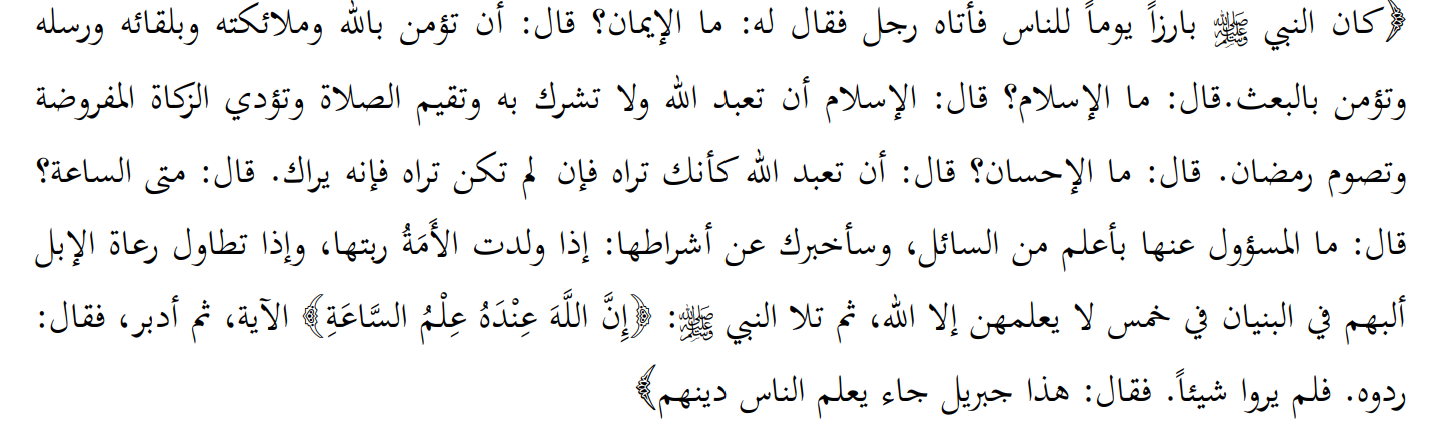
Abu Hurairah narró que el Profeta ﷺ estaba un día con la gente cuando un hombre se acercó y le preguntó: "¿Qué es el Imán?" Él ﷺ respondió: "Es creer en Allah, en Sus ángeles, en el encuentro con Él, en Sus mensajeros y en la resurrección." Preguntó: "¿Qué es el Islam?" Él ﷺ respondió: "El Islam es que adores a Allah y no cometas shirk, que establezcas la oración, que pagues el zakat obligatorio y que ayunes en Ramadán." Preguntó: "¿Qué es el Ihsan?" Él ﷺ respondió: "Que adores a Allah como si Le vieras, y si no puedes verLe, ciertamente Él te ve." Preguntó: "¿Cuándo será la Hora?" Él ﷺ respondió: "Quien es preguntado sobre ella no sabe más que quien pregunta. Te hablaré de sus señales: cuando la madre dé a luz a su señora y cuando los pastores construyan edificios altos. Es una de las cinco cosas que nadie conoce excepto Allah." Luego el Profeta ﷺ recitó el aleya: "Ciertamente, Allah posee el conocimiento de la Hora." Entonces el hombre se dio la vuelta y se marchó. El Profeta ﷺ dijo a los Sahaba: "Llamadle", pero no vieron nada. Él ﷺ dijo: "Este era Yibril, vino para enseñar a la gente su religión." [Bukhari]
Abu Hurairah narrated that the prophet was with the people one day when a person came and asked him, "What is Emaan?" He said, "It is the belief in Allah , his angels, in the meeting with him , his messengers and the resurrection." He asked, "What is Islam?" He said, "Islam is that you worship Allah and do not commit Shirk, establish the prayer, pay the enjoined Zakat and you fast in Ramadan." He said, "What is Ihsaan?" He said, "That you worship Allah as if you see him, and if you can not see him, surely he sees you." He said, "When is the hour?" He said, "The one questioned about it knows no better then the questioner. I will tell you of its signs. When the mother will give birth to her Master and when the shepherd will build tall buildings. It is one of the five things that no one will know them except Allah ." Then the prophet recited the Ayat, "Indeed Allah has the knowledge of the hour." Then the man turned and left. The prophet said to the Sahaba call him but they didn't see anything. He said, "This was Jibril, he came to teach people their Deen." [Bukhari]
Hay varios episodios mencionados en los Ahadiz en los que Jibril descendió y habló con el Profeta ﷺ, y él escuchaba. Esta era una forma de revelación para el Mensajero, pues el ángel le transmitía los significados en forma de conversación. La revelación por palabras y significado se limita al Noble Corán. En cuanto a la revelación por significado, el Mensajero ﷺ la expresaba mediante sus propias palabras, a través de la aplicación, es decir, sus acciones, o mediante el silencio, y esto es la Sunnah.
There are a number of incidents mentioned in Ahadith in which Jibril descended and talked to the prophet and he would listen. This was a form of revelation for the messenger, as the angel would tell the messenger the meanings in the form of a conversation. The revelation by words and meaning is restricted to the Noble Qur’ān. As for revelation by meaning, the messenger would express this by using his own words, through application i.e. his actions, or by silence and this is the Sunnah.
El Hadiz Qudsi se considera Sunnah porque, aunque su significado es revelado por Allah, sus palabras son del Profeta ﷺ. Las palabras del Hadiz Qudsi no son de Allah, porque las palabras que son de Allah están específicamente reservadas para el Corán, y esto se demuestra por su inimitabilidad. Aunque la Sunnah llega en forma de inspiración, de sueño y de algo que se arroja directamente en el corazón, también llega tanto en estado de vigilia como en forma de diálogo entre Jibril y el Mensajero ﷺ.
The Hadith Qudsi is regarded as Sunnah because although its meaning is revealed from Allah its words are from the prophet . The words of the Hadith Qudsi are not from Allah because the words that are from Allah are specifically for the Qur’ān and this is proven by its inimitability. Although the Sunnah comes in the forms of inspiration, dream and is cast directly in the heart, it also comes both in wakefulness and as a dialogue between Jibril and the messenger .
El Corán sólo fue revelado a través del mensajero porque sus palabras son de Allah. Hay numerosos aleyas que detallan la revelación del Corán. Allah dice,
The Qur’ān is only revealed through the messenger because its words are from Allah . There are numerous ayats detailing the revelation of the Qur’ān. Allah says,
Y te hemos revelado el Corán en árabe [TMQ Shura:7]
"And we have revealed the Quran to you in Arabic" [TMQ Shura:7]
"Y lo que te hemos revelado (¡oh Muhammad ﷺ!) del Libro, es la (pura) verdad" [TMQ Fatir: 31]
" And what We have revealed to you (O Muhammad [saw]) of the Book, it is the (very) truth " [TMQ Fatir: 31]
El libro al que se refiere es el Corán, y «min» aquí indica representación.
The book referred to is the Qur’ān and “min” here is to indicate representation.
"Este Corán me ha sido revelado para que con él os advierta a vosotros y a quienquiera que llegue a él." [TMQ An’aam: 6]
“This Qur'ân has been revealed to me that I may therewith warn you and whomsoever it may reach " [TMQ An’aam: 6]
«Te relatamos (Muhammad ﷺ) la mejor de las historias mediante Nuestras Revelaciones, de este Corán» [TMQ Yoosuf: 3]
" We relate to you (Muhammad [sal-Allâhu 'alayhi wa sallam]) the best of stories through Our Revelations to you, of this Qur'ân" [TMQ Yoosuf: 3]
«Y recita lo que te ha sido revelado (¡oh Muhammad ﷺ!) del Libro (el Corán) de tu Señor. Nadie puede cambiar Sus Palabras». [TMQ alKahf: 27]
" And recite what has been revealed to you (O Muhammad PBUH) of the Book (the Qur'ân) of your Lord. None can change His Words, " [TMQ alKahf: 27]
Es el Corán. Hay también otros aleyas que mencionan la revelación en general, incluida la Sunnah. Por ejemplo, Allah dice,
It is the Qur’ān. There are other ayats as well, which mention the revelation in general including the Sunnah. For example, Allah says,
«Si sigo en la guía, es por la Revelación de mi Señor que me ha sido enviada» [TMQ As-saba: 50]
" If I remain guided, it is because of the Revelation of my Lord to me” [TMQ As-saba: 50]
Y Él dice,
And He says,
"En verdad, te hemos revelado a ti (oh Muhammad ﷺ) como revelamos a Nuh (Noé) y a los profetas después de él". [TMQ Nisa: 163]
" Verily, We have sent the Revelation to you (O Muhammad [saw]) as We sent the Revelation to Nûh (Noah) and the Prophets after him" [TMQ Nisa: 163]
Y Él dice,
And He says,
"Y sigue lo que te es revelado de tu Señor. Ciertamente, Allah está bien informado de lo que hacéis." [TMQ Ahzaab: 2]
"And follow that which is revealed to you from your Lord. Verily, Allâh is Well-Acquainted with what you do" [TMQ Ahzaab: 2]
Estos dos estados mencionados han sido tratados en los textos. El tercer estado se menciona en Su dicho,
These two mentioned states have been discussed in the texts, The third state is mentioned in His saying,
«O desde detrás de un velo» [TMQ Shura: 51]
"Or from behind a veil” [TMQ Shura: 51]
Esto es lo que sucedió con Musa. Este aleya hace referencia al episodio en el que Allah habló a Musa desde detrás de un velo. Es como cuando una persona velada habla con algunos dignatarios y con personas de distinción: habla desde detrás de un velo y, aunque se oye la voz del otro, no lo ve. Así fue como Allah habló con Musa.
This is what happened with Musa . This Ayat is indicating to the incident in which Allah spoke to Musa from behind a veil. That is, just as the veiled person speaks with some dignitaries and with people of distinction. He speaks from behind a veil and although one hears the other person’s voice, he does not see him. This is the manner in which Allah spoke with Musa .
Un incidente de este tipo ocurrió solo una vez con el Profeta ﷺ durante el Isra' wal-Mi'raYY, que no solo ha sido mencionado en un hadiz auténtico, sino que también ha sido indicado por la Sura al-Naym. Allah (SWT) dice:
Such an incident only occurred once with the prophet during the al-Isra wal-Miraj, which has not only been mentioned in an authentic Hadith, but has also been indicated by Sura al-Najm. Allah says,
"No es sino una Revelación que ha sido revelada. Le ha sido enseñado (este Corán) por uno poderoso en fuerza [Jibril]. Uno libre de todo defecto en cuerpo y mente, entonces él (Jibril) se elevó y se mantuvo firme. Mientras él [Jibril] estaba en la parte más alta del horizonte, luego se acercó y se aproximó, y estuvo a una distancia de dos largos de arco o incluso más cerca. Entonces (Allāh) reveló a Su siervo [Muhammad ﷺ a través de Jibril] lo que reveló." [TMQ Najm: 4-10]
"It is only a Revelation revealed.He has been taught (this Qur'ân) by one mighty in power [Jibril].One free from any defect in body and mind then he (Jibrîl) rose and became stable.While he [Jibrîl)] was in the highest part of the horizon, Then he [Jibrîl] approached and came closer, And was at a distance of two bows' length or (even) nearer. So (Allâh) revealed to His slave [Muhammad [saw] through Jibrîl [as]] whatever He revealed." [TMQ Najm: 4-10]
Con excepción de este acontecimiento, es decir, al-Isra wal-Miraj, la revelación descendió sobre el Profeta ﷺ en forma de inspiración y por medio de un mensajero.
With the exception of this event i.e. al-Isra wal-Miraj, the revelation descended upon the prophet in the form of an inspiration and through a messenger.
Todas las formas de revelación son pruebas. La comunicación entre el ángel y el mensajero, mediante palabra, señal o conversación, es una revelación clara. La inspiración y las visiones son revelaciones claras, y que Allah hable a los profetas también es una forma de revelación. Esta revelación constituye una prueba categórica, pues ha sido transmitida en los textos más auténticos y de significado definido.
All the types of revelation are forms of evidence. The communication between the angel and the messenger by talk or indication or conversation is a clear revelation. The inspiration and visions are clear revelations and Allah speaking to the prophets is also a form of revelation. This revelation is a categorical proof as it has been reported in the most authentic and definite texts of definite meaning.