9. Ciencia y cultura
9. Science And Culture
En árabe se dice: el hombre ha obtenido (‘alima) conocimiento (‘ilm). Esto significa que alcanzó la verdadera realidad del conocimiento (‘ilm). Adquirir conocimiento de una cosa significa llegar a conocerla, es decir, quedar informado de un asunto o tener trato con él. También en la lengua se dice: ha adquirido comprensión (thaqifa), lo que significa que se ha vuelto diestro, por lo tanto está instruido y es culto (thaqif). Ha comprendido (thaqifa) una lengua, es decir, la ha dominado y entendido con rapidez. Estos significados lingüísticos son la base del uso de las palabras. Sin embargo, si estas palabras se emplean para indicar otros significados relacionados con el significado lingüístico, eso está permitido, como ocurre con la adopción del término fa’il (sujeto) en la gramática, por ejemplo. El significado lingüístico (de las palabras) era el que prevalecía, y por eso los antiguos aplicaban la palabra ‘ilm a todas las formas de conocimiento, sin distinguir entre las ciencias y las disciplinas. Después, la gente comenzó a considerar las disciplinas intelectuales y naturales como generales para todas las personas, mientras que las otras disciplinas tradicionales (textuales) se consideraban propias de la nación de la que habían sido transmitidas. Posteriormente, tanto la ciencia (‘ilm) como la cultura (thaqafa) comenzaron a definirse según distintas disciplinas específicas, adquiriendo significados terminológicos diferentes de sus significados lingüísticos. Según esta terminología, tienen el siguiente significado: la ciencia (‘ilm) es el conocimiento que se adquiere mediante la observación, la experimentación y la educación, como la física, la química y el resto de las ciencias empíricas, y la cultura (thaqafa) es el conocimiento que se adquiere por vía de la transmisión, el aprendizaje y la deducción, como en el estudio de la historia, las lenguas, la jurisprudencia (fiqh), la filosofía y el resto de las disciplinas no empíricas. Y hay otras disciplinas no empíricas que se incluyen como ciencias (‘ilm), aunque pertenecen a la cultura (thaqafa), como la aritmética, la ingeniería y la industria; aunque pertenezcan a la cultura, se consideran parte de la ciencia porque son universales para todas las personas y no son propias de una sola nación. De manera semejante, todo lo que pertenece a la cultura relacionado con oficios que se asemejan a la industria, como el comercio y la navegación, se considera parte de la ciencia y es universal. En cuanto a las artes, como la pintura, la escultura y la música, forman parte de la cultura. Siguen una perspectiva particular, que es una cultura específica. La diferencia entre cultura (thaqafa) y ciencia (‘ilm)
In Arabic language it is said: the man has obtained (‘alima) knowledge (‘ilm). This means that he attained the true reality of knowledge (‘ilm). He gained knowledge of a thing means he became cognisant of it, which means that he became informed of a matter or acquainted with it. Also in the language it is said: He has gained comprehension (thaqifa), which means that he has become proficient, thus he is educated and cultured (thaqif). He has understood (thaqifa) a language (means) he has mastered and understood it swiftly. These linguistic meanings are the basis of the use of words, However if these words were used to indicate other meanings that relate to the linguistic meaning then that is permitted, like in the case of the adoption of the word fa’il (subject) in grammar for example. The linguistic meaning (of the words) was prevailing and this is why the ancients used to apply the word ‘ilm on all forms of knowledge without differentiating between the sciences and disciplines. Then people began to consider intellectual and natural disciplines as being general to all people whilst other traditional (textual) disciplines were considered specific to the nation from which it was transferred. Subsequently, each of science (‘ilm) and culture (thaqafa) began to be defined according to different specific disciplines, acquiring terminological meanings which were different to their linguistic meanings. According to this terminology they have the following meaning: Science (‘ilm) is the knowledge which is acquired through observation, experimentation and education like physics, chemistry and the rest of the empirical sciences and culture (thaqafa) is the knowledge which is acquired by way of transmission, learning and deduction as in (the study of) history, languages, jurisprudence (fiqh), philosophy and the rest of the non-empirical disciplines. And there are other non-empirical disciplines which are included as sciences (‘ilm) even though they come within culture such as arithmetic, engineering and industry; even though they come under culture (thaqafa) they are regarded as part of science because they are universal to all people and not specific to any one nation. In a similar way anything from the culture related to crafts which resemble industry such as trade and shipping; they are considered to be part of science and they are universal. As for the arts such as; painting, sculpture and music they are part of culture. They follow a particular viewpoint; which is a specific culture. The difference between culture (thaqafa) and science (‘ilm)
Es que la ciencia es universal para todas las naciones y no es propia de ninguna nación con exclusión de otra. En cuanto a la cultura (zaqafa), puede ser específica, al estar atribuida a la nación de la que surgió, o puede formar parte de las características específicas y particulares de la nación, como la literatura y las biografías de sus héroes, y su filosofía acerca de la vida; o bien puede ser universal, como el comercio, la navegación, etc. Por lo tanto, la ciencia se adopta universalmente de todas las naciones porque es universal y no es propia de ninguna nación en particular. En cuanto a la cultura (zaqafa), la nación debe empezar por su propia cultura; cuando la haya estudiado y la conozca hasta que se fije en sus mentes, entonces puede estudiar otras culturas. Los musulmanes solían diferenciar entre las ciencias que una persona adquiría por sí misma y las ciencias que recibía de otros. Ibn Jaldún dice en su libro al-Muqaddima:
is that science is universal to all nations and not specific to any nation to the exclusion of another nation. As for culture (thaqafa) it might be specific, being ascribed to the nation from which it resulted or it may be part of the nation’s specific and particular characteristics such as literature and biographies of heroes, and their philosophy concerning life or they may be universal such as trade, shipping etc. Therefore, science is adopted universally from all nations because it is universal and not specific to any particular nation. As for culture (thaqafa) the nation should begin with its own culture, when she has studied it and is cognisant of it until it becomes focused in their minds then they can study other cultures. The Muslims used to differentiate between the sciences which a person used to attain by himself and the sciences he used to receive from others. Ibn Khaldun says in his book al-Muqaddima:
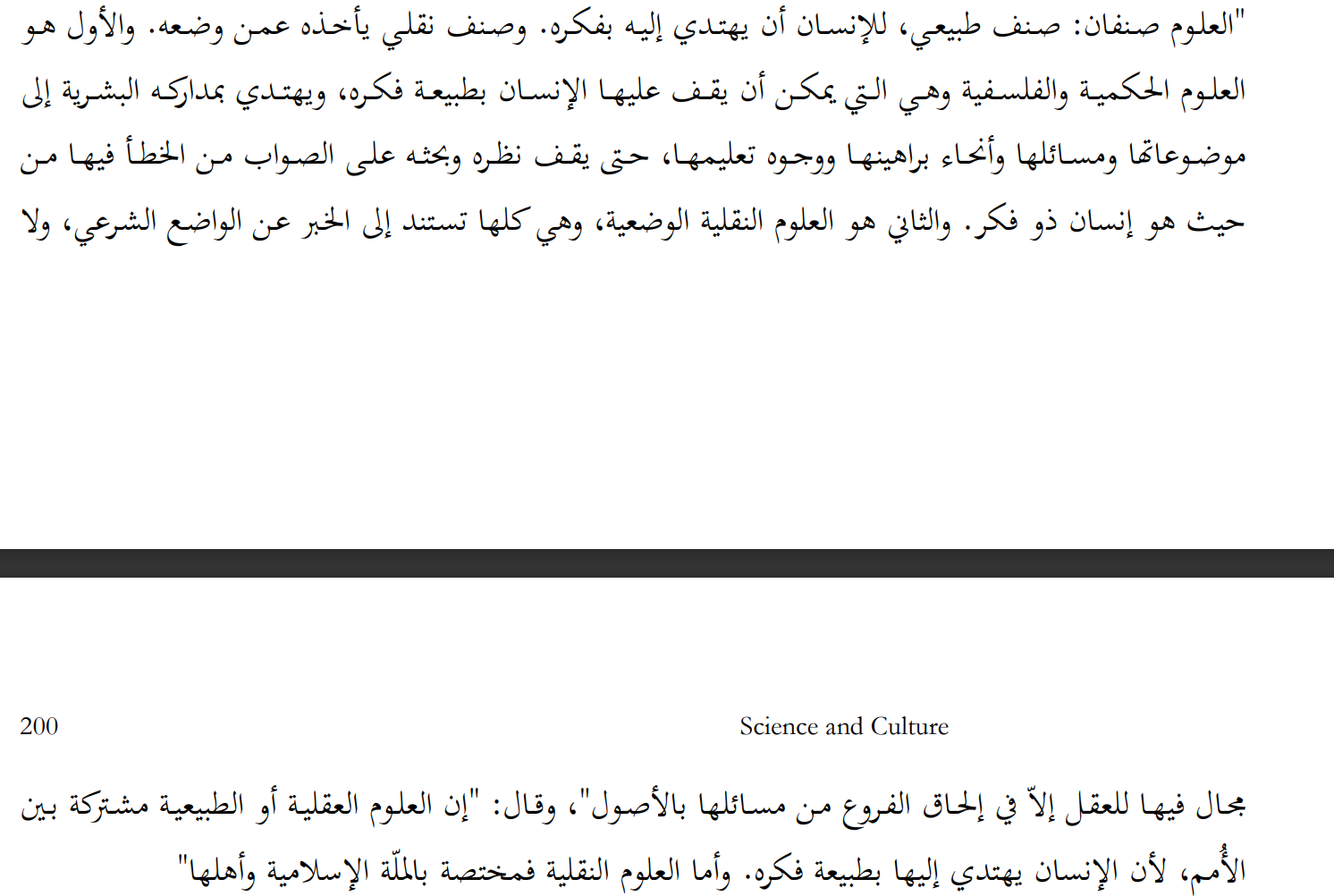
Las ciencias son de dos tipos: uno natural, al que el hombre llega mediante su razonamiento, y otro textual, que toma de quien lo estableció. El primero comprende las ciencias filosóficas y racionales, que puede buscar con su pensamiento y ser guiado, a través de sus facultades humanas, hacia sus temas y cuestiones, todas sus pruebas decisivas y los aspectos de sus enseñanzas. Así, en su discernimiento y estudio, distingue lo correcto de lo incorrecto, en tanto que ser humano dotado de la facultad del pensamiento. El segundo son las ciencias textuales y escritas. Dependen de la transmisión que procede de una fuente shar'i. En este terreno, la mente no tiene margen alguno salvo relacionar las cuestiones secundarias con el usul (fundamento).
“The sciences are of two types: A natural type which is for man to arrive at through his thinking and a textual type which he takes from the one who authored it. The first are the philosophical and aphoristic sciences which he can seek by his thought and be guided through the human faculties to its subjects and issues and all its decisive proofs and aspects of its teachings. So as in his discernment and study he attains the correct (opinion) from the incorrect, in his capacity as a human being possessing the faculty of thought. The second are the textual and written sciences. They depend on the report coming from a shar’i source. The mind has no scope in this regard except to relate the branch issues to the usul (foundation)”.
Dijo también: «Las ciencias racionales o naturales son comunes a todas las naciones, puesto que el hombre llega a ellas de forma natural mediante su pensamiento. En cuanto a las ciencias textuales, son propias de la religión musulmana y de sus adeptos». Parece que lo que Ibn Jaldún quiso decir al especificar las ciencias textuales con la millah islámica fue solo un ejemplo, pues también otras naciones distintas de la nación islámica tienen ciencias textuales propias, como su legislación y su lengua. La afirmación de Ibn Jaldún no indica que distinguiera entre ciencia y cultura. Solo indica que distinguió entre ciencias textuales y ciencias racionales. Sus comentarios no son una prueba de que los musulmanes diferenciaran entre ciencia y cultura; más bien son una prueba de que los musulmanes solo diferenciaban entre disciplinas. Así, las dividieron en dos secciones. Sin embargo, su división se hacía en función de su adquisición general y no en función de la manera de adquirirlas. Por eso las designaron como ciencias racionales, es decir, adquiridas mediante la mente, y ciencias textuales, adquiridas a partir del texto. En cambio, hoy la gente distingue entre disciplinas en función de la manera en que fueron recibidas. Así, aplican el término «ciencia» (‘ilm) a todo lo que se adquiere mediante el método empírico, y el término «cultura» (zaqafa) a todo lo que se adquiere por medios distintos del método empírico.
He also said “The rational or natural sciences are common to all nations since man arrives at them naturally through his thought. As for the textual sciences they are specific to the Muslim religion and its adherents.” It appears that what Ibn Khaldun meant by specifying the textual sciences with the Islamic millah was only an example because nations other than the Islamic nation as well have textual sciences specific to them such as their legislation and language. Ibn Khaldun’s statement does not indicate that he distinguished between science and culture. It only indicates that he distinguished between textual and rational sciences. His comments are not an evidence to say that the Muslims used to differentiate between science and culture rather they are an evidence to prove that the Muslims used only to differentiate between disciplines. Thus, they divided them into two sections. However their division was in terms of their general acquisition and not in terms of the manner of acquisition. So they designated them as rational sciences i.e, acquired via the mind. And textual sciences acquired from the text. However, people today differentiate between disciplines in terms of the manner in which they were received. Thus, they apply the term ‘science’ (‘ilm) on anything that is acquired through the empirical method and they apply the term ‘culture’ (thaqafa) on anything acquired by means other than the empirical method