17.8 El método para designar al Califa
17.8 The Method To Appoint The Khalifah
Cuando la Shari'ah hizo obligatorio para la Ummah designar un Khalifah, también definió el método mediante el cual se designa al Khalifah. Este método está probado por el Corán, la Sunnah y el Ijma' de los Sahabah (ra), y este método es la bay'ah. Así, la designación del Khalifah se lleva a cabo mediante la bay'ah a él. La prueba de que este método es la bay'ah se confirma por la bay'ah de los musulmanes al Profeta ﷺ y por la orden del Profeta ﷺ de que demos bay'ah al Imam. La bay'ah de los musulmanes al Profeta ﷺ no fue por su profetismo, sino por el gobierno, pues fue una bay'ah sobre la acción y no una bay'ah sobre la creencia. Así, se le dio la bay'ah al Profeta ﷺ en su calidad de gobernante y no en calidad de Profeta y Mensajero. Porque el reconocimiento del profetismo y del Mensaje es un asunto de creencia y no de bay'ah, por lo que la bay'ah solo pudo haberse dado a él en su calidad de jefe del Estado. La bay'ah fue mencionada en el Corán y en los hadices. Dijo Allah (swt):
When the Shari’ah made it obligatory upon the Ummah to appoint a Khalifah, it also defined the method by which the Khalifah is appointed. This method is proven by the Qur’an, the Sunnah and the Ijma’a of the Sahabah (ra), and this method is the bay’ah. So the appointment of the Khalifah is carried out by the bay’ah to him. The Proof that this method is the bay’ah is confirmed from the bay’ah of the Muslims to the Prophet (saw) and from the order of the Prophet (saw) for us to give bay’ah to the Imam. The bay’ah of the Muslims to the Prophet (saw) was not on his Prophethood; rather it was on ruling, since it was a bay’ah over action and not a bay’ah on belief. So the Prophet (saw) was given the bay’ah in his capacity as a ruler and not as a Prophet and a Messenger. Because the acknowledgement of the Prophethood and the Message is a matter of belief and not a bay’ah, so the bay’ah could only have been for him in his capacity as the head of the State. The bay’ah was mentioned in the Qur’an and the ahadith. Allah (swt) said:
"¡Oh Profeta ﷺ! Si las creyentes acuden a ti para hacerte un juramento de lealtad (bay'ah) de que no asociarán nada a Allah como copartícipe, no robarán, no cometerán adulterio, no matarán a sus hijos, no inventarán ninguna mentira que hayan urdido entre sus manos y sus pies, ni te desobedecerán en lo que sea correcto, entonces acéptales el juramento de lealtad (bay'ah)." [TMQ 60:12]
"O Prophet, if the believing women come to give you a bay’ah that they will not associate anything as partners to Allah, not to steal, not to commit adultery, not to kill their children, not to produce any lie that they have devised between their hands and feet, nor disobey you in what is right then give them the bay’ah" [TMQ 60:12]
Allah (SWT) también dijo:
Allah (swt) also said:
"Ciertamente, quienes te prestan juramento de lealtad (Muhammad) solo se lo prestan a Allah. La mano de Allah está por encima de sus manos."
"Lo! Those who give bay’ah to you (Muhammad) they give bay’ah only to Allah. The hand of Allah is above their hands"
Al-Bujari relató: Ismail nos transmitió que Malik me transmitió de Yahya bin Said, quien dijo: «Ubadah bin Waleed me informó que mi padre me informó de 'Ubadah bin as-Samit (ra), quien dijo:
Al-Bukhari reported: Ismail related to us that Malik related to me from Yahya bin Said who said: “Ubadah bin Waleed informed me that my father informed me from ‘Ubadah bin as-Samit (ra) who said:
que escucharíamos y obedeceríamos al gobernante tanto en el tiempo en que estuviéramos activos como en el tiempo en que estuviéramos cansados, que no lucharíamos contra el gobernante ni le desobedeceríamos, que nos mantendríamos firmes en la verdad o diríamos la verdad dondequiera que estuviéramos, y que en el Camino de Allah no temeríamos la censura de los censuradores.
“that we would listen to and obey him both at the time when we were active and at the time when we were tired and that we would not fight against the ruler or disobey him, and would stand firm for the truth or say the truth wherever we might be, and in the Way of Allah we would not be afraid of the blame of the blamers.
Al-Bujari relató: Alí bin Abdullah nos transmitió que Abdullah bin Yazid nos transmitió que Saíd (que es ibn al-Musayyib) dijo: Abu 'Aqil Zahrah bin Ma'bad me narró de su abuelo 'Abdullah bin Hisham, quien presenció al Profeta ﷺ, que su madre Zaynab, hija de Hamid, lo llevó ante el Mensajero de Allah ﷺ y dijo: "Oh Mensajero de Allah, acepta su juramento de lealtad". El Profeta ﷺ dijo:
Al-Bukhari reported: Ali bin Abdullah related to us that Abdullah bin Yazeed related to us that Saeed (who is ibn al-Musayyib) who said: Abu ‘Aqeel Zahrah bin Ma’bad narrated to me from his grandfather ‘Abdullah bin Hisham who witnessed the Prophet (saw) that his mother Zaynab, daughter of Hameed, took him to the Messenger of Allah (saw) and said: “O Messenger of Allah, take his pledge. The Prophet (saw) said:
«Es un niño», y le pasó la mano por la cabeza (la frotó) e hizo du'a por él.
“He is a child, and rubbed (wiped) his head and said du‘a for him.”
Al-Bujari dijo: ‘Abdan bin Abu Hamza nos relató de Al-‘Amash, de Abu Salih, de Abu Hurairah (ra), quien dijo: El Mensajero de Allah ﷺ dijo:
Al-Bukhari said: ‘Abdan bin Abu Hamza related to us from Al-‘Amash from Abu Salih from Abu Hurairah (ra) who said: The Messenger of Allah (saw) said:

(Habrá tres tipos de personas a quienes Allah no les hablará el Día de la Resurrección ni los purificará de sus pecados, y tendrán un castigo doloroso: son, (1) un hombre que posee agua sobrante (más de lo que necesita) en un camino y se la niega a los viajeros. (2) Un hombre que presta juramento de lealtad a un Imam (gobernante) y lo hace solo por beneficios mundanos: si el Imam le da lo que quiere, cumple su juramento; de lo contrario, no cumple su compromiso. (3) Y un hombre que vende algo a otro hombre después de la oración del 'Asr y jura por Allah (un juramento falso) que le han ofrecido tanto por ello, con lo que el comprador le cree y lo compra, aunque en realidad el vendedor no le han ofrecido tal precio.)
“(There will be three types of people whom Allah will neither speak to them on the Day of Resurrection nor will purify them from sins, and they will have a painful punishment: They are, (1) a man possessed superfluous water (more than he needs) on a way and he withholds it from the travelers. (2) a man who gives a pledge of allegiance to an Imam (ruler) and gives it only for worldly benefits, if the Imam gives him what he wants, he abides by his pledge, otherwise he does not fulfill his pledge; (3) and a man who sells something to another man after the `Asr prayer and swears by Allah (a false oath) that he has been offered so much for it whereupon the buyer believes him and buys it although in fact, the seller has not been offered such a price..”
De estos tres ahadith se deduce explícitamente que la bay'ah es el método para designar al Jalifa. El hadiz de 'Ubadah afirma que prestó bay'ah al Profeta ﷺ para escuchar y obedecer, y esta es una bay'ah a un gobernante. El hadiz de 'Abdullah bin Hisham afirma que el Profeta ﷺ rechazó su bay'ah porque no era maduro, lo que indica que se trata de una bay'ah sobre el gobierno. Del hadiz narrado por Abu Hurairah (ra) se desprende claramente que es una bay'ah al Imam. La palabra 'Imam' en el hadiz no está definida, es decir, se refiere a cualquier Imam. Hay otros ahadith que se refieren a prestar bay'ah al Imam. Se relata en Muslim, a través de 'Abdullah bin 'Amru, que el Profeta ﷺ dijo:
From these three ahadith it is explicit that the bay’ah is the method of appointing the Khalifah. The hadith of ‘Ubadah states that he gave bay’ah to the Prophet (saw) to listen and obey and this is a bay’ah to a ruler. The hadith of ‘Abdullah bin Hisham states that the Prophet (saw) rejected his bay’ah because he was not mature which indicates that it is a bay’ah on ruling. From the hadith reported by Abu Hurairah (ra) it is evident that it is a bay’ah to the Imam. The word ‘Imam’ in the hadith is undefined i.e. any Imam. There are other ahadith which refer to giving bay’ah to the Imam. It is reported in Muslim via Abdullah bin ‘Amru that the Prophet (saw) said:
“Quien haya prestado bay'ah a un Imam, dándole su apretón de manos y el fruto de su corazón, debe obedecerle en cuanto pueda. Si otra persona viene a disputarle el mando, que le sea cortado el cuello a este último”.
“Whoever gave bay’ah to an Imam giving him his handshake and the fruit of his heart should obey him as much as he can. If another person comes to dispute with him, strike the neck of the latter”.
Muslim narra de Abu Said al-Juderi, quien dijo: El Profeta ﷺ dijo:
Also Muslim narrates from Abu Said al-Khudri who said: The Prophet (saw) said:
"Si se presta juramento de lealtad (bay'ah) a dos califas, mata al último de ellos."
“If a bay’ah is given to two Khalifahs kill the latter of them.”
Y Muslim narró que Abu Hazim dijo: «Acompañé a Abu Hurairah (ra) durante cinco años y lo escuché narrar del Profeta ﷺ, quien dijo:
And Muslim narrated that Abu Hazim who said: “I accompanied Abu Hurairah (ra) for five years and heard him narrate from the Prophet (saw) who said:
"Los profetas gobernaban a los hijos de Israel. Cada vez que moría un profeta, otro profeta le sucedía, pero no habrá profeta después de mí. Habrá califas y serán muchos. Preguntaron: ¿Qué nos ordenas entonces? Dijo: Cumplid con el juramento de lealtad (bay'ah) a ellos uno tras otro y dadles lo que les corresponde. Ciertamente Allah les preguntará sobre aquello que les encomendó."
“The Prophets ruled over the children of Israel. Whenever a Prophet died another Prophet succeeded him, but there will be no Prophet after me. There will be Khulafaa and they will number many. They asked: What then do you order us? He said: Fulfill the bay’ah to them one after the other and give them their due. Surely Allah will ask them about what He entrusted them with.”
Entonces, los textos del Corán y la Sunnah son claros en que el método para designar al Khalifah es la bay'ah. Todos los Sahabah lo comprendieron y lo siguieron. Así, Abu Bakr (ra) recibió una bay'ah especial en el patio de Banu Sa‘ida, y una bay'ah pública en la mezquita; quienes no le dieron la bay'ah en la mezquita, y cuya bay'ah se considera válida, la dieron más tarde, como ‘Ali bin Abu Talib (ra). ‘Umar (ra) recibió la bay'ah de los musulmanes, ‘Uthman (ra) también recibió la bay'ah de los musulmanes, y ‘Ali (ra) recibió la bay'ah de los musulmanes igualmente. Por tanto, la bay'ah es el único método para designar un Khalifah para los musulmanes.
So the texts from the Qura'n and the Sunnah are clear that the method of appointing the Khalifah is the bay’ah. All the Sahabah understood this and followed it. So Abu Bakr (ra) was given a special bay’ah in the courtyard of Banu Sa‘ida, and a public bay’ah in the mosque, those who did not give him the bay’ah in the mosque and whose bay’ah is considered gave it later on like ‘Ali bin Abu Talib (ra). ‘Umar (ra) was given the bay’ah from the Muslims, ‘Uthman (ra) also was given the bay’ah by the Muslims and ‘Ali (ra) was given the bay’ah by the Muslims as well. So the bay’ah is the only method to appoint a Khalifah for the Muslims.
En cuanto a los detalles prácticos para llevar a cabo la bay'ah, son evidentes en el nombramiento de los cuatro Julafá' que sucedieron directamente a la muerte del Profeta ﷺ: Abu Bakr (ra), 'Umar (ra), 'Uthman (ra) y 'Ali (ra). Y todos los Sahabah (ra) aceptaron esto y lo confirmaron. Si hubiera sido contrario a la Shari'ah, lo habrían rechazado sin duda, pues se trata de lo más importante de lo que depende el bienestar de los musulmanes y la perdurabilidad del gobierno islámico. Quien siga lo sucedido en el nombramiento de estos Julafá' encontrará que algunos musulmanes debatieron en el patio de los Banu Sa'ida; los candidatos fueron solamente Sa'd (ra), Abu 'Ubaydah (ra), 'Umar (ra) y Abu Bakr (ra), y como resultado del debate se le dio la bay'ah a Abu Bakr (ra). Al día siguiente se convocó a los musulmanes a la mezquita y le dieron su bay'ah. Como consecuencia de esta bay'ah, Abu Bakr (ra) se convirtió en Jalifa de los musulmanes. Cuando Abu Bakr (ra) sintió que su enfermedad conllevaba la muerte, llamó a los musulmanes para consultarles quién podría ser el siguiente Jalifa. La opinión en estas consultas se centró solamente en 'Ali (ra) y 'Umar (ra). Continuó con estas consultas durante tres meses. Cuando las completó y conoció la opinión de la mayoría de los musulmanes, les anunció que 'Umar (ra) sería el Jalifa después de él. Inmediatamente después de su muerte, los musulmanes acudieron a la mezquita y dieron la bay'ah de Jilafah a 'Umar (ra), por lo que llegó a ser Jalifa por esta bay'ah de los musulmanes, no por las consultas ni por el anuncio de Abu Bakr (ra). Cuando 'Umar (ra) fue apuñalado, los musulmanes le pidieron que designara a un sucesor, pero él se negó. Insistieron, así que dejó la decisión en manos de seis Sahabah (ra). Luego, después de su muerte, los candidatos designaron a uno de ellos, 'Abdurrahman bin 'Auf (ra), como representante. Este recurrió a la opinión de los musulmanes y los consultó. Después declaró la bay'ah a 'Uthman (ra). Los musulmanes se levantaron y prestaron su bay'ah a 'Uthman (ra), y de ese modo llegó a ser el Jalifa por el juramento de lealtad de los musulmanes y no por el anuncio de 'Abdurrahman (ra). Más adelante, 'Uthman (ra) fue asesinado, y la mayoría de los musulmanes de Medina y Kufa prestaron su bay'ah a 'Ali bin Abu Talib (ra), de modo que él también llegó a ser el Jalifa por la bay'ah de los musulmanes.
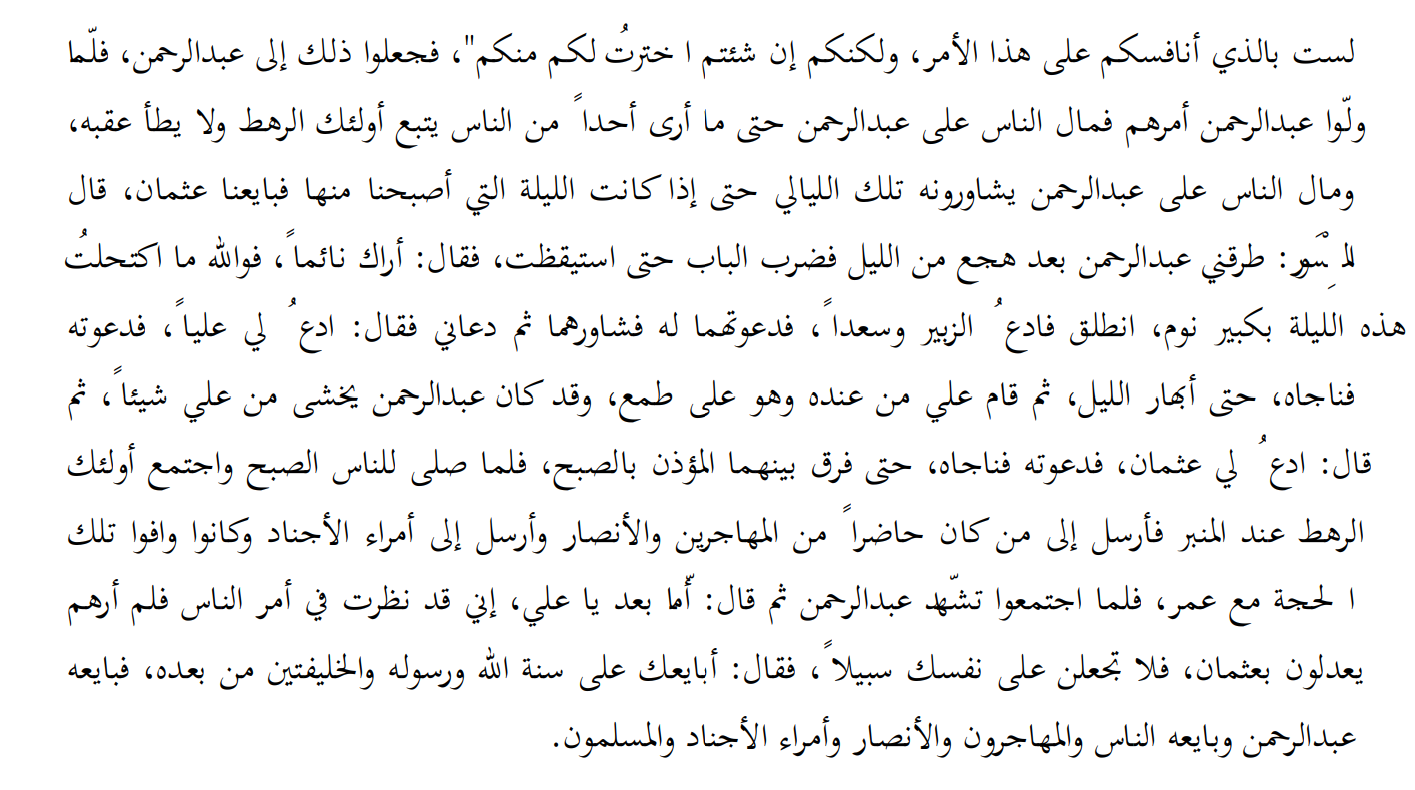
“No soy yo quien compite con ustedes por este asunto, pero si lo desean, podría elegir para ustedes a uno de entre ustedes.” Así que encargaron esto a ‘Abdurrahmán. Cuando ‘Abdurrahmán se hizo cargo de este asunto, la gente acudió a él hasta tal punto que no vi a nadie que siguiera a aquel grupo ni que se quedara atrás de ellos. La gente acudía a ‘Abdurrahmán para consultarle durante aquellas noches, hasta la noche en que nos despertamos por la mañana y dimos nuestro juramento de lealtad (bay‘ah) a ‘Uzmán. Al-Miswar dijo: ‘Abdurrahmán llamó a mi puerta, después de que hubiera transcurrido parte de la noche, hasta que me desperté. Me dijo: “Veo que estás durmiendo. Por Allah, esta noche mis ojos apenas han encontrado sueño. Ve y llama a Az-Zubair y a Sa‘d.” Yo los invité a venir. Él les consultó. Luego me llamó y me dijo: “Llama a ‘Alí por mí”, así que lo llamé. Mantuvo una conversación en voz baja con él hasta que se desvaneció la noche. Entonces ‘Alí se marchó con algunas expectativas, y ‘Abdurrahmán temía algo de ‘Alí. Después dijo: “Llama a ‘Uzmán por mí”, así que lo llamé. Mantuvo una conversación en voz baja con él hasta que se separaron, justo cuando el muecín llamó a la oración del alba (fayr). Tras dirigir a la gente en la oración del alba, cuando el grupo de seis personas se reunió junto al minbar (púlpito), envió a buscar a todos los muhayirun y ansar presentes (en Medina) y a los jefes del ejército que realizaron la peregrinación ese año con ‘Umar. Cuando se reunieron, ‘Abdurrahmán recitó los dos testimonios de fe (shahadahs) y dijo: “¡Oh ‘Alí! He considerado el asunto de la gente y no veo que nadie se equipare a ‘Uzmán, así que no dejes que nada te perturbe.” Y dijo (a ‘Uzmán): “Te doy la bay‘ah según el camino de Allah, de Su Mensajero ﷺ y de los dos califas que le sucedieron.” Así, ‘Abdurrahmán, los muhayirun, los ansar, los jefes del ejército y el resto de los musulmanes le prestaron la bay‘ah.
“I am not one who competes with you for this matter but if you wish I could choose for you one from among you. So they assigned this to ‘Abdurrahman . When they charged ‘Abdurrahman with this matter, people turned to him to the extent that I did not see any one who followed this group or stepped behind them. The people turned to ‘Abdurrahman consulting him in those nights until the night of which we woke up in the morning and gave our pledge to ‘Uthman. Al-Miswar said: ‘Abdurrahman knocked at my door, after a part of the night had passed, until I woke up. He said: I see you sleeping. By Allah, my eyes did not find much sleep tonight. Set forth and call Az-Zubair and Sa‘d. I invited them to him. He consulted with them. Then he called me and said: Call ‘Ali for me, so I called him. He carried on a whispered conversation with him until the night faded away. Then ‘Ali left him with some expectations, and ‘Abdurrahman was afraid about something from ‘Ali. Then he said call ‘Uthman for me, so I called him. He carried on whispered conversation with him until they departed as the muezzin called for fajr prayer. After he led the people in the fajr prayer, and the group of six persons met near the minbar (pulpit), he sent for all the Muhajirs and Ansar who were present (in Madinah) and sent for the leaders of the army who delivered the pilgrimage that year with ‘Umar. When they met, ‘Abdurrahman recited the two testimonies of faith (shahadahs) and said: O ‘Ali! I viewed the matter of the people and did not see them equalling anyone to ‘Uthman, so do not let anything disturb yourself. And he said (to ‘Uthman): I give you the bay’ah upon the way of Allah, His Messenger and the two Khulafaa who came after him. So ‘Abdurrahman, the Muhajirs, the Ansar, the leaders of the army and rest of the Muslims gave him the bay’ah.”
Por tanto, los candidatos a la Jilafa se limitaban al grupo nombrado por ‘Umar (ra) después de que los musulmanes se lo pidieran. ‘Abdurrahmán bin ‘Awf (ra), tras retirarse él mismo de la candidatura a la Jilafa, consultó la opinión de los musulmanes sobre quién sería el Jalifa. Luego anunció el nombre de la persona que los musulmanes deseaban, después de haberlo consultado con ellos. Una vez anunciado el nombre de la persona que el pueblo quería, se le dio la bay‘ah y se convirtió en Jalifa por esta bay‘ah. Por ello, el hukm shar‘i relativo al nombramiento del Jalifa consiste en limitar los candidatos a la Jilafa a quienes representen la opinión de la mayoría de los musulmanes. Después, sus nombres se dan a conocer a los musulmanes y se les pide que elijan a uno de los candidatos como Jalifa para todos. Entonces se determina a quién han elegido la mayoría de los musulmanes, y se toma la bay‘ah de todos los musulmanes para él, hubiera sido elegido específicamente por cada persona o no. Este es el método por el Ijma‘ de los Sahabah respecto a que ‘Umar (ra) limitara los candidatos a la Jilafa a seis personas concretas, y por el consenso de los Sahabah en que ‘Abdurrahmán (ra) tomara la opinión de todos los musulmanes sobre quién sería su Jalifa, y por el consenso en dar la bay‘ah a quien ‘Abdurrahmán (ra) anunció como la persona elegida por los musulmanes como Jalifa, lo cual queda claro cuando dijo:
So the nominees for the Khilafah were limited to the group named by ‘Umar (ra) after the Muslims had asked him to do so. ‘Abdurrahman bin ‘Auf (ra), after he withdrew himself from the nomination to the Khilafah, took the opinion of the Muslims about who would be the Khalifah. He then announced the name of the person who the Muslims wanted after consulting with them. After he announced the name of the person who the people wanted, the bay’ah was given to him and he became the Khalifah by this bay’ah. Therefore the hukm shari’ concerning the appointment of the Khalifah is to limit the nominees for the Khilafah by those who represent the opinion of the majority of Muslims. Then their names are displayed to the Muslims and they are asked to select one of the nominees to be Khalifah for all. Then it is determined whom the majority of the Muslims have chosen, and the bay’ah from all the Muslims is taken for him, whether each person had specifically chosen him or not. This is the method because of the Ijma’a of the Sahabah about ‘Umar (ra) limiting the nominees for the Khilafah to six specific persons, and the consensus of the Sahabah that ‘Abdurrahman (ra) takes the opinion of all the Muslims about who will be the Khalifah for them, and the consensus to give the bay’ah to the one who ‘Abdurrahman (ra) announced as the person elected by Muslims as a Khalifah is clear when he said:
«He hecho un examen de las tendencias de la gente y he notado que no consideran a nadie igual a ʿUthmān.»
“I have looked at the people's tendencies and noticed that they do not consider anybody equal to `Uthman.”
Todos estos puntos aclaran el hukm shari’ con respecto al nombramiento del Khalifah.
All of these points clarify the hukm shari’ concerning the appointment of the Khalifah.
Quedan dos cuestiones por examinar. La primera: ¿quiénes son los musulmanes que nombran al Jalifa? ¿Son las personas influyentes o un número determinado de musulmanes? ¿O todos los musulmanes nombran al Jalifa? La segunda cuestión se refiere a las prácticas de este siglo en las elecciones, como las votaciones secretas, las urnas y el recuento de votos. ¿Son estos asuntos compatibles con el Islam, y permite el Islam o no?
Two issues remain to be examined. One of them is who are the Muslims who appoint the Khalifah? Are they the influential people or a certain specific number of Muslims? Or do all of the Muslims appoint the Khalifah? The second issue concerns the actions occurring in this century in elections such as secret ballots, polling boxes and counting votes. Are these matters consistent with Islam and does Islam allows them or not?
En cuanto a la primera cuestión, Allah (swt) ha otorgado la autoridad a la Ummah y ha hecho de la designación del Khalifah un derecho y un deber de todos los musulmanes; y no lo hizo un derecho de un grupo particular con exclusión de otro, ni de una jama‘ah dejando de lado a otra jama‘ah, pues el bay’ah es un deber para todos los musulmanes. El Profeta ﷺ dijo:
As for the first issue, Allah (swt), has given the authority to the Ummah and he (swt) made the appointment of the Khalifah a right and duty for all Muslims; and He did not make it a right for one particular group excluding another, nor for a jama‘ah leaving another jama‘ah aside, since the bay’ah is a duty upon all the Muslims. The Prophet (saw) said:
«Quien muera sin tener un juramento de lealtad sobre su cuello, morirá la muerte de la yahiliyyah».
“Whoever dies without having a pledge upon his neck would die the death of jahiliyyah”,
Y esto es general para todo musulmán. Por lo tanto, las personas influyentes no poseen el derecho exclusivo a designar al Jalifa, y no pueden ignorar al resto de los musulmanes. Tampoco personas concretas tienen ese derecho exclusivo. Más bien, este derecho corresponde a todos los musulmanes sin excepción; incluso abarca a los fāsiq (pecadores) y a los munāfiqīn (hipócritas), siempre que sean musulmanes adultos, porque el texto de la Shari'ah llegó en forma general en este caso y nada vino a limitarlo (a concretarlo en ciertas personas) salvo el rechazo del juramento de los jóvenes que aún no han alcanzado la edad de la pubertad. Por tanto, el texto debe tomarse en sentido general.
And this is general for every Muslim. Therefore, the influential people do not possess the exclusive right to appoint the Khalifah and cannot ignore the rest of the Muslims. Nor do specific persons have the exclusive right. Rather, this right is for all the Muslims with no exception, it even includes the fajirs (wicked people) and munafiqeen (hypocrites), provided they are mature Muslims because the Shari’ah text came in a general form in this instance and nothing came to limit it (make it specific to certain people) except the refusal of the pledge from the young who have not yet reached the age of puberty. So the text has to be taken generally.
No obstante, no es una condición que todos los musulmanes ejerzan este derecho. Aunque es un deber, pues la bay'ah es fard, es fard kifayah (obligación de suficiencia) y no fard ain (obligación individual). Por tanto, si algunos de los musulmanes la cumplen, el deber se levanta de los demás musulmanes. Pero todos los musulmanes deben estar capacitados para ejercer su derecho a elegir al Khalifah, independientemente de si usan o no ese derecho. En otras palabras, todo musulmán debe poder participar en la selección del Khalifah. Así, la cuestión es capacitar a los musulmanes para llevar a cabo el deber de establecer el Khalifah que Allah (swt) les ha prescrito, de tal manera que dicho deber quede cumplido (de sus hombros). La cuestión no es la participación real de todos los musulmanes en la realización de este deber. Esto se debe a que el deber que Allah (swt) ha prescrito es establecer el Khalifah para los musulmanes por su consentimiento, y no es requisito que todos los musulmanes lo realicen. De ello se derivan dos cuestiones: una es que el consentimiento de todos los musulmanes en el establecimiento del Khalifah se logra. La segunda es que el consentimiento de todos los musulmanes sobre la designación no se logra. Sin embargo, los musulmanes están capacitados (para participar en la designación) en ambos casos.
However, it is not a condition that all Muslims practise this right. While it is a duty, because the bay’ah is fard, it is fard kifayah (obligation of sufficiency) and not fard ain (individual obligation). Thus, if some of the Muslims fulfill it, the duty drops from the rest of the Muslims. But all Muslims must be enabled to practice their right in electing the Khalifah, regardless of whether they use their right or not. In other words, every Muslim must be able to participate in selecting the Khalifah. So the issue is to enable the Muslims to carry out the duty of establishing the Khalifah which Allah (swt) prescribed upon them, in such a way that this duty falls (from their shoulders). The issue is not the actual participation of all the Muslims in conducting this duty. This is because the duty which Allah (swt) has prescribed is to establish the Khalifah for the Muslims by their consent, and it is not a requirement for all Muslims to perform it. Two matters result from this: One of them is that the consent of all the Muslims in the establishment of the Khalifah is achieved. Secondly, the consent of all the Muslims about the appointment is not achieved. The Muslims are however enabled (to participate in the appointment) in both cases.
"En principio, las cosas están permitidas, salvo que exista una evidencia de prohibición."
“In Principle things are permitted unless there exists an evidence of prohibition.”
La diferencia entre método (tariqah) y estilo es que el método es una acción que se considera en sí misma como un origen, o una rama de una acción para la cual no existe una evidencia general sobre su origen; más bien, su evidencia es específica para ella. El estilo es una acción que es una rama de una acción —es decir, del origen— sobre la cual no existe evidencia general. Por lo tanto, el método debe apoyarse en una evidencia de la Shari'ah, porque es una norma de la Shari'ah, y en consecuencia debe seguirse, y los musulmanes no tienen elección al respecto, salvo que su norma sea la de ibahah (permisibilidad). Esto es distinto del estilo, que no depende de una evidencia de la Shari'ah, sino que queda incluido en la norma de su origen. Por ello, no es obligatorio seguir un estilo particular, incluso si el Mensajero ﷺ
The difference between method (tareeqah) and style is that the method is an action which is considered by itself as an origin, or a branch to an action that does not have a general evidence for its origin; rather its evidence is specific to it. The style is an action which is a branch to an action—i.e. the origin—upon which there is no general evidence. Therefore, the method must depend upon a Shari’ah evidence because it is a Shari’ah rule, thus it must be adhered to and Muslims have no choice concerning it unless its rule is ibaha (of permissibility). This is different from the style which does not depend on a Shari’ah evidence; rather it is included in the rule of its origin. Therefore, it is not obligatory to follow a particular style even if the Messenger (saw)
Más bien, a un musulmán se le permite usar cualquier estilo siempre que conduzca a la realización de la acción, y así se convierte en una rama de la acción. Por ello se dice que el estilo está definido por el tipo de acción.
did so. Rather a Muslim is allowed to use any style as long as it leads to the performance of the action, and thus it becomes a branch to the action. Thus it is said that the style is defined by the type of action.