17.3 El juramento de lealtad (bay'ah)
17.3 The Pledge (bay’ah)
El bay'ah es una obligación para todos los musulmanes, y es un derecho de todo musulmán, hombre o mujer. La evidencia de que es una obligación se encuentra en numerosos ahadiz del Profeta ﷺ, en los que dijo:
Bay’ah is an obligation upon all Muslims, and it is a right for every Muslim, man or woman. The evidence for it being an obligation is in many ahadith of the Prophet (saw), in which he said:
«Quien muere sin tener un bay'ah sobre su cuello, muere una muerte de yahiliyyah.»
“Whosoever dies without having a bay’ah upon his neck dies a death of jahiliyyah.”
En cuanto a que sea un derecho de los musulmanes, el propio bay'ah lo indica, pues el bay'ah lo ofrecen los musulmanes al Khalifah, y no el Khalifah a los musulmanes. El bay'ah de los musulmanes al Profeta ﷺ quedó confirmado en los ahadiz. Al-Bujari relató que ‘Ubadah bin as-Samit (ra) dijo:
As for being a right for Muslims, the bay’ah itself indicates that, because the bay’ah is offered by the Muslims to the Khalifah, and not by the Khalifah to the Muslims. The bay’ah of the Muslims to the Prophet (saw) was confirmed in the ahadith. Al-Bukhari reported that ‘Ubadah bin as-Samit (ra) said:
«Hicimos bay'ah al Profeta ﷺ de escuchar y obedecer en lo que nos agrade y en lo que nos disguste, y de no disputar la orden de quienes tienen autoridad, de decir la verdad dondequiera que estemos, y de no temer la censura de nadie al actuar o hablar por causa de Allah.»
“We made a bay’ah to the Prophet (saw) to hear and to obey in whatever pleases and displeases us, and that we would not dispute the order of those in charge, that we would speak the truth wherever we are, and that we would not fear the blame of anyone when acting or speaking for the sake of Allah.”
Al-Bujari relató de Ayyub, de Hafsa, de Umm 'Atiyyah, quien dijo:
Al-Bukhari reported from Ayyub from Hafsa from Umm ‘Atiyyah who said:
«Le prestamos juramento de lealtad (bay'ah) al Profeta ﷺ, y él me recitó el versículo: {Que no asociarán nada en la adoración con Allah} (TMQ 60.12). Y también nos prohibió lamentarnos y llorar en voz alta por los muertos. Una mujer de entre nosotras extendió su mano y dijo: "Fulana lloró por un muerto de mi familia, y quiero recompensarla por ese llanto". El Profeta ﷺ no le respondió nada, y ella se marchó y regresó.» Wait, correction: the translation should be in Spanish, not French. Here is the corrected version: Le prestamos juramento de lealtad (bay'ah) al Profeta ﷺ, y él me recitó el versículo: {Que no asociarán nada en la adoración con Allah} (TMQ 60.12). Y también nos prohibió lamentarnos y llorar en voz alta por los muertos. Una mujer de entre nosotras extendió su mano y dijo: "Fulana lloró por un muerto de mi familia, y quiero recompensarla por ese llanto". El Profeta ﷺ no le respondió nada, y ella se marchó y regresó.
“We gave a bay’ah to the Prophet (saw) and he recited to me the verse That they will not associate anything in worship with Allah (TMQ 60.12). And he also prevented us from wailing and lamenting over the dead. A woman from us held her hand out and said, "Such-and-such a woman cried over a dead person belonging to my family and I want to compensate her for that crying" The Prophet did not say anything in reply and she left and returned.”
Y en Al-Bujari, de Abu Hurairah (ra), quien dijo: El Profeta ﷺ dijo:
And in Al-Bukhari from Abu Hurairah (ra) who said: The Prophet (saw) said:
“(Hay) tres personas a las que Allah no hablará el Día de la Resurrección, ni las purificará, y para ellas hay un castigo doloroso: una persona que tiene agua de sobra en el camino y se la niega al viajero; una persona que presta juramento de lealtad (bay'ah) a un imam solo por sus intereses mundanos, de modo que si el imam le da lo que quiere, cumple el juramento, y si no, no lo cumple; y una persona que vende una mercancía a otra después del asr (última hora de la tarde) y jura por Allah que le ofrecieron tal y tal cantidad por ella, aunque no fue así, y el comprador le cree y la compra.”
“(There are) three persons to whom Allah will not talk on the Resurrection Day, nor purify them, and for them is a severe punishment: A person who has an excess of water on the road and prevents the wayfarer from it; a person who gives bay’ah to an Imam for his worldly affairs only, so if the Imam gave him that which he wants he fulfilled (the bay’ah) to him, otherwise he would not; and a person trading a commodity to another after asr (late afternoon) and he swore by Allah that he was offered so and so for it, although he was not, and the person believed him and bought it.”
Al-Bujari narró de ‘Abdullah bin ‘Umar (ra), quien dijo:
Al-Bukhari narrated from ‘Abdullah bin ‘Umar (ra) who said:
«Cuando hacíamos el bay'ah al Profeta ﷺ de escuchar y obedecer, él nos decía: En la medida en que seáis capaces».
“When we gave a bay’ah to the Prophet (saw) to hear and obey, he would say to us: As much as you are capable of”
«Cuando prestamos juramento de lealtad (bay'ah) al Profeta ﷺ para escuchar y obedecer, él nos decía: En la medida de vuestras capacidades».
“When we gave a bay’ah to the Prophet (saw) to hear and obey, he would say to us: As much as you are capable of”
«Hice bay'ah al Profeta ﷺ para escuchar y obedecer, y él me instruyó: en la medida de tus posibilidades, y a dar buen consejo a todo musulmán.»
“I gave bay’ah to the Prophet (saw) to hear and obey and he instructed me: As much as you are able, and to give good advice to every Muslim.”
Narró Al-Bujari de Yunada bin Abi Umayya, quien dijo:
Al-Bukhari narrated from Junada bin Abu Umayyah who said:
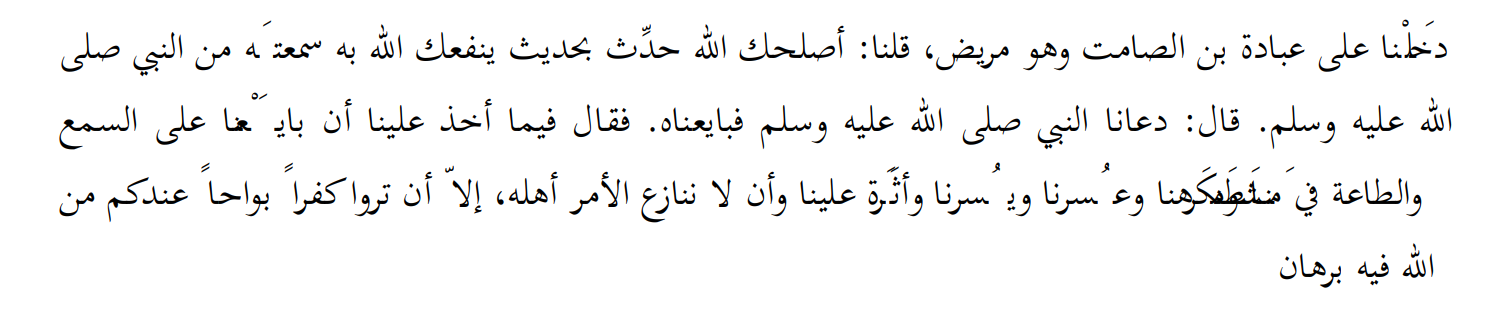
Entramos en la casa de ‘Ubadah bin as-Samit mientras estaba enfermo y le dijimos: Que Allah le conceda salud, infórmenos de un hadiz que haya oído del Profeta ﷺ, mediante el cual Allah (SWT) pueda beneficiarle. Él dijo: El Profeta ﷺ nos invitó y le dimos nuestro bay’ah (juramento de lealtad). Entre las condiciones sobre las que nos tomó juramento estaba la de escuchar y obedecer (las órdenes), tanto en el momento en que estábamos activos como cuando estábamos cansados, en los tiempos de facilidad y de dificultad, y cuando viéramos preferencia (de otros sobre nosotros), y no disputar la autoridad de quienes están investidos de ella, diciendo: Salvo que veáis un kufr bawah (incredulidad manifiesta) sobre el cual tengáis una prueba clara de Allah.
“We entered the house of ‘Ubadah bin as-Samit while he was ill and we said: May Allah make you healthy, inform us of a hadith you heard from the Prophet (saw) by which Allah (swt) may benefit you. He said: The Prophet (saw) invited us and we gave him our bay’ah (pledge of Allegiance). And among the conditions on which he took the pledge from us, was that we were to listen and obey (the orders) both at the time when we were active and when we were tired , and in the times of ease and hardship and when we see preference (for others over us), and not to dispute the authority of those who are entrusted with it saying: Unless you see open disbelief (kufr bawah) upon which you have a clear proof from Allah.”
La bay'ah al Jalifah está en manos de los musulmanes, y es su derecho; son ellos quienes dan la bay'ah, y es su bay'ah la que hace que el califato se contrate para un Jalifah. La bay'ah puede darse estrechando la mano o por escrito. 'Abdullah bin Dinar narró diciendo:
The bay’ah for the Khalifah is in the hands of the Muslims, and it is their right; it is they who give the bay’ah, and it is their bay’ah which makes the Khilafah contracted for a Khalifah. The bay’ah can be by shaking hand or by writing. ‘Abdullah bin Dinar narrated saying:
“Presencié cómo Ibn ‘Umar se reunía la gente alrededor de ‘Abdulmalik ibn Marwan. Él escribió: Acepto escuchar y obedecer al siervo de Allah, ‘Abdulmalik, Amir al-Mu’mineen, conforme a la Sunnah de Allah y la Sunnah de Su Profeta ﷺ en la medida de mis capacidades.”
“I witnessed bin ‘Umar where the people gathered around ‘Abdulmalik bin Marwan. He wrote: I agree to listen and obey to the slave of Allah, ‘Abdulmalik the Amir al-Mu’mineen, according to the Sunnah of Allah and the Sunnah of His Prophet as much as I am able.”
Además, el bay'ah es correcto por cualquier medio (waseelah). Sin embargo, el bay'ah debe ser otorgado por la persona madura, por lo que es impropio que lo otorgue un joven. Abu Aqeel Zahra bin Ma‘bed relató de su abuelo ‘Abdullah bin Hisham —quien presenció al Profeta ﷺ— que su madre Zaynab, hija de Hameed, lo llevó ante el Profeta ﷺ y dijo: "¡Oh Profeta de Allah, toma el juramento de lealtad de él!". El Profeta ﷺ dijo:
Moreover, the bay’ah is correct by any means (waseelah). However, the bay’ah has to be given by the mature person, so it is improper to be given by the young. Abu Aqeel Zahra bin Ma‘bed reported from his grandfather ‘Abdullah bin Hisham--who witnessed the Prophet (saw)--that his mother Zaynab, the daughter of Hameed, took him to the Prophet (saw) and said: O Prophet of Allah, take a pledge from him. The Prophet (saw) said:
«Es un niño», le pasó la mano por la cabeza e hizo una du‘a por él.
“He is a child, wiped his head and made a du‘a for him.”
En cuanto a las palabras del bay'ah, no están restringidas a términos específicos. Sin embargo, deben incluir actuar conforme al Libro de Allah (swt) y a la Sunnah de Su Profeta (saw) por parte del Khalifah, y obediencia en la adversidad y en la facilidad, y obediencia en lo que agrada y en lo que desagrada por parte de quien presta el bay'ah (al Khalifah). Cuando quien hace el juramento ha dado su bay'ah al Khalifah, o el Khilafah queda contratado con el Khalifah mediante el bay'ah de otros musulmanes, entonces el bay'ah se ha convertido en un fideicomiso sobre el cuello de quien da el bay'ah, y no le está permitido retractarse. Es un derecho del contrato del Khilafah hasta que lo haya dado, y una vez dado debe cumplirlo. No le está permitido retractarse de él. Al-Bukhari narró de Jabir bin 'Abdullah (ra) que un beduino dio al Profeta (saw) su juramento de lealtad al Islam, y le sobrevino una enfermedad, así que dijo al Profeta (saw): "Permíteme retirar mi bay'ah", pero el Profeta (saw) se negó, y el hombre se marchó. Entonces el Profeta (saw) dijo:
As for the words of the bay’ah they are not restricted to specific terms. However they must include acting according to the Book of Allah (swt) and the Sunnah of His Prophet (saw) by the Khalifah, and obedience in hardship and ease and obedience, and whatever pleases and displeases on the part of the person who gives the bay’ah (to the Khalifah). Whenever the one who pledges has given his bay’ah to the Khalifah or the Khilafah is contracted to the Khalifah by the bay’ah of other Muslims, then the bay’ah has become a trust on the neck of the one who gives the bay’ah and he is not allowed to retract it. It is a right for the contract of the Khilafah until he has given it, and once he has given it he must abide by it. He is not allowed to retract from it. Al-Bukhari narrated from Jabir bin ‘Abdullah (ra) that a Bedouin gave the Prophet (saw) his pledge on Islam, and an illness struck him so he said to the Prophet (saw): “Let me withdraw my bay’ah but the Prophet (saw) refused, and the man left. The Prophet (saw) then said:
«Medina es como un horno: expulsa las impurezas, selecciona a los buenos y los perfecciona.»
“Medina is like a furnace, it expels out the impurities and selects the good ones and makes them perfect.”
Y se narra de Nafi‘a, quien dijo: Ibn ‘Umar (ra) me dijo que escuchó al Profeta ﷺ decir:
And it is narrated from Nafi‘a who said: Ibn ‘Umar (ra) said to me that he heard the Prophet (saw) saying:
«Quien retire su mano de la obediencia (al Emir) no tendrá argumento alguno en su defensa cuando se presente ante Allah el Día de la Resurrección.»
“Whoever withdraws his hand from obedience (to the Amir) will find no argument (in his defense) when he stands before Allah on the Day of Resurrection.”
Romper la bay'ah del Califa equivale a retirar la mano de la obediencia a Allah (swt). Así ocurre si su bay'ah al Califa es una bay'ah de contrato o si es una bay'ah de obediencia a un Califa que los musulmanes aceptaron y a quien dieron su bay'ah. Sin embargo, si en un principio dio su bay'ah a un Califa y esta no se completó porque los musulmanes en su conjunto no lo aceptaron como Califa, entonces tiene derecho a retirarse de esa bay'ah. La prohibición mencionada en el hadiz se centra en el retiro de una bay'ah a un Califa, no a un hombre para quien el Califato no se llegó a consumar.
To break the bay’ah of the Khalifah is withdrawing of one’s hand from the obedience of Allah (swt). This is the case if his bay’ah to the Khalifah is a bay’ah of contract or it is a bay’ah of obedience to a Khalifah whom the Muslims accepted and gave their bay’ah to. However, if he gave his bay’ah in the beginning to a Khalifah and it was not completed because the Muslims as a whole did not accept him as Khalifah, then he has the right to withdraw from that bay’ah. The prohibition mentioned in the hadith is focused on the withdrawal of a bay’ah to a Khalifah, not to a man for whom the Khilafah was not accomplished