20. Yihad
20. Jihad
Yihad es emplear uno su esfuerzo en combatir por el camino de Allah (swt), ya sea directamente o colaborando con riqueza, con opinión, aumentando el número de combatientes o de otra forma. La lucha para hacer prevalecer la palabra de Allah es yihad. En cuanto al yihad mediante la palabra en el camino de Allah (swt), este es yihad si el discurso se relaciona directamente con el combate en el camino de Allah. Si no se relaciona directamente con él, no es yihad según la Shari'ah, aunque implique dificultad y aunque sus resultados beneficien en la exaltación de la palabra de Allah (swt). Esto se debe a que el yihad en la Shari'ah se refiere específicamente al combate, de modo que dentro de él entra todo lo que se relaciona directamente con el combate. Lo mismo ocurre con la opinión, la escritura y la palabra: son yihad si están directamente relacionados con el combate en el camino de Allah (swt), como el discurso dirigido al ejército para animarlo a combatir directamente o las palabras que incitan a combatir a los enemigos. Si no es así, no se considera yihad. Ni la lucha política ni la reprensión a los gobernantes se denominan yihad, aunque su recompensa sea grande y su beneficio para los musulmanes sea enorme. La cuestión no es la dificultad ni el beneficio, sino el significado legal con que vino este término en la Shari'ah. El significado en la Shari'ah es el combate y todo lo que se relaciona con él, en cuanto a opinión, palabra, escritura, estrategia y otras cosas.
Jihad is expending (one’s) effort in fighting in the way of Allah (swt) directly or assisting by wealth or opinion or increasing numbers or other than that. The fighting to raise the word of Allah is jihad. As for jihad by speaking in the path of Allah (swt), this is jihad if the speech relates directly to fighting in the way of Allah. If it does not relate directly to it, it is not Shar’i jihad even if it involves difficulty and even if the results benefit in raising the word of Allah (swt). This is because jihad in Shar’a is specific to fighting, so there enters within it everything related directly to fighting. Similar to the opinion is writing and speaking; they are jihad if they are related directly to fighting in the way of Allah (swt) like the speech to the army to encourage it to fight directly or words inciting fighting the enemies. If not, this is not (jihad). Neither political struggle nor rebuking the rulers is termed jihad though their reward is high and their benefit to the Muslims great. The issue is neither difficulty nor the benefit, but rather it is the Shar’i meaning with which it came for this word. The Shari’ah meaning is fighting and all that it relates to from opinion, speech, writing, strategy and other things.
La causa de la yihad no es la yizia, aunque dejemos de combatirlos cuando acepten pagar la yizia. Más bien, la causa de la yihad es que aquellos contra quienes combatimos son infieles (kuffar) que rechazaron la da'wah. Dijo Allah (SWT):
The cause of jihad is not jizyah even though we stop (fighting) them when they accept the jizyah. Rather, the cause of jihad is that those whom we fight are disbelievers (kuffar) who rejected the da’wah. Allah (swt) said:
«Combatid a quienes no creen en Allah ni en el Último Día, ni prohíben lo que Allah y Su Mensajero han prohibido, ni siguen la religión de la verdad entre los Pueblos del Libro, hasta que paguen la yizia de su propia mano, humillados» [TMQ 9:29].
Fight those who do not believe in Allah nor the Last Day, nor forbid what Allah and His Messenger have forbidden, nor follow the deen of truth among the People of the Book until they pay the jizyah from their hands while they are humiliated” [TMQ 9:29].
La orden de combatirlos es (debido a) su atributo de incredulidad, es decir, combatidlos porque no creen en Allah ni en el Último Día, etc. Así, esta descripción es una restricción y en este punto se convierte en una causa. Por tanto, la causa del combate es la incredulidad. Apareció en otro aleya:
The command to fight them is (due to) their attribute of disbelief i.e. fight them because they do not believe in Allah and the Last Day etc. So this description is a restriction and at this point it becomes a cause. So the cause of fighting is disbelief. It came in another ayah:
«¡Oh, creyentes! Combatid a los incrédulos que están cerca de vosotros, y que encuentren en vosotros dureza» [TMQ 9:123]
“O you who believe, fight those who encircle you (close to you geographically) of the disbelievers and let them find harshness in you” [TMQ 9:123]
Así que la orden de combatirlos se debe al atributo de la incredulidad. Hay muchos aleyas similares, como:
So the command to fight them is due to the attribute of disbelief. There are many similar ayat such as:
«Combatid a los aliados de Satanás» [TMQ 4:76]
“Fight the allies of Satan” [TMQ 4:76]
Y
And
«Combatid a los líderes de la incredulidad» [TMQ 9:12]
“Fight the leaders of disbelief” [TMQ 9:12]
Y
And
"Combatid a los politeístas en su totalidad" [TMQ 9:36]
“Fight the polytheists altogether” [TMQ 9:36]
Todos estos aleyas ordenan el combate debido a un atributo específico que es la causa de la lucha, es decir, la incredulidad. En cuanto al pago de la yizia, el Corán la combinó con la humillación como causa para detener el combate, no como causa del combate. De aquí se entiende que la causa de la yihad es la incredulidad. Si aquellos contra quienes combatimos aceptan la da'wa, se hacen musulmanes; si se niegan a aceptar el Islam (pero) aceptan pagar la yizia y ser gobernados por el Islam, se acepta de ellos y no se les combate, pues no está permitido obligarles a aceptar el Islam. Mientras acepten ser gobernados por él y paguen la yizia, se han sometido a la da'wa aunque no hayan aceptado el Islam. En consecuencia, no está permitido combatirlos después de que acepten ser gobernados por él y paguen la yizia. Sin embargo, si aceptan pagar la yizia pero se niegan a ser gobernados por el Islam, no está permitido aceptar esto de ellos, porque la causa del combate, que es que son incrédulos que se han negado a aceptar la da'wa, sigue vigente, por lo que combatirlos sigue siendo obligatorio, una obligación que no ha caído de los hombros de los musulmanes. En cuanto a los tratados de emergencia en los que el Jalifa acepta de ellos la yizia mientras los deja gobernarse por el sistema de la incredulidad, debido a la ausencia de las condiciones externas e internas que lo permitan, la Sharía concedió una dispensa para esta situación de necesidad, por lo que no se hace analogía sobre ella. Por tanto, la causa de la yihad es que aquellos contra quienes combatimos son incrédulos que se negaron a aceptar la da'wa, y no hay otra causa para la yihad. En cuanto a que la yizia junto con la humillación sea causa para detener el combate, esto aplica solo a los árabes no politeístas. En cuanto a los árabes politeístas, no se acepta de ellos sino el Islam o el combate, según la declaración de Allah:
All these ayat command the fighting due to a specific attribute which is the cause of fighting i.e. disbelief. As for the payment of jizyah, the Qur’an combined it with humiliation as the cause of stopping the fighting not the cause of fighting. From here it is understood that the cause of jihad is disbelief. If those whom we fight accept the da’wah they become Muslims; if they refuse to accept Islam (but) accept to pay the jizyah and be ruled by Islam, it is accepted from them and they are not fought as it is not permitted to force them to accept Islam. As long as they accept to be ruled by it and pay the jizyah, they have submitted to the da’wah even if they have not accepted Islam. Accordingly, it is not allowed to fight them after they accept to be ruled by it and pay the jizyah. However, if they accept to pay the jizyah but refuse to be ruled by Islam, it is not allowed to accept this from them because the cause of fighting which is that they are disbelievers who have refused to accept the da’wah remains standing so fighting them remains obligatory, an obligation which has not fallen from the Muslims’ necks. As for the emergency treaties in which the Khalifah accepts from them the jizyah while leaving them to rule themselves by the system of disbelief, due to the absence of compliance of the external and internal circumstances for it, the Shar’a gave concession to this emergency situation in the situations of necessity so no analogy is done upon it. Therefore the cause of jihad is that those whom we fight are disbelievers who refused to accept the da’wah and there is no other cause for jihad. As for jizyah together with humiliation being a cause to stop fighting, this is only with non polytheist Arabs. As for polytheist Arabs, it is not accepted from them except Islam or fighting due to Allah’s statement:
«Lucharán contra ellos o se volverán musulmanes» [TMQ 48:16].
“You will fight them or they will become Muslims” [TMQ 48:16].
La yihad es obligatoria por el texto explícito del Corán y la Hadiz. Allah (SWT) dijo:
Jihad is obligatory by the explicit text of the Qur’an and Hadith. Allah (swt) said:
"Combatidlos hasta que no haya más fitnah y la religión sea solo para Allah" [TMQ 8:39]
“Fight them so that there remains no (fitnah) and the deen becomes only for Allah” [TMQ 8:39]
Y Él (swt) dijo:
And He (swt) said:
"Combatid a quienes no creen en Alá ni en el Último Día, ni prohíben lo que Alá y Su Mensajero han prohibido, ni siguen la religión de la verdad entre la Gente del Libro, hasta que paguen la yizia de sus propias manos mientras están humillados". [TMQ 9: 29 ]
“Fight those who don’t believe in Allah nor the Last Day, nor forbid what Allah and His Messenger have forbidden, nor follow the deen of truth among the People of the Book until they pay the jizyah from their hands while they are humiliated” [TMQ 9: 29 ]
Y Allah (SWT) dijo:
And Allah (swt) said:
"Si no salís (a la yihad), Él os castigará con un castigo doloroso" [TMQ 9: 39]
“If you do not go out (for jihad), He will punish you with a painful punishment” [TMQ 9: 39]
Y Él (swt) dijo:
And He (swt) said:
{"¡Oh, creyentes! Combatid a quienes os rodean de los incrédulos, y que encuentren en vosotros dureza}" [TMQ 9: 123].
“O you who believe, fight those who encircle you of the disbelievers and let them find harshness in you” [TMQ 9: 123].
Se narra de Anas (ra), quien dijo: «El Mensajero de Allah ﷺ dijo:
It is narrated from Anas (ra) who said: “The Messenger of Allah (saw) said:
"Combatid a los politeístas con vuestra riqueza, vuestras manos y vuestras lenguas" (narrado por An-Nisai).
“Fight the polytheists with your wealth, your hands and your tongues” (narrated by An-Nisai).
También de Anas, que el Profeta ﷺ dijo:
Also from Anas that the Prophet (saw) said:
«¡Ciertamente! Salir por la mañana temprano o por la tarde para combatir en el camino de Allah es mejor que el mundo y lo que contiene». (Narrado por Al-Bujari).
“Verily! Setting out in the early morning or in the evening in order to fight in Allah's way is better than the world and what it contains.” (narrated by Al-Bukhari).
También narró que él ﷺ dijo:
He also narrated that he (saw) said:
«Se me ha ordenado combatir a la gente hasta que digan: "No hay dios sino Allah"»
“I was commanded to fight the people until they say ‘There is no god but Allah”
Imam Ahmad y Abu Dawud narraron de Anas, quien dijo: El Mensajero de Allah ﷺ dijo:
Imam Ahmad and Abu Dawud narrated from Anas who said: The Messenger of Allah (saw) said:
«…la yihad continuará ejerciéndose desde el día en que Allah me envió como profeta hasta el día en que el último miembro de mi comunidad combata contra el Dajjal (Anticristo). La tiranía de cualquier tirano y la justicia de cualquier gobernante justo no la invalidarán».
“…jihad will be performed continuously since the day Allah sent me as a prophet until the day the last member of my community will fight with the Dajjal (Antichrist). The tyranny of any tyrant and the justice of any just (ruler) will not invalidate it.”
Se narra de Zayd bin Jalid, quien dijo: El Mensajero de Allah ﷺ dijo:
It has been narrated from Zayd bin Khalid who said: The Messenger of Allah (saw) said:
«Quien prepare a un guerrero en el camino de Allah ha combatido también, y quien cuide bien de su familia en su ausencia (khayr) ha combatido también» (narrado por Ahmad).
“Whoever prepares a warrior in the way of Allah has (also) fought, and whoever takes care of his family in goodness (khayr) after him has (also) fought” (narrated by Ahmad).
Se dijo: «¡Oh Mensajero de Allah!, ¿quién es mejor entre las personas?». El Mensajero de Allah ﷺ dijo: «Un creyente que lucha en el camino de Allah con su cuerpo y su riqueza» (narrado por Al-Bujari).
“It was said: O Messenger of Allah, which of the people is better? The Messenger of Allah (saw) said: ‘A believer who does jihad in the way of Allah by his body and wealth” (narrated by Al-Bukhari).
Y él ﷺ dijo:
And he (saw) said:
"Quien muere sin haber combatido ni haber pensado jamás en combatir, ha muerto con una rama de hipocresía."
“Whoever dies without fighting or his soul thinking of fighting has died upon a branch of hypocrisy.”
Se ha narrado de Abu Awfa (ra) que el Mensajero de Allah ﷺ dijo:
It has been narrated from Abi Awfa (ra) that the Messenger of Allah (saw) said:
«Sabed que el Paraíso se encuentra bajo la sombra de las espadas» (narrado por Al-Bujari).
“Know that paradise is beneath the shade of swords” (narrated by Al-Bukhari).
Se relata de Abu Hurayra (ra), quien dijo:
It is narrated from Abu Hurayra (ra) who said:

«Uno de los Sahabah del Mensajero de Allah ﷺ pasó junto a un barranco con ríos de agua dulce y quedó asombrado por su belleza, así que dijo: ¿Y si me separara de la gente y me quedara en este barranco? Pero nunca lo haré hasta pedir permiso al Mensajero de Allah ﷺ, así que se lo mencionó al Mensajero de Allah ﷺ, quien dijo: No lo hagas, pues la permanencia de uno de vosotros en el camino de Allah es mejor que su oración en su casa durante setenta años» (narrado por At-Tirmidhi).
“One of the Sahabah of the Messenger of Allah (saw) passed by a ravine with rivers of sweet water in it and was astounded by its beauty, so he said: What if I separated from the people and stayed in this ravine? But I will never do it until I seek permission from the Messenger of Allah (saw) so he mentioned that to the Messenger of Allah who said: Do not do (so) for the standing of one of you in the way of Allah is better than his praying in his house for seventy years” (narrated by At-Tirmidhi).
La yihad es una obligación de suficiencia (fard kifayah) en su modalidad ofensiva, y una obligación individual (fard ‘ayn) frente al enemigo que los ataca, siendo al mismo tiempo una obligación de suficiencia para el resto. La obligación no cesa hasta que el enemigo sea expulsado y la tierra islámica sea liberada de su inmundicia. Que la yihad sea una obligación de suficiencia en su modalidad ofensiva significa que comenzamos a combatir al enemigo aunque ellos no nos hayan atacado primero. Si ningún musulmán realiza el combate ofensivo en ningún período, serán pecadores por haberlo abandonado. Si la gente de Egipto realiza la yihad ofensiva, entonces (su obligación) queda cubierta para la gente de Indonesia, pues existe un combate efectivo de musulmanes contra incrédulos belicosos y, por tanto, la obligación de la yihad se ha cumplido. Sin embargo, si estalla un combate entre musulmanes e incrédulos, pero la suficiencia (kifayah) no se alcanza con que la gente de Egipto combata por sí sola a los incrédulos, entonces su obligación no queda cubierta para la gente de India e Indonesia por la acción de la gente de Egipto e Irak. Más bien, es obligatoria para el musulmán más cercano, luego para el siguiente más cercano al enemigo, hasta que se alcance la suficiencia; si la suficiencia no se alcanza sino con todos los musulmanes, entonces la yihad se vuelve obligatoria para todos los musulmanes hasta que el enemigo sea sometido. La yihad es una obligación de suficiencia (fard kifayah) si el Califa no le ha ordenado avanzar; en cuanto a aquel a quien el Califa le ha ordenado tomar parte, la yihad se le ha vuelto obligatoria por la palabra de Allah:
Jihad is an obligation of sufficiency (fard kifayah) offensively, and an individual obligation (fard ‘ayn) against the enemy who attacks them while being a obligation of sufficiency upon the rest. The obligation does not fall until the enemy is expelled and the Islamic land liberated from their filth. The meaning of jihad being an obligation of sufficiency offensively is that we start fighting the enemy even if they do not start (fighting) us. If no Muslim performs the fighting offensively at any period then they will be sinful for leaving it. If the people of Egypt perform the offensive jihad then (its obligation) falls from the people of Indonesia, as there exists practical fighting by Muslims against belligerent disbelievers therefore the obligation of jihad has occurred. However if fighting broke out between Muslims and disbelievers but the sufficiency (kifayah) has not occurred by the people of Egypt fighting the disbelievers alone, then its obligation does not fall from the people of India and Indonesia by the performance of the people of Egypt and Iraq. Rather it is obligatory upon the nearest (Muslim) then the nearest to the enemy until sufficiency occurs; if sufficiency does not occur except with all the Muslims, then jihad becomes obligatory upon all the Muslims until the enemy is subdued. Jihad is an obligation of sufficiency (fard kifayah) if the Khalifah has not told him to advance; as for the one whom the Khalifah has told him to take part, then jihad has become obligatory upon him due to Allah’s statement:
«¡Oh, creyentes! ¿Qué os pasa, que cuando se os dice: “Marchad en el camino de Allah”, os aferráis a la tierra?»
“O you who believe, what is wrong with you that when it is said: ‘Go forth in the way of Allah’ you hold firm to the earth”
Y su (saw) dicho: Note: the rules say to keep "(saw)" as it is when it appears, and to write ﷺ after mentions of the Prophet. Since this is a mention of the Prophet with an abbreviated honorific, I replace it with ﷺ. Y su dicho ﷺ:
And his (saw) statement:
«Y si se te pide que avances, entonces avanza».(Narrado por Bujari y Muslim)
“And if you are asked to advance, then advance.” (Narrated by Bukhari & Muslim)
El significado de la suficiencia en la yihad en el Estado Islámico es que surja para la yihad un pueblo cuyo combate sea suficiente; ya sea un ejército para el que existen registros (dawawin), como ocurría en tiempos de Umar (ra), o que se hayan preparado para la yihad de forma voluntaria, como ocurría en tiempos de Abu Bakr (ra). Da igual si son los primeros, los segundos o ambos en conjunto, de modo que, si el enemigo los ataca, sean capaces de defenderse, y así se trata de una obligación de suficiencia para ellos. Si no son capaces de defenderse, entonces el Califa prepara a otros para la yihad, y así sucesivamente. La yihad ofensiva no significa que iniciemos directamente el combate contra el enemigo; más bien, primero debemos llamarlos al Islam.
The meaning of the sufficiency in jihad in the Islamic State is that there arise for jihad a people whose fighting is sufficient; whether they are an army for whom there are books of accounts (dawawin) for this as was the case in the time of Umar (ra), or they had prepared themselves for jihad freely as was the case in the time of Abu Bakr (ra). It is the same whether the first ones or the latter ones or both of them together such that if the enemy targets them they are able to defend so it is a obligation of sufficiency upon them. If they are unable to defend, then the Khalifah prepares others for jihad and so on. Offensive jihad does not mean that we initiate fighting the enemy directly; rather we must first call them to Islam.
No está permitido a los musulmanes combatir a quienes no les ha llegado la da'wah islámica; antes bien, primero deben ser llamados al Islam. Si rechazan, se les pide que paguen la yizyah; y si la rechazan, los combatimos. Lo narró Muslim de Sulaymán ibn Buraydah, de su padre:
If is not allowed for Muslims to fight those whom the Islamic da’wah has not reached; rather, the disbelievers must first be called to Islam. If they reject, then they are asked to pay the jizyah; and if they reject, we fight them. Muslim narrated from Sulayman bin Buraydah from his father:
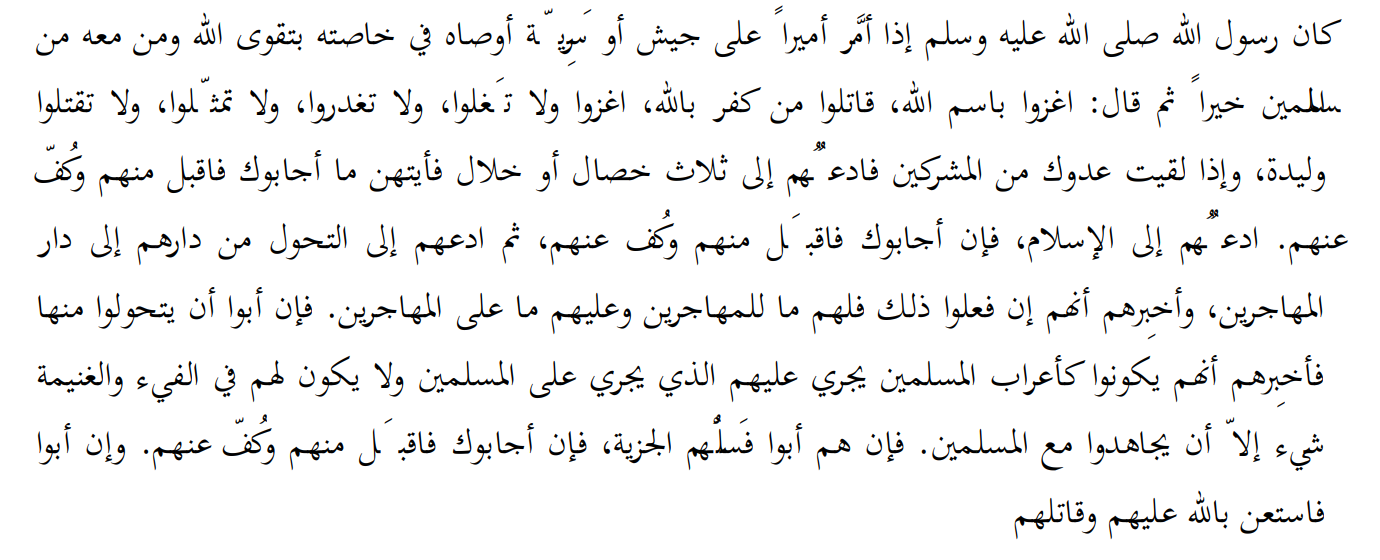
“Siempre que nombraba a un hombre para dirigir una unidad militar, el Mensajero de Allah ﷺ le aconsejaba especialmente que temiera a Allah y que tratara bien a los musulmanes que estaban con él. Y decía ﷺ: ‘Combatid en el Nombre de Allah y por la causa de Allah. Combatid a quienes no creen en Allah. Combatid, pero no seáis traidores, no robéis del botín de guerra, no mutiléis y no matéis a los niños. Cuando os encontréis con vuestro enemigo entre los politeístas, llamadles a una de tres cosas. A cualquiera de ellas que respondan, aceptadla de ellos y absteneos de combatirles. Invitadles a abrazar el Islam, y si responden, aceptadlo de ellos y absteneos de combatirles. Luego invitadles a abandonar su tierra y trasladarse a la tierra de los emigrantes. Decidles que si hacen eso, tendrán los mismos derechos y deberes que los emigrantes. Si se niegan, decidles que serán como los beduinos musulmanes (que viven en el desierto), sujetos a las mismas normas de Allah que los creyentes. Pero no tendrán parte alguna en el Fay’ ni en el botín de guerra, a menos que luchen junto a los musulmanes. Si se niegan a entrar en el Islam, pedidles que paguen la yizya. Si lo hacen, aceptadlo de ellos y absteneos de combatirles. Pero si se niegan, buscad la ayuda de Allah contra ellos y combatidles’”
“Whenever he appointed a man to lead a military detachment, the Messenger of Allah (saw) would advise him especially to fear Allah and treat the Muslims with him well. He (saw) said: ‘Fight in the Name of Allah and in the cause of Allah. Fight those how disbelieve in Allah. Fight but do not be treacherous, do not steal from the spoils of war, do not mutilate and do not kill children. When you meet your enemy from among the polytheists, call them to one of three things. Whichever of them they respond to, accept it from them and refrain from fighting them. Invite them to accept Islam, and if they respond then accept it from them and refrain from fighting them. Then invite them to leave their land and move to the land of the polytheists. Tell them that if they do that, then they will have the same rights and duties as the polytheists. If they refuse, then tell them that they will be like the Muslim Bedouins (who live in the desert), subject to the same rulings of Allah as the believers. But they will have no share of Fay’ or war spoils, unless they fight alongside the Muslims. If they refuse to enter Islam, then ask them to pay the Poll-tax. If they do that, then accept it from them and refrain from fighting them. But if they refuse, then seek the help of Allah against them and fight them”
Y de Ibn Abbas (ra):
And from ibn Abbas (ra):
«El Mensajero de Allah ﷺ nunca combatió sin antes invitarles» (narrado por Ahmad).
“The Messenger of Allah (saw) never fought except that he invited them” (Narrated by Ahmad).
Y de Furwat bin Maseek, quien dijo:
And from Furwat bin Maseek who said:
«Le dije al Mensajero de Allah ﷺ: ¿Debo luchar contra los de mi pueblo que avanzan (contra) los que de ellos huyen? Él dijo: Sí. Cuando me di la vuelta (para irme), me llamó y dijo: No los combatas hasta que los invites al Islam.»
“I said to the Messenger of Allah, should I fight with those of my people advancing (against) those of them fleeing? He said: Yes. When I turned (to go), he called me and said: Do not fight them until you invite them to Islam.”