17. El Califato
17. The Khilafah
El Jilafah es el liderazgo general o global de todos los musulmanes del mundo con el fin de establecer las leyes de la Shari'ah islámica y de llevar la da'wa del Islam al mundo. Es lo mismo que la Imamah, pues la Imamah y la Jilafah tienen el mismo significado. Varios ahadiz sahih las mencionan con el mismo sentido. Ninguno de los dos términos ha tenido jamás en ningún texto de la Shari'ah, es decir, el Corán o la Sunnah, un significado distinto del otro, ya que estas dos fuentes son las únicas fuentes de la Shari'ah. No es obligatorio aferrarse al término de Jilafah o Imamah, sino que es obligatorio aferrarse al significado del término.
The Khilafah is the general or overall leadership for all the Muslims in the world in order to establish the laws of the Islamic Shari’ah and to carry the da’wa of Islam to the world. It is the same as the Imamah, as the Imamah and Khilafah have the same meaning. Several saheeh ahadith mention them with the same meaning. Neither of the two terms has ever come with any meaning different from the other in any Shari’ah text i.e. the Qur’an or the Sunnah, as these two (sources) are the only Shari’ah sources. It is not compulsory to hold to the term of Khilafah or Imamah, but rather it is compulsory to hold to the meaning of the term.
El establecimiento del Califato es una obligación para todos los musulmanes en todas las regiones del mundo. Establecerlo, como el cumplimiento de cualquier obligación que Allah (SWT) impuso a los musulmanes, es un asunto ineludible, sin opción ni indulgencia. El descuido en cumplirlo es uno de los peores pecados, por el que Allah (SWT) castiga con los castigos más severos.
Establishing the Khilafah is an obligation upon all Muslims in all regions of the world. Establishing it, like the performing of any obligation that Allah (swt) obliged upon Muslims, is an inevitable matter without choice or leniency in it. Negligence in performing it is one of the worst sins for which Allah (swt) punishes with the strictest of the punishments.
Las pruebas para establecer el Califato sobre todos los musulmanes (provienen de): El Corán, la Sunnah y el Ijmaa' as-Sahabah.
The evidence for establishing the Khilafah upon all Muslims (come from): The Qura'n, The Sunnah and Ijmaa as-Sahabah.
En cuanto al Corán, Allah (SWT) ha ordenado al Mensajero ﷺ que juzgue entre los musulmanes conforme a todo lo que Él (SWT) le reveló, y Su orden (SWT) a él ﷺ fue de manera categórica. Allah (SWT) se dirigió al Profeta ﷺ diciendo:
As for the Qura'n, Allah (swt) has ordered the Messenger (saw) to rule between Muslims by all that He (swt) revealed to him (saw), and His order (swt) to him was in a decisive manner. Allah (swt) addressed the Prophet (saw) saying:
«Y juzga entre ellos conforme a lo que Allah ha revelado, y no sigas sus pasiones alejándote de la verdad que te ha llegado.» [TMQ 5:48]
"And rule between them by that which Allah revealed to you, and do not follow their vain desires away from the truth which came to you" [TMQ 5:48]
Y Él (swt) dijo:
And He (swt) said:
«Y juzga entre ellos conforme a lo que Allah ha revelado, y no sigas sus caprichos, y cuídate de que no te aparten de parte alguna de lo que Allah te ha revelado» [TMQ 5:49]
"And rule between them by that which Allah revealed to you and do not follow their whims, and beware (be on the alert) that they may deviate you away from even some part of what Allah revealed to you" [TMQ 5:49]
El discurso de Allah (SWT) al Profeta ﷺ es un discurso para su Ummah, a menos que exista una evidencia que limite el discurso a él ﷺ. En este caso no existe tal evidencia, por lo que el mandato se dirige a todos los musulmanes para que establezcan el hukm (la ley). El establecimiento del Jalifato no significa otra cosa que el establecimiento del hukm y de la autoridad. Además, Allah (SWT) hizo obligatorio para los musulmanes obedecer a quienes detentan la autoridad, es decir, al gobernante, lo cual indica que la existencia de quien detenta la autoridad es obligatoria para los musulmanes. Allah (SWT) dijo:
The speech of Allah (swt) to the Prophet (saw) is a speech to his Ummah unless there is evidence which limits the speech to him (saw). In this case there is no such evidence, so the address is to all the Muslims to establish the rule (hukm). The establishment of the Khalifah does not mean other than the establishment of the rule and the authority. Moreover, Allah (swt) made it obligatory upon Muslims to obey those in authority i.e. the ruler, which indicates that the existence of the one in authority is obligatory upon Muslims. Allah (swt) said:
"¡Oh, creyentes! Obedeced a Allah y obedeced al Mensajero de Allah ﷺ y a quienes tengan autoridad entre vosotros" [TMQ 4:59]
"O you who believe obey Allah and obey the Messenger and those in authority amongst you" [TMQ 4:59]
Allah (swt) no ordena obedecer a alguien que no existe. Esto indica que la existencia de la persona con autoridad es obligatoria. Cuando Allah (swt) ordena obedecer a quienes tienen autoridad, Él (swt) está ordenando su establecimiento. El resultado de establecer al gobernante es el establecimiento del hukm shar'i (el juicio de la Shari'ah), y el hecho de no establecerlo tendrá como consecuencia el abandono del hukm shar'i. Por lo tanto, su existencia es obligatoria, pues la consecuencia de no establecerla sería caer en lo prohibido, es decir, el abandono del hukm shar'i.
Allah (swt) does not order obedience to someone who does not exist. This indicates that the existence of the person in authority is obligatory. When Allah (swt) commands obedience to those in authority then He (swt) is commanding their establishment. The result of establishing the ruler is the establishment of the Shari’ah rule (hukm shar’i) and the failure to establish it will result in neglecting the Shari’ah rule (hukm shar’i). Thus his existence is obligatory as the result of the failure to establish it is will be from the prohibited matters i.e. the neglect of the Shari’ah rule (hukm shar’i).
En cuanto a la Sunnah, Nafi‘ relató que dijo: Abdullah bin ‘Umar me dijo que escuchó al Profeta ﷺ decir:
As for the Sunnah, Nafi‘ reported saying: Abdullah bin ‘Umar said to me that he heard the Prophet (saw) saying:
«Quien retire su mano de la obediencia se encontrará con Allah el Día de la Resurrección sin tener argumento alguno a su favor, y quien muera sin tener un juramento de lealtad (bay'ah) sobre su cuello muere una muerte de ignorancia (jahiliyyah).»
“Whoever removes his hand from obedience will meet Allah on the Day of Resurrection without having any proof for him, and whoever dies without a pledge of allegiance (bay’ah) on his neck dies a death of ignorance (jahiliyyah).”
Así que el Profeta (ﷺ) hizo obligatorio para todo musulmán tener una bay'ah sobre su cuello, y describió que quien muera sin una bay'ah sobre su cuello muere una muerte de yahiliyyah. La bay'ah no puede ser para nadie excepto el Jalifa. El Profeta (ﷺ) hizo obligatorio para todo musulmán tener sobre su cuello una bay'ah a un Jalifa, pero no hizo obligatorio para todo musulmán dar la bay'ah a un Jalifa. El deber es la existencia de una bay'ah sobre el cuello de cada musulmán apto, es decir, la existencia de un Jalifa que, en consecuencia, merece una bay'ah sobre el cuello de todo musulmán. Así pues, es la presencia del Jalifa la que pone una bay'ah sobre el cuello de cada musulmán, tanto si el musulmán dio la bay'ah personalmente a él como si no. Por tanto, este hadiz del Profeta (ﷺ) es evidencia de que el nombramiento del Jalifa es una obligación, y no una prueba de que dar la bay'ah sea obligatorio. Esto es así porque lo que el Profeta (ﷺ) reprendió fue la ausencia de una bay'ah sobre el cuello de un musulmán hasta su muerte, pero no reprendió la ausencia de la bay'ah. Muslim narró de Al-'Araach, de Abu Hurairah (ra), del Profeta (ﷺ), quien dijo:
So the Prophet (saw) made it compulsory upon every Muslim to have a bay’ah on his neck, and described that whoever dies without a bay’ah on his neck that he dies a death of jahiliyyah. The bay’ah cannot be for anyone except the Khalifah. The Prophet (saw) made it obligatory upon every Muslim to have on his neck a bay’ah to a Khalifah, yet he did not make it an obligation upon every Muslim to give bay’ah to a Khalifah. The duty is the existence of a bay’ah on the neck of every eligible Muslim i.e. the existence of a Khalifah who accordingly deserves a bay’ah upon the neck of every Muslim. So it is the presence of the Khalifah which places a bay’ah on the neck of every Muslim, whether the Muslim actually gave a bay’ah to him (in person) or not. Therefore, this hadith of the Prophet (saw) is evidence that the appointment of the Khalifah is an obligation and not a proof that giving the bay’ah is obligatory. This is so because what was rebuked by the Prophet (saw) was the absence of a bay’ah on the neck of a Muslim until he dies, but he did not rebuke the absence of the bay’ah. Muslim narrated from Al-’Araj from Abu Hurairah (ra) from the Prophet (saw) who said:
«Ciertamente, el Imam es un escudo detrás del cual los pueblos combaten y con el cual se protegen.»
“Behold, the Imam is a shield from behind whom the people fight and by whom they protect themselves.”
Y Muslim relató de Abu Hazim, quien dijo:
And Muslim reported from Abu Hazim who said:
«Acompañé a Abu Hurairah durante cinco años y lo escuché relatar del Profeta ﷺ, quien dijo: "Los profetas gobernaron a los hijos de Israel. Cada vez que moría un profeta, otro profeta le sucedía, pero no habrá profeta después de mí. Habrá califas y serán muchos." Preguntaron: "¿Qué nos ordenas entonces?" Dijo: "Cumplid el juramento de lealtad (bay'ah) a ellos uno tras otro y dadles su derecho. Ciertamente Allah les preguntará por aquello que les confió."»
“I accompanied Abu Hurairah for five years and heard him reporting from the Prophet who said: The Prophets ruled over the children of Israel. Whenever a Prophet died another Prophet succeeded him, but there will be no Prophet after me. There will be Khulafaa and they will number many. They asked: What then do you order us? He said: Fulfil the bay’ah to them one after the other and give them their due right. Surely Allah will ask them about what He entrusted them with.”
Y de Ibn ‘Abbas, del Profeta ﷺ, quien dijo:
And from bin ‘Abbas from the Prophet (saw) who said:
«Si alguien ve en su emir algo que le desagrada, que tenga paciencia. Pues, en verdad, quien se separa de la autoridad (sultán) del Islam aunque sea por un palmo y muere en ese estado, ha muerto una muerte de yahiliyya».
“If anyone sees in his Amir something that displeases him let him remain patient. For, behold, he who separates himself from the sultan (authority of Islam) by even so much as a hand span and dies thereupon, has died a death of jahiliyyah”.
En estos ahadiz, el Profeta ﷺ nos informa de que los gobernantes dirigirán los asuntos de los musulmanes, e incluye la descripción del Jalifa como un escudo, es decir, una protección. Por tanto, la descripción del Imam como escudo informa sobre los beneficios de la presencia del Imam, y así constituye una orden de actuar. Esto es así porque, si la información transmitida por Allah (SWT) y por el Profeta ﷺ contuviera una reprimenda, sería una orden de prohibición, y si contuviera una alabanza, sería una orden de actuar. Si la acción ordenada es necesaria para implementar un hukm shar'i (norma de la Sharía), o si por su descuido se descuidaría un hukm shar'i, entonces esta orden es decisiva. En estos ahadiz también hay información de que quienes dirigen los asuntos de los musulmanes son Julafa', lo que indica una orden de designarlos. Asimismo, incluyen una prohibición para los musulmanes de separarse de la autoridad, lo que indica la obligación de los musulmanes de designar una autoridad para sí mismos, es decir, de gobernar. Además, el Profeta ﷺ ordenó a los musulmanes obedecer al Jalifa y combatir a quienes disputen su autoridad como Jalifa, lo que indica una orden de designar un Jalifa y de proteger su Jilafa luchando contra quien dispute con él. Muslim relató que el Profeta ﷺ dijo:
In these ahadith, the Prophet (saw) informs us that leaders will run the affairs of Muslims, and they include the description of the Khalifah as a shield i.e. a protection. So the description of the Imam as a shield is informative of the benefits of the presence of the Imam, thus it is a command for action. This is because if the information conveyed by Allah (swt) and the Prophet (saw) contained rebuke then it is a command of prohibition, and if it contained praise then it is a command for action. If the ordered action is necessary to implement a hukm shari’ (Shari’ah rule), or by its negligence a hukm shar‘i will be neglected, then this command is decisive. In these ahadith there is information also that those who run the affairs of Muslims are Khulafaa, which indicates an order to appoint them. They also include a prohibition for Muslims to separate from the authority, which indicates the obligation upon Muslims to appoint an authority for themselves i.e. ruling. Moreover, the Prophet (saw) ordered the Muslims to obey the Khalifah and to fight those who dispute his authority as Khalifah, which indicates an order to appoint a Khalifah and to protect his Khilafah by fighting against whosoever disputes with him. Muslim reported that the Prophet (saw) said:
«Quien prestó juramento de lealtad a un Imam, dándole la mano y el fruto de su corazón, debe obedecerlo en cuanto pueda; y si otro viene a disputarle el mando, debes golpear el cuello de ese hombre.»
“He who pledged allegiance to an Imam giving him the clasp of his hand and the fruit of his heart shall obey him as long as he can, and if another comes to dispute with him you have to strike the neck of that man.”
Entonces, la orden de obedecer al Imam es una orden de establecerlo, y la orden de combatir a quienes disputen con él es prueba de que este mandato es decisivo para mantener la presencia de un solo Califa.
So the command to obey the Imam is an order to establish him, and the command to fight those who dispute with him is evidence that this command is decisive in maintaining the presence of one Khalifah.
En cuanto al consenso (Ijma'a) de los Compañeros (ra), todos ellos coincidieron en la necesidad de establecer un sucesor o Califa tras la muerte del Profeta ﷺ, y todos acordaron designar un sucesor de Abu Bakr, luego de 'Umar, y luego de 'Uthman, tras la muerte de cada uno de ellos. El consenso de los Compañeros (ra) sobre el establecimiento de un Califa se manifestó de manera contundente cuando retrasaron el entierro del Profeta ﷺ tras su muerte mientras se ocupaban de designar un sucesor, a pesar de que el entierro del difunto es fard (obligatorio), y de que es haram para quienes deben preparar su entierro ocuparse de cualquier otra cosa hasta completarlo. Los Compañeros (ra) estaban obligados a dedicarse a preparar el entierro del Profeta ﷺ; sin embargo, algunos de ellos se ocuparon de designar un Califa en lugar de llevar a cabo el entierro, y otros guardaron silencio ante esa ocupación y participaron en el retraso del entierro durante dos noches, pese a poder oponerse al retraso y pese a poder enterrar al Profeta ﷺ. Así pues, hubo un consenso en ocuparse de designar un Califa antes que en enterrar al difunto. Esto no podría ser legítimo a menos que la designación de un Califa sea más obligatoria que el entierro del difunto. Además, todos los Compañeros (ra) coincidieron a lo largo de sus vidas en la obligación de designar un Califa. Aunque discreparon sobre la persona que debía ser elegida como Califa, nunca discreparon sobre la designación de un Califa, ni cuando murió el Profeta ﷺ, ni cuando falleció cualquiera de los Califas bien guiados (Khulafaa ar-Rashidun). Por tanto, el consenso de los Compañeros es una prueba clara y sólida de que la designación de un Califa es obligatoria.
As for the Ijma’a of the Sahabah (ra) they all agreed upon the necessity to establish a successor or Khalifah to the Prophet (saw) after his death, and they all agreed to appoint a successor to Abu Bakr, then to ‘Umar, then to ‘Uthman, after the death of each one of them. The Ijma’a of the Sahabah (ra) to establish a Khalifah manifested itself emphatically when they delayed the burial of the Prophet (saw) after his death while engaged in appointing a successor to him, despite the fact that the burial of the dead person is fard, and that it is haram upon those who are supposed to prepare for his burial to engage themselves in anything else until they complete the burial. The Sahabah (ra) were obliged to engage themselves in preparing the burial of the Prophet (saw), instead some of them engaged themselves in appointing a Khalifah rather than carrying out the burial, and some others kept silent on this engagement and participated in delaying the burial for two nights despite their ability to deny the delay and their ability to bury the Prophet (saw). So this was an Ijma’a to engage themselves in appointing a Khalifah rather than to bury the dead. This could not be legitimate unless the appointment of a Khalifah is more obligatory than the burial of the dead. Also, all the Sahabah (ra) agreed throughout their lives upon the obligation of appointing a Khalifah. Although they disagreed upon the person to be elected as a Khalifah, they never disagreed upon the appointment of a Khalifah, neither when the Prophet (saw) died, nor when any of the Khulafaa ar-Rashidun died. Therefore the Ijma’a of the Sahabah is clear and strong evidence that the appointment of a Khalifah is obligatory.
«Lo que es necesario para cumplir un wajib (deber) es en sí mismo un wajib»
‘What is necessary to accomplish a wajib (duty) is itself a wajib’
Así, el establecimiento de un Califato es también obligatorio según este principio divino.
So the establishment of a Khalifah is also compulsory according to this divine principle.
Por lo tanto, queda claro a partir de estas evidencias que el establecimiento del gobierno y de la autoridad entre los musulmanes es fard, y también queda claro que el nombramiento de un Khalifah que asuma la responsabilidad del gobierno y la autoridad es obligatorio para los musulmanes con el fin de implementar las normas de la Shari'ah, y no meramente por el gobierno y la autoridad en sí mismos. Reflexiona sobre lo que Muslim narró de su dicho ﷺ a través de 'Awf bin Malik:
Therefore, it is clear from these evidences that the establishment of the rule and the authority amongst Muslims is fard, and it is also clear that the appointment of a Khalifah who takes the charge of the rule and the authority is compulsory upon Muslims in order to implement the Shari’ah rules and not merely for the sake of rule and authority in themselves. Reflect upon what Muslim narrated of his saying (saw) via ‘Awf bin Malik:
«Los mejores de vuestros Imames (líderes) son aquellos a quienes amáis y que os aman, que oran por vosotros y vosotros oráis por ellos; y los peores de vuestros Imames son aquellos a quienes odiáis y que os odian, y vosotros los maldecís y ellos os maldicen. Se le preguntó al Mensajero de Allah ﷺ: ¿No deberíamos enfrentarnos a ellos con las espadas? Él respondió: No, mientras establezcan la salat (es decir, el Islam) entre vosotros.»
“The best of your Imams (leaders) are those whom you love and they love you, who pray for you and you pray for them; and the worst of your Imams are those whom you hate and they hate you and you curse them and they curse you. The Messenger of Allah (saw) was asked: Should we not face them with the swords? He said: No, not as long as they establish salat (meaning Islam) among you.”
Este hadiz es claro al informar sobre los buenos y los malos gobernantes, y claro al prohibir enfrentarlos con la espada mientras establezcan la religión (dīn), ya que establecer la oración (ṣalāt) indica el sostenimiento de la religión y el gobierno según ella.
This hadith is clear in informing about the good and bad leaders, and clear in prohibiting confronting them with the sword as long as they establish the deen, since establishing the salat (prayer) indicates upholding of the deen and ruling by it.
Así pues, la obligación de los musulmanes de nombrar al Khalifah, quien establece las leyes del Islam y transmite su llamado, es un asunto cuya certeza no admite duda en los textos auténticos de la Shari'ah. Además, es un deber obligatorio, ya que Allah (SWT) impuso como fard a los musulmanes establecer el gobierno del Islam y proteger el honor de los musulmanes. Sin embargo, este deber es colectivo: si un grupo de la Ummah lo cumple, el fard queda satisfecho y la responsabilidad se levanta del resto de la Ummah. Y si parte de la Ummah no logró cumplir el fard, aunque sí realizó las acciones que lo establecen, la responsabilidad permanece sobre todos los musulmanes, y el fard sigue recayendo sobre cada musulmán mientras los musulmanes no tengan un Khalifah.
So the obligation upon Muslims to appoint the Khalifah who establishes the laws of Islam and conveys its call is a matter which has no doubt with regard to its certainty in the sound texts of Shari’ah. Moreover, it is an obligatory duty due to the fact that Allah (swt) made it fard upon Muslims to establish the rule of Islam and to protect the honour of Muslims. However, this duty is a collective one, so if some people of the Ummah accomplished it, the fard is fulfilled and thus responsibility drops from the rest of the Ummah. And if part of the Ummah was unable to achieve the fard, though they carried out the actions which establish it, then the responsibility remains upon all the Muslims, and the fard remains upon every Muslim as long as Muslims are without a Khalifah.
Abstenerse de establecer un Califato para los musulmanes es uno de los pecados más graves, pues equivale a dejar de cumplir una de las obligaciones más importantes del Islam, de la que depende la aplicación del din; más aún, de ella depende incluso la existencia misma del Islam en el campo de batalla de la vida. Por tanto, los musulmanes en su conjunto cometen un gran pecado al abstenerse de establecer un Califato para todos los musulmanes. Y si todos acordaran permanecer sin Califato, el pecado recaería sobre todos los musulmanes en todas las regiones habitadas (todo el mundo). Sin embargo, si algunos musulmanes se dedicaran a trabajar para establecer un Califato y los demás no lo hicieran, el pecado se librará de los hombros de quienes comenzaron a trabajar para establecer el Califato, aunque el fard permanezca sobre ellos hasta que se designe el Califato. (Esto es así) porque la participación en el establecimiento del fard elimina el pecado por la demora en establecerlo en su tiempo debido, y por su no establecimiento, debido al trabajo de uno para establecerlo y a su aversión hacia lo que le impide establecerlo.
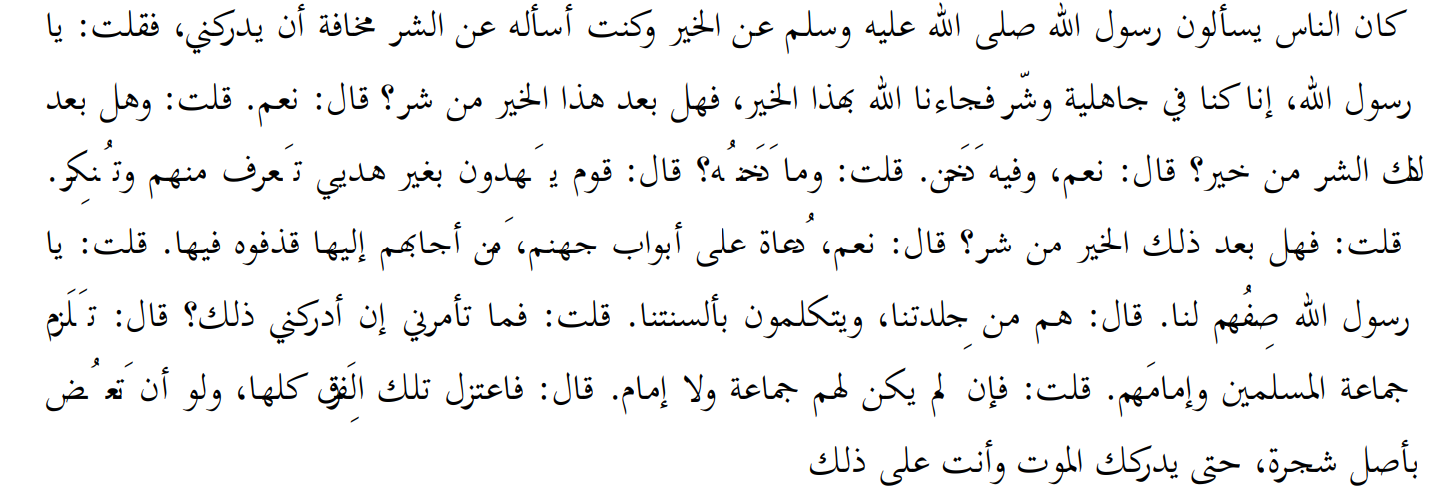
"La gente solía preguntarle al Profeta de Allah ﷺ sobre el bien, y yo le preguntaba sobre el mal por temor a que me alcanzara. Así que dije: ¡Oh Profeta de Allah! Estábamos en tiempos de yahiliyyah y de corrupción, y luego Allah nos trajo este bien. ¿Habrá después de este bien alguna corrupción? Él ﷺ dijo: Sí. Dije: ¿Habrá después de esa corrupción algún bien? Dijo: Sí, y tendrá humo (dujan). Dije: ¿Qué es su humo? Dijo: Gente que guía, pero no con mi guía. Reconoces a algunos de ellos y niegas a otros. Dije: ¿Habrá después de ese bien alguna corrupción? Dijo: Sí, llamadores (du'at) que invitan a las puertas del Infierno. Quien acepte su invitación, lo arrojarán a él (al Infierno). Dije: ¡Oh Profeta de Allah, descríbelos para nosotros! Dijo: Son de nuestra misma piel (de nuestro pueblo) y hablan nuestra lengua. Dije: ¿Qué me ordenas hacer si me alcanza ese asunto? Dijo: Adhiérete a la yama'ah de los musulmanes y a su Imam. Dije: ¿Y si los musulmanes no tienen yama'ah ni Imam? Dijo: Entonces apártate de todos esos grupos, aunque tengas que morder la raíz de un árbol hasta que te llegue la muerte en esa condición."
“The people used to ask the Prophet of Allah (saw) about the good and I used to ask him about the bad in fear that it might catch me. So I said: O Prophet of Allah! We were in times of jahiliyyah and mischief then Allah brought us this good, so is there any mischief after this good? He (saw) said: Yes. I said: Will there be any good after that mischief? He said: Yes, and it has smoke (dukhan). I said: What is its smoke? He said: People guiding but not on my guidance. You recognise some (from them) and deny some. I said: Will there be any mischief after that good? He said: Yes, callers (du’at) who invite at the doors of Hellfire. They throw him into it (hell) whoever accepted their invitation. I said: O Prophet of Allah, describe them to us. He said: They are of our own skin (of our people) and talk our language. I said: What do you order me to do if that (matter) caught me? He said: Adhere to the jama‘ah of Muslims and their Imam. I said: What if the Muslims have no jama‘ah nor an Imam? He said: Then separate from all those groups, even if you (have to) bite the root of a tree till death comes to you as such.”
Este hadiz es claro en su expresión: el Profeta (ﷺ) ordenó a los musulmanes adherirse a la yama‘ah de los musulmanes y a su Imam, y apartarse de quienes invitan a las puertas del infierno. El preguntante le preguntó qué debía hacer con esos llamadores a las puertas del Fuego en la situación en que los musulmanes no tienen Imam ni yama‘ah; entonces el Profeta (ﷺ) le ordenó que se separara de todos esos grupos, sin desligarse de los musulmanes ni abstenerse de la acción para establecer un Imam. Así pues, su orden es clara: "Apártate de todos esos grupos", y enfatizó la separación de dichos grupos incluso hasta el punto de que su aislamiento de ellos lo llevaría a aferrarse al tronco de un árbol hasta que le llegue la muerte. Su significado es adherirse a tu religión y mantenerte alejado de los llamadores extraviados que están a las puertas del Infierno. En este hadiz no hay excusa ni permiso (para nadie) para abandonar la labor de establecer un Califato; se limita, más bien, al mandato de adherirse a la religión y abandonar a los llamadores a las puertas del infierno, y el pecado recaerá sobre él si no trabaja para establecer un Califato. Así pues, se le ordena abandonar los grupos extraviados para salvaguardar su religión de los llamadores a la desviación, aunque tuviera que morder la raíz de un árbol, pero no distanciarse de la comunidad musulmana ni abandonar la labor de establecer las leyes de la religión y un Imam para los musulmanes.
This hadith is clear in its expression that the Prophet (saw) ordered the Muslims to adhere to the jama‘ah of Muslims and to adhere to their Imam, and to leave those who invite people to the doors of hell. The questioner asked him what he has should do in relation to those callers at the doors of Hellfire in the situation wherein the Muslims have no Imam and no jama‘ah; thereupon the Prophet (saw) ordered him to separate from all these groups, not to disassociate himself from the Muslims nor to abstain from the action for establishing an Imam. So his order is clear “Separate from all those groups”, and he emphasised the separation from those groups even to the extent that his isolation from them would make him clench to the trunk of a tree until death comes to him. Its meaning is to adhere to your deen and keep away from the misguiding callers who are at the doors of Hellfire. In this hadith there is no excuse or permission (for anybody) to abandon the work for establishing a Khalifah, it is, rather, confined to the command of adhering to the deen and abandoning the callers at the doors of hell, and the sin will remain on him if he does not work to establish a Khalifah. So he is ordered to abandon the misguiding groups in order to save his deen from the callers of the misguidance, even if he had to bite the root of a tree, but not to distance himself from the Muslim community and abandon the work for establishing the laws of the deen and establishing an Imam for Muslims.
Otro ejemplo es lo que al-Bujari narró de Abu Said al-Judri, quien dijo:
El Mensajero de Allah ﷺ dijo: Llegará un tiempo en que la mejor propiedad de un musulmán serán las ovejas, que llevará a las cimas de las montañas y a los lugares de lluvia (valles), para huir con su religión de las aflicciones (fitan).
“The Messenger of Allah (saw) said: A time will come that the best property of a Muslim will be sheep which he will take on the top of mountains and the places of rainfall (valleys) so as to flee with his religion from afflictions (fitan)”
Esto no significa que uno deba aislarse de la comunidad musulmana, abandonar la práctica de las leyes de la religión y establecer un Califato para los musulmanes cuando no existe ningún Califato en la tierra. Todo lo que contiene es una explicación de cuál es la mejor riqueza del musulmán en tiempos de aflicción; no alienta la separación de los musulmanes ni el aislamiento de la gente.
This does not mean that one should isolate oneself from the Muslim community, abandon practising the laws of the deen and establishing a Khalifah for Muslims when there is no Khilafah on earth. All that it contains is an explanation of what is the best wealth of the Muslim at the times of affliction; it does not encourage separation from the Muslims and isolation from the people.
En consecuencia, ningún musulmán sobre la faz de esta tierra tiene excusa para abandonar el deber de establecer el din que Allah (swt) ha ordenado, es decir, el establecimiento de un Califa para los musulmanes cuando no existe un Califato en la tierra, cuando no hay nadie que aplique los castigos (hudud) de Allah (swt) para proteger los sagrados límites de Allah (swt), y nadie que aplique las leyes del din y unifique a la comunidad musulmana bajo la bandera de La ilaha illa Allah, Muhammad ur-Rasul Allah. No existe permiso en el Islam para abandonar la labor de este deber hasta que se haya completado efectivamente.
Accordingly, no Muslim on the face of this earth has an excuse to abandon the duty of establishing the deen which Allah (swt) has ordered, that is, the establishment of a Khalifah for Muslims when there is no Khilafah on the earth, when there is no one to implement the punishments (hudood) of Allah (swt) to protect the sanctities of Allah (swt), and no one to implement the laws of the deen and unify the Muslim community under the banner of La ilaha illa Allah, Muhammad ur-Rasul Allah. There is no permission in Islam to abandon the work for this duty until it is indeed completed.