17.9 La Shari'a no designó a una persona específica para el Califato
17.9 The Shar'a Did Not Designate A Specific Person For The Khilafah
La opinión de que el Mensajero (saw) designó a una persona específica como Jalifa después de él contradice los textos de la Shari'ah. Y la afirmación de que el Mensajero (saw) nombró a ciertas personas como Julafá después de él hasta el Día del Juicio es aún más contraria a los textos islámicos.
The view that the Messenger (saw) designated a specific person to be the Khalifah after him contradicts the Shari’ah texts. And the statement that the Messenger (saw) nominated certain persons to be Khulafaa after him until the Day of Judgement is even more contradictory to the Islamic texts.
En cuanto a la invalidación de la opinión de que el Mensajero de Allah ﷺ designó a alguien para el califato después de él, esto se evidencia de numerosas maneras:
As for invalidating (the opinion) that the Messenger (saw) nominated the Khilafah for someone after him, this is apparent in numerous ways:
Primero: Esto contradice la bay'ah (pledge), puesto que nombrar a una persona significa informar a los musulmanes sobre quién será el Khalifah sobre ellos. Por tanto, el Khalifah sería conocido, de modo que no quedaría necesidad de legislar (tashri') la bay'ah, ya que la bay'ah es el método de designar al Khalifah. Así, si ya ha sido designado de antemano, no queda necesidad de demostrar el método para designarlo, pues de hecho ya ha sido designado. Tampoco puede decirse que la bay'ah sea el juramento de obediencia al Khalifah, pues la Shar'a ha enunciado la obediencia al Khalifah y a los que ostentan la autoridad (ulu al-amr) en muchos otros textos distintos del texto de la bay'ah. La obediencia ha sido solicitada explícitamente a los musulmanes; en cuanto a la bay'ah, ha sido solicitada a los musulmanes en otra(s) petición(es), no en consideración de ser (meramente) obediencia, aunque sí incluye el sentido de obediencia, sino en consideración de ser un contrato para el Khilafah. Su significado en todos los ahadiz que la mencionan no es la obediencia, sino dar liderazgo a aquel con quien se hace la bay'ah y prepararse para someterse a ese liderazgo. Por tanto, hacer de la bay'ah una condición para designar el Khilafah contradice que el Mensajero de Allah ﷺ nombrara a una persona concreta como Khalifah después de él. Además, las palabras de la bay'ah que aparecen en los ahadiz auténticos (Saheeh) se presentan de forma general ('aam) sin especificación (takhsees), e incondicionada (mutlaq) sin restricción alguna (taqyeed), para cualquiera. Si significaran la bay'ah a una persona específica, no serían generales ni incondicionadas.
First: This contradicts the pledge (bay’ah) since nominating a person means informing the Muslims as to who will be the Khalifah over them. Hence the Khalifah would be known so there would remain no need for legislating (tashri’) the pledge as the pledge is the method of appointing the Khalifah. So if he has already been appointed in advance, there remains no need to demonstrate the method of appointing him as, in fact, he has already been appointed. Nor can it be said that the pledge is the pledge of obedience to the Khalifah since the Shar’a has enunciated the obedience to the Khalifah and those in charge (ulu al-amr) in many other texts distinct from the text of the pledge. Obedience has been explicitly requested from Muslims; as for the pledge, it has been requested from Muslims in other request(s) not in consideration as being (merely) obedience, though it does include the meaning of obedience, but in consideration as being a contract for the Khilafah. Its meaning in all the ahadith that mentioned it is not obedience, rather it is about giving leadership to the one who is pledged and preparing to submit to this leadership. So making the pledge a condition for appointing the Khilafah contradicts the Messenger (saw) nominating a specific person to be Khalifah after him. Moreover, the words of the pledge which came in the correct (Saheeh) ahadith came in a general manner (‘aam) without specification (takhsees), and unrestricted (mutlaq) without any restriction (taqyeed), for anyone. Were they to mean the pledge for a specific person they would not have been general and unrestricted. The word(s) of the ahadith are:
“Quien muera sin un juramento de lealtad sobre su cuello,”
“He who dies without a pledge on his neck,”
“Quien le presta juramento de lealtad a un Imam”
“Whosoever pledges an Imam,”
Y
And
"Un hombre que presta juramento de lealtad a un Imam."
“A man who pledges an Imam.”
La opinión de que el Mensajero (saw) designó a una persona concreta para que fuera Jalifa después de él contradice e invalida la generalidad y el carácter no restringido del juramento de lealtad (bay'ah). Por tanto, no puede decirse que la bay'ah sea precisamente el modo de designar al Jalifa mientras que la designación del Jalifa es algo separado de la bay'ah; por eso el Jalifa es designado primero y luego se le presta la bay'ah. No se debe decir esto, porque la bay'ah es el método para designar al Jalifa, y eso no significa que sea exactamente lo mismo que su designación. Tampoco se debe decir que es obligatorio designar primero al Jalifa y reconocer su designación antes de prestarle la bay'ah, pues eso significaría que existe otro método para designar al Jalifa, de modo que la bay'ah serviría únicamente para su obediencia, mientras que los ahadiz sobre la bay'ah indican todos que es el método para designar al Jalifa y que no hay otro camino. Considérese su (saw) declaración:
The opinion that the Messenger (saw) designated a specific person to become Khalifah after him contradicts and invalidates the generality and unrestricted nature of the pledge. Therefore, it cannot be said that this means that the ba’yah is the very way of appointing the Khalifah while the appointment of the Khalifah is separate to the ba’yah, this is why the Khalifah is appointed first & then the ba’yah is given to him; one should not say this because the ba’yah is the method of appointing the Khalifah and this does not mean that it is exactly the same as his appointment. Nor should one say that it is compulsory to first appoint the Khalifah and acknowledge his appointment before giving him the ba’yah as this would mean that there is another method for appointing the Khalifah such that the ba’yah is merely for his obedience, whereas the ahadith about the ba’yah all indicate that it is the method to appoint the Khalifah and there is no other way. Consider his (saw) statement:
«Quien muera sin un juramento de lealtad sobre su cuello»;
“Whoever dies without a pledge on his neck”;
Es bastante explícito en su significado que quien muere sin haber nombrado a su Imán mediante el juramento de lealtad (bay'ah), y no significa de ninguna manera quien muere sin obedecer a un Imán. Esto indica que en este hadiz el Profeta ﷺ se refiere al método de designación del Califa, y no a la mera obediencia. Considera también su declaración ﷺ:
It is quite explicit in meaning that whoever dies without appointing his Imam via the pledge and it does not mean in any way whoever dies without obeying an Imam. This indicates that in this hadith the Prophet means the method of appointing the Khalifah and does not mean mere obedience. Also consider his (saw) statement:
«Cuando se preste juramento de lealtad a dos califas, mata al último».
“When the pledge is given to two Khalifahs, kill the latter”;
Esto es explícito en que, si se nombran dos califas, se debe matar al último de ellos. Asimismo, todos los ahadiz del Profeta ﷺ son explícitos en que es el método para nombrar al califa. Los ahadiz del Profeta ﷺ son explícitos en no significar mera obediencia ni obediencia absoluta (mutlaq); más bien, significan seguir a quien ha sido nombrado como califa, con el sentido de que este es el método para nombrar al califa. Además, no existe ni un solo hadiz auténtico, ya sea en su transmisión o en su significado, que demuestre un método para nombrar al califa distinto de la bay'ah.
This is explicit that if two Khalifahs are appointed, kill the later of them. Likewise all ahadith of the Prophet are explicit that it is the method of appointing the Khalifah. The ahadith of the Prophet are explicit in not meaning mere obedience or unrestricted (mutlaq) obedience; rather, they mean following the one appointed as the Khalifah with their meaning that this is the method of appointing the Khalifah. Further, there is not even one authenticated hadith, whether in narration or meaning, which demonstrates a method of appointing the Khalifah other than the ba’yah.
Segundo: Se han narrado ahadiz del Mensajero (saw) que indican que habrá disputas y contiendas entre la gente acerca del Califato y competencia por él. Si hubiera existido un texto del Mensajero ﷺ referente al nombramiento de una persona concreta, no surgiría disputa en presencia de ese texto, o el Mensajero ﷺ habría declarado que la gente disputaría con esa persona. Sin embargo, los textos vinieron diciendo que la gente disputaría entre sí, y también aclararon el método para resolver esta disputa y zanjar la cuestión del Califato. Muslim narró en su Saheeh: Wahab bin Baqiyyat al-Wasiti me narró que Khalid bin Abdullah al-Juzairi nos dijo, desde Abu Nadhra, desde Abu Saeed al-Khudri, quien dijo: El Mensajero de Allah ﷺ dijo:
Second: Ahadith have been narrated from the Messenger (saw) indicating that there will be disputes and contentions among people about the Khilafah and competition over it. If there was a text from the Messenger (saw) concerning the appointment of a (specific) person, there would not arise a dispute in the presence of that text or the Messenger (saw) would state that people would dispute with that person. Whereas the texts came saying that people would dispute between themselves and it also clarified the method to resolve this dispute and settle the issue of the Khilafah. Muslim narrated in his Saheeh: Wahab bin Baqiyyat al-Wasiti narrated to me that Khalid bin Abdullah al-Juzairi told us from Abu Nadhra from Abu Saeed al-Khudri who said: The Messenger of Allah (saw) said:
«Si se presta juramento de lealtad a dos califas, mata al último de ellos.»
“If the pledge is given to two Khalifahs, kill the latter of them.”
Muslim también dijo en su Saheeh: Zuhayr bin Harb e Ishaq bin Ibrahim me narraron, diciendo Ishaq: "Nos informaron", y Zuhayr dijo: "Nos narró Jareer, de Al-'Amash, de Zaid bin Wahhab, de Abdurrahman bin Abdurrabb al-Ka'aba, quien dijo: Entré a la mezquita y Abdullah bin 'Amru bin al-'Aas estaba sentado a la sombra de la Ka'aba con gente reunida a su alrededor. Me uní a ellos y me senté con él. Dijo: Estábamos con el Mensajero de Allah ﷺ en un viaje, y nos detuvimos en un campamento cuando un anunciador (mu'adhin) del Mensajero de Allah ﷺ anunció la oración colectiva. Entonces todos nos reunimos ante el Mensajero de Allah ﷺ, quien dijo:
Muslim also said in his Saheeh: Zuhayr bin Harb and Ishaq bin Ibrahim narrated to me, with Ishaq saying we were informed and Zuhayr said it was narrated to us by Jareer, from Al-‘Amash from Zaid bin Wahhab from Abdurrahman bin Abdurrabb al-Ka’aba who said: I entered the mosque and Abdullah bin ‘Amru bin al-‘Aas was seated in the shade of the Ka’aba with people gathered around him. So I joined them and sat with him. He said: We were with the Messenger of Allah (saw) in a voyage and we stopped at an encampment when an announcer (mu’adhin) of the Messenger of Allah (saw) announced the collective prayer. So we all gathered before the Messenger of Allah (saw) who said:

«No hubo profeta antes de mí que no estuviera obligado a guiar a su comunidad hacia lo mejor que conocía para ellos y a advertirles de lo peor que conocía para ellos, hasta que dijo: Quien haya prometido lealtad a un Imam, dándole la mano y el fruto de su corazón, debe obedecerle en cuanto pueda. Si otro viene a disputarle el mando, golpead el cuello de ese otro.»
“There was no Prophet before me except that it was obligatory upon him to guide his Ummah to the best that he knew for them and warn them of the worst he knew for them until he said: Whoever pledged an Imam, giving him the clasp of his hand and the fruit of his heart, should obey him as much as he can. If another comes to dispute with him, strike the neck of the other person.”
También narró Muslim en su Saheeh: Muhammad bin Bashar nos narró que Muhammad bin Ja'far nos narró que Shu'ba nos narró desde Furrat al-Qazzaz, desde Abu Hazm, quien dijo: Permanecí con Abu Hurayra durante cinco años y lo oí narrar del Profeta ﷺ, quien dijo:
Muslim also narrated in his Saheeh: Muhammad bin Bashar narrated to us that Muhammad bin Ja’far narrated to us that Shu’ba narrated to us from Furrat al-Qazzaz from Abu Hazm who said: I remained with Abu Hurayra for five years and heard him narrate from the Prophet (saw) who said:
Los hijos de Israel tenían profetas que se ocupaban de sus asuntos como políticos (tasusuhum). Cada vez que moría un profeta, le sucedía otro. Sin embargo, no habrá profeta después de mí, pero habrá califas que serán numerosos. Dijeron: ¿Qué nos ordenas? Él dijo: Cumplid el juramento de lealtad, uno tras otro.
“The children of Israel had Prophets taking care of their affairs as politicians (tasusuhum). Whenever one Prophet died, another followed him. However, there will be no Prophet after me but there will be Khulafaa who will be many. They said: What do you command us? He said: Fulfil the pledge one after the other.”
Muslim narró en su Saheeh: Uthman bin Abu Shayba nos narró que Yunus bin Abu Ya'fur les narró a ellos de su padre, de Arfaja, quien dijo que escuchó al Mensajero de Allah ﷺ decir:
Muslim narrated in his Saheeh: Uthman bin Abu Shayba narrated to us that Yunus bin Abu Ya’fur narrated to them from his father from Arfaja who said he heard the Messenger of Allah (saw) saying:
"Quien encuentre, cuando todos vuestros asuntos estén unidos bajo un solo hombre, que alguien intenta incitar a la rebelión o dividir vuestra unidad, que lo mate."
“Whoever finds when all your affairs have been united under one man, intending to incite rebellion or divide your unity, kill him.”
Esto significa que el Califato es un derecho de todos los musulmanes, de modo que cualquiera puede aspirar a él. Esto contradice la afirmación de que el Mensajero de Allah ﷺ designó a una persona concreta como Califa después de él.
This means that the Khilafah is the right of all Muslims such that anyone can contend for it. This contradicts the (saying that) the Messenger (saw) nominated a specific person to be the Khalifah after him.
Tercero: Los ahadiz en que apareció la palabra Imam para designar al Califa llegaron con esta palabra en forma indeterminada; y cuando llegó en forma determinada, o bien llegó determinada con el artículo "al" de la especie, o bien relacionada con un sustantivo colectivo. En los casos en que llegó determinada con "al", se trataba del "al" de especie, según indicaba el contexto de la frase. El Mensajero ﷺ dijo:
Third: The ahadith which came with the word Imam denoting the Khalifah came with this word in an unspecified form; and when it came in an specified one, it either came specified with “the” (“al”) of the species or related to a collective noun. In the possibilities which came specified with “al”, it was the “al” of species by evidence of the sentence. The Messenger said:
"Quien preste juramento de lealtad a un Imam"
“Whoever pledges an Imam”,
“…se opuso a un imán injusto”,
“…stood against an unjust Imam”,
«Habrá imames después de mí.»
“there will be Imams after me.”
Y dijo:
And he said:
"El Imam es quien es un guardián (ra'i) sobre la gente, y es responsable de sus ciudadanos",
“The Imam is the one who is a guardian (ra’i) over the people and he is responsible for his citizens”,
Ciertamente, el Imán es un escudo detrás del cual se combate y por quien se es protegido.
“Verily the Imam is a shield from behind whom they fight and by whom they are protected”
y dijo:
and he said:
«…al Imán de los musulmanes»,
“…to the Imam of the Muslims”,
"Los mejores de vuestros imames",
“The best of your Imams”,
"…los peores de vuestros Imames."
“…the worst of your Imams.”
Todo esto indica que el Mensajero (saw) dejó la cuestión de quién sería el Khalifah después de él sin especificar, sin designar a una persona concreta. Esto es explícito en su indicación de que el Mensajero ﷺ no designó a una persona específica para el Khilafah, sino que lo dejó como un derecho de todos los musulmanes. Cuando se añade a esto que algunos textos vinieron con lenguaje en plural (jam'u), esto se convierte en un texto claro que niega que el Imam sea una persona específica.
All this indicates that the Messenger (saw) left the issue concerning who would be the Khalifah after him unspecified without specifying him. This is explicit in its indication that the Messenger (saw) did not designate a specific person for the Khilafah but rather left it as a right for all Muslims. When you add to this that some texts came with the collective (jam’u) language, this becomes a clear text in negating the Imam being a specific person.
Cuarto: Los Sahabah (ra) discreparon en su tiempo sobre quién debía ser el Jalifa entre ellos. Esta diferencia entre las personas es evidencia de que el Mensajero (saw) no designó a una persona específica para el Califato. Entre las mismas personas que discreparon están aquellas de las que se dice que el Mensajero se pronunció sobre su Califato, a saber: Abu Bakr (ra) y Ali (ra). A pesar de sus diferencias, ninguno de ellos argumentó jamás que existiera un texto del Mensajero (saw) según el cual el Califato le correspondía a él, ni ninguno de los Sahabah (ra) argumentó que existiera un texto a favor de determinadas personas en general. Si hubiera existido algún texto, habrían argumentado con él; así que su falta de argumentación basada en texto alguno significa que no existe un texto que señale a una persona específica para el Califato. Tampoco debe decirse que existe un texto que se conoció después de ellos pero que no les llegó, porque tomamos nuestra religión de los Sahabah (ra). Son ellos quienes nos transmitieron el Corán y narraron los hadices. Por tanto, si no hay texto alguno procedente de los Sahabah (ra), entonces no se reconoce de ninguna manera. Tomamos lo que procede de ellos y desechamos lo que no procede de ellos. En relación con la cuestión de un texto sobre un Jalifa después del Mensajero (saw), encontramos que todos los Sahabah (ra), sin excepción, incluidos Abu Bakr (ra) y Ali (ra), coincidieron en la ausencia de cualquier texto que designara a una persona específica para el Califato, pues no lo mencionaron a pesar de la necesidad de hablar y de la obligación de mencionar el texto si hubiera existido. Esto indica la invalidez de que el Mensajero (saw) hubiera designado a una persona para el Califato. Tampoco debe decirse que la omisión de mencionar el texto se debió a la precaución de preservar la unidad de los musulmanes, pues esto supondría ocultar una norma de Allah y no transmitirla en el momento en que era urgentemente necesaria, especialmente en un asunto tan importante para los musulmanes. Este ocultamiento en la religión de Allah no es posible que proceda de los Compañeros (ra) del Mensajero de Allah ﷺ.
«Si yo designo a un califa, en verdad alguien mejor que yo designó a un califa, es decir, Abu Bakr. Y si no lo hago, entonces alguien mejor que yo no lo hizo, es decir, el Mensajero de Allah ﷺ.»
“If I appoint a Khilafah, verily one better than me did appoint a Khalifah i.e. Abu Bakr. And if I do not, then one better than me did not i.e. the Messenger of Allah (saw).”
Muslim narró de Ibn Umar que Umar bin al-Jattab (ra) dijo:
Muslim narrated from bin Umar that Umar bin al-Khattab (ra) said:
"Verdaderamente Allah ʿazza wa Jall preservará la religión. Si yo no designo un califa, verdaderamente el Mensajero de Allah ﷺ no designó; y si yo designo, verdaderamente Abu Bakr sí designó."
“Verily Allah ‘azza wa jall will preserve the deen. If I do not appoint a Khalifah, verily the Messenger of Allah (saw) did not appoint; and if I do appoint, verily Abu Bakr did appoint.”
Este es un texto claro de que el Mensajero (ﷺ) no designó a un Califa. Tampoco debe decirse que esta es la opinión de Umar, pues cuando un compañero dice: "El Mensajero (ﷺ) hizo esto o no hizo aquello, o estuvimos en su tiempo así, o hubo en su tiempo tal y tal cosa", esto es un hadiz que se usa como evidencia, no simplemente la opinión de un compañero. Además, Umar lo dijo en presencia y a la vista de los Sahabah (ra), y Alí (ra) estaba presente, y esta declaración llegó a él y no se opuso, lo cual indica su acuerdo con lo que Umar (ra) narró.
This is a clear text that the Messenger (saw) did not appoint a Khalifah. Nor should one say that this is Umar’s opinion for when a companion says, ‘The Messenger (saw) did this or did not do this or we were in his time like this or there was in his time such and such’, this is a hadith used as evidence not merely a companion’s view. Moreover, Umar said this within the hearing and sight of the Sahabah (ra), and Ali (ra) was present and this statement reached him and he did not oppose it, which indicates their agreement upon what Umar (ra) narrated.
Todo esto se refiere a la ausencia de cualquier texto específico que designe a una persona concreta para el Califato. En cuanto a los textos aducidos por quienes sostienen que existen textos que designan a una persona concreta, entre estos textos están los que se aducen para indicar que el Mensajero ﷺ nombró a Abu Bakr (ra) para ser Jalifa después de él, mientras que otros se aducen para indicar que nombró a Ali (ra) como Jalifa después de él. Debemos presentarlos y explicar su contenido.
This is all with respect to the absence of any specific text designating a specific person for the Khilafah. As for the texts brought by those who say that there are texts designating a specific person, among these texts are those brought to indicate that the Messenger appointed Abu Bakr (ra) to become Khalifah after him whereas others are brought to indicate that he appointed Ali (ra) as the Khalifah after him. We must present them and explain their contents.
En cuanto a los textos que aducen quienes dicen que el Mensajero (ﷺ) designó a Abu Bakr (ra), estos se dividen en dos: una parte en la que el Mensajero (ﷺ) alaba a Abu Bakr (ra), sin que haya nada que indique que el Mensajero (ﷺ) lo designó. La otra parte es aquella en la que algunos deducen por inferencia que el Mensajero (ﷺ) designó a Abu Bakr (ra), mientras que otros deducen que lo propuso a Abu Bakr (ra). Presentaremos su modelo citando algunos de ellos, señalando que ninguno de ellos excede el significado de alabanza.
As for the texts brought by those who say the Messenger (saw) appointed Abu Bakr (ra), they are divided into two: One portion in which the Messenger (saw) praises Abu Bakr (ra) wherein there is nothing to indicate that the Messenger (saw) appointed him. The other portion is one wherein some deduce by deduction that the Messenger (saw) appointed Abu Bakr (ra) while others deduce that he nominated Abu Bakr (ra). We will present their model by presenting some of them, noting that none of them exceed the meaning of praise.
«Ciertamente, la persona más generosa conmigo en compañía y en riqueza es Abu Bakr. Si yo tomara un amigo íntimo (jalil) distinto de mi Señor, habría tomado a Abu Bakr (ra), pero en su lugar está la hermandad del Islam y su amor. No debe quedar en la mezquita ninguna puerta que no esté cerrada, salvo la puerta de Abu Bakr.» ﷺ
“Verily the most gracious of people to me in his companionship and wealth is Abu Bakr. Were I to take an intimate friend (khaleel) other than my Lord, I would have taken Abu Bakr (ra) but instead there is the brotherhood of Islam and its love. There should not remain in the mosque any door but that it should be closed except for the door of Abu Bakr.”
Muslim también narró este hadiz, pero con una redacción distinta, aunque similar a estos. Nada en este hadiz permite concluir que él designara a Abu Bakr (ra) como Jalifa. Lo único que contiene es un elogio a Abu Bakr (ra) por parte del Mensajero (ﷺ), y el Mensajero (ﷺ) elogió a muchos compañeros por su nombre. Han llegado también hadices con elogios a Umar (ra), Uzmán (ra), Alí (ra), Sa'd bin Abi Waqqas (ra), Talha (ra), Az-Zubair (ra), Abu 'Ubaida bin al-Yarrah (ra), Al-Hasan (ra) y Al-Husáin (ra), Zayd bin Haritha (ra), Usama bin Zayd (ra), Abdullah bin Ya'far (ra), Jadiyah (ra), Aisha (ra), Fátima (ra), hija del Profeta (ﷺ), Umm Salama (ra), Bilal (ra) y otros. El elogio, por sí solo, no indica de ninguna manera una designación como Jalifa.
Muslim also narrated this hadith but with different wording, although similar to these ones. There is nothing in this hadith to make a person say that he appointed Abu Bakr (ra) as Khalifah. All that it contains is praise for Abu Bakr (ra) from the Messenger (saw), and the Messenger (saw) praised many companions by name. There have come ahadith with praise for Umar (ra), Uthman (ra), Ali (ra), Sa’d bin Abu Waqqas (ra), Talha (ra), Az-Zubayr (ra), Abu ‘Ubaydah bin al Jarrah (ra), Al-Hassan (ra) and Al-Hussein (ra), Zayd bin Haritha (ra), Usama bin Zayd (ra), Abdullah bin Ja’far (ra), Khadija (ra), Aisha (ra), Fatima (ra) daughter of the Prophet (saw), Umm Salamah (ra), Bilal (ra) and others. Praise by itself does not in any way whatsoever indicate appointment to be Khalifah.
En cuanto a los ahadiz de los que algunos dedujeron la califatura de Abu Bakr (ra), son cuatro ahadiz, que presentaremos y aclararemos en todo lo que contienen. Estos ahadiz son:
As for the ahadith from which some deduced the Khilafah of Abu Bakr (ra), they are four ahadith which we will present and clarify all that they contain. These ahadith are:
Primero: Al-Bujari narró de Al-Qasim bin Muhammad (ra), quien dijo:
First: Al-Bukhari narrated from Al-Qasim bin Muhammad (ra) who said:
«Aisha dijo: ¡Oh, mi cabeza! Entonces el Mensajero de Allah ﷺ dijo: Si eso llegara a suceder y yo estuviera vivo, pediría perdón por ti y rezaría por ti. Aisha dijo: Eso es algo grave. Por Allah, creo que desearías mi muerte para que, si sucediera, pasaras el resto de tus días felizmente casado con algunas de tus esposas. El Profeta ﷺ dijo: Más bien es mi cabeza la que pesa. Tenía la intención o el plan de enviar por Abu Bakr y su hijo para hacerle una promesa (‘ahd), de modo que ninguna persona hablara ni alguien deseara. Luego dije: Allah lo rechazará y los creyentes lo impedirán, o Allah lo impedirá y los creyentes lo rechazarán.»
“Aisha said: O my head so the Messenger of Allah (saw) said: If it were to happen and I were alive, I would ask for you to be forgiven and pray for you. Aisha said: That is a serious matter. By Allah, I believe that you would like my death so that it if happened, you would spend the rest of your days wedded happily with some of your wives. The Prophet (saw) said: Rather it is my head which is heavy. I intended or planned to send for Abu Bakr and his son so as to give him a promise (‘ahd) so that no person will speak or a wisher wish. Then I said that Allah will reject and the believers prevent that or Allah will prevent and the believers reject.”
Muslim narró este hadiz de Aisha (ra) con estas palabras de ella: El Mensajero de Allah ﷺ me dijo durante su enfermedad:
Muslim narrated this hadith from Aisha (ra) in this wording from her: The Messenger of Allah (saw) said to me in his illness:
«Llama a tu padre, Abu Bakr, y a tu hermano para que escriba un libro, pues temo que alguien desee o diga: "Yo soy mejor" (o "tengo prioridad"). Pero Allah lo rechazará, y también los creyentes, excepto Abu Bakr.»
“Call for me your father, Abu Bakr, and your brother so that I write a book for I fear that a wisher will wish or a speaker say: I am better (or take precedence). But Allah will reject, and so the believers, except for Abu Bakr.”
En segundo lugar: Al-Bujari narró de Muhammad bin Jubayr bin Mut'im, de su padre, quien dijo:
Secondly: Al-Bukhari narrated from Muhammad bin Jubayr bin Mut’im from his father who said:
Una mujer vino al Profeta ﷺ y le habló sobre un asunto; y él le ordenó que volviera a él. Ella dijo: «¡Oh Mensajero de Allah, ﷺ, y si vengo y no te encuentro?», refiriéndose a la muerte. Entonces él dijo: «Si no me encuentras, ve a Abu Bakr».
“A woman came to the Prophet (saw) and spoke to him about something; and he commanded her to return to him. She said: O Messenger of Allah, what if I came and did not find you—as if she meant death—so he said: If you do not find me, then go to Abu Bakr.”
Muslim narró este hadiz de Muhammad bin Jubayr bin Mut'im, de su padre, con las siguientes palabras:
Muslim narrated this hadith from Muhammad bin Jubayr bin Mut’im from his father in the words:
Una mujer le preguntó algo al Mensajero de Allah ﷺ, y él le ordenó que volviera a él. Ella dijo: «Oh Mensajero de Allah, ¿y si vengo y no te encuentro?». Mi padre dijo: «Como si quisiera decir la muerte». Entonces él dijo: «Si no me encuentras, ve a Abu Bakr».
“A woman asked the Messenger of Allah (saw) something and he commanded her to return to him. She said: O Messenger of Allah, what if I come and do not find you—My father said: As if she meant death—so he said: If you do not find me, then go to Abu Bakr.”
En tercer lugar: Al-Bujari narró de Aisha (ra), la madre de los creyentes,
Thirdly: Al-Bukhari narrated from Aisha (ra), the mother of the believers,
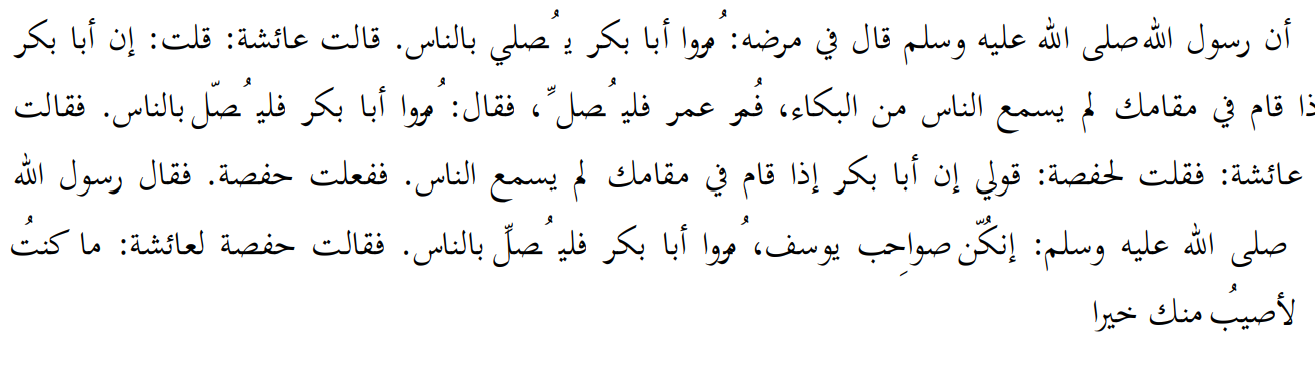
«Que el Mensajero de Allah ﷺ me dijo durante su enfermedad: Ordena a Abu Bakr que dirija la oración de la gente. Aisha dijo: Yo dije: Cuando Abu Bakr esté en tu lugar, la gente no lo oirá por su llanto, así que ordena a Umar que dirija las oraciones. Él dijo: Ordena a Abu Bakr que dirija la oración de la gente. Aisha dijo: Le dije a Hafsa: Dile que cuando Abu Bakr esté en tu lugar, la gente no lo oye, y ella lo hizo. El Mensajero de Allah ﷺ dijo: Sois como las compañeras de Yusuf. Ordena a Abu Bakr que dirija la oración de la gente. Hafsa le dijo a Aisha: ¡Nunca lograré ningún bien a través de ti!»
“That the Messenger of Allah (saw) told me during his illness: Command Abu Bakr to lead the people in prayer. Aisha said: I said: When Abu Bakr stands in your place, people do not hear him for his crying so command Umar to lead prayers. He said: Command Abu Bakr to lead people in prayer. Aisha said: I said to Hafsa: Say that when Abu Bakr stands in your place, the people do not hear, and she did that. The Messenger of Allah (saw) said: You are like the companions of Yusuf. Command Abu Bakr to lead the people in prayer. Hafsa said to Aisha: I will never achieve any good through you!”
Cuarto: Muslim narró de Ibn Abu Mulaykah, quien dijo:
Fourthly: Muslim narrated from bin Abu Mulkiyya who said:

"Oí que le preguntaron a Aisha: ¿A quién habría designado el Mensajero de Allah ﷺ como califa después de él, si lo hubiera designado? Ella dijo: Abu Bakr. Se le preguntó: ¿Y después de Abu Bakr? Ella dijo: Umar. Entonces se le preguntó: ¿Y después de Umar? Ella dijo: Abu 'Ubaydah bin al-Jarrah, y se detuvo ahí."
“I heard Aisha being asked: Whom would the Messenger of Allah (saw) have appointed as Khalifah after him had he so appointed? She said: Abu Bakr. She was asked: Then whom after Abu Bakr? She said: Umar. She was then asked: Then whom after Umar? She said: Abu ‘Ubaydah bin al-Jarrah, and she stopped at that.”
Todos estos ahadiz no son una prueba adecuada de que el Mensajero (saw) designara a Abu Bakr (ra) como Jalifa. El primer hadiz se rechaza por dos razones: la primera es que el Mensajero ﷺ dijo:
All these ahadith are not suitable evidence for the Messenger (saw) appointing Abu Bakr (ra) as Khalifah. The first hadith is rejected for two reasons: The first is that the Messenger (saw) said:
«Deseé o pretendí»
“I wished or intended”
Pero él no lo hizo, por lo que esto no es una prueba. Pues la prueba es la palabra del Mensajero (saw), su acción o su aprobación tácita; todo lo que no sea esto no se considera evidencia de la Shari'ah. En segundo lugar, Aisha (ra) es hija de Abu Bakr, por lo que, de haber existido este hadiz, ella lo habría informado a Abu Bakr (ra). Entonces él lo habría argumentado cuando acudió al patio (saqeefa) para discutir con los Ansar cuando se reunieron para jurar lealtad a un Califa de entre ellos. Por lo tanto, este hadiz es rechazado (mardud) y no es apto como prueba para el nombramiento de Abu Bakr (ra) como Califa.
But he did not do so, so this is not an evidence. For the evidence is the Messenger’s (saw) saying, action or silent consent; anything other than these is not considered Shari’ah evidence. Secondly, Aisha (ra) is Abu Bakr’s daughter so were this hadith present she would have informed Abu Bakr (ra). Then he would have argued with it when he went to the courtyard (saqeefa) to contend with the Ansar when they gathered to pledge allegiance to a Khalifah amongst them. Therefore this hadith is rejected (mardud) and is unsuitable to be an evidence for the appointment of Abu Bakr (ra) as Khalifah.
En cuanto al segundo hadiz, no indica el nombramiento de Abu Bakr (ra) como califa, porque la mujer dijo: «Si no te encuentro»; es correcto, pues, que no lo hallara debido a su ausencia en una guerra o por cualquier otro asunto. Nada en él indica que con sus palabras «Si no te encuentro» quisiera decir que usted había muerto. Las palabras que aparecen en el hadiz «como si quisiera decir la muerte» son palabras de Yubayr y de su entendimiento. Por tanto, la orden del Mensajero ﷺ de que ella acudiera a Abu Bakr (ra) si venía y no lo encontraba no es prueba del nombramiento de Abu Bakr (ra) como califa después del Mensajero ﷺ. Aun si nos viéramos obligados a tomar su entendimiento como referido a la muerte, estas palabras seguirían sin designar a Abu Bakr como califa después de él ﷺ. En cuanto al tercer hadiz, se trata del nombramiento para dirigir la oración y nada más. El nombramiento para dirigir la oración no significa nombramiento en autoridad (hukm). En cuanto a su afirmación: «El Mensajero de Allah ﷺ estuvo complacido con él en un asunto de la religión (din), ¿acaso no debemos estar complacidos con él en un asunto del mundo (dunya)?», esta es su interpretación, y es errónea, porque hay una gran diferencia entre la oración y el gobierno. No todo el que es apto para ser imam en la oración es apto para ser gobernante. Además, el texto es específico de la oración, por lo que no abarca otras cosas, ni debe entenderse que se refiere a otras cosas debido a la especificidad (juṣūṣiyya) del texto.
As for the second hadith, it does not indicate the appointment of Abu Bakr (ra) as Khalifah because the woman said: “If I did not find you”; so it is correct that she failed to find him due to his absence in a war or any other matter. There is nothing in it to indicate that she meant by her words “If I did not find you” that you had died. The words which came in the hadith “As if she meant death” are the words of Jubayr and his understanding. So the Messenger’s command for her to go to Abu Bakr (ra) if she came and did not find him is no proof for the appointment of Abu Bakr (ra) as Khalifah after the Messenger (saw). Even if we were compelled to take her understanding to mean death, these words still would not designate Abu Bakr as Khalifah after him (saw). As for the third hadith, this is the appointment over prayer and nothing else. Appointment over prayer does not mean appointment in authority (hukm). As for their statement: “The Messenger of Allah was pleased with him in a matter of the deen, so should we not be pleased with him in a matter of the world (dunya)”; this is their understanding, and it is erroneous because there is a large difference between prayer and ruling. Not all who are suitable to become a leader (Imam) in prayer are suitable to be a leader in ruling. Moreover, the text is specific to prayer so it does not encompass other things, nor should it be taken to mean other things due to the specificity (khususiyya) of the text.

«Que el Mensajero de Allah ﷺ dijo: Mañana daré la bandera (rayah) a alguien por cuyas manos Allah dará la victoria. Dijo: Así que la gente pasó la noche pensando a cuál de ellos se le daría. Cuando la gente se despertó, fueron temprano por la mañana ante el Mensajero de Allah ﷺ esperando que se les diera a ellos, pero él dijo: ¿Dónde está Ali bin Abi Talib? Dijeron: Le duelen los ojos, oh Mensajero de Allah. Dijo: Mandad a buscarlo para que venga a mí. Cuando llegó, le escupió en los ojos y oró por él. Se curó como si nunca hubiera tenido dolor, y le dio la bandera.»
“That the Messenger of Allah (saw) said: I will give the flag (rayah) tomorrow to someone by whose hands Allah will conquer. He said: So the people spent the night thinking which one of them it would be given to. When people woke up, they went early in the morning to the Messenger of Allah (saw) hoping it would be given to them, but he said: Where is Ali bin Abi Talib? They said: His eyes are paining O Messenger of Allah. He said: Send for him to come to me. When he came, he spit in his eyes and prayed for him. He was cured as if he never had pain, and he gave him the flag.”
Muslim narró este hadiz de Abu Hurairah con las siguientes palabras:
Muslim narrated this hadith from Abu Hurairah with the words:

"El Mensajero de Allah ﷺ dijo el día de Jaybar: Daré esta bandera a alguien que ama a Allah y a Su Mensajero, y por cuyas manos Allah dará la victoria. Umar bin al-Jattab dijo: Nunca había deseado el liderazgo sino ese día. Dijo: Lo imaginé con la esperanza de que me llamaran para ello. Dijo: El Mensajero de Allah ﷺ llamó a Ali bin Abi Talib y le entregó la bandera."
“The Messenger of Allah (saw) said on the day of Khayber: I will give this flag to someone who loves Allah and His Messenger by whose hands Allah will conquer. Umar bin al-Khattab said: I had never wished for leadership except for that day. He said: I visualised it hoping that i would be called for it. He said: The Messenger of Allah (saw) called Ali bin Abi Talib and gave him the flag.”
Al-Bukhari narró en el capítulo de las virtudes de Ali (ra) que el Mensajero de Allah ﷺ dijo a Ali (ra):
Al-Bukhari narrated in the chapter of virtues of Ali (ra) that the Messenger of Allah (saw) said to Ali (ra):
«Tú eres de mí y yo soy de ti.»
“You are of me and I am of you.”
Muslim narró de ‘Amir bin S’ad bin Abi Waqqas (ra), de su padre, quien dijo: Muawiya bin Abu Sufyan (ra) ordenó a S’aad (ra) diciendo: ¿Qué te ha impedido insultar a Abu Turab (ra)? Él dijo: Cuando recuerdo tres cosas que el Mensajero de Allah ﷺ dijo de él, nunca lo insultaré. Que yo tuviera una sola de estas cosas me es más querido que los camellos rojos. El Mensajero de Allah ﷺ lo dejó atrás en algunas de sus expediciones de guerra, así que Ali (ra) le dijo: ¡Oh Mensajero de Allah ﷺ, me has dejado atrás con mujeres y niños? El Mensajero de Allah ﷺ le dijo:
Muslim narrated from ‘Amir Bin S’ad bin Abi Waqqas (ra) from his father who said: Muawiya bin Abu Sufyan (ra) commanded S’aad (ra) saying: What has prevented you from insulting Abu Turab (ra)? He said: When I remember three (things) which the Messenger of Allah (saw) said of him, I will never insult him. That I should have even one of these is more beloved to me than red camels. The Messenger of Allah (saw) left him behind in some of his war expeditions, so Ali (ra) said to him: O Messenger of Allah (saw), have you left me behind with women and children? The Messenger of Allah (saw) said to him:
«¿No te complace estar en la misma posición junto a mí que la de Harún junto a Musa, excepto que no habrá profeta después de mí?» ﷺ
“Are you not pleased to be in the same status next to me like the status of Harun next to Musa, except that there is no Prophet after me.”
También le oí decir el día de Jaibar:
I also heard him say on the day of Khayber:
«Voy a dar la bandera a un hombre que ama a Allah y a Su Mensajero ﷺ, y a quien Allah y Su Mensajero ﷺ aman.
‘I will give the flag to a man who loves Allah and His Messenger, and whom Allah and His Messenger love.
Dijo: Nos pusimos en marcha por ello y él dijo:
He said: We moved for it and he said:
"Llama a Ali", así que fue traído y tenía los ojos inflamados. Escupió en sus ojos y le dio la bandera, y Allah le concedió la victoria a través de él.
“Call Ali, so he was brought and he had sore eyes. He spit in his eyes and gave him the flag, and Allah conquered through him.’
Y cuando fue revelado este versículo:
And when this verse was revealed:
Di: «Venid, llamemos a nuestros hijos y a vuestros hijos» [TMQ 3:61],
Say: Come and let us call our sons and your sons [TMQ 3:61],
El Mensajero de Allah ﷺ llamó a Ali (ra), Fátima (ra), Hasán (ra) y Husáin (ra) y dijo:
The Messenger of Allah (saw) called Ali (ra), Fatima (ra), Hassan (ra) and Husain (ra) and said:
«¡Oh Allah, esta es mi familia!»
‘O Allah, this is my family.’”
Muslim narró de Sahl bin S'aad, quien dijo: Un hombre de la familia de Marwan fue nombrado (como gobernante) de Madinah. Dijo: Llamó a Sahl bin S'aad y le ordenó que injuriara a Ali (ra). Dijo: Sahl se negó, así que se le dijo: Si te niegas, entonces di: Que Allah maldiga a Abu Turab (ra). Sahl dijo: Ali (ra) no tiene un nombre más querido para mí que Abu Turab (ra), y se alegraba cuando se le llamaba por él. Se le dijo: Infórmanos del suceso sobre por qué se le llamó Abu Turab (ra). Entonces dijo: El Mensajero de Allah ﷺ llegó a la casa de Fátima y no lo encontró en la casa, así que dijo:
Muslim narrated from Sahl bin S’aad who said: A man from the family of Marwan was appointed (as ruler) over Madinah. He said: He called Sahl bin S’aad and commanded him to insult Ali (ra). He said: Sahl refused, so it was said to him: If you refuse, then say: Allah curse Abu Turab (ra). Sahl said: Ali (ra) has no name more beloved to me than Abu Turab (ra), and he would be pleased when called by it. It was said to him: Inform us of the incident as to why he was called Abu Turab (ra), so he said: The Messenger of Allah (saw) came to Fatima’s house and did not find him in the house, so he said:
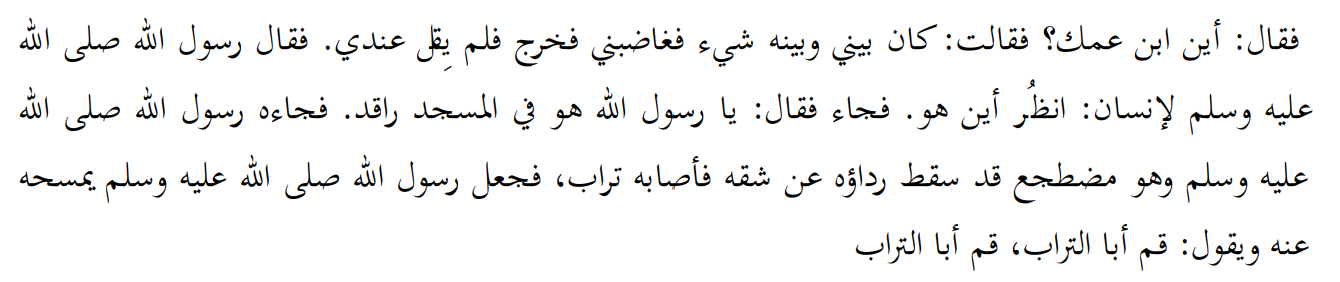
«¿Dónde está el hijo de tu tío paterno?». Ella dijo: Hubo algo entre él y yo, me hizo enfadar y se marchó sin decírmelo. Entonces el Mensajero de Allah ﷺ le dijo a alguien: «Ve a averiguar dónde está». Este regresó y dijo: «¡Oh Mensajero de Allah!, está descansando en la mezquita». Así que el Mensajero de Allah ﷺ fue a verlo mientras estaba recostado. Su manto se le había caído del cuerpo y se le había manchado de polvo, por lo que el Mensajero de Allah ﷺ comenzó a sacudírselo mientras decía: «Levántate, ¡oh Abu Turab!».
“Where is the son of your paternal uncle?” She said: There was something between him and me, and he made me angry and left without telling me. So the Messenger of Allah (saw) said to someone: “Go find out where he is.” He came back and said: O Messenger of Allah, he is resting in the mosque. So the Messenger of Allah (saw) came to him while he was reclining. His cloak had fallen from his body and dirt had touched him, so the Messenger of Allah (saw) began wiping it off him while saying: “Stand up, O Abu Turab.”
Muslim narró de ʿAdiyy bin Zāhit, de Dharr, quien dijo: Alí dijo:
Muslim narrated from ‘Adiyy bin Thabit from Dharr who said: Ali said:
«Por Aquel que hendió la semilla y creó lo que tiene vida, el Profeta ﷺ me hizo una promesa: que nadie me amaría sino un creyente, y que nadie guardaría rencor contra mí sino un hipócrita.»
“By Him Who split up the seed and created something living, the Prophet (may peace and blessings be upon him) gave me a promise that no one but a believer would love me, and none but a hypocrite would nurse grudge against me..”
No hay nada en estos ahadices que lleve a alguien a decir que el Mensajero (saw) nombró a Ali (ra) como Jalifa después de él. El hadiz de Jaibar es un elogio del Mensajero de Allah. La afirmación del Mensajero (saw) a Ali (ra): Note: the rules require ﷺ after each mention of the Prophet, but the source writes "(saw)" in its abbreviated form, which the rules say to replace with ﷺ. Applying that rule: No hay nada en estos ahadices que lleve a alguien a decir que el Mensajero ﷺ nombró a Ali (ra) como Jalifa después de él. El hadiz de Jaibar es un elogio del Mensajero de Allah ﷺ. La afirmación del Mensajero ﷺ a Ali (ra):
There is nothing in these ahadith to make someone say that the Messenger (saw) appointed Ali (ra) to be Khalifah after him. The hadith of Khayber is praise from the Messenger of Allah. The Messenger’s (saw) statement to Ali (ra):
"Tú eres de mí y yo soy de ti"
“You are of me and I am of you”
Es una alabanza del Mensajero de Allah ﷺ. En cuanto al hadiz de Sa'd en el que se dice:
Is a praise from the Messenger of Allah (saw). As for the hadith of S’aad in which came:
«¿No te complace tener ante mí el estatus que tuvo Harún con Musa?»
“Are you not pleased to have the status before me as that of Harun with Musa”,
Este tema se tratará en la segunda categoría de los ahadices sobre el tema. En ella también está el hadiz de Jaibar, que es una alabanza, y en él se dice que Ali (ra), Fátima (ra), Hasan (ra) y Husáin (ra) son su familia, lo cual es una alabanza, y también el hadiz de Sahl bin Sa'd es una alabanza. Así como el Mensajero de Allah ﷺ elogió a Ali (ra), también elogió a otros de entre sus Compañeros (ra). El elogio del Mensajero ﷺ hacia una persona no indica de ninguna manera su designación.
This subject will be discussed in the second category of the ahadith on the topic. In it is also the hadith of Khayber which is a praise and in it is that Ali (ra), Fatima (ra), Hassan (ra) and Husain (ra) are his family which is a praise, and the hadith of Sahl bin S’ad is a praise. Just like the Messenger of Allah (saw) praised Ali (ra), he also praised others among his Sahabah (ra). The Messenger’s praise for a person does not in any way indicate his appointment.
En cuanto a la segunda categoría de ahadices, que son aquellos de los que algunos dedujeron que el Mensajero (saw) afirmó textualmente que Ali sería el Jalifa después de él, se resumen en estos cuatro textos:- 1- Al-Bujari narró de Mus'ab bin S'ad, de su padre
As for the second category of ahadith which are those from which some deduced that the Messenger (saw) stated textually that Ali would be the Khalifah after him, they are summarised in these four texts:- 1- Al-Bukhari narrated from Mus’ab bin S’ad from his father
Que el Mensajero de Allah ﷺ partió hacia Tabuk y designó a Ali, así que él dijo: ¿Me dejas atrás junto con las mujeres y los niños? Él dijo: ¿No te complace tener el mismo estatus conmigo que tuvo Harún con Musa, excepto que no habrá ningún Profeta después de mí? ﷺ
“That the Messenger of Allah (saw) left for Tabuk and appointed Ali, so he said: Do you leave me behind along with women and children? He said: Are you not pleased to have the same status with me as Harun had with Musa, except that there is no Prophet after me?”
Muslim narró de ʿĀmir bin Saʿd bin Abi Waqqas (ra), de su padre, quien dijo: El Mensajero de Allah ﷺ le dijo a ʿAlí (ra):
Muslim narrated from ‘Amir bin S’ad bin Abi Waqqas (ra) from his father who said: The Messenger of Allah (saw) said to Ali (ra):
«Tú eres para mí en la misma posición que Harún tuvo respecto a Musa, excepto que no habrá profeta después de mí.» ﷺ
“You are to me of the same status as Harun was to Musa, except that there is no Prophet after me.”
Y Muslim narró de Ibrahim bin S'ad, de S'ad, que el Profeta ﷺ dijo a Ali (ra):
And Muslim narrated from Ibrahim bin S’ad from S’ad that the Prophet (saw) said to Ali (ra):
«¿No te complace tener conmigo la misma relación que Harun tuvo con Musa?»
“Are you not pleased to have the same relation with me as Harun had with Musa”
Ibn Ishaq narró diciendo: El Mensajero de Allah ﷺ dejó atrás a Ali bin Abi Talib (ra) para que cuidara y supervisara a su familia. Los hipócritas comenzaron a difundir falsos rumores y le dijeron: Él ﷺ no lo dejó atrás sino porque le resultaba difícil y para que a él le resultara fácil. Cuando los hipócritas dijeron eso, Ali bin Abi Talib (ra) tomó sus armas y salió hasta encontrarse con el Mensajero de Allah ﷺ, que estaba acampado en Al-Jarf, y dijo: Oh Profeta de Allah ﷺ, los hipócritas afirman que usted ﷺ me dejó atrás porque me resultaba difícil y para hacerme la vida fácil. Él dijo:
Ibn Ishaq narrated by saying: The Messenger of Allah (saw) left behind Ali bin Abi Talib (ra) to look after and supervise his family. The hypocrites started spreading false rumors and said to him that: He (saw) did not leave him behind except for the reason that it was hard on him and so that it could become easy for him. When the hypocrites said that, Ali bin Abi Talib (ra) took his weapons and moved out until he met the Messenger of Allah (saw) who was encamped at Al-Jarf and said: O Prophet of Allah (saw), the hypocrites claimed that you left me behind because it was hard for me and to make it easy for me. He said:

«Mintieron; más bien, te dejé atrás por lo que dejé detrás de mí, así que regresa y supervisa a mi familia y a tu familia en mi nombre. ¿No te complace, oh Ali, tener ante mí la misma posición que Harún tuvo ante Musa, excepto que no habrá profeta después de mí?» ﷺ
“They lied; rather I left you behind due to what I left behind me so return and supervise my family and your family on my behalf. Are you not pleased, O Ali, to have the same status before me as Harun had before Musa except that there is no Prophet after me?”
Así pues, Alí regresó a Medina y el Mensajero de Allah ﷺ continuó su viaje. As-Sayyid Abd al-Husain Sharaf ud-Deen mencionó lo siguiente en el libro “Al-Muraja’at”: “El hadiz de Jabir bin Abdullah, quien dijo: El Mensajero de Allah ﷺ dijo:”
So Ali returned to Madinah and the Messenger of Allah (saw) continued on his journey. As-Sayyid Abd al-Husain Sharaf ud-Deen mentioned the following in the book “Al-Muraja’at ”: “The hadith of Jabir bin Abdullah who said: The Messenger of Allah (saw) said:
¡Oh Ali! En verdad, te es permitido en la mezquita lo que me es permitido a mí, y tu relación conmigo es la de Harún con Musa, excepto que no habrá profeta después de mí.
O Ali, verily it is allowed for you in the mosque what is allowed for me, and your relation with me is that of Harun with Musa except that there is no Prophet after me.”
2. Muslim relató de Yazid bin Hayyan, quien dijo: Salí con Husain bin Sabra y Umar bin Muslim hacia Zayd bin Arqam (ra). Cuando nos sentamos con él, Husain le dijo: “En verdad, oh Zayd, tuviste la fortuna de alcanzar mucho bien. Viste al Mensajero de Allah ﷺ, escuchaste sus hadices, combatiste junto a él y rezaste detrás de él. En verdad, oh Zayd, tuviste la fortuna de alcanzar mucho bien. Relátanos, pues, oh Zayd, lo que oíste del Mensajero de Allah ﷺ.” Él dijo: “Oh hijo de mi hermano, por Allah que me he hecho viejo y se ha acercado mi tiempo. He olvidado parte de lo que entendí del Mensajero de Allah ﷺ, así que acepta lo que te relate y no me obligues a decir aquello que no relato.” Luego dijo: “El Mensajero de Allah ﷺ se puso de pie un día ante nosotros, hablando en las aguas conocidas como Khum, entre La Meca y Medina. Alabó a Allah, lo glorificó, exhortó y recordó, y luego dijo:”
2. Muslim narrated from Yazid bin Hayyan who said: I left with Husain bin Sabra and Umar bin Muslim to Zayd bin Arqam (ra). When we sat with him, Husain said to him: “Verily, O Zayd, you met a great deal of good. You saw the Messenger of Allah (saw), heard his hadith, fought with him and prayed behind him. Verily, O Zayd, you met a great deal of good. So relate to us, O Zayd, of what you heard from the Messenger of Allah (saw). He said: O son of my brother, by Allah I have become old and my time has approached. I have forgotten some of that, which I understood from the Messenger of Allah (saw), so accept whatever I relate to you and do not force me on that which I do not relate. Then he said: The Messenger of Allah (saw) stood one day before us speaking at the waters known as Khum between Makkah and Madinah. He thanked Allah, praised Him, exhorted and reminded then said:
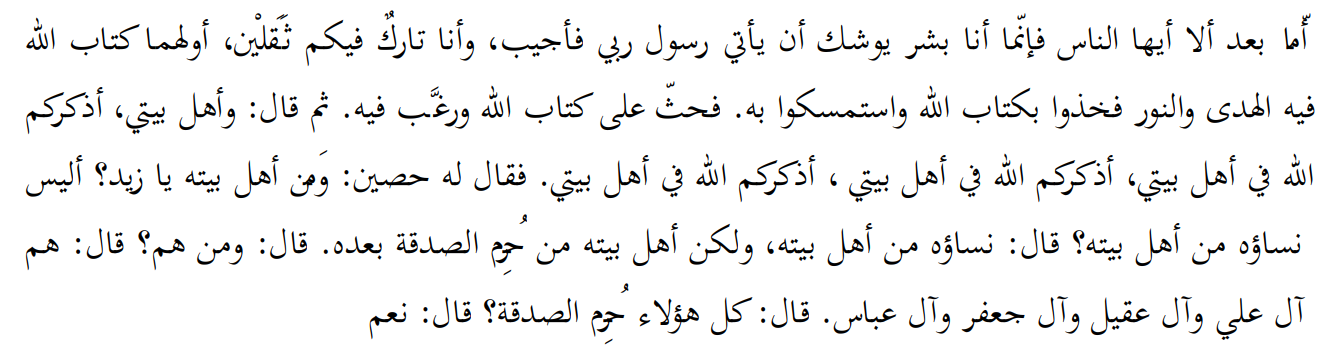
"Ahora, al asunto. Oh gente, yo soy un ser humano. Estoy a punto de recibir a un mensajero (el ángel de la muerte) de mi Señor, y yo, en respuesta al llamado de Allah, me despediré de ustedes, pero dejo entre ustedes dos cosas de gran peso: la primera es el Libro de Allah, en el que hay guía correcta y luz; así que aférrense al Libro de Allah y sigan sus enseñanzas." Exhortó (a nosotros) (a aferrarnos) al Libro de Allah y luego dijo: "La segunda son los miembros de mi casa. Les recuerdo (sus deberes) hacia los miembros de mi familia." Husain le dijo a Zaid: "¿Quiénes son los miembros de su casa? ¿Acaso sus esposas no son miembros de su familia?" A lo que respondió: "Sus esposas son miembros de su familia, pero aquí los miembros de su familia son aquellos para quienes está prohibido aceptar el Zakat." Y preguntó: "¿Y quiénes son ellos?" A lo que respondió: "'Ali y los descendientes de 'Ali, 'Aqil y los descendientes de 'Aqil, los descendientes de Ja'far y los descendientes de 'Abbas." Husain dijo: "Estos son aquellos para quienes la aceptación del Zakat está prohibida." Zaid dijo: "Sí."
" Now to our purpose. O people, I am a human being. I am about to receive a messenger (the angel of death) from my Lord and I, in response to Allah's call, (would bid good-bye to you), but I am leaving among you two weighty things: the one being the Book of Allah in which there is right guidance and light, so hold fast to the Book of Allah and adhere to it. He exhorted (us) (to hold fast) to the Book of Allah and then said: The second are the members of my household I remind you (of your duties) to the members of my family. He (Husain) said to Zaid: Who are the members of his household? Aren't his wives the members of his family? Thereupon he said: His wives are the members of his family (but here) the members of his family are those for whom acceptance of Zakat is forbidden. And he said: Who are they? Thereupon he said: 'Ali and the offspring of 'Ali, 'Aqil and the offspring of 'Aqil and the offspring of Ja'far and the offspring of 'Abbas. Husain said: These are those for whom the acceptance of Zakat is forbidden. Zaid said: Yes.”
Así el Sayyid Abd al-Husain Sharaf ud-Deen mencionó en su libro “Al-Muraja’at” este hadiz a través de la siguiente narración, que At-Tabarani transmitió mediante una cadena cuya autenticidad es aceptada unánimemente, desde Zayd bin Arqam (ra), quien dijo: El Mensajero de Allah ﷺ habló en Ghadeer Khum, bajo unos árboles, y dijo:
As-Sayyid Abd al-Husain Sharaf ud-Deen mentioned in his book “Al-Muraja’at” this hadith via the following narration which At-Tabarani narrated through a chain whose authenticity is unanimously accepted from Zayd bin Arqam (ra) who said: The Messenger of Allah (saw) spoke at Ghadeer Khum underneath some trees and said:
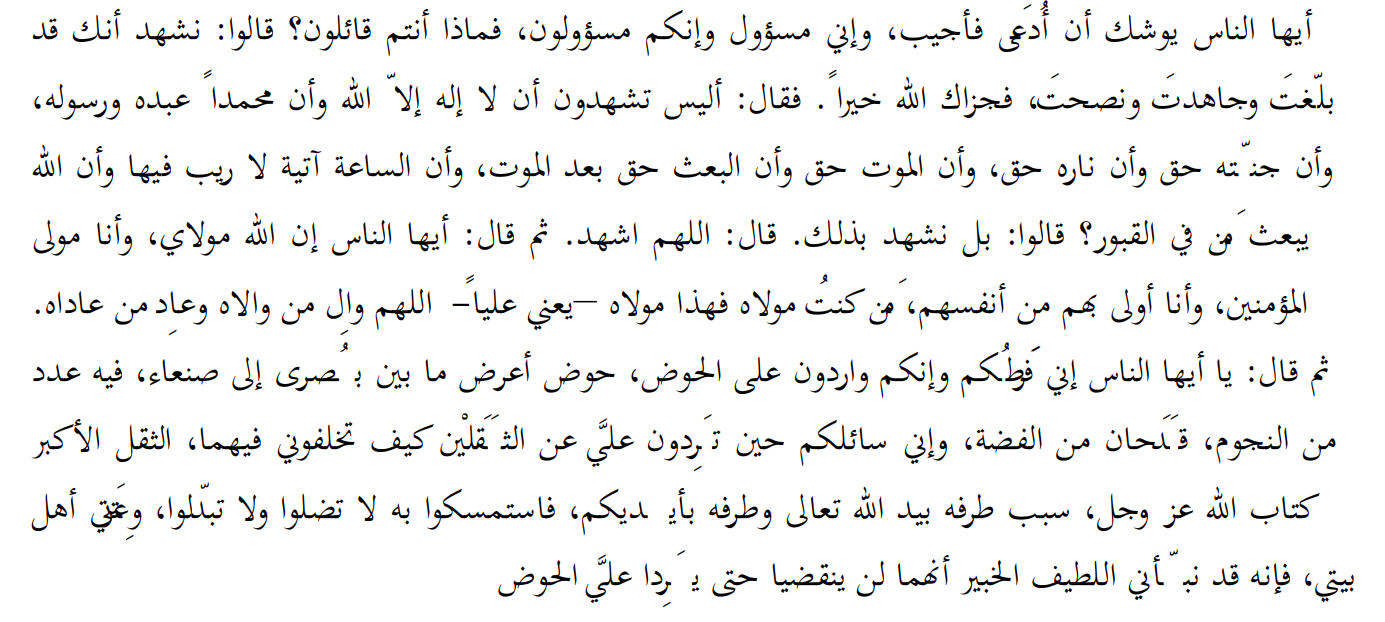
“Oh, pueblo, está por llegar el momento en que seré llamado y responderé (refiriéndose a la muerte). Ciertamente, yo soy responsable y vosotros sois responsables, ¿qué diréis entonces? Dijeron: Daremos testimonio de que transmitiste el mensaje, luchaste y aconsejaste, que Allah te recompense bien. Él dijo: ¿No dais testimonio de que no hay más dios que Allah y de que Muhammad es Su siervo y Mensajero ﷺ, de que el Paraíso es verdad y el Fuego es verdad, de que la muerte es verdad y la resurrección después de la muerte es verdad, de que la Hora (del Juicio) llegará sin duda alguna, y de que Allah resucitará a todos los que están en sus tumbas? Dijeron: Sí, damos testimonio. Entonces dijo: Oh pueblo, ciertamente Allah es mi Protector y yo soy el protector de los creyentes, de tal modo que tengo preferencia sobre ellos incluso sobre sí mismos. Quien me tome por protector, entonces este es su protector, es decir, Ali. ¡Oh Allah, sé amigo de quien le sea amigo y sé enemigo de quien le sea enemigo! Luego dijo: Oh pueblo, ciertamente os dejaré y me encontraréis en el Estanque, un estanque más ancho que la distancia entre Basora y Saná. En él hay copas de plata tan numerosas como las estrellas. Ciertamente os preguntaré, cuando os presentéis ante mí, sobre las dos cosas de peso, cómo las cuidasteis después de mí. La más pesada y grande es el Libro de Allah, azza wa jalla, un sabab (cuerda) cuyo un extremo está en las manos de Allah y el otro en vuestras manos. Aferraos a él firmemente para que no os extraviéis ni cambiéis, y a mi Ahl al-Bayt (familia), la gente de mi casa. Ciertamente, el Clemente y Omnisciente (swt) me ha informado de que no se separarán hasta que se presenten ante mí en el Estanque (fuente).”
“O people, it is about to be that I am called and I will respond (indicating death). Verily, I am accountable and you are accountable, so what will you say? They said: We will testify that you conveyed, struggled and advised so may Allah recompense you well. He said: Do you not bear witness that there is no deity but Allah and Muhammad is His slave and Messenger, that Paradise is true and Hellfire is true, that death is true and resurrection after death is true, that the Hour (of Judgement) will come without any doubt, and that Allah will resurrect all those in their graves? They said: Yes, we do bear witness. Then he said: O people, verily Allah is my Patron and I am the patron of the believers such that I take precedence before them over their own selves. Whoever takes me as his patron then this one is his patron—meaning Ali. O Allah, befriend whoever befriends him and take as enemy whoever takes him as an enemy. Then he said: O people, verily I will leave you and you will find me at the Cistern, a cistern wider than the distance from Basra to Sana’a. In it are tumblers of silver the number of stars. Verily I will ask you when you come before me on the two weighty things, how you took care of them after me. The weightier and greater one is the Book of Allah ‘azza wa jalla, a (sabab) of which one end is in the hands of Allah and the other in your hands. Hold tightly to it so that you do not go astray or change, and my Utra (household), the people of my house. Verily The Kind & All-Knowing (swt) has informed me that they will never seperate until they come before me at the cistern (fountain)”
(Este es el final de lo que mencionó As-Sayyid Abd al-Husain Sharaf ud-Deen). Y el Sheij Abd al-Husain Ahmad Al-Ameeni An-Najafi afirmó lo siguiente en su libro «Al Ghadeer»: «Cuando terminó sus ritos de adoración, es decir, el Profeta ﷺ, y partió hacia Medina, junto con el mencionado grupo o grupos de personas, llegó a Ghadeer Khum en Al-Jahfa, donde se bifurcan los caminos para los habitantes de Medina, Egipto e Irak. Era el día 15 de Dhul-Hiyya, y Jibril, el fiel, descendió hacia él desde Allah (SWT) con Su dicho:
(This is the end of what As-Sayyid Abd al-Husain Sharaf ud-Deen mentioned). And Shaikh Abd al-Husain Ahmad Al-Ameeni An-Najafi stated the following in his book “Al Ghadeer”: “When he finished his rites of worship i.e. the Prophet (saw) and left for Madinah, together with the mentioned group(s) of people, he reached Ghadeer Khum in Al-Jahfa where the roads branch for the people of Madinah, Egypt and Iraq. This was the 15th day of Dhul-Hijja and Jibril, the trustworthy, descended to him from Allah (swt) with His saying:
«¡Oh Mensajero! Transmite lo que se te ha revelado de tu Señor». [TMQ 5:67]
‘O Messenger, deliver what was revealed to you from your Lord” [TMQ 5:67]
Y Él le ordenó que hiciera que Ali (ra) se pusiera de pie para hacer saber a la gente e informarles de lo que había sido revelado respecto a su guía y a la obligación de obedecerle por parte de todos. Los primeros de la gente estaban cerca de Al-Yahfa, así que el Mensajero de Allah ﷺ ordenó a quienes se habían adelantado que regresaran y reunió a quienes se habían retrasado en aquel lugar, y prohibió a la gente acampar bajo los cinco grandes árboles. Cuando la gente acampó y quienes estaban bajo ellos (los árboles) se pusieron de pie hasta que se anunció la oración del dhuhr, él se dirigió hacia ellos y oró bajo ellos. Era un día abrasador, en el que un hombre se colocó parte de su manto sobre el rostro y parte bajo los pies debido al calor intenso, y el Mensajero de Allah ﷺ era protegido del sol por una prenda sobre el árbol de sumra. Cuando él ﷺ terminó su oración, se puso de pie para hablar en medio de la gente, sobre la joroba de un camello, y habló en voz alta, de modo que todos le oyeran, y dijo ﷺ
And He commanded him to cause Ali (ra) to stand to let the people know and inform what was revealed regarding his patronage and the obligation of obedience upon every one. The first of the people were close to Al-Jahfa so the Messenger of Allah (saw) commanded those who had proceeded to return and enclosed those who had delayed at that place, and he prohibited people from encamping beneath the five large trees. When the people took camp and those underneath them (the trees) stood until the dhuhr prayer was announced, he headed for them and prayed beneath them. It was a sizzling day where a man placed some of his cloak upon his face and some under his feet due to the severe heat, and the Messenger of Allah was shaded by a garment upon the sumra tree due to the sun. When he (saw) finished his prayer, he stood to speak in the middle of the people on the hump of a camel and he spoke with a raised tone with every one hearing him and he (saw) said
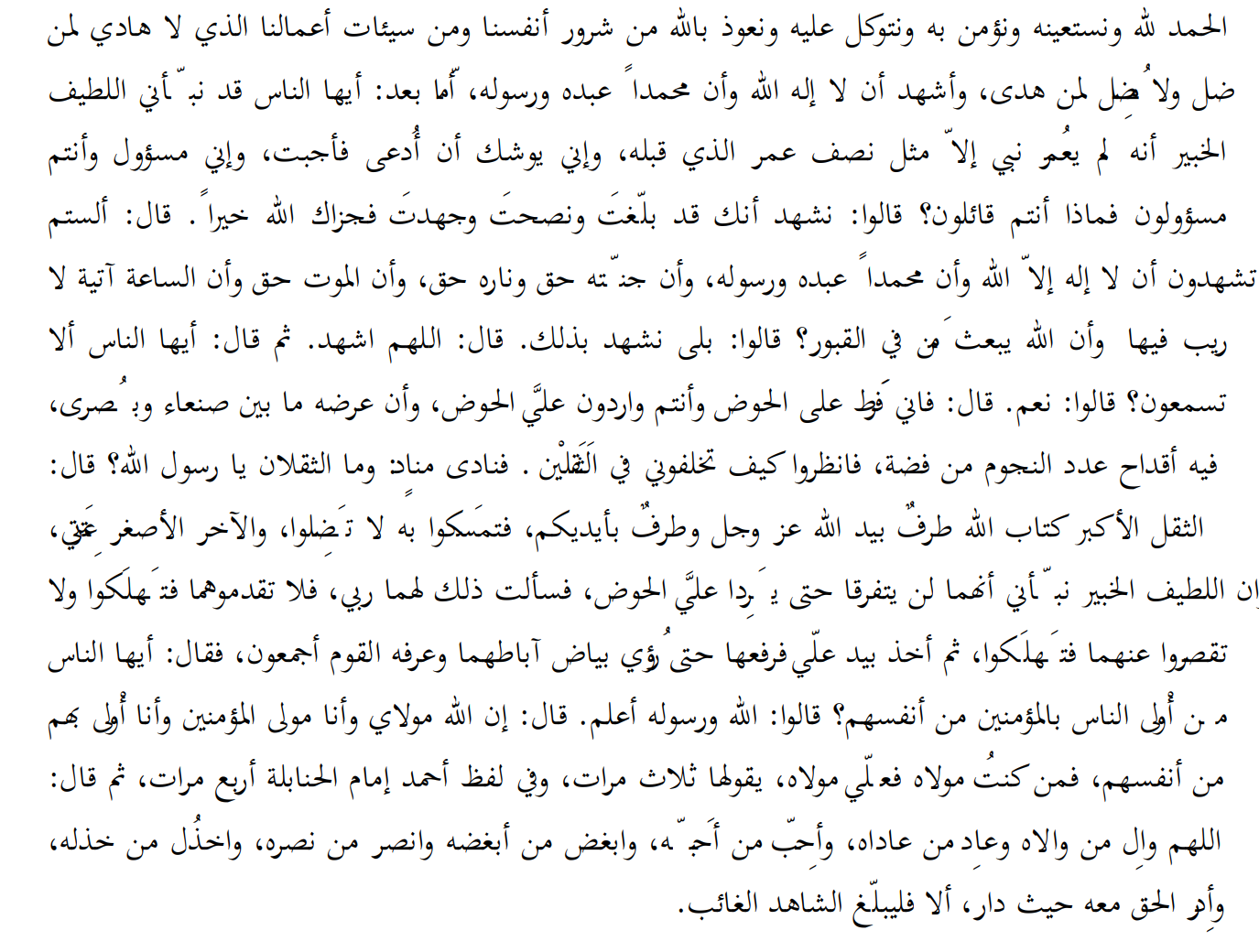
Toda alabanza es para Allah, a Quien pedimos ayuda, en Quien creemos y en Quien confiamos. Pedimos a Allah que nos proteja de los males de nuestras almas y de nuestras malas obras, Aquel a quien nadie puede guiar si Él lo extravía, ni extraviar si Él lo guía. Doy testimonio de que no hay más dios que Allah y que Muhammad ﷺ es Su siervo y Mensajero. En cuanto a lo que sigue: ¡Oh gente!, en verdad el Bondadoso y Omnisciente (swt) me ha informado de que no concede longevidad a un Profeta sino la mitad de la que tuvo el que lo precedió. En verdad, está próximo que yo sea llamado y responda. En verdad, yo soy responsable y vosotros sois responsables, ¿qué diréis entonces? Dijeron: Damos testimonio de que en verdad has transmitido, aconsejado y luchado, así que que Allah te recompense bien. Dijo ﷺ: ¿No dais testimonio de que no hay más dios que Allah y que Muhammad ﷺ es Su siervo y Mensajero, de que Su Paraíso es verdad y Su Infierno es verdad, de que la muerte es verdad, de que la Hora llegará sin duda alguna y de que Allah resucitará a quienes están en las tumbas? Dijeron: Sí, damos testimonio de ello. Dijo ﷺ: ¡Oh Allah, sé testigo! Luego dijo ﷺ: ¡Oh gente!, ¿no vais a escuchar? Dijeron: Sí. Dijo ﷺ: En verdad iré al estanque (al-Kawthar) y vosotros seréis presentados ante mí en el estanque, cuya anchura es la distancia entre Saná y Basora. En él hay copas de plata cuyo número es el de las estrellas, así que mirad cómo cuidáis de las dos cosas de gran peso después de mí. Un pregonero anunció: ¿Y cuáles son las dos cosas de gran peso, oh Mensajero de Allah? Dijo ﷺ: La mayor de las dos cosas de gran peso es el Libro de Allah, cuyo un extremo está en la mano de Allah y el otro en vuestras manos, así que aferraos a él y no os extraviaréis. La otra, menor, es mi familia (‘itrah). En verdad, el Bondadoso y Omnisciente (swt) me informó de que no se apartarán hasta que Alí llegue al estanque, y así se lo pedí a mi Señor. No os adelantéis a ellos ni los descuidéis, pues si lo hacéis, pereceréis. Entonces tomó la mano de Ali y la alzó hasta que se vieron sus axilas, y todos lo reconocieron, y dijo: «¡Oh gente! ¿Quién tiene prioridad sobre los creyentes respecto a sí mismos?». Dijeron: «Allah y Su Mensajero lo saben mejor». Dijo: «Verdaderamente Allah es mi Protector (mawla) y yo soy el protector de los creyentes, de modo que tengo prioridad sobre ellos respecto a sí mismos. Quien me tiene por protector, entonces Ali es su protector». Lo dijo tres veces, y según las palabras del Imam Ahmad, Imam de los hanbalíes, cuatro veces. Luego dijo: «¡Oh Allah, sé amigo de quien le sea amigo y enemigo de quien le sea enemigo. Ama a quien le ame y odia a quien le odie, apoya a quien le apoye y abandona a quien le abandone, y que la verdad esté con él dondequiera que se encuentre. Verdaderamente, que el testigo presente informe al ausente»".
"All praise is due to Allah whom we ask for help, believe in and depend upon. We ask Allah to protect us from the evils of our souls and bad deeds, the One whom none can guide whom He causes to go astray or misguide whom He guides. I bear witness that there is no god but Allah and Muhammad is His slave and Messenger. As for what follows: O people, verily the The Kind & All-Knowing (swt) has informed me that He does not grant longevity to a Prophet except half the like of the one before him. Verily it is about to be that I will be called and I will respond. Verily I am accountable and you are accountable, so what will you say? They said: We bear witness that verily you have conveyed, advised and struggled so may Allah reward you well. He said: Do you not bear witness that there is no god but Allah and that Muhammad is His slave and Messenger that His paradise is true and His hellfire is true, that death is true, that the Hour will come without any doubt and that Allah will resurrect those in the graves? They said: Yes, we bear witness to this. He said: O Allah, do bear witness. Then he said: O people, will you not listen? They said: Yes. He said: Verily I will go to the cistern (alkauthar) and you will be presented at the cistern, whose breadth is that between Sana’a and Basra, before me. In it are cups of silver the number of which are the number of stars, so look how you take care of the two weighty things after me. An announcer announced: And what are the two weighty things, O Messenger of Allah? He said: The greater of the two weighty things is the Book of Allah, one end of which is in the hand of Allah and the other in your hands so hold fast to it and you will not go astray. The other smaller one is my household (‘utra). Verily the Kind & All-Knowing (swt) informed me that they will not go away until Ali reaches the cistern and I asked that from my Lord. So do not precede them or neglect them and if you do so you will perish. Then he took the hand of Ali and raised it until their armpits were seen and everyone recognised him and he said: O people, who takes precedence before the believers over their own selves? They said: Allah and His Messenger know best. He said: Verily Allah is my Patron (mawla) and I am the patron of the believers such that I take precedence before them over their own selves. So whoever has me as his patron then Ali is his patron. He said this three times, and in the words of Imam Ahmad, Imam of the Hanbalis, four times. Then he said: O Allah, befriend whoever befriends him and become an enemy to whoever takes him as an enemy. Love whoever loves him and hate whoever hates him, support whoever supports him and abandon whoever abandons him, and let the truth be with him wherever he is resides. Verily, let the witness who is present inform the (one who is) absent.’”
3. Quienes afirman que el Mensajero (saw) anunció claramente el califato de Ali (ra) citan hadices en sus libros. En cuanto a esos hadices, no haremos objeto de investigación sus narraciones, a pesar de que los dos jeques, Al-Bujari y Muslim, no los narraron, y que no fueron transmitidos por ningún narrador de fiar, y que la mayoría de ellos se encuentra entre los hadices fabricados. No haremos de sus narraciones el objeto de la investigación, de modo que digan que estos hadices no fueron transmitidos por narradores de fiar antes de ustedes, pero sí lo fueron por narradores de fiar antes de nosotros, para que aquel para quien el hadiz sea autenticado lo use como prueba. No convertiremos eso en el campo de la investigación; más bien, haremos objeto de la investigación los textos mismos tal como llegaron en las narraciones. Estos son los textos de los que dedujeron que el Mensajero (saw) designó a Ali como sucesor tras él, y estos hadices son conocidos como los hadices de la “wilaya”, de los cuales presentaremos algunos, y el resto tiene el mismo significado e incluso las mismas palabras.
3. Those who say that the Messenger (saw) clearly announced the Khilafah of Ali (ra) narrated ahadith in their books. As for these ahadith, we will not make the place of research in them their narrations, despite the fact that the two sheikhs Al-Bukhari and Muslim did not narrate them, nor were they narrated via any trustworthy narrators and most of them are among the fabricated ahadith. We will not make their narrations the subject of research such that they say that these ahadith were not narrated by trustworthy narrators before you but were narrated by trustworthy narrators before us so that the one for whom the hadith is authenticated uses it as an evidence. We will not make that the domain of research; rather we will make the matter of research the texts themselves as they came in the narrations. These are the texts from which they deduced that the Messenger (saw) appointed Ali to be the Khalifah after him—and these ahadith are known as the ahadith of “wilayah”—from which we will present some of them and the rest carry the same meaning and even the same wordings.
a) Abu Dawud At-Tayalisi narró de ‘Ibn Abbas (ra) que el Mensajero de Allah ﷺ le dijo a Ali ibn Abi Talib (ra):
a) Abu Dawud At-Tayalisi narrated from ‘Ibn Abbas (ra) that the Messenger of Allah (saw) said to Ali ibn Abi Talib (ra):
"Tú eres el walí de todos los creyentes después de mí."
“You are the waliy of all believers after me.”
b) En Kanz al-'Ammal se narra de Imran bin Husain que dijo que el Mensajero de Allah ﷺ envió una expedición y puso al frente de ellos a Ali bin Abi Talib (ra). Este se reservó para sí una esclava de la quinta parte (khums), y ellos rechazaron esto de él. Cuatro de ellos acordaron quejarse de él ante el Profeta ﷺ, así que, cuando llegaron, uno de los cuatro se levantó y dijo: ¡Oh Mensajero de Allah ﷺ!, ¿no ves que Ali (ra) hizo tal y tal cosa?, y él ﷺ se apartó de él. El segundo se levantó y dijo lo mismo, y él se apartó de él. El tercero se levantó y dijo lo mismo, y él se apartó de él. Y el cuarto se levantó y dijo lo mismo que ellos habían dicho. El Mensajero de Allah ﷺ se volvió hacia ellos con la ira visible en su rostro y dijo:
b) It has been narrated in Kanz al-’Ammal from Imran bin Husain who said that the Messenger of Allah (saw) sent an expedition and appointed Ali bin Abi Talib (ra) over them. He chose for himself a slave girl from the fifth (khums) and they rejected this from him. Four of them agreed to complain about him to the Prophet (saw) so, when they came, one of the four stood and said: O Messenger of Allah (saw), do you not see that Ali (ra) did such and such, and he (saw) turned away from him. The second stood and said the same, so he turned away from him. The third stood and said the same, so he turned away from him. And the fourth stood and said the same as they had said. The Messenger of Allah (saw) turned towards them with anger visible in his face and said:
Lo que quiero para ti con respecto a Ali: en verdad, Ali es de mí y yo soy de él, y él es el walí de todo creyente después de mí.
What do you want for me with regards to Ali? Verily Ali is from me and I am from him, and he is the waliy of every believer after me.”
c) Y en un hadiz largo de ‘Amru bin Maymun, de ‘Ibn Abbas (ra), quien dijo: El Mensajero de Allah ﷺ envió a fulano con la sura At-Tawbah. Luego envió a Ali (ra) tras él para que la tomara de él, y dijo:
c) And in a long hadith from ‘Amru bin Maymun from ‘Ibn Abbas (ra) who said: The Messenger of Allah (saw) sent so and so with Surah At-Tawbah. He then sent Ali (ra) after him to take it from him and said:
"Nadie debe tomarla excepto un hombre que es de mí y yo soy de él."
“No one should take it except a man who is from me and I am from him.”
d) Kanz al-'Ummal, de Wahhab bin Hamza, quien dijo: Viajé con Ali (ra) y vi en él dureza, así que dije que, cuando regresara, me quejaría de ello. Y regresé y mencioné a Ali (ra) ante el Mensajero de Allah ﷺ, y él dijo:
d) IKanz al-’Ammal from Wahhab bin Hamza who said: I travelled with Ali (ra) and I saw harshness from him, so I said that when I will return I will complain about it. So I returned and mentioned Ali (ra) to the Messenger of Allah (saw) and he said:
"No digas esto por Ali, pues él es tu waliy después de mí."
“Do not say this for Ali, as he is your waliy after me.”
e) En Kanz al-'Ammal, de Ibn Abbas, quien dijo: El Mensajero de Allah ﷺ dijo:
e) In Kanz al-’Ammal from ‘ibn Abbas who said: The Messenger of Allah (saw) said:
"Quien desee vivir mi vida, morir mi muerte y residir en el Jardín del Edén que mi Señor ha regado, que entonces tome a Ali como su walí después de mí."
“Whoever is pleased to live my life, die my death and to reside in the paradise of Eden irrigated by my Lord then let him befriend Ali as a waliy after me.”
f) En Muntakhab al-Kanz, de Zayyad bin Mutarraf, quien dijo: Escuché al Mensajero de Allah ﷺ decir:
f) In Muntakhab al-Kanz from Zayyad bin Mutarraf who said: I heard the Messenger of Allah (saw) saying:
«Quien desee vivir mi vida, morir mi muerte y entrar en el paraíso que mi Señor me ha prometido —y es un paraíso eterno— entonces que sea amigo de Ali y de sus descendientes después de mí. Ciertamente, ellos nunca os sacarán de la puerta de la guía ni os harán entrar por la puerta del extravío».
“Whoever would like to live my life, die my death, and enter the paradise promised to me by my Lord—and it is an eternal paradise—then let him befriend Ali and his descendants after me. Verily they will never remove you from the door of guidance nor enter you into the gate of misguidance.”
g) En Kanz al-'Ammal, de Ammar bin Yasir, quien dijo: El Mensajero de Allah ﷺ dijo:
g) In Kanz al-’Ammal from Ammar bin Yasir who said: The Messenger of Allah (saw) said:
«Encomiendo a quien crea en mí y confíe en mí la wilayah de Ali bin Abi Talib. Quien sea amigo de él ha sido amigo mío, y quien sea amigo mío ha sido amigo de Allah. Quien lo ame me ha amado a mí, y quien me ame ha amado a Allah. Quien lo odie me ha odiado a mí, y quien me odie ha odiado a Allah.»
“I bequeath whoever believes in me and trusts me with the wilayah of Ali bin Abi Talib. Whoever befriends him has befriended me and whoever befriends me has befriended Allah. Whoever loves him has loved me, and whoever loves me has loved Allah. Whoever hates him has hated me, and whoever hates me has hated Allah.”
h) También en Al-Kanz, de Ammar, se ha narrado en un hadiz marfu':
h) Also in Al-Kanz from Ammar it has been narrated in a marfu hadith :
«¡Oh Allah! Quien crea en mí y confíe en mí, que tome por aliado a Ali bin Abi Talib ﷺ. Ciertamente su wilayah es mi wilayah ﷺ, y mi wilayah es la wilayah de Allah ta'ala.»
“O Allah, whoever believes and trusts in me, let him befriend Ali bin Abi Talib. Verily his wilayah is my wilayah and my wilayah is the wilayah of Allah ta’ala.”
4. Hay ahadiz narrados por quienes afirman que el Mensajero (saw) declaró abiertamente el califato de Alí (ra). Estos ahadiz no han sido narrados por ninguna persona fiable, y la mayoría son ahadiz fabricados. No los presentamos para investigarlos desde el ángulo de su transmisión, de modo que se afirme que están autenticados para quienes los narran. Más bien, los presentamos para hacer el punto de investigar sus textos según lo que aparece en ellos. Estos ahadiz contienen la hermandad del Mensajero (saw) con Alí (ra) y el hecho de hacerlo heredero después de él. Presentamos algunos de ellos, y el resto tiene el mismo significado e incluso las mismas palabras.
4. There are ahadith narrated by those who say that the Messenger (saw) openly declared the Khilafah of Ali (ra). These ahadith have not been narrated by any trustworthy person and most of them are fabricated ahadith. We present them not to research them from the angle of their narration so that they are claimed to be authenticated for those who narrate them. Rather we present them to make the point of research their texts according to what came in their texts. These ahadith contain the brotherhood of the Messenger (saw) with Ali (ra), and making him the heir after him. We present a few of them with the remainder carrying the same meaning and even the same wordings.
a) El Profeta ﷺ estableció una hermandad entre los Muhayirin y se eligió a Ali (ra) para sí mismo. En lo que resultó del hadiz de la primera hermandad, «Ali dijo: ¡Oh Mensajero de Allah ﷺ!, en verdad mi alma me abandonó y mi espina dorsal se quebró cuando te vi hacer lo que hiciste con tus compañeros distintos de mí. Si esto es una señal de tu enojo conmigo, entonces me quejo solo ante ti y pido tu perdón». El Mensajero de Allah ﷺ dijo:
a) The Prophet (saw) established a brotherhood between the Muhajirin and chose Ali (ra) for himself. In what came of the hadith of the first brotherhood, “so Ali said: O Messenger of Allah (saw), verily my soul left me and my spine has been broken when I saw you do what you did with your companions other than me. If this is a sign of your anger with me, then I complain only to you and beg your pardon. The Messenger of Allah (saw) said:
"Por Aquel que me envió con la verdad, no te dejé sino para mí. Tú eres para mí en la posición de Harún respecto a Musa, excepto que no hay profeta después de mí. Eres mi hermano y mi heredero." Preguntó: "¿Qué heredaré yo de ti?" Respondió: "¿Qué heredaron los profetas antes de mí? El Libro de su Señor y la Sunnah de sus profetas."ﷺ
By the One who sent me with truth, I only left you for myself. You are to me of the status of Harun to Musa except that there is no Prophet after me. You are my brother and inheritor. He said: What will I inherit from you. He said: What did the Prophets inherit before me, the Book of their Lord and the Sunnah of their Prophets.”
b) El Profeta ﷺ estableció una hermandad entre los Muhayirin y los Ansar cinco meses después de la hégira, pero no estableció hermandad entre Ali (ra) y ninguno de los Ansar; más bien lo eligió para sí mismo. Así aparece en el hadiz de la segunda hermandad.
b) The Prophet (saw) made a brotherhood between the Muhajirin and the Ansar five months after the hijrah, but he did not make a brotherhood between Ali (ra) and any of the Ansar; rather he chose him (Ali) for himself. It came in the hadith of the second brotherhood
Que el Mensajero (saw) dijo a Ali: "¿Te enojaste conmigo cuando establecí una hermandad entre los Muhayirin y los Ansar, pero no establecí una hermandad entre ti y ninguno de ellos? ¿No te complace ser semejante a la posición que tenía Harún respecto a Musa para mí, excepto que no habrá profeta después de mí?"
“That the Messenger (saw) said to Ali: Did you become angry at me when I made a brotherhood between the Muhajirin and Ansar but did not make a brotherhood between you and any of them? Are you not pleased to be similar to the status of Harun to Musa for me except that there is no Prophet after me”
c) Se narra que el Mensajero ﷺ salió un día hacia sus compañeros con el rostro iluminado, y Abdurrahman bin Awf (ra) le preguntó, y él dijo:
c) It is narrated that the Messenger (saw) went out one day to his companions with his face brightened so Abdurrahman bin Awf (ra) asked him and he said:
«Buenas noticias me llegaron de mi Señor sobre mi hermano y el hijo de mi tío paterno, y mi hija: que Allah casará a Ali con Fátima.»
“Good news came to me from my Lord about my brother and paternal uncle’s son and my daughter, that Allah will marry Ali with Fatima.”
Cuando se consideraba al novio idóneo para el matrimonio de Sayyida Annisa (líder de las mujeres), el Profeta ﷺ dijo:
When the sayyid Annisa’s (leader of the women) deserving groom for her marriage was being considered, the Prophet (saw) said:
—Oh Umm Ayman, llama a mi hermano por mí. Ella dijo: ¿Es tu hermano y aun así lo casas con tu hija? Él dijo: Sí, oh Umm Ayman. Entonces ella llamó a Ali y él vino.
“O Umm Ayman, call my brother for me. She said: He is your brother yet you are marrying him (to your daughter)? He said: Yes, O Umm Ayman. So she called Ali and he came.”
Y el Profeta ﷺ le habló un día sobre un juicio entre él, su hermano Ja'far y Zayd bin Haritha, diciendo:
And the Prophet (saw) spoke to him one day regarding a judgement between him, his brother Ja’far (saw) and Zayd bin Haritha (saw), saying:
«En cuanto a ti, oh Ali, eres mi hermano, el padre de mi hijo, y de mí y para mí.» ﷺ
“As for you, O Ali, (you are) my brother, the father of my son, and from me and for me.”
d) El Mensajero ﷺ le prometió a Ali (ra) un día, diciéndole:
d) The Messenger (saw) promised to Ali (ra) one day saying:
"Tú eres mi hermano y mi wazir. Saldarás mis deudas, cumplirás mis compromisos y completarás mis responsabilidades."
“You are my brother and my wazeer. You will repay my debts, fulfill my commitments and complete my responsbilities.”
3) En Kanz al-'Ammal, él ﷺ dijo
3) In Kanz al-’Ammal, he (saw) said
Está escrito en la puerta del Paraíso: No hay más dios que Allah, Muhammad es el Mensajero de Allah ﷺ, Ali es el hermano del Mensajero de Allah ﷺ.
“It is written on the gate of Paradise: There is no god but Allah, Muhammad is the Messenger of Allah, Ali is the brother of the Messenger of Allah.”
Estos cuatro textos, que son aquellos en los que el Mensajero (saw) lo puso (a Ali) en la posición de Harún respecto a Musa, el texto en el que dejó el Libro de Allah y a Sus descendientes, el texto de la wilayah y el texto de la hermandad, son los textos de los que algunos musulmanes dedujeron que el Mensajero ﷺ designó a Ali (ra), es decir, lo nombró Califa después de él. Veámoslos texto por texto:
These four texts, which are the texts in which the Messenger (saw) made him (Ali) of the status of Harun to Musa, the text that he left the Book of Allah and His progeny, the text of wilayah, and the text of brotherhood, are the texts from which some Muslims deduced that the Messenger (saw) appointed Ali (ra) i.e. made him the Khalifah after him. Let us take them text by text:
En cuanto al primer texto, aquel que hizo que Ali ocupara la posición de Harún respecto a Musa ante el Mensajero (ﷺ), su significado se aclara al estudiar la ocasión en que fue dicho y al estudiar su redacción. En cuanto a la ocasión, el Mensajero (ﷺ) dijo este hadiz el día de la batalla de Tabuk. En esa ocasión, el Mensajero (ﷺ) designó en Medina, en su lugar, a Muhammad bin Maslamah (ra) para supervisar los asuntos de los musulmanes y administrar el gobierno, y designó a nuestro maestro Ali (ra) sobre su familia y le ordenó que los supervisara. Los hipócritas lo criticaron y dijeron: No lo dejó atrás sino porque le resultó difícil, y quiso facilitarle las cosas. Cuando los hipócritas dijeron esto, Ali (ra) tomó su arma y partió hasta encontrarse con el Mensajero (ﷺ), que estaba acampado en Al-Jarf, y dijo:
As for the first text, which is the text which made Ali at the status of Harun to Musa before the Messenger (saw), its meaning is clarified though studying the occcasion in which it was said and studying its wording. As for the occasion, the Messenger (saw) said this hadith on the day of the battle of Tabuk. Therein the Messenger (saw) appointed in Madinah in his place Muhammad bin Maslamah (ra) to supervise the Muslims’ affairs and administer the rule, and appointed our master Ali (ra) over his family and commanded him to supervise them. The hypocrites shook him and said: He did not leave him behind except because it had become hard on him he wanted to make it easy for him. When the hypocrites said this, Ali (ra) took his weapon and left until he met the Messenger (saw) who was encamped at Al-Jarf and said:
«¡Oh Profeta de Allah! Los hipócritas afirmaron que me dejaste atrás porque me consideraste una carga y deseabas aligerarla para mí». Él (ﷺ) dijo: «Mintieron. Más bien te dejé atrás por lo que dejo tras de mí. Regresa, pues, y ocupa mi lugar sobre mi familia y sobre la tuya. ¿No te complace, oh Ali, que tengas para conmigo la misma posición que Harún tuvo con Musa, excepto que no habrá profeta después de mí?».
“O Prophet of Allah, the hypocrites claimed that you left me behind because you found a burden on meand wished to make it light for me. He (saw) said: They lied, rather I left you behind due to what I left behind me. So return and take my place over my family and your family. Are you not pleased, O Ali, that you are of the same status to me as Harun to Musa except that there is no Prophet after me?”
Así pues, el Mensajero de Allah ﷺ continuó su viaje. El hadiz sobre que Ali (ra) ocupa para el Mensajero ﷺ la misma posición que Harún para Musa se refiere a que el Mensajero ﷺ lo designó sobre su familia, según la evidencia de la propia declaración de Ali (ra).
So the Messenger of Allah (saw) continued on his travel. The hadith about Ali (ra) being the same status for the Messenger (saw) as Harun for Musa concern to his (saw)’s appointing him over his (saw) family by the evidence of Ali’s (ra) own statement:
«¿Me dejas atrás con las mujeres y los niños?»
“Do you leave me behind with women and children?”
La realidad del incidente es que fue designado sobre su familia, por lo que no puede entenderse que haya sido designado sobre el Califato, especialmente cuando se sabe que el Profeta ﷺ designó a Muhammad bin Maslamah como gobernante en su lugar y especificó a Ali (ra) para que supervisara a su familia cuando le dijo: «mi familia y tu familia». Además, que el Mensajero de Allah ﷺ designara a uno de sus compañeros para gobernar cuando partía a la batalla no significa que esa persona designada fuera el Califa en su lugar, como lo demuestra el hecho de que el Mensajero ﷺ designó a muchos en las batallas. En la batalla de Al-‘Asheera designó a Abu Salamah bin Abd al-Asad sobre Madinah; en la batalla de Safwan designó a Zayd bin Haritha (ra) sobre Madinah; en la batalla de Banu Lahyan designó a ibn Umm Maktum (ra) sobre Madinah, y así sucesivamente. La designación por parte del Mensajero ﷺ de alguien para gobernar Madinah hasta su regreso de las batallas no indica que dicha designación implicara la autoridad sobre el Califato; por tanto, ¿qué impide que lo designara solo sobre su familia, mientras nombraba a otro con autoridad hasta su regreso de la batalla?
The reality of the incident is that he was appointed over his family so it cannot be taken to mean that he was appointed over the Khilafah, particularly when it is known that he (saw) appointed Muhammad bin Maslamah as the ruler in his place and specified Ali (ra) to supervise over his family when he said to him, “my family and your family.” Moreover, the Messenger’s (saw) appointment of one of his companions over the rule when he left for battle does not mean that this appointed person is the Khalifah in his place by the evidence that the Messenger (saw) appointed many in the battles. In the battle of Al-‘Asheera he appointed Abu Salamah bin Abd al-Asad over Madinah, in the battle of Safwan he appointed Zayd bin Haritha (ra) over Madinah, in the battle Banu Lahyan he appointed ibn Umm Maktum (ra) over Madinah, and so on. The appointment by the Messenger (saw) of someone to rule over Madinah until he returns from his battles does not indicate that means his appointment over the Khilafah, so what if he appointed him only over his family while appointing another in authority until he returns from his battle.
En relación con el nombramiento. En cuanto al dicho del Mensajero ﷺ:
This is in relation to the appointment. As for the saying of the Messenger (saw):
¿No te complace ser semejante a la posición de Harún con respecto a Musa?
“Are you not pleased to be similar to the status of Harun with Musa?”
¿No te complace que tengas, en aquello para lo que has sido designado, lo que Harún supervisó para Músa? Es la semejanza de Alí (ra) con Harún en el sentido de la semejanza, que es el nombramiento; es decir, tu similitud conmigo al designarte (o al dejarte atrás) es semejante a la de Harún cuando Músa lo designó. Este es el significado de las palabras del hadiz, y estas palabras no tienen ningún otro significado. Este significado queda determinado y se convierte en el único significado por lo que dijo Alí (ra) al Mensajero ﷺ.
The meaning of its words is: Are you not pleased that there is for you, in what you are appointed over, what Harun supervised for Musa. It is the resemblance of Ali (ra) with Harun in the way of resemblance being the appointment i.e. your similitude in my appointing you (or leaving you behind) is similar to that of Harun when Musa appointed him. This is the meaning of the words of the hadith and these words do not have any other meaning. This meaning is specified and becomes the only meaning due to Ali’s (ra) saying to the Messenger:
«¿Me dejas atrás con los niños y las mujeres?»
“Do you leave me behind with children and women?”
Con la declaración del Mensajero ﷺ:
With the Messenger’s statement:
¿No te complace que tengas conmigo una relación similar a la que tenía Harún con Musa?
“Are you not pleased to be related to me similar to the status of Harun with Musa?”
Esto llegó como respuesta a la pregunta de Ali (ra) y como réplica a su afirmación. Para entender lo que significa este hadiz, hay que volver al Glorioso Corán para ver, dentro del asunto del nombramiento de Harún por parte de Musa, en qué consiste. Al volver al Glorioso Corán, encontramos que este suceso se menciona en el Corán en el siguiente texto:
This came in response to this question of Ali (ra) and as a response to his statement. To understand what is meant by this hadith one must return to the Glorious Qur’an to see within the issue of Musa’s appointing Harun to see what it is. Returning to the Glorious Qur’an, we find that this event is mentioned in the Qur’an in the following text:
«Y citamos a Mûsâ (Moisés) treinta noches y las completamos con diez más, de modo que el plazo fijado por su Señor se cumplió en cuarenta noches. Y Mûsâ dijo a su hermano Hârûn (Aarón): "Sé mi sucesor entre mi pueblo, obra rectamente (ordenando a la gente que obedezca a Allâh y que solo a Él adore) y no sigas el camino de los mufsidûn (corruptores)"».
“And we appointed for Mûsâ (Moses) thirty nights and added (to the period) ten (more), and he completed the term, appointed by his Lord, of forty nights. And Mûsâ (Moses) said to his brother Hârûn (Aaron): "Replace me among my people, act in the right way (by ordering the people to obey Allâh and to worship Him Alone) and follow not the way of the Mufsidûn (mischief-makers)” [TMQ 7:142].
Entonces el significado del hadiz es: ¿No te complace que yo te designe sobre mi familia como Musa designó a Harún sobre su pueblo, de modo que tú ocupes ante mí el rango que Harún ocupaba respecto a Musa por razón de la designación? Así pues, la intención del hadiz es calmar el corazón de nuestro maestro Ali, pues vino disgustado por esta designación, y al mismo tiempo informa a Ali (ra) de que ocupará el lugar del Profeta ﷺ sobre su familia cuando él esté ausente, igual que Harún ocupó el lugar de Musa sobre su pueblo cuando este estaba ausente. En cuanto a su dicho:
So the hadith’s meaning becomes: Are you not pleased that I appoint you over my family like Musa appointed Harun over his people, so that you become before me of the status of Harun to Musa due to the appointment? So the hadith’s intent is to pacify our master Ali’s heart as he came displeased by this appointment, and at the same time it informs Ali (ra) that he will take his (saw) place over his family when he is absent just like Harun took Musa’s place over his people when he was absent. As for his saying:
«Excepto que no hay profeta después de mí»
“Except that there is no Prophet after me”
Esto anula la semejanza de la profecía, porque Harún era profeta ﷺ y, por tanto, era un profeta ﷺ que ocupaba el lugar de otro profeta ﷺ cuando este estaba ausente. Por eso el Mensajero ﷺ excluyó la profecía, para eliminar cualquier idea de que tuviera el mismo rango en la profecía. Tampoco debe decirse que su afirmación,
This negates the resemblance of Prophethood because Harun was a Prophet (saw) so he was a Prophet (saw) taking the place of another Prophet (saw) when he was absent. So the Messenger (saw) excluded Prophethood to remove any imagination that he is of the same status in Prophethood. Nor should one say that his statement,
«No habrá profeta después de mí»
“No Prophet after me”
Significa "después de mi muerte", ya que las palabras se relacionan con el nombramiento durante su vida. Esto se debe a que Harún era profeta junto con Musa durante la vida de este, no después de su muerte; era su sucesor (jalifa) sobre su pueblo mientras Musa estaba ausente durante su vida, no después de su muerte. Así pues, el Mensajero de Allah ﷺ solo hizo su afirmación: "Excepto que no hay profeta después de mí", porque Harún fue profeta durante la ausencia de Musa mientras este vivía; por tanto, hizo esta afirmación para negar la profecía a Ali (ra). Además, el Mensajero de Allah ﷺ nos informó, en un hadiz auténtico narrado por Al-Hakim, que Harún murió durante la vida de Musa. Así pues, no se plantea la cuestión del nombramiento después de la muerte, pues esta no existió en Harún y Musa, con quienes se establece la semejanza, y por tanto no existe en el Profeta ﷺ y en Ali (ra), que son los que se asemejan.
Means after my death as the words are related to appointment during his life. This is because Harun was a Prophet along with Musa during his life not after his death; he was his deputy (khalifa) over his people while he (Musa) was absent during his life not after his death. So the Messenger only made his statement: “Except that there is no Prophet after me” because Harun was a Prophet during Musa’s absence while he lived; so he made this statement in order to negate Prophethood from Ali (ra). Moreover, the Messenger of Allah (saw) informed us in an authenticated hadith narrated by Al-Hakim that Harun died during Musa’s life. So there does not raise the issue of appointment after death as it did not exist in Harun and Musa, who are those with whom resemblance is made, thus it does not exist in the Prophet (saw) and Ali (ra) who are the resemblers.
Este es el significado del hadiz y no contiene ninguna indicación de nombramiento para el Califato, ni puede entenderse de ninguna manera que el Mensajero ﷺ pretendiera con este hadiz establecer claramente y designar a Alí (ra) como Califa sobre los musulmanes después de la muerte del Mensajero ﷺ. El hadiz tratado se refiere al nombramiento de Alí (ra) sobre la familia del Mensajero ﷺ durante su ausencia debido a la batalla de Tabuk. En cuanto a las demás narraciones que aparecen en este hadiz, es decir, su dicho ﷺ:
This is the hadith’s meaning nor does it contain any indication to appointment for the Khilafah nor can it be understood in any way that the Messenger (saw) intended by this hadith to clearly state and make Ali (ra) the Khalifah over the Muslims after the Messenger’s (saw) death. The hadith discussed is related to the appointment of Ali (ra) over the Messenger’s (saw) family during his absence due to the battle of Tabuk. As for the remaining narrations which came in this hadith i.e. his (saw) saying:
¿No te complace estar ante mí en la posición que tenía Harún con Musa?
“Are you not please to be before me of the status of Harun with Musa?”
Algunas de ellas son narraciones autenticadas, como las recogidas por Al-Bujari y Muslim en sus obras de hadices, a través de ‘Amir e Ibrahim, los dos hijos de S’ad, mientras que otras no están autenticadas, pero todas llegaron con el mismo texto. Esto significa que el hadiz fue dicho en Tabuk y en otras ocasiones. La respuesta a esto es que las narraciones auténticas son aquella que forma parte del episodio, es decir, las narraciones que contienen únicamente las palabras del Mensajero de Allah ﷺ separadas del episodio, lo cual no significa que se trate de un episodio distinto del episodio de Tabuk. Los narradores y recopiladores de hadices narran con frecuencia una parte de un hadiz o una parte de un episodio, acortándolo hasta el lugar de la prueba. Incluso si aceptamos que el hadiz no se refería únicamente al episodio de Tabuk, sino que fue dicho en Tabuk y en otras ocasiones, eso significaría que el Mensajero de Allah ﷺ designó a nuestro maestro Ali (ra) sobre su familia de forma permanente, tanto durante Tabuk como en otras ocasiones; tampoco significaría su designación (que Allah enaltezca su rostro) para el Califato tras la muerte del Mensajero de Allah ﷺ. Todo lo que indica la explicación de la palabra y el significado del hadiz es: ¿No te complace que te haya designado sobre mi familia durante mi ausencia, del mismo modo que Harún supervisó a Musa durante su ausencia, salvo que Harún era un Profeta y tú no eres un Profeta, porque no hay Profeta después de mi profecía? Esto aparece en la narración de Muslim, a través de ‘Amir bin S’ad, de su padre.
Some of them are authenticated narrations like those by Al-Bukhari and Muslim in their hadith from ‘Amir and Ibrahim, the two sons of S’ad, while others are not authenticated, but all of them came with the same text. This means that the hadith was said in Tabuk and at other times. The response to this is that the authentic narrations are a narration which is a part of the incident i.e. narrations with the Messenger’s (saw) words alone separated from the incident which does not mean that it is an incident other than the incident of Tabuk. Narrators and collectors of hadith frequently narrate a part of a hadith or a part of an incident, shortening it to the place of evidence. Even if we accept that the hadith was not only about the incident of Tabuk but was said in Tabuk and other times, then this would mean that the Messenger (saw) appointed our master Ali (ra) over his family permanently during Tabuk and at other times; nor would it mean his appointment (may Allah ennoble his face) over the Khilafah after the Messenger’s (saw) death. All that the explanation of the hadith’s word and meaning indicate is: Are you not pleased that I appointed you over my family during my absence just like Harun supervised for Musa during his absence, except that Harun was a Prophet and you are not a Prophet because there is no Prophet after my Prophethood. This came in Muslim’s narration from Amir bin S’ad from his father:
¿No te complace ser para mí lo que Harún fue para Musa, excepto que no habrá profeta después de mí? ﷺ
“Are you not pleased that you become before me of the status of Harun with Musa except that there is no Prophet after me”
i.e. después de mi profecía. Esta es la semejanza con la que el Mensajero (saw) comparó a Ali (ra) con él, igual que Harún con Musa: es decir, el nombramiento y nada más, el nombramiento durante su ausencia y nada más, y el nombramiento sobre su familia, tal como aparece en el texto del hadiz en su totalidad. La frecuencia con la que se repite un hadiz no cambia su significado para darle un significado alternativo. Así, el nombramiento en Tabuk fue solo sobre la familia del Mensajero ﷺ, como queda demostrado sin lugar a dudas, mientras que las demás narraciones fuera de Tabuk transmitieron el mismo texto mencionado en Tabuk, tanto en palabras como en significado, sin mencionar la restricción del episodio de Tabuk, es decir, la familia. Más bien, no mencionan ninguna restricción en absoluto; por tanto, las medimos según lo mencionado en la narración de Tabuk. Esto se debe a que la narración de Tabuk está restringida a la familia, mientras que las demás narraciones están libres de cualquier restricción en el nombramiento, así que medimos lo no restringido según lo restringido. Tampoco debe decirse que las demás narraciones son generales, pues las palabras del hadiz no son de los términos generales; los textos de todas las narraciones, ya sea la narración: "¿No estás complacido?", o la narración: "Ciertamente tú", o la narración: "Tú", y similares, que expresan la posición de Harún con respecto a Musa, son todos específicos de un estatus concreto, que es el estatus de Harún con Musa, que no es un estatus general. Salvo que el estatus de Harún con respecto a Musa aparece sin restricción en algunas de las narraciones, que no estaban restringidas por ninguna condición, mientras que en algunas narraciones estaban restringidas a la familia; por tanto, medimos lo no restringido según lo restringido, de modo que todas las narraciones quedan restringidas a la familia.
i.e. after my Prophethood. This is the similitude with which the Messenger (saw) compared Ali (ra) in relation to him just like Harun in relation to Musa i.e. the appointment and nothing else, appointment during his absence and nothing else, and appointment over his family as came in the hadith’s text in its entirety. The frequency with which a hadith is repeated does not change its meaning to give it an alternative meaning. So the appointment in Tabuk was only over the Messenger’s (saw) family as is proven without doubt, while the other narrations in other than Tabuk conveyed the same text mentioned in Tabuk in words and meaning without mentioning the restriction in the incident of Tabuk i.e. the family. Rather, they do not mention any restriction at all thus we measure them upon what was mentioned in the narration of Tabuk. This is because the narration of Tabuk is restricted to the family while the other narrations are free of any restriction in the appointment so we measure the unrestricted upon the restricted. Nor should one say that the other narrations are general as the words of the hadith are not from the general words as the texts of all the narrations whether the narration: “Are you not pleased” or the narration: “Verily you” or the naration: “You” and the similar which is of the weightage of Harun with Musa; all these words are specific to a specific status which is of the status of Harun with Musa which is not of the general status. Except that the status of Harun to Musa came unrestricted in some of the narrations which were not restricted by any restriction, while they were restricted to the family in some of the narrations so we measure the unrestricted upon the restricted such that all the narrations are restricted to the family.
«Y désignáme un ayudante de mi familia, Hârûn (Aarón), mi hermano. Fortaléce mi fuerza con él, y que comparta mi tarea (de transmitir el Mensaje de Allah y la Profecía)» [TMQ 20:29].
“And appoint for me a helper from my family, Hârûn (Aaron), my brother. Increase my strength with him, And let him share my task (of conveying Allâh's Message and Prophethood” [TMQ 20:29].
No tienen cabida en relación con el estatus de Harún respecto a Musa, ni con el nombramiento como Jalifa, ya que es una súplica que Musa hizo a Allah para que hiciera de su hermano un asistente suyo y le concediera la profecía junto con él, pues los asuntos que Musa pidió a Allah (SWT) que compartiera con Harún fueron la profecía y el mensaje; por tanto, la asociación se limitó a estos asuntos y no abarcó el gobierno, ya que Musa no fue gobernante sino solamente profeta. Además, la petición fue una solicitud de ayuda para él y de que se le asociara en su misión, no una petición de su nombramiento (en el gobierno).
There is no place for them in relation to the status of Harun to Musa nor the appointment as the Khalifa since it is a prayer which Musa Made to Allah to make his brother an assistant to him and to give him the Prophethood along with him because the matters which Musa prayed to Allah (swt) to associate Harun with him upon were Prophethood and the Message so the association was only in these matters not the rule, as Musa was not a ruler but only a Prophet. Moreover, the request was a request for assistance for him and associating him in his matter, not a request for his appointment (in rule).
Por encima de todo esto, estos asuntos no son una indicación del estatus de Musa respecto a Harún; más bien, la indicación del estatus de Musa respecto a Harún es que lo designó sobre su pueblo durante su ausencia; así, su estatus ante él era que cuidó de su pueblo durante su ausencia. No existe base alguna para la ayuda y la asociación en la profecía en las palabras del Mensajero: “con el estatus de Harún respecto a Musa”, pues en realidad el significado se limita a la designación sobre el pueblo, y los textos no transmiten ningún otro significado que este.
Above all this, these matters are not an indication to the status of Musa to Harun; rather an indication for the status of Musa to Harun is his appointing him over his people during his absence; so his status before him is that he took care of his people during his absence. There is no existence for assistance and association in the Prophethood in the statement of the Messenger: “of the status of Harun to Musa” infact the meaning is restricted to the appointment over the people and the texts do not carry any meaning other than this.
Se ha dicho que Musa era un gobernante, porque se le reveló una Shari'ah para gobernar con ella, pues contiene soluciones y castigos, y era el líder de un ejército que pretendía ocupar Bait al-Maqdis cuando su pueblo le dijo:
It has been said that Musa was a ruler because a Shari’ah was revealed to him to rule by ,as there are solutions and punishments within it, and he was a leader of an army which intended to occupy Bait al-Maqdis when his people said to him:
«Tú y tu Señor id y combatid» [TMQ 5:24],
You and your Lord go and fight” [TMQ 5:24],
Así pues, su designación de Harún sobre su pueblo fue una designación en la profecía y también en la autoridad. La respuesta a esto es que Musa no fue un gobernante, ni se narra en el Corán ni en otro lugar que él ejecutara las normas sobre los hijos de Israel (Banu Israil) por la fuerza y la autoridad, ni que fuera un gobernante sobre ellos. Quienes gobernaron a Banu Israil con la Sharía de Musa no fueron el propio Musa ni durante su vida, sino los profetas que vinieron después de él, como Dawud, Sulaimán y otros reyes. En cuanto al liderazgo de Musa sobre los ejércitos, nunca ocurrió. Los aleyas de la sura Al-Ma'ida, desde la aleya 19 hasta la 26, no contienen nada que indique el liderazgo de Musa sobre el ejército; lo que contienen es que Musa (as) pidió a su pueblo que entrara en la Tierra Santa. Ellos se negaron y le dijeron que allí había gigantes agresivos, por lo que nunca entrarían hasta que aquellos gigantes se marcharan; le pidieron a él y a su Señor que fueran a luchar, pero él no fue, y el resultado fue su exilio durante cuarenta años en el desierto. En cuanto a la revelación de la Sharía a Musa (as) con sus soluciones y castigos, esto no significa que Musa (as) gobernara con ella; la realidad es que él la trajo y la transmitió a Banu Israil. Intentó llevarlos a Bait al-Maqdis, pero se extraviaron en el desierto y no se estabilizaron hasta que terminó su período. Cuando terminó el castigo del exilio, se pusieron en marcha y fueron gobernados por reyes y profetas entre ellos según la Sharía de Musa, como afirma el Corán en más de una sura. Además, las aleyas en las que se designó a Harún son explícitas en que fue una designación en nombre de Musa en la profecía cuando Musa fue a encontrarse con Allah (swt), lo cual se encuentra en la sura Al-A'raf, desde la aleya 141:
So his appointment of Harun over his people was an appointment in Prophethood and also in authority. The response to this is that Musa was not a ruler, nor is it narrated in the Qur’an or elsewhere that he would execute the rules upon the children of Israel (Banu Israil) by strength and the authority or that he was a ruler over them. Those who ruled Banu Israil with the Shari’ah of Musa were not Musa himself or in his lifetime, rather it was those Prophet who came after him like Dawud, Sulayman and other kings. As for Musa’s leadership over the armies, it never occurred. The ayaat which are in Surah Al-Maidah from ayah 19 to ayah 26 do no have anything within them which indicates Musa’s leadership over the army; rather what is within them is that Musa (as) requested his people to enter the Holy Land. They refused and said to him that there are giant aggressive people within it so they would never enter until these giants left; they asked him and his Lord to go and fight but he did not go so the result was their exile for fourty years in the wilderness. As for the revelation of the Shari’ah to Musa (as) with solutions and punishments, this does not mean that Musa (as) ruled with these; rather the reality is that he came with it and conveyed it to Banu Israil. He tried to take them to Bait al-Maqdis but they strayed in the wilderness and they did not stabilise until his period had ended. After their punishment with the exile ended, they moved and were ruled by kings and Prophets among them by the Shari’ah of Musa, which is stated by the Qur’an in more than one Surah. Moreover, the ayaat in which Harun was appointed are explicit that it was an appointment on behalf of Musa in Prophethood when Musa went to meet Allah (swt), which is in Surah Al-‘Araf from ayah 141:
«Y citamos a Mûsâ (Moisés) treinta noches y las completamos con diez más, de modo que el plazo fijado por su Señor se cumplió en cuarenta noches. Y Mûsâ dijo a su hermano Hârûn (Aarón): "Sé mi sucesor entre mi pueblo, obra rectamente (ordenando a la gente que obedezca a Allâh y que solo a Él adore) y no sigas el camino de los mufsidûn (corruptores)"».
“And we appointed for Mûsâ (Moses) thirty nights and added (to the period) ten (more), and he completed the term, appointed by his Lord, of forty nights. And Mûsâ (Moses) said to his brother Hârûn (Aaron): "Replace me among my people, act in the right way (by ordering the people to obey Allâh and to worship Him Alone) and follow not the way of the Mufsidûn (mischief-makers)” [TMQ 7:142].
«Y Musa escogió de su pueblo a setenta hombres» [TMQ 7:155].
“And Musa chose from his people seventy men” [TMQ 7:155].
Todos estos se relacionan con la profecía y con el nombramiento en ella, con el arrojar de las tablas (por parte de Musa), con que los Banu Israil tomaran el becerro para adorarlo y cosas similares; no hay nada en ellos que guarde la menor relación con el gobierno y la autoridad. No es posible sospechar que tenga relación con el gobierno y la autoridad, por lo que no hay prueba de que Musa fuera gobernante y de que nunca nombrara a Harún en el gobierno en absoluto.
All of these are related to the Prophethood and appointment in it, and the throwing of the tablets (by Musa), and the Banu Israil taking to worship the calf and the like; there is nothing within them with the slightest relationship to rule and authority. It is not possible to suspect that it is related with the rule and authority, so there is no evidence that Musa was a ruler and he never appointed Harun in the rule at all.
Este es el significado de todos los ahadith revelados, ya sea que hayan surgido con una causa, como el incidente de Tabuk, o sin causa alguna, que indican que el Mensajero (saw) encargó a Ali (ra) la supervisión de su familia durante su ausencia en vida, de manera similar a como Musa encargó a Harún la supervisión de su pueblo durante su ausencia en vida. Con esta acción, es decir, el nombramiento de Ali (ra) por parte del Mensajero (saw), Ali pasó a tener para el Mensajero (saw) un estatus comparable al de Harún con respecto a Musa. No hay indicio alguno en estos ahadith de que el Mensajero (saw) dijera que Ali (ra) se convertiría en el Jalifa sobre los musulmanes en el gobierno después de la muerte del Mensajero de Allah (saw).
This is the meaning of all the revealed ahadith whether they came with a cause like the incident of Tabuk or without any cause, which indicate that the Messenger (saw) made Ali (ra) supervise his family while he was absent during his lifetime similar to how Musa made Harun supervise his people while he was absent during his lifetime. With this action i.e. the Messenger’s (saw) appointment of Ali (ra), Ali became to the Messenger (saw) comparable to the status of Harun to Musa. There is no indication in these ahadith that the Messenger (saw) stated that Ali (ra) would become the Khalifah over the Muslims in ruling after the Messenger of Allah (saw)’s death.
En cuanto al segundo texto y el hadiz de Ghadir Jum, en la narración auténtica, es decir, la narración de Muslim, se exhorta a los musulmanes a aferrarse al Libro de Allah y a la familia de la casa del Profeta ﷺ, a ser generosos con ellos, a honrarlos y a no hacerles daño. No hay en ella indicio alguno de que el Mensajero ﷺ designara a su familia para el Califato. El hadiz dice: «En cuanto a la gente de mi casa, les exhorto ante Allah por la gente de mi casa»; nada en esto indica que él hiciera de la familia de su casa los califas en el gobierno sobre la gente después de su muerte. Las palabras son claras en su texto explícito (mantuq) y en su significado, de modo que jamás puede entenderse que designara a la familia de su casa, o a cualquiera de ellos, para gobernar a los musulmanes mediante el Califato después de él. En cuanto a la segunda y la tercera narración, y a todas las narraciones semejantes a ellas, no alteran lo que en ella se contiene. Hay dos cuestiones en estas narraciones. Primero, al hacer a Allah el protector en su afirmación:
"Verdaderamente Allah es mi Protector, y yo soy el protector de los creyentes de tal manera que soy más querido para ellos que sus propias almas. Así pues, aquel del que yo soy protector, entonces este es su protector, es decir, Ali. ¡Oh Allah, sé amigo de quien sea amigo de él y enemigo de quien sea enemigo de él!"
“Verily Allah is my Patron, and I am the patron of the believers such that I am dearer to them than their own souls. So the one for whom I am his patron, then this is his patron meaning Ali. O Allah, befriend whoever befriends him and be an enemy to whoever is an enemy to him.”
En cuanto al segundo asunto, este es que él aconsejó a su descendencia a practicar buenas obras, diciendo:
As for the second matter, this is that he advised his progeny to undertake good deeds by saying:
"Y mi descendencia, la gente de mi casa, pues en verdad el Amable y Omnisciente me informó que nunca se separarán hasta que lleguen a la fuente."
“And my progeny, the people of my house, for verily the kind and All knowing informed me that they will never end until they arrive at the cistern.”
No hay nada además de estos dos asuntos en todos estos ahadices, a pesar de su número y de las diferentes narraciones. En cuanto al primero, que es la amistad, lo trataremos durante la discusión sobre los ahadices de la (wilayat), inmediatamente después de este texto. En cuanto al segundo, no difiere de ser un consejo a los musulmanes para que sean buenos con su descendencia, la gente de su casa, siendo generosos con ellos, honrándolos y no molestándolos, pues serán interrogados acerca de ellos. Asimismo, que la familia de la casa y el Libro de Allah (swt) permanecerán unidos hasta el Día del Juicio. No hay nada en este hadiz ni en el hadiz de Ghadir Jumm que vaya más allá de aconsejar a los musulmanes que hagan el bien a su descendencia; no hay nada en él que indique el nombramiento de Ali (ra), o de la gente de su casa, para el Califato tras la muerte del Mensajero de Allah ﷺ. ¿Dónde está el nombramiento en la declaración del Mensajero ﷺ según todas las narraciones anteriores recogidas en el hadiz de Ghadir Jumm?
There is nothing other than these two matters in all these ahadith, despite all their number and differing narrations. As for the first matter, which is the friendship, we shall discuss it during the discussion upon the ahadith of (wilayat) directly after this text. As for the second matter, it does not differ from being an advice to Muslims to be good to his progeny,, the people of his house, by being gracious to them, honouring and not annoying them as they will be questioned about them. Also that the family of the house and the Book of Allah (swt) will remain linked until the Day of Judgement. There exists nothing in this ahadith and the ahadith of Ghadeer Khum more than advising Muslims to do good to his progeny; there is nothing within in it indicating the appointment of Ali (ra), or the people of his house, over the Khilafah after the death of the Messenger of Allah (saw). Where is the appointment in the Messenger’s (saw) statement according to all previous narrations narrated in the hadith of Ghadeer Khum:
«Ciertamente os preguntaré cuando lleguéis a mí acerca de las dos cosas de gran peso: el Libro de Allah y mi ('itrah), la familia de mi casa». ﷺ
“Verily I will question you when you reach me about the two weighty matters, the Book of Allah and my (‘utra), the family of my house”
O su declaración:
Or his statement:
«Ciertamente os he dejado dos cosas de gran peso: el Libro de Allah ta'ala y mi descendencia (‘itra)» ﷺ
“Verily I have left for you two weighty matters, the Book of Allah ta’ala and my progeny (‘utra)”
Or
Or
«Ciertamente os dejo dos cosas de gran peso: el Libro de Allah y mi descendencia (‘itra), la familia de mi casa» ﷺ
“Verily I leave for you two weighty things, the Book of Allah and my progeny (‘utra), the family of my house”
Or:
Or:
«Ten cuidado con cómo ocupas mi lugar en esos dos asuntos»
"Be careful how you take my place over the two matters”
Or:
Or:
"No os adelantéis a ellos para que perezcáis, ni os descuidéis de ellos para que perezcáis."
“Do not go ahead of them so that you perish nor neglect them so that you perish.”
¿Hay algo más en estos textos que recordar a los musulmanes su descendencia (ﷺ) y exhortarles a tratarla bien? ¿Entiende alguien de esto que significa que ellos son los Julafá en el gobierno de los musulmanes tras la muerte del Mensajero de Allah (ﷺ)? ¿De dónde se toma esto? ¿Del texto literal de las palabras o de sus significados? Así pues, no hay evidencia en el hadiz de Jum que respalde el nombramiento de Alí (ra), o de las personas de su familia, para el califato; por tanto, deducirlo a partir de él no se sostiene.
Is there more in these texts than reminding the Muslims about his progeny (saw) and exhorting them to be good to them? Does anyone understand from this that this means that they are the Khulafaa in ruling over Muslims after the Messenger of Allah (saw)’s death? From where is this taken? From the stated text of the words or their meanings? Thus there is no evidence in the hadith of Khum for the appointment of Ali (ra), or the people of his family, over the Khilafah; so deducing through it fails.
En cuanto al tercer texto, que son los ahadiz sobre (wilayah), estos ahadiz, con estas palabras, no fueron narrados por los dos Sheikhs, Al-Bujari y Muslim. Además, aunque estos ahadiz fueran autenticados ante quienes se apoyan en ellos como prueba del nombramiento de Ali, los textos que presentan no pueden en modo alguno utilizarse para deducir tal nombramiento. Todas sus palabras no son más que
As for the third text, which is the ahadith of (wilayah), these ahadith by these words were not narrated by the two Sheikhs Al-Bukhari and Muslim. Moreover, even if these ahadith are authenticated before those who rely upon them as evidence for Ali’s appointment, the texts they present cannot possibly be used to deduce such appointment. All their words are no more than
«El walí de todo creyente después de mí»,
“The waliy of every believer after me”,
«Tu waliy después de mí»,
“Your waliy after me”,
«Tú eres el walī de todo creyente después de mí»,
“You are the waliy of every believer after me”,
«El walī de los creyentes después de mí»,
“The waliy of the believers after me”,
"Ciertamente él es vuestro wali después de mí",
“Verily he is your waliy after me”,
«Que tome a Ali como waliy después de mí»,
“Let him take Ali as waliy after me”,
«Que tome a Ali y a sus descendientes como waliy después de mí»,
“Let him take Ali and his descendants as waliy after me”,
"Quien lo toma como waliyy ha tomado a mí como waliyy",
“Whoever takes him as waliyy has taken me as waliy”,
«Verdaderamente, su wilāyah es mi wilāyah»,
“Verily his wilayah is my wilayah”,
"Sé amigo de quien sea amigo de él."
“Befriend whoever befriends him.”
Todas estas palabras y otras similares de todas las demás narraciones no difieren de los términos al-waliyy, al-mawla y al-muwalat; por eso se conocen como los hadices de (al-wilayah). La interpretación de todos ellos se encuentra en el hadiz de Ghadir Jum:
All these words and their like from all the rest of the narrations do not differ from the word al waliyy, al-mawla and al-muwalat; so they are known as the hadith of (al-wilayah). The interpretation of all of them is in the hadith of Ghadeer Khum:
«¡Oh Allah, sé un walī para quien lo toma como walī, y sé un enemigo para quien lo toma como enemigo!»
“O Allah, be a waliyy for those who take him as waliy, and be an enemy for those who take him as an enemy.”
El significado aquí es su apoyo y que estén con él y mantengan la amistad (al-wala') y el amor hacia ellos. Las palabras "waliyy" y "tawallaa" aparecen en el Corán. Allah (SWT) dijo:
The meaning here is their support and that they be with him and bear friendship (al-wala) and love for them. The word “waliyy” and “tawallaa” have come in the Qur’an. Allah (swt) said:
«Él (swt) protege (yatawalla) a los justos (as-saliheen)» [TMQ 7:196]
“He (swt) protects (yatawalla) the righteous (as-saliheen)” [TMQ 7:196]
Y:
And:
«Y quien tome por protector a Allah, a Su Mensajero ﷺ y a los creyentes, ciertamente el partido de Allah será el vencedor».
“And whoever protects (yatawalla) Allah and His Messenger and the beleivers, verily the party of Allah are the victorious”
Y:
And:
En verdad, vuestro único walí es Allah, Su Mensajero y los creyentes. [TMQ 5:55]
“Verily your only waliy is Allah and His Messenger and those who believe” [TMQ 5:55]
Y:
And:
"Su (de Satanás) única autoridad es sobre quienes lo toman como waliy." [TMQ 16:100]
“His (Satan) only authority is over those who take him as waliy” [TMQ 16:100]
Y:
And:
"Alá es el walí de los creyentes" [TMQ 2:257]
“Allah is the waliy of the believers” [TMQ 2:257]
Y:
And:
«No tienen contra Él ningún walí» [TMQ 6:70]
“They do not have against Him any waliy” [TMQ 6:70]
Y:
And:
«Y quien toma a Satanás por su walī» [TMQ 4:119]
“And whoever takes Satan as his waliy” [TMQ 4:119]
Y:
And:
«No tomen a los judíos y a los cristianos como awliyaa» [TMQ 5:51]
“Do not take the Jews and Christians as awliyaa” [TMQ 5:51]
Y:
And:
"Ciertamente hemos dispuesto para su waliy un camino" [TMQ 17:33]
“Verily We have ordained for his waliy a way” [TMQ 17:33]
Y:
And:
"Verdaderamente, mi walí es Allah" [TMQ 7:196]
“Verily my waliy is Allah” [TMQ 7:196]
Y:
And:
Eso es porque Allah es el Waliy de quienes creen, y los incrédulos no tienen waliy [TMQ 47:11].
“That is because Allah is the waliy of those whose believe and the disbelievers had no waliyy” [TMQ 47:11].
En el idioma árabe: el amigo (al-waliyy) es lo opuesto al enemigo, por eso se dice: lo tomó como amigo. El (mawla) es el defensor y el amo (as-sayyid). La amistad es lo opuesto a la enemistad. Y el waliy: aquel que se ocupa de los asuntos del menor de edad, como el padre y el abuelo. El waliy del contrato matrimonial, de los bienes y del huérfano es quien se encarga del asunto y se convierte en su tutor. En el Mu'jam Lisan al-'Arab (un diccionario árabe): "Al-waliy es uno de los nombres de Allah (swt), que es el Auxiliador (An-Nasir), Aquel que dirige (Al-Mutawalli) los asuntos del universo y de todas las criaturas, el Supervisor (Al-Qaim) sobre ellas." Y dice: "El waliy es el veraz (as-siddiq), el Auxiliador, el seguidor (at-tab'i) y el amado." Abu Al-'Abbas dijo sobre su expresión (saw): "Aquel del que yo soy su (mawla), entonces Ali es su (mawla)", es decir, quien me ame y me tome como amigo debe tomarlo a él como amigo. Nada de esto significa gobierno (hukm) ni autoridad (sultan). Incluso los intérpretes de este hadiz que afirman que es un texto explícito sobre el califato de Ali (ra) no logran aportar ningún significado claro en el idioma según el cual la palabra "mawla" signifique lingüísticamente gobierno y autoridad. Por ejemplo, el jeque Abd al-Husain Ahmad Al-Amini An-Najafi dice lo siguiente en su libro "Al Ghadeer", al explicar el hadiz de Al-Ghadeer: "En este punto ya no le queda al investigador refugio alguno para no caer en el error de afirmar que "mawla" tiene el sentido de lo más apropiado en algo, incluso si transigimos en que este sea uno de sus significados y que lingüísticamente sea una palabra con varios significados." La palabra "mawla" tiene veintisiete significados, sin mencionar entre ellos el gobierno y la autoridad. Dijo: Después de conocer los significados de "mawla", que llegan hasta veintisiete, no es posible que aparezca en el hadiz con un significado que no concuerde con el contexto del mismo, y estos significados son:
In the (Arabic) language: the friend (al-waliyy) is opposite to the enemy so it is said: He took him as a friend. The (mawla) is the supporter and the master (as-sayyid). Friendship is opposite to enemity. And the waliy: One who takes care of affairs of the minor like the father and grandfather. The waliy of the marriage contract, the properties and the orphan is the one who takes care of the affair and becomes his sponsor. In the Mu’jam Lisan al-‘Arab (an Arabic dictionary): “Al-waliy is among the names of Allah (swt) who is the Helper (An-Nasir) and he is the One in Charge (Al-Mutawalli) of the affairs of the universe and all creatures, the Supervisor (Al-Qaim) over them.” And it said: “The waliy is the truthful (as-siddiq), the Helper, the follower (at-tab’i) and the beloved.” Abu Al-‘Abbas said about his statement (saw): “The one for whom I am his (mawla), then Ali is his (mawla)”i.e. whoever loves and befriends me should befriend him. None of this is the meaning of rule (hukm) and authority (sultan). Even the interpreters of this hadith who say that it is a clear text for the Khilafah of Ali (ra) are unable to come with any clear meaning in the language that the word “mawla” means the rule and authority linguistically. For example, Sheikh Abd al-Husain Ahmad Al-Amini An-Najafi says the following in his book “Al Ghadeer” in explaining the hadith of Al-Ghadeer: “At this point there no longer remains for the researcher any refuge from committing suicide that “mawla” came with the meaning of the foremost suitable in something even if we condescend that this is one of its meaning and that linguistically it is a word with several meanings.” The word “mawla” came with twenty seven meanings without mentioning the rule and authority among them. He said: After we know about the meanings of “mawla” which reach up to twenty seven meanings, it is not possible that it comes with a meaning in the hadith except with that which conforms to it in meaning, (and these meanings) are:
Verdaderamente, lo que consideramos en este asunto específico, tras investigar en el vasto mar de la lengua, en los diccionarios de la literatura y en los diccionarios del árabe, es que la realidad del significado de «al-mawla» no puede ser sino la más apropiada entre aquellas que reúnen estos significados en conjunto y las toman cada una de ellas con cierta atención.
“Verily that which we consider in this specific issue after researching in the deluge of the language, the dictionaries of literature and the dictionaries of Arabic is that the reality of the meaning of “al-mawla” cannot be but the foremost suitable in something which collect these meanings collectively and is taken from each one of them with a manner of attention.”
Así pues, es evidente a partir de esto que la palabra no tenía el significado de gobernante y que "al-muwalat" no tenía el significado de gobierno, ni en el Corán, ni en el Hadiz, ni en la lengua. Las palabras se interpretan por su significado lingüístico o por su significado en la Sharia; entonces, ¿de dónde se tomó la explicación de estos ahadiz según la cual "waliy" y "muwalat" significan entregar el Califato a Alí (ra) y a su familia? Cuando seguimos a quienes dedujeron de estos ahadiz cualquiera de los significados de "waliy" y "muwalat", nunca aparece en ningún texto el significado de supervisar el gobierno. Es cierto que, si relacionamos la palabra "waliy" con la palabra "amr", su significado se convierte en gobernante, y se dice "waliyy al-amr". En los ahadiz que llaman ahadiz de "al-wilayah", la palabra "amr" nunca aparece junto a la palabra "waliy" en ninguna de sus narraciones, ni en otras narraciones, lo que niega, a partir de los ahadiz, el significado de encargarse del Califato después del Mensajero de Allah ﷺ.
So it is apparent from this that the word did not come with the meaning of ruler and that “al muwalat” did not come with the meaning of rule, neither in the Qur’an or Hadith or the language. Words are interpreted either by their linguistic or Shari’ah meanings, so from where was the explanation of this ahadith taken that the “waliy” and “muwalat” means giving the Khilafah to Ali (ra) and his family? When we follow those who deduced by these ahadith in any of the meanings of “waliy” and “muwalat”, there never comes the meaning of supervising the rule in any of the texts. It is true that if we relate the word “waliy” with the word “amr”, then its meaning becomes the ruler and it is said “waliyy al-amr”. In the ahadith which they call the ahadith of “al-wilayah”, the word “amr” never comes together with the word “waliy” in any of their narrations, or any other narrations, which negates the meaning of taking care of the Khilafah after the Messenger of Allah (saw) from the ahadith.
Es cierto que la palabra «wilayah» por sí sola, y no las palabras «mawla», «waliy» o «muwalat», es un término con muchos significados, entre ellos el apoyo (nusra) y la autoridad, es decir, el gobierno. En los ahadices que se transmiten, está el hadiz mencionado en Kanz al-'Ammal, en el que aparece la palabra «wilayah», por lo que se podría decir que esto significa gobierno, según lo que indica la lengua. La respuesta es que esta palabra aparece en el hadiz con el sentido de tomar como amigo, lo que se desprende del texto del hadiz. Su texto, según lo que transmiten quienes lo utilizan como prueba, es:
It is true that the word “wilayah” alone not the words “mawla” or “waliy” or “muwalat” is a word with many meanings including support (nusra) and authority i.e. the rule. In the ahadith which they narrated is the hadith mentioned in Kanz al-’Ammal which came with the word “wilayah” so one may say this means rule according to what the language states. The response is that this word came in the hadith by the meaning of taking as a friend which is indicated by the hadith’s text. Its text, according to what is narrated by those who use it as evidence, is:
«¡Oh Alá, quien crea en mí y confíe en mí, que tome por amigo a Alí bin Abi Talib, pues en verdad su wilaya es mi wilaya, y mi wilaya es la wilaya de Alá ta'ala!»
“O Allah, whoever believes in me and trusts me, let him befriend Ali bin Abi Talib for verily his wilayah is my wilayah and my wilayah is the wilayah of Allah ta’ala.”
Este texto especifica que su significado es el apoyo, como lo pidió el Mensajero de Allah ﷺ a quien creyera en él ﷺ, de hacerse amigo de Ali (ra), porque quien apoya a Ali apoya al Mensajero ﷺ, y quien apoya al Mensajero ﷺ apoya a Allah (swt). Este es el significado de la palabra "wilayah", y por eso se expresó con la palabra "faa".
This text specifies that its meaning is support as the Messenger (saw) requested that whoever believes in him (saw) to befriend Ali (ra) because whoever supports him supports the Messenger (saw) and whoever supports the Messenger (saw) supports Allah (swt). This is the meaning of the word “wilayah” and this is why it was expressed by the word “faa”:
«Porque, en verdad, su wilayah es mi wilayah.»
“For verily his wilayah is my wilayah.”
No es posible entender que dar autoridad (sultan) a alguien sea darme a mí (lo mismo); más bien, la única comprensión es que quien lo apoya me apoya a mí. Así queda claro que todos los ahadices que vinieron (diciendo) que Ali (ra) es el "waliy" de todo creyente después del Mensajero de Allah ﷺ y su "mawla", y que deben darle "muwalat" y hacerse amigos suyos porque su "wilayah" es la "wilayah", todos estos ahadices, según el lenguaje y los textos coránicos, no pueden en modo alguno interpretarse como asumir el mando del gobierno, ni en cuanto al significado de la palabra ni en cuanto a su posición en las oraciones que aparecen en los mencionados ahadices. Por tanto, no son prueba de que el Mensajero de Allah ﷺ designara a Ali (ra) para el Califato después de él, y así su argumentación con estos textos fracasa. Aquí debemos tomar nota de dos cuestiones. La primera es que la palabra se conjuga a partir de un mismo artículo, y eso no significa que todas las conjugaciones de este artículo tengan un significado unificado de modo que una tome el significado de la otra. El idioma puede tener más de una palabra para un mismo significado, o puede dar un solo significado establecido para una palabra sin conferir ese significado a ninguna otra, según lo establecieron los árabes. La semejanza de las palabras en la conjugación no implica semejanza en el significado; más bien, la palabra toma el significado que los árabes le establecieron, sin tener en cuenta el artículo de conjugación. Las palabras "ja'a" y "aja'a" proceden de un mismo artículo; a pesar de ello, el significado de "ja'a" es "vino" y el de "aja'a" es "dar refugio a" (alja'a). "An-nadhuw" con "kasra" en la "nun" significa camello enflaquecido, mientras que con "dhumma" en la "nun" significa prenda de vestir. En cuanto a la palabra “mawla”, no significa eso por el hecho de que uno de sus significados sea el agente y el encargado de un asunto, ni el más destacado de la gente; de ello no se sigue que signifique gobierno y autoridad, pues la expresión “waliy al-amr” significa gobierno y autoridad por la misma conjugación. El “mawla” difiere en significado de “waliy al-amr”, del mismo modo que el agente y el encargado de un asunto difieren en significado de “waliy al-amr”. “Waliy al-amr” es específico del gobernante, mientras que “mawla” tiene muchos significados, ninguno de los cuales es el de gobernante. El agente en los asuntos significa el encargado de cada asunto y no específicamente el gobernante, y de ello no se entiende el gobernante, porque la lengua no le asignó este significado. El asunto depende de la aceptación según lo que los árabes establecieron para la palabra, no de lo que alguien pueda entender de un conjunto de palabras o de diversas indicaciones. Por tanto, mientras los árabes no establecieron el uso de la palabra “mawla” para significar gobierno y autoridad, nunca puede interpretarse así. Esto es lo primero. En cuanto a lo segundo, son las connotaciones del contexto en general; sin embargo, no pueden dar a una palabra un significado distinto del que los árabes le asignaron en su lenguaje explícito. Las connotaciones precisan uno de los significados de una palabra polisémica o contrastan con ella, y la desvían de otro, pero no crean un nuevo significado para esa palabra que los árabes no le asignaron. La palabra “mawla” aparece en el hadiz llamado el hadiz de las dos cosas valiosas o el hadiz de Jum, y en las frases aparecen connotaciones que indican una exhortación a los musulmanes a confiar en función de su confianza en el Mensajero de Allah ﷺ, pero eso no le da un nuevo significado, a saber, que Alí (ra) se convierte en gobernante después del Mensajero de Allah ﷺ, mientras la lengua no le haya asignado este significado. De esto se desprende claramente que el hadiz de Ghadir Juhm y otros que llegaron con las palabras «mawla» y «waliy» no pueden llevar a la deducción de que Ali (ra) sea el Califa, debido a que los árabes no asignaban explícitamente este significado a dicha palabra.
«Tú eres mi hermano y mi heredero»,
“You are my brother and inheritor”,
"Mi hermano y el hijo de mi tío paterno",
“My brother and paternal uncle’s son”,
"Mi hermano y padre de mi hijo",
“My brother and father of my son”,
«De mí y para mí»,
“From me and for me”,
“Mi hermano y mi asistente (wazeer), quien paga mis deudas, cumple mi promesa y me libera de mis responsabilidades”
“My brother and assistant (wazeer) who repays my debts, fulfills my promise and frees me from by responsibilities”
"Ali es el hermano del Mensajero de Allah ﷺ."
“Ali is the brother of the Messenger of Allah.”
Todas estas son palabras y frases de las que no se puede deducir de ninguna manera el nombramiento. Esto se debe a que no van más allá de asuntos vinculados entre dos personas: la primera expresa la extrema cercanía de la segunda con él (al decir que es su hermano). El Mensajero de Allah ﷺ expresó su extrema cercanía con Ali (ra) llamándolo su hermano y diciendo que es de él, que es su ayudante y que paga sus deudas. Esto no es un asunto general, ni tiene que ver con el gobierno o el Califato. Aunque insistamos en que Ali (ra) es hermano o hijo del Mensajero de Allah ﷺ, esto no indica que su significado sea que sea el Califa después de él. Su declaración a Ali de que:
All of these are words and sentences from which one cannot possibly deduce the appointment in any way. This is because they do not go beyond matters linked between a pair, the first expressing the extreme closeness of the second to him by (saying he is) his brother. The Messenger (saw) expressed his extreme closeness to Ali (ra) to him by calling him his brother and saying that he is from him, is his assistant and repays his debts. This is not any general matter nor does it relate to the rule or Khilafah. Even if we insist that Ali (ra) is the Messenger’s (saw) brother or his son, this does not indicate its meaning to be that he is the Khalifah after him. His statement to Ali that:
"Eres mi hermano, mi hijo o mi ayudante"
“You are my brother or son or assistant”
o cualquier otra cosa similar no tiene relación alguna, ni en la lengua ni en la Shari'ah, con la regla ni indica nada relativo al nombramiento sobre el Califato. Estos ahadith no son adecuados como prueba de que el Mensajero de Allah ﷺ prometió a Ali (ra) el Califato después de él, y por lo tanto no cumplen como evidencia. En cuanto al tercer tipo, en el que llegaron textos claros de que el Mensajero de Allah ﷺ designó a Ali (ra) para ser Califa después de él, son dos ahadith: el primero es una de las narraciones del hadiz de Ghadeer en una versión del autor del libro "Al-Ghadeer", y el segundo es el hadiz que llaman el hadiz de la casa. En cuanto a la narración del autor del libro "Al Ghadeer", mencionó una narración al comienzo de su libro sin mencionar las palabras "mi heredero y Califa", y luego mencionó otra narración posterior que atribuyó a At Tabari, que llegó con las palabras "mi heredero y Califa" de forma explícita. Así, el jeque Abd al Husain Ahmad Al-Amini An-Najafi, autor del libro "Al-Ghadeer", dijo en su libro bajo el capítulo "Al-Ghadeer en el Libro del Aziz": "Al-Hafiz Abu Ja'far Muhammad bin Yareer At Tabari, quien murió en el año 310 de la Hégira, narró en su relato del libro "Al-Wilayah", entre las cadenas del hadiz de Al-Ghadeer, de Zayd bin Arqam (ra), quien dijo: 'Cuando el Profeta ﷺ se detuvo en Ghadeer Jum en su regreso de la peregrinación de despedida, al mediodía, cuando el sol estaba muy caliente, ordenó reunir las tiendas alrededor de los altos árboles que estaban juntos. Llamó a la oración colectiva, y nos reunimos. Pronunció un largo sermón y dijo: "Verdaderamente Allah (swt) me reveló:
Or other similar things have no relationship in any way whatsoever, either in the language or the Shari’ah, to the rule or carry any indication relating to the appointment over the Khilafah. These ahadith are not suitable to be evidence that the Messenger (saw) promised Ali (ra) the Khilafah after him, and accordingly they do not fulfil as evidence. As for the third type in which clear texts(s) came that the Messenger (saw) appointed Ali (ra) to become Khalifah after him, they are two ahadith: the first is one of the narrations of the hadith of Ghadeer in one narration by the writer of the book “Al-Ghadeer” and the second is the hadith which they call the hadith of the house. As for the narration of the writer of the book of “Al Ghadeer”, he mentioned a narration in the beginning of his book without mentioning the words “my heir and Khalifah” and then mentioned another later narration which he ascribed to At Tabari which came with the words “my heir and Khalifah” explicitly. So he, Sheikh Abd al Husain Ahmad Al-Amini An-Najafi, the writer of the book “Al-Ghadeer” said in his book under the chapter “Al-Ghadeer in the Book of Al-‘Aziz”: “Al-Hafidh Abu Ja’far Muhammad bin Jareer At Tabari who died in 310 Hijri narrated in his narration in the book of “Al-Wilayah” among the chains of the hadith of Al-Ghadeer from Zayd bin Arqam (ra) who said: ‘When the Prophet (saw) stopped at Ghadeer Khum in his return from the farewell pilgrimage at the time of forenoon when the sun was very hot, he commanded to assemble the tents around the lofty trees which were assembled. He called for the collective prayer so we gathered. He gave a lengthy khutbah and said: “Verily Allah (swt) revealed to me:
«Transmite lo que te ha sido revelado de tu Señor. Y si no lo haces, entonces no habrás transmitido Su mensaje, y Allah te protegerá de la gente.» [TMQ 5:67]
‘Convey what has been revealed to you from your Lord And if you don’t then you have not delivered his message and Allah will protect you from the people’ [TMQ 5:67]
«Jibril me ordenó de parte de mi Señor que me detuviera en este punto de testimonio y que informara a todas las personas blancas y negras (es decir, a todos los hombres) que Ali bin Abi Talib es mi hermano, heredero, Jalifa y el Imam después de mí.»
Jibril commanded me ob behalf of my Lord that I stand at this witness point and inform all white and black persons (i.e. all people) that Ali bin Abi Talib is my brother, heir, Khalifah and the Imam after me.’”
Esta es una de las narraciones del hadiz de Ghadir Jumm, y debido al significado de su texto es rechazada, de modo que lo que se dice en ella sobre el legado, el nombramiento y el liderazgo después del Mensajero ﷺ carece de validez y de todo fundamento por muchas razones, tales como:
This is one of the narrations of the hadith of Ghadeer Khum, and due to the meaning of its text it is rejected so that what is said within it of the bequest, appointment and leadership after the Messenger is void without any basis for many causes such as:
1. Este aleya no fue revelada en la peregrinación de despedida, sino que fue revelada después de la sura Al-Fath, en el año de Hudaybiyya. Esta aleya pertenece a la sura Al-Maidah, que fue revelada después de la sura Al-Fath, y la sura Al-Fath fue revelada durante el regreso del Profeta ﷺ del Tratado de Hudaybiyya. Una mirada al Mushaf muestra claramente el momento de la revelación de la aleya: “¡Oh Mensajero! Transmite lo que te ha sido revelado”, y muestra que fue revelada después de Al-Fath. Así, la aleya fue revelada cuatro años antes de la peregrinación de despedida y no tiene relación con el hadiz de Ghadir Jum, pues todas las narraciones del hadiz de Ghadir Jum dicen que ocurrió en la peregrinación de despedida. Esto, por sí solo, basta para rechazar este hadiz y certificar la invalidez de lo que se afirma en él sobre el testamento y el nombramiento.
1. This ayah was not revealed in the farewell pilgrimage, rather it was revealed after Surah Al Fath in the year of Hudaybiyya. This ayah is from Surah Al-Maidah which was revealed after Surah Al-Fath, and Surah Al-Fath was revealed during his (saw) return from the Treaty of Hudaybiyya. One glance to the Mushaf shows clearly the time of the revelation of the ayah: “O Prophet, convey what has been revealed to you” and shows it was revealed after Al-Fath. So the ayah was revealed four years before the farewell pilgrimage and has no relationship with the hadith of Ghadeer Khum in all the narrations since all narrations of the hadith of Ghadeer Khum say that it happened in the farewell pilgrimage. This alone is enough to reject this hadith and certify its invalidity of what is claimed within it about the testament and appointment.
2. El significado del aleya es claro en su texto expreso, y en que el Mensajero recibe el mandato de transmitir lo que le fue revelado por su Señor; y lo que le fue revelado por su Señor era el Mensaje islámico. Esto queda determinado y establecido como el único significado pretendido, y no otro, por Su declaración en la misma aleya: “Y si no lo haces, entonces no has transmitido Su Mensaje”, es decir, si no transmites lo que te fue revelado, entonces en verdad no has transmitido Su mensaje. Este es un texto claro de que la intención de la aleya “lo que te fue revelado” es el mensaje de Allah y nada más. Además, cada vez que aparece la palabra transmitir (balligh) en el Corán, significa transmitir el mensaje de Allah (swt), y nunca ha tenido en el Corán ningún otro significado. Allah (swt) dijo:
«Y transmitieron el mensaje de Allah» [TMQ 33:39]
“And they conveyed the message of Allah” [TMQ 33:39]
Y:
And:
«Os transmito el mensaje de mi Señor» [TMQ 7:62]
“I convey to you the message of my Lord” [TMQ 7:62]
Y:
And:
"Transmito el mensaje de mi Señor" [TMQ 72:28]
“I convey the message of my Lord” [TMQ 72:28]
Ha llegado un texto incompleto: solo aparece "Also, whenever the words". Por favor, envíame el fragmento completo que deseas traducir.
Also, whenever the words
«Lo que te fue revelado» [TMQ 5:64]
“What was revealed to you” [TMQ 5:64]
Estos aleyas fueron revelados en el Corán, y su propósito es la Shari'ah, y no tienen ningún otro significado en el Corán. Allah (SWT) dijo:
These ayat were revealed in the Qur’an, the purpose is the Shari’ah and it does not come with any other meaning in the Qur’an. Allah (swt) said:
«Y quienes creen en lo que te fue revelado y en lo que fue revelado antes de ti» [TMQ 2:4]
“And those who believe in what was revealed to you and what was reveeld before you” [TMQ 2:4]
Y:
And:
«Creemos en lo que te fue revelado» [TMQ 2:91
“We believe in what was revealed to you” [TMQ 2:91
Y:
And:
«Creemos en Alá y en lo que nos fue revelado, y en lo que fue revelado a Ibrahim» [TMQ 2:136]
“We believed in Allah and what was revealed to us and what was revealed to Ibrahim” [TMQ 2:136]
Y:
And:
Y ciertamente entre la gente del Libro hay quienes creen en Allah y en lo que fue revelado a ti y en lo que fue revelado [TMQ 3:199]
“And verily among the people of the Book are those who believe in Allah and what was revealed to you and what was revealed” [TMQ 3:199]
Y:
And:
«¿Estás enojado con nosotros solo porque creímos en Allah y en lo que nos fue revelado, y en lo que fue revelado antes?» [TMQ 5:59]
“Are you angry with us except that we believed in Allah and what was revealed to us and what was revealed earlier?” [TMQ 5:59]
Y:
And:
«Si tan solo hubieran establecido la Torá y el Evangelio y lo que les fue revelado por su Señor» [TMQ 5:66]
“If only they had established the Torah and Gospel and what was revealed to them from their Lord” [TMQ 5:66]
Y:
And:
«Hasta que establezcáis la Torá y el Evangelio y lo que os ha sido revelado de vuestro Señor. Pero lo que te ha sido revelado de tu Señor sólo aumentará la rebeldía y la incredulidad de muchos de ellos». [TMQ 5:68]
“Until you establish the Torah and Gospel and what was revealed to you from your Lord. But what was revealed to you from your Lord will only increase the excess and disbelief of many of them” [TMQ 5:68]
Y:
And:
“Cuando oyeron lo que fue revelado al Mensajero ﷺ, ves sus ojos rebosar de lágrimas” [TMQ 5:83]
“When they heard what was revealed to the Messenger you see their eyes flowing with tears” [TMQ 5:83]
Y así en todas las aleyas del Corán. En cuanto a la aleya:
And so in all the ayat of the Qur’an. As for the ayah:
"Transmite lo que te ha sido revelado" [TMQ 5:67],
“Convey what was revealed to you” [TMQ 5:67 ],
En el aleya anterior y en la aleya siguiente se mencionaron las palabras «lo que fue revelado» con un mismo significado, es decir, la Shari'ah. Incluso las palabras de la aleya siguiente son las mismas:
In the ayah before and in the ayah after it was mentioned the words “what was revealed” with one meaning i.e. the Shari’ah. Even the words in the following ayah are the same:
«Lo que te ha sido revelado de tu Señor» [TMQ 5:67].
“What was revealed from your Lord” [TMQ 5:67].
Todo esto sirve para precisar que el significado de «lo que te ha sido revelado» en Su dicho: «Transmite lo que te ha sido revelado» [TMQ 5:67] es la Sharia islámica. Esto resulta claro para todo aquel que sigue estas dos palabras, «transmite» y «lo que te ha sido revelado», en todos los aleyas del Corán.
All this goes to specify the meaning of “what was revealed to you” in His saying: “Convey what was revealed to you” [TMQ 5:67] to be the Islamic Shari’ah. This is clear to all who follow these two words, “convey” and “what was revealed to you”, in all the ayat of the Qur’an.
3. La palabra “revelado” en Su dicho: “lo que te fue revelado” es un verbo en participio pasado construido sobre una forma impersonal (f’il madhi mubni li al-majhul), lo que significa que con ello se pretende todo lo que ya le había sido revelado de su Señor, es decir, lo que llegó a él de la revelación y fue revelado al Mensajero ﷺ; así, Allah (SWT) ordena al Mensajero ﷺ que transmita a la gente lo que previamente le había sido revelado. Por tanto, el significado es transmitir algo revelado antes de la revelación del aleya, y no transmitir un asunto específico que llegó con la revelación del aleya, de modo que el aleya fue revelada a causa de ello y se le ordenó transmitirlo. Así pues, el Mensajero ﷺ lo interpretó como referido al testamento y al nombramiento. Por ello no es posible hacer del hadiz una explicación del aleya, pues el hadiz que se convirtió en la causa de la revelación del aleya dice que el aleya fue revelado con motivo del suceso mencionado en el hadiz, es decir, fue revelado sobre algo en el momento de que ocurriera. Mientras que el aleya es explícito en que se trata de la transmisión de algo que ocurrió antes de que el aleya fuera revelado. Por lo tanto, el hadiz no es adecuado para ser la causa de la revelación.
3. The word “revealed” in His saying: “what was revealed to you” is a past participle verb built upon an ambigous (f’il madhi mubni li al-majhul) which means that what is intended from him is to convey all that has already been revealed to him from his Lord i.e. what came to him from the revelation and revealed to the Messenger (saw); so Allah (swt) commands the Messenger (saw) to convey to the people what has previously been revealed to him. So the meaning becomes to convey something revealed before the ayah’s revelation not to convey a specific matter which came with the ayah’s revelation such that the ayah was revealed because of it and he was commanded to convey it so the Messenger translated it to mean the testament and appointment. Therefore it is not possible to make the hadith an explanation for the ayah as the hadith which became the cause of the ayah’s revelation says that the ayah was revealed upon the incident mentioned by the hadith, so it was revealed upon something at the time of its happening. Whereas the ayah is explicit that it is the conveyance of something that occurred before the ayah was revealed. Therefore the hadith is not suitable to be the cause of the revelation.
4. La palabra «lo que (ma)» en Su dicho: «lo que te fue revelado» es un pronombre relativo (ism mawsul), o un sustantivo indefinido con intención (nakira maqsuda), lo que hace admisible que lo revelado a él sea un asunto y una norma, o muchos asuntos y muchas normas; es decir, su significado podría ser transmitir la norma revelada a ti, o transmitir todo lo que Nosotros (swt) te revelamos de los diversos asuntos y normas. Lo que especificaría cualquiera de estos dos significados es la connotación contextual, y la mera lectura del aleya, sin hablar de su análisis, aclara que Su dicho: «Entonces no has transmitido Su mensaje» designa, mediante Su expresión «Su mensaje», que el significado de «lo que» es todo lo que te fue revelado, que es el mensaje de Allah (swt). Esto niega de manera decisiva que el significado de «lo que» sea una sola norma revelada a ti; además, la expresión «Su mensaje» ha aclarado que el sentido de «lo que te fue revelado» es el mensaje de Allah.
«Allah te protegerá de la gente. Ciertamente, Allah no guía a la gente incrédula». [TMQ 5:67]
“Allah will protect you from the people. Verily Allah does not guide the disbelieving folk” [TMQ 5:67]
Es una garantía de Allah al Mensajero (ﷺ) y una protección para él frente al daño que le sobrevendrá como consecuencia de transmitir el mensaje de Allah (SWT). Esta garantía no se refiere al daño que le sobrevendría por transmitir una sola norma, sino por transmitir todo el mensaje a los incrédulos, y en particular cuando su transmisión va acompañada de combate. El significado del final del aleya es que Allah te protegerá al transmitir este mensaje mediante la yihad frente al daño de la gente, pues cuando se reveló el aleya, el método de transmitir el mensaje era la yihad, es decir, el combate con espadas. No es posible que se quiera decir que Él (SWT) te protegerá de quienes envidiaban a Ali (ra) por haberlo nombrado califa, es decir, que te protegerá, según su opinión, de Abu Bakr (ra), Umar (ra), Uthman (ra) y sus semejantes, pues la protección del aleya es frente a la gente, no frente a los creyentes. El significado de "la gente" queda especificado como incrédulos por Su declaración al concluir el aleya.
Is an assurance from Allah to the Messenger (saw) and safety to him from the harm which will affect him as a result of delivering His (swt) message. This assurance is not because of harm which will affect him from delivering one rule, rather from conveying the entire message to the disbelievers and particularly where its conveyance is accompanied by fighting. The meaning of the end of ayah is that Allah will protect you in conveying this message by jihad from the harm of the people because when the ayah was revealed, the method of delivering the message was jihad i.e. fighting with swords. It is not possible that it is meant that He (swt) will protect you from those envious of Ali (ra) in making the Khilafah for him i.e. protect you according to their view from Abu Bakr (ra), Umar (ra), Uthman (ra) and their like as the protection in the ayah is from the people not believers. The meaning of “the people” is specified to be the disbelievers by His statement in concluding the ayah:
«Ciertamente Allah no guía a la gente incrédula» [TMQ 5:67].
“Verily Allah will not guide the disbelieving folk” [TMQ 5:67].
Esta promesa de Allah (swt) a Su Mensajero (ﷺ) de protegerlo y preservarlo del daño de los incrédulos en la transmisión de lo que se le reveló especifica que el significado de la transmisión en el aleya es la transmisión del mensaje del Islam. Se ha dicho que no tiene sentido Su expresión: "Transmite lo que se te ha revelado", pues él ya lo está transmitiendo en la práctica. La respuesta a esto es que este mandato de transmitir no se aparta de una de dos cosas: o bien el Mensajero ha ocultado el mensaje sin transmitirlo, o bien hay personas a las que no se les ha transmitido el mensaje, de modo que la falta de transmisión a ellas se considera falta de transmisión al mundo. Es imposible que este mandato signifique que ocultó una norma específica que le fue revelada y que no transmitió, o la transmisión de una norma sin la cual el mensaje no estaría completo, porque el ocultamiento de una sola norma menoscabaría la profecía del Mensajero (ﷺ) y su mensaje igual que el ocultamiento de todo el mensaje, por lo que es imposible que signifique el ocultamiento de una norma específica. Además, la aleya dice:
So this promise from Allah (swt) to His Messenger (saw) to protect and preserve him from the harm of disbelievers in conveying what was revealed to him specifies that the meaning of the conveyance in the ayah is the conveyance of the message of Islam. It has been said that there is no meaning in His statement: “Convey what was revealed to you” while he is conveying in practice. The response to this is that this command to convey does not depart from one of two matters: Either the Messenger has concealed the message without conveying it, or there are people to whom the message has not been conveyed so the absence of conveyance to them is considered the absence of conveyance to the world. It is impossible for this command to mean his concealing a specific rule revealed to him which he did not convey or conveyance of one rule without which the message is not complete because the concealment of one rule will denigrate the Messenger’s (saw) Prophethood and his message like the concealment of the entire message, so it is impossible for it to mean the concealment of one specific rule. Also the ayah says:
«Entonces no habrías transmitido Su mensaje» [TMQ 5:67].
“Then you would not have conveyed His message” [TMQ 5:67].
Esto anula la transmisión, lo que significa que no ha entregado el mensaje, no que no haya transmitido una norma específica. En particular, la transmisión de una norma se considera transmisión del mensaje. El Mensajero (ﷺ) desde el primer día transmitió las normas según se iban revelando, de modo que la transmisión de cada norma se consideraba transmisión. Por tanto, es imposible que el significado sea no transmitir una norma específica; más bien, el sentido de la frase es que no ha transmitido el mensaje. Como es imposible que no transmitiera el mensaje, y se ha demostrado que antes del aleya ya estaba transmitiendo, el significado de la revelación del aleya es que hay personas a quienes el mensaje no ha llegado, de modo que la falta de transmisión hacia ellas se considera falta de transmisión al mundo. Y la transmisión del mensaje no se considera transmisión salvo si es transmisión al mundo. Por ello Allah (swt) le ordenó que transmitiera el mensaje a las personas a quienes no había llegado, es decir, que lo transmitiera al mundo hasta que se considerara transmitido, y que esta transmisión se realizara por el método de la yihad. Este significado se ve reforzado por el hecho de que el aleya fue revelado al Mensajero (ﷺ) después del Tratado de Hudaybiyya. Los Quraysh habían sido hasta entonces el principal enemigo contra el que el Mensajero (ﷺ) luchó para difundir la da'wa, de modo que el tratado con ellos podría llevar a entender que se detenía la transmisión por medio de la yihad. Por eso Allah le ordenó continuar la transmisión por el método de la yihad al resto de los pueblos a los que no había transmitido entre los árabes, romanos, persas, coptos y otros, de modo que su transmisión se convirtiera en transmisión del mensaje al mundo, y para que la transmisión de este mensaje se considerara universal. Esto es lo que ocurrió en la práctica. Después de la revelación de este aleya, el Mensajero (saw) luchó contra los judíos en Jaybar, preparó la batalla de Mu'tah, marchó con un gran ejército a Tabuk y permaneció allí, conquistó La Meca, y escribió a los reyes de Persia, los coptos, Roma y otros reyes, lo que aclaró de él el significado de la revelación de Su enunciado:
This negates the conveyance which means that he has not delivered the message not that he has not conveyed a specific rule, in particular the conveyance of one rule is considered the conveyance of the message. The Messenger (saw) from the first day onwards conveyed the rules according to their revelation such that the conveyance of each rule was considered the conveyance. Thus it is impossible for the meaning to be not conveying one specific rule; rather the sentence’s meaning is that he has not conveyed the message. Since it is impossible for him to not convey the message, and it has been proven that before the ayah he was (already) conveying, the meaning of the ayah’s revelation becomes that there are people to whom the message has not been conveyed such that the absence of conveyance to them is considered absence of conveyance to the world. And the message’s conveyance is not considered conveyance except if it is conveyance to the world. Due to this Allah (swt) commanded him to convey the message to the people whom it has not reached i.e. convey it to the world until it is considered conveyance and that this conveyance be by the method of jihad. This meaning is strengthened (by the fact) that the ayah was revealed to the Messenger (saw) after the Treaty of Hudaybiyya. Quraysh used to be the chief enemy whom the Messenger (saw) fought with in spreading the da’wa until that time, so the treaty with them would perhaps lead one to understand the stopping of conveyance via jihad. So Allah commanded him to continue the conveyance via the method of jihad to the rest of the people whom he has not conveyed to among the Arabs, Romans, Persians, Copts and others such that his conveyance becomes conveyance of the message to the world so that the conveyance of this message is considered universal. This is what occurred in practice. After the revelation of this ayah the Messenger (saw) fought the Jews at Khayber, prepared the battle of Mu’tah, went with a large army to Tabuk and remained there, conquered Makkah, and wrote to the kings of Persia, the Copts, Rome and other kings which clarified from him the meaning of the revelation of His statement:
"Transmite lo que te ha sido revelado" [TMQ 5:67].
“Convey what was revealed to you” [TMQ 5:67].
Y:
And:
«Entonces no habrías transmitido Su mensaje» [TMQ 5:67].
“Then you would not have conveyed His message” [TMQ 5:67].
Y:
And:
«Allah te protegerá de la gente» [TMQ 5:67].
“Allah will protect you from the people” [TMQ 5:67].
Y:
And:
«Ciertamente, Allah no guía al pueblo de los incrédulos». [TMQ 5:67].
“Verily Allah will not guide the disbelieving folk”. [TMQ 5:67].
En cuanto al hadiz de la casa, tal como se narra en Kanz al-‘Ammal y como se explica en Nahj al-Balagha, se resume de la siguiente manera: Cuando
As for the hadith of the house as narrated in Kanz al-‘Ammal and as explained in Nahj al-Balagha, it is summarised as followed: When
«Y advierte a tus parientes más cercanos» [TMQ 26:214]
“And warn your nearest kinsfolk" [TMQ 26:214]
fue revelado, el Mensajero ﷺ llamó a Ali (ra) para que preparara comida y convocara a la familia de Abd al-Muttalib, y Ali (ra) cumplió estas órdenes. Cuando la gente se había saciado y relajado, el Mensajero ﷺ se puso de pie ante ellos y comenzó a hablar.
was revealed, The Messenger (saw) called Ali (ra) to prepare food and call the family of Abd al-Muttalib so Ali (ra) executed these commands. After the people had become satisfied and relaxed, the Messenger stood before them speaking:
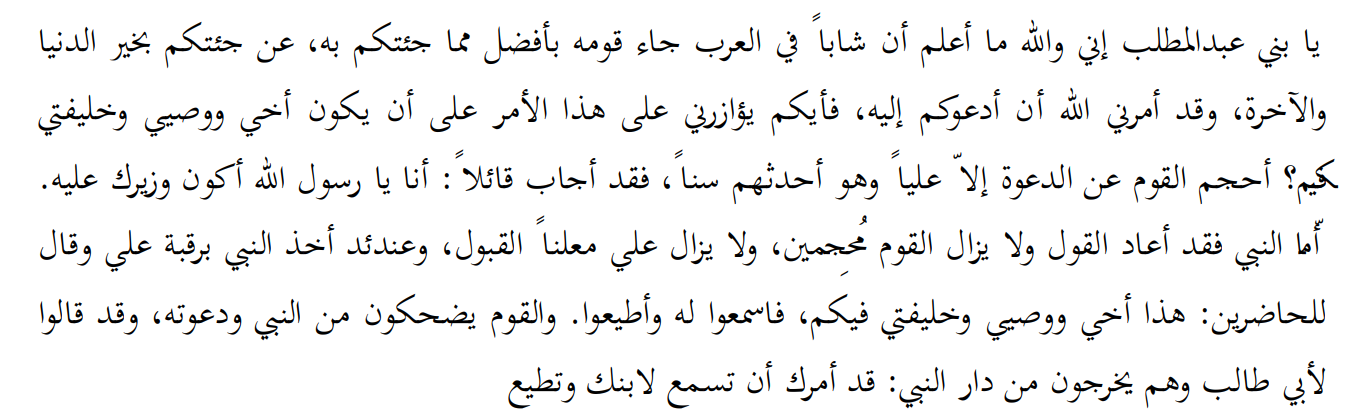
"Oh, Banu Abd al-Muttalib, por Alá, no conozco a ningún joven entre los árabes que haya venido a su pueblo con algo mejor que aquello con lo que yo he venido a ustedes. En verdad, he venido a ustedes con el bien de este mundo y del Más Allá. Alá me ha ordenado llamarlos a Él, así que ¿cuál de ustedes me ayudará en este asunto para que sea mi hermano, mi heredero y mi Jalifa entre ustedes?" La gente se apartó de la da'wa, excepto Ali, el más joven de ellos, quien respondió diciendo: "Yo, oh Mensajero de Alá, seré tu asistente en este asunto." El Mensajero ﷺ repitió sus palabras, y la gente permaneció apartada mientras Ali seguía anunciando su aceptación. Entonces el Mensajero ﷺ tomó el cuello de Ali y dijo a los presentes: "Este es mi hermano, mi heredero y mi Jalifa entre ustedes, así que escúchenlo y obedézcanlo." La gente se rió del Profeta ﷺ y de su invitación, y dijeron a Abu Talib al salir de la casa del Mensajero ﷺ: "Te ha ordenado que escuches a tu hijo y le obedezcas."
O Banu Abd al-Muttalib, by Allah I do not know any youth among the Arabs who has come to his people with a thing better than what I have come to you with. Verily I have come to you with the good of this world and the Hereafter. Allah has commanded me to call you to Him, so which one of you will assist me in this matter so that he may become my brother, inheritor and my Khalifah among you? The people kept away from the da’wa except Ali, the youngest among them, who responded saying: I, O Messenger of Allah, will be your assistant upon this matter. The Messenger repeated his statement and the people remained away while Ali continued announcing his acceptance. So the Messenger took the neck of Ali and said to those present: This is my brother, inheritor and my Khalifah among you so listen to him and obey. The people laughed at the Prophet and his invitation, and said to Abu Talib while leaving the Messenger’s house: ‘He has commanded you to listen to your son and obey him.’”
Este es el resumen del hadiz de la casa tal como lo narran quienes lo utilizan como prueba.
This is the summary of the hadith of the house as narrated by those who depend upon it as evidence.
Al-Bujari relató el incidente del día en que
Al-Bukhari narrated the incident of the day when
«Y advierte a tus parientes más cercanos» [TMQ 26:214]
“And warn your nearest kinsfolk” [TMQ 26:214]
Se reveló (diciendo) que el Mensajero (saw) se puso de pie sobre (el monte) Safa, sin mencionar la preparación de comida. Ahmad bin Hanbal narró en su Musnad dos hadices: uno sobre la preparación de comida sin mencionar que fue el día en que se reveló «Y advierte a tus parientes más cercanos», y otro que menciona que la preparación de comida fue el día en que se reveló la aleya. Mostraremos primero estos textos y después explicaremos lo que contienen.
Was revealed (saying) that the Messenger (saw) stood upon (Mount) Safa, without mentioning the preparation of food. Ahmad bin Hanbal narrated in his Musnad two hadiths, one about the preparation of food without mentioning it was the day in which “And warn your nearest kinsfolk” was revealed and another mentioning that the preparation of food was on the day the ayah was revealed. We will show these texts first then explain what they contain.
Al-Bujari narró de Ibn ‘Abbas (ra) quien dijo: Cuando
Al-Bukhari narrated from Ibn ‘Abbas (ra) who said: When
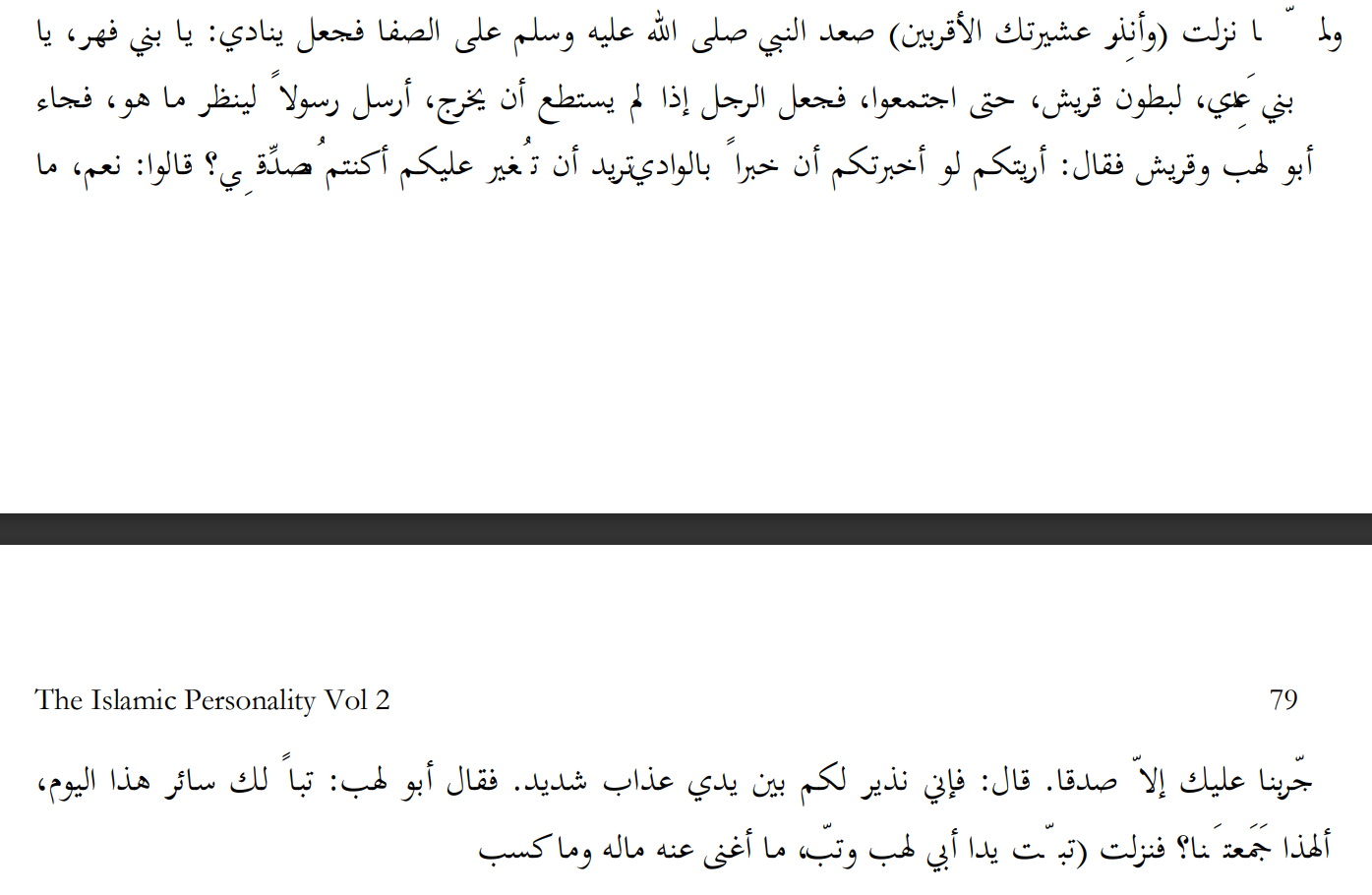
“Y cuando fue revelado: {Y advierte a tus parientes más cercanos}, el Mensajero subió a Safa y comenzó a proclamar: ¡Oh Banu Fihr, oh Banu Adiyy!, dirigiéndose a todos los clanes (butun) de Quraysh, hasta que se reunieron. Quien no pudo acudir envió a un mensajero para ver qué ocurría. Llegaron Abu Lahab y Quraysh, y él dijo: «Si os dijera que hay hombres a caballo en el valle que pretenden atacaros por sorpresa, ¿me creeríais?». Dijeron: Sí, nunca te hemos puesto a prueba en nada salvo que te hemos hallado diciendo la verdad. Él dijo: En verdad, soy para vosotros un amonestador ante un castigo severo. Abu Lahab dijo: ¡Maldito seas por el resto del día! ¿Por eso nos has reunido? Entonces fue revelado: {¡Perezcan las dos manos de Abu Lahab, y que él perezca! No le servirán de nada su riqueza ni lo que ganó}. [TMQ 111:1-2]”
“And when And warn your nearest kinsfolk was revealed, the Messenger stood upon Safa and started announcing: O Banu Fihr, O Banu Adiyy for all the (butun) of Quraysh until they gathered together. Whoever was unable to go had sent a messenger to see what was happening. Abu Lahab and Quraysh came and he said: ‘If I told you there were horses (men) in the valley intending to attack you suddenly, would you believe me?’ They said: Yes, we have not tried you in anything except to find you saying the truth. He said: Verily, I am a warner to you before a severe punishment! Abu Lahab said: Woe be upon you for the rest of the day. Is it because of this that you gathered us? So “Perish the two hands of Abû Lahab (an uncle of the Prophet [sal-Allâhu 'alayhi wa sallam]) and perish he!, His wealth and his children will not benefit him!” [TMQ 111:1-2] was revealed”
Esto indica que el episodio de la preparación de la comida no ocurrió el día en que se reveló "Y advierte a tus parientes más cercanos", ya que no concuerda con lo que se relata en el texto del hadiz. Ahmad bin Hanbal dijo en su Musnad: "'Affan nos relató que Abu Awana nos relató, de Uthman bin al-Mughira, de Abu Sadiq, de Rabi'a bin Najidh, de Ali (ra), quien dijo: El Mensajero de Allah ﷺ reunió o convocó a los Banu Abd al-Muttalib en todos sus grupos para comer y beber. Les preparó una cantidad de comida, la cual comieron hasta quedar saciados. Dijo: La comida permaneció como si no se hubiera tocado. Luego pidió una bebida de azafrán, la cual bebieron hasta quedar llenos, y la bebida permaneció como si no se hubiera tocado. Entonces el Profeta ﷺ dijo:"
This indicates that the incident of the preparation of food was not on the day in which “And warn your nearest kinsfolk” was revealed as it does not concur with what occurred in the hadith’s text. Ahmad bin Hanbal said in his Musnad: ‘Affan related to us that Abu Awana related to us from Uthman bin al-Mughira from Abu Sadiq from Rabi’a bin Najidh from Ali (ra) who said: The Messenger of Allah (saw) gathered or called Banu Abd al-Muttalib in all their groups to eat and drink. He prepared for them a quantity of food which they ate until they were satisfied. He said: The food remained as if it had not been touched. Then he called for a saffron drink which they drank until they will full, and the drink remained as if it had not been touched. Then he (saw) said:

«¡Oh Banu Abd al-Muttalib! Yo he sido enviado específicamente a vosotros y a la humanidad en general. Habéis visto ahora de este signo (āyah) lo que visteis, así que ¿cuál de vosotros me dará su juramento de lealtad para convertirse en mi hermano y compañero?». Dijo: Ninguno de ellos se levantó, así que me levanté por él, aunque yo era el más joven del grupo, y él dijo: «Siéntate». Lo repitió tres veces, tras lo cual me levanté por él, y él dijo: «Siéntate», hasta la tercera vez, en que golpeó mi mano con la suya.
“O Banu Abd al-Muttalib, I have been sent specifically to you and to humanity in general. You have now seen of this sign (ayah) what you saw, so which one of you will give me a pledge in order to become my brother and companion?’ He said: None of them stood, so I stood for him though I was the youngest of the group and he said: Sit down. He repeated it three times following which I stood for him and he said ‘Sit down’, until the third time he struck my hand with his hand.”
Esto aclara que no existe ningún momento en este incidente en el que se produjera la revelación de "Y advierte a tus parientes más cercanos", y que el Mensajero de Allah ﷺ les ofreció el Islam para que quien se hiciera musulmán fuera su hermano y compañero, y que no le dijo nada a Ali (ra).
This clarifies that there is no moment in this incident of the revelation of “And warn your nearest kinsfolk”, and that the Messenger (saw) offered Islam to them so that whoever became a Muslim would become his brother and companion and that he did not say anything to Ali (ra).
En cuanto a la segunda narración, Ahmad bin Hanbal la relató en su Musnad: "Aswad bin Amir nos relató, Shareek nos relató, de Al-'Amash, de Al-Minhal, de 'Ibad bin Abdullah al Asadi, de Ali, quien dijo: Cuando fue revelado el aleya "Y advierte a tus parientes más cercanos", el Mensajero de Allah ﷺ reunió a la familia de su casa. Se reunieron treinta personas; comieron y bebieron, y luego él ﷺ les dijo:"
As for the second narration, Ahmad bin Hanbal narrated in his Musnad: “Aswad bin Amir related to us that Shareek related to us from Al-‘Amash from Al-Minhal from ‘Ibad bin Abdullah al Asadi from Ali who said: When the ayah “And warn your nearest kinsfolk” was revealed, the Messenger (saw) gathered the family of his house. Thirty people gathered; they ate and drank then he (saw) said to them:
"¿Quién garantizará mis deudas y promesas para estar conmigo en el Paraíso, y será mi Jalifa sobre mi familia?" Un hombre, a quien Shareek no nombró, dijo: "¡Oh Mensajero de Allah ﷺ, tú eres un océano (bahr), entonces quién podría encargarse de esto?". Luego otro dijo (lo mismo?). Él ofreció eso a la familia de su casa, así que Ali (RA) dijo: "Yo (lo haré)".
"Which one will guarantee my debts and promises so as to be with me in Paradise, and he will be my Khalifah over my family? A man, whom Shareek did not name, said: O Messenger of Allah, you were an ocean (bahr) so who could take care of this? Then another said (the same?). He offered that to the family of his house, so Ali (RA) said: I (will).”
La palabra sucesor o califa no aparece en estos dos textos de ninguna manera. Más bien, solo aparece la palabra califa restringida a su familia, y el califato sobre la familia no es el califato en el cargo de gobierno o liderazgo, ni tiene ninguna relación con él. Estos son los textos que llegaron en los libros Saheeh, y llegaron en numerosas narraciones con redacciones similares y significados unificados, y en ninguna de ellas aparecieron las palabras sucesor o califato. Nunca ha aparecido, ya sea por medio de alguno de los compiladores de los Saheeh (libros de hadices) o de alguno de los narradores fiables, ni siquiera en un hadiz, la palabra o las palabras sucesor o califa de ninguna manera, ya sea en relación con Ali o con cualquier otra persona, por lo que la prueba cae debido a la ausencia de cualquier evidencia de ello en los libros Saheeh.
The word inheritor or Khalifah does not appear in these two texts in any way at all. Rather it is only the word Khalifah which appears restricted to his family, and the Khilafah over the family is not the Khilafah in the post of rule or leadership nor does it have any relationship with that. These are the texts which came in the Saheeh books, and they came in numerous narrations with similar wordings and unified meanings, and there did not appear in any of them the words inheritor or Khilafah. There has never appeared, either via any of the compilers of the Saheeh (books of ahadith) or any of the trustworthy narrators, in even one hadith the word(s) inheritor of Khalifah in any way at all either in relation to Ali or anyone else, so the evidence falls due to the absence of any evidence for it in the Saheeh books.
En cuanto al texto narrado por quienes disputan sobre el nombramiento de Ali, a quien denominan el hadiz de la casa, este texto con esta narración (riwayah) es rechazado en su significado (dirayah). Un hadiz se rechaza en su dirayah por su significado, y en su riwayah por su cadena de transmisión. Así, si es rechazado en su cadena o en su significado, no puede ser considerado y cae como prueba. En cuanto a rechazar su significado, ello se debe a múltiples razones, entre ellas:
As for the text narrated by those who contend about the appointment of Ali which they named the hadith of the house, this text with this narration (riwayah) is rejected in its meaning (Dirayah).A hadith is rejected in its dirayah based on its meaning, and its narration based on its chain. So if it is rejected in its chain or meaning then it cannot be considered and it falls as evidence. As for rejecting its meaning, this is due to many reasons including:
En primer lugar: en este hadiz parece que el Mensajero (saw) buscó la ayuda de la familia de Abd al-Muttalib en su da'wa con la condición de que el gobierno pasara a ser suyo después de ellos. Esto es nulo por dos aspectos: primero, esto contradice la declaración y la acción del Mensajero ﷺ en el episodio en que rechazó la petición de la tribu de que el gobierno pasara a ser suyo después de él si se hacían musulmanes, a lo que respondió:
«La autoridad es un asunto que pertenece a Allah, y Él (swt) la colocará donde Él quiera.»
“Authority is a matter which belongs to Allah, and He (swt) will place it where He wishes.”
Ibn Hisham narró en su libro de la Sirah del Profeta ﷺ: Ibn Ishaq dijo que Az-Zuhri narró que se encontró con los Banu Amr bin Sa’sa’ah, por lo que los invitó a Allah ‘azza wa jalla y se ofreció a ellos. Un hombre entre ellos, a quien llamaban Bayjirat bin Furra, le dijo: Por Allah, si tomara a este joven de los Quraysh, comería (es decir, conquistaría) a los árabes por medio de él. Luego dijo: ¿Y si nos comprometiéramos a apoyar tu causa, y Allah te concediera la victoria sobre quienes se oponen a ti? ¿Estará el gobierno en nuestras manos después de ti? Él respondió: “El gobierno pertenece a Allah, y Él lo coloca donde quiere.” Entonces le dijo: ¿Vamos a sacrificar nuestras gargantas por ti, para que cuando Allah (swt) te conceda la victoria, el gobierno pase a otro? Entonces no tenemos necesidad de tu causa, y lo rechazaron.” ¿Cómo puede el Mensajero ﷺ decir: “El asunto pertenece a Allah, y Él lo colocará donde quiera”, es decir, el asunto del Califato y el gobierno después de él, y sin embargo dice a los Banu Abd al-Muttalib:
Ibn Hisham narrated in his book of the Sirah of the Prophet (saw): Ibn Ishaq said that Az-Zuhri narrated that he met Banu Amr bin Sa’sa’ah so he invited them to Allah ‘azza wa jalla and offered himself to them. One man among them, whom they called Bayjirat bin Furra, said to him: By Allah, if I were to take this youth from the Quraysh, I will eat (i.e. conquer) the Arabs through him. Then he said: What if we were to pledge to support your matter then Allah will grant you victory over those who oppose you. Will the rule be with us after you? He said: “The rule is for Allah and He places it where He wills.” He said: So he said to him: Will we sacrifice our throats for you, then when Allah (swt) grants you victory the rule becomes for someone else? Then we have no need of your matter, and they rejected him.” How can the Messenger (saw) say: “The matter belongs to Allah and He will place it where He wills” i.e. the matter of the Khilafah and the rule after him, yet he says to Banu Abd al-Muttalib:
¿Quién de ustedes me ayudará en este asunto para que sea mi hermano, mi heredero y mi califa entre ustedes?
“Which one of you will assist me upon this matter so that he may become my brother, inheritor and Khalifah among you?”
¿No es esto una contradicción clara? Inevitablemente, es necesario que una de estas dos afirmaciones sea rechazada. Dado que se dice del hadiz de la casa que ocurrió cuando
Is this not a clear contradiction? Inevitably, it is necessary that one of these two statements be rejected. Since it is said of the hadith of the house that it occurred when
"Advierte a tus parientes más cercanos" [TMQ 26:214]
“Warn your nearest kinsfolk” [TMQ 26:214]
Fue revelado, es decir, en el tercer año de la misión del Mensajero ﷺ, y el hadiz:
Was revealed i.e. the third year of the messenger ship and the hadith:
«El asunto pertenece a Allah y Él lo coloca donde Él quiere»
“The matter belongs to Allah and He places it where He wills”
cuando el Mensajero (SWT) se ofreció a las tribus, es decir, en el décimo año después de la misión, y por tanto después del hadiz de la casa; así que es el hadiz de la casa el que queda rechazado. En cuanto al segundo aspecto, es que el Mensajero ﷺ, en este hadiz, ofreció algo a los incrédulos para que se hicieran musulmanes; más bien, les ofreció lo más grande, que es el Califato después de él sobre todos los musulmanes, como precio por su entrada en el Islam. Esto contradice la actuación del Mensajero ﷺ en su da'wa y las normas de la Shari'ah. El Mensajero ﷺ invitaba a la gente al Islam porque es la religión correcta, y nunca se ha narrado de él, ni siquiera mediante un hadiz débil, que ofreciera algo, pequeño o grande, a un kafir a cambio de su entrada en el Islam. En cuanto a aquellos cuyos corazones deben ser conquistados, son musulmanes a quienes se les entrega del zakat para fortalecer el Estado a través de ellos, no kuffar a quienes se les da para que entren en el Islam. Tampoco está permitido dar algo a los kuffar a cambio de que entren en el Islam.
when the Messenger (saw) offered himself to the tribes i.e. in the tenth year after the messenger ship and therefore after the hadith of the house; so it is the hadith of the house which is rejected. As for the second side, it is that the Messenger (saw) in this hadith offered something to the disbelievers so that they may become Muslims, rather he offered them the greatest thing which is the Khilafah after him over all Muslims as the price for their entering into Islam. This contradicts the Messenger’s action in his da’wa and the Shari’ah rules. The Messenger would invite people to Islam because it is the correct deen and it has never been narrated from him, even through a weak hadith that he offered anything whether small or large to a kafir in exchange for his entering into Islam. As for those whose hearts are to be reconciled, they are Muslims who are given from the zakat in order to strengthen the State through them, not kuffar who are given so that they enter Islam. Nor is it allowed to give something to kuffar in exchange for their entering Islam.
En segundo lugar: El hadiz menciona que el Mensajero (saw) preparó un banquete de boda y una comida para los kuffar con el fin de invitarlos al Islam, y los reunió alrededor de una comida para que entraran en el Islam, y no preparó comida para Ali (ra), que ya había aceptado el Islam. Así pues, si estas personas rechazan el Islam y rechazan que el poder pase a ellos después de él a cambio del Islam, no hay lugar allí para que Ali (ra) dé su aceptación, pues no se le está invitando al Islam porque ya es musulmán, y no hay ningún discurso dirigido a él. Por eso no hay lugar en esta reunión para que le diga:
Secondly: The hadith mentions that the Messenger (saw) prepared a wedding feast and meal for kuffar in order to invite them to Islam, and he gathered them around a meal so that they may enter Islam and he did not prepare food for Ali (ra) who had already accepted Islam. So if these people reject Islam and reject that the rule becomes theirs after him in exchange for Islam, there is no place there for Ali (ra) for giving his acceptance as he is not being invited to Islam because he is already a Muslim, and there is no speech addressed to him. This is why there is no place in this gathering such that he says to him:
"Este es mi hermano, mi heredero y mi califa entre ustedes, así que escúchenlo y obedézcanlo."
“This is my brother, inheritor and my Khalifah among you so listen to him and obey”
Ya que él no es el destinatario de la alocución ni de la negociación. Tercero: El hadiz menciona que el grupo rechazó el Islam y, a pesar de que él repitió su oferta, persistieron en rechazar el Islam y en rechazar que el gobierno pasara a ser suyo después de él a cambio de entrar en el Islam. Seguían siendo kuffar, entonces ¿cómo podría el Mensajero de Allah ﷺ decirles, al dirigirse a ellos:
Since he is not the target of the address or the negotiation. Thirdly: The hadith mentions that the group rejected Islam, and despite him repeating his offer they persisted in rejecting Islam and rejecting that the rule becomes theirs after him in exchange for entering Islam. They remained kuffar so how could the Messenger (saw) say to them in addressing them:
"Este es mi Jalifa entre vosotros"
“This is my Khalifah among you”
Ordenándoles escuchar y obedecerle mientras él sabe que son kuffār que han rechazado el Islam? ¿Y cómo podría ser él el Khalīfah entre ellos mientras son kuffār?
Commanding them with hearing and obeying him while he knows they are kuffar who have rejected Islam? And how could he be the Khalifah among them while they are kuffar?
En cuarto lugar: La narración que ellos transmiten dice:
Fourthly: The narration they narrate says:
"Este es mi hermano, mi heredero y mi califa entre ustedes, así que escúchenlo y obedézcanlo."
“This is my brother, inheritor and my Khalifah among you so listen to him and obey”
Esto es una alocución a la familia de Abd al-Muttalib, pues las palabras comienzan con su expresión "¡Oh, Banu Abd al-Muttalib!". Por tanto, es específica para ellos, ya que él lo hizo jalifa sobre ellos, es decir, sobre la familia de Abd al-Muttalib, y no jalifa de los musulmanes, pues dijo: "y mi jalifa entre vosotros". Así, no es jalifa de los musulmanes, como muestra el texto explícito. Tampoco puede decirse aquí que la lección se extrae por la generalidad del texto y no por la especificidad de la causa, ya que este es un hecho concreto y no una causa (sabab), sin mencionar que las palabras también son específicas y no generales: "¡Oh, Banu Abd al-Muttalib!", "mi jalifa entre vosotros". Por ello, la especificación es necesaria, debido a que se trata de un hecho concreto y no de una causa, y también a la ausencia de expresiones generales.
This is an address to the family of Abd al-Muttalib since the words started with his saying “O Banu Abd al-Muttalib.” So it is specific to them as he made him a Khalifah over them i.e. over the family of Abd al-Muttalib not the Khalifah of the Muslims since he said, “and my Khalifah over you.” Thus he is not the Khalifah for the Muslims as is depicted by the explicit text. Nor can one say here that the lesson is by the generality of the text not the specificity of the cause since this is a specific incident not a cause (sabab) not mentioning that the words are also specific and not general: “O Banu Abd al-Muttalib”, “my Khalifah among you” so the specification is demanded due to this being a specific incident not a cause, and also due to the absence of general words.
Basta uno solo de estos cuatro puntos para revelar la falsedad de este hadiz y su contradicción, y es obligatorio rechazar su narración (dirayah). Por lo tanto, queda aclarado que el Mensajero de Allah ﷺ no declaró explícitamente que Ali (ra) fuera el Jalifa después de él. De todo esto se desprende con claridad que los ahadices narrados por quienes sostienen que el Mensajero de Allah ﷺ designó a una persona para el Jilafa después de él son ahadices rechazados, no aptos para ser tomados como prueba, y por tanto caen. No queda ninguna evidencia de que el Mensajero de Allah ﷺ designara a alguien para encargarse del Jilafa después de él; por el contrario, la evidencia establecida es la contraria, es decir, que el Mensajero de Allah ﷺ dejó el asunto en manos de los musulmanes para que eligieran a quien quisieran en relación con la persona, pero le especificó el método para nombrar al Jalifa.
Just one of these four matters suffices to reveal the falsehood of this hadith and its contradiction, and it is obligatory to reject its narration (dirayah). Therefore it is clarified that the Messenger (saw) did not explicitly state making Ali (ra) the Khalifah after him. From all this it becomes clear that the ahadith narrated by those who argue that the Messenger (saw) designated a person for the Khilafah after him are rejected ahadith unsuitable to depend upon as evidence so they fall. There remains no evidence that the Messenger (saw) designated anyone to be in charge of the Khilafah after him; rather the evidence has been established contrary to that i.e. that the Messenger (saw) left the matter to the Muslims to choose whom they want in relation to the person but he specified for them the method for appointing the Khalifah.