20.3 El mártir
20.3 The Martyr
Los mártires (shuhadaa) son de tres tipos: el shaheed solo de la Otra Vida pero no según las normas del mundo; el shaheed solo de este mundo; y el shaheed de este mundo y de la Otra Vida. En cuanto al shaheed solo de la Otra Vida y no de este mundo, se mencionan en los ahadiz. En algunas narraciones son siete, en otras ocho, en otras nueve y en otras once. La postura auténtica, según lo que llegó en Muslim, es que son cinco, que son: (al-mat'un), que es quien muere de peste, es decir, la famosa pestilencia; el (mabtun), que es quien padece diarrea; el ahogado, que muere a causa del agua; quien muere por (al-hadm), es decir, el edificio derrumbado; y quien muere en el camino de exaltar la palabra de Allah fuera del campo de batalla. Muslim narró de Abu Hurayra (ra) que el Mensajero de Allah ﷺ dijo:
Martyrs (shuhadaa) are of three types; the shaheed of the Akhirah but not by the rules of the world; the shaheed of the world only and the shaheed of the world and Akhirah. As for the shaheed of the Akhirah only and not of this world, they are mentioned in the ahadith. In some narrations they are seven, in some eight, in some nine and in some eleven. The authentic (position) as what came in Muslim is that they are five who are: (al-mat’un) who is the one who dies in the plague i.e. the famous pestilence, the (mabtun) who is the one with diarrhoea, the drowned person who dies because of water, the one who dies of (al-hadm) i.e. the collapsed building, and the one who dies in the way of raising the word of Allah outside the battlefield. Muslim narrated from Abu Hurayra (ra) that the Messenger of Allah (saw) said:
“Un hombre que caminaba por el camino encontró una rama espinosa en el camino y la quitó. Allah le agradeció y le perdonó. El Profeta ﷺ dijo: Los mártires (shuhadaa) son cinco: (al-mat’un), (al-mabtun), el ahogado, el que murió en un edificio derrumbado y el shaheed en el camino de Allah ‘azza wa yalla.”
“A man walking along the road found a thorn-branch in the road and removed it. Allah was grateful to him and forgave him. He (saw) said: The martyrs (shuhadaa) are five: (al-mat’un), (al-mabtun), the drowned one, the one who died in a collapsed (building) and the shaheed in the way of Allah ‘azza wa jalla.”
Narró Muslim, de Abu Hurairah (ra), quien dijo: El Mensajero de Allah ﷺ dijo:
Muslim narrated from Abu Hurairah (ra) who said: The Messenger of Allah (saw) said:
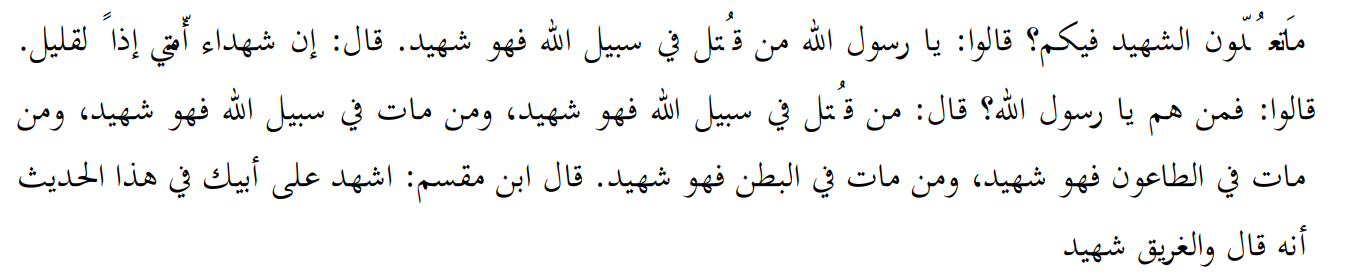
"¿A quién consideran mártir (shahīd) entre ustedes?" Dijeron: "¡Oh, Mensajero de Allah ﷺ!, quien es muerto en el camino de Allah es mártir." Él dijo: "Entonces los mártires de mi Ummah serían pocos." Dijeron: "Entonces, ¿quiénes son, oh Mensajero de Allah ﷺ?" Él dijo: "Quien es muerto en el camino de Allah es mártir, quien muere en el camino de Allah es mártir, quien muere por la peste es mártir, quien muere por causa del estómago es mártir (Ibn Muqsim dijo: Doy testimonio sobre tu padre en este hadiz de que dijo) y el ahogado es mártir."
“Whom do you consider a shaheed among you? They said: O Messenger of Allah, the one killed in the way of Allah is a shaheed. He said: Then the shuhadaa among my Ummah would be few. They said: Then who are they, O Messenger of Allah? He said: The one killed in the way of Allah is a shaheed, the one who dies in the way of Allah is a shaheed, the one killed in pestilence is a shaheed, the one killed due to the stomach is a shaheed (ibn Muqsim said: I testify that upon your father in this hadith that he said) and the drowned person is a shaheed.”
El significado de estos shuhadaa es que les corresponde en la Ajirah la recompensa de los mártires; en cuanto a este mundo, se les lava y se reza por ellos. Cuando la palabra “shaheed” se menciona en relación con la recompensa y con el hadiz al respecto, es correcto generalizarla a estas personas. Sin embargo, si la palabra “shaheed” se usa de forma no restringida y sin connotación alguna, no se entiende que designe a estas personas, sino únicamente a quienes fueron muertos en el camino de Allah.
The meaning of these shuhadaa is that there is for them in the Akhirah the reward of the shuhadaa; as for this world, they are washed and prayed over. When the word “shaheed” is said in connection with reward and the hadith about that, it is correct to generalize it to these (persons). However, if the word “shaheed” is used in an unrestricted manner without any connotation, then it is not taken to denote these (persons) but rather to denote only those killed in the way of Allah.
En cuanto al mártir de este mundo, no el de la Ajirah, es aquel que recibe las normas del mártir de este mundo en la medida en que no se le lava ni se reza por él, sino que se le entierra con sus ropas. Sin embargo, no recibe en la Ajirah la recompensa del mártir que luchó para que la palabra de Allah sea la más alta. Este es quien lucha por algo distinto a la senda de Allah, como luchar solo por fama o botín, o mientras se retira. Esto se debe a que los ahadices especificaron la recompensa del mártir para quien lucha en la senda de Allah (swt), y para quien combate avanzando, no retrocediendo. Lo narró Muslim de Abu Musa al-Ash'ari.
As for the shaheed of the world not the Akhirah, he is the one who takes the rules of the shaheed of the world in so far as he is not washed nor prayed over but rather buried in his clothes. However he does not take in the Akhirah the reward of the shaheed who fought to raise the word of Allah the highest. This is the one who fights in other than the way of Allah such as fighting for fame or booty alone or while retreating. This is because the ahadith specified the shaheed’s reward for the shaheed who fights in the way of Allah (swt), and the one fighting advancing not retreating. Muslim narrated from Abu Musa al-Ash’ari
«Que un hombre se acercó al Profeta ﷺ y dijo: ¡Oh Mensajero de Allah!, el hombre que lucha por el botín, el hombre que lucha para ser mencionado y el hombre que lucha para que se vea su rango: ¿cuál de ellos está en el camino de Allah? El Mensajero de Allah ﷺ dijo: «Quien lucha para que la palabra de Allah sea la más alta, ese está en el camino de Allah».»
“That a man came to the Prophet (saw) and said: O Messenger of Allah, the man who fights for booty, the man who fights to be mentioned and the man who fights so that his rank is seen. Which one is in the way of Allah? The Messenger of Allah (saw) said: ‘The one who fights so that the word of Allah be highest is the one in the way of Allah.”
Muslim relató de Abu Musa
Muslim narrated from Abu Musa
“El Mensajero de Allah ﷺ fue preguntado sobre el hombre que lucha (para mostrar) su valentía, el que lucha por ira, y el que lucha para presumir (hipócritamente). El Mensajero de Allah ﷺ dijo: Quien lucha para que la palabra de Allah sea la más alta, ese está en el camino de Allah.”
“The Messenger of Allah (saw) was asked about the man who fights (to show his) courage, the one who fights out of anger, and the one who fights to show off (hypocritically). The Messenger of Allah (saw) said: The one who fights so that the word of Allah is highest is in the way of Allah.”
El Mensajero puso como condición para que al mártir (shahid) se le perdonen sus pecados que combata avanzando y no retrocediendo. Muslim lo narró por medio de Abdullah bin Abi Qatadah, de Qatadah, quien oyó que se narraba del Mensajero de Allah ﷺ
The Messenger made a condition of the shaheed being forgiven his sins that he fights advancing not retreating. Muslim narrated from Abdullah bin Abi Qatadah from Qatadah that he heard it being narrated from the Messenger of Allah
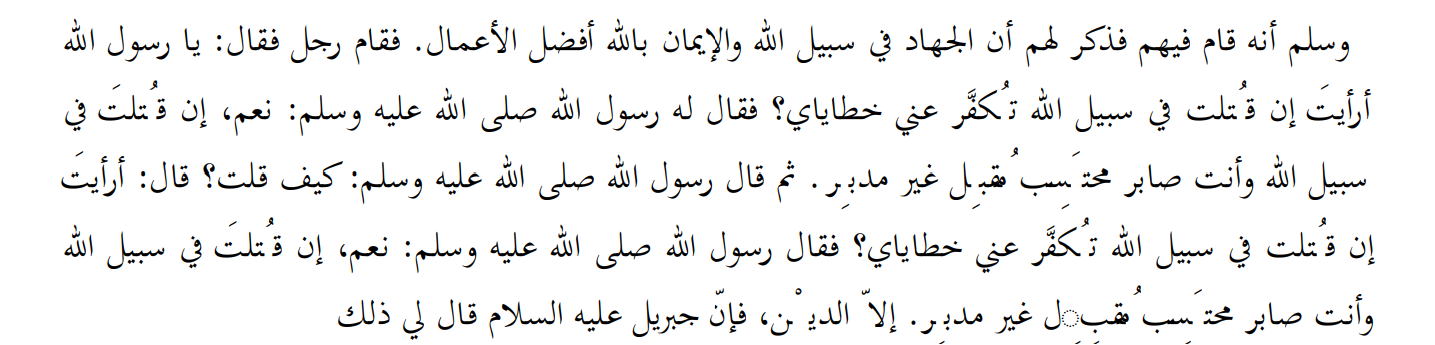
«Que se puso de pie entre ellos y les recordó que la yihad en el camino de Allah y la creencia firme en Allah son las mejores acciones. Entonces un hombre se levantó y dijo: ¡Oh Mensajero de Allah! ¿Crees que si luchara en el camino de Allah, todos mis errores serían perdonados? El Mensajero de Allah ﷺ le dijo: Sí, si luchas en el camino de Allah, y eres paciente, esperanzado, avanzas y no retrocedes. Luego el Mensajero de Allah ﷺ dijo: ¿Qué dijiste? Él dijo: ¿Crees que si luchara en el camino de Allah, todos mis pecados serían perdonados? El Mensajero de Allah ﷺ dijo: Sí, si eres paciente, esperanzado, avanzas y no retrocedes, excepto por las deudas, como me dijo Jibril (AS).»
“That he stood among them and reminded them that jihad in the way of Allah and decisive belief in Allah is the best deeds. So a man stood up and said: O Messenger of Allah, do you see that if I fought in the way of Allah that all my errors would be forgiven? The Messenger of Allah (saw) said to him: Yes, if you fought in the way of Allah and you are patient, hopeful, advancing and not retreating. Then the Messenger of Allah (saw) said: What did you say? He said: Do you see that if I fought in the way of Allah that all my sins would be forgiven? The Messenger of Allah (saw) said: Yes, if you are patient, hopeful, advancing and not retreating except for debts as Jibril (AS) told me that.”
La comprensión de esto es que los pecados del combatiente que huye no son perdonados, ni tiene la recompensa del shahid. En cuanto al que combate por fama, el Mensajero de Allah ﷺ aclaró que sería castigado, y aun así lo llamó shahid. Muslim narró de Sulayman bin Yasar, quien dijo: La gente se dispersó alrededor de Abu Hurairah (ra), y Natil, que era de los habitantes de Sham, le dijo: ¡Oh, jeque! Relátanos un hadiz que hayas oído del Mensajero de Allah ﷺ. Él dijo: Sí, oí al Mensajero de Allah ﷺ decir:
The understanding of this is that the retreating fighter’s sins are not forgiven nor does he have the reward of the shaheed. As for the one fighting for fame, the Messenger (saw) clarified that he would be punished and (yet) called him shaheed. Muslim narrated from Sulayman bin Yasar who said: People dispersed about Abu Hurairah (ra) and Natil who was from the people of Sham said to him: O Sheikh related to us a hadith you heard from the Messenger of Allah (saw). He said: Yes, I heard the Messenger of Allah (saw) saying:
"Ciertamente, la primera persona que será juzgada el Día del Juicio es un hombre que murió como shahid. Es traído ante Él (Allah) y le informa de las bendiciones (de Allah), y él las reconoce. Él (swt) le dice: ¿Qué hiciste con ellas? Responde: Luché por Ti hasta que fui muerto como shahid. Él dice: Mientes. Más bien, luchaste para que se dijera: '(es) valiente', y así se dijo. Entonces Él ordena sobre él, y es arrastrado boca abajo hasta que es arrojado al Fuego."
“Verily the first person(s) to be judged on the Day of Judgement is a man who was killed as a shaheed. He is brought to Him (Allah) and He informs him of the bounties (of Allah) and he acknowledges them. He (swt) says: What did you do with them? He answers: I fought for you until I was killed as a shaheed. He says: You lied. Rather you fought so that it be said ‘(he is) brave’ and it has been said. Then He commands regarding him and he is dragged upon his face until he is thrown into the Fire”
Hasta el final del hadiz. Esto indica que quien muere como mártir por fama, aunque en este mundo reciba las normas del shahid, no obtendrá la recompensa del shahid el Día del Juicio, sino que será castigado.
Till the end of the hadith. This indicates that the one killed for fame, even if he takes the rules of the shaheed in this world, will not gain the reward of the shaheed on the Day of Judgement but would be punished.
En cuanto al mártir (shaheed) de este mundo y de la Ajirah, es aquel que combate contra los incrédulos para elevar la palabra de Allah y que muere en el campo de batalla entre musulmanes e incrédulos, ya sea que el combate tuviera lugar en tierra de guerra o en tierra islámica. Allah (swt) dijo:
As for the shaheed of the world and the Akhirah, he is the one who fights the disbelievers to raise the word of Allah and was killed in the battle (field) between Muslims and disbelievers, whether the fighting was in the land of war or the Islamic land. Allah (swt) said:
«No creáis que los que han sido muertos en el camino de Allah están muertos. Más bien, están vivos y reciben sustento junto a su Señor» [TMQ 3:169].
“Do not think that those killed in the way of Allah are dead. Rather they are alive and receiving sustenance before their Lord” [TMQ 3:169].
Este shahíd es aquel sobre cuyos derechos llegaron las normas de la Sharía. Se especifica que es el que muere asesinado en la guerra contra los incrédulos; de igual manera, quien resultó herido en el campo de batalla y murió a causa de la herida recibida en él también se considera como el que muere en el campo de batalla. En cuanto a los demás, no se consideran shahíd. Por consiguiente, el que muere combatiendo a los rebeldes (bughat) no se considera shahíd, ni tampoco el que resultó herido en el campo de batalla, se recuperó de la herida y murió después a causa de ella. El shahíd que tiene normas específicas, y aquel del que Allah afirmó que está vivo, se limita al que muere en el campo de batalla contra los incrédulos para enaltecer la palabra de Allah, y al que resulta herido en el campo de batalla y muere a causa de esta herida.
This shaheed is the one upon whose rights came in the Shari’ah rules. He is specified as the one killed in the war with disbelievers; similarly the one who was wounded in the battlefield then died of the wound he received in the battlefield is also considered like the one killed in the battlefield. As for other than these, they are not considered shaheed. Accordingly the one killed in fighting with rebels (bughat) is not considered shaheed nor the one wounded in the battlefield then recovered from the wound then died because of it. The shaheed who has specific rules, and the one about whom Allah stated that he is alive, is specified to the one killed in the battlefield with the disbelievers to raise the word of Allah and the one injured in the battlefield then died due to this wound.
La norma sobre el mártir mencionado es que no se le lava ni se le envuelve en mortaja; más bien, se le entierra con su sangre y sus ropas, porque el mártir resucitará el Día del Juicio con el olor de su sangre, como el almizcle más fragante. En cuanto a que no se lave al mártir, esto se debe a lo que narró Al-Bujari de Yabir, quien dijo:
The rule of this mentioned shaheed is that he is neither washed nor shrouded in burial shrouds; rather he is buried in his blood and clothes because the shaheed is resurrected on the Day of Judgement with the smell of his blood like the sweetest-smelling musk. As for not washing the shaheed, this is due to what Al-Bukhari narrated from Jabir who said:
"El Mensajero de Allah ﷺ solía reunir a dos hombres de entre los muertos en Uhud en una misma tela, y luego decía: ¿Cuál de ellos conocía más del Corán? Si se le indicaba uno de los dos, lo colocaba primero en la fosa (lihd) y decía: Yo soy testigo sobre estos. Ordenó que fueran enterrados con su sangre y no rezó por ellos ni los lavó."
“The Messenger of Allah (saw) would collect two men of those killed in Uhud in one cloth, and then he would say: Which one of them knew more of the Qur’an? If one of the two was indicated to him, he brought him forward in the grave-niche (lihd) and said: I am a witness over these. He commanded their burial with their blood and did not pray over them nor wash them.”
Y Ahmad (narrado) que el Profeta ﷺ dijo sobre los que murieron en Uhud:
And Ahmad (narrated) that the Prophet (saw) said about those killed in Uhud:
"No los laven, porque cada herida o (cada gota de) sangre despedirá almizcle el Día del Juicio, y él no rezó por ellos."
“Do not wash them because each wound or (each drop of) blood will diffuse musk on the Day of Judgement and he did not pray over them.”
Se narra que el Profeta ﷺ dijo sobre los que murieron en Uhud:
It is narrated that the Prophet (saw) said about those killed in Uhud:
"Envuélvanlos con su sangre y no los laven, pues no hay herida alguna sufrida en el camino de Allah que no vaya a llegar el Día del Juicio con su vena yugular manando sangre, cuyo color es el color de la sangre y cuyo olor es el olor del almizcle."
“Cover them in their blood and do not wash them as there is no wound wounded in the way of Allah save that it will come on the Day of Judgement with its jugular vein flowing blood whose colour is the colour of blood and the odour is the odour of musk.”
Se ha narrado de Anas
It has been narrated from Anas
Que el Profeta ﷺ no oró por los que murieron en Uhud ni oró sobre ellos.
“That the Prophet (saw) did not pray over those killed in Uhud or pray over them.”
Del mismo modo que no lavó a los muertos en Uhud, tampoco lavó a los mártires de Badr; asimismo, no lavó a los mártires de Jandaq ni de Jaibar. Así quedó claro que el mártir no se lava. Igualmente, el mártir no se envuelve en sudarios como se envuelve al difunto; más bien, se le amortaja con las ropas que lleva puestas, debido a la declaración del Mensajero de Allah ﷺ sobre los muertos en Uhud:
Just as he did not wash those killed in Uhud, he did not wash the shuhadaa of Badr; similarly he did not wash the shuhadaa of Khandaq and Khayber. So it became clear that the shaheed is not washed. Similarly the shaheed is not enshrouded as the dead person is shrouded; rather he is shrouded in the clothes that he has due to the Messenger of Allah (saw)’s statement about those killed in Uhud:
"Envuélvanlos con sus heridas y su sangre" (narrado por Ahmad)
“Cover them in their wounds and blood” (narrated by Ahmad)
Y también debido a lo que narró Ibn Abbas (ra)
And also due to what ibn Abbas (ra) narrated
«Que el Mensajero de Allah ﷺ ordenó respecto a los caídos en Uhud que se les quitaran el hierro y las pieles, y que fueran enterrados con su sangre y sus ropas» (narrado por Abu Dawud).
“That the Messenger of Allah (saw) commanded about those killed in Uhud that the iron and skins be removed from them and that they be buried with their blood and clothes” (narrated by Abu Dawud).
En cuanto a la oración sobre el shahid, es lícito orar por ellos y es lícito no orar por ellos. En cuanto a la licitud de la oración sobre ellos, esto se debe a los relatos que llegaron de que el Mensajero de Allah ﷺ oró por los muertos en Uhud después de su entierro, y oró por Hamza y por un hombre muerto en el campo de batalla. En Al-Bukhari se narra de Uqbah bin ‘Amir
As for the prayer over the shaheed, it is allowed to pray over them and it is allowed not to pray over them. As for the permissibility of prayer over them, this is due to the narrations which came that the Messenger (saw) prayed over those killed in Uhud after their burial and prayed over Hamza and a man killed in the battlefield. In Al-Bukhari it is narrated from Uqbah bin ‘Amir
Oró por los que murieron en Uhud después de ocho años; la oración por los difuntos fue como una despedida a los vivos y a los muertos. ﷺ
“He (saw) prayed over those killed in Uhud after eight years, the prayer over the dead was like a farewell to those alive and those dead.”
Y de Abu Dawud, de Malik al-Ghiffari
And from Abu Dawud from Malik al-Ghiffari
Él (saw) oró por los que murieron en Uhud en grupos de diez, con Hamza en cada grupo de diez, hasta que oró setenta veces por él. Wait, I must follow the rules precisely: ﷺ must be written after every mention of the Prophet, instead of "(saw)". So the correct translation is: Él ﷺ oró por los que murieron en Uhud en grupos de diez, con Hamza en cada grupo de diez, hasta que oró setenta veces por él.
“He (saw) prayed over those killed in Uhud in groups of ten with Hamza in each ten until he prayed seventy times over him.”
Abu Dawud narró de Abu Salim, de un hombre de los Compañeros del Profeta ﷺ, quien dijo:
Abu Dawud narrated from Abu Salim from a man of the Prophet (saw)’s Sahabah who said:

“Atacamos por sorpresa a una tribu de Juhainah. Un hombre de los musulmanes buscó a un hombre de ellos para golpearlo, pero falló y se golpeó a sí mismo. El Mensajero de Allah ﷺ dijo: ¡Vuestro hermano, oh comunidad de musulmanes! Así que la gente se apresuró y lo encontró muerto. El Mensajero de Allah ﷺ lo cubrió con sus ropas y su sangre, rezó por él y lo enterró. Dijeron: ¿Es un shahid? Él dijo: Sí, y yo soy testigo por él.”
“We attacked by surprise a tribe from Juhainah. A man of the Muslims sought a man of them to strike him, but he missed and struck himself. The Messenger of Allah (saw) said: Your brother, O community of Muslims so the people hastened and found him dead. The Messenger of Allah (saw) covered him in his clothes and blood, prayed over him and buried him. They said: Is he a shaheed? He said: Yes, and I am a witness for him.”
«Atacamos por sorpresa a una tribu de Juhainah. Un hombre de los musulmanes persiguió a un hombre de ellos para golpearlo, pero falló y se golpeó a sí mismo. El Mensajero de Allah ﷺ dijo: "Vuestro hermano, ¡oh comunidad de musulmanes!". Entonces la gente se apresuró y lo encontró muerto. El Mensajero de Allah ﷺ lo cubrió con sus ropas y su sangre, rezó por él y lo enterró. Dijeron: "¿Es un shahid?". Él dijo: "Sí, y yo soy testigo de ello".»
“We attacked by surprise a tribe from Juhainah. A man of the Muslims sought a man of them to strike him, but he missed and struck himself. The Messenger of Allah (saw) said: Your brother, O community of Muslims so the people hastened and found him dead. The Messenger of Allah (saw) covered him in his clothes and blood, prayed over him and buried him. They said: Is he a shaheed? He said: Yes, and I am a witness for him.”
Que el Profeta ﷺ no oró por los que murieron en Uhud ni los lavó.
“That the Prophet (saw) did not pray over those killed in Uhud or wash them.”
Y Ahmad lo narró de Anas
And Ahmad narrated from Anas
Los shuhada de Uhud no fueron lavados. Fueron enterrados con sus ropas y no se rezó por ellos.
“The shuhadaa of Uhud were not washed. They were buried in their clothes and not prayed over.”
Al-Bukhari narró de Jabir bin Abdullah (ra), quien dijo:
Al-Bukhari narrated from Jabir bin Abdullah (ra) who said:

El Profeta ﷺ solía juntar a dos hombres de los caídos en Uhud y luego decía: "¿Cuál de ellos memorizó más del Corán?". Cuando se le indicaba uno de los dos, lo colocaba primero en la fosa, y dijo: "Yo soy testigo sobre estos el Día del Juicio", ordenó que fueran enterrados con su sangre y no los lavó ni rezó por ellos.
“The Prophet (saw) would combine between two men of those killed in Uhud then say: Which one of them memorized more of the Qur’an? When one of the two was indicated to him, he would bring him forward in the grave-niche and he said: I am the witness over these on the Day of Judgement, commanded their burial in their blood and did not wash them or pray over them.”
Estos ahadiths son auténticos y de indicación explícita en que no se reza sobre el shahid. Ash-Shafi'i respondió al hadiz de Ibn 'Abbas (ra) y a lo que se derivó de su significado en cuanto a rezar sobre quienes murieron en Uhud antes de su entierro, diciendo: "que la información llegó como si se refiriera a casos concretos frente a la mutawatirah de que el Mensajero no rezó sobre quienes murieron en Uhud." Todos estos ahadiths son auténticos, tanto los que narran que el Mensajero (ﷺ) rezó sobre los shuhada como los que narran que no rezó sobre ellos. No hay forma de rechazar ninguno por su autenticidad, pues son de los que se usan como pruebas tanto en la transmisión como en el significado. Tampoco hay forma de dar preferencia a uno sobre otro, pues es improbable que los Compañeros olvidaran rezar sobre esos shuhada, como también es improbable que dejaran un asunto contrario a lo establecido sobre él (ﷺ) en cuanto a rezar sobre los muertos. Entonces, ¿cómo puede uno prevalecer sobre el otro? Tampoco debe decirse que la oración mencionada en los ahadiths que establecen rezar por el shahid se refiere a la súplica (du'a), de modo que su expresión "rezó" signifique "hizo du'a". No se puede decir esto, pues las realidades de la Sharia tienen precedencia sobre las lingüísticas siempre que no haya una connotación que lo indique. Aquí no hay tal connotación, por lo que es inevitable que el significado de "rezar" sea la oración legislada sobre los muertos. Tampoco debe decirse que los ahadiths de rezar sobre los muertos derogan los ahadiths de no rezar sobre ellos, pues uno de ellos, el de rezar sobre quienes murieron en Uhud ocho años después, es posterior a todos los demás, ya que llegó en la transmisión de Ibn Hibban.
These ahadith are established and of explicit indication that the shaheed is not prayed over. Ash Shafi’ responded to the hadith of ibn Abbas (ra) and what came of its meaning regarding praying over those killed in Uhud before their burial “that the information came as if it were specific ones in the face of mutawatirah that the Messenger did not pray over those killed in Uhud.” All these ahadith are established whether those narrated that the Messenger (saw) prayed over the shuhadaa or those narrated that he didn’t pray over them. There is no way to reject any of them due to their authenticity, and because they are of those used as proofs in narration and meaning. There is no way to outweigh one over the other as it is remote that the Sahabah forgot to pray over those shuhadaa, just as it is also remote for them to leave an issue which is opposite of what is established about him (saw) of praying over the dead. So how can one be outweighed over the other? Nor should one say that the prayer in the ahadith which established the prayer over the shaheed is the du’a so that his saying “prayed” means made du’a. One cannot say this since the Shari’ah realities precede the linguistic (realities) as long as there is no connotation. Here there is no connotation so it is inevitable that the meaning of prayer is the Shari’ah prayer over the dead. Nor should one say that the ahadith of praying over the dead abrogates the ahadith of not praying over them since one of them, which is the prayer over those killed in Uhud after eight years is prayed to later than all the ahadith since it came in the narration of ibn Hibban
"Luego entró en su casa y no salió hasta que Allah le hizo morir."
“Then he entered his house and did not go out until Allah caused him to die.”
No se debe decir eso, porque el carácter tardío del hadiz por sí solo no basta como indicio de derogación; más bien tiene que haber otra connotación de la que se entienda la derogación. Aquí no hay ninguna connotación presente, así que no hay derogación en ello. Por tanto, todas las narraciones siguen siendo reconocidas y se entienden en el sentido de que no rezar por el mártir (shaheed) está permitido. No se narra que el Mensajero de Allah ﷺ rezara por los que murieron en Badr, en Jandaq o en Jaibar. También se entienden en el sentido de que si alguien reza por el mártir no hay nada (malo) en ello, y que no se impide a la gente rezar por ellos. Al mártir se le llama shaheed (testigo) porque el Paraíso es testimoniado para él por el texto explícito del Corán. Allah (swt) dijo:
One should not say that because the lateness of the hadith alone is not sufficient indication of abrogation; rather there must be another connotation from which abrogation is understood. Here no connotation is present so there is no abrogation in it. So all the narrations remain recognized and are taken to mean that not praying over the shaheed is allowed. It is not narrated that the Messenger (saw) prayed over those killed in Badr, Khandaq or Khayber. They are also taken to mean that if one prays over the shaheed there is nothing (wrong) in that and people are not prevented from praying over them. The shaheed is named shaheed (witness) as Paradise is witnessed for him by the explicit text of the Qur’an. Allah (swt) said:
Verdaderamente Allah ha comprado a los creyentes sus almas y sus bienes a cambio del Paraíso. Ellos combaten por el camino de Allah, matan y son muertos. {Verdaderamente Allah ha comprado a los creyentes sus almas y sus bienes a cambio del Paraíso. Combaten por el camino de Allah, matan y son muertos} [TMQ 9:111].
“Verily Allah purchased from the believers there souls and wealth in return for paradise. They fight in the way of Allah, killing and being killed” [TMQ 9:111].
Muslim narró de Jabir, quien dijo:
Muslim narrated from Jabir who said:
Un hombre dijo: ¿Dónde estaré, oh Mensajero de Allah, si me matan? Él dijo: En el Paraíso. Entonces arrojó los dátiles que tenía en las manos y luchó hasta que fue muerto. Y en el hadiz de Suwaid: Un hombre le dijo al Profeta ﷺ el día de Uhud.
“A man said: Where am I, O Messenger of Allah, if I am killed? He said: In Paradise. So he threw the dates that were in his hands and fought until he was killed and in the hadith of Suwaid. A man said to the Prophet (saw) on the day of Uhud.”
Se narra de Anas bin Malik (ra) que el Mensajero de Allah ﷺ marchó con sus Compañeros hasta llegar a Badr antes que los politeístas. Los politeístas llegaron, y el Mensajero de Allah ﷺ dijo:
It is narrated from Anas bin Malik (ra) that the Messenger of Allah (saw) went with his Sahabah until they preceded the polytheists to Badr. The polytheists came and the Messenger of Allah (saw) said:
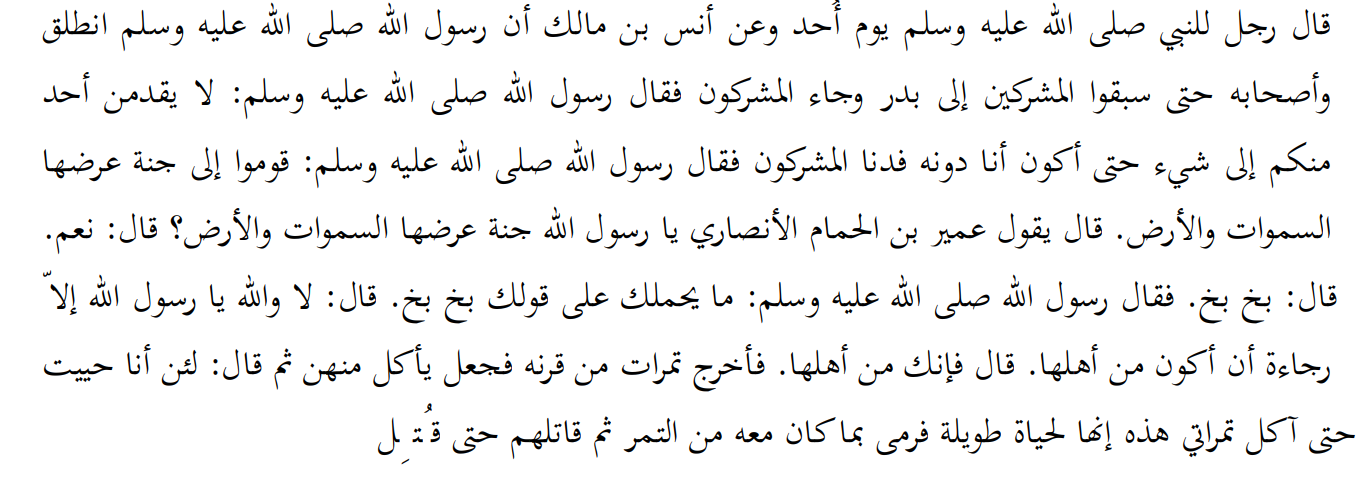
“Que ninguno de vosotros se adelante a nada sin que yo esté presente. Los politeístas se acercaron, y el Mensajero de Allah ﷺ dijo: Levantaos hacia un Paraíso cuya anchura es la de los cielos y la tierra. Dijo: ‘Umayr bin al-Hammam al-Ansari dijo: ¡Oh Mensajero de Allah!, ¿un Paraíso cuya anchura es la de los cielos y la tierra? Él dijo: ¡Bakh! ¡Bakh! Entonces el Mensajero de Allah ﷺ dijo: ¿Qué te llevó a decir ¡Bakh! ¡Bakh!? Dijo: Nada, por Allah, salvo la esperanza de ser uno de sus habitantes. Dijo: Ciertamente tú eres uno de sus habitantes. Sacó dátiles de su aljaba y comenzó a comer de ellos. Luego dijo: Si viviera hasta comerme estos dátiles, sería una vida larga. Arrojó los dátiles que le quedaban y luchó hasta que fue muerto.” (Narrado por Muslim).
“Let none of you precede to anything without my being. The polytheists came close so the Messenger of Allah (saw) said: Stand forth to a Paradise whose breadth is that of the heavens and the earth. He said: ‘Umayr bin al-Hammam al-Ansari said: O Messenger of Allah, a Paradise whose breadth is that of the heavens of the earth? He said: (Bakh! Bakh!). So the Messenger of Allah (saw) said: What carried you to your statement, (Bakh! Bakh!). He said: Nothing, by Allah, except the hope that I be one of its people. He said: Verily you are one of its people. He removed dates from his (qaran) and began eating from them. Then he said: If I were to live until I ate these dates, it would then be a long life! He threw the dates that had then fought them until he was killed” (Narrated by Muslim).
Así que Allah (SWT) y el Mensajero de Allah ﷺ han dado testimonio del Paraíso para el shahíd. En cuanto a la vida del shahíd, está establecida por el texto explícito del Corán. Allah (SWT) dice:
So Allah (swt) and the Messenger of Allah (saw) have witnessed the Paradise for the shaheed. As for the life of the shaheed, it is established by the explicit text of the Qur’an. Allah (swt) said:
«No pienses que quienes fueron muertos en el camino de Allah están muertos, sino que están vivos y reciben sustento junto a su Señor. Complacidos con lo que Allah les concedió de Sus favores y con buenas nuevas para quienes quedaron atrás y aún no los han alcanzado, de que no hay temor para ellos ni se entristecerán. Tienen buenas nuevas de bendiciones de Allah y de Su favor, y en verdad Allah no deja perder la recompensa de los creyentes». [TMQ 3:169].
“Do not think that those killed in the way of Allah are dead, rather (they are) alive with sustenance before their Lord. Pleased with what Allah gave them of His favours and with good tidings for those behind them who have not met them, that there is no fear for them nor do they grieve. They have glad tidings of blessings from Allah and His favour, and verily Allah does not cause the reward of the believers to be lost” [TMQ 3:169].
Esta vida de los shuhada es invisible, una realidad que no comprendemos ni percibimos tal como es en la morada eterna. Aunque no comprendemos esta vida oculta ni la percibimos, creemos, no obstante, en su existencia, aunque no comprendamos su realidad. Nuestra convicción en su existencia es algo ineludible, pues está establecida por un texto coránico definitivo. Allah (swt) dijo:
This life for the shuhadaa is unseen which we do not understand nor perceive as it is in the eternal abode. Although we do not understand this hidden life nor perceive it, nevertheless we believe in its existence but do not understand its reality. Our conviction in its existence is an inevitable matter as it is established by a definite Qur’anic text. Allah (swt) said:
«No digáis de los que son muertos por la causa de Allah que están «muertos»... Antes bien, están vivos, pero vosotros no lo percibís» [TMQ 2:154].
“Do not say of those killed in the way of Allah (are) ‘dead’... Rather they are alive but you do not know” [TMQ 2:154].
La vida de los shuhadaa pertenece a lo oculto (asuntos) en los que es obligatorio creer. En cuanto a la virtud de los shuhadaa, es una gran virtud sin igual, y el Profeta ﷺ la aclaró en numerosos hadices. Al-Bujari narró de Qatadah, quien dijo: Escuché a Anas bin Malik (que Allah esté complacido con él) decir del Profeta ﷺ que dijo:
The life of the shuhadaa is from the unseen (matters) in which iman is obliged. As for the virtue of the shuhadaa, it is a great virtue without an equivalent and he (saw) clarified it in numerous ahadith. Al-Bukhari narrated from Qatadah who said: I heard Anas bin Malik (ra) from the Prophet (saw) who said:
«Nadie de los que entren en el Paraíso querría volver al mundo para obtener todo lo que hay en la tierra, excepto los shuhadaa, quienes desearían regresar al mundo para ser muertos diez veces, debido a lo que ven del honor (karamah).»
“No one who enters Paradise would like to return to the world to obtain all that is upon the world except the shuhadaa who would wish to return to the world to be killed ten times due to what he sees of the honour (karamah).”
Y en Al-Bujari:
And in Al-Bukhari:
Al-Mughira bin Shu’bah dijo que nuestro Profeta ﷺ nos informó del mensaje de nuestro Señor: que quien sea muerto entre nosotros va al Paraíso. Y Umar le dijo al Profeta ﷺ: “¿No están nuestros muertos en el Paraíso y sus muertos en el Fuego?”. Él dijo: “Sí”.
“Al-Mughira bin Shu’bah said that our Prophet (saw) informed us of the message of our Lord that whoever is killed among us goes to Paradise and Umar said to the Prophet (saw): ‘Are not our dead in Paradise and their dead in the Fire. He said: Yes.”
Y de Abdullah bin ‘Amru bin al-‘Aas, que el Mensajero de Allah ﷺ dijo:
And from Abdullah bin ‘Amru bin al-‘Aas that the Messenger of Allah (saw) said:
«Se perdonan todos los pecados del mártir, excepto la deuda» (narrado por Muslim).
“All the shaheed’s sins are forgiven except the debt” (narrated by Muslim).
«Se perdonan todos los pecados del mártir, excepto la deuda» (narrado por Muslim).
“All the shaheed’s sins are forgiven except the debt” (narrated by Muslim).
«El que muere matado en el camino de Allah tiene perdonados todos sus pecados, excepto la deuda.»
“The one killed in the way of Allah has all his sins wiped out except the debt.”
Y Al-Bukhari y Muslim narraron de Abu Hurairah (ra), de la boca del Profeta ﷺ, quien dijo:
And Al-Bukhari and Muslim narrated from Abu Hurairah (ra) from the Prophet (saw) who said:
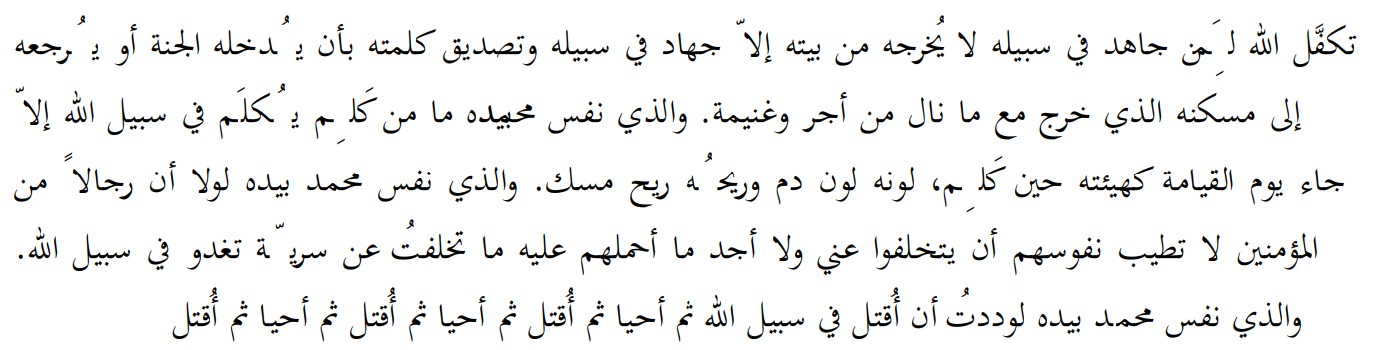
"Allah garantiza seguridad a quien muere en yihad por Su causa, quien no sale de su casa por ninguna otra razón que no sea el yihad por Su causa y creyendo en Sus palabras, que Él lo admitirá en el Paraíso o lo devolverá a su morada de la que salió, junto con lo que haya logrado de recompensa o botín. Por Aquel en cuya mano está el alma de Muhammad ﷺ, quien resulte herido en el camino de Allah no llegará el Día del Juicio sino con la misma forma en que fue herido: su color será el color de la sangre y su olor el olor del almizcle. Por Aquel en cuya mano está el alma de Muhammad ﷺ, si no fuera porque hay hombres entre los creyentes cuyas almas no se complacen en quedarse atrás de mí (cuando yo parta), ni yo encuentro con qué transportarlos, no me quedaría atrás de ninguna expedición que salga por el camino de Allah por la mañana. Por Aquel en cuya mano está el alma de Muhammad ﷺ, me encantaría morir en el camino de Allah, luego ser resucitado, luego muerto, luego resucitado, luego muerto, luego resucitado, luego muerto."
“Allah guarantees security for the one who dies jihad in His way, not leaving his house for any other reason except jihad in His way and believing in His words, that He will enter him into Paradise or return him to his abode from which he left together with what he achieved of reward or booty. By the One in whose hand lies the should of Muhammad, whoever is wounded in the way of Allah will not come on the Day of Judgement except in his form when he was wounded, his colour the colour of blood and his odour the odour of musk. By the one in whose hand lies the soul of Muhammad, were it not that there were men among the believers whose souls are not pleased to stay behind me (when I go) nor do I find that could carry them upon, I would not stay behind any expedition that goes out in the way of Allah in the morning. By the One in whose hand lies the soul of Muhammad, I would love to die in the way of Allah then I am resurrected then killed, then resurrected then killed, then resurrected then killed.”